Sendai, Japan Wednesday, April 4th, 2019

1. Getting to Sendai

After seeing a ballgame in Shinjuku Tuesday night, we rose early to take the train from Shinjuku to Tokyo Station to catch the Shinkansen to Sendai for an early afternoon ballgame. Since we were leaving Tokyo for a few days, we checked out of our hotel, taking our luggage with us. Typically, we would not take the train during morning commute in Tokyo (considering the crush of people during this time), but we made a reservation on the Narita Express. This gave us some breathing room while lugging our bags.

JR tickets from Shinjuku to Sendai

Upon arriving at Tokyo Station, we boarded Car 9 (the Green Car) on the 0910 Hayabusa (the Falcon) for Sendai station. During the one hour and 30 minute trip, we were treated to sweeping vistas of the terrain. While a flight would have been shorter, taking the bullet train afforded us a view of Japan that was well worth the extra time.

From the Shinkansen, headed north toward Sendai. Snow capped mountains in the distance reminded us that it was still winter in parts of Japan.

Arriving at Sendai station around 1040, we were too early to check into our hotel (located across the street from the station). However, we planned for this. Within Sendai station were rows and rows of lockers, many large enough to easily hold our bags. Conveniently, we were able to pay with our Suica cards. Luggage secured, we headed out toward the ballpark.

2. Rakuten Seimei Park Miyagi

Initially, we planned to take the subway from the station to the ballpark, a distance of a little more than a kilometer. Confused by which direction was which down in the subway, we abandoned this option, and instead decided to walk. The weather was cloudy and cool, perfect for an early April stroll. The walk also allowed us to take in more of Sendai.

A manhole encountered on the way to the ballpark in Sendai. (Photo credit: Jeff Hayes)

We were far from alone on the walk; it seemed as though much of Sendai was headed to the park for the early afternoon game. Reaching the park well ahead of the start time, we had plenty of time for pictures. Like most Japanese ballparks, there was plenty to do and see outside of the park, with games, food stands and places to purchase team apparel.

There were signs outside the park indicating the stadium was cashless, meaning we needed to buy a card to make purchases within the ballpark. This was something we had not yet seen. Should you plan to catch a game in Sendai, this is something to consider.
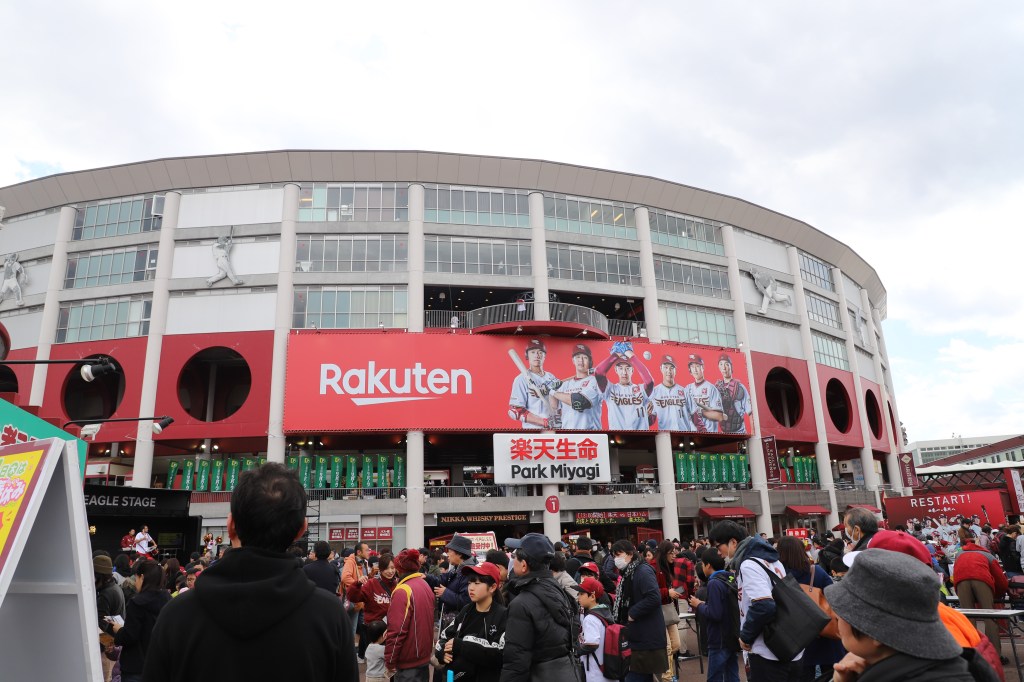
Outside of Rakuten Seimei Park, shortly before game time. Like many NPB ballparks, there was plenty to see and do, including live entertainment. (Photo credit: Jeff Hayes).

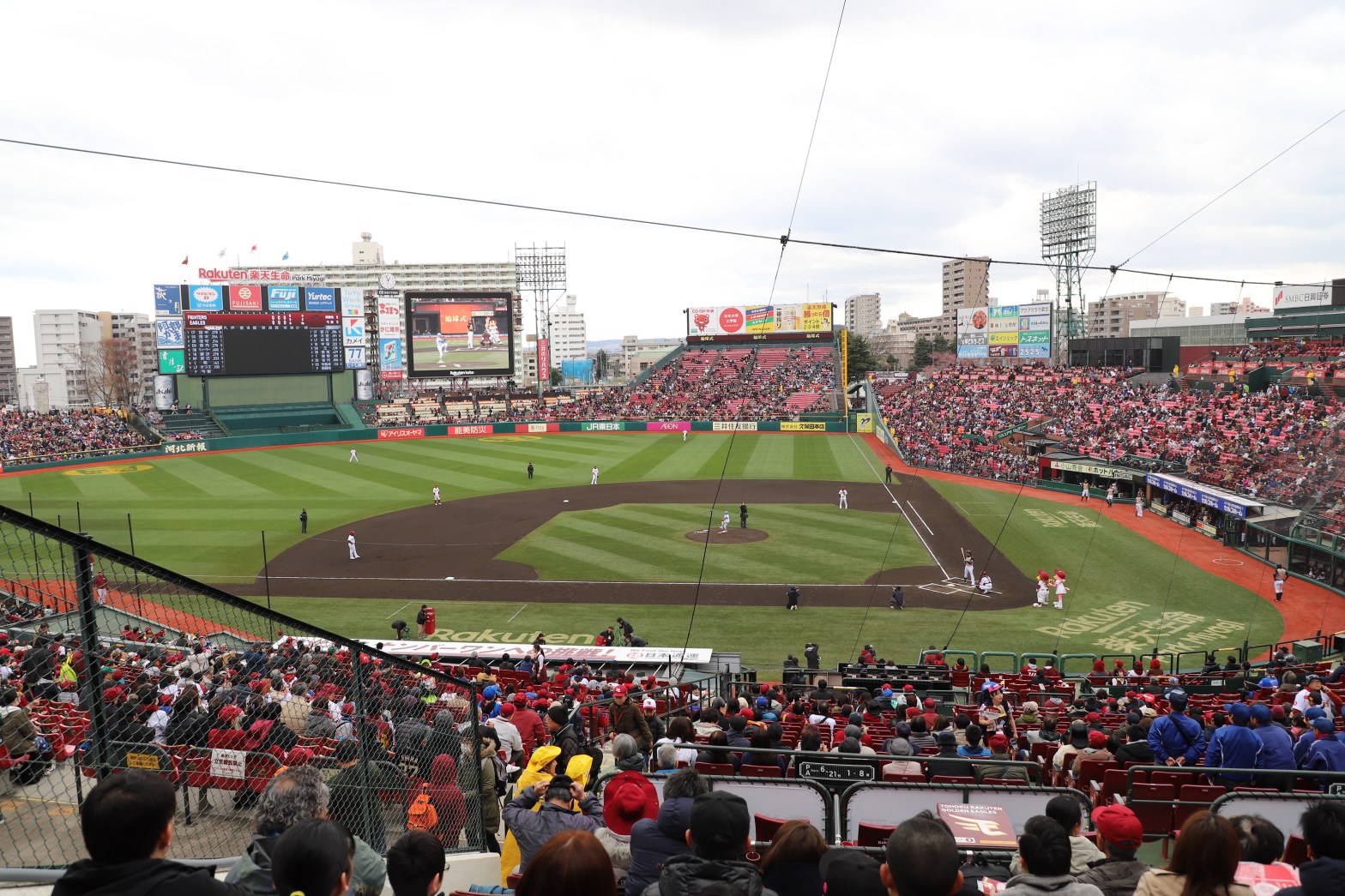
Our seats were just to the third base side of home plate, at the top of the lower level. These seats allowed for a great view of the field. For the 1300 start, the Sendai Rakuten Golden Eagles hosted the Hokkaido Nippon Ham Fighters. Unlike other parks we’d visited, there was less English here, with just some on the scoreboard and on the field. In a strange sense, it felt like we were really in Japan, as Sendai is NOT an international city (like Tokyo or Osaka).

Rakuten Seimei Park Miyagi was as appealing as expected, in spite of the gray skies. The capacity is small compared to other NPB ballparks, holding less than 25,000 people. Nearly every seat in the park was filled, even with the early afternoon start. It seems that, unlike MLB contests, the start time of the game does not curtail crowd size. Like some MLB parks, it was interesting to note that the home team’s dugout was on the third base side.
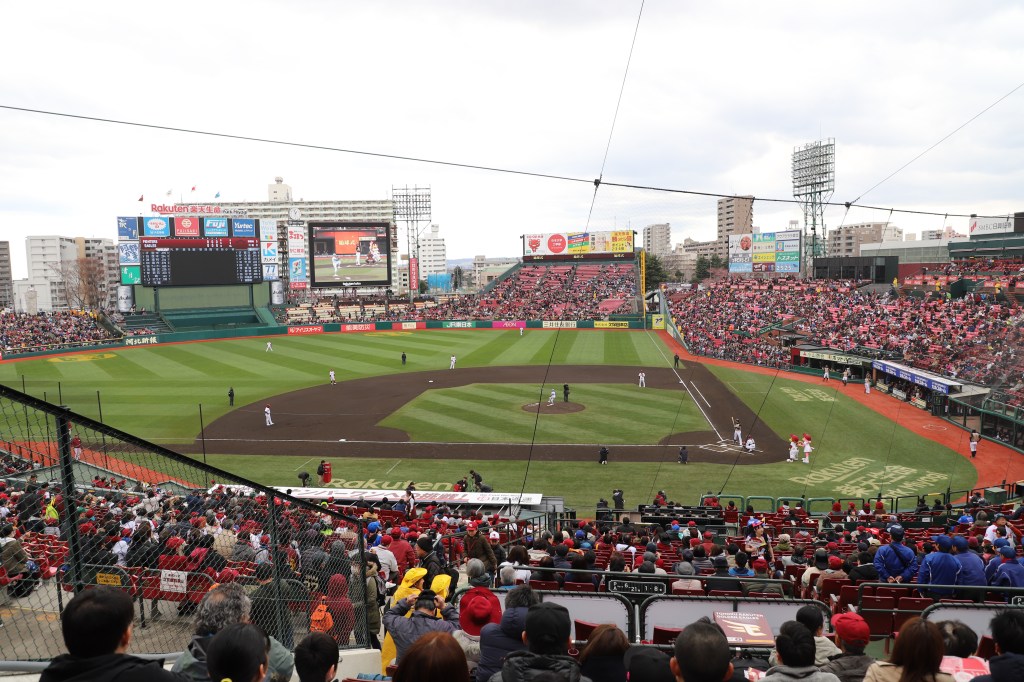
Our seats at Rakuten Seimei Park Miyagi. Despite the clouds and cool weather, the park was essentially filled. (Photo credit: Jeff Hayes)

As was the case in other NPB ballparks, we were limited as to how much of the park we could access. This did hinder of our ability to fully explore the stadium, as well as take pictures. However, the view from our park was excellent, with only the far left field corner obscured. After the typical pre game pageantry, the first pitch was thrown precisely at 1300.

The Golden Eagles struck first, scoring three runs in the bottom of the first. Due mainly to his inability to contain the Golden Eagles offense early, the Fighters starting pitcher lasted only 1 2/3 innings. The teams settled into the game by trading scoreless innings through the fifth inning. The Golden Eagles offense erupted once again in the bottom of the sixth, scoring eight runs and putting the game out of reach of the Fighters.
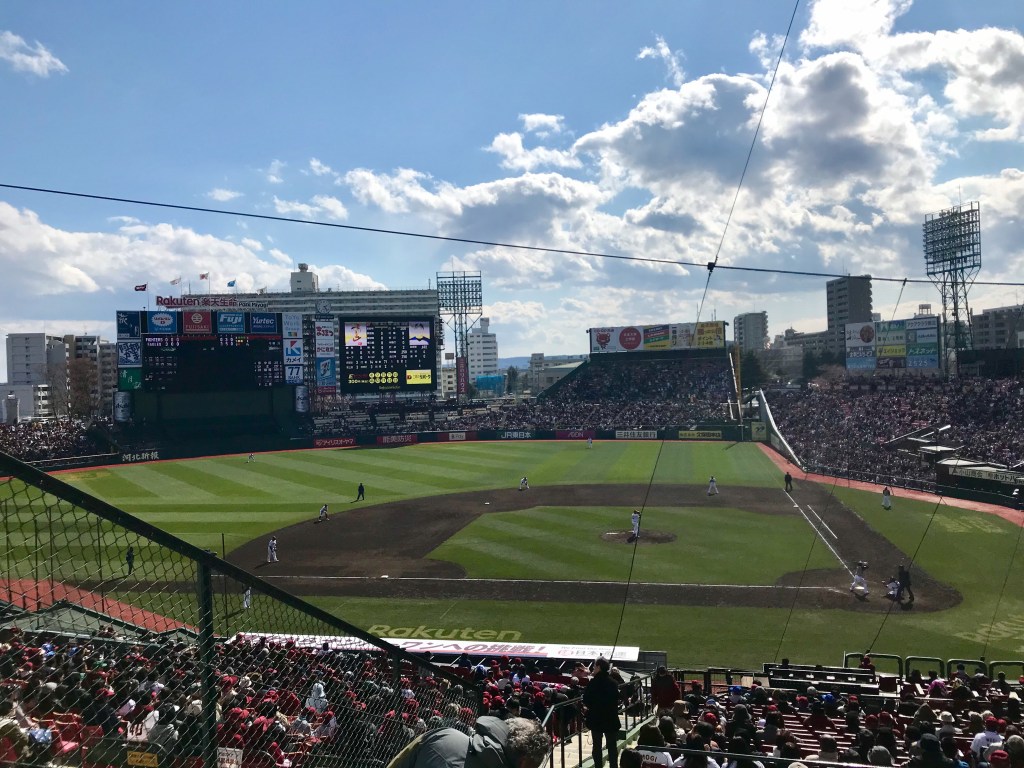
Increasing sunshine provided some relief from the gloom and cool temperatures. The park seemed to come to life as the sun came out.

As the game continued, the clouds slowly dissipated, with sunshine providing some warmth toward the end of the game. The increasing sunshine also lifted the veil over the ballpark, revealing its colors. The Golden Eagles won the ballgame 11-3, with a game time of nearly 3 hours and 40 minutes. Rakuten Seimei Park is a cozy ballpark, barely larger than the biggest MiLB parks in the US. Its size holds a charm not generally not found in MLB parks. If it was not so far away from Tokyo, I would readily visit the park again.

On the way back to the hotel, we discovered the Golden Eagles team store. In the store we found a MUCH larger selection of team apparel than at the ballpark, which allowed my brother to find a Tohuku jersey (a reference to the region of Japan). We noticed many older Golden Eagles fans wearing the same jersey at the game. Following some exploration of nearby Sendai, we had an early dinner, then relaxed after a long day.

Yokohama, Sunday April 7th, 2019

The last stop on our 2019 stadium tour brought us to Yokohama Stadium, the home of the Yokohama DeNA BayStars. Unlike the previous stops on the tour, the weather was much more agreeable, with a hint of spring in the air.


1. Getting to the game

The cherry blossoms were in full bloom in Tokyo. (Photo credit: Jeff Hayes)

We did not go straight from our hotel in Tokyo to the stadium. After walking through Tokyo (admiring the cherry blossoms), we headed out in search the Seibu Lions team store in the Ikebukuro section of Tokyo. We took the Marunouchi line from Tokyo Station to Ikebukuro station, a journey of about 20 minutes. After a few false starts, we found the Seibu Department Store. The Lions team store was located on the 8th floor. The team store was surprisingly small, but my brother was able to get a Lions jersey.

From the Ikebukuro station, we took the Fukutoshin line to the Nihon-Odori station, with the trip taking about 50 minutes. From the station, it was a short walk (about 400 meters) to Yokohama Stadium.


2. Yokohama Stadium

It was a beautiful afternoon at Yokohama Stadium, as the DeNA BayStars took on the Tokyo Yomiuri Giants. We arrived about an hour before the 13:00 start, which gave us time to explore the surroundings. Unlike most Japanese ball parks, there wasn’t much to see outside the park, so after a cursory look outside we entered the ballpark.

Quite intentionally, the BayStars team store was located just beyond the gate. Of course, we perused the store, purchasing apparel and a yearbook (completely in Japanese). Prices here were higher than other team stores. For example a Giant cap sold for nearly 10,000 yen (about $100 USD). Not yet possessing a Giants cap, I was tempted, but ultimately passed on the opportunity.

The information on the ticket was barely discernible, so we heeded advice given early on to show our tickets to team employees until they showed us our seats. We sat on the left field side, beyond third base in the lower level. Even an hour before the game, the stadium was packed (which we found to be true just about everywhere in Japan).

The view from our seats. (Photo credit: Jeff Hayes)

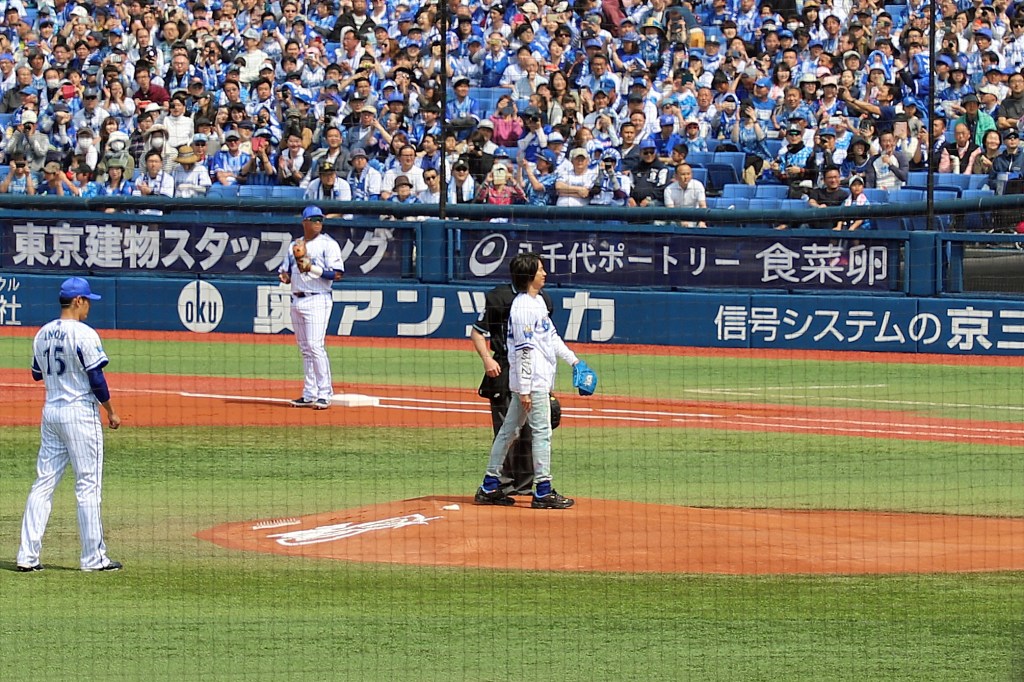
Just before of the start of the game, there was an audible murmur in the crowd, as a young man walked out to the mound to throw out to the first pitch. The crowd clearly knew who he was, though we didn’t have a clue. The young man was a member of a J-Pop band, whose name escapes me.

A celebrity throwing out the first pitch. We later learned he was a member of a J-Pop band. (Photo credit: Jeff Hayes)

The lineups were announced before the start of the game. Quite unexpectedly, the lineup announcements were in English, which was a first at an NPB game. In fact, the announcements sounded as though they were being made in an American ballpark. The English continued for each at bat, a nice touch for a foreign baseball fan. Unlike the other ballgames we saw in Japan, there were many foreign fans in attendance. Our entire row was comprised of Americans, except for the Giants fans sitting next to us.

Very MLB like scoreboard in Yokohama.

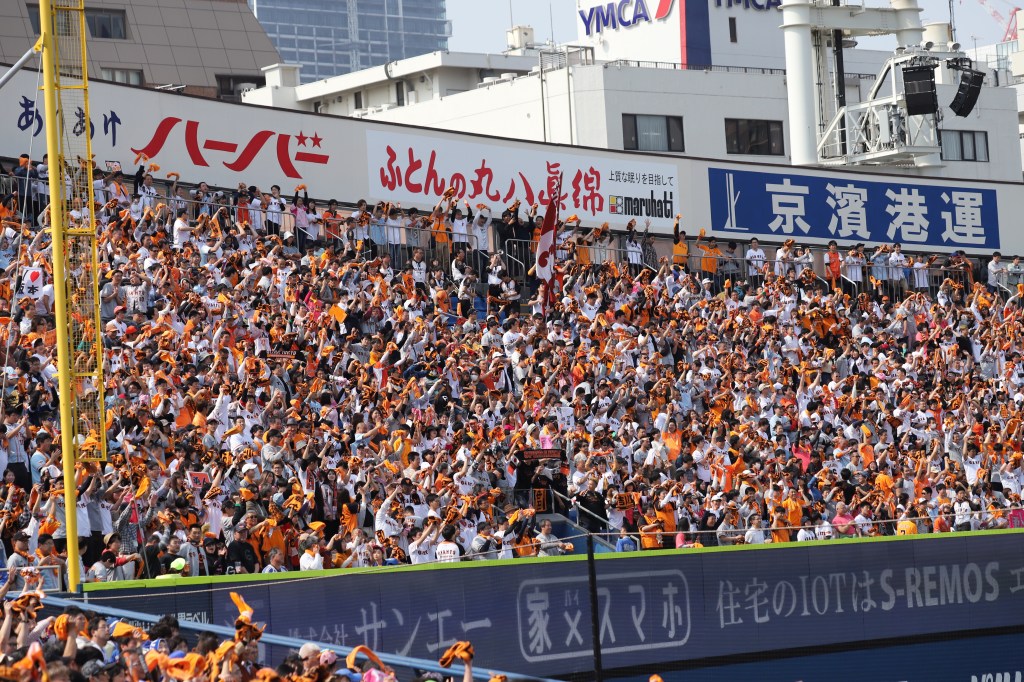
The visiting Giants had a large cheering section in left field (as is customary in Japan). The section sang a different song for each player. Being the third time we’d seen the Giants, we actually recognized the batters by the fight song chanted by the fans.

The Giants fans cheered loudly when the Giants were at bat, from the 1st inning through the 9th. (Photo credit: Jeff Hayes)

Not to be outdone, the remainder of the stadium chanted for the BayStars in the bottom of the 1st inning. Having been to eight NPB games, it still amazes me that the fans have the stamina to maintain the cheering the entire game (want to hear the chanting? Check it out here.) The fans, the warm weather, and the ballpark made this my favorite stop on our NPB baseball tour (though my brother would disagree).

The BayStars fans cheering for their team. (Photo credit: Jeff Hayes)

The game itself was fairly one-sided, with the BayStars taking an early lead and holding on for a 5-1 victory. Rather than stretch during the middle of the 7th inning, the Japanese have another tradition we’ve seen at every ballpark so far. Fans inflated balloons and released them when instructed. The resulting display is quite colorful, and view a montage of balloon tradition is available here.

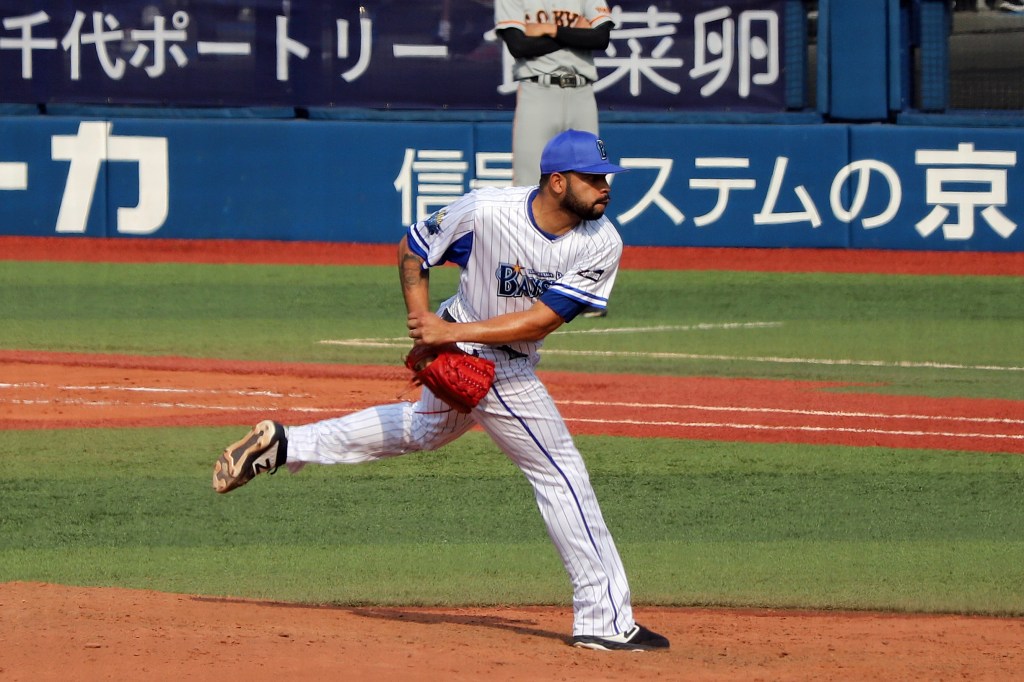
Like most other ball games in Japan, we saw some foreign players, though none of names were familiar. Seemingly, most of the foreign players were fireballers, with fastballs over 95 mph (a skill homegrown pitchers did not appear to possess on a consistent basis).

DeNA BayStars left hander Edwin Escobar. Escobar had brief stints with the Red Sox and Diamondbacks. (Photo credit: Jeff Hayes)

The game time was a reasonable two hours and 45 minutes, the shortest game we saw on this trip. Typically, NPB games last between three and three and one-half hours. However, unlike the US, nobody in Japan seems to mind. For the Japanese, baseball is more than a game; it’s an event.

The pageantry of NPB baseball. (Photo credit; Jeff Hayes)

Seeing baseball games in Japan: Part 4: Being a baseball fan in a Foreign Land

During our visits to Japan, we experienced a culture to which we had no direct connection. Even though the culture was different, there were many touchstones from home. Below are some of the customs about which we learned traveling in Japan.


1. The Language Barrier

Traveling to a land where you neither read or speak the language can be daunting. However, we found that in urban areas that there is enough English present to put you at ease. Virtually all signage has English as well as Japanese, so navigating your way is relatively easy.

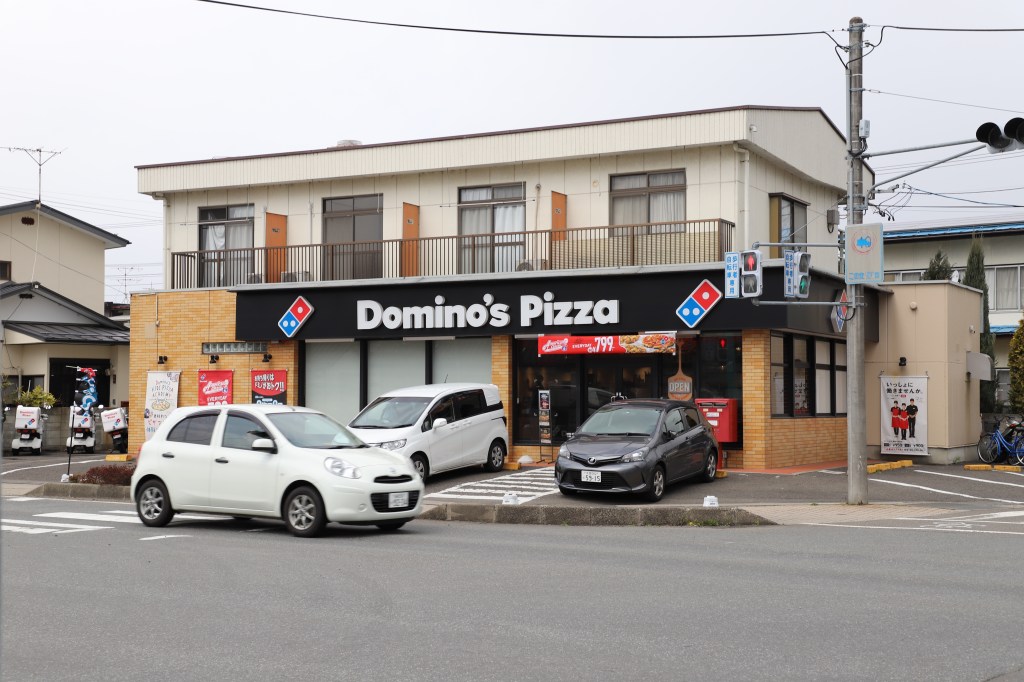
Traveling outside of the major urban areas could present more of a challenge when it comes to communicating with locals. For example, we found that Fukushima and Sendai had much less of an English presence than Tokyo or Osaka. These cities offered us our real first taste of being in Japan. Still, in these areas, there were still some reminders of home.

Domino’s Pizza in Fukushima, Japan (Photo credit: Jeff Hayes)

If you plan to travel outside of the more urban areas of Japan, it might be a good idea to load Google Translate (or something similar) on your phone. To be safe, I loaded a version of Translate with a static dictionary, in the event we found ourselves outside of good cell reception.


2. Walking on the left side

The Japanese drive on the left side of the road, and they, for the most part, walk on the left side of the sidewalk, and the left side of stairs. The only large scale exception to this rule we saw was in Osaka, where it seemed customary to walk on the right. Of course, not everyone does this. In Tokyo, this custom seemed less rigid, with people walking on each side (much like you might find in Manhattan). Overall, to be considerate, try to walk on the left side.


2. Interacting with locals

As a rule, it seems as though the Japanese shy away from dealing with foreigners. In urban areas, this not quite as evident as in more suburban or rural areas. In fact, we had a young Japanese woman ask if we needed help purchasing train tickets at Tokyo Station. By contrast, I offered to help an elderly couple in Tokyo carrying boxes that were clearly too large for them. They politely declined and went about their way.

Don’t be insulted if a seat next to you on a train remains empty, even during peak travel times. It’s just their way.

4. Tipping


In Japan, there is no tipping. Unlike everywhere else we have been, the Japanese see tipping as rude or an insult, as though you were paying them extra to do their jobs well. This includes restaurant servers, hotel employees and cab drivers.


5. Eating on the Run in Japan

While most places we’ve been have convenience stores in abundance, there are ubiquitous in Japan. In virtually every urban area we’ve visited, there are 7-11 stores. Just like in the US, you can grab a quick snack or drink. Unlike the US, however, you can actually get a small meal at the 7-11, and even eat it there. In fact, we saw as many people eating at 7-11s as more traditional fast food restaurants.

The 7-11 stores are far from the only convenience stores in Japan. On seemingly every block stood a Family Mart or a Lawsons. These stores have plenty of snacks and drinks too, and some are even located near or within hotels in Tokyo. In addition, there are vending machines almost everywhere, offering drinks and water. If you travels keep you busy, convenience stores and vending machines will keep you fueled until you time for a meal.