Collinsville, IL/St. Louis August 13th, 2017

On the way to the hotel Saturday afternoon, I noticed a sign for the Cahokia Mounds in Collinsville, Illinois. Years before, I’d read about the mounds in the book 1491, which described a thriving community in the region 1000 years ago. Since we had time before the 100 pm game in St Louis, this seemed like a great opportunity to learn about the mounds and their ancient inhabitants.

1. Cahokia Mounds State Historic Site

Monks Mound, Collinsville, IL. (Photo credit: Jeff Hayes)

The Cahokia Mounds State Historic Site, located in Collinsville, Illinois, was about 15 minutes from the hotel. We arrived shortly after the site opened. After walking around the grounds for a bit, we entered the Cahokia Mounds Museum.

Almost immediately, we became immersed in this pre-Columbian civilization. Generally considered the northern extent of the Mexican and Central American societies, during its peak, the city in this location had the largest population in North America until Philadelphia in the 1780s. The museum had many excellent displays depicted daily life, showing an advanced culture in place long before the arrival of Europeans centuries later.
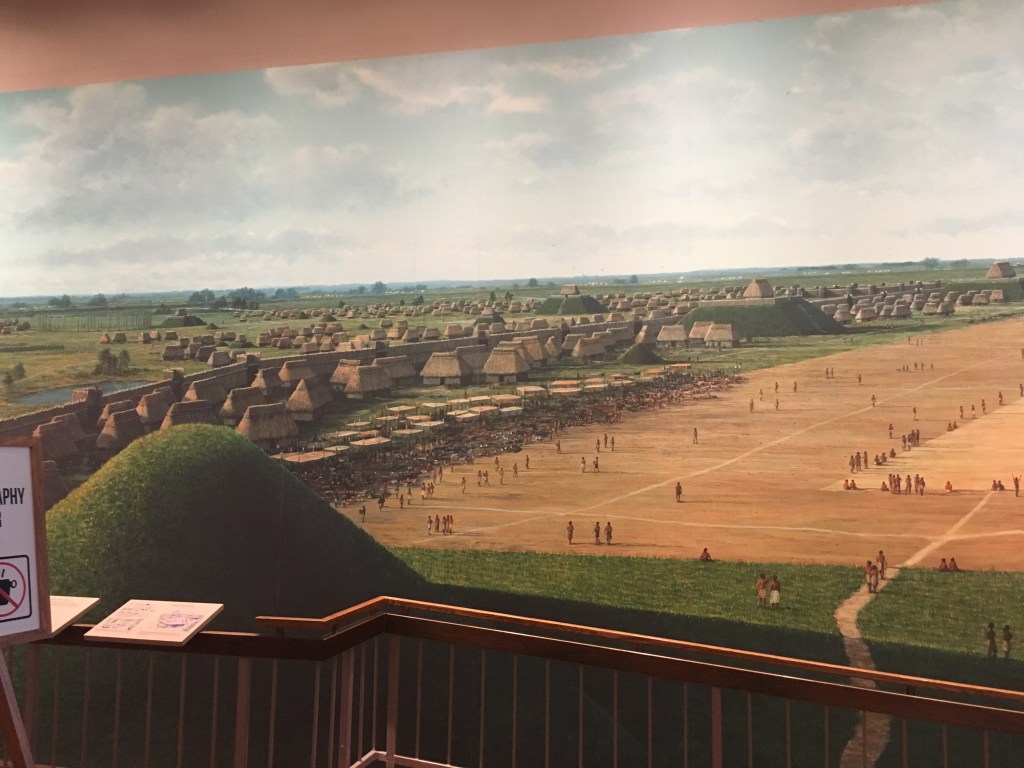
A depiction of the Mississippian society near its peak between 1000 and 1200 CE. (Photo credit: Jeff Hayes)

The decline of the society began in the 13th century, as they fell prey to some of the issues associated with areas with dense population centers. Overhunting, deforestation, difficulty securing food supplies, and flooding began to make the site increasingly untenable. As the problems mounted, the site was abandoned sometime before 1350.

One of the displays in the museum showing what daily life might have been like. (Photo credit: Jeff Hayes)

We spent more than an hour in the museum, and could have spent another examining all of the displays. In that time, I felt was though we got a glimpse of what life must have been like at the height of the civilization. While I was vaguely aware of the place and the people, I had no idea just how robust and successful this society had become.
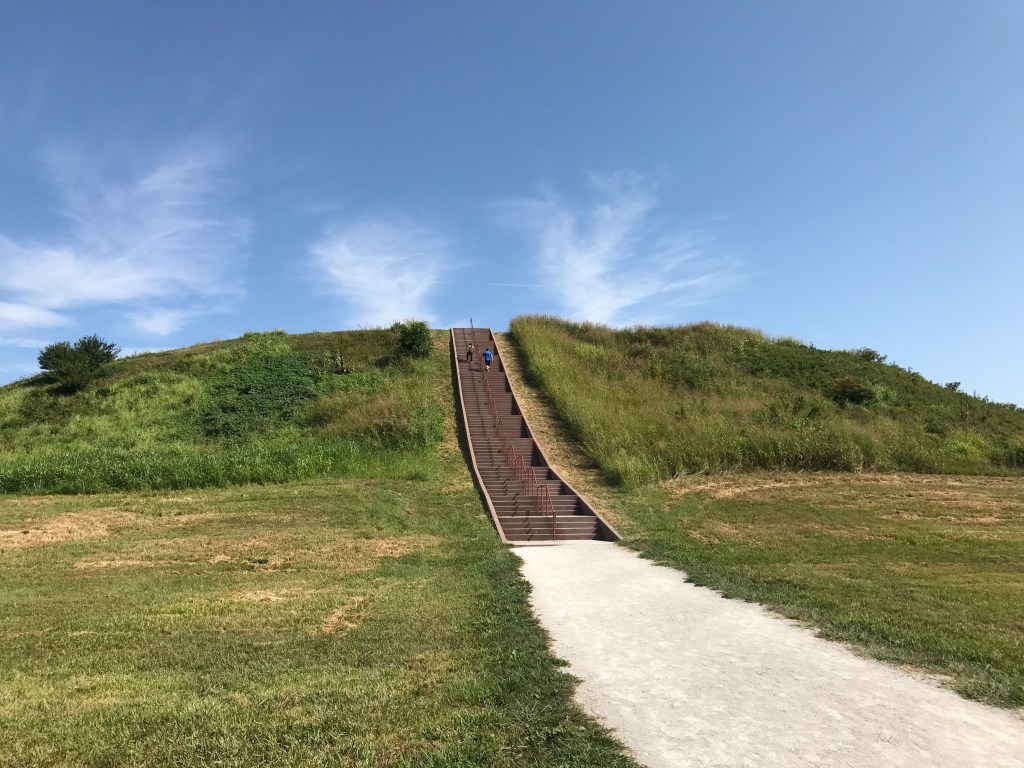
Monk Mound, the largest of the mounds on this site. My brother climbed the steps, and can be seen on the right with the blue shirt. (Photo credit: Jeff Hayes)

Upon leaving the museum, we decided to investigate Monks Mound, the largest of the mounds here. At 100 feet, it is the largest largest manmade earthen mound north of Mexico. Its 10 story height precluded me from scaling it, but my brother climbed the steps to the top. The view afforded a glimpse of downtown St Louis, less than 10 miles away.

The view from the top of Monks Mound. Note the skyline of St Louis in the distance. (Photo credit: Jeff Hayes)

Having stayed longer than anticipated, we needed to leave this place to get to Busch Stadium in advance of the 100 pm game start. This was yet another pleasant surprise on the trip, finding a museum and grounds dedicated to a people of who I knew very little. If you find yourself near Collinsville, Illinois, do yourself a favor and visit the Cahokia Mounds State Historic Site; I’m certainly glad we did.

2. Busch Stadium, St Louis.

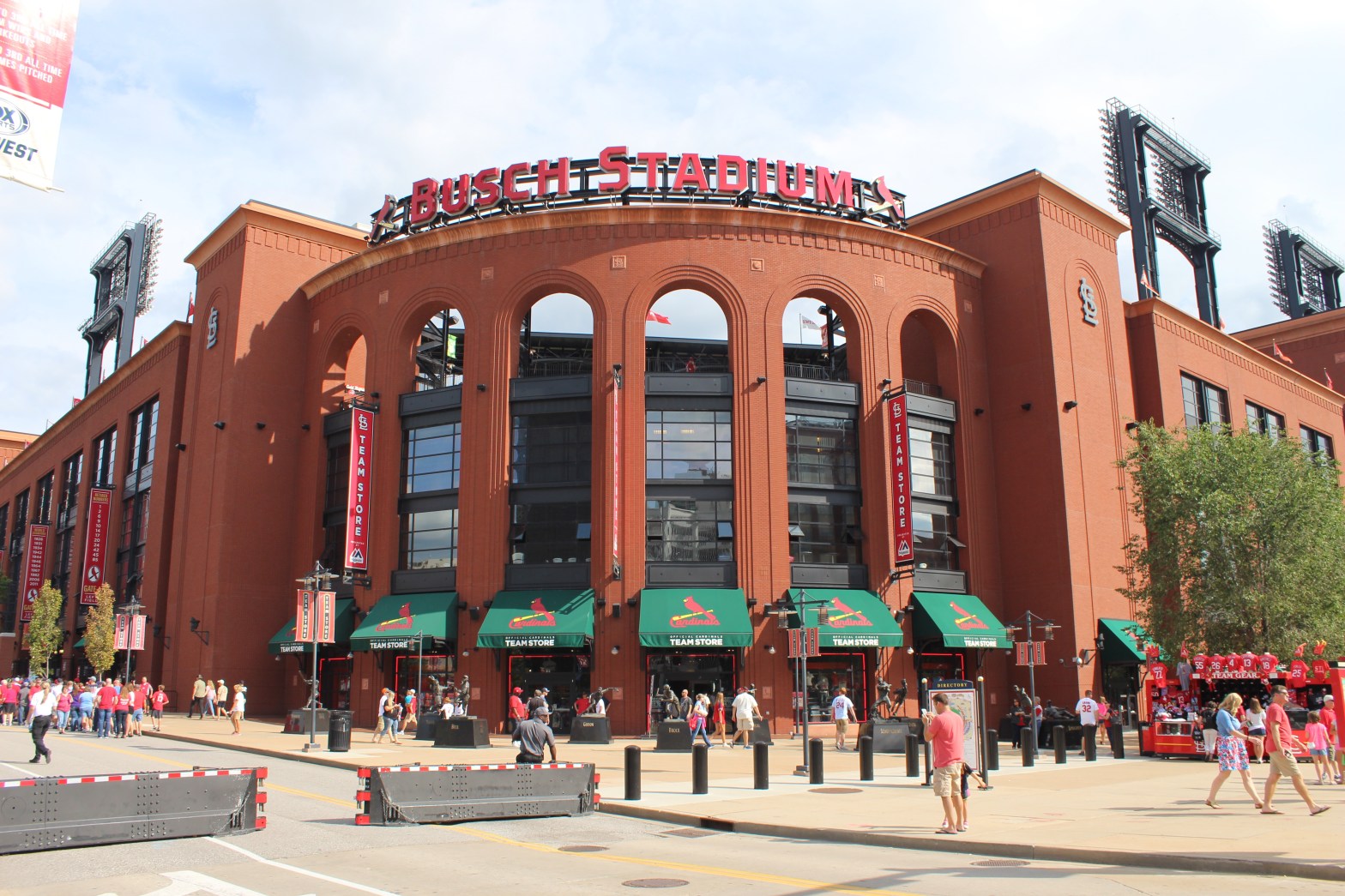
Welcome to Busch Stadium! (Photo credit: Jeff Hayes)

Unlike Saturday, when we were coming into St Louis from Indianapolis, we left ourselves sufficient time to explore the “new” Busch Stadium early Sunday afternoon. We arrived early enough to find parking in the lot directly across the the same. Of course, parking this close to a ballpark can cause headaches later, especially for a well-attended game.
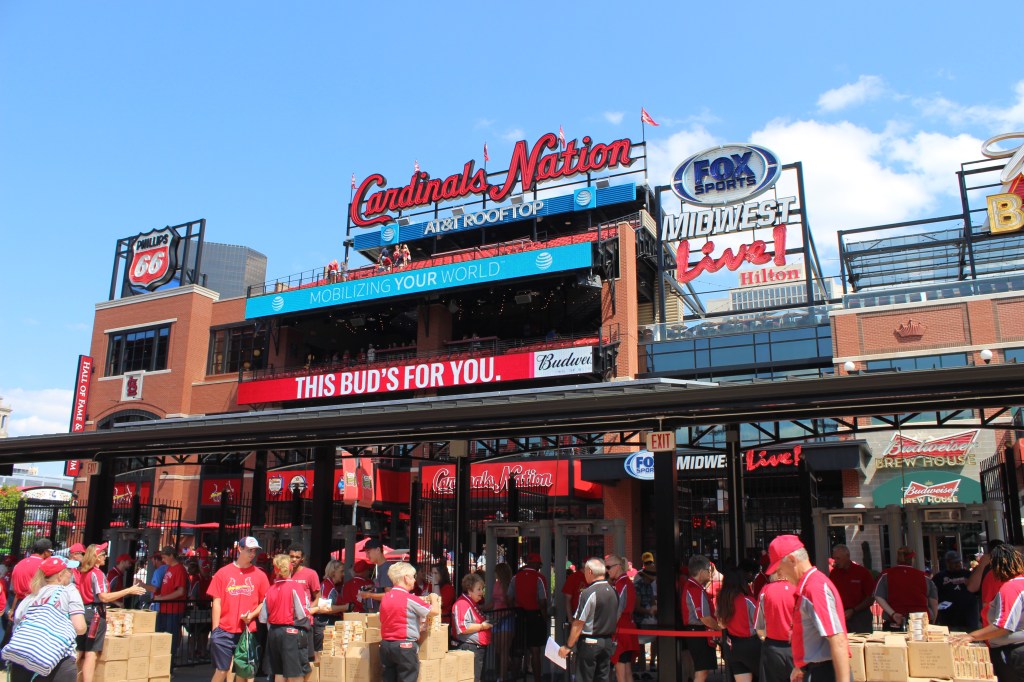
Cardinals Nation at Busch Stadium. From a distance, it appears to be part of the stadium. However, upon closer inspection, it is across the street. (Photo credit: Jeff Hayes)

As part of the 30th anniversary celebration of the 1987 Cardinals, today featured another giveaway. Typically, the items given away are not something I would necessarily keep. When I received the giveaway, drink coasters featuring four different Cardinals logos, I thought the same thing. However, I quickly discovered this was no ordinary giveaway. The coasters were solid, encased in a wooden coaster holder. Not only did I keep them, I still use them today.

One of the four coasters received at a Busch Stadium.

Once inside, we wandered about the ballpark. We noticed things that were not obvious when seeing the ballpark on TV. For example, Cardinal Nation, a collection of shops, pubs and restaurants in left field, is not attached to the stadium. Instead, it is beyond the left field seats, across a pedestrian path. We walked around for about 30 minutes, taking pictures and taking in the beautiful “new” ballpark.

View of the Busch Stadium scoreboard, with the Arch in the background. (Photo credit: Jeff Hayes)

In my opinion, the best park of the ballpark is the view. The Cardinals hit a home run designing the stadium to take advantage of the Arch and buildings as a backdrop. In fact, it was this view on TV that sparked our interest in visiting. Of course, the view is far better in person, and alone was worth the trip to see this beautiful ballpark.

The view from our seats. (Photo credit: Jeff Hayes)

Eventually, we found our way to our seats, after visiting the concession stand of course. Our seats for the matinee were an upgrade from our seats last night, and thankfully, we were just out of the reach of the sun. Even though the warmth and humidity were tolerable, the sun can make or break viewing a ballgame, but today it wasn’t an issue.

Starting for the Atlanta Braves was knuckleballer was RA Dickey, a veteran right hander who won the 2012 Cy Young Award for the New York Mets. Though he was past his prime, Dickey was dominant this afternoon, allowing one run on seven hits in seven inning. Being Mets fans, we had a special interest in seeing Dickey. We did learn that he is NOT a fan of the hot weather, expending only as much energy as necessary.
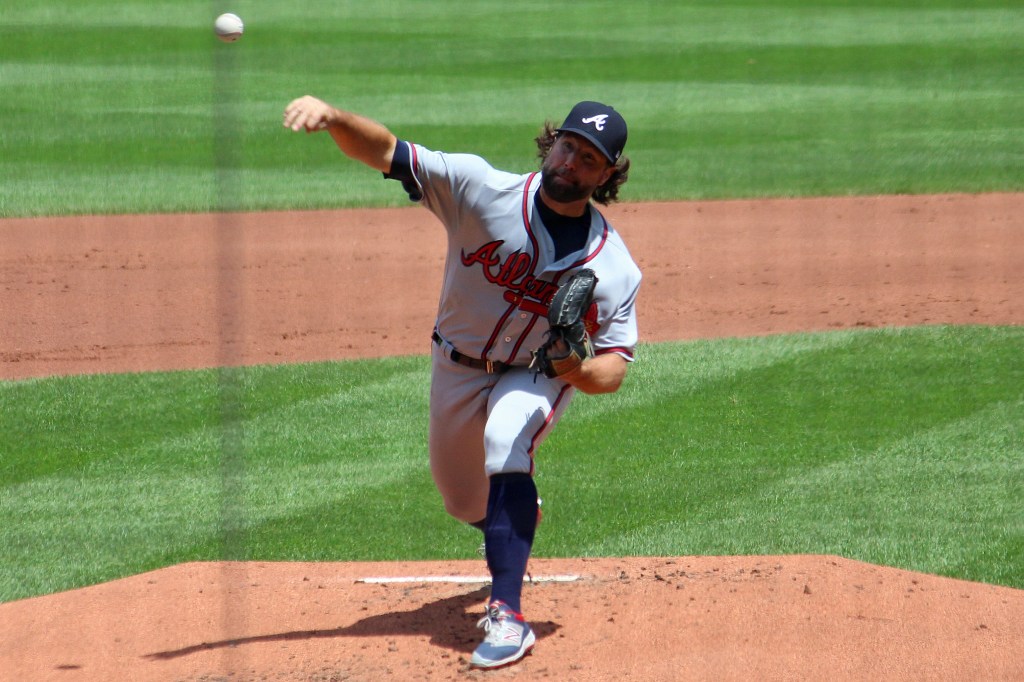
RA Dickey delivers at pitch at Busch Stadium. Dickey pitched a gem, giving up one run on seven hits in seven innings of work. (Photo credit: Jeff Hayes)

Despite the strong start by Dickey, the Cardinals chipped away at the Braves’ lead. In the bottom of the 8th, the Cards loaded the bases with two outs. With the pitcher’s spot in the lineup due up, Yadier Molina, who had the day off, was tapped to pinch hit. An extra base hit could have tied the contest, so Molina prepared for the at bat.
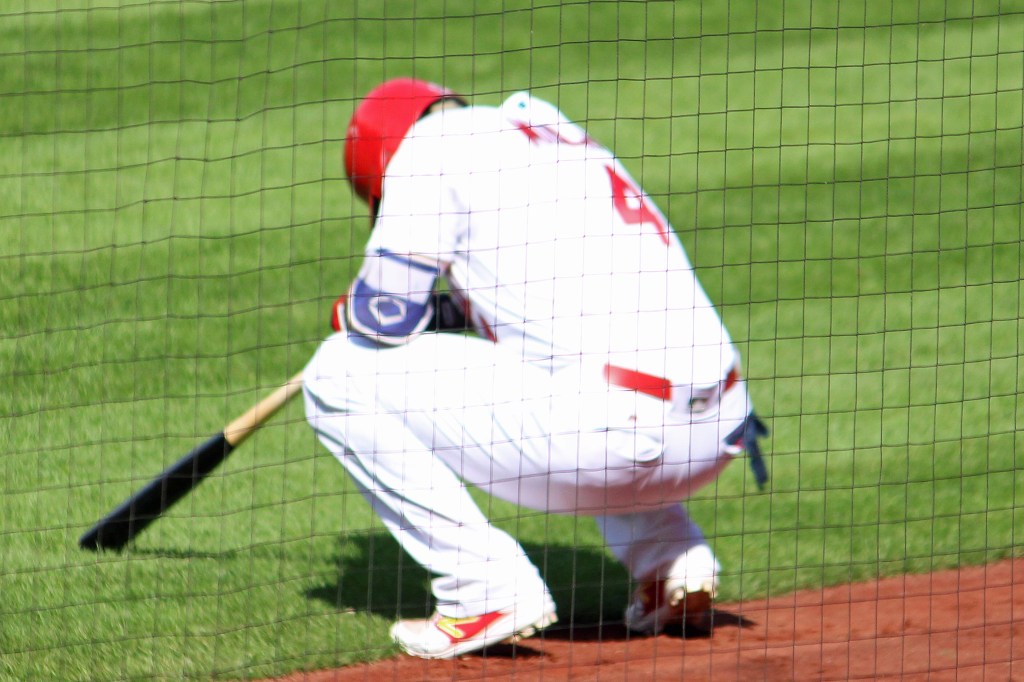
Yadier Molina preparing himself for a pinch hitting appearance. (Photo credit: Jeff Hayes)

The dramatic at bat ended as Molina grounded out, third to first, to end the inning and the Cardinals threat. The Cardinals went down meekly in the ninth, allowing the Braves to claim the 6-3 victory. We were treated to a good ballgame on a sunny and warm afternoon in one of the best new ballparks we’ve seen. Busch Stadium is much better than its predecessor with respect to environment and fan experience. Should I find myself in this part of the world in baseball season, I’ll be sure to come back to a great ballpark, run by a great baseball operation.
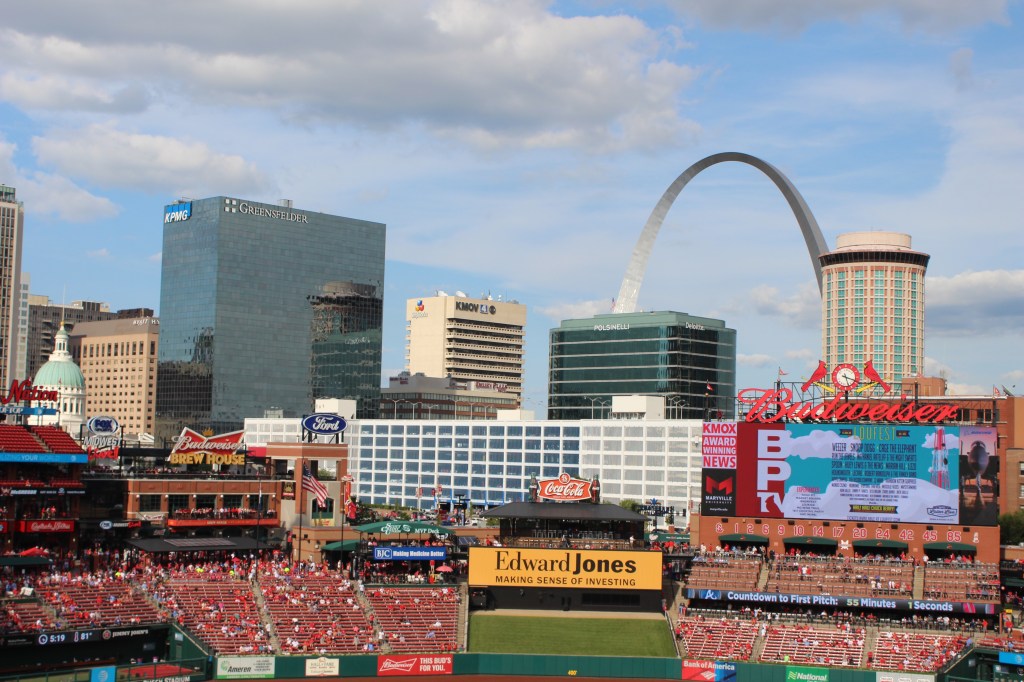
Hope to see you again soon, Busch Stadium! (Photo credit: Jeff Hayes).

2017 Oakland-Alameda California

While planning a trip to Yosemite National Park, we decided to slip in a visit to Oakland-Alameda County Coliseum, home of the Oakland A’s. Having visited every other active MLB ballpark, we dragged our feet visiting this stadium. In the past, we joked that the only way we’d see that stadium is if we were in central California for some other reason. Well, it seems that time had arrived, and we acquiesced to a visit to the see Oakland A’s at home.

Oakland-Alameda County Stadium. (Photo credit: Jeff Hayes)

1. New Jersey to California

We caught a flight from Newark/Liberty Airport to San Francisco International Airport on the morning of Saturday, September 10th. Choosing to visit in September was a conscious decision, as that month generally provides the best weather in the Bay Area during baseball season. Not having flown cross country in about a decade, I forgot how little I enjoy flying. Because I was not careful choosing our seats, we were cramped in less than desirable seats in economy for the six hour flight.

We arrived in the late afternoon of that sunny and very warm day. Weary from the travel and a busy schedule before the trip, we caught an early dinner, then settled into our hotel in Oakland.

2. Alameda/Oakland, Sunday September 11, 2017

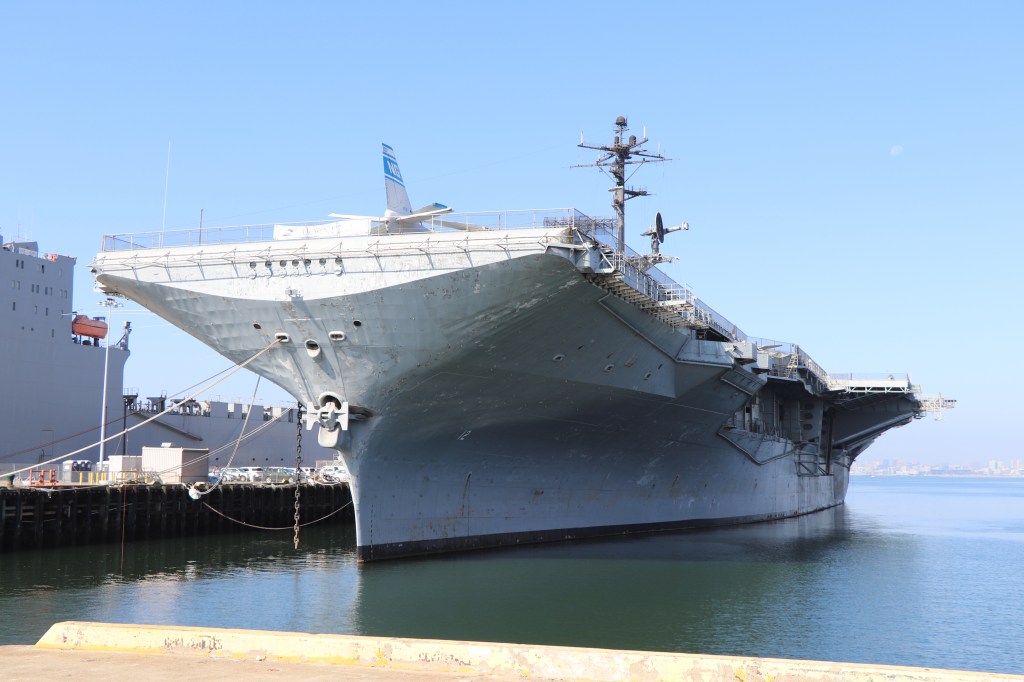
With some time before the 100 pm game at the Oakland-Alameda County Coliseum, we decided to head to Alameda in search of the “nuclear wessels”. To our disappointment, the nuclear vessels were nowhere to be found. However, we did find the USS Hornet.

The USS Hornet Sea, Air and Space Museum in Alameda, CA. (Photo credit: Jeff Hayes)

The USS Hornet, commissioned in World War II, saw limited action in the Korean and Vietnam Wars, and recovered the astronauts from Apollo 11 and 12 after splashdown. Decommissioned in 1970, it became a floating museum, moored in Alameda since 1998. Though we arrived just before it opened, the day was already warm. Upon boarding the ship we wandered about, waiting for our guided tour to begin. The all-volunteer staff was both enthusiastic and very knowledgeable, clearly passionate about their ship.

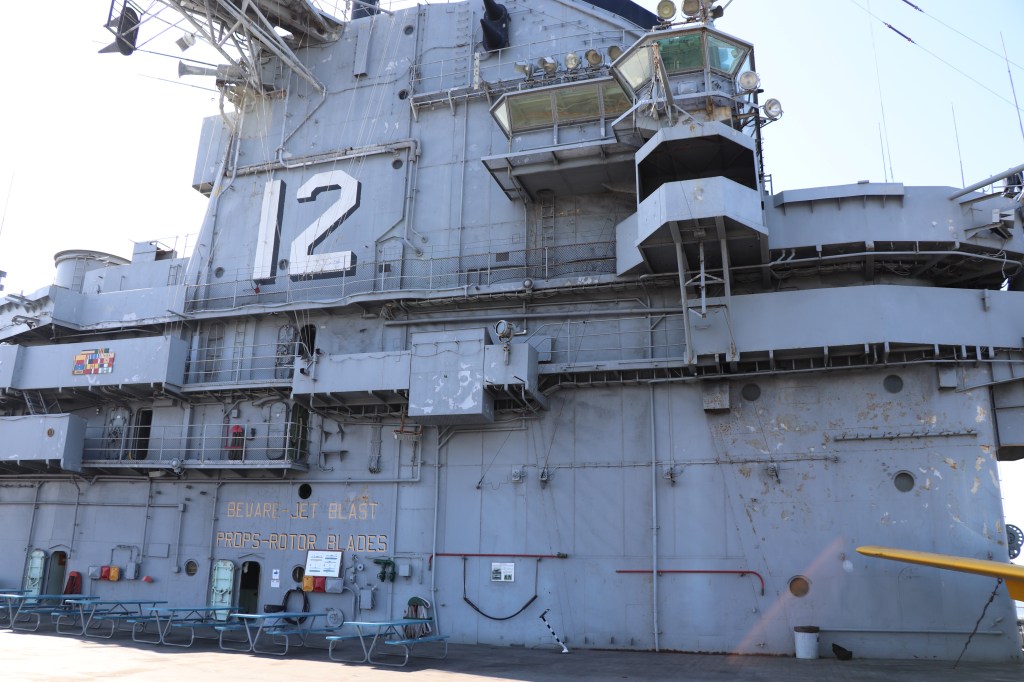
Deck of the USS Hornet. (Photo credit: Jeff Hayes)

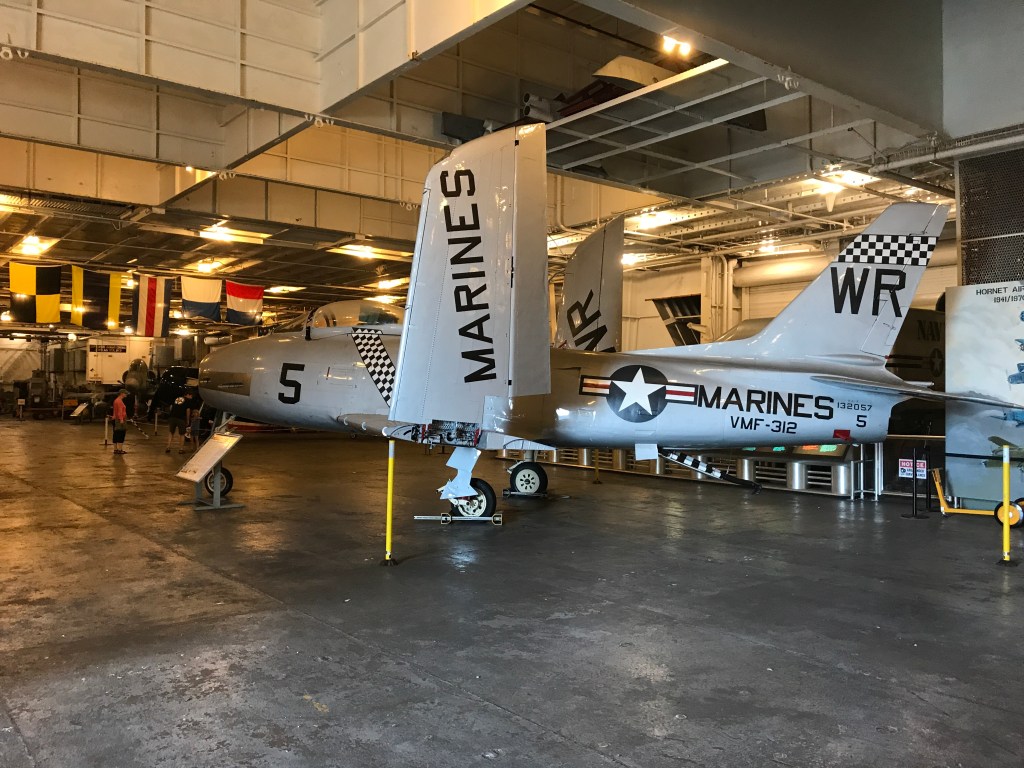
During the briefing before the tour, we were reminded that the ship was constructed for use by young men in good physical shape. Tight spaces and sharp turns within the ship made navigation tough for “normal people” (translation: I wasn’t going to these places aboard the USS Hornet). Following the briefing, the tour began. We walked along the museum section of the ship, where we saw types of planes that called the Hornet home during its mission.

Planes on the hangar deck of the USS Hornet. (Photo credit: Jeff Hayes)

When the tour led us to the interior of the ship, I waited as my brother went to visit the battle bridge. Though it had been been renovated several times during its service, the battle bridge was depicted as the one used during its limited service in Vietnam. Following the tour, we were free to walk about the hangar deck and the main deck of the ship.

The battle bridge of the USS Hornet. (Photo credit: Jeff Hayes)

Among the aircraft on display on the USS Hornet, my favorite were the F-14s on the main flight deck. The song “Danger Zone” echoed through my head as I examined the pride of the Navy’s planes, imagining what it might be like to pilot one. Before leaving the Hornet, we went astern to get a better view of the San Francisco skyline. This would be as close to the City by the Bay as we would get during this trip.

San Francisco from the USS Hornet, through the haze of the late morning on a very warm day. (Photo credit: Jeff Hayes)

3. Oakland-Alameda County Coliseum

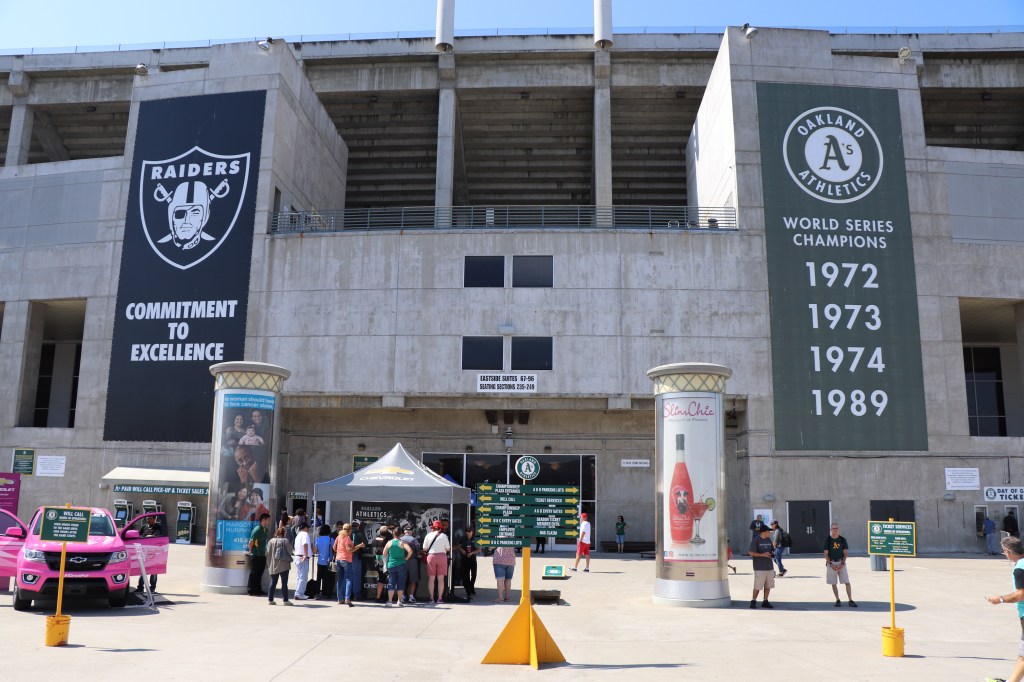
Oakland-Alameda County Coliseum, Oakland CA. (Photo credit: Jeff Hayes)

The USS Hornet was about 15 minutes from the stadium, and along the way we saw Willie Stargell Avenue. Arriving about 90 minutes before the game, we had ample time to tour the stadium, inside and out. From the outside, the Oakland-Alameda County Coliseum resembled many of the multi-purpose stadiums from that era. In fact, it looked aged, likely many years from its best days.

Oakland-Alameda County Coliseum, home of MLB and NFL champions. (Photo credit: Jeff Hayes)

Walking around the concourse of the stadium, the early afternoon shifted from very warm to hot! Temperatures were in the lower 90s F (33 degrees Celsius), though thankfully the sun splashed day was not humid. After touring the stadium, we ducked into the inner concourse to get something to eat and drink before finding our seats.

While standing in line, someone noticed that my brother wearing his Hartford Yard Goats t-shirt (obtained earlier this summer). It was unusual that someone here would know the team, since had they recently moved to Hartford. However, their new home, Dunkin Donuts Park, was not available in 2016, due to ongoing political issues. This fan mentioned he wanted to visit then, but it didn’t open on time.

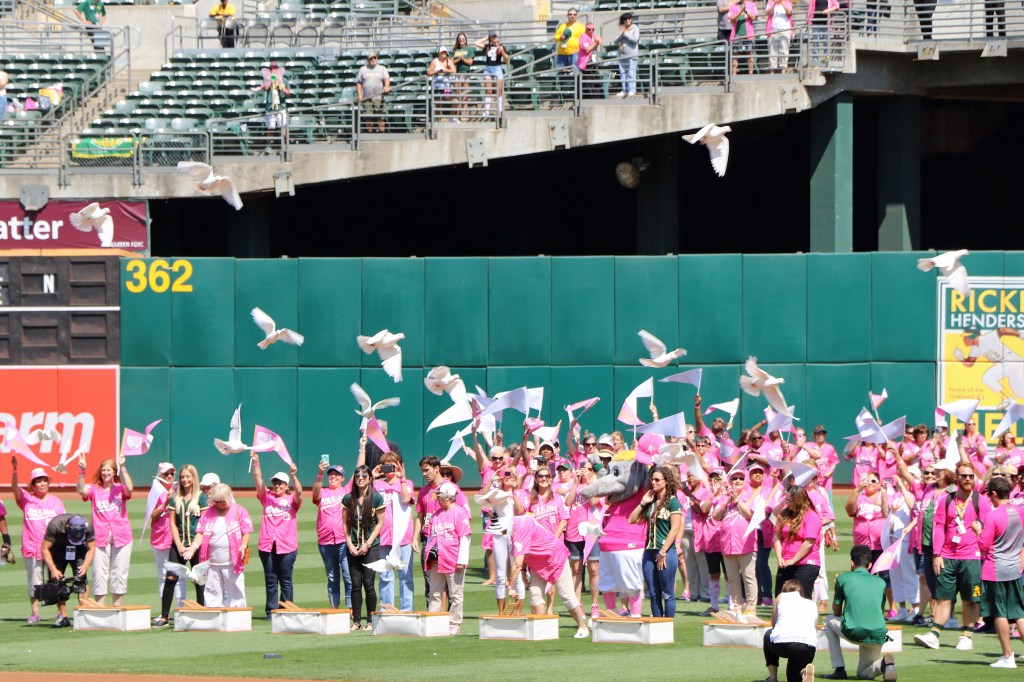
Breast Cancer Awareness Day in the Coliseum. (Photo credit: Jeff Hayes)

Finding our seats, we discovered we were in full sunshine. When we purchased the tickets, I didn’t believe that the mid September sun in Oakland would be an issue. Undaunted, we settled in for the game. The pregame ceremony were tied into Breast Cancer Awareness Day, and the ceremony was emotional, ending with the release of doves.

Taking in the ballpark before the first pitch, I realized that my preconceived notion of the Coliseum may have been wrong. While it is indeed a multi-purpose stadium, it was not the rundown facility I had expected. Granted, we did not experience the plumbing issues that grabbed national headlines, but I felt as though the poor reputation the Coliseum has may be unfounded.

The view from our seats at the Oakland-Alameda County Coliseum. (Photo credit: Jeff Hayes)

Despite the fact that this was important game for both teams (since the A’s were only three games back of the AL West leading Houston Astros), there were many empty seats at the game. It made me wonder if the heat was a contributing factor in the low attendance, or if baseball was not as popular in Oakland as it had been in the past.

Starting for the Houston Astros was left hander Dallas Keuchel, two years after his Cy Young award winning season. However, he didn’t bring his best stuff out of the bullpen, allowing four runs in 5 2/3 innings with four walks.

Dallas Keuchel delivering a pitch during the second inning at the Coliseum. (Photo credit: Jeff Hayes)

In contrast, A’s starter Kendall Graveman pitched a gem, allowing one run in six innings. Supporting the great start, the A’s scored 11 runs in the fourth through eight innings. With the A’s putting the game away in commanding fashion, I turned my attention back to the stadium. Though aging and need of maintenance, the ballpark holds special memories for both A’s and Raiders fans. We’ve seen stadiums in worse shape, especially at the end of their lives. The Coliseum was a fine place to see a ballgame, especially under the cloudless sky.

The A’s slant on the race many teams run during the seventh inning stretch, featuring Dennis Eckersley, Rollie Fingers and Rickey Henderson. (Photo credit: Jeff Hayes)

Following the game, I took one more look at the place. Even though it’s true I wouldn’t have traveled to California simply to see the Coliseum, I’m happy that I visited on this sunny, hot afternoon. It helped me disperse the idea that the stadium was simply a dump. Will we visit again?? It is unlikely, but I did enjoy the afternoon watching a game at the Oakland-Alameda County Coliseum.

2018 Baseball Road Trip – Day 3 (New Orleans Louisiana/Biloxi Mississippi)

Sunday morning in New Orleans dawned wet and humid, with steady rain falling through mid morning. The rain tapered to showers by about 1000 am, as we awaited the 100 pm game between the Oklahoma City Dodgers and the host New Orleans Baby Cakes. To our great surprise, the Baby Cakes tweeted that the game was postponed not long after 1000 am. Though it was wet and humid, it seemed as though the game could have been played.

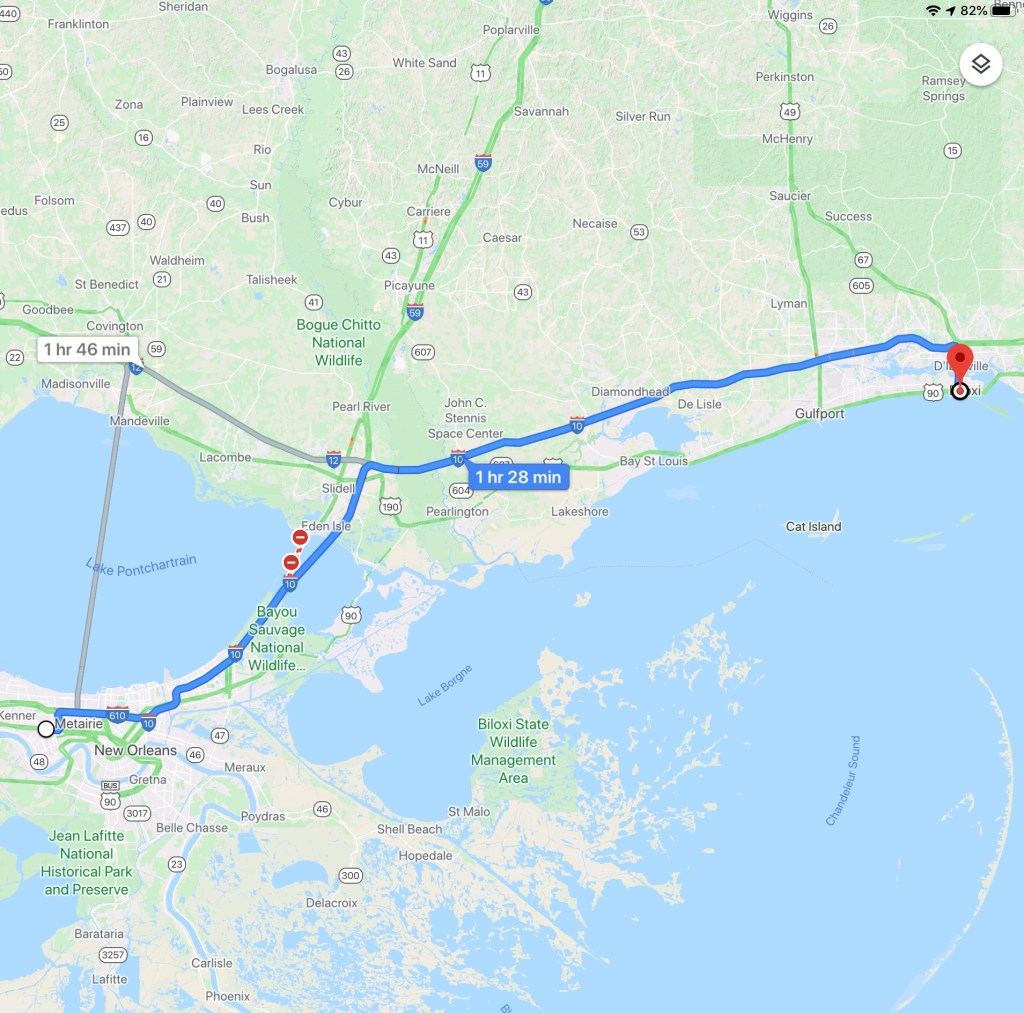
Suddenly, we were faced with a hole in our schedule. Not wanting to wander the French Quarter in the drizzle and fog, we searched for something else to do. My brother noted that there was baseball in Biloxi, Mississippi, with a 200 pm start time. Since there was no baseball here, we headed out to southwest Mississippi.

Google maps showed a 90 minute trip from our hotel to MGM Park in Biloxi, MS.

Unfortunately, the rain seemed to follow us east toward the border. In fact, it fell so heavily that I considered pulling off and waiting it out. As we drove, I was prepared for the possibility of arriving in Biloxi just in time for the game to be postponed. As we got closer to our destination, the rain subsided, though the sky remained threatening.

In spite of the rain, we made good time getting to Biloxi, which left us an opportunity to explore the city. The skyline of Biloxi was dominated by the Beau Rivage Resort & Casino, located along the Gulf of Mexico. It is the largest building in Biloxi by far, and we could see it from the highway into town.

The Beau Rivage Resort & Casino in Biloxi, MS. (Photo credit: Jeff Hayes)

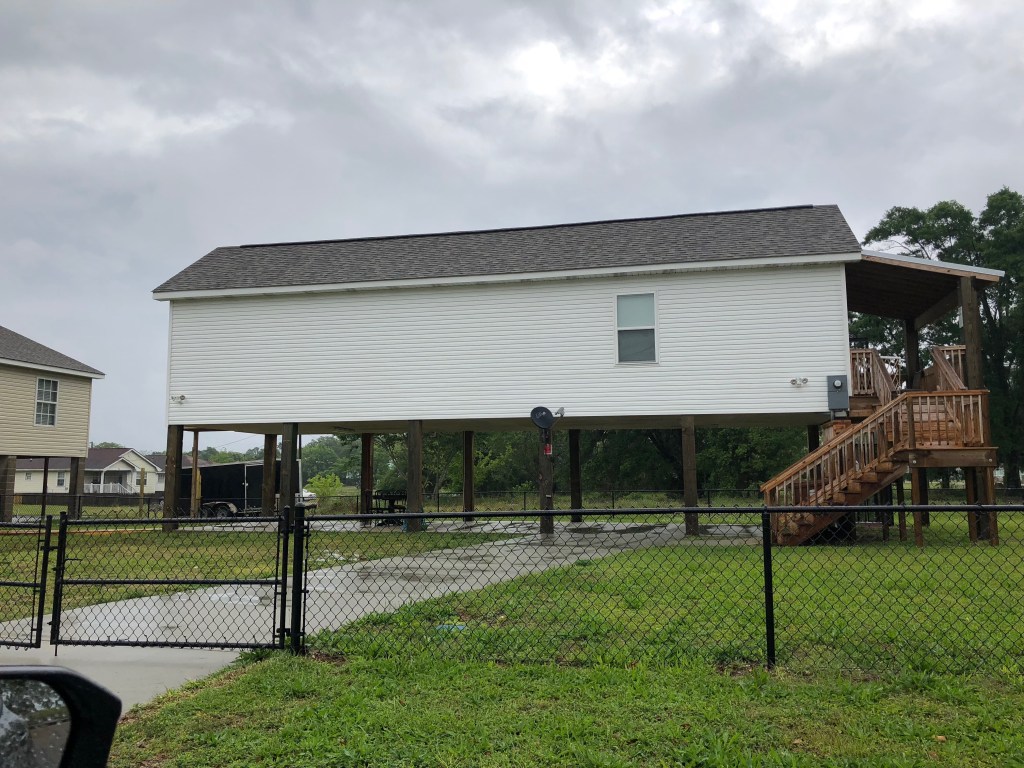
Driving through Biloxi, it was clear that the effects of Hurricane Katrina were still haunting the city. Newer construction was built on pylons several feet tall, hopefully saving the homes in the event of another hurricane. It was also clear that parts of the city haven’t recovered from the storm, with many unoccupied buildings away from the coast.

A home rebuilt on pylons to hopefully prevent damage in the event of another tropical system. (Photo credit:Jeff Hayes)

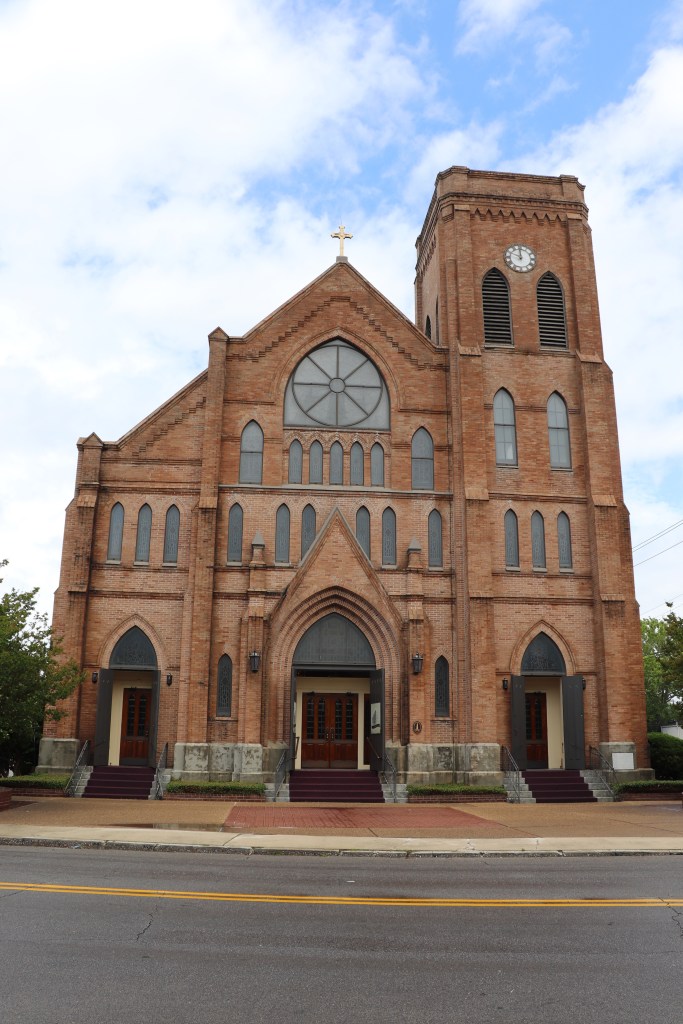
Of course, we happened on churches in Biloxi. The one that struck me most was the Nativity BVM Parish Life Center. The church towered over its section of Biloxi, and is part of a larger complex on Washington Loop. Even with the clouds and rain, the building exuded character. After driving through much of the city, we headed back toward the ballpark to find parking.

Nativity BVM Parish Cathedral, Biloxi MS. (Photo credit:Jeff Hayes)

1. MGM Park

Upon arriving at the ballpark, we found no parking in the general vicinity. We pulled into a parking lot adjacent to the park itself, where the attendant told us that the parking lot was for players, scouts and others involved in the game. When I asked where we could park nearby, the attendant looked in the car, pointed to my brother, and said “He looks like scout”. At first, I didn’t get it, but he was offering to let us parking in the players lot for the game. Talk about Southern hospitality!!!

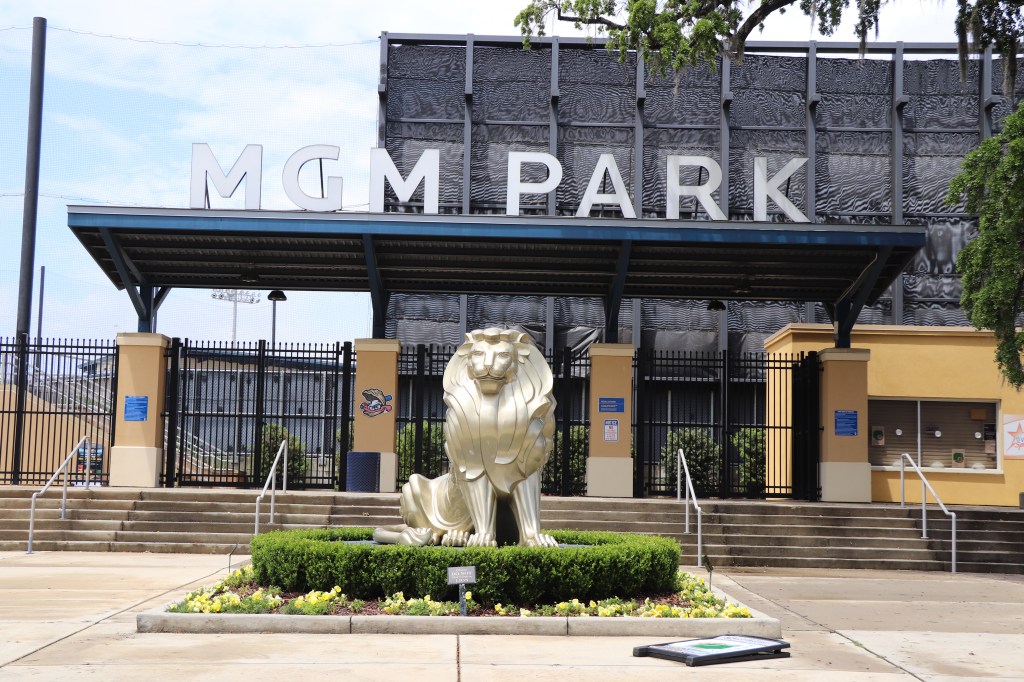
Welcome to MGM Park in Biloxi, MS! (Photo credit: Jeff Hayes)

We proceeded to walk completely around the park before going inside. MGM Park is the home of the Biloxi Shuckers, the Double A affiliate of the Milwaukee Brewers. Their opponent this afternoon was the Montgomery Biscuits, the Double A affiliate of the Tampa Bay Rays. The game was slated to start at 200 pm, but one look at the field suggested that time might be optimistic.

The rain had ended, and the sun was peaking out from the clouds, but there were puddles on the field. We wandered through the concourse as the ground crew worked feverishly to ready the field for the game (that’s how it’s done New Orleans Baby Cakes!). While we were walking, we heard a voice yell out “Bowie BaySox!”. Since I was the only one there wearing a Bowie BaySox cap, I assumed he meant me.

MGM Park about an hour before game time. Note the large puddle in the infield behind second base. (Photo credit: Jeff Hayes)

As it turns out, the gentleman (whose name escapes me) worked in public relations with the Bowie BaySox years ago, but he remembered the BaySox caps. He gave us an oral history of MGM Park, and then offered us a tour of the press box. My brother took him up on his offer, and spent some time in the Shuckers press box before the game.

Just as we found our seats, the sun started to come out, with clearing coming in from the Gulf of Mexico. My brother applied sun screen, and asked me if I wanted to do the same. Saying “I think I’ll be ok” was me not respecting the sun in late April near the Gulf Coast. Eventually, bright sunshine splashed the field, and I was on my way to a nasty sunburn.

While we waited for the game to start, the ground crew worked to ready the field. Obviously, they had their work cut out for them. (Photo credit: Jeff Hayes)

Due to the diligent work of the ground crew, the game only started about 30 minutes late. Starting for the Biloxi was Wade Miley. He had signed late in the off season, and was sent to Biloxi to tune up before joining the Brewers. Miley was rusty, and it showed, as he gave up four runs (including two HRs) in three plus innings of work before being taken out of the game.

Wade Miley delivering a pitch in the top of the first inning. (Photo credit: Jeff Hayes)

The remainder of the pitchers entering the game for the Shuckers fared no better than Miley, giving up nine runs on 10 hits in mop up work. In contrast, the Shuckers offense was limited to three runs by the Biscuits’ pitchers. With the outcome of the game determined fairly early, some of the relatively sparse crowd exited early, leaving the ballpark nearly empty for the last half of the game.

A view of the a Gulf of Mexico from MGM Park. (Photo credit: Jeff Hayes)

For the rest of the game, I admired the view of the ballpark. Even though it was obviously a prefabricated stadium (based on the appearance of the seating area), the views made this place stand out. With the Beau Rivage Resort & Casino prominent in centerfield, and Gulf over right field, the ballpark looked much bigger than it actually was.

The view from our seats, with the Beau Rivage Resort & Casino looming over the centerfield fence. (Photo credit: Jeff Hayes)

Following the final out, the Shuckers invited fans to play catch on the field. Of course, my brother and I were prepared, retrieving our gloves from the car. We spent the next 20 minutes playing catch on the field of MGM Park, before we were gently reminded that the ballpark would be closing soon. After our game of catch, we briefly visited the beach adjacent to the Beau Rivage Resort & Casino. There were seemingly more seagulls than people as the sun began to set, and the white sandy beach reminded me of home.

The beach along the Gulf of Mexico in Biloxi, MS. (Photo credit: Jeff Hayes)

The quick walk along the water was the perfect ending to a great day. This experience was my favorite of the trip, in part due to the fact that it was completely unplanned. The clear skies made for a much easier drive through the darkness back the hotel in New Orleans.