Arlington, Texas Sunday September 14th 2003

Texas Ranger Official Program

Checking out of our motel Sunday morning, we still had a two hour plus drive to Arlington. We were not in a particular hurry, since the game between the hometown Texas Rangers and the visiting Oakland A’s had been “flexed” from early afternoon to early evening to accommodate ESPN’s Sunday Night game. Instead of a 215 pm CDT start, the first pitch would be thrown at 710 pm.

1. Heading to Arlington

With time to spare, we took our time getting into the Dallas metro area, finding lunch before deciding how we wanted to proceed. Since we were staying in the area overnight (flying out of Dallas the next morning), we checked into our hotel before heading out in the direction of the stadium. We arrived well ahead of the first pitch, and secured parking just outside of the Ballpark in Arlington, home of the Texas Rangers.

A demonstration was underway just outside the ballpark as we arrived. Based on the signage carried by the demonstrators, it appeared to be tied to gay rights. Being from the Northeast, I assumed that the demonstration was a pro gay rights rally. Almost immediately, I was proven wrong, as it was clear this was an anti gay rights assembly. This should not have surprised me, given the section of the country. To my great surprise, the demonstration was far from peaceful, as homophobic slurs were flying at what I considered an alarming rate.

Being from New Jersey, it took all of my restraint NOT to respond to the vitriol present at that rally, and there were several verbal altercations between demonstrators and passersby. Wanting to avoid a possibly ugly interaction, we left the area in search of a quieter location to wait for the gates to open at the stadium.

The Ballpark in Arlington. (Photo credit: Jeff Hayes)

We stumbled upon the Legends of the Game Baseball Museum, located at the ballpark. Inside the museum, we found displays complete with bats, jerseys, and trophies belonging to baseball greats. There are exhibits on Texas Rangers history, the Negro Leagues and the Texas League, and the museum has facilities for students of the game to conduct research. While not as inclusive as the National Baseball Hall of Fame (nestled in Cooperstown, NY) or the Negro League Baseball Museum (located in Kansas City, MO), the museum was an enjoyable way to pass some time and is recommended if you attend a Rangers home game.


2. The Ballpark in Arlington

Composite image of the Ballpark in Arlington. (Photo credit: Jeff Hayes)

Fortunately for me, high clouds filtered the still strong mid September sun in Arlington, mercifully keeping temperatures in the 80s leading up to game time. The Ballpark in Arlington is an open air stadium, which was a controversial decision when the plans for the ballpark were announced. It is not unusual for temperatures to hover near 100 degrees F during summer afternoons and evenings, potentially putting the health of players and fans alike at stake. Because of the heat, most Rangers home games were played in the evening to avoid the worst of the conditions.

Cooler temperatures made exploring the park more enjoyable, at least for me. The Ballpark in Arlington was bigger than I expected, complete with three decks encompassing almost all of the entire playing field. With a capacity of greater than 48,000, it was one of the biggest “new” MLB ballparks. From our first look inside the ballpark, it was clear that a fair amount of planning was done to create the stadium’s atmosphere.

In a nod to the past, home plate, the foul poles and the bleachers were transplanted from Arlington Stadium, the home of the Texas Rangers from 1972 through 1993. The roof over the right field porch was reminiscent of Tiger Stadium, the former home of the Tigers. Finally, the white steel facade in the outfield was based on the facade of the old Yankee Stadium. Perhaps the most noticeable feature of the park was the office suites in centerfield, beyond the grassy noll that served as the batter’s eye. All of the above resulted in a large ballpark, much larger than I had expected.

A view of left and center field from near home plate. Note the location of the visitors bullpen, just to the right of the Southwest Airlines sign in left field. (Photo credit: Jeff Hayes)

While touring the ballpark, we happened upon the visitor’s bullpen in left field, which was enclosed under the lower level concourse. A’s pitcher Barry Zito was warming up in the bullpen before the game, getting in his between start throwing. Because of the closed nature of the bullpen, Zito, a left hander who’s game was predicated on control and pitch placement (rather than velocity), was seemingly throwing very hard during his warmup (due to the echo).

As we were watching Zito throw, a young fan walked up and said “Hey Barry, you are throwing really hard”. Normally, players ignore fan comments, even during warmups, as they are concentrating on getting ready for competition. However, Zito stopped throwing, looked up at the young fan and said “Ah, don’t let the sound fool you”. With that one sentence, Zito showed me that he was respectful of fans, and that he was fully aware that he was indeed not a hard thrower.

The view from our seats. (Photo credit: Jeff Hayes)

Following our tour, we headed for the concession stands to get a baseball dinner. With hots dogs, pretzels and drinks in hand, we headed toward our seats. Despite a strong starting lineup, the Rangers were mired in last place in the AL West. With the home team limping toward the end of a disappointing season, there were plenty of good seats available for the game. We were fortunate enough to score seats in the lower level, just to the third base side of home plate.

Starting for the visiting Oakland A’s was right hander Justin Duchscherer. Not one of the five man Oakland rotation, Duchscherer was making a spot start, just his third of the season. On the mound for the Rangers was left hander Tony Mounce, the fifth starter in the Texas rotation. Given the relative weakness of the starting pitching, we expected the strong lineups for both teams put on a hitting display. We didn’t have to wait long for the offensive fireworks to begin, as the teams combined for seven runs in the first two innings.

A ticket from the game. (Photo credit: Jeff Hayes)

After this outburst however, both offense were quieted into the middle innings. While Tony Mounce lasted six innings for the Rangers, the A’s starter (Duchscherer) didn’t make it out of the fourth inning, leaving the game in the hands of the A’s bullpen. As evening faded into night at the Ballpark in Arlington, conditions became a bit cooler. Scoring slowed the pace of the game, leaving us some time to get a sense of the environment within the ballpark.
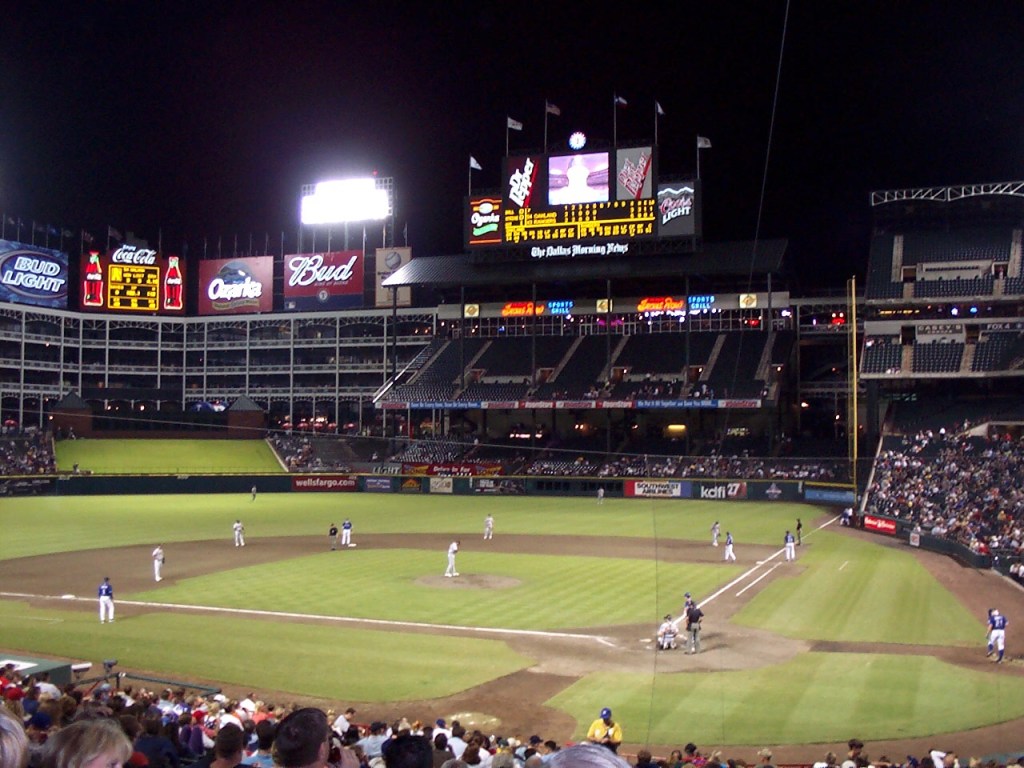
Nighttime view of the Ballpark in Arlington. (Photo credit: Jeff Hayes)

Not surprisingly, a disappointing season for the Rangers resulted in a sparse crowd, which seemed even smaller than the announced attendance 17,000. So few people in the park made the ballpark appear even larger, robbing the place of any charm or intimacy. A collage of pieces from other parks gave the Ballpark at Arlington an almost forced feel, further diluting any sense of identity. To be fair, the ballpark DID provide a pleasant environment in which to watch a game, but I didn’t get the same feel I did at other ballparks in our travels.

Following Alex Rodriquez’s 43th home run in the bottom of the fifth, the hometown Rangers took a 5-3 lead. In the top of the seventh, the A’s broke the game open with three runs, and a trio of A’s reliever closed the door on the potent Texas office to seal a 6-5 win for the A’s. We filed out of the park with the rest of the remaining crowd, taking what would be our last look at the Ballpark in Arlington. Even though we had a good time seeing a ballgame here, there was not enough to bring us back any time soon.

The A’s celebrating after their 6-5 victory over the Rangers. (Photo credit: Jeff Hayes)
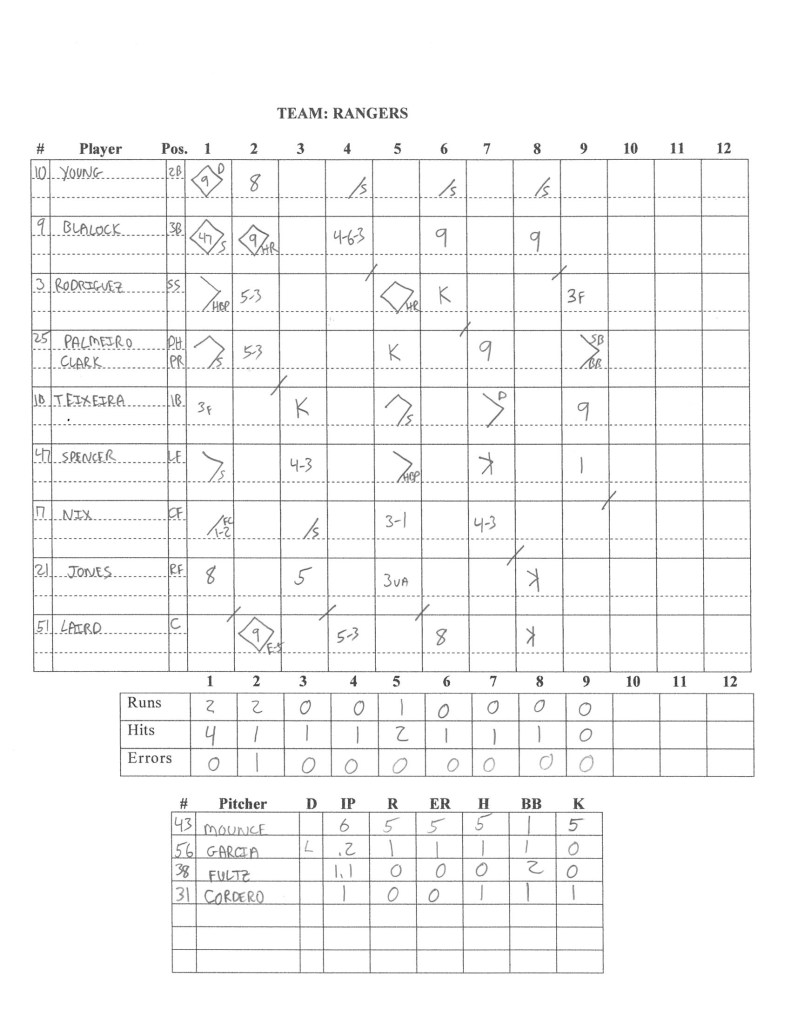
My scorecard from the game

Houston, Texas Saturday September 13th 2003

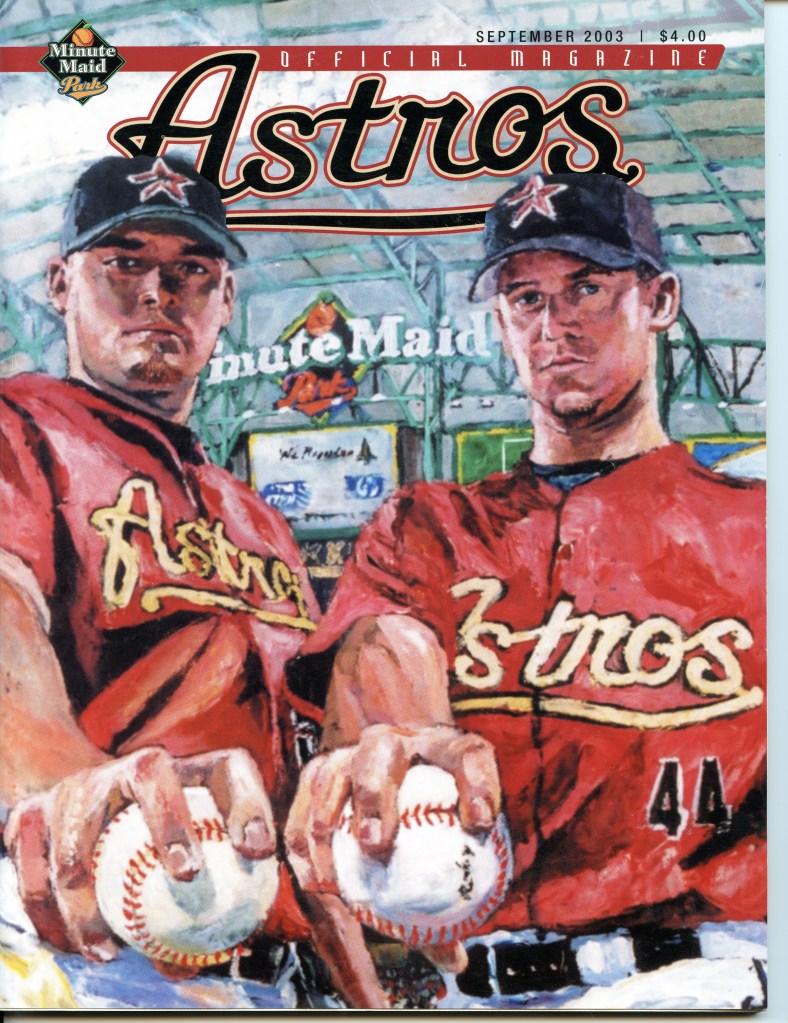
Houston Astros program September 2003

1. New Jersey to Houston

Our last baseball trip of 2003 took us to the Lone Star State at the tail end of summer. Since our first stop in Texas was Houston, we flew from Newark, NJ to the George Bush Intercontinental Airport on Saturday morning. Because it was a Saturday, we breezed through security at Newark-Liberty Airport, and the nearly four hour flight was uneventful. Landing in Houston in the early afternoon, we picked up our rental car and headed out to explore Houston.

Since we had some time before the scheduled first pitch at 710 pm, we set our sights on the Johnson Space Center, home of NASA. While we didn’t have enough time for a formal tour, we did stop to visit the few features that were located outside of the center itself. The highlight of the brief visit was seeing the Saturn V rocket, which launched the Apollo spacecraft toward the Moon.


2. Minute Maid Park

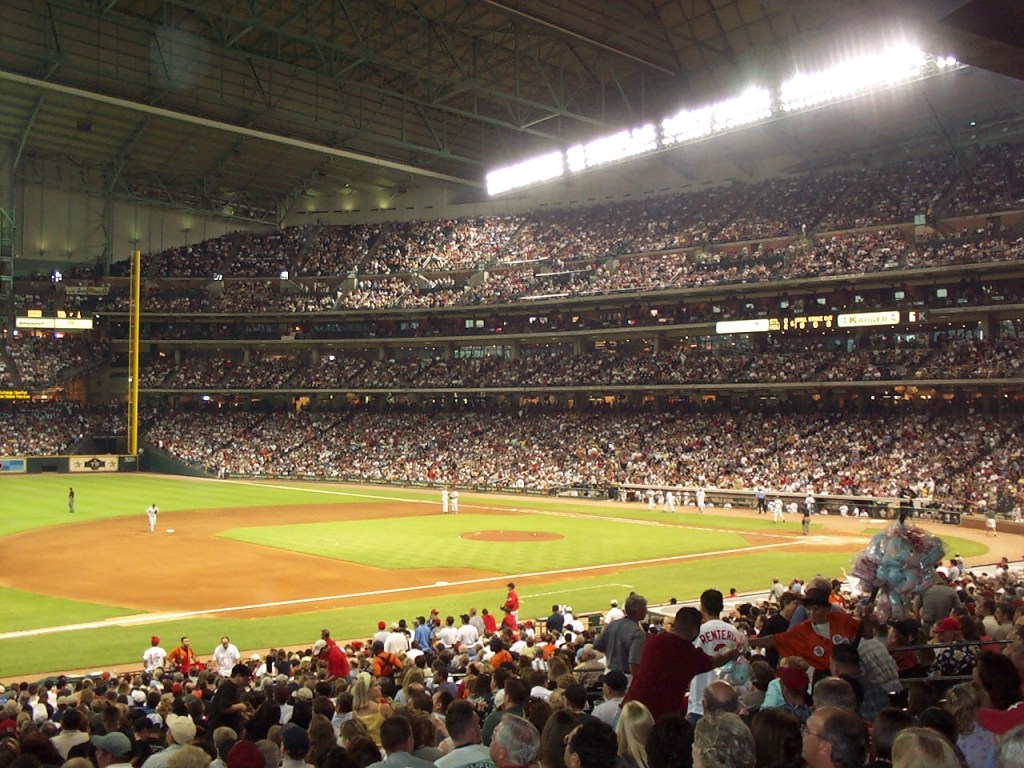
Minute Maid Park with the roof closed. Note the train on the track above the left field wall. (Photo credit: Jeff Hayes)

Hot and humid conditions met us at Minute Maid Park as we arrived about 90 minutes before the first pitch. Parking did not pose any particular problem, as there were parking lots located just outside of the ballpark. Had those lots been unavailable, there were myriad options for parking with a quarter of a mile of the park. Walking up to the stadium, I began to feel the effects of the hot and humid conditions.

Upon walking into Minute Maid Park, it was obvious that the roof was closed, as we went from bright sunshine to the dimly light stadium. Apparently the heat and humidity was the primary reason for the roof closure, presumably for the comfort of the fans, as the weather was otherwise tranquil.

Minute Maid Park from behind home plate shortly before the first pitch. Note Tal’s Hill in deep centerfield, as well as the train above the left field seats. (Photo credit: Jeff Hayes)

As is our custom, we conducted a walking tour of the park. Following the lower concourse around the playing field, it was immediately clear that quite a bit of thought and planning went into layout of the stadium. One of the quirkier features of the park was a hill in centerfield, complete with a flag pole. Dubbed Tal’s Hill (named in honor of former Astros Tal Smith), the hill was a nod to the past, when a few ballparks had features in play (such as Monument Park in the old Yankee Stadium).

Another of the quirkier features of Minute Maid Park was the train track on the top of the exterior wall behind the left field fence. As the Astros take the field, hit a home run, or win a ballgame, the train travels the 800 foot span of the wall. The train is an homage to Union Station, once a transportation hub in Houston, which had been incorporated into the construction of the stadium.

The right field stands of Minute Maid Park. (Photo credit: Jeff Hayes)

Though Minute Maid Park appeared huge with the roof closed (as do most domed stadiums), the relatively small dimensions of the ballpark made it feel almost cozy. Following our exploration, we went in search of a baseball dinner. Of course, the three year old park had many dining choices, including several grills featuring barbecue. Somewhat pressed for time, we chose more standard baseball fare from concession stands in the left field concourse.

With snacks and drinks in hand, we headed toward our seats. The hometown Astros hosted the St Louis Cardinals for the evening contest, and the NL Central Division rivals drew a large crowd. Because of the rivalry, good tickets were hard to secure, so our seats were located in the lower level, between third base and the left field foul pole. Though not the best of views, we settled in to our seats, awaiting the first pitch.

The view from our seats. (Photo credit: Jeff Hayes)

Starting for the visiting Cardinals was right hander Matt Morris. The six foot five inch right hander was an important part of the St Louis rotation, just two years removed from a 22 win season in 2001. On the mound for the hometown Astros was right hander Roy Oswalt. Pegged as the number four starter in the Houston rotation, Oswalt made 21 starts in 2003, posting a 10-5 record. Given the strong starting pitching and importance of the game in the playoff picture, we expected to see a pitcher’s duel at Minute Maid Park.

As anticipated, pitching dominated the first three innings of the game, which resulted in a very quickly paced game. With the Astros coming up to bat in the bottom of the third inning, Cardinals catcher Mike Methany was ejected from the contest, presumably for arguing balls and strikes with the home plate umpire. Following the ejection, St Louis pitching coach confronted the umpire and was also ejected. The fireworks associated with the ejections took some time to unfold, slowing the momentum of the game.

A ticket from the game.

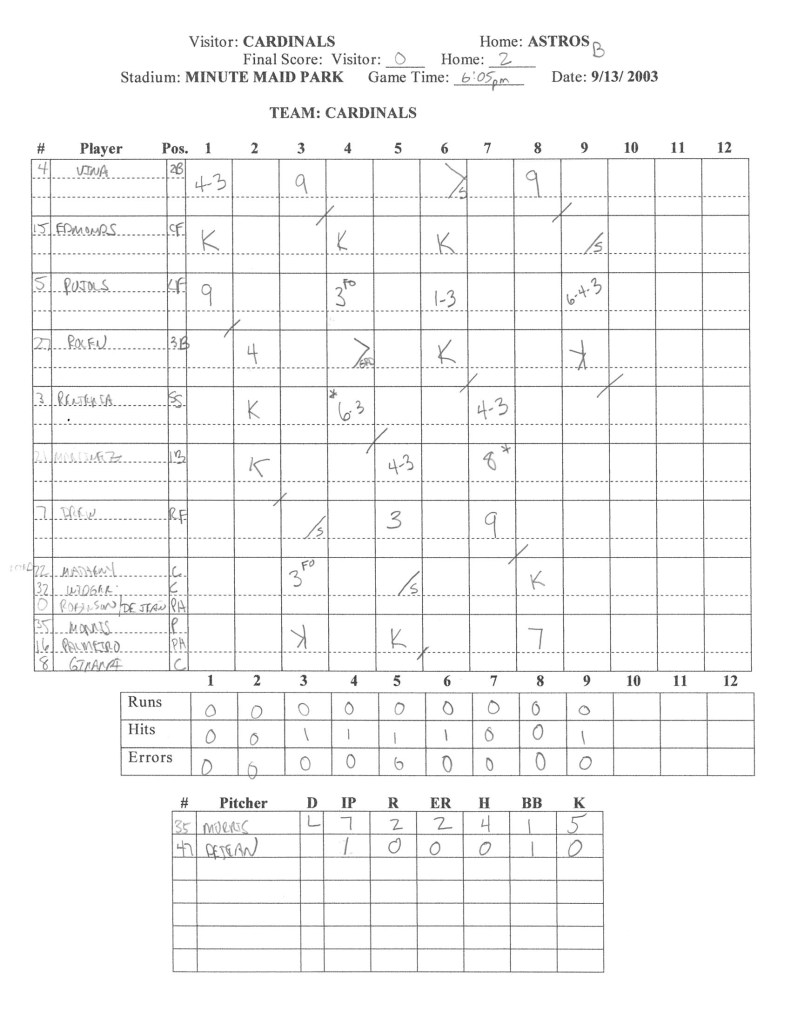
Following the ejections, the Astros scored single runs in the fourth and fifth innings, featuring 1B Jeff Bagwell’s 35th home run of the season. Meanwhile, Houston starter Roy Oswalt kept the Cardinals batters off balance, keeping St Louis scoreless into the late innings.

Being from NJ, my brother and I have accents that were out of place in Texas, and while talking amongst ourselves, we caught the attention of another out-of-towner. A young man a few rows below us recognized our accents, which was surprising until we discovered he was from Connecticut. He was kind enough to ensure that we displayed proper baseball etiquette for games in Texas. We were reminded that booing was considered rude in Houston (though we had no reason to boo), and that we needed to sing “Deep in the Heart of Texas”, clapping when appropriate, during the seventh inning stretch. Finally, when I questioned the meaning of a confusing public announcement, he told me “this is Texas, dumb it down”. Chucking at his retort, I’m not sure anybody else picked up on snarky comment.

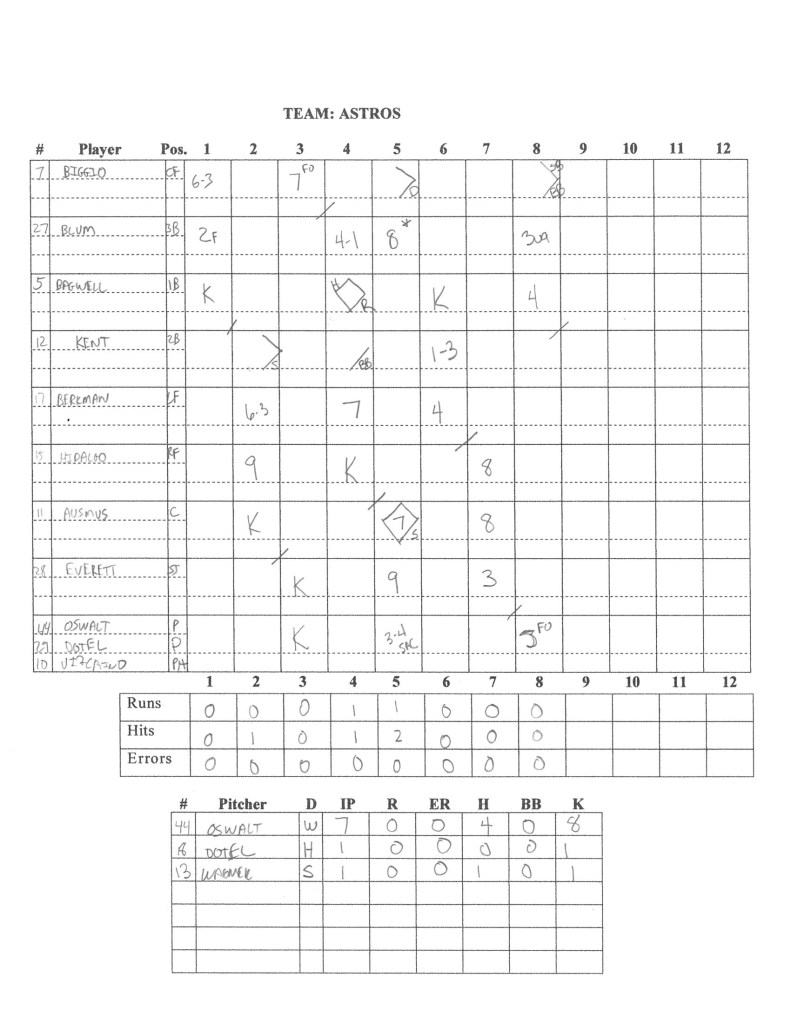
My scorecard from the game.

During the seventh inning stretch, the roof of Minute Maid Park was retracted. As the action on the field continued during the bottom of the seventh, the roof slowly and almost inaudibly moved from left field to right field, taking about 20 minutes to fully retract. The heat and humidity before the game had been replaced by cooler conditions and a light breeze. Like most stadiums with roofs, Minute Maid Park seemed smaller with the roof open, and suddenly the ballpark seemed even cozier. After seven strong innings by Astros starter Roy Oswalt, closer Billy Wagner shut down the venerable St Louis offense in the ninth, nailing down a 2-0 Houston victory.

The briskly paced game took just two hours and six minutes to complete. If the two ejections hadn’t occurred in the third inning, the game would have taken less than two hours, which in our experience is quite a rarity. Most of the more than 42,000 fans had stayed until the end of the game, slowing our exit and giving us some time to reflect on our visit. It was clear that quite a bit of thought went into the layout of Minute Maid Park, complete with nods to the past, as well as amenities common in “newer” MLB parks. Our visit was relatively short, but enjoyable, as we were treated to an outstanding game in an excellent facility.

Our night was not quite over, however. Trying to cut down on the amount of traveling necessary to catch a game at the Ballpark in Arlington the next day, we drove from Houston on our way toward the Dallas Metroplex. Knowing we wouldn’t be able to complete the nearly four hour drive that night, we stopped at a motel just off Interstate 45 North about halfway between the two large Texas cities. Arriving after midnight, we needed to ring a bell for service. A young woman graciously checked us into a room for the night. Behind the desk, we could see a young boy, probably no older than five, jumping around and having fun. Apparently the young woman’s son, she smiled when I mentioned his late night enthusiasm, suggesting that his behavior was typical when she worked overnights.

Kansas City, MO Sunday August 8th 2004

Kauffman Stadium, home of the Kansas City Royals. (Photo credit: Jeff Hayes)

1. Kansas City, Missouri

After breakfast near the hotel in Kansas City, Kansas, we decided to explore downtown Kansas City, Missouri. High cloudiness started to filter the strong early August sunshine, and even though it was still early, we were seeing all the hallmarks of a hot and humid day in the heartland of America.

While researching resources for this blog post, I was HORRIFIED to discover that I could not locate the pictures I took in Kansas City, MO. Somewhere among my many moves, failed hard drives and incomplete backups, I apparently lost irreplaceable memories of our exploration. Unfortunately, a quick description of what we saw cannot replace the images I took.

Our first stop was East Kansas City, in the Vine Street area. Rife with history, it was clear that this portion of Kansas City was in recovery, whose best days were decades before. Unable to locate 12th Street and Vine (made popular in the song Kansas City by Wilbert Harrison), we strolled through this historic section of the city.

A ticket for the Negro Leagues Baseball Museum in Kansas City, MO. (Photo credit: Jeff Hayes)

Along the way, we discovered the Negro Leagues Baseball Museum, located at 1616 East 18th Street. Not knowing precisely what to expect, we found an amazing collection of history and memorabilia chronicling the story of the Negro Leagues from its beginnings into the early 1950s. While we were enthralled by the rich history of the league, by far my favorite display was the wax figures of the Negro Leagues stars arranged on a mock playing field.

Standing next to the life sized wax figures, I realized that the players were smaller in stature than I imagined, yet their presence was definitely larger than life. We spent nearly two hours in the museum, and we could have easily spent two more wandering among history, but the gates at Kauffman Stadium were about to open, so we cut our visit short. If you are even a casual baseball fan, you owe it to yourself for visit the museum if you are in the Kansas City area.


2. Kauffman Stadium

Outside Gate A of Kauffman Stadium, Kansas City, MO. (Photo credit: Jeff Hayes)

Following our visit to East Kansas City, we drove to Kauffman Stadium, home of the Royals. which took about 15 minutes. Kauffman Stadium is co located with Arrowhead Stadium, home of the NFL’s Kansas City Chiefs, as part of the Truman Sports Complex. Both stadiums are surrounded by large parking lots, with hotels and restaurants located beyond the complex. These stadiums were constructed during a time when other cities opted for multi-purpose stadiums, and the baseball-only Kauffman Stadium (commonly referred to as the “K”) opened in 1973.

We arrived at the complex just about as the gates opened at Kauffman Stadium, which gave us ample time to explore our surroundings. Arriving as early as we did, we had our choice of parking spaces, which cost a reasonable $10.00. Hazy sunshine brought with it hot and humid conditions, which limited our exploration to some degree. We first explored the outside of Arrowhead Stadium, which is a football-only facility. Unfortunately, we were much too early in the season to catch a Chiefs game.

Outside Arrowhead Stadium, home of the NFL’s Kansas City Chiefs. (Photo credit: Jeff Hayes)

We next focused our attention on the outside of Kauffman Stadium. Though this was my brother’s first visit to the home of the Royals, I had been here many times before. My employer had a training center in Kansas City, and we were housed at a Holiday Inn just across the street from the complex. Naturally, I visited Kauffman Stadium (which was called Royals Stadium in those days) as often as possible while I was in town. In fact, I first visited the park when it featured an AstroTurf surface, which was replaced by natural grass in 1995.

Though it had been a number of years since I’d attended a game here, it did not appear as though much had changed. Located just outside the park were statues of Royals greats. George Brett (perhaps the greatest Royal of all) crouched in his easily recognizable batting stance greeted fans as they walked up from the immense parking lot. Native son Frank White was also immortalized is stone outside the park.

Royals great George Brett immortalized outside Kauffman Stadium. (Photo credit: Jeff Hayes)

The heat and humidity cut short our tour of the outside of the stadium, so we entered the park through the main entrance behind home plate. Clearing the main concourse, I could see that indeed very little had changed since my last visit. Kauffman Stadium was dignified in its simplicity, eschewing some of the trappings of “newer” MLB parks constructed within the past decade.

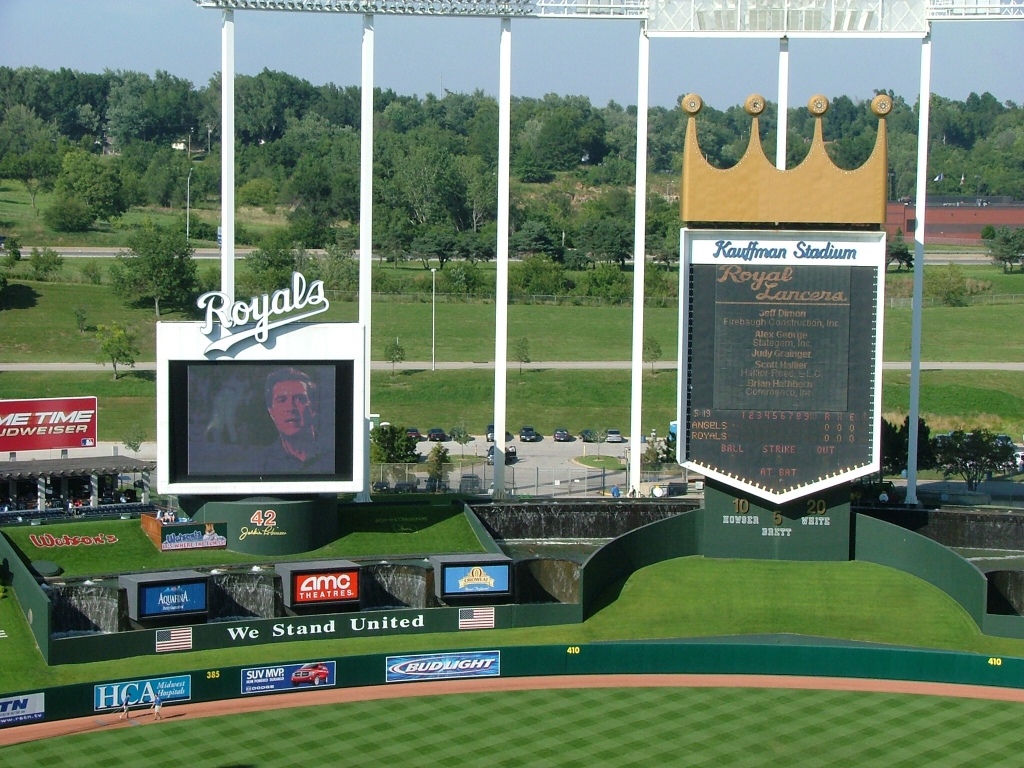
We wandered through the stadium, exploring the lower levels. Unfortunately, the right centerfield section of the park, where the iconic fountains reside (as well as the video and score boards), was not accessible on the concourse. In order to enjoy these sights, we headed back toward home plate. Kauffman Stadium was, compared to some of the newer MLB parks, uncluttered and almost elegant, which I found to be both attractive and refreshing.

A great look at the scoreboard and video board in centerfield at Kauffman Stadium. (Photo credit: Jeff Hayes)

Following our tour of the ballpark, we headed for the main concession stand behind home plate. The heat and humidity had taken a toll on me, and I was in need of hydration. While there many places to get something to eat at Kauffman Stadium, which not surprisingly featured beef and pork products, we chose more standard ballpark fare. With hot dogs, pretzels and drinks in hand, we made our way toward our seats. We were able to secure seats near the top of the lower level, just to the left of home plate.

A ticket from the game. (Photo credit: Jeff Hayes)

Settling into our seats just before game time, we noticed that the crowd for the early evening start was fairly sparse. Perhaps it was the fact that the Royals were not competitive, or that the game time was 610 PM on a Sunday, but Kauffman Stadium was not quite half full by the time the first pitch was thrown. In fact, less than 18,000 fans attended the game, despite the warm and hazy conditions,

The hometown Royals hosted the Anaheim Angels for the final game of the three game set. Both teams were in the midst of disappointing seasons, especially the Royals, who had the second worst record in baseball. Taking the ball for the visiting Angels was right hander John Lackey, who was the workhorse of the Anaheim starting rotation. Starting the Royals was right hander Mike Wood. The 23 year old was struggling through a tough 2004 campaign, with an ERA over 5.00.

The view from our seats. (Photo credit: Jeff Hayes)

Both teams scored in the first inning, and I was beginning to wonder if we were in for a slugfest, given the mediocre starting pitching combined with warm and humid conditions. Each team scored runs in the fifth inning, and what I though might be an offensive outburst had turned into a tight ballgame. Even with the scoring, the nearly pinpoint control of the starting pitchers (who walked only one batter a piece). kept the contest moving at a brisk pace through the first six innings.

During the game, I found my attention captured by the foundations in right centerfield. Dubbed the Water Spectacular, it is the largest privately owned fountain system in the world. Among the fountains are waterfalls and cascades, which keeps the water in nearly continuous motion before and after games, as well as in between innings. Having seen the waterfalls on TV for decades, they seemed more majestic in person, particularly when backlit during night games.

The fountains at Kauffman Stadium, which may be my favorite feature of the ballpark. (Photo credit: Jeff Hayes)

With the Royals ahead 4-3 in the top of the ninth innings, Kansas City brought in right hander Nate Field to nail down the victory. However, Field did not have it this night, surrendering a solo home run to Angels LF Jose Guillen, which tied the score. A combination of Angels hits and Royals errors allows the visitors to tack on two more runs to take a 6-4 lead. Angels closer Francisco Rodriguez (K-Rod) shut the door on the Royals in the bottom of the ninth, striking out two while earning his eighth save of the season.

The scoreboard chronicling the Angels taking the lead in the top of the ninth inning. (Photo credit: Jeff Hayes)

While waiting for the sparse Royals crowd to thin out before leaving, I took one final look at Kauffman Stadium. This park has always been one of my favorites, based primarily on the fact that it was simple yet elegant. Good use of space, the fountains and the unobtrusive scoreboard and video board produced a GREAT place to see a ballgames.

Since we last visited Kauffman Stadium, there have been a LOT of changes, not all of which appear to have improved the experience. Based solely on what I have seen on TV and in pictures, the “K” does not seem to be as appealing as it once was, as ownership seems to believe exchanging simplicity for extra amenities was a good idea. As much as I enjoyed Kansas City and the baseball atmosphere there, I am not sure I am as excited to go back to Kauffman Stadium as I was in the past.

Good night from the “K”. (Photo credit: Jeff Hayes)
My scorecard from the game.