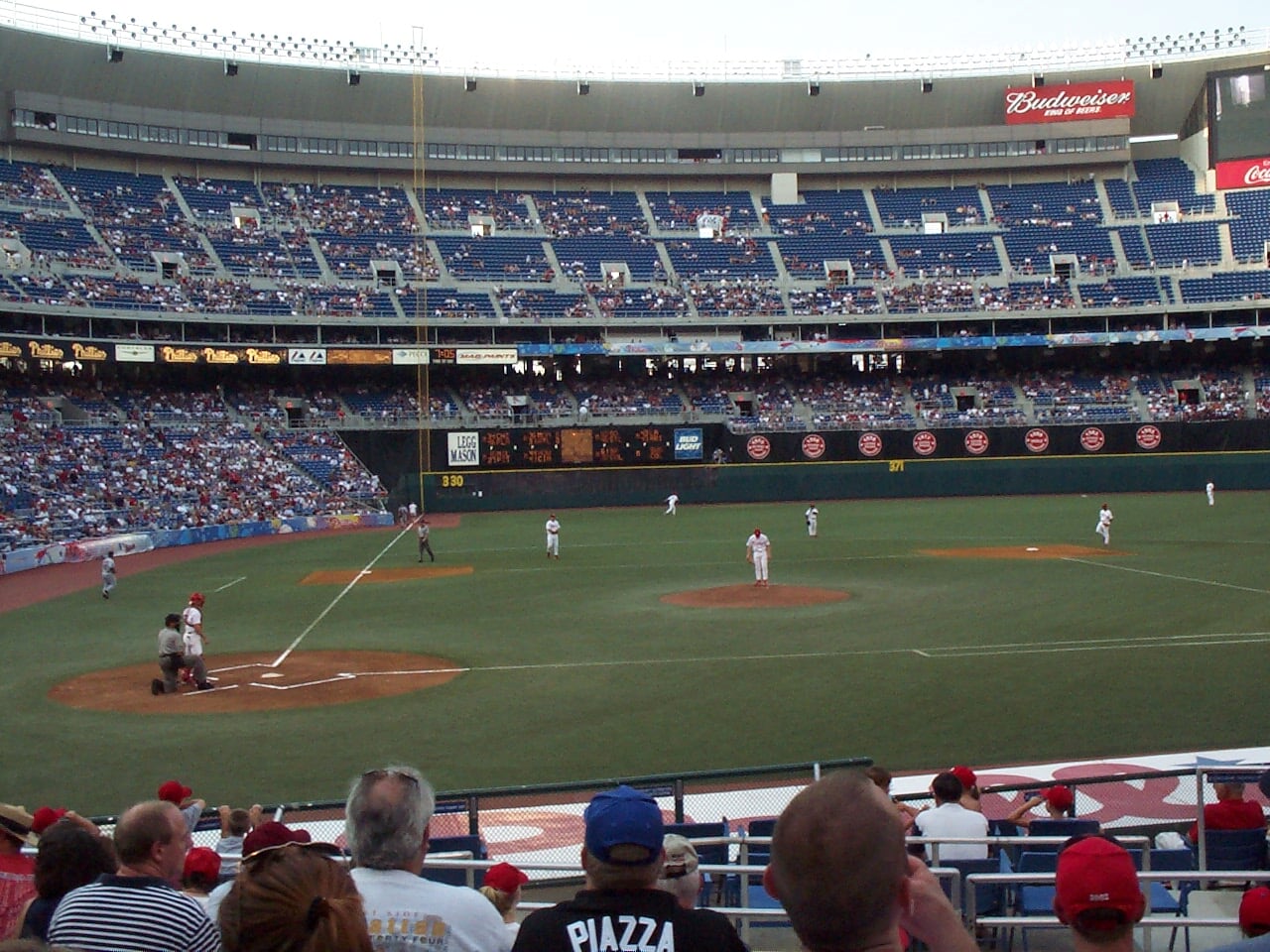
Veterans Stadium/Citizens Bank Park, Philadelphia PA

Veterans Stadium, Philadelphia, PA. (Photo credit: Jeff Hayes)

Veterans Stadium (1987-2003)

  • First visit: exact date unknown; some time in the of spring 1987
  • Last visit: Wednesday July 3rd 2002

From the Jersey shore (where we grew up), Veterans Stadium in Philadelphia, PA was the closest MLB park. However, we did not visit the ballpark until sometime in the spring of 1987. Our first visit came as part of a bus trip from the local high school, as driving to Philadelphia at that point was not an option. During the mid to late 1980s, the Mets teams were competitive, which made getting seats at Shea Stadium was nearly impossible. In order to see the best Mets teams in more than a decade, we had to see them at the Vet (as it was referred to often). Phillies teams during that era were becoming progressively less competitive, which meant good seats for Mets games at the Vet were much easier to obtain.

Veterans Stadium was a multipurpose behemoth, home to the Phillies and the NFL Eagles. Like most multipurpose stadiums of the time (such as Three Rivers Stadium in Pittsburgh PA or Riverfront Stadium in Cincinnati OH), the Vet was an enclosed, multi tiered park with a nearly symmetrical outfield. The Vet held over 56,000 fans for baseball (and over 65,000 for football), with many of the seats for baseball much further away from the action than “newer” MLB parks that followed in the 1990s. There were times, when sitting in the upper deck in centerfield, we would see a ball put in play by the batter, only to hear the crack of the bat a split second later. As a budding scientist, I was intrigued to discover that we were seated so far from home plate that the speed of sound was a consideration while following the action.

The Phiily Phanatic (with his ATV) entertaining fans at Veterans Stadium. Not a big fan of mascots, the Phanatic may have been the best mascot I’ve seen. (Photo credit: Jeff Hayes)

Debuting in 1971, the Vet featured an AstroTurf playing surface (except for the home plate area, cutouts around the bases, and the pitcher’s mound). With a thin artificial surface sitting on a concrete base (for stability), heat radiating from that surface would often exceed 110 degrees F (and sometime approach 125 degrees F) during the hottest part of the summer. In addition, the thin turf provided little protection to players on the field, and long term play on that surface caused many injuries, resulting in the shortening of players’ careers. Why did teams use AstroTurf, even with its obvious shortcomings? Like most things, it was all about the money. Two teams sharing a natural grass playing surface (like Shea Stadium) would put serious stress on both the field and the grounds crew, occasionally resulting in a subpar playing field. An artificial surface eliminated that problem.

Veterans Stadium was a generic park, with an adequate if unspectacular scoreboard and video board. Unlike ballparks that would follow, food and beverages were obtained from concession stands or wandering vendors only, with specialty foods and in-house restaurants gradually appearing toward the end of the Vet’s tenure. As mentioned earlier, there were seats that were fairly distant from the action, and the engineering for optimal fan viewing was not yet available. This meant that fans down each line spent an inordinate amount of time leaning toward home plate, which could become fatiguing. However, Phillies fans were treated to possibly the best mascot in sports, the Philly Phanatic. While I found most team mascots uninteresting, the Phanatic would often push the limits of what mascots should do on the field. Luckily, most players (and at least a few umpires) were in on the joke, and would play along with the Phanatic to entertain the fans.
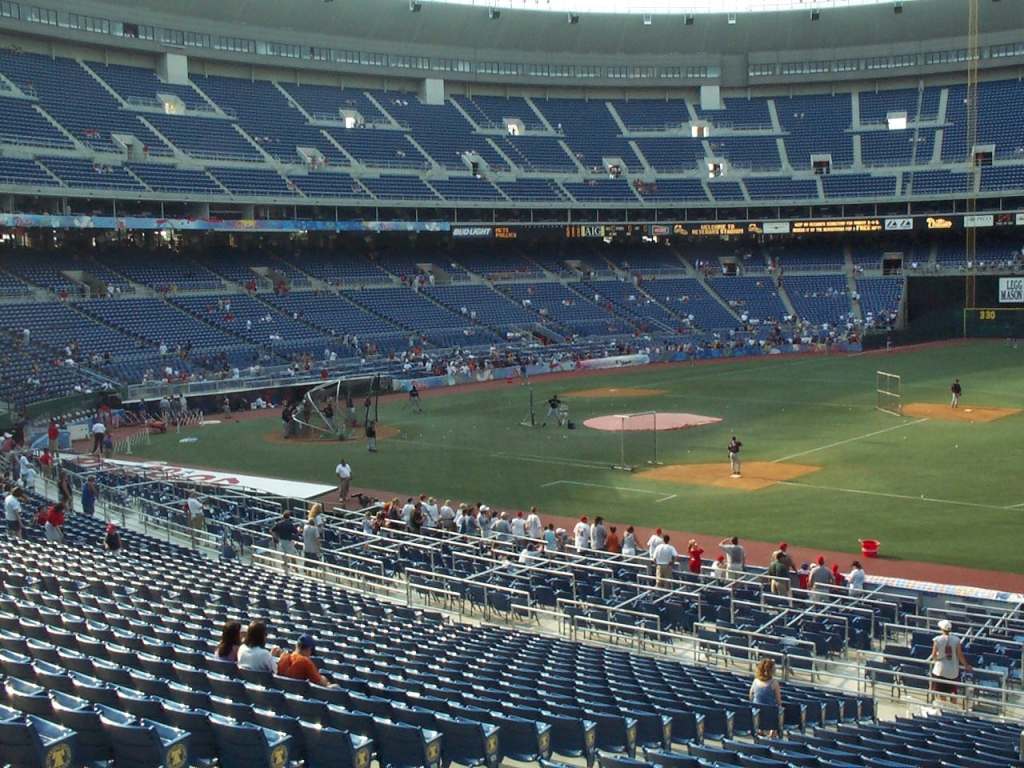
Veterans Stadium during batting practice. (Photo credit: Jeff Hayes)

During our early visits to the Vet, we did NOT have a camera, so most of the information about the stadium comes from personal experience, rather than a digital record. For the most part, Veteran Stadium was a decent place to see a baseball game, though it lacked any sense of intimacy because of its immense size. We did get to see Hall of Fame third baseman Mike Schmidt toward the end of his career, as well as many battles between the Mets and Phillies. We saw Barry Sanders and the Detroit Lions take on the Eagles at the Vet in the early 1990s, and Pink Floyd, the Who and the Rolling Stones between 1989 and 2003. Perhaps the most memorable event we saw at the Vet was when Phillies shortstop Dickie Thon hit a game winning home run against the Mets Don Aase on September 12th 1989. That loss essentially ended the Mets playoff hopes for the 1989 campaign.

A discussion of Veterans Stadium would be incomplete with including details about the courtroom and jail housed within it. If you are not familiar with the sports fans in Philadelphia, they can be a raucous bunch, especially when alcohol is involved. Philadelphia fans have booed Santa Claus and the Easter Bunny, and have been known to be ruthless to visiting and home players alike. Through personal experience, we learned NOT to identify ourselves as fans of the visiting team, lest we incur the wrath of the hometown fanatics. Fan misbehavior became so frequent that Philadelphia County officials found it necessary to place holding cells and a courtroom within the stadium. Individuals committing offenses would be held in the jail cell, awaiting arraignment and adjudication of their misdeeds.
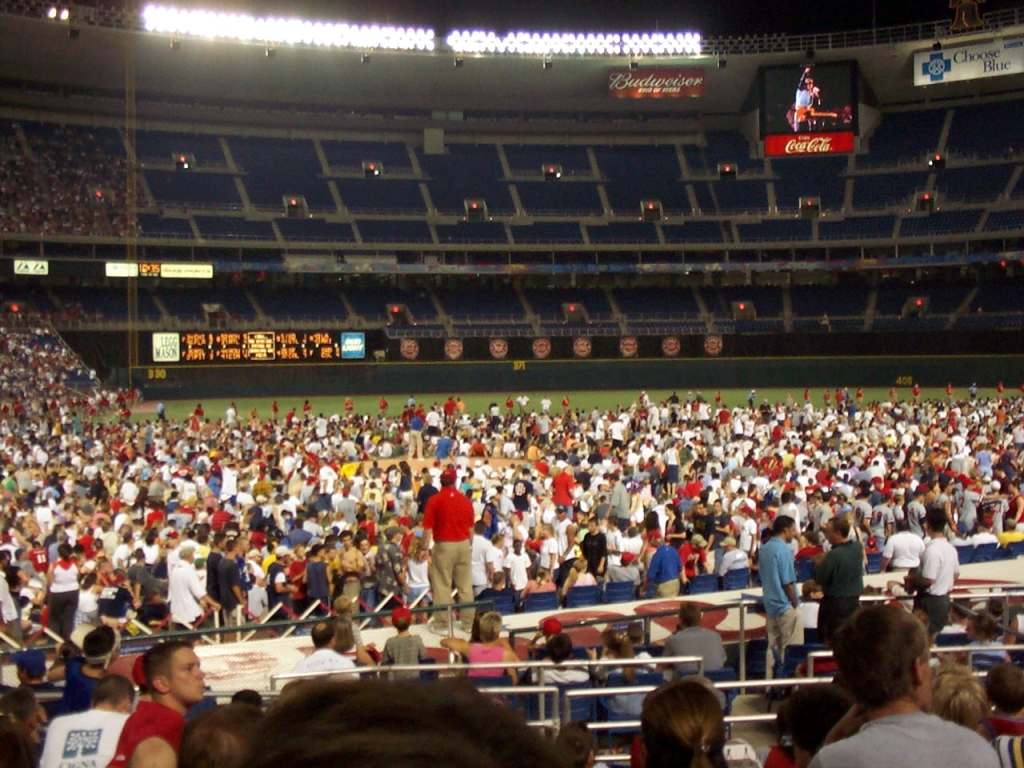
Fans were permitted on the field for a fireworks display in 2002. (Photo credit: Jeff Hayes)

Perhaps the worst aspect of Veterans Stadium was parking and traffic after the game. While there was more than enough parking for the stadium around the Vet, at times finding acceptable parking was difficult. The neighborhood surrounding the park was sketchy in places, and returning to that spot after a night game had to be considered when choosing where to leave your vehicle. We never had a problem with parking, but it would not be a stretch of the imagination to believe that safety could be a concern. Once the game was over, it always felt like you were on your own exiting the area. In the early days, police did NOT direct traffic after games, and leaving became a test of wills. It was not unusual to wait more than an hour in traffic at the Vet after a game before you could get on one of the many highways out of the region. In later years, the police did direct traffic after games, and the process of leaving became much more palatable.

Veterans Stadium, like other multipurpose facilities of the time, was an acceptable place to see a ballgame, but by no means a fan friendly environment. After the completion of Citizens Bank Park, Veterans Stadium met an ignominious end, as it was imploded (on live local TV) March 21st, 2004. We frequented the Vet as often as we did because it was easier to see the Mets in Philadelphia than Queens NY. Unlike Shea Stadium, I do not miss the Vet.
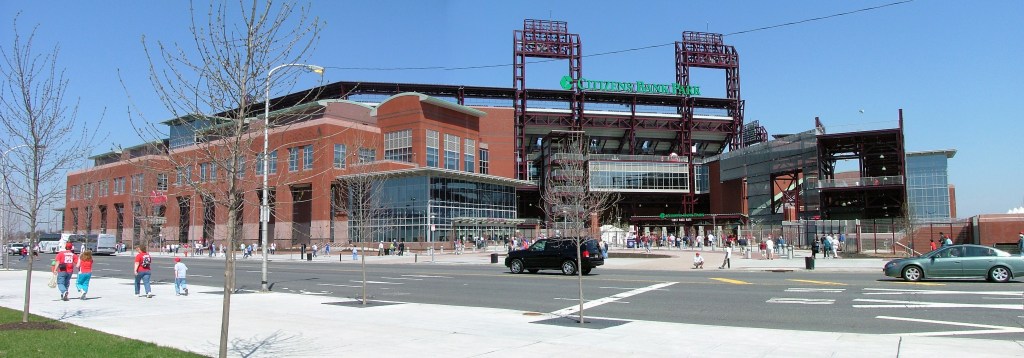

A panorama from Citizen Bank Park in 2004. (Photo credit: Jeff Hayes)

Citizens Bank Park (2004-2019)

  • First visit: Saturday April 17th 2004
  • Most recent visit: Saturday August 31st 2019

Philadelphia authorized the construction of separate stadiums for baseball and football in the late 1990s, a significant departure from previous policy concerning spending tax dollars on ballparks. Originally slated to be constructed in downtown Philadelphia (like other new MLB ballparks during this time), protests from residents of the Chinatown section of Center City ultimately resulted in the new baseball stadium being located near the site of Veterans Stadium in South Philadelphia. Ground was broken for Citizens Bank Park (the future home for the Phillies) in June of 2001, and during our visits to the Vet, we would check on the progress of the new ballpark.
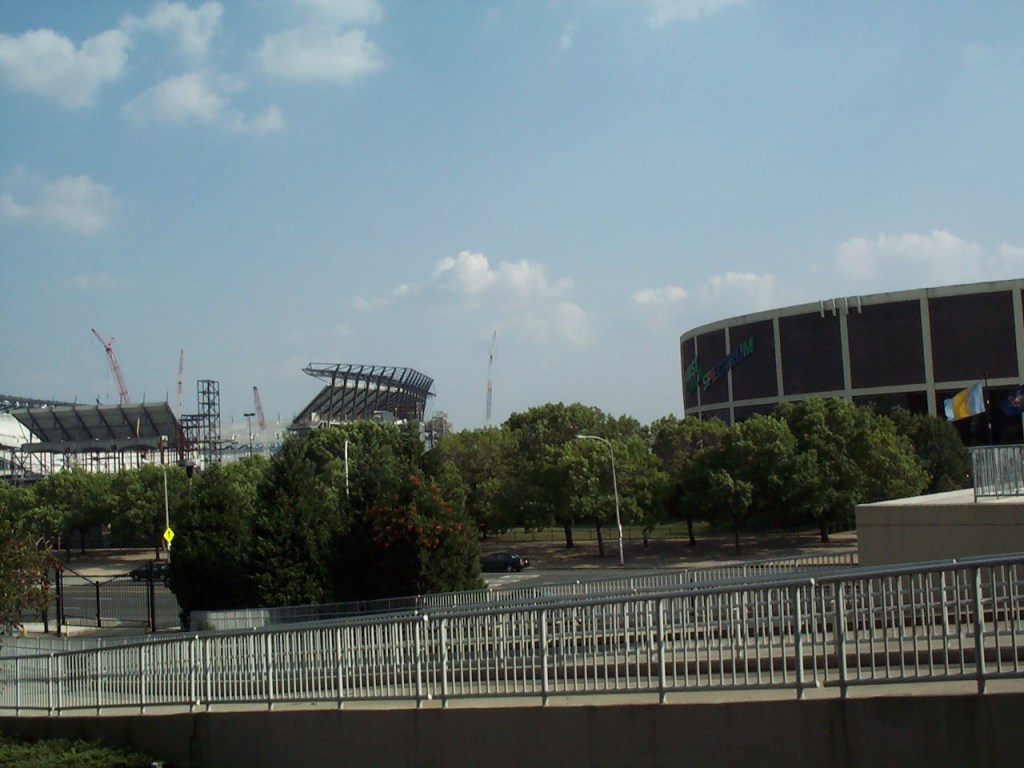
A view of the new ballpark under construction near the site of Veterans Stadium and the Spectrum. (Photo credit: Jeff Hayes)

Citizens Bank Park opened its doors on April 3rd 2004, and we our first visit occurred a scant two weeks later on Saturday April 17th, as the hometown Phillies hosted Montreal (in their last season as the Expos). There was not much to see outside of the stadium quite yet, so after a cursory look around, we entered the ballpark through the home plate entrance.

Upon entering, we could immediately see that Citizens Bank Park was a vast improvement on its predecessor. Instead of a behemoth, the ballpark was smaller and more intimate, clearly designed with the baseball fan experience in mind. A wide open centerfield offered a glimpse of Center City Philadelphia, though a very unfortunately placed advertisement sign ruins the view to some degree. A three tiered seating area stretches from left field foul pole into right field, where an auxiliary scoreboard spans the length of the lower deck. Beyond the foul pole in left field was a detached bleacher section, with a very impressive videoboard above it. Obviously constructed as a signature of the newly minted ballpark, it doubles as a scoreboard, filled with any stat a diehard baseball fan could imagine.
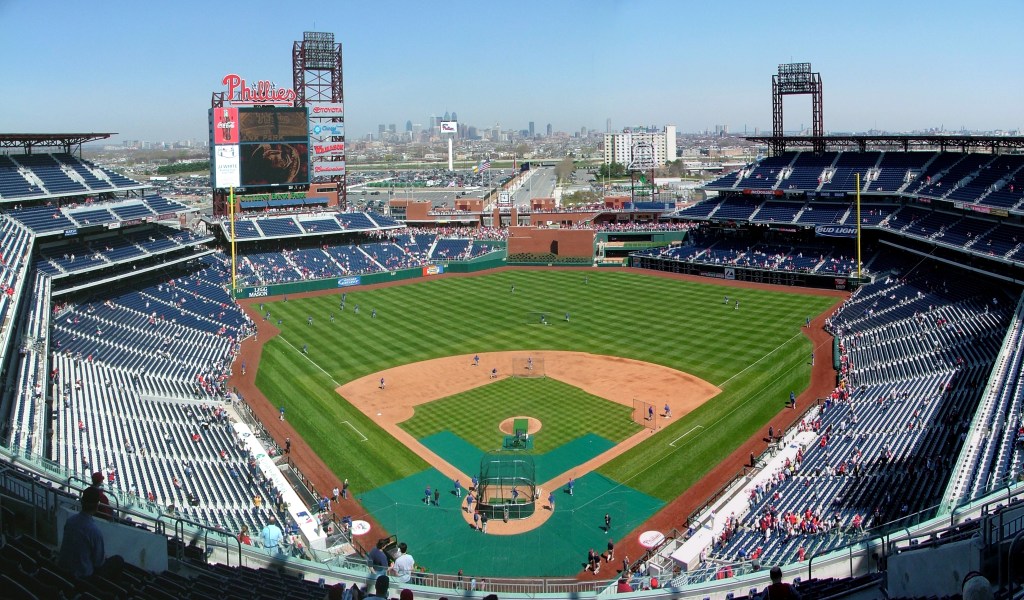
Panorama of Citizen Bank Park from the upper deck behind home plate. Note the sign blocking a portion of the view of Center City Philadelphia. (Photo credit: Jeff Hayes)

After drinking in the new park (and its natural grass playing field, a welcome departure from the Vet), we walked along the concourse, which encircled the playing field. Lined with places to eat and shops with Phillies merchandise, the lower concourse snaked through the rear of the lower level into centerfield. From this vantage point, we got a good view of the bullpens. Arranged vertically, the Phillies bullpen, originally placed on the top, was subsequently moved to the lower level, in part to reduce the amount of heckling from rowdy Phillies fans (this is Philadelphia, after all).

Citizens Bank Parks’ bullpens in centerfield, with the visitors bullpen on top and the hometown pen on the field level. (Photo credit: Jeff Hayes)

Next to the bullpens was the batter’s eye in centerfield. Adorned with shrubbery amid a small field of grass, the batter’s eye featured a brick wall that was slowly being consumed by an ever expanding area of ivy. One of the quirks of Citizens Bank Park, “The Angle”, was located on the left side of the batter’s eye. It marked the deepest part of the park, a nod to the “imperfections” of ballparks from the past. Moving toward the left field foul pole, we encountered the Phillies Baseball Walk of Fame. Nearly three dozen plaques arranged on the wall paid homage to Phillies greats, labeled as the Phillies Centennial Team.
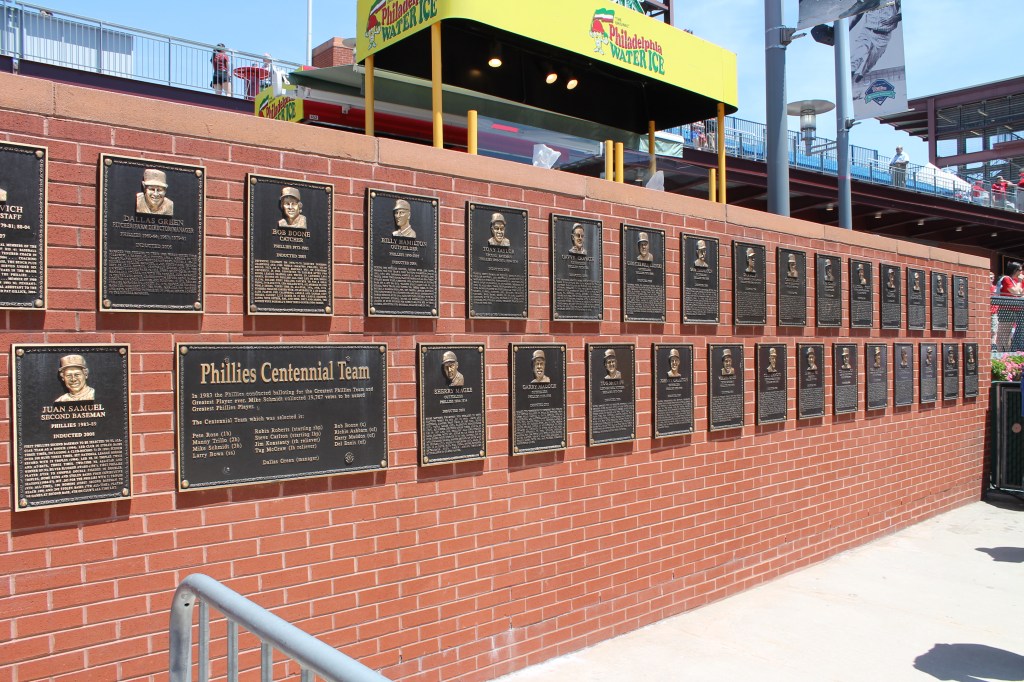
Phillies Baseball Walk of Fame at Citizens Bank Park. (Photo credit: Jeff Hayes)

Finding our seats for our first visit to the new ballpark, I couldn’t help but feel as though the Phillies organization “got it right”. Following the template forged by Oriole Park at Camden Yards, the Citizens Bank Park gave fans a much better experience, bringing them closer to the action than ever before. The open air feel to the stadium, as well as clean sight lines, made for a truly enjoyable visit. Unlike Veterans Stadium, there were myriad places to eat, with many restaurants offering virtually anything you could want to eat or drink at the ballgame.

Making a nearly clean break from the past, I did not see anything brought over the the new ballpark from the Vet, save for the Liberty Bell located outside of the stadium. However, this IS still Philadelphia, and unfortunately, unruly fans did make the trek from the old stadium to the new one. In fact, we experienced our most harrowing fan interaction at Citizens Bank Park, when a group of Phillies fans engulfed us, preventing us from exiting our seats until the remainder of the fans in that section left. Being outnumbered, we had little choice but to capitulate, reminding us that this place was NOT safe for fans of visiting teams.
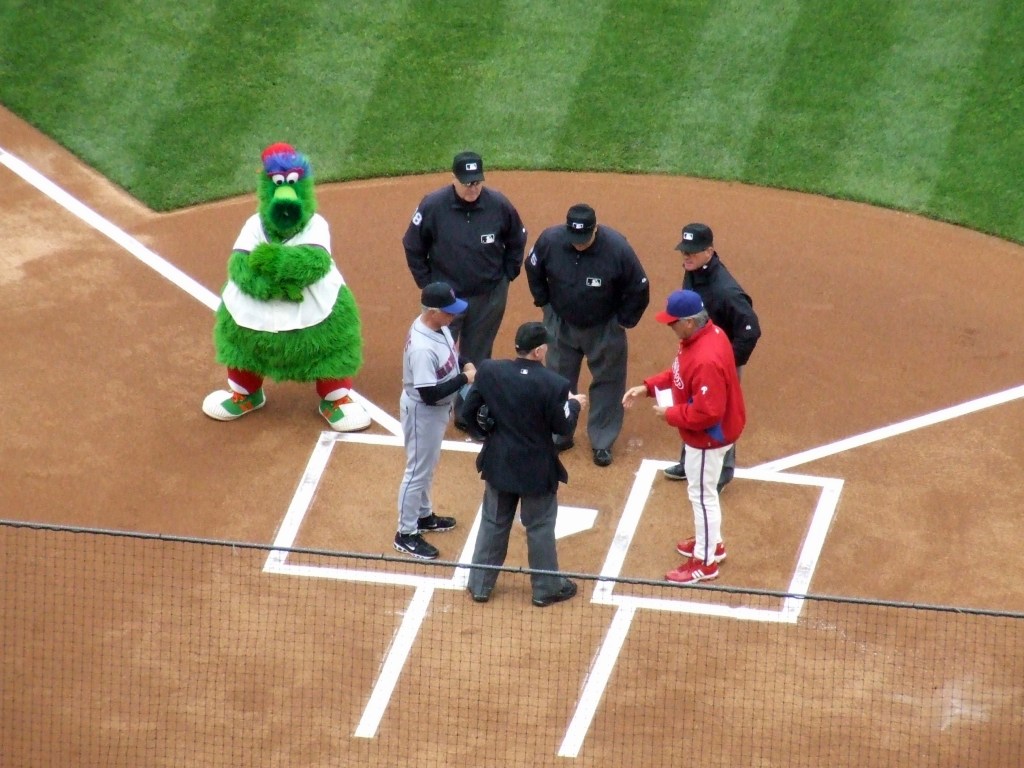
The Philly Phanatic overseeing the exchange of lineup cards at Citizens Bank Park on April 30th, 2011. (Photo credit: Jeff Hayes)

Other than the less than affable Philly crowds, the only aspect of Citizens Bank Park I did not like was the small outfield dimensions. Unlike the Vet, which was cavernous, this ballpark was a “band box”, which promoted home runs. Had Mike Schmidt played in this smaller park his entire career, he might have approached Hank Aaron’s career home run record. Though home runs are appealing to most fans, from my perspective, more home runs make them less exciting.

Being much closer to central NJ than Shea Stadium (and later Citi Field), Citizens Bank Park was our first choice to see New York Mets games, even if they were the visiting team. Other than some forced quirks designed to introduce some character to the stadium, and the raucous fan base, the ballpark offers a first rate facility for baseball, and we visit as often as time and circumstance dictate.
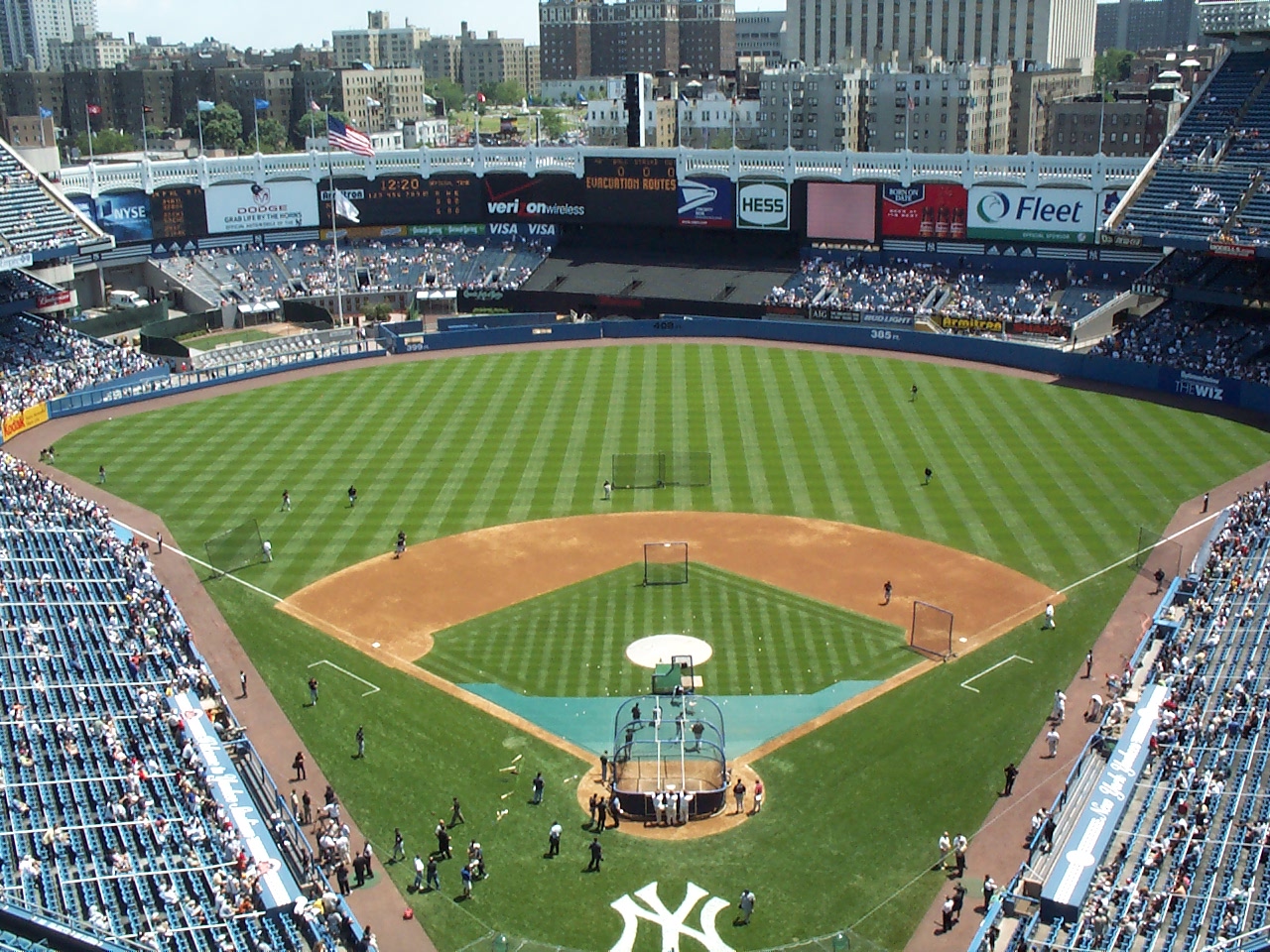
Yankee Stadium, Bronx NY

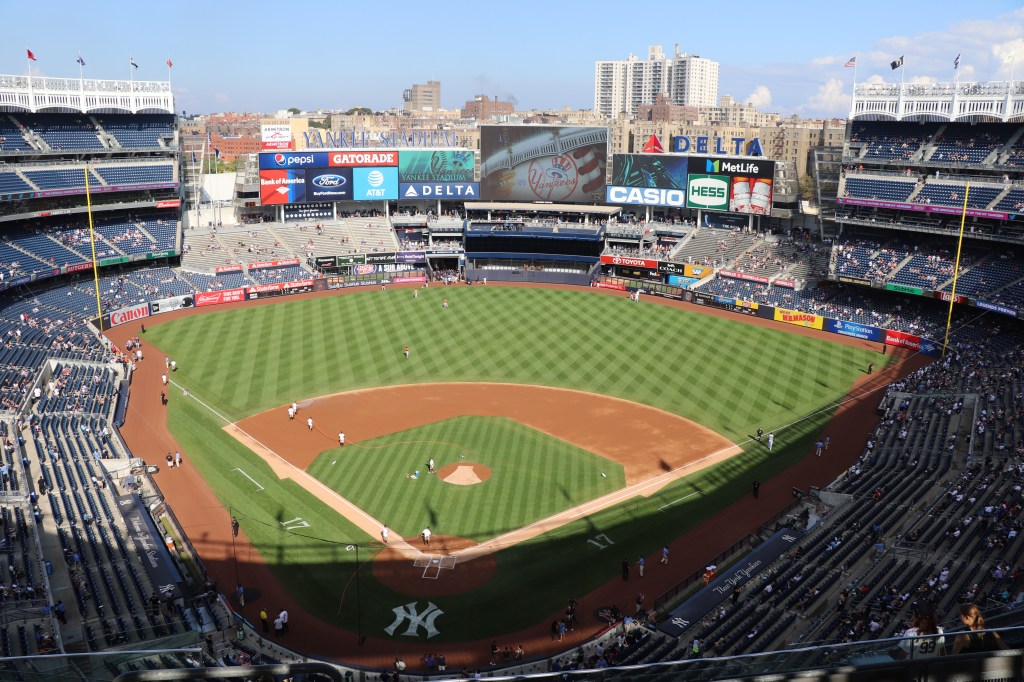
Yankee Stadium from the upper deck behind home plate. (Photo credit: Jeff Hayes)
  • First visit: Saturday September 9th 1995
  • Most recent visit: Saturday September 16 2017

Our first visit to Yankee Stadium took place on September 9th 1995, as the Yankees hosted the Boston Red Sox for a matinee contest. This visit was to the “second” Yankee Stadium, as the original configuration was renovated significantly in 1974 and 1975 (during which time the Yankees played at Shea Stadium, the home of the New York Mets). While still in the same physical location as the original “House That Ruth Built”, the renovations modernized the ballpark. Unfortunately, I did not have the opportunity to visit the “old” Yankee Stadium.

Much like Shea Stadium in Queens, Yankee Stadium, located in the Bronx, is not easy to access coming from central NJ. Driving to the stadium was not deemed an option, as parking was limited and expensive, and exiting the region after the game was a nightmare. Instead, we chose to drive into Manhattan, park at the Javits Center parking lot, and hop on the C subway train to the ballpark (which took about 30 minutes). Without much to see in the immediate vicinity of the park, we entered the ballpark from the gate behind home plate.

The view from our seats at Yankee Stadium in 2004. (Photo credit: Jeff Hayes)

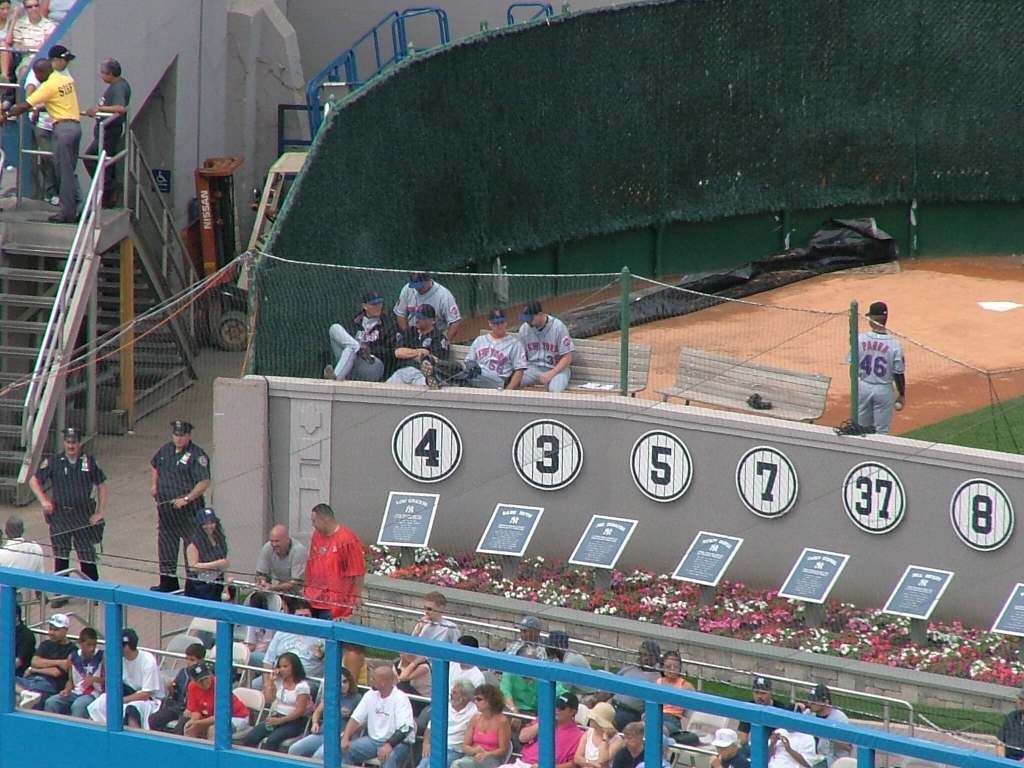
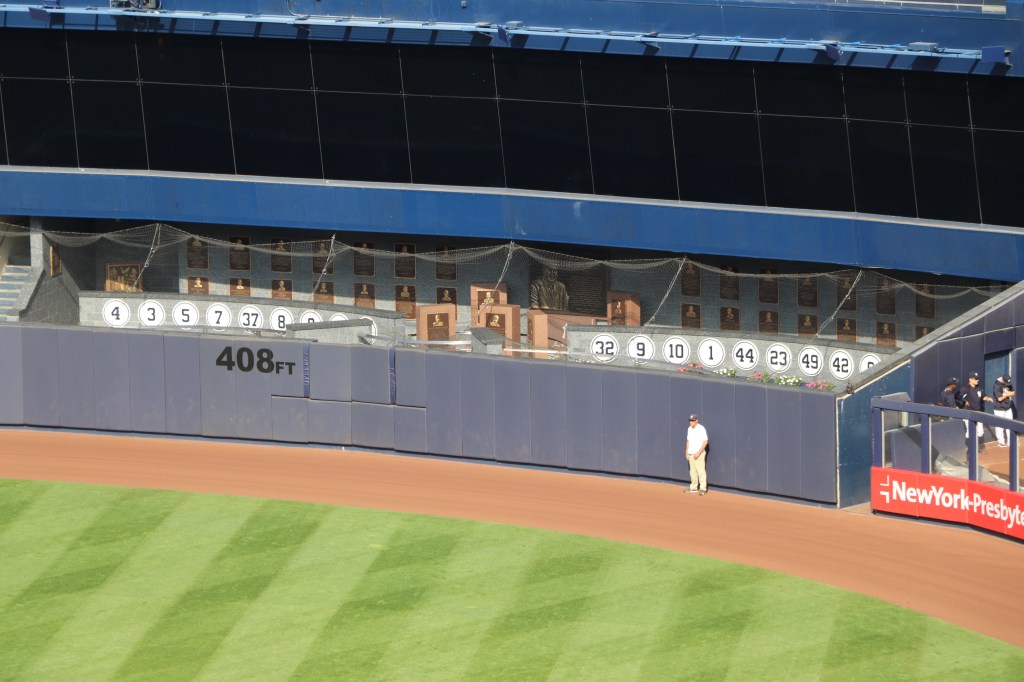
Crossing from the darkness of the tunnel to the light of Yankee Stadium, it was instantly clear that we had entered a baseball cathedral. Seemingly immense in size, many of the landmarks I had seen on TV came within view. By this time, the outfield walls had been brought in considerably, especially in centerfield. Monument Park (an outdoor museum containing plaques and busts of Yankee greats), which was once in the playing field at the stadium, was adjacent to the visiting bullpen beyond the left centerfield wall. Bleachers in left center and right field bracketed the batter’s eye in centerfield. Dubbed the “bleacher creatures”, fans in the right field bleachers at Yankee Stadium had a reputation for occasional vulgar behavior (which rattled opposing right fielders), as well as tossing D batteries at visiting players.

Perhaps the best known landmark in this hallowed ballpark was the white façade stretching atop the bleachers. Made originally of copper (which would occasionally turn green as the copper became exposed to the air), it was scrapped during the renovation in the mid 1970s, replaced by a concrete version which was in place when we visited. Even though we were not Yankees fans by any means, we could help not being overwhelmed by the air of history within this place. It is mind boggling how many Hall of Famers called Yankee Stadium home, and how many championships were won in this park.

A look at a portion of Monument Park at Yankee Stadium from the right field upper deck seats. (Photo credit: Jeff Hayes)

During 1995, the Yankees were emerging from a decade long slumber during which time they did not appear in the playoffs. As the team improved with rising young stars interspersed with veterans, the attendance at Yankee Stadium rebounded. Because of this, we were often relegated to upper deck seats, particularly when the Red Sox (and later the crosstown Mets) were in town. We were surprised by how steep the seating area was in the upper deck, and there were times when I felt uncomfortable walking up and down the seemingly harrowing concrete stairs. Though it did not happen to us, I could see other battling vertigo when trying to navigate the upper deck at Yankee Stadium.

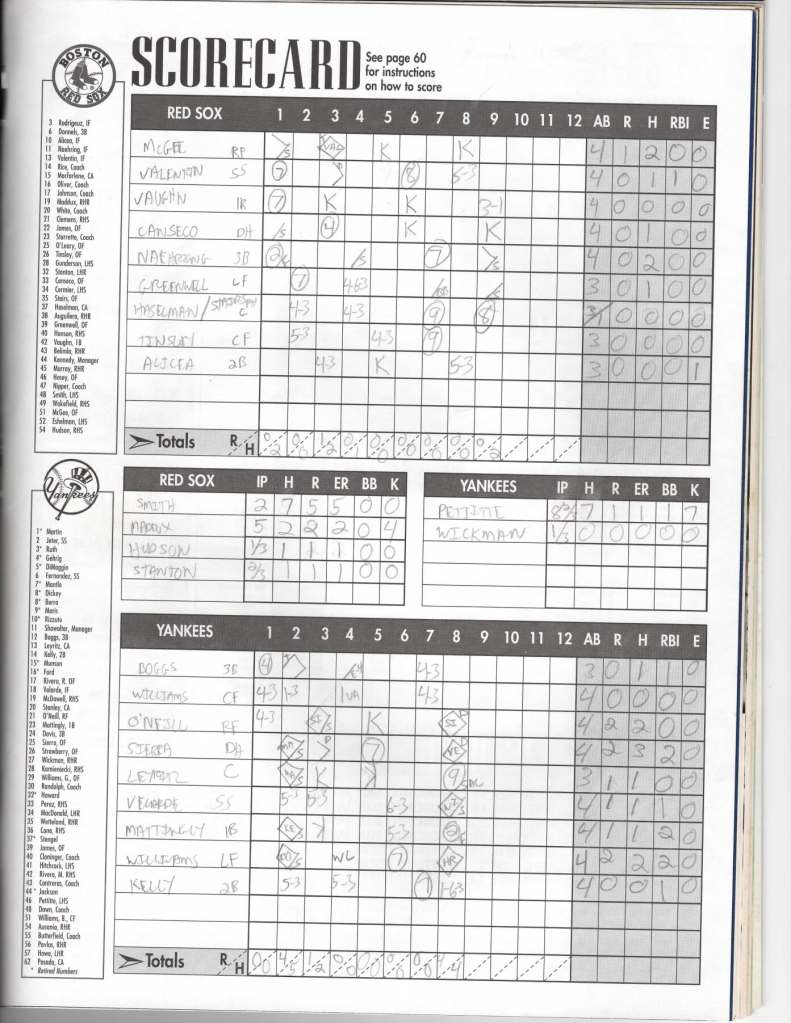
Luckily for us, we were able to catch a game during the final season of the Yankees captain, Don Mattingly. By this time, a degenerative spinal condition had eroded his once considerable skills, and during this visit to Yankee Stadium, Mattingly played first base and batted seventh. On this day, the Yankees defeated the Red Sox 9-1, with rookie lefthander Andy Pettitte securing the victory with 8 2/3 inning of one run ball. Some of the pieces in place that day would comprise the penultimate dynasty of the 1990s.

My scorecard for the game.

Visits to Yankee Stadium for the next decade or so were infrequent, usually scheduled when the Yankees hosted the Mets. We DID try to get tickets to the Subway Series in 2000, but not surprisingly tickets were scarce, and at that time, prohibitively expensive from resale vendors. After that time, the Yankees were perpetual contenders, as the Mets slid downhill for a few years. That downturn for the Mets made it somewhat easier to secure tickets at the stadium, though generally in the upper deck. One of my most vivid memories of Yankee Stadium occurred in 2002, when the Mets Roger Cedeno completed a straight steal of home plate (an exceedingly rare baseball event).

Fortunately for us, our upper deck seats (just to the left of home plate) gave us a fantastic view of the action. Taking a large lead off third base, Cedeno made a mad dash for the plate. Not sure of what I was seeing, I asked my brother what he was doing; it was, after all, the first straight steal of home I had seen in person. Though the Mets fortunes against the Yankees were generally disappointing, they did allow us to see Hall of Famers in pinstripes through 2008, including Derek Jeter and Wade Boggs, as well as players on the outside looking in, such as Roger Clemens and Alex Rodriquez. No matter what you may think of the last two players, Yankee Stadium was a great place to see these premiere athletes compete.

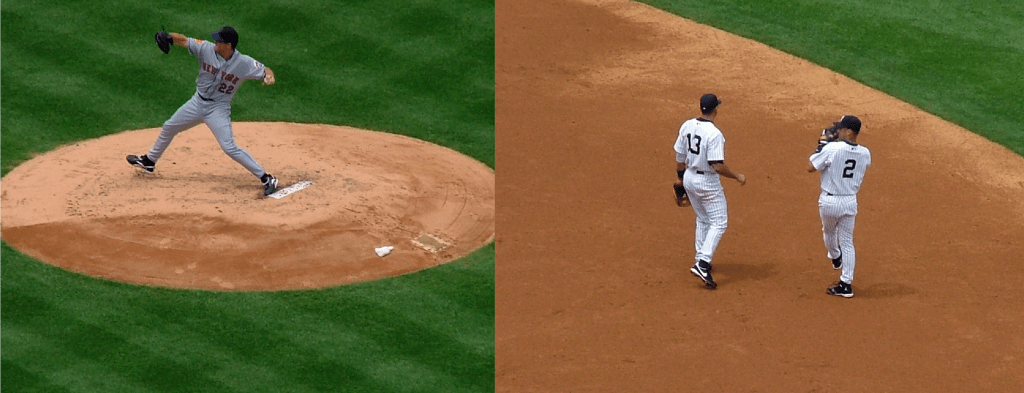
Actions shots of Yankee Stadium during series with the Mets. On the left, Mets left hander Al Leiter delivers a pitch, and on the right, Derek Jeter (2) and Alex Rodriquez (13) interact after a play. (Photo credit: Jeff Hayes)

The “new” Yankee Stadium – September 16, 2017

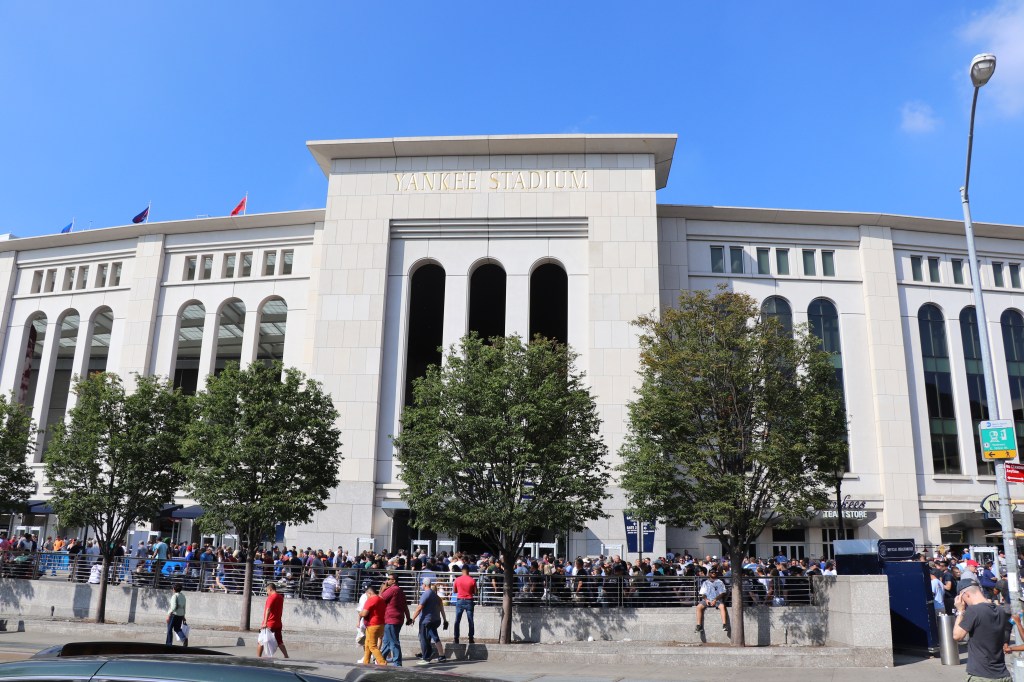
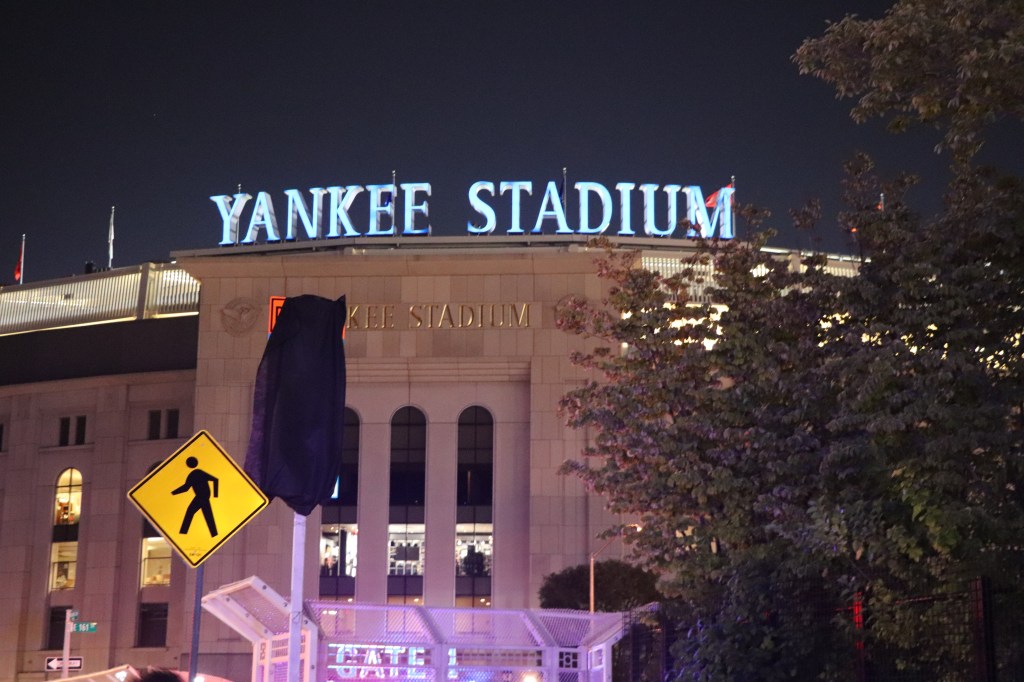
The view of the “new” Yankee Stadium from just behind the home plate entrance. (Photo credit: Jeff Hayes)

Ground was broken for the “new” Yankee Stadium just across the street from the second incarnation of the “old” Yankee Stadium in 2006. Completed in time for the beginning of the 2009 season, the latest version of Yankee Stadium looked and felt like its predecessor. Much of the design was inspired by the original stadium, with Monument Park making the trip to the new park. After demolition of the old ballpark, the space was turned into parkland named Heritage Field.

Rather than transport the façade from the old stadium, new facade was crafted from steel instead of concrete for the new ballpark. The high definition video board in centerfield was the third largest in the world when it debuted, providing nearly twice the area of the video board in the old stadium. With fan comfort in mind, the stadium was laid out like a bowl, which made the seating more accessible, eliminating the nearly vertigo inducing steepness of the upper deck of its predecessor. Approximately 1300 pictures from various sources are scattered throughout the stadium. Dubbed “The Glory of the Yankees Photo Collection”, Yankee players and moments from the teams fabled past were featured in the photos.

The “new” Yankee Stadium from the upper deck behind home plate. Note the white steel facade adorning the upper deck in left and right field. (Photo credit: Jeff Hayes)

All of the amenities of the new stadium were well done, creating an atmosphere similar to the old ballpark, updated for the 21st century. However, there was one huge step backward (in my opinion) with the new ballpark. In an obvious attempt to generate scoring, the outfield dimensions are smaller than the “old” stadium, giving the park the feel of a “bandbox” (a term denoting a ballpark that favored home runs). While the left and right field lines in the older versions of Yankee Stadium were (relatively) short, the remainder of the park was large enough to deter “cheap” home runs. Having the bleachers extending into left center and right center does enhance the fan experience (placing them closer to the action), but it also seems to invite more home runs. While this is typical of many “newer” MLB parks, in my opinion these changes were implemented chiefly to facilitate home runs.

The transported Monument Park in its new home in centerfield. (Photo credit: Jeff Hayes)

During our pre game tour of the new Yankee Stadium, it was clear that the organization delivered a significant upgrade to the old stadium, with this version feeling much cozier (with the capacity right around 50,000). Gone was the history of the old stadium, but the newer facilities afforded a better overall fan experience, including myriad places to eat scattered across the stadium. With the Yankees on their way to yet another playoff berth, there was large crowd in attendance to see the late Saturday afternoon contest against the Baltimore Orioles.

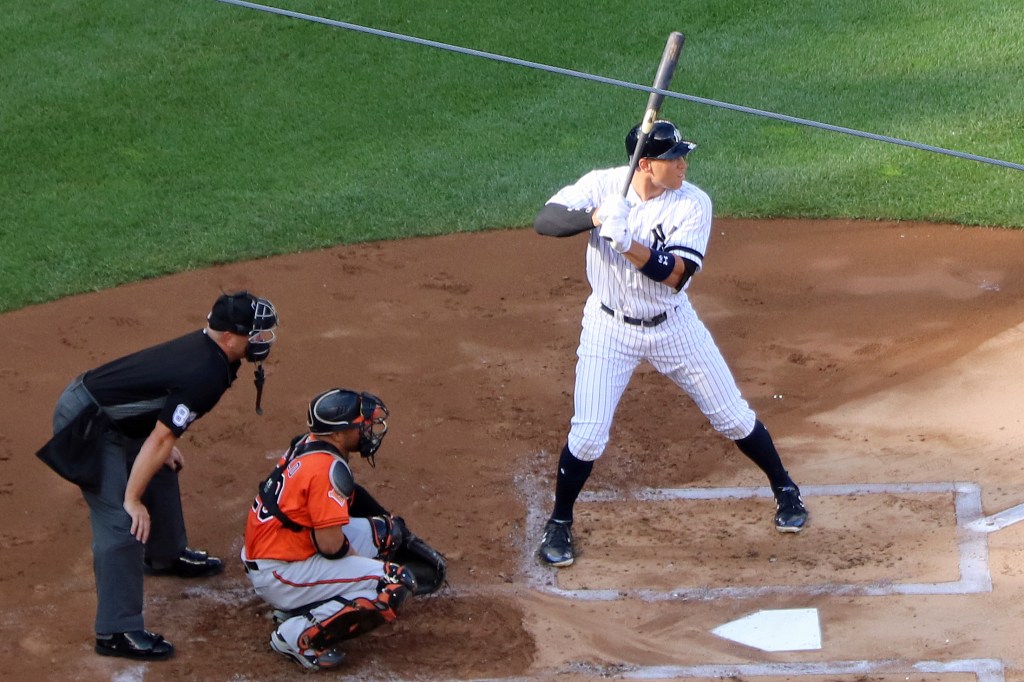
On this clear and seasonably warm afternoon, the hometown Yankees sent left hander Jordan Montgomery to the hill to face the young Orioles lineup. Montgomery, a prized pitching prospect, was finishing a very effective rookie season. Baltimore sent veteran right hander Jeremy Hellickson to the mound to face the potent Yankee offense, which featured right fielder Aaron Judge. Judge was putting the finishing touches on a record setting rookie campaign, which would earn him AL Rookie of the Year honors. Shadows were a factor early in the game, due primarily to the 410 PM start (presumably to accommodate the Fox broadcast).

Yankee right fielder Aaron Judge in the batter’s box at Yankee Stadium. (Photo credit: Jeff Hayes)

Once the shadows crept beyond home plate and the pitcher’s mound, New York used the long ball to score seven runs through the first five innings. Meanwhile, Yankee starter Jordan Montgomery consistently mowed down the Baltimore lineup. Montgomery left after six innings’ work, surrendering no runs on just four hits, while striking out six. His counterpart, Orioles starter Jeremey Hellickison, lasted a scant three innings, allowing six runs during his time of the mound. A trio of Baltimore relievers allowed three runs in mop up work, as the Yankees took a commanding 9-0 lead.

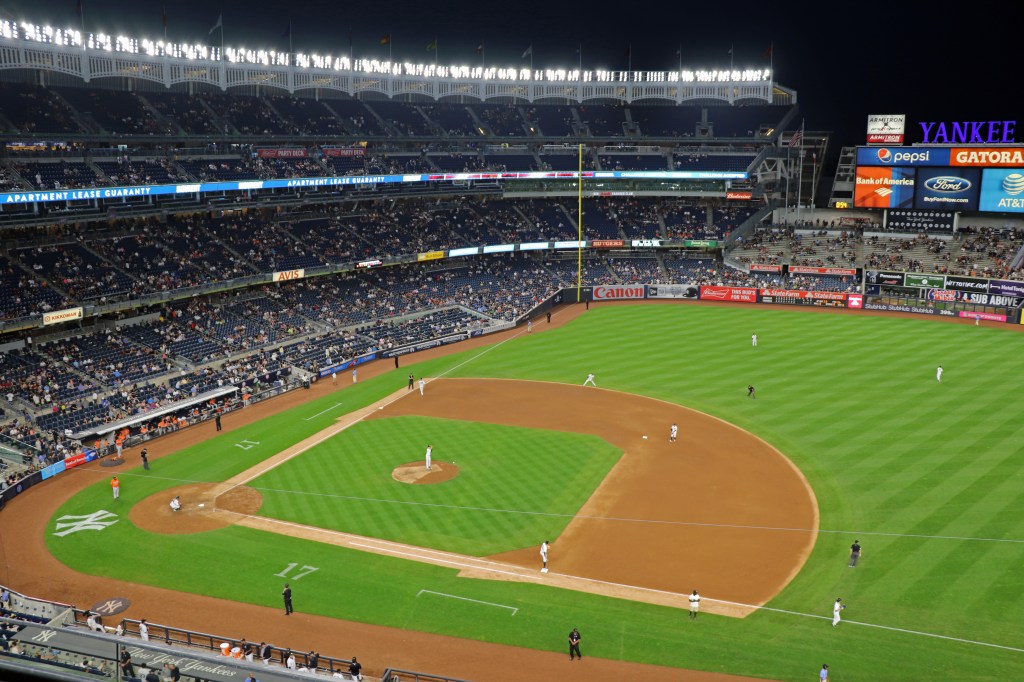
Despite the scoring, the pace of the game was comparatively quick, which left us little time to enjoy the atmosphere of the new ballpark. As late afternoon blended into early evening, Yankee Stadium took on a different hue. The ballpark appeared to soften under the lights, revealing that the once swelling crowd had diminished to a smattering of remaining faithful, with the game well in hand for the Bombers.

The view from our seats as night fell at Yankee Stadium. After the New Yok offensive outburst, the crowd thinned out considerably in the later innings. (Photo credit: Jeff Hayes)

Entering the ninth inning, Yankee pitching held the young but improving Baltimore lineup in check. However, the Orioles did not go quietly, scoring three runs on a lead off home run by CF Austin Hays, followed by a series of walks, punctuated by a balk that allowed a run. Left hander Chasen Shreve, who had been enjoying a successful 2017 season as a bullpen stalwart, lost his command, giving up four walks before exiting the game. Those that remained for the top of the ninth became frustrated, audibly moaning and screaming after each walk. Finally, Yankee fans were treated a merciful end to the top of the ninth, as New York claimed a 9-3 victory. As quickly the first part of the game passed, the last three innings were that slow, with the ninth inning requiring nearly 30 minutes to complete.

In total, the game time was in excess of three and one-half hours, leaving just a few thousand fans to file out of Yankee Stadium into the streets around it. As we exited, I reflected on the new stadium. Overall, we were impressed by the stadium, (minus the smaller dimensions than its predecessor), as the organization successfully recreated the feel of Yankee Stadium, while updating it to make the ballpark more modern. Being in just about the same location as the old ballpark, it remains difficult to access from central NJ, so even though we enjoyed the atmosphere, I am not sure how often we will visit in the future.

Goodnight from the “new” Yankee Stadium! (Photo credit: Jeff Hayes)

St Louis MO, Saturday August 7th 2004

Busch Stadium, St Louis MO. Note the cranes in the background, aiding in the construction of the “new” Busch Stadium. (Photo credit: Jeff Hayes)

1 Newark NJ to St Louis MO

Our first baseball trip of 2004 took us to Missouri, the Show Me state, to see games in St Louis and Kansas City. Since this was planned as a weekend trip, there was insufficient time to drive from NJ to MO, and we chose to fly instead. In order to catch the first pitch in St Louis at 1220 pm CDT, we needed to fly out of Newark NJ early Saturday morning.

A cold front had just passed Newark as our flight to St Louis started, so we experienced short bursts of intense turbulence as we climbed toward 10,000 feet. Once we reached cruising altitude, the turbulence subsided, but not before my stomach informed me that breakfast during the flight was probably not a good idea.

We chose to fly Midwest Airlines, a now defunct airline that featured spacious leather seats and complimentary chocolate chip cookies. Though the cost of the flight was a bit higher than other airlines serving St Louis, the roomy cabin was worth the extra money. Other than the bumpy climb out of Newark, the two hour flight was uneventful, bringing us into St Louis less than two hours before game time. After picking up our rental car, we headed for the stadium.

2. Busch Stadium

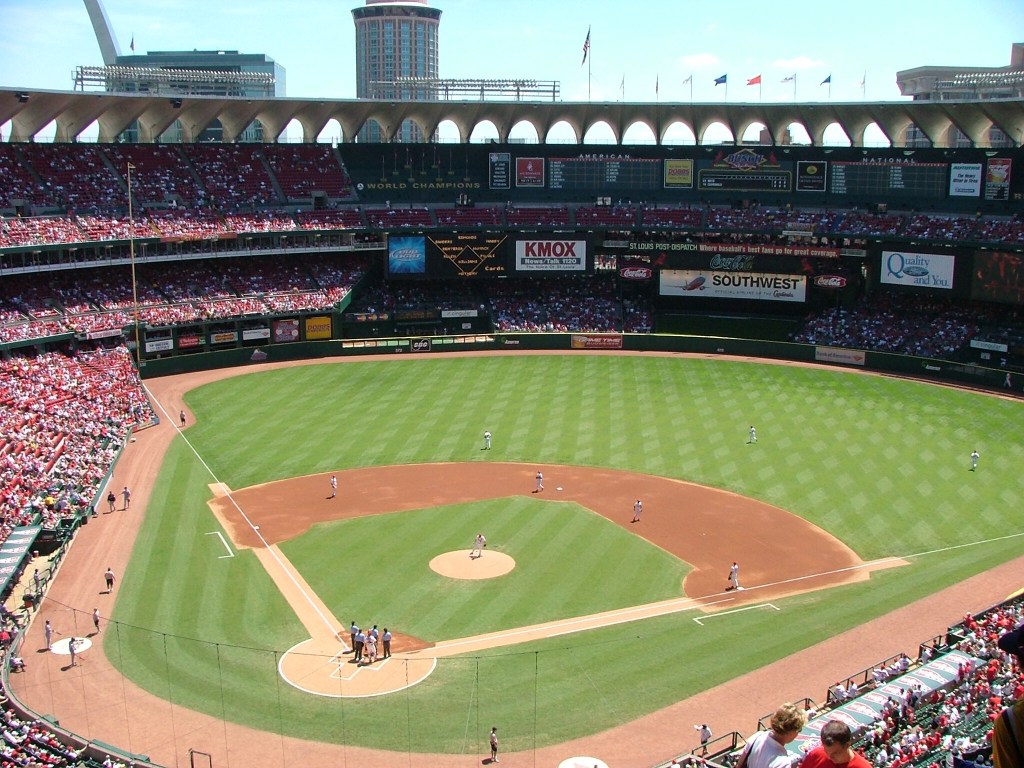
Busch Stadium with the Gateway Arch and the buildings of downtown St Louis in the background. (Photo credit: Jeff Hayes)

We arrived at Busch Memorial Stadium less than an hour before the first pitch, leaving us little time to explore the environment around the park. Instead, we headed inside upon arrival, wandering the concourses before heading to our seats. Busch Stadium was one of the cadre of multi purpose stadiums constructed from the mid 1960s into the early 1970s, housing both MLB and NFL teams playing on the then-new AstroTurf.

AstroTurf was developed as an alternative to natural grass playing surfaces, starting with the Astrodome in Houston Texas, since grass could not be grown under the dome. Laid out on a field of concrete (which provided a stable surface), the AstroTurf was an unforgiving inch thick “carpet” which often heated to 130 F during the summer. Eventually, AstroTurf was eschewed in favor of grass surfaces, which is what we found in Busch Stadium early that afternoon.

Busch Stadium shortly before game time. (Photo credit: Jeff Hayes)

Crystal clear skies and rapidly warming temperatures greeted us as we found our seats shortly before the first pitch. Per usual, Busch Stadium was filled to near capacity, as St Louis fans are generally considered to be some of the best in the game. The opponents for the hometown Cardinals this afternoon was the New York Mets. St Louis was enjoying a strong 2004 season, with a commanding 10 1/2 game lead over the second place Houston Astros in the NL Central Division. By contrast, the Mets were battling their way through another sub .500 season, occupying the fourth spot in the NL East.

Starting for the visiting Mets was right hander Kris Benson. Making his first start for the Mets after being traded from the Pittsburgh Pirates, Benson was in the midst of a fairly average season, with a .500 record and an ERA over 4.00. The hometown Cardinals sent right hander Woody Williams to the mound. Williams was an 18 game winner for the Cardinals in 2003, and was still an important piece of the starting rotation for a formidable St Louis team. With the afternoon warming quickly, we were wondering if the ball would carry well at Busch Stadium this afternoon, resulting in an offensive display.

The view from our seats. (Photo credit: Jeff Hayes)

From the very start, the Cardinals fans were a force, with a loud din discernible for much of the game. Being from the Northeast, I would posit that the best fans in baseball were from the part of the USA, but the boisterous St Louis fans were slowly changing my mind. Despite the building heat, starting pitching dominated the early portion of the matinee. Each team scored a single run through six innings, and with both starters showing their best stuff, the game quickly became an old fashioned pitchers duel

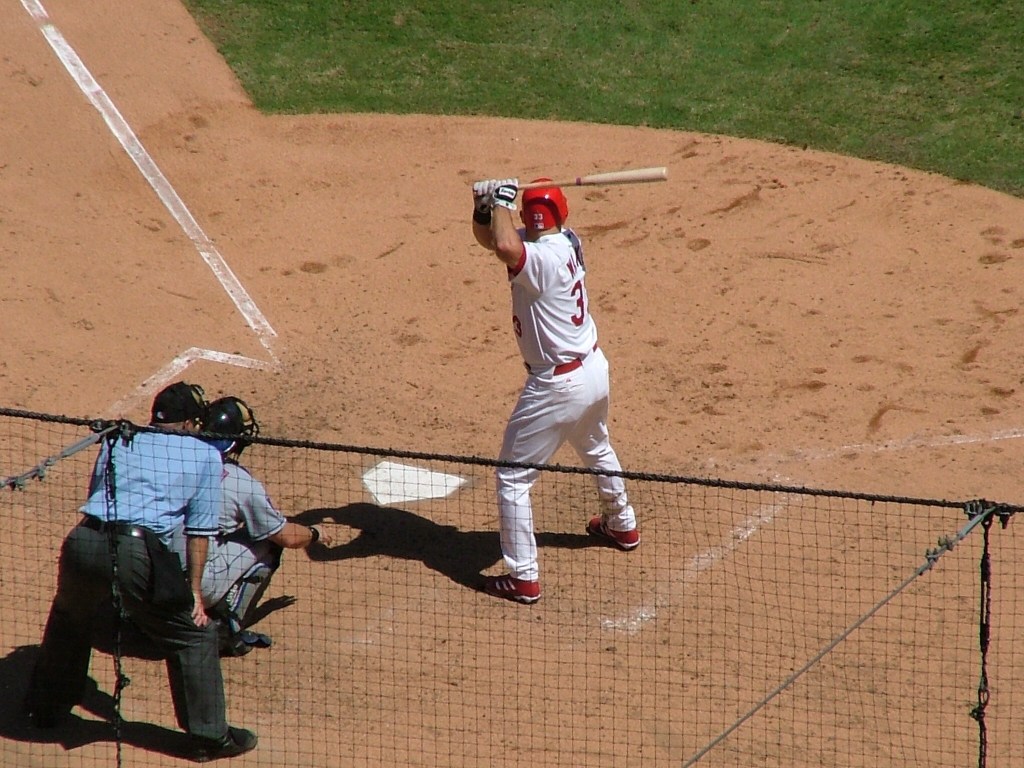
As part of their playoff push, the Cardinals had acquired slugger Larry Walker from the Colorado Rockies at the trade deadline on July 31st. Walker’s first at-bat in a St Louis uniform came in the bottom of the 7th as a pinch-hitter. Looking to quench my thirst, I approached a vendor to purchase a soft drink as Walker came to the plate. Both the vendor and I paused the transaction to watch the at-bat. Walker received a standing ovation as he strode to the plate, which was understandable, as the Cardinals fans though they were welcoming a presence that would propel them through the playoff run. However, when Walker struck out, the Cardinals fans gave him another standing ovation, a highly unusual response to a strikeout. In fact, it was so unusual that the vendor pointedly asked me “have you ever seen anything like that?”.

Larry Walker in his first at-bat with the St Louis Cardinals. (Photo credit: Jeff Hayes)

Both starting pitchers exited that game by the end of the seventh inning, leaving the tight contest in the hands of the respective bullpens. Quite unexpectedly, a game that I thought might be one-sided because of the Mets recent struggles had become one of the best games I’d seen in person in years. The score remained tied at 1-1 going into the bottom of the ninth inning, giving the Cardinals one last chance to end the game before extra innings.

Having experienced the devoted and vocal Cardinal fans first hand, I was very surprised to see them execute “the wave” during a critical portion of a tightly contested ballgame. It was almost as though the fans were not fully aware of the game situation, instead becoming lost in the moment of being at the ballpark. The Cardinal pushed across the winning run with two outs in the bottom of the ninth, securing a well-fought 2-1 victory.

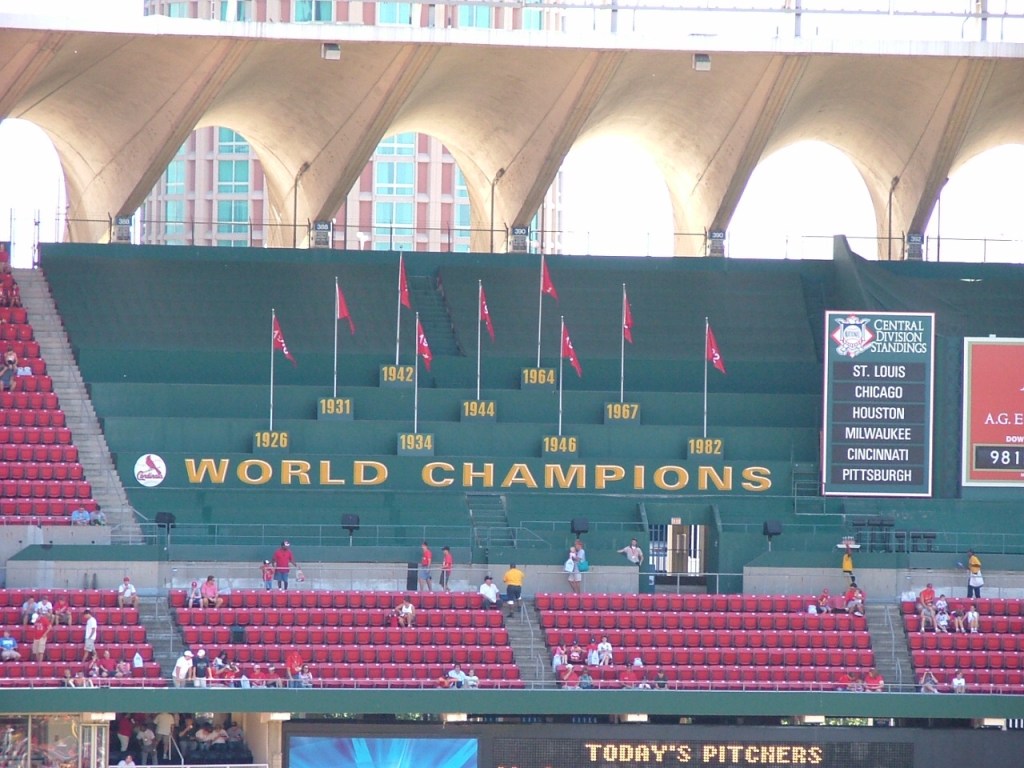
A tribute to the venerable St Louis Cardinals franchise at Busch Memorial Stadium. (Photo credit: Jeff Hayes)

We’d just witnessed one of the best ballgames I’d seen in a long time at the home of an iconic MLB franchise. Though Busch Stadium itself was a typical multi-purpose facility, a product of its time, the crowd made it feel like a great place to see a ballgame (despite their curious wave display in the bottom of the ninth). Having seen the stadium, there was no reason to return until the new ballpark was ready, which was a couple of years away. Still, it WAS fun to see a baseball game in the heartland of America.

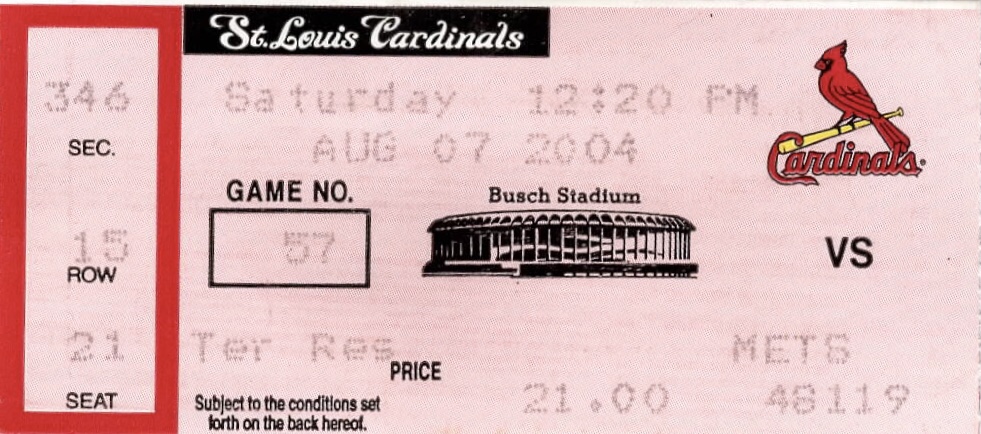
A ticket from the game. (Photo credit: Jeff Hayes)

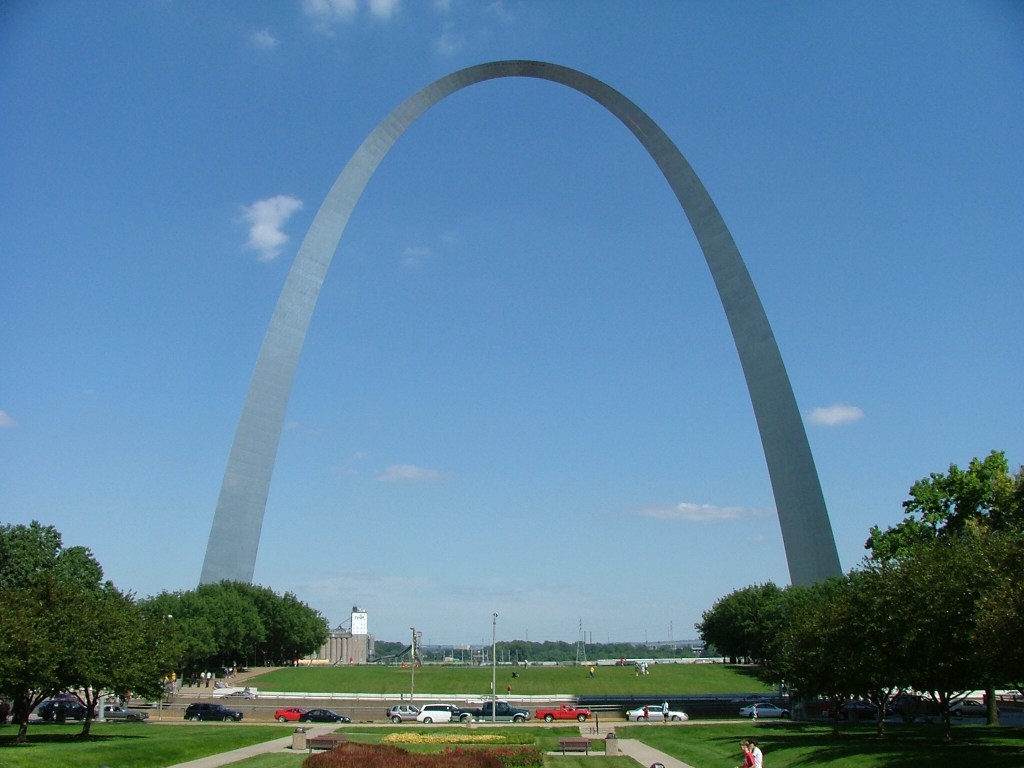
Our destination after the game was a hotel room in eastern Kansas, before we visited Kaufman Stadium in nearby Kansas City the following afternoon. Before heading out onto Interstate 70 west, we briefly visited the Gateway Arch, the longtime symbol of the opening of the western USA. It was also my first visit to the Mississippi River, an iconic symbol of the heartland of the USA. We would see the river at several points along its journey in the coming years.

The Gateway Arch in St Louis. (Photo credit: Jeff Hayes)

We didn’t linger long in the Gateway Arch National Park, as we had a 300 mile drive ahead of us. Light traffic heading west on Interstate 70 allowed us to reach the hotel just outside of Kansas City in less than four hours.

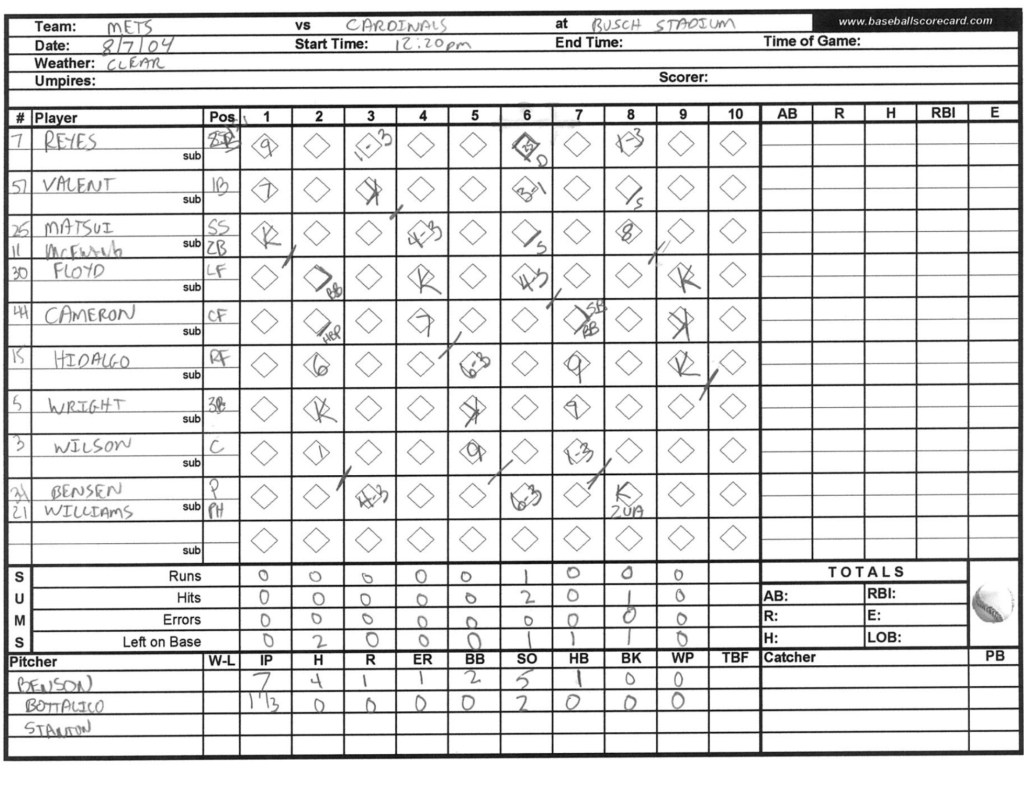
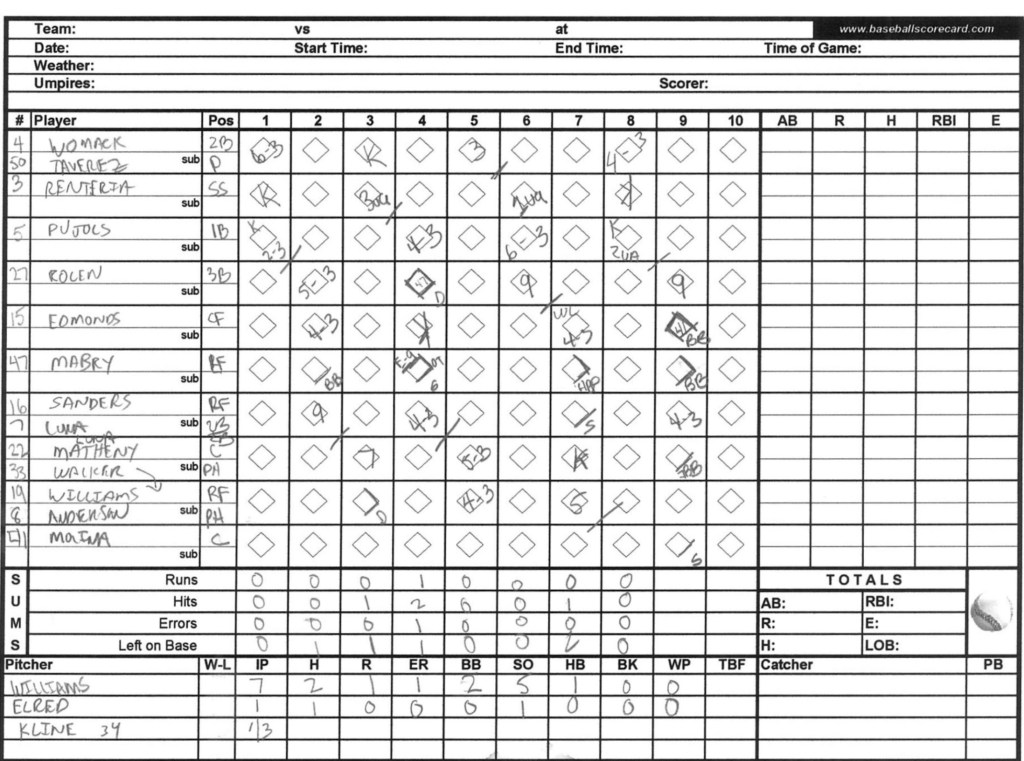
Our scorecard for the game.