Prince George’s County Stadium, Bowie Maryland

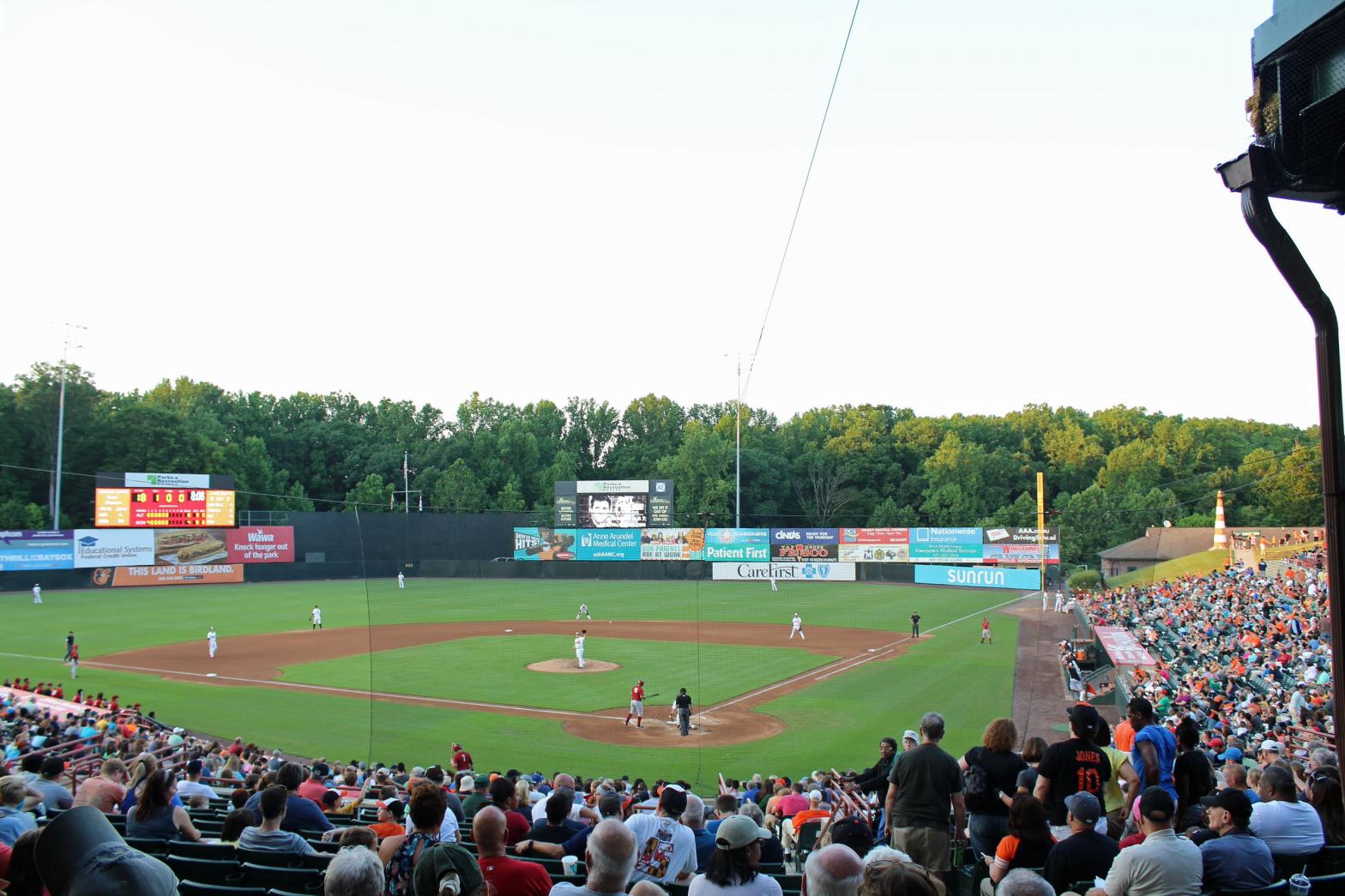
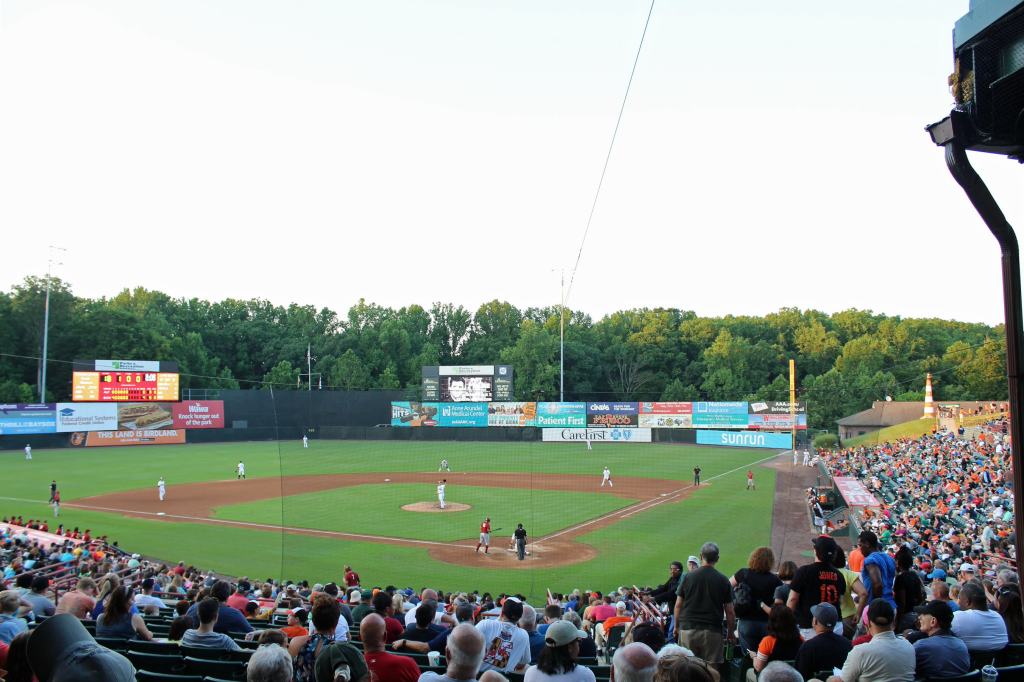
Prince George’s County Stadium from behind home plate in the lower level. (Photo credit: Jeff Hayes)
  • First visit: unknown, sometime in the summer of 2013
  • Most recent visit: Friday, September 13 2019

A job change in early 2013 brought me to the Washington DC area, and I was pleasantly surprised to see the wide array of baseball options that came with the move. The Washington Nationals were only a 20 minute train ride from home, and the Baltimore Orioles were just a 45 minute car ride north along Interstate 95. There was also a number of minor league options an hour away or less, with the Bowie Baysox (the AA affiliate of the Baltimore Orioles) the closest, a mere 20 minute car ride away (as long as traffic on the Beltway cooperated). Since the ballpark was easily accessible, I adopted the Baysox as my team in the new surroundings.

Though I do not recall the exact date of my first visit to Prince George’s County Stadium (the home of the Bowie Baysox) in 2013, I do remember a few surprises from the trip. The first surprise was parking. Because Prince George’s County Stadium holds about 10,000 fans, the parking lot for the stadium is huge. Not knowing where to park, I flagged down an attendant and asked him the cost of parking. With a wry smile, he told me that parking was free. If memory serves, this was first stadium I’d visited that had that perk. Arriving about an hour before game time, I was able to park right next to the ballpark. Not having a ticket for the game, I feared that I would not be able to secure a good seat so close to game time.

The view from seats we typically occupied for Baysox games at Prince George’s County Stadium (Photo credit: Jeff Hayes)

Asking for the best available seat, I received my second surprise. Despite arriving close to game time, there were great seats available. Not knowing anything about the layout of the park, I took seats near the on deck circle just to the left of home plate, about six rows from the field. At the time, I could not believe my luck, but after going to a few games, I realized that, despite easy access off Route 50 in Bowie, attendance was generally fairly light. That was both shocking and disappointing to me, but I eventually learned that Bowie did not aggressively advertise, which could a contributing factor to the low attendance. Quickly I learned to enjoy the relatively sparse attendance, as it virtually guaranteed me great seats any time I went to the ballpark.

Passing through an old styled turnstile, my ticket was torn by a friendly and knowledgeable ticket taker, leading me into the lower concourse. A quick walking tour of the stadium followed. Like most minor league ballpark from the 1990s, the ballpark was a cookie cutter prefabricated stadium, with seats in the lower levels, and aluminum bench seating in the upper sections. There were also enclosed club suites at the top of the stadium, stretching from the home dugout behind home plate to the visitor’s dugout (we never saw a game from these seats). Down the right field line is a kid-friendly play area, complete with a carousel, as well as other attractions. A lighthouse located near the play area blared following a Baysox home run.

Prince George’s County Stadium at sunset on a warm summer evening.

Like most minor league parks, Prince George’s County Stadium featured a grass playing field, as well as series of wooden advertising signs perched above and just behind the outfield wall. In left centerfield there was a scoreboard, which seemed out of date and a bit worse for wear. At this time, there was no video board, which I found odd, as most AA stadium have at least a small but functional videoboard. Finishing my tour of the ballpark, I stopped for a baseball dinner before heading to my seat. Standard concession stands were available on the lower concourse, as well as specialty food and drink carts along the lower concourse. On this night, only the right field concession stand was operating, but the small crowd meant a short wait time. Walking back on the concourse toward my seat I discovered a table that offered scorecards and rosters for both the Baysox and the visiting team. Being an old-timer, I keep score at games, and I found these offerings very useful.

The scoreboard at Prince George’s County Stadium. A video board was added in right centerfield to supplement the aging scoreboard. (Photo credit: Jeff Hayes)

My first visit to Prince George’s County Stadium was an evening contest, which led to my third surprise. The lightning for the playing field seemed woefully underpowered, leaving portions of the outfield (especially centerfield) fairly dark. My brother and I would joke later that outfielders, rather than losing balls in the lights, would lose ball in the dark. Overall, Prince George’s County Stadium seemed like an average minor league park, with signs of aging that indicate that the park was older than its 20 years. Despite its shortcomings, I would grow accustomed to the “charm” the ballpark offered, and much like the old Shea Stadium in New York, it became like an old friend.

Lineup card exchange at home plate just before game time. Note the lack of fans in the seats minutes before the start of the game. This image also shows the kids play area at the top of the picture, as well as Louie, the Baysox mascot in front of the Baysox dugout. (Photo credit: Jeff Hayes)

Sparse crowds like the one on that night gave me access to the action like I’d never seen. In fact, I was so close to the action that I couldn’t speak badly about the batter in the visitor’s on deck circle; he might hear me! My proximity to the field also allowed to see and hear the game in a way that isn’t possible in an MLB park. In general, minor league baseball is more about evaluating talent and less about strategy. It is not unusual to see players (especially pitchers) leave ballgames seemingly without a logical reason; we would later learn that once a manager had seen what he needed from a player, that player could be removed from the game. Pitching changes during innings are scarce, as teams are interested in seeing what players do under pressure, rather than making moves designed to win games.

As a result, minor league games tend to move along more quickly that their MLB counterparts. In between most innings, the Baysox offered games and contests in foul territory (typically in front of the dugouts), plucking fans out of the stands to participate in the contests. Despite the obvious attempt to make the games there more family friendly, there were a strange lack of kids in the park. Perhaps with myriad options for entertainment in the DC area, and MLB baseball as little as 20 minutes away, families were opting for choices other than Baysox baseball. My recall of the first game itself is fuzzy at best, but it did remember that exiting Prince George’s County Stadium was made simple, as cones and attendants made sure that the traffic flow was smooth. In about 20 minutes time, I went from the parking lot to my home with little difficulty. Even with the shortcomings offered by the home of the Baysox, I knew that I would frequent this place often, as it appeared to be a fine way to spend a summer evening.

A close up view of the centerfield fence at Prince George’s County Stadium. Once darkness falls, this area would become a problem for outfielders trying to track down fly balls.

Over the years, my brother and I would frequent Prince George’s County Stadium often, particularly on weekends when the AA affiliates of the New York Mets (the Binghamton Mets/Rumble Ponies) and New York Yankees (the Trenton Thunder) were in town. All told, I probably saw about 100 games at the ballpark between 2013-2019, usually near the on deck circle. Going as often as I did, I befriended many of the staff members, with whom I would swap baseball tales, talking about players we liked or ballparks we visited. My brother and I would be mistaken for scouts more often than you might expect, as I kept score, my brother took pictures, and we chatted almost non stop about the game. The only things (other than my job, which required shift work) that would keep me away when I could manage to go were rain and heat. DC and environs generally experience hot, humid summers, and this would occasionally keep me home. Thunderstorms were a nearly daily occurrence in the summer, and it seemed we had to endure rain delays more than any other place I had been.

Even with these distractions, we attended games at the park whenever possible, as prices were reasonable, great seats were almost always available, and fireworks occurred most summer nights (when weather permitted). Still, I was sad to see so few fans at the park. Occasionally, Orioles players would complete their injury rehabilitation at Prince George’s County Stadium, but attendance on these days/nights were surprisingly light. Perhaps my greatest memory of the ballpark was when the Baysox allowed fans to play catch on the field following a Sunday matinee. My brother and I brought our gloves and eagerly took the field when instructed. We were both surprised how good the turf in the field looked and felt, and we spent about 30 minutes on the field before being shooed away by management so that they could close the stadium for the day. That was only the second time I’d stepped foot on a professional baseball field, and despite being 52 years old, I was as excited as some of the kids playing catch with their parents.

My brother posing in front of the centerfield wall at Prince George’s County Stadium.

During my time at Prince George’s County Stadium, I became an ardent fan of minor league baseball. In addition to the more intimate experience offered by the smaller ballparks, I found myself becoming invested in the younger players as they passed through Bowie. Many players I saw in Bowie would eventually make an appearance with the Orioles, or other MLB teams, and I felt a certain satisfaction in knowing I saw these players on the way up. My experiences at Prince George’s County Stadium rekindled what was flagging relationship with baseball, and because of that, now I prefer minor league games over MLB games. Thanks Bowie!

PNC Park, Pittsburgh PA

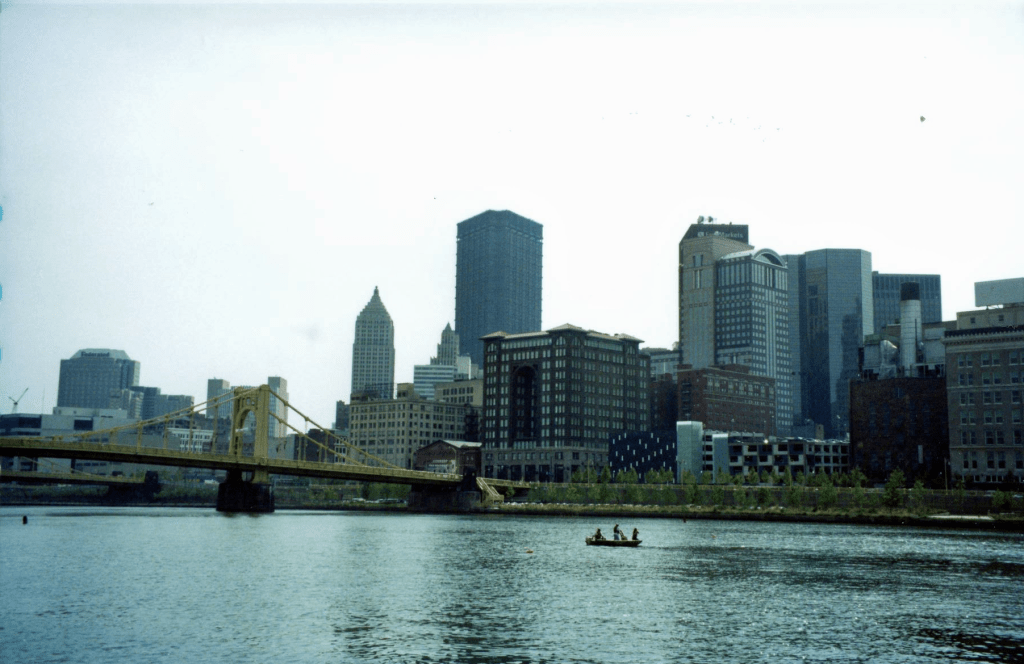
Looking at PNC Park in Pittsburgh across the Allegheny River. (Photo credit: Jeff Hayes)
  • First visit: Wednesday September 19th 2001
  • Most recent visit: Sunday September 17 2006

Our first visit to PNC Park was not supposed to happen. This game was originally scheduled to be played at Shea Stadium in New York City, but following the attacks on September 11th 2001, the parking lot at Shea was used as a staging area to deal with the aftermath of the attacks. Since Shea Stadium would not be available for baseball in the near term, the games were moved to PNC Park in Pittsburgh PA. After a short break, baseball resumed on September 17th 2001, and the Mets played a three game set against the Pirates, starting on that date.

Since we had travel plans scrapped after the attacks (we were flying to Chicago to see the Pirates take on the Cubs, but the games and flights were cancelled), we both had some time off. We chose to attend the last game of the series, a Wednesday matinee on September 19th. Getting an early start from central NJ, we made the 365 mile drive in about five and one-half hours, arriving at the ballpark before noon. Because the game was supposed to be played in New York, there was not much demand for parking, which allowed us to park just across the street from the stadium for a reasonable price.

The view of downtown Pittsburgh from the walking path along the Allegheny River adjacent to PNC Park.

With time before the game, we briefly wandered around the park. Along the right field wall, we discovered a walking path adjacent to the Allegheny River. Dubbed Three Rivers Heritage Trail, the concrete path snakes along the river for about one and one-half miles. Given our time constraints, we did not amble nearly that far, but we did enjoy the view of downtown Pittsburgh from the riverside. Even if we were not taking in a ballgame that day, a simple trek along the river would have provided an early afternoon of peaceful vistas. Its proximity to the river enhanced the appeal of PNC Park, and we had not even seen the inside of the stadium yet!

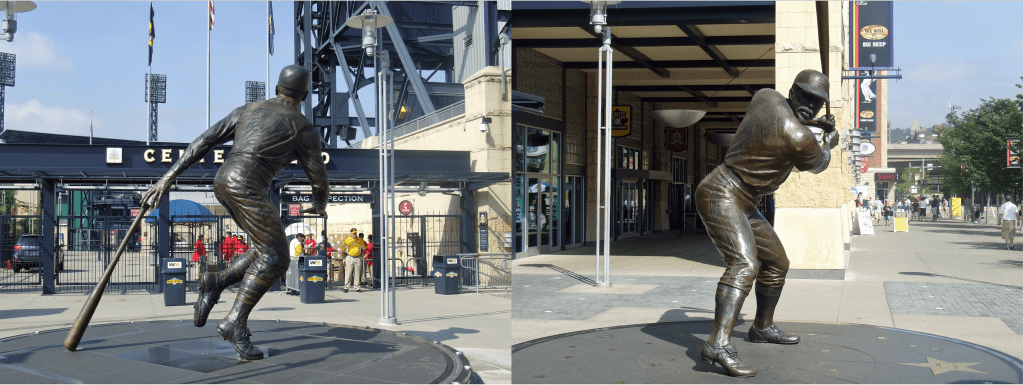
During our exploration of the environs of the the stadium, we found a pair of Pirates greats immortalized in bronze. Both Roberto Clemente and Willie Stargell were on display outside the park, with each statue larger than life. Roberto Clemente was just a bit before my time, as I was a toddler when he had his best years in Pittsburgh. Conversely, I was much more familiar with Stargell, with his trademark “windmill” bat twirl just before the arrival of the pitch. Two other statutes stood outside the ballpark (Honus Wagner and Bill Mazeroski) eluded our search, but perhaps we would view them on another visit.

Pirates greats Roberto Clemente (left) and Willie Stargell (right) are immortalized outside of PNC Park in Pittsburgh PA. (Photo credit: Jeff Hayes)

PNC Park is a baseball only stadium, at the end of its inaugural season in September 2001. Since the game was not supposed to be played in PNC Park, there were few fans present was we ended our tour of the outside of the stadium before heading into the park. It seemed that, based on the number of New York jerseys we saw on people milling around near the home plate entrance, those who did attend the matinee were mainly Mets fans, making a drive similar to ours. Apparently a five hour drive did not deter the New York faithful, who seemed determined to see the game. Unfortunately, the weather was less than cooperative, with warm and humid conditions under mainly cloudy skies.

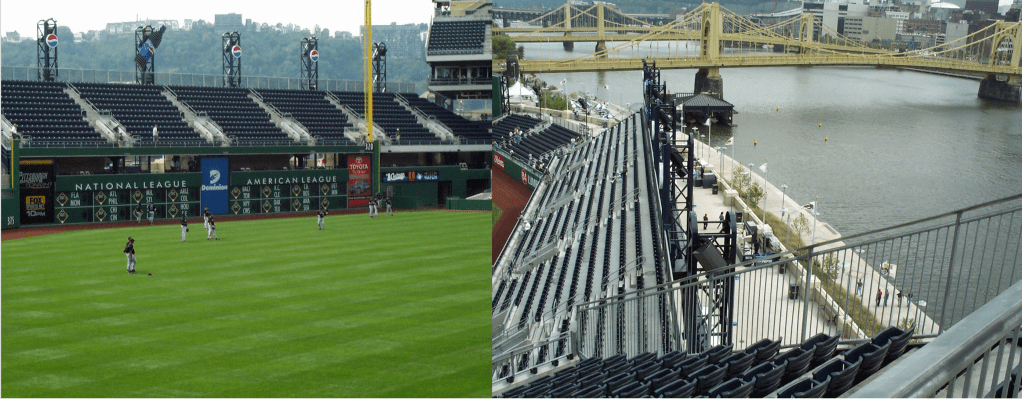
Once inside, we could immediately see that the view of downtown Pittsburgh was the focus of the new ballpark. Unlike its predecessor (Three Rivers Stadium), PNC Park was open in centerfield, providing a sweeping vista of the city and Allegheny in front of it. Rather than AstroTurf, the field was covered with Kentucky bluegrass, which looked a bit worse for wear after a hot Pittsburgh summer. As we started to walk along the lower concourse toward right field, I couldn’t tear myself away from the view beyond the centerfield wall! Beyond the ballpark, several of the bridges connecting the north shore of the Allegheny River to downtown Pittsburgh were painted Aztec gold. At the time, I did not understand why they were painted this hue, but research later indicated that the bridges connected surrounding areas to the Golden Triangle section of the city. In any case, even the overcast of the day could not hide the luster of the bridges, and I discovered that I’d found my new favorite MLB ballpark!

The view of PNC Park and surroundings from the upper deck. (Photo credit: Jeff Hayes)

Following the lower concourse to the right field line brought us to the detached bleacher area, which extends from the foul pole to the 375 foot sign in right centerfield (where a hand operated scoreboard runs the length of the 21 foot high fence). Venturing up into the bleachers gave us a great view of the river and the city. Each seat provided a clean view of the action, due primarily to the elevated nature of the bleachers. Continuing counter clockwise on the lower concourse, we encountered a smaller bleacher area adjacent to the green batter’s eye in centerfield. Since the crowd was small, there were very few fans here, but given the sight lines here (as all seats in PNC Park are angled to produce the best view of home plate), these seats appear as though they would be almost as good as the seats in the right field bleachers.

Standing on the lower concourse behind the batter’s eye gave us an amazing view of the bridges and downtown Pittsburgh. Even the pictures we took on the cloudy and humid day (resulting in haze that partially obscured the city) could not do justice to the backdrop for PNC Park. Even if we did not see a game here, the view alone was worth the time and expense. Proceeding toward home plate, we got a close up view of the video board, which stood atop two tiered seating in left field. The video board seemed curiously small for a brand new park, which is not necessarily a bad thing. Light stands bracketing the video board were wrought steel, and looked similar those at Comerica Park. In fact, the placement and size of the video board at Comerica Park bore a striking resemblance to what we saw at PNC Park.

The right field bleachers at PNC Park, with a great view of the riverfront at the top of the section. (Photo credit: Jeff Hayes)

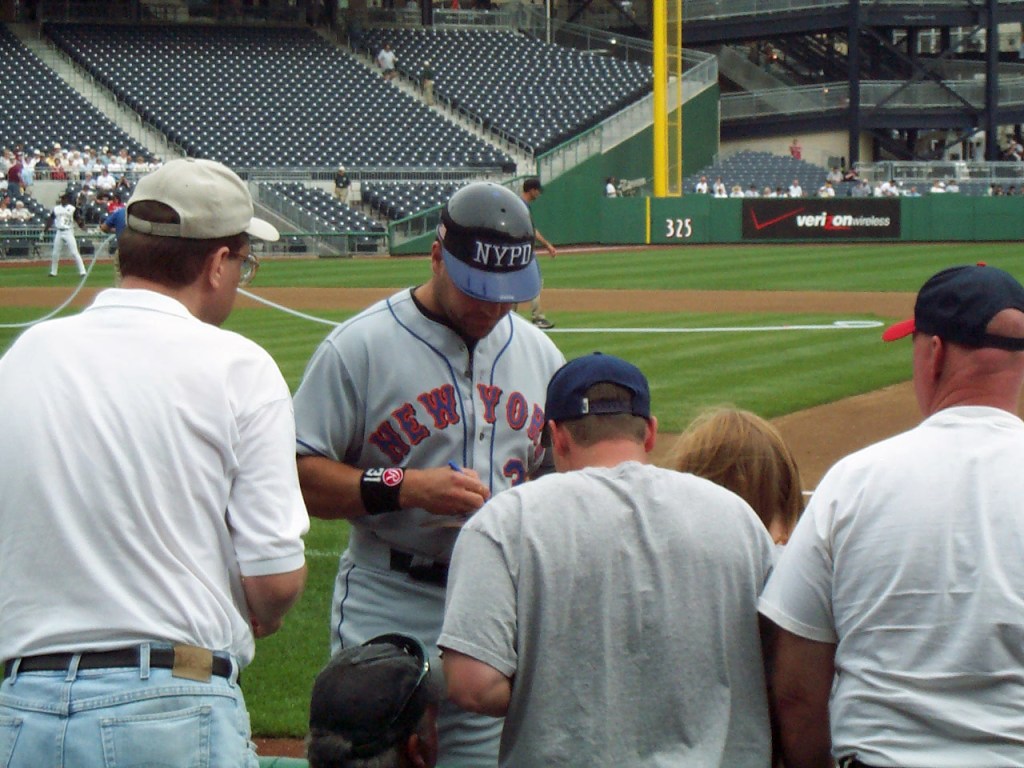
We completed the loop around the stadium on the lower concourse behind home plate, and went in search of a baseball lunch. Like most “newer” MLB stadiums, PNC Park has many places to eat, including outlets of many popular local restaurants, with premium services available in the club level provided by Levy’s Restaurant. Per my usual, I eschewed these choices, instead choosing hot dogs and drinks to bring to our seats. In keeping with the somber nature of the situation following the attacks on 9/11, there was a sense of sullenness in the crowd, and even the typically boisterous Mets fans kept their enthusiasm in check for the game. Mets players were wearing hats of the various first responder services (like the NYPD, NYFD, etc.) that gallantly answered the call during and after the attacks.

Mets catcher Mike Piazza, donning an NYPD helmet, signing autographs for fans at PNC Park. (Photo credit: Jeff Hayes)

Despite the air of melancholy in the air at PNC Park that afternoon, Mets players did sign autographs and interact with the crowd. Because the game was moved to Pittsburgh with little advance notice, we were able to get seats along the right field line just beyond the Mets dugout (PNC Park is one of the few MLB parks where the home team dugout is on the third base side). Though I was mesmerized by the ballpark and its surroundings, we were there to see a game. Following a World Series berth in 2000, New York, facing a depleted Pirates squad, overcame an early deficit to win the game, 9-2. We were treated to a Mike Piazza home run, and the game time was under three hours. Facing a long drive home, we headed straight to the parking lot. PNC Park was as advertised and much more, leaving me dazzled. We would have to return, if only to the the park and its views in better weather conditions.

My scorecard from the game.

Our second visit to PNC Park was not as hurried, as we planned a weekend visit to Pittsburgh to once again see the New York Mets. Unlike our previous stay, clear skies and pleasantly warm and dry conditions were expected for Saturday and Sunday. Our trip from central NJ to Pittsburgh was uneventful, and we drop off our bags at the hotel before heading to the park. Leaving ourselves plenty of time to explore, we crossed the Allegheny River on one of the bridges, where my brother got some excellent shots of the stadium, with the river in the foreground. Given the great late summer weather, we strolled along the riverfront, where we encountered scores of people walking, biking and sitting along the banks of the river.

A view of the Roberto Clemente Bridge just north of PNC Park. (Photo credit: Jeff Hayes)

Following our extended tour of the area, we headed into PNC Park through the home plate entrance. Of course, we wandered through the ballpark, though we didn’t spend as much time doing so, as we would get a better look at the park the next afternoon. After visiting the concession stand in the lower level behind home plate for a baseball dinner, we headed to our seats. Because the Pirates were playing out a disappointing season, tickets for the game were plentiful, and we were fortunate enough to secure good seats just to the right of home plate in the lower level.

Sunshine, though decreasing with time, afforded us a better look at PNC Park and downtown Pittsburgh. The Aztec gold of the bridges crossing the Allegheny seemed more vivid in the waning daylight, and the overall feel of the park was much lighter, a stark contrast to our previous visit, when skies were gray and the country was still reeling from the attacks on 9/11. PNC Park has a two tiered seating area extending from the left field foul pole behind home plate to the right field foul pole (minus the luxury boxes and the press level). When combined with the bleachers, there were just over 38,000 seats in the ballpark (which is the second smallest capacity in MLB), and almost all of the seats in the stadium offer a view of downtown Pittsburgh.

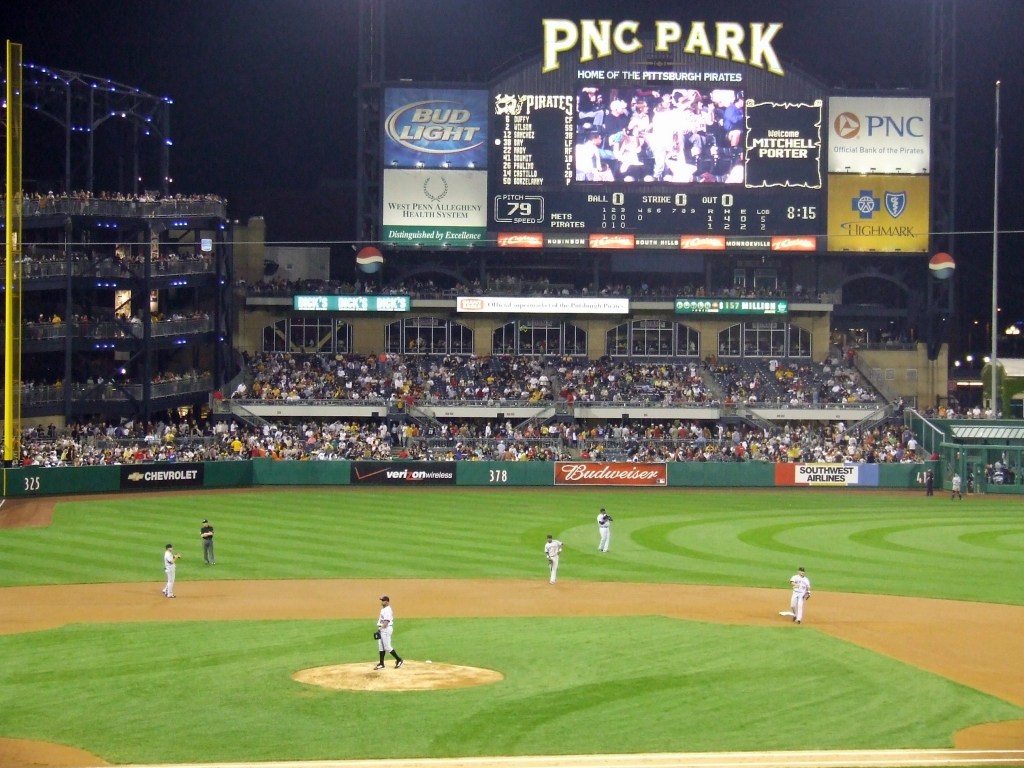
The view from our seats for the Saturday night game. (Photo credit: Jeff Hayes)

PNC Park offers one of the smallest distances from home plate to the backstop (51 feet), giving fans nearly unprecedented closeness to the action. Clearly, the stadium was designed with a maximum fan experience in mind. When combined with the spectacular views of the city and the river, my opinion that PNC Park was the best park in MLB (though my brother would disagree, as he is partial to Comerica Park) was cemented. Even after the game started, I found myself scoping out the park and scenery beyond it, instead of paying more attention to the action on the field. More than once, I found myself envious of the Pirates home, wishing and hoping that the Mets would construct a ballpark with similar magic.

View of the Pittsburgh skyline from out seats in PNC Park. (Photo credit: Jeff Hayes)

Though 25 games under .500 coming into the game, the Pirates kept pace with the visiting Mets (who were destined for a division championship and a trip to the 2006 NLCS), as evening blended into night. Surprisingly, there were few lights emanating from the buildings in downtown Pittsburgh, as I expected the coming of night might allow the downtown area to shine. That was probably the only negative we encountered on our visit to the park that evening. Had the game been a nationally televised broadcast, it is possible that the city might have obliged with more lights from the structures, producing a spectacle for the fans in attendance and those on TV.

Between the time we entered the ballpark before the game and the third inning, the crowd filled out nicely. Even the four level steel rotunda in left field, used primarily for standing room only, was filled with fans. Officially, there were more than 37,000 people in the ballpark that night (nearly a sellout), but the actual count was almost certainly less. In any event, the fans in attendance made their presence felt, and the game was deadlocked at two going into the bottom of the ninth. Pittsburgh scratched out a run in the bottom of the frame, beating the Mets and their closer, Aaron Heilman 3-2. As the jubilant Pirate fans filed out of PNC Park that night, I quickly scanned the ballpark while we waited to exit. As we left, I remember thinking that I hoped the Pittsburgh fans appreciated the park they were lucky enough to call home.

PNC Park at night. (Photo credit: Jeff Hayes)

Sunday September 17 2006 was a mainly sunny and pleasantly warm late summer day, and after breakfast we headed out to PNC Park to see the finale of the series. Early morning fog was begin transformed into cumulus clouds as the sun shone over the park, and the filtered sunshine showed that we were indeed headed toward fall, despite the warm weather. We did not spend as much time outside of the park as the previous day, but we did focus our attention on the river. Much like we saw in Cincinnati in 2004, there was quite a bit of river boat traffic this Sunday morning, and it reminded me what life might have been like on the river long ago. Leftover haze gave the river and its surroundings a softer hue, and somehow this seemed to add to the appeal of the area.

A passing river boat tour on the Allegheny River. (Photo credit: Jeff Hayes)

Upon entering the park, we conducted one final walkthrough of the stadium with the best conditions we had seen so far. Based on the number of fans milling around outside, the crowd promised to be much smaller than the game the previous night. Our experience has taught that Sunday afternoon games were usually more lightly attended than Saturday night games, and it seemed that trend would hold for the afternoon contest. In addition, we had entered football season, which meant the part of the crowd that might have come to see a poorly performing Pirate team instead stayed home to watch gridiron action. Regardless of the reason, we expected to have more elbow room for the matinee contest.

Before getting a baseball lunch and heading for our seats, we headed up the upper deck to get some pictures of the stadium with downtown as the backdrop. From that vantage point, my brother took some of my favorite ballpark pictures, and even those picture did not do the scenery justice. Though we did not have pristine conditions, the panorama my brother constructed from those pictures qualify (in my opinion; his may vary) as his best work at baseball stadiums, and helps to shape my opinion of PNC Park being the best ballpark in MLB.

This is it: my favorite picture of PNC Park, courtesy of my brother. (Phot credit: Jeff Hayes)

Our seats were very similar to those of the previous night, in the lower level just to the right of home plate. For the New York Mets, the game was not particularly meaningful, as they were on their way to the NL East title, but most of the regular starters were in the lineup. On the mound for the Mets was right hander John Maine, who was the number five starter in the New York rotation. For the hometown Pirates, left hander Zach Duke took the mound. Duke was the ace of the Pittsburgh staff, and we were not quite sure what to expect out of either team, with so little at stake for either team this late in the season.

Pittsburgh scored two runs against the Mets in the bottom of the first inning, and as it would turn out, that would be more than enough for Duke, who tossed eight shutout innings against a formidable New York lineup. Despite the second straight flat performance by the Mets, the game was again almost superfluous, as the fine late summer conditions made PNC Park shine even more than the night before. In between innings, I spent my time shifting my attention from one feature to the other, while my brother’s camera was busy capturing the nearly perfect baseball environment. As we suspected, the crowd was quite thin, nowhere near the announced crowd of nearly 30,00. Later I would learn that the Pirates’ attendance in 2006 was 1.8 million, which was next to last in the NL. Apparently, a poorly playing team trumped the beautiful ballpark, which had been racking up accolades since it opened its doors in 2001.

The view from our seats. (Photo credit: Jeff Hayes)

Time passed quickly during the low scoring game, which clocked in at about two hours and 30 minutes, which was shorter than the league average. Before I knew it, we were leaving this baseball palace, headed out for a five hour drive back home to central NJ (during which we would listen to the Jets lose another game). To say we thoroughly enjoyed the ballpark would be a great understatement. Though we were split as to whether we thought that PNC Park was the best MLB park, we did agree that it was a great baseball experience that we would have to repeat as soon as possible. If you find yourself near Pittsburgh during baseball season, check to see if the Pirates are home. If they are, GO! You will be glad that you did.

Goodbye PNC Park. Hope to see you again soon! (Photo credit: Jeff Hayes)

Fenway Park, Boston MA

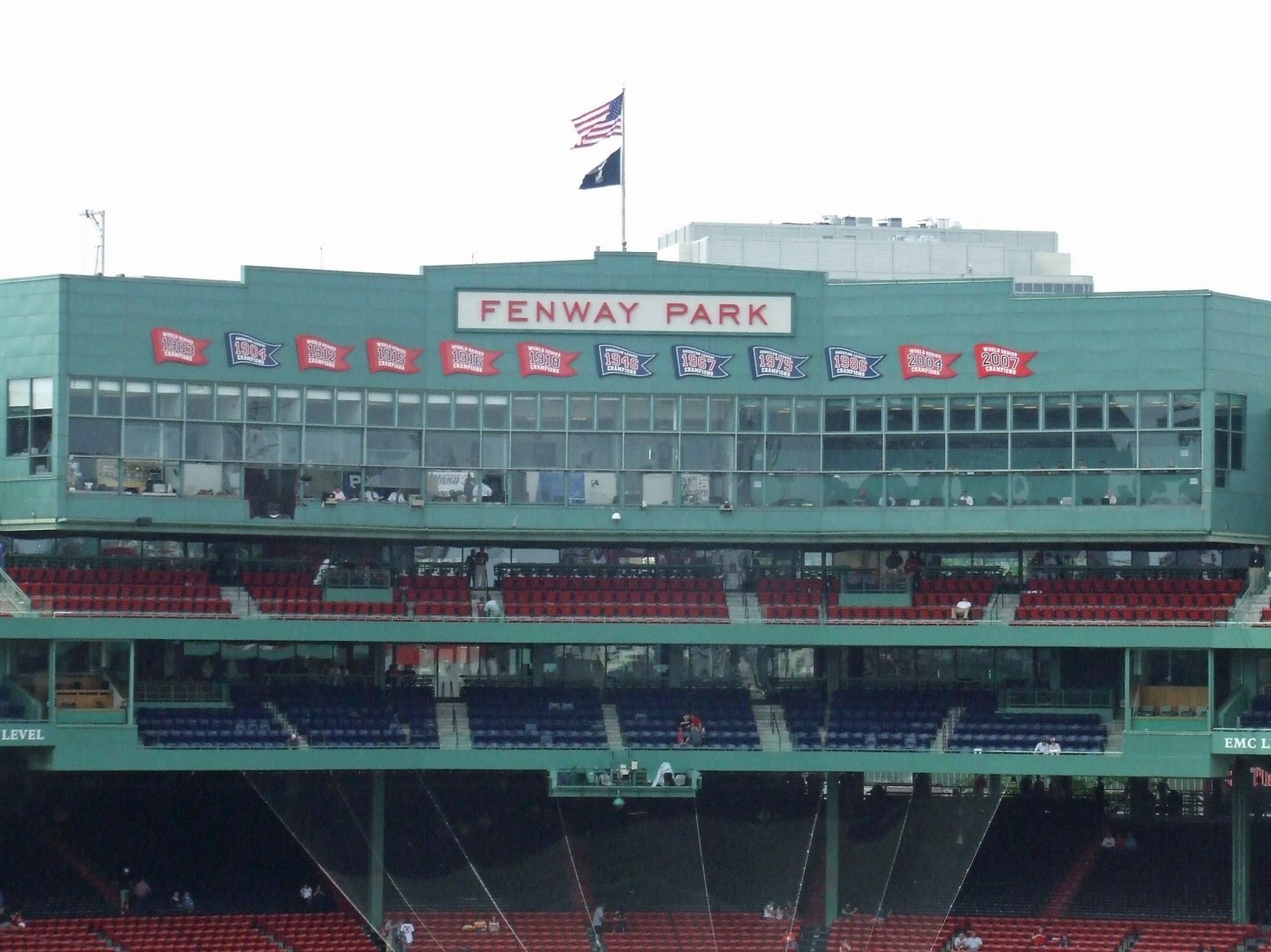
Welcome to Fenway Park, Boston MA! (Photo credit: Jeff Hayes)
  • First visit: Sunday April 18th 1999
  • Most recent visit: Sunday May 24th 2009

Our first visit to this baseball cathedral came in April 1999. We did not arrive together; my brother came up to Boston with some friends, and I traveled south from Yarmouth ME (just northeast of Portland). For me, the trip took about two and one-half hours, traveling south along Interstate 95. While the drive to Boston was uneventful, the drive through Boston was anything but. Since Fenway Park is nestled within the city, I had to navigate my way through downtown to reach it, which took longer than I expected. Having been to Fenway Park before (in 1996), I knew that there was precious little parking around the stadium, and I was shocked by the price of parking (which was about $30 back then), leaving my car in a gas station parking lot.

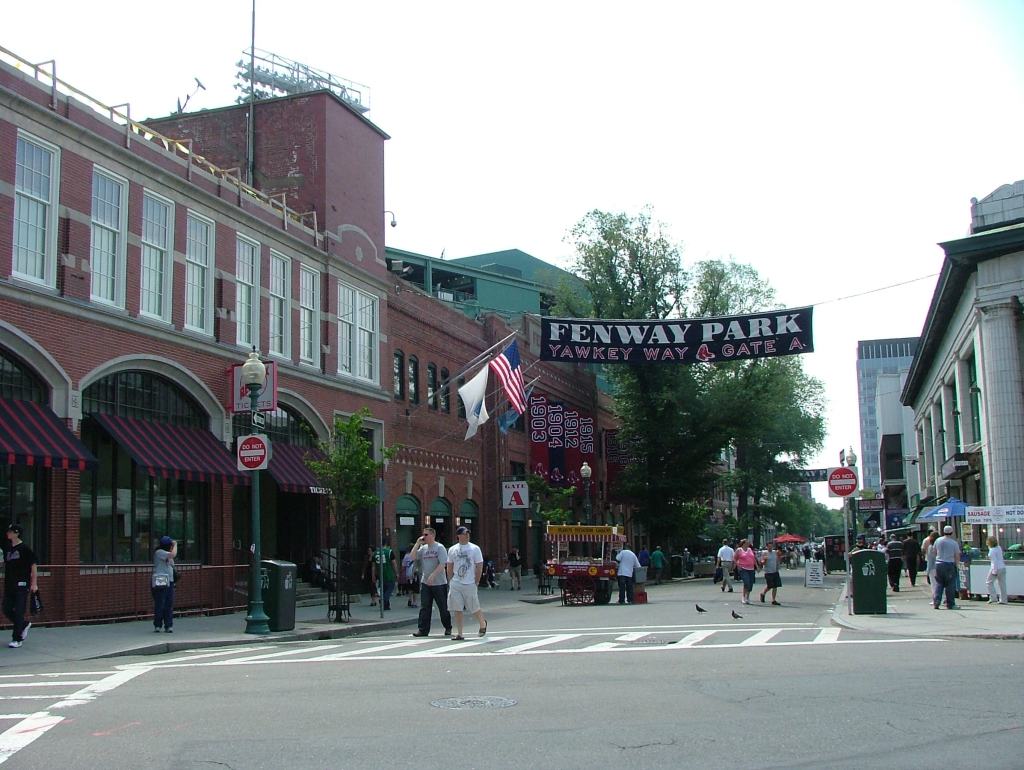
As expensive as the parking was for the Fenway, I was just across the street from the oldest MLB park. Not surprisingly, the neighborhood around the ballpark was packed, as vendors sold food, drinks and programs outside the park (often at greatly reduced prices). Fans milled around outside the stadium, as legions of others debarked from the “T” train (shorthand for the Massachusetts Bay Transit Authority or MBTA). This would be the last time I would drive to Fenway; taking the T from outside the the city to the park made so much more sense, with the Fenway Station stop a mere 500 feet from the park. If I wasn’t in a baseball mood coming up to Fenway, the sight of the venerable stadium and the buzz of the crowd would have certainly set the mood for me!

Ted Williams immortalized in bronze outside Fenway Park. (Photo credit: Jeff Hayes)

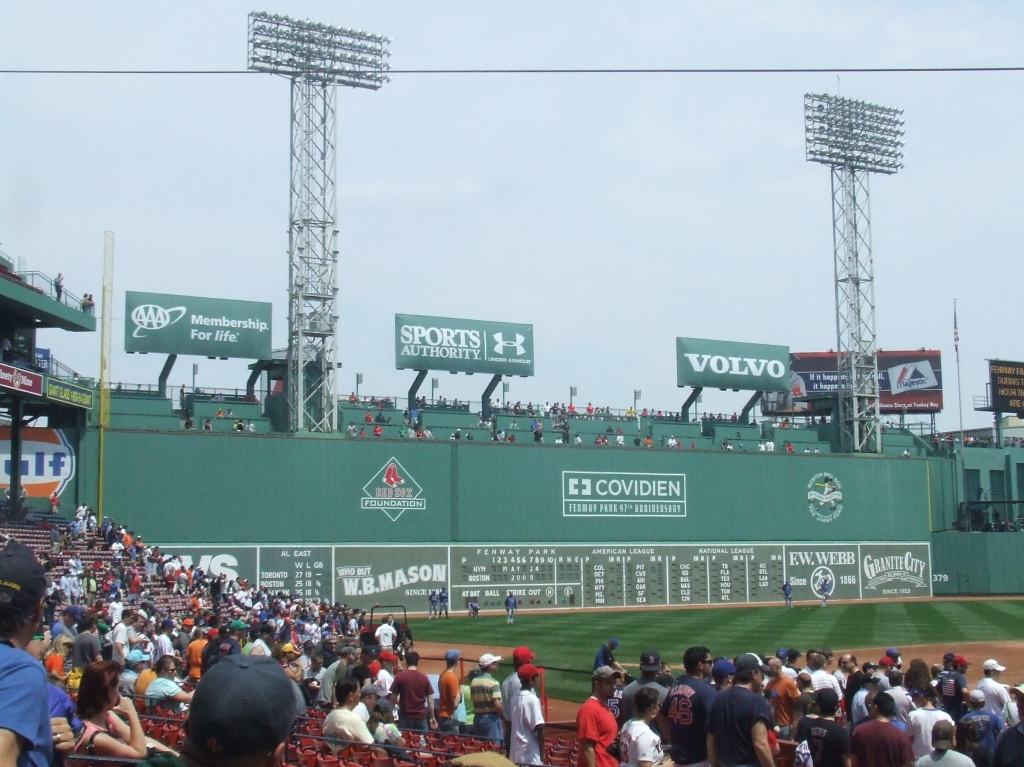
Entering the stadium from the home plate entrance, I emerged into the bright milky sunshine of Fenway Park. Much like I had seen on TV for so many years, the view of the stadium was dominated by the Green Monster. Almost a mythical presence, the Monster is one of the most recognizable ballpark features (along with the ivy in Wrigley Field) in baseball. Part of Fenway since it opened in 1912, the Monster has changed its appearance over the years, most notably adding seats at the top for the 2003 season. Beyond the Monster lies the iconic Citgo sign, another instantly recognizable feature to baseball fans. Unbeknownst to me before visiting, the sign is about one-quarter of a mile from Fenway; it looks much closer on TV.

After meeting up with my brother and his friends, we toured the ballpark. While the playing field and walls of Fenway Park are kept in good shape, the same cannot be said of the concourse stretching behind the seating areas from left field through home plate to right field. Actually, I was surprised to see how much this area has aged in comparison to the rest of the ballpark. In any event, we saw the staff at the concession stands standing with their arms crossed, not looking particularly friendly; I later read that this is a normal pose for them when not occupied. As was typical for me, I purchased hot dogs and a Coke before heading to our seats.

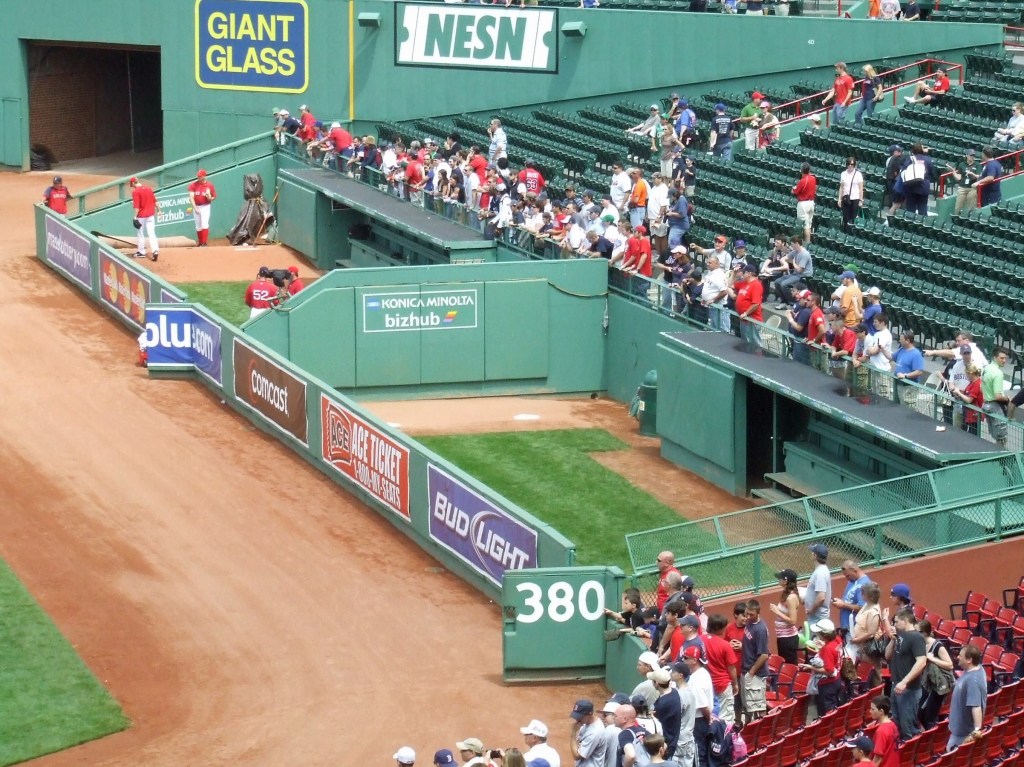
The bullpens at Fenway Park. Red Sox right fielder Dwight Evans made an amazing catch here to rob Cincinnati’s Joe Morgan of a go ahead home run in the top of the 10th inning of Game Six of the 1975 World Series. (Photo credit: Jeff Hayes)

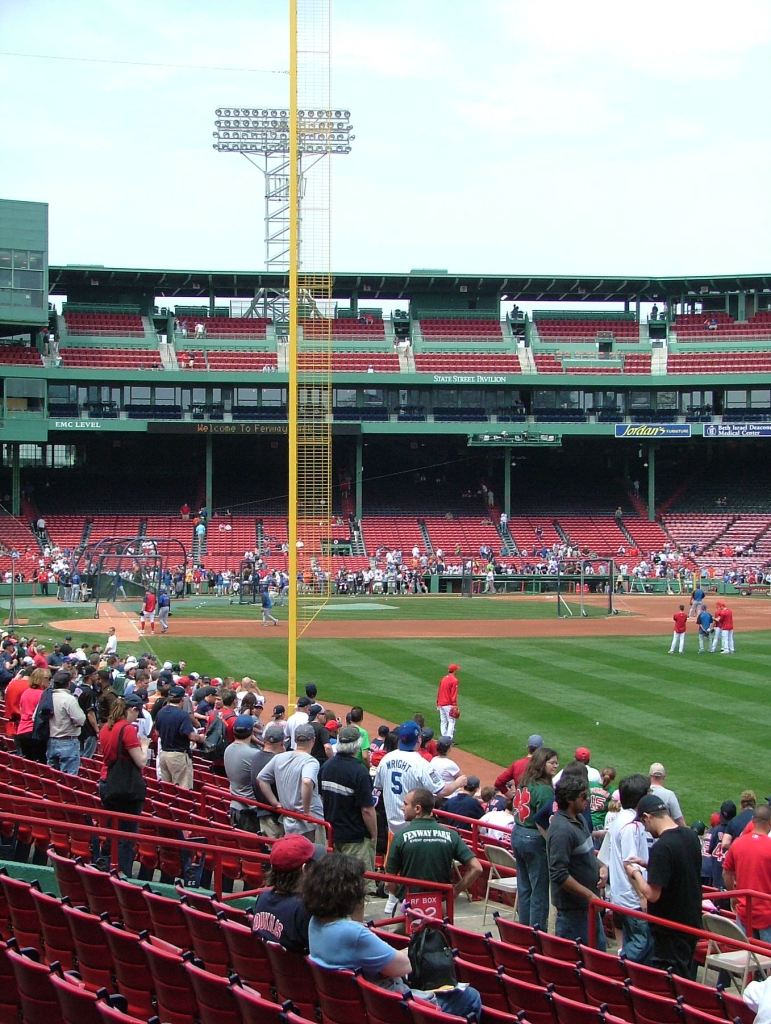
On that afternoon, we saw the Red Sox host the Tampa Bay Devils Rays, sitting near the right field foul pole. Though the view from the seats was not exactly fan friendly, I was just glad to be there. Sunshine and relatively light winds allowed temperatures to rise into the lower 60s (17 degrees C), which is pleasantly warm for northern New England in mid April. While the game was mostly unremarkable (as the Rays beat the Sox 5-1), my most vivid memory of the game (outside of finally visiting Fenway) was Jose Canseco’s solo home run in the top of the sixth inning. Fenway Park has short fences in both left and right field (though the Monster takes away some home runs due to its height), but no park (outside of Yellowstone) was going to hold the ball hit by Canseco. That home run was one of the longest home runs I have ever seen personally, easily clearing the top of the Monster, sailing over Lansdowne Street into the parking lot behind it.

For much of the rest of the game, I was marveling at the fact that I WAS AT FENWAY PARK! Along with Wrigley Field in Chicago, this ballpark is steeped in baseball tradition that dated back to World War I. As a kid, I watched the 1975 World Series from Fenway, which was one of the best series ever played. As a young adult, I saw the New York Mets sweep the games played here in the 1986 World Series on TV as well. Many Hall of Famers called Fenway home, and over a 40 year period (from the early 1940s through the early 1980s), only three players manned left field on a regular basis, and each one of these players is in the Hall of Fame. Though some changes had been made to the ballpark since my youth, it was still very much the stadium I remember from TV for all of those years.

A panorama of Fenway Park from the upper deck to the right of home plate. (Photo credit: Jeff Hayes)

Our second trek to Fenway Park together occurred on Sunday, May 24th 2009, as the Red Sox were hosting the New York Mets for the final game of a weekend series. My brother was visiting me in the Maine, and we drove down to Suffolk Downs (a racetrack), located outside of Boston. Parking there, we took the Green Line of the MBTA rail system to Fenway Park. Though the train ride was about 30 minutes, it was still faster (and cheaper) to park and ride than to drive to Fenway Park and attempt to find parking. As was the case a decade ago, the area outside of Fenway Station was buzzing with Sox fans, and that continued through our short walk to the ballpark. With a little more time to explore than our previous sojourn, we wandered through the neighborhood immediately around the park.

Jersey Street was reminiscent of Eutaw Street in Baltimore, with a wide variety of restaurants and food vendors near Fenway, serving practically any type of cuisine you could desire. Like Eutaw Street, we did not partake in the local food, but based on the number of people indulging, it appeared as though you could have a good afternoon simply sampling the food and drink the area has to offer. Instead, we chose to walk around the park. This time, my brother armed with his camera, we lit out, taking picture of the exterior of Fenway Park.

People milling around outside of Fenway Park well before game time. (Photo credit: Jeff Hayes)

As we past the left field wall, we saw a cab pull up to the curb. As the occupant exited, there was an audible murmur from the people nearest the vehicle. As we got closer, we could see that it was Mets centerfielder, Carlos Beltran. It seemed odd that (a) Beltran would get to the stadium so late (as I was sure the remainder of his teammates were already in the clubhouse), and (b) that the perennial All Star, who was near the end of a seven year, $119 million contract, would opt for a cab, and not a limo. Beltran disappeared quickly, not interacting with any of the cadre of Mets fans who were at Fenway for the weekend series.

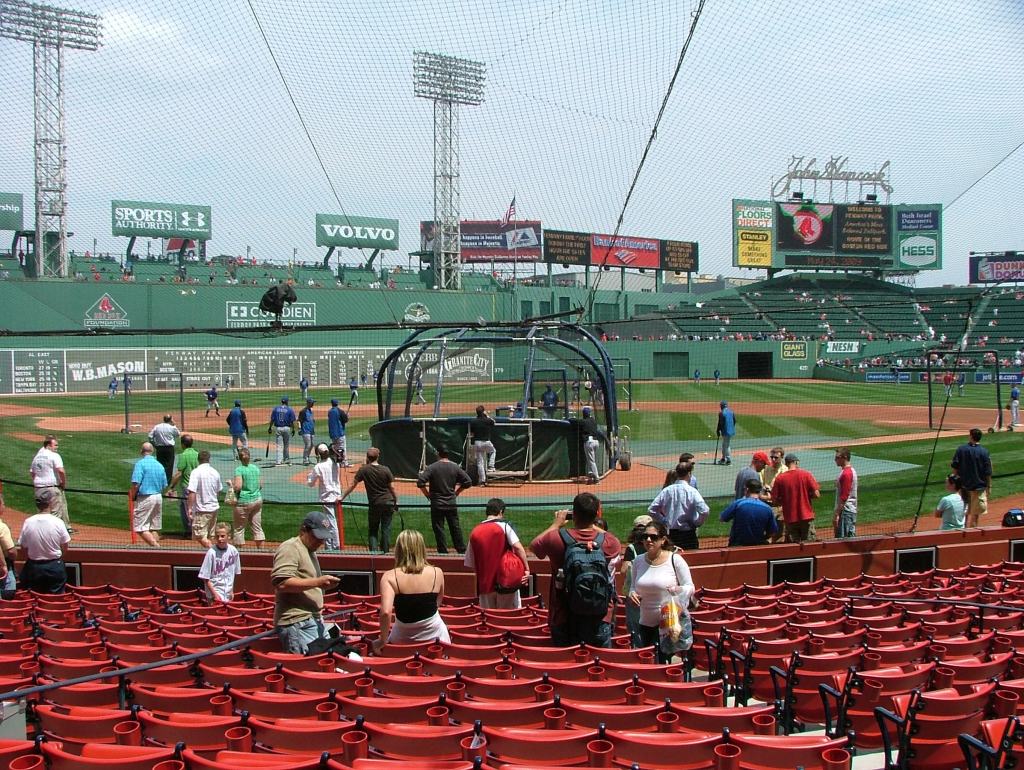
After finishing our tour of the exterior of the park, we entered Fenway through the home plate entrance. Because the Red Sox were playing so well, tickets to the park were nearly impossible to obtain outside of third party resellers, and those prices were exorbitant. A coworker offered us his standing room only (SRO) tickets for the game. Since we NEVER choose the SRO option for games, we were not aware of the potential pitfalls of those accommodations. Once you enter the park with SRO tickets, you need to stake your claim at the rail of your choice and hold onto it for the remainder of the game. Had I known what an SRO ticket entailed, I would have paid the bloated prices for seats, even if they were obstructed (as there are still obstructed seats at Fenway, most of which are blocked by support girders in the lower levels).

The view from behind home plate during batting practice. This was definitely NOT our view for the game. (Photo credit: Jeff Hayes)

Though it had been a decade since our last visit, I was just as excited to be there that day, especially because the Mets were in town. We wandered the lower concourse toward right field after visiting the home plate area. It was still fairly early, but we noticed there was a fairly large contingent of Mets fans lining the right field line, which was a bit surprising considering the availability of tickets for the game. Walking to the right field bleachers, we reached the extent to which we could explore in that direction, so we headed toward the left field line and the Green Monster. We weren’t able to visit the seats of the Monster, as they section had a separate entrance from the street below.

A panorama of Fenway Park from centerfield. (Photo credit: Jeff Hayes)

Having explored as thoroughly as possible, it was time for us to find a place from which we would view the game on this warm and humid afternoon. Not surprisingly, most of the rails already had a couple of lines of spectators near them, which meant we would have to keeping looking for a spot, finally settling on a mediocre view of the action down the left field line. About 15 minutes before game time, a thunderstorm made its presence known north of the stadium. Though the storm was still a good distance away, it was clear that it was strong, and heading our way. Despite the clear and present danger, the decision was made to start the game, even as the ferocious storm neared.

A view of downtown Boston over the center field bleachers on this hazy, warm and humid afternoon at Fenway Park. (Photo credit: Jeff Hayes)

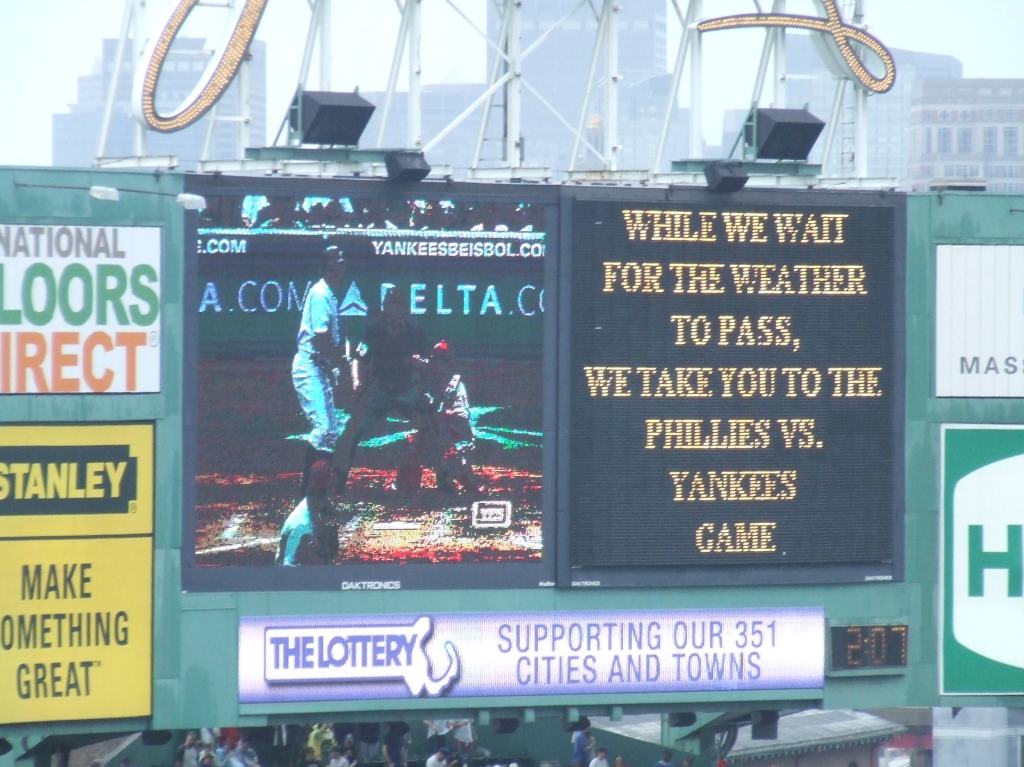
As the Mets took the field for the bottom of the first inning, the storm struck. Gusty winds, torrential rains, vivid lightning and continuous thunder accompanied the squall, sending the sellout crowd scurrying for cover. While it was clear this storm was going to impact the stadium, the game was started anyway, and I was at a loss to explain why the umpires would allow this to occur. A 45 minute rain delay ensued, as the fans in the tightly packed concourse waited increasingly impatiently for the storm to pass, if for no other reason than being able to get out of the concourse. When play resumed, both starting pitchers came back out, but had the rain delay lasted much longer, that might not have been the case.

Some entertainment on the videoboard as we waited for the storm to pass. (Photo credit: Jeff Hayes)

In 2009, the New York Mets were on the decline, after having some success earlier in the decade, while the Red Sox were a bit more than a year removed from their latest world championship. That did not bode well for the Mets, but both starting pitchers were ineffective (due to the rain delay?), resulting in a mini slugfest through the first half of the game. After that time, the potent Sox offense feasted in the beleaguered Mets bullpen, and the their chances for victory faded after that point. All the while, we were relegated to viewing action from a couple of rows from the railing, which was a dismal experience. With the Mets losing, and tiring of the poor vantagepoint, we did something we have only done a handful of times in the nearly 40 years of seeing baseball games together; we left before the end of the game.

A close up of the Green Monster from the lower level field seats. The hand operated scoreboard was one of the last of its kind, but newer ballparks started installing them for the retro feel. (Photo credit: Jeff Hayes)

Disappointed by the bad look at the action, we headed out to catch the “T” back to Suffolk Downs. Though this experience was not as good as the first, it WAS still Fenway Park. With so many features, quirks and landmarks, it would be difficult to cover all of them in this missive. It is one of my favorite parks (even more so than Wrigley Field, its contemporary), even though it IS aging. In need of a facelift at least, perhaps it is time to consider a new home for the Sox, leaving Fenway Park in place as a living museum, a reminder of what baseball once was. This opinion does NOT align with most fans, but I would prefer that the ballpark NOT go through the same changes as Wrigley Field, which could alter Fenway Park so much that the original stadium becomes unrecognizable.

The view from the right field foul pole, dubbed the “Pesky Pole”, as Red Sox 2B Johnny Pesky would occasionally take advantage of the short porch near the line. These were our seats for the first visit to Fenway. (Photo credit: Jeff Hayes)