Kyoto/Osaka, Tuesday September 25th, 2018

1. Kyoto

We started the day in Kyoto, the ancient capital of Japan, where we had been stationed during this portion of our baseball tour. Having arrived at the tail end of the monsoon season, the weather was generally warm and humid, with periodic sunshine and showers. These conditions made being outside tricky, but we braved the elements to explore Kyoto during the morning hours.

We utilized local mass transit in Kyoto, as the area was too expansive to walk, given the weather conditions. The concierge at the hotel provided us with bus passes for the day at greatly reduced prices. Should you find yourself in Kyoto, check with the hotel staff to purchase a day pass.

Along the banks of the Kamo River in Kyoto. (Photo credit: Jeff Hayes).

Our first stop was the western edge of Kyoto. Nestled between the foothills of the Hira Mountains and the Kamo River, the view was spectacular, even if the weather did not cooperate. The area was very popular with tourists, and the walkways and the restaurants were jammed on this cloudy and humid morning. We walked toward the foothills, reaching the Arashiyama Bamboo Grove toward late morning.
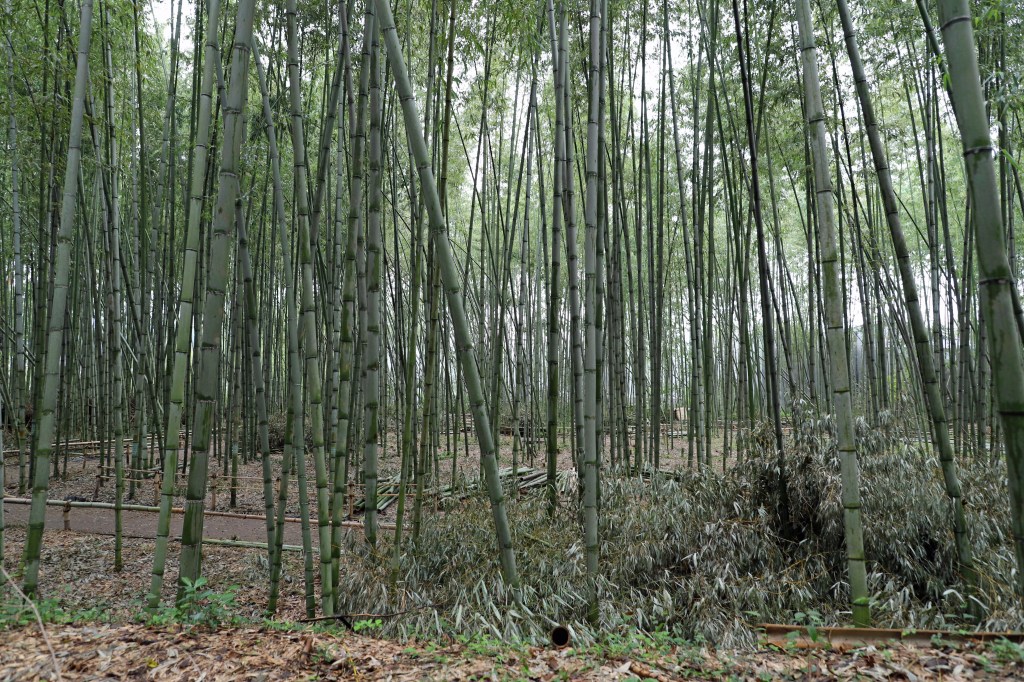
The fabled Bamboo Forest of Kyoto. If it wasn’t for the throngs walking through, it would be a very peaceful place. (Photo credit: Jeff Hayes).

In quieter times, I envision this place being peaceful, almost spiritual. However, on this day, the masses of people moving through the grove made it less so, though the walk was still worth the visit. At the end of the grove, there was an opportunity to visit some of the local wildlife.

A path in the mountains leads to the Monkey Park Iwatayama. The snow monkeys are located above the grove, about a 20 minute climb into the mountains. Unfortunately, I was unable to make the climb, missing out on an opportunity to feed and walk with the monkeys in the cloud shrouded peaks above. If you are interested in visiting the monkeys and taking in the views of Kyoto (should the weather allow it), you can learn more here.
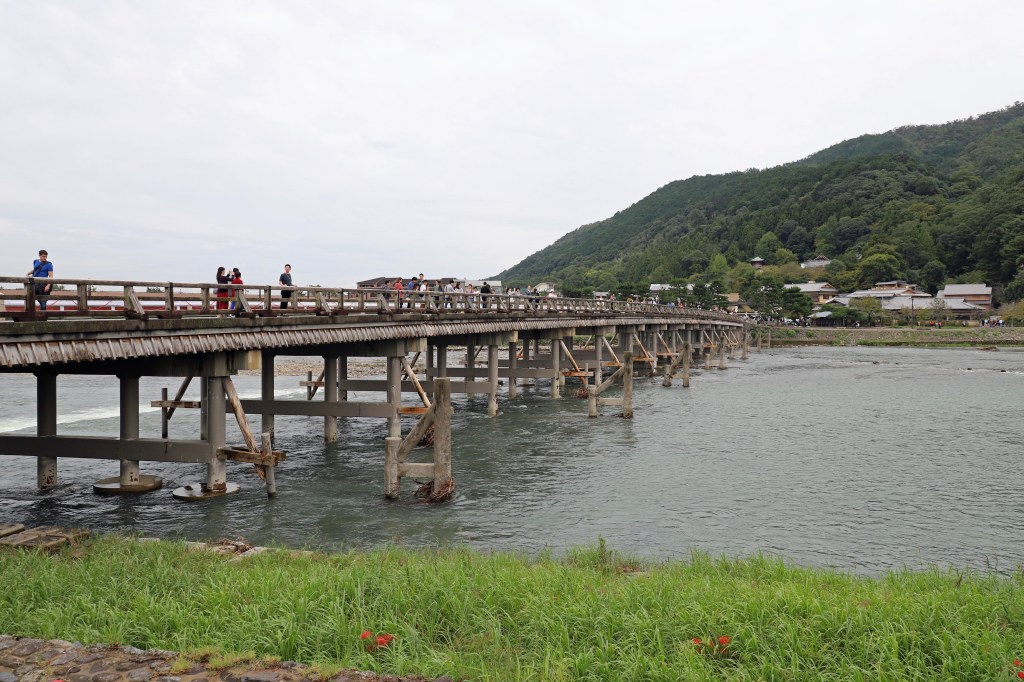
Togetsu-kyō Bridge in Kyoto. (Photo credit: Jeff Hayes)

Following our visit to the bamboo forest, we backtracked across the Kamo River on the Togetsu-kyō Bridge. Wandering along the river was peaceful, especially in between waves of tourists. Sitting along the river offered wonderful views of the mountains, though the higher peaks were obscured in clouds. It isn’t difficult to understand why the Japanese see this place as a cultural or moral center. Kyoto harkens back in time, and is often viewed as the Japan the way it once was.

We ate lunch at a local restaurant just off the beaten path, on the edge of the foothills. In addition to a wide variety of Japanese dishes, the restaurant also offered Italian cuisine. We’ve seen this in our travels across Japan. Perhaps the Japanese view Italian dishes as a “safe” alternative to Japanese dishes for tourists, or maybe they just like Italian food. Either way, having a limited and decidedly non-adventurous palette, I opted for the ravioli, which was surprisingly good.

One of many temples we saw in Kyoto, complete with women dressed in geisha garb. However, we discovered that being dressed like a geisha does not make her a geisha. (Photo credit: Melissa Willis).

After lunch, we wandered through the Arashiyama section of Kyoto. Despite the many cultural touchstones of Kyoto, I found my attention was riveted by the natural beauty of this place. Having crossed the bridge back into a more city like setting, we saw geishas in training, as well as a number of temples. In between temples, there were many, many places to buy souvenirs and take pictures. Having spent much of the early afternoon exploring, we caught the bus back to the hotel to rest before the game in Osaka that evening.

Even though there are many cultural sites to see in Kyoto, my memories are filled with images like this. Plus, there are snow monkeys up there!

2. Getting to Osaka

Following a short rest at the hotel, we started out for Osaka to catch a a game at the Kyocera Dome between the visiting Fukuoka SoftBank Hawks and the Orix Buffaloes. We took the Tokaido-Sanyo bullet train from Kyoto Station to Osaka Station, a trip of about 30 minutes. Upon arriving at Osaka Station, we boarded the Osaka Loop Line (using our Suica card) for the 20 minute ride to Taisho Station. From there, we walked about 700 meters to the stadium.

Google Maps showing the Osaka Loop Line. After arriving at Taisho Station, we walked to the stadium.

3. Kyocera Dome

Arriving not much more than an hour before game time, we walked to the Kyocera Dome box office to purchase tickets for the game. At virtually every other NPB ballpark, this might be a risky strategy. Most teams draw very well, with few day of game tickets available. However, the Buffaloes don’t draw well, and to our surprise, there were very good seats available.
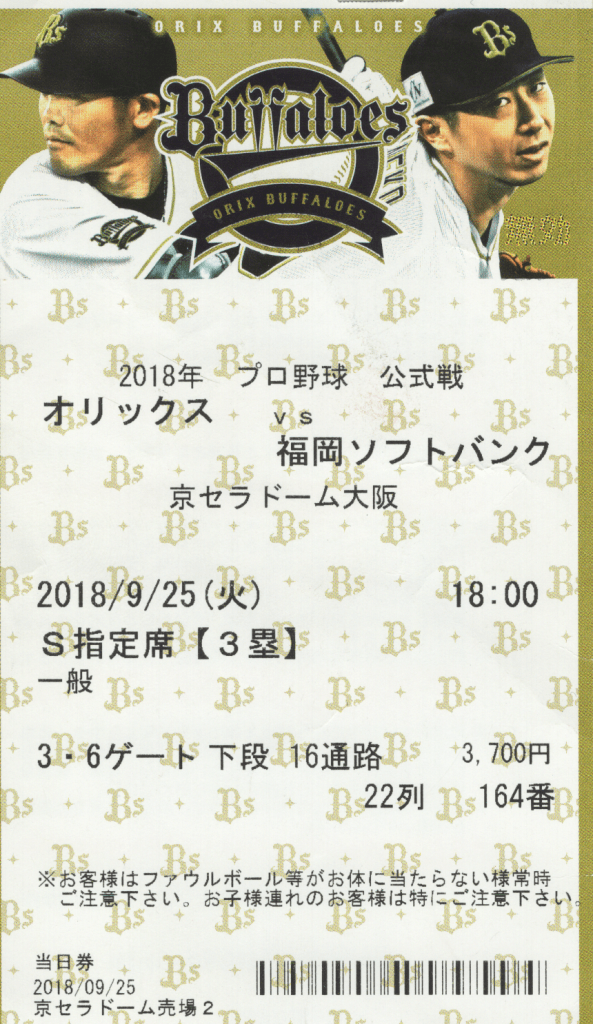
The information on this ticket is more difficult to decipher than most NPB tickets. We needed assistance finding our seats.

Fortunately for us, the box office staff understood enough English help us purchase the tickets. The ticket was more difficult to read than most, with no English and little obvious information containing the location of our seats. We followed some advice given earlier in the trip, and continued to hand our tickets to staff members until we were shown to our seats.

Since we had some time before the first pitch, we visited the team store. Unlike most team stores near or within the ballpark, the store had a large selection of souvenirs and apparel. After paying for the game tickets with cash, I didn’t realize that I had little money left when I attempted to pay for a Buffaloes cap (which was FAR more expensive than I originally thought).

In search of funds, I found an ATM in the stadium. As I had expected, my card was declined, since it was NOT a Japanese issued card. My brother came to my aid, but in my haste, I laid out near $100 USD for a cap that should have cost closer to $30 USD. This was my first mistake with Japanese currency (which was abetted by my misreading of the label). From that point on, I made sure to have enough cash on hand to solve most minor problems.
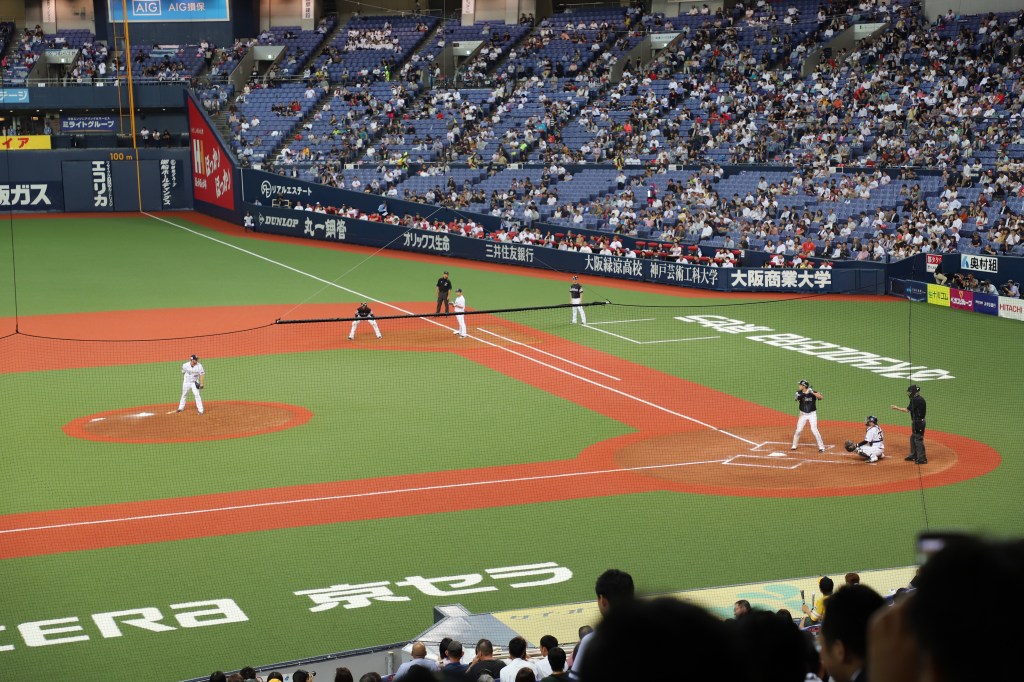
The view from our seats. (Photo credit: Jeff Hayes).

Returning to our seats shortly before the first pitch, we got the feel for the ballpark. The Kyocera Dome is a large indoor stadium, that seemed even larger with a sparse crowd. The park was reminiscent of Tropicana Field in St Petersburg, FL, in that it felt dim and empty. The Orix Buffaloes do not draw well, and that was evident in the stadium that night. As is typical, there was a sizable contingent for the visiting team in attendance, and there were times when the visiting team’s fans out cheered the home team’s fans.

The roof of the Kyocera Dome. Its appearance was eerily reminiscent of the bottom of an alien ship. (Photo credit: Jeff Hayes)

The Kyocera Dome also has a unique roof. The roof looks like the underbelly of an alien ship, casting a presence over the entire field. Against the backdrop of the huge roof, the thin crowd made the park seem nearly empty. The visiting Hawks scores early and often against the hapless Buffaloes, to the delight of the Hawks’ faithful in the left field stands. Though the Buffaloes did scores some runs late, the Hawks held on for an 8-5 victory.

The fairly sterile environment, lack of fan support, and the poor team on the field made this stop the least enjoyable on our Japanese tour. While we may visit Osaka again, it is highly doubtful that the Kyocera Dome will be on the agenda.
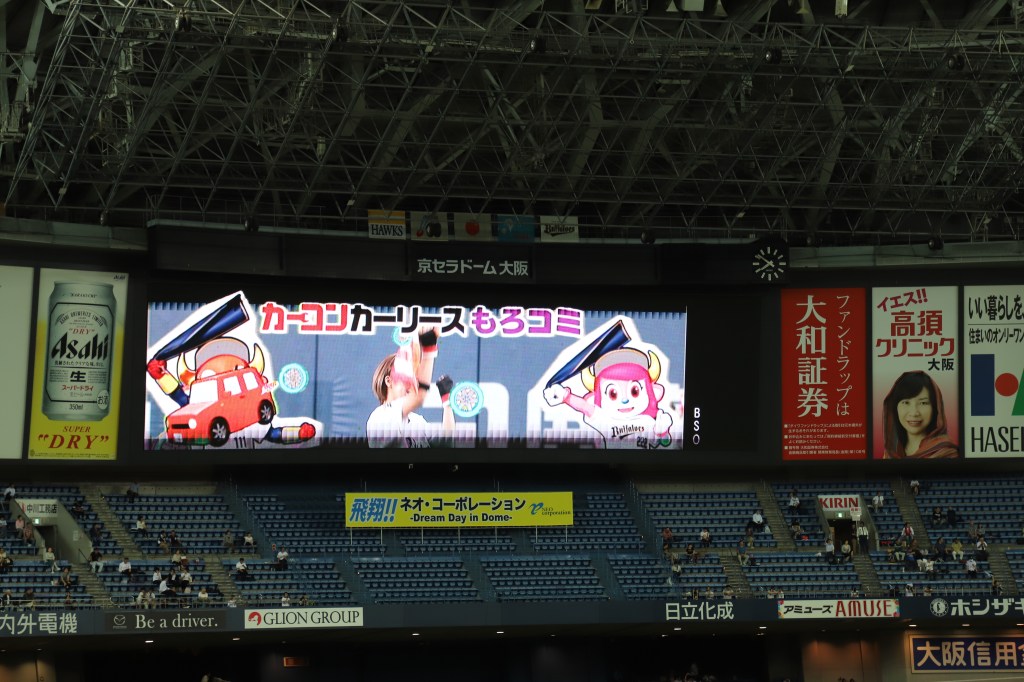
The colorful scoreboard was more entertaining than the game at times. Note the scattering of fans in the left and centerfield seats. (Photo credit: Jeff Hayes).

Tokorozawa, Monday April 2, 2019

Our first stop on the 2019 Japanese baseball tour was Tokorozawa, on the northwest outskirts of Tokyo. Slated for an 1800 start, the Saitama Seibu Lions hosted the Chiba Lotte Marines at the MetLife Dome. The game marked the beginning of the season for both teams. After a cool day in Tokyo, temperatures were already plunging when we headed out from the hotel in Shinjuku to the ballpark.

1. Getting to the MetLife Dome

There is an old saying in the state of Maine (USA) about how to get somewhere. The saying states that there are a number of ways to get there, but none of them are good. That old saying could apply to getting to the MetLife Dome from Tokyo. There are a few train lines to the stadium, and each one requires at least three station and three train line changes. Needless to say, this trip is not for the faint of heart, especially if you are not comfortable with busy trains and stations.

A screen capture of the route we took from Shinjuku to Tokorozawa for the game. There are several possible routes to the staidum, and I am not sure which is the best. After some quick research in the Google Maps app, this is the route we chose.

From Shinjuku Station, we caught the Saikyo line to Ikebukuro Station. We were on this line for just one stop, reaching the Ikebukuro Station in about six minutes. Because of the game start time (1800), we were forced to travel during the beginning of the commute, which meant a packed car. From here, we changed to the Ikeburuko Line, headed for the Nishi-Tokorozawa Station. We were on this line for 27 minutes (four stops) before reaching the next station. At the Nishi-Tokorozawa Station, we changed to the Sayama Line to the Seibukyujo-Mae Station, and took it for two stops (about six minutes). From the station, it was a short walk to the stadium (less than 250 meters). The entire trip (included line and train changes) was about 51 minutes, and you should build in more than an hour to get the stadium.

A recap of the trip from Shinjuku Station to the Metlife Dome

  • Take the Saikyo Line from the Shinjuku Station to the Ikebukuro Station (one top, six minutes)
  • Take the Ikeburuko Line from the Ikebukuro Station to the Nishi-Tokorozawa Station (four stops, 27 minutes)
  • Take the Sayama Line from the Nishi-Tokorozawa Station to the Seibukyujo-Mae Station (two stops, six minutes)
  • The MetLife Dome is a short walk (less than 250 meters) from the Seibukyujo-Mae Station.

Best advice: use the Google Maps app to determine the best route from your starting point to the stadium BEFORE YOU LEAVE. This simple strategy could save you some frustration later. Be prepared for crowded trains if you travel near the commute, and leave yourself some time to find the train lines you need to catch at each station.

2. MetLife Dome

From the outside, the MetLife Dome looks as the name implies: a domed stadium.

The view of the MetLife Dome leaving the train station. (Photo credit: Jeff Hayes)

However, upon further inspection, it becomes clear that this is not a typical domed stadium. The locals call the MetLife Dome the “stadium with an umbrella”. The stadium was built in 1979 without the dome, which was finished after the 1998 season. The dome covers the stadium, but unlike most domed stadiums in the US, it is open on all sides (hence the description “stadium with an umbrella”). This allows air into the stadium, and crosswinds as well.

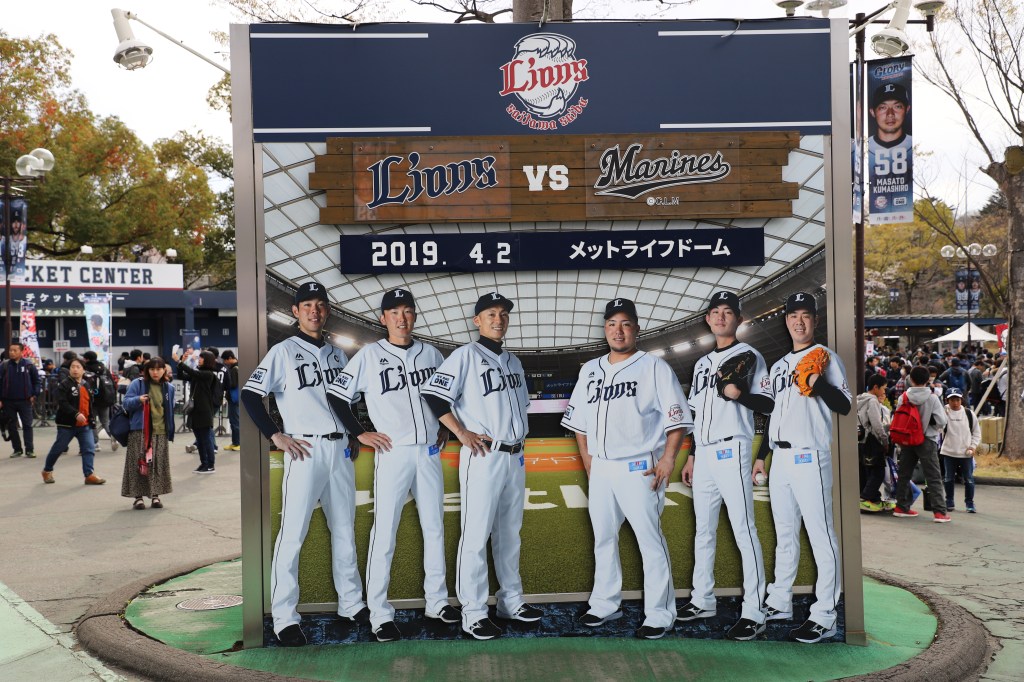
Like most NPB ballparks, there is plenty to do and see outside the stadium. There are shops and food stands, and you could even have your picture taken with life like images of the Lions. (Photo credit: Jeff Hayes)

Most NPB ballparks have things to do and see outside the stadium, and the MetLife Dome was no different. There were plenty of places to eat and drink, as well as shops for home team apparel. In fact, I was able to get a Chiba Lotte Marines cap at one of the stands, even though they were the visiting team. Given the distance from Tokyo, it was not suprising that we did not see too many foreign faces, or hear much English spoken. After soaking in the atmosphere outside the park, we headed to the gate to enter the ballpark.

My ticket for the game. While I don’t read Japanese, we were able to determine the gate number, row and seats from the ticket.

Much like in the US, stadium security checks bags, but there does not seem to be a size limit to the bag you can bring into the park (as long as it does not get in the way of others). Concession stands were found shortly after walking in, and we decided to get something to drink. Being a distance from Tokyo, ordering was a challenge, since the staff at the concession stands did not seem comfortable with English. However, there was a picture menu available at the window, and I was able to get some water by pointing to it, and indicating how many waters with my fingers. Not an elegant approach, but it did the trick.

The view from our seats. You can see over the left field wall the opening to the outside. (Photo credit: Jeff Hayes)

We were able to walk the concourse surrounding the playing field, taking pictures as we made the loop. We arrrived early enough to catch batting practice and fielding practice. The sun coming in from left field was nearly blinding at times, and wreaked havoc with throws from the outfield to the catcher. Even though it was just practice, many of the Lions players made impressive plays in the field, and throws to the plate.

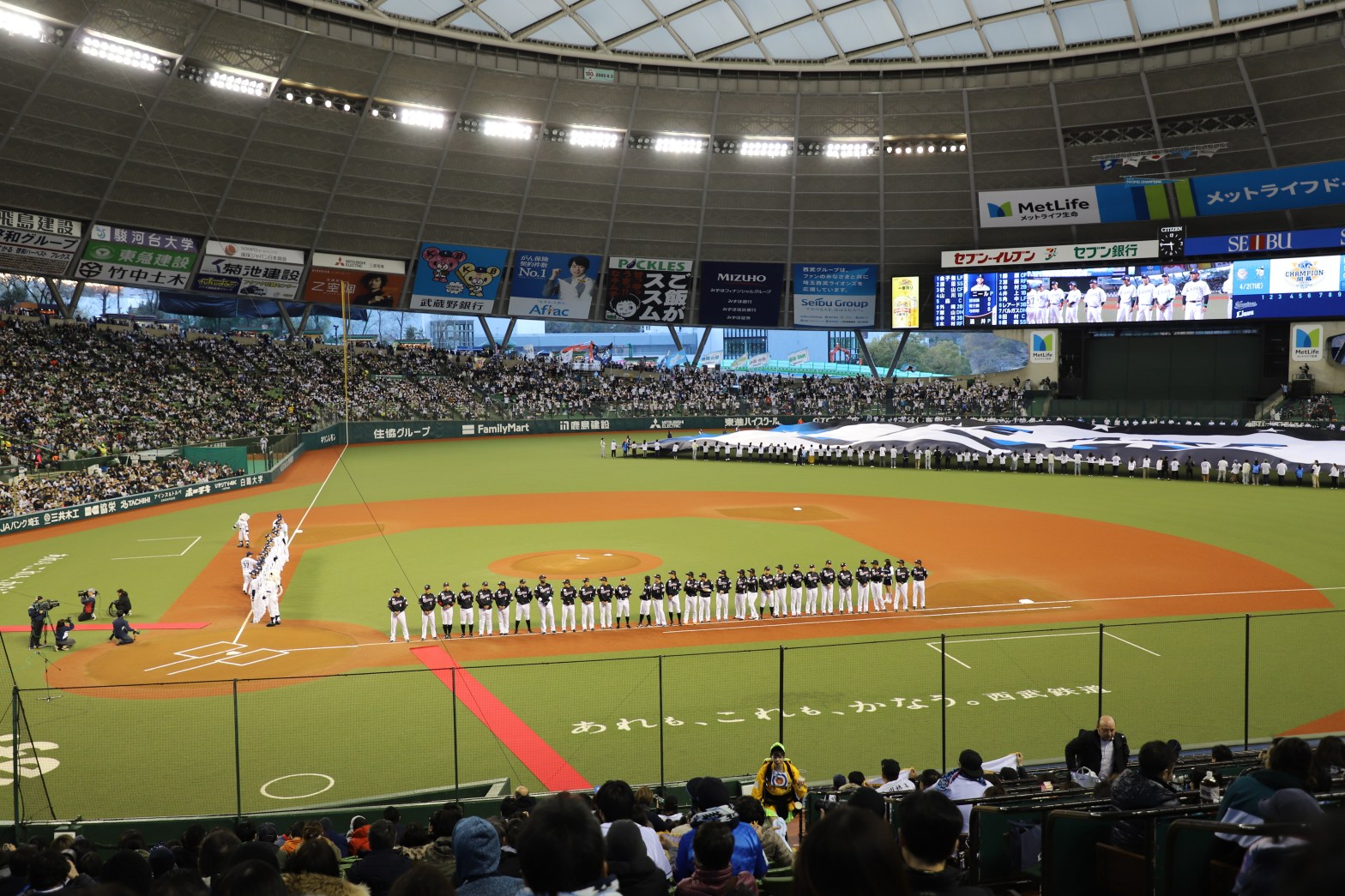
Unbeknowst to us, this was the Opening Night of the 2019 season for both teams. The Lions won the NPB championship in 2018, and we were treated to the pagentry of Opening Night and the ceremony for winning the championship. Luckily, the festivites took place well ahead of the game start time, and at 1800 we were ready to start the game.

Lineup exchange at the plate just before game time. Note that the managers and umpires are dressed for the cold weather. (Photo credit: Jeff Hayes)

While there were some foreign players in the lineup (there usually are), none of them were familiar. The open air nature of the of the stadium allowed a persistent 20 km/hour wind from the north to penetrate the field, and it became obvious early on that this was going to be a cold night in Tokorozawa. The wind was biting, make temperatures near 8 degress Celsius at game time feel much colder.

A scoreless tie through two innings was broken by the Lions, who scored one run in the third, and two runs in the fourth, fifth and sixth innings each, pushing the game out of reach for the Marines. The Marines did respond with runs in the sixth, seventh and eight, but not enough to overcome the deficit. The pace of play in NPB games is typically slower than MLB games (if that is even possible), and we had only reached the seventh inning by the time the game was three hours old.

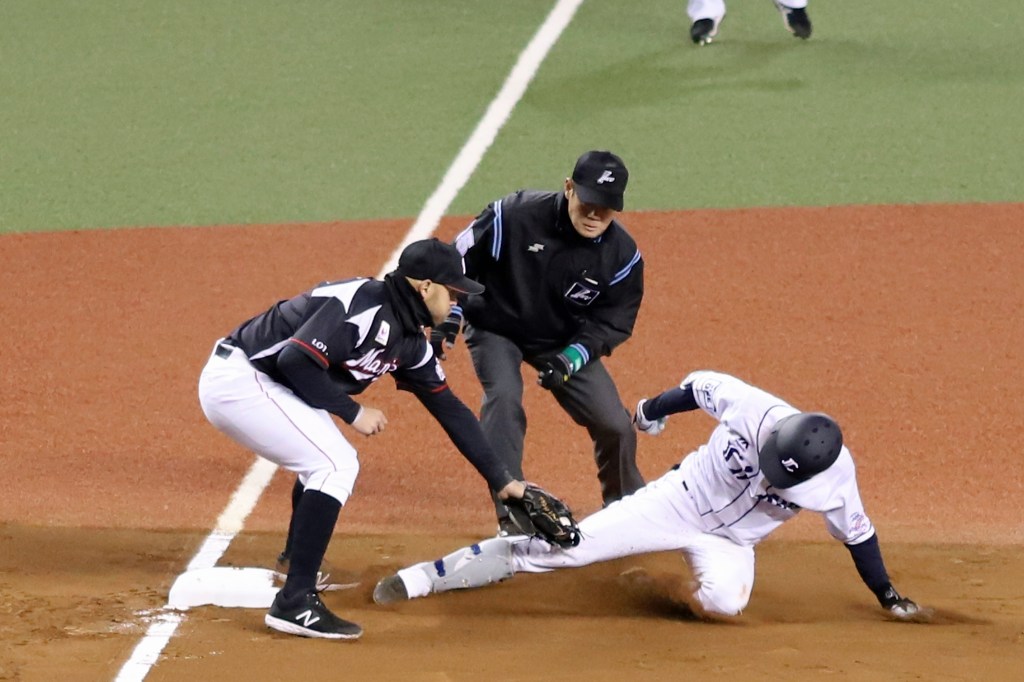
A bang bang play at third. Though the call at third was safe, my brother’s picture clearly shows that the throw beat the runner. There is replay in NPB games, but this play did NOT generate a replay challenge. (Photo credit: Jeff Hayes)

By the middle of the seventh inning (when the Japanese release balloons, rather than stretch), the cold had become pervasive. This die hard baseball fan had had enough of the cold, and we did something we have done just a handful of times in the past: leave before the end of the game. By this time, air temperatures were near 3 degrees Celsius, and wind chill values were below zero Celsius (possibly qualifying as the coldest baseball game I’ve ever attended). Having gotten the feel for the stadium and the environment (even in the cold, the fans chanted for every batter; you can get a sense of that here), we headed for the train.

We were hardly alone, as there was a steady stream of fans headed for the train station. This caused a bit of delay getting on the train, and once inside, we noticed that the cell signal was not that strong. Using Google Maps for directions became problematic, but fortunately we were able to recall the steps taken to get there, and reversed them to get back to hotel in Shinjuku.

Think baseball is big in Tokorozawa? (Photo credit: Jeff Hayes)

While the stadium was nice, with good sight lines and an excellent scoreboard in centerfield, the number of train changes, as well as the cold, lessened the enjoyment of the event. Because of these factors, I am not sure I will visit this stadium again.

Shinjuku, Wednesday, April 3rd, 2019

Shinjuku at night. Shinjuku is probably my favorite part of Tokyo..

1. Tokyo to Fukushima

Since we had time, and the JapanRail Pass at our disposal, the day started with a side trip to Fukushima. We intentionally left after the Tokyo morning commute, arriving at Tokyo Station after 0900. We boarded the Tohoku-Hokkaido Shinkansen bound for Fukushima station at 1000.

Shortly after leaving the Tokyo metro area, we were surrounded by rural Japan, interspersed with smaller towns along the way. Based on our speedometer apps, the bullet train topped out near 180 mph (300 kph). Visiting Fukushima aside, I simply enjoyed riding the train. The ride afforded us an opportunity to see parts of Japan we might otherwise miss.

The view from the train, traveling north toward Fukushima. The snow capped mountains in the distance reminded us that it was still winter in part of central Japan.

Sunshine in Tokyo was gradually replaced by clouds as we moved north. A cool start in Shinjuku turned into a winter’s day the further north we reached. The 93 minute trip felt like a trip back in time, as spring reverted to winter before our eyes. Not far outside of Fukushima, the sky became overcast, and the skies opened up. However, rather than a rain shower, we encountered a fairly vigorous snow shower.

Snow showers descending out of the mountains toward the train outside of Fukushima.

By the time we reached Fukushima, the sun was peeking out from behind the clouds. However, despite the weak early April sun, it was cold, with a stiff northwest wind making feel like mid January. We braved the cold to walk around the city. Fukushima, a city of a roughly 250,000, is about 10 miles from the exclusion zone following the earthquake and tsunami in 2011.

Despite arriving near midday, the city was curiously devoid of activity. Walking through central Fukushima, we encountered few people outside. Passing the local high school, we were greeted by some students, who insisted on high-fiving us as they passed. We’ve noticed in our travels that younger people will interact with us, while older Japanese tend to shy away.

Walking down the street from the station, we encountered an older Japanese woman. I fully expected her to walk by without even looking up, as we have seen in the past. However, as she approached us, her eyes brightened, smiled and warmly said “Good morning!” in English as she passed. I stopped in my tracks, as I was stunned. In the moment, I wondered when the last time she said good morning in English.

Domino’s in Fukushima. Not pictured here is the Denny’s just down the street. Almost reminds me of home. (Photo credit: Jeff Hayes)

While we didn’t see many people on this cold afternoon, we did find some reminders of home down the street from the station. Seeing the American franchises in Fukushima, I couldn’t help but wonder if we were exporting something that could change the way the Japanese eat.

After walking through the streets of Fukushima for more than an hour, we headed back toward the train station for the trip back to Shinjuku. On the lower level of the station, there were shops and places to eat. Instead of a meal, we opted to get something from the convenience store there, then headed upstairs to track level.

A display in the Fukushima train proudly announcing that baseball and softball will be played here in the 2020 Olympics. (Photo credit: Jeff Hayes)

On the track level, we discovered an impressive model train setup, as well as displaying touting the arrival of the world for baseball and softball with the Olympics in 2020. The Fukushima station was possibly the nicest train station we visited in Japan. Walking through the station to catch the train back to Tokyo, I couldn’t help but wonder if the quiet town of Fukushima was ready for what was coming in little more than a year.

2. Getting to the game in Shinjuku

Following the quick trip to Fukushima, we ate a late lunch and relaxed at the hotel before heading out to the game. Fortunately for us, our hotel was less than 3.5 kilometers from the park. Since there was not a clear path to walk there, we took the Chu-Sobu Line from Shinjuku Station to Meiji Jingu Station. The trip consisted of three stops, followed by a 1.1 kilometer walk from the Meiji Jingu Station to Mejij Jingu Stadium. After leaving the station, it was not clear how to get to the stadium. Once you leave the station, you need to cross UNDER the tracks and head up a gentle slope to reach the sidewalk on the other side.

Once you reach the top of the slope, you will see a stadium. When we were there in April of 2019, the stadium was under construction. This is NOT Meiji Jingu Stadium; it is a stadium for hosting events for the Olympics. You need to walk beyond this stadium, cross the street and walk a couple of blocks to arrive at Meiji Jingu Stadium. We managed the walk and search for the stadium with relative ease. However, if you are traveling with someone who has difficulty getting around, you may want to consider hailing a taxi at the train station.

On a side note, the entrance to Meiji Jingu Shrine is across the street from the sports complex. It is a picturesque park with the shrine in the middle. This is not a place to visit just before a game; the shrine grounds are too sprawling to attempt to cover shortly before a game. Instead, if your schedule allows it, visit the shrine when you have a couple of hours to devote to it.

Meiji Jingu Shrine in Shinjuku. The sprawling complex has several central buildings, as well as trails for hiking. (Photo credit: Jeff Hayes)

3. Meiji Jingu Stadium

Like many NPB ballparks, the official team store for the Tokyo Yakult Swallows is not at the stadium. Actually, it about 250 meters BEFORE the stadium on the left hand side of the street. If you have trouble finding it, just follow the crowd. The store is VERY popular, and we suggest leaving some time to browse before heading to the park. Inside the store, we found the standard fare, with a good selection of apparel. My brother scored a colorful Swallows jersey, while I opted for a cap and yearbook (which is, of course, in Japanese). Don’t worry about taking your team store bags into the stadium; unlike MLB parks, the NPB parks are more lax when it comes to bringing bags into the stadium. You will, however, have to open your bag for security before entering the ballpark.

Following the mini shopping spree, we headed for the stadium just up the road. There was not much to see outside, so after a cursory look, we entered the ballpark. We were able to discern the gate through which we were supposed to enter, but after that we had to hand our tickets to stadium staff to help us to our seats.

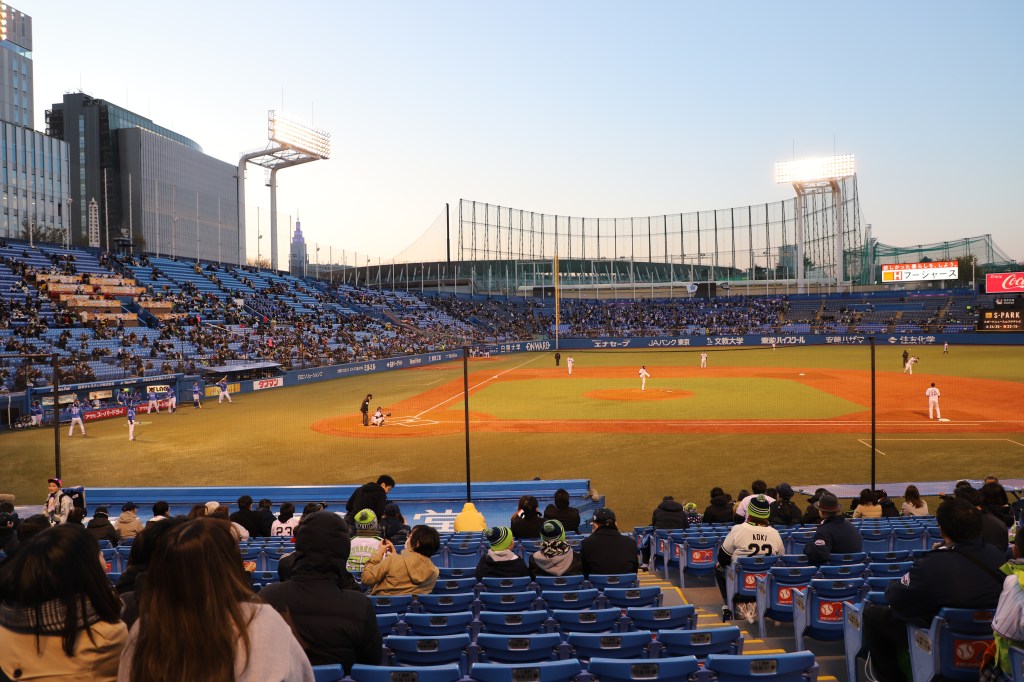
The view from our seats in Meiji Jingu Stadium. Unlike most of the NPB games we’ve seen, this one was lightly attended. Perhaps the fact that the game time temperature for the 1800 start was about 5 Celisus (about 41 degrees Farenheit) had something to do with the small crowd. (Photo credit: Jeff Hayes)

From the moment we decided to come to Japan to see baseball games, Meiji Jingu Stadium was on our radar. This ballpark is hallowed ground. Beside being the second oldest ballpark in Japan (having opened in 1926), it is one of four major league stadiums in which Babe Ruth played that are still in use (the others being Koshen Stadium near Kobe, Japan, Fenway Park in Boston, and Wrigley Field in Chicago). It should be noted that this distinction will disappear after the 2020 NPB baseball season. For the 2021 season, the Swallows move into the new stadium down the street constructed for use in the Olympics.

From the first view, it was clear that this stadium was a classic, a must see for baseball fans. Cozy by MLB standards, the stadium holds 35,000+ fans (and the seats are a tight fit for visitors), but on this night, there were nowhere near that many people in the seats. Just like night games in the US in April, you run the risk of conditions that are not ideal for watching a game. The temperature for the 1800 start was 41 F, under a perfectly clear sky. The Swallows hosted the Yokohoma DeNA BayStars (a team we would see at home later in the week).

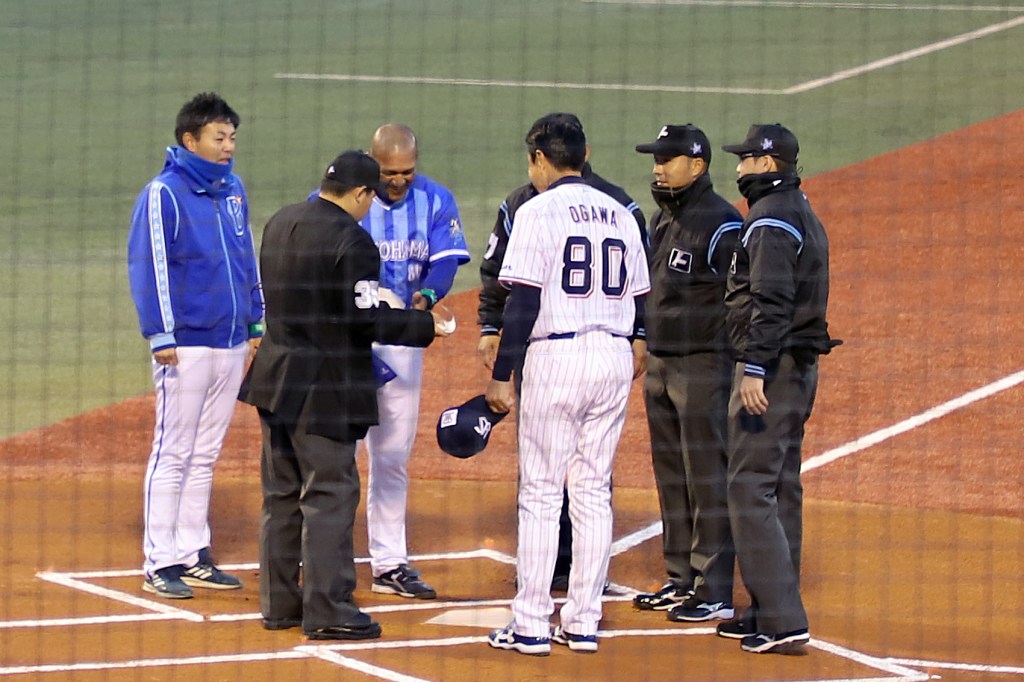
For the exchange of the lineup cards, the managers, coaches and umpires were bundled up against the cold. (Photo credit: Jeff Hayes)

There were some familiar names in the lineup for both teams. For the visiting BayStars, Neftalí Soto was batting second and playing RF. Soto played for the Reds in 2013/2014, and was in the Washington Nationals farm system as recently as 2017 (we saw him play as a member of the Harrisburg Senators).

Wladimir Balentien, the LF for the DeNA BayStars.

The Swallows lineup featured Nori Aoki (who played for the Royals, Giants and Mets in the MLB) batting second and playing CF. In LF was Wladimir Balentien, who played for the Reds and Mariners between 2007 and 2009. The Swallows struck first in bottom of the 1st inning with a single run. The BayStars responded with four runs in the top of the 4th inning, a lead they would protect through the middle innings. The relatively slow pace of the Japanese game, coupled with the very cold temperatures for a baseball game, had this veteran fan ready to call it a night in the 7th inning. My brother convinced me to brave the cold for just a bit longer, though I wasn’t so sure about that decision.

Despite the cold, the BayStars fans filled the left fields stands, the traditional seating for opponet fans at NPB parks. (Photo credit: Jeff Hayes)

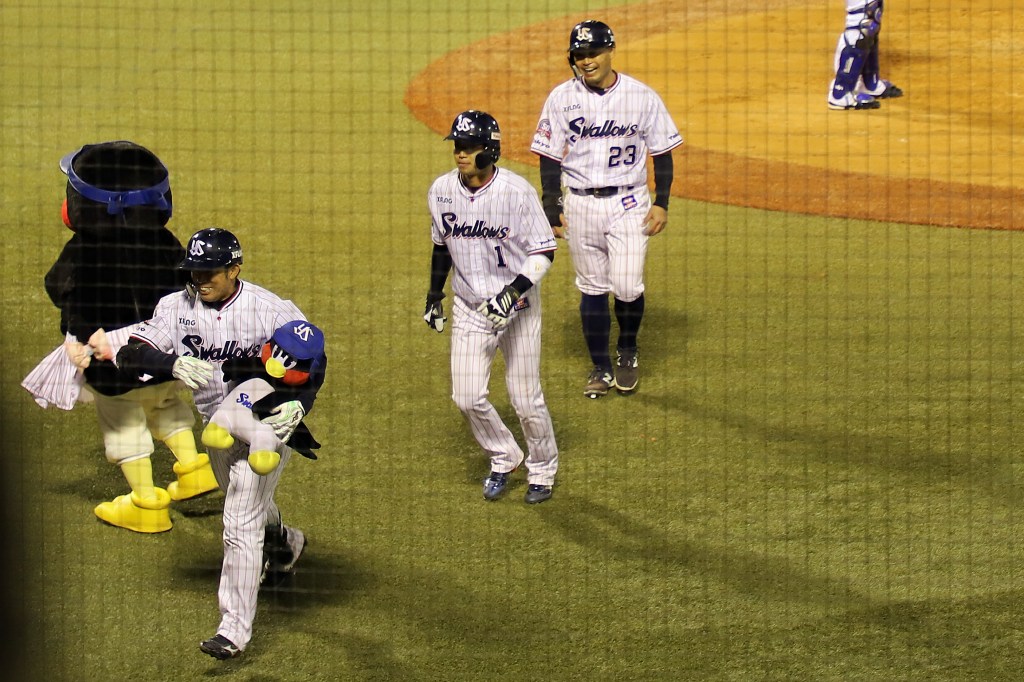
The Swallows offense came to life on this cold night in the bottom of the 8th, as a three run homer by RF Yuhei Takai tied the game at 4. After a scoreless top of the 9th, the Swallows scored in the bottom of the 9th to win 5-4. The game clocked in at about three hours, which seems to be about average for an NPB game. The cold made it seem longer, but the Swallows comeback, and the crowd reaction to it, made sitting in the cold worth the effort.

RF Yuhei Takai receiving a Tsubakuro doll (the Swallows mascot) after hitting a three run homer to tie the game. It is customary for players to receive a doll after hitting a home run in Japan. (Photo credit: Jeff Hayes)

The ending was befitting of the venue. We feel fortunate to have visited Meiji Jingu Stadium, steeped in tradition and NPB history. It will be a sad day when the Swallows move out of this historic and beautiful ballpark for a new home just down the street.