Clipper Magazine Stadium, Lancaster PA July 10-11 2021

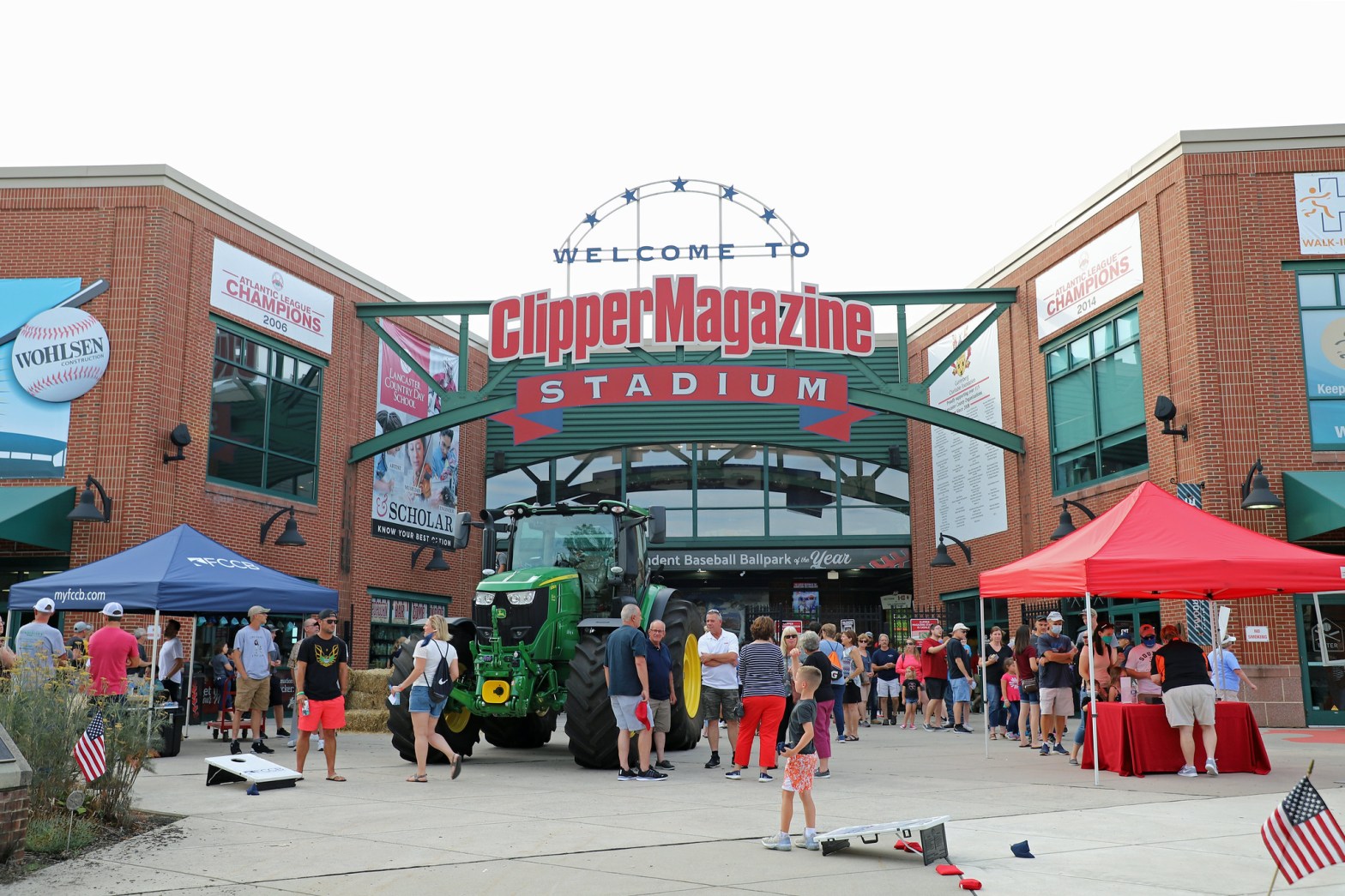
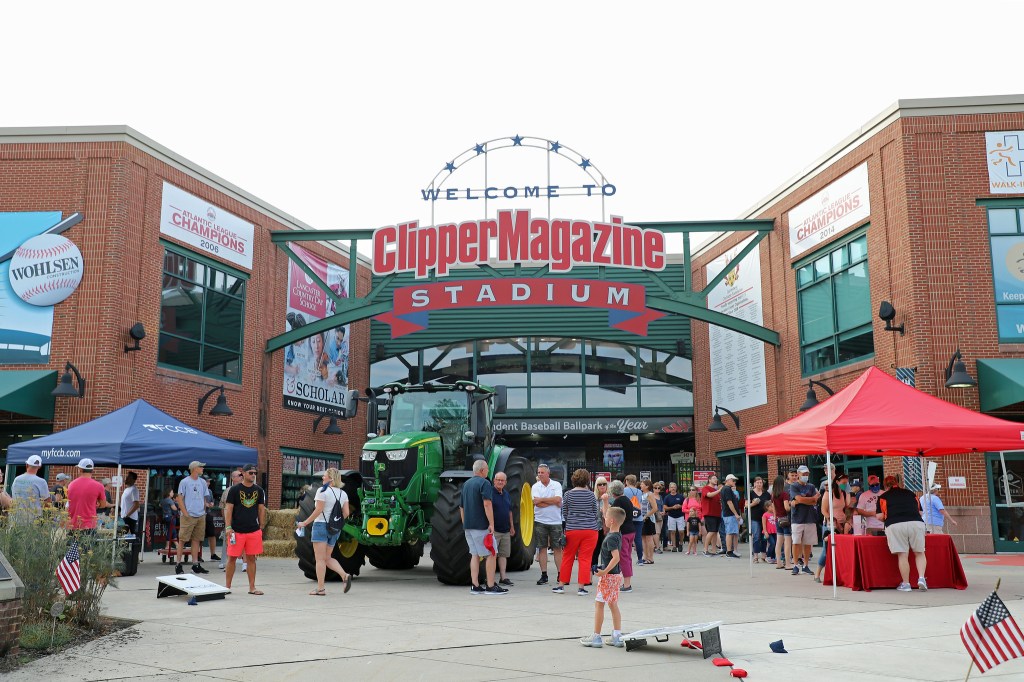
Clipper Magazine Stadium on Farm Show Night in Lancaster, PA. (Photo credit: Jeff Hayes)

Though the threat of storms loomed across central and southeast PA during the weekend of July 10-11, 2021, my brother and I planned to visit Clipper Magazine Stadium to see the Atlantic League of Professional Baseball’s (ALPB) Lancaster Barnstormers take on the Gastonia Honey Hunters for the final two games of their weekend series. Clipper Magazine Stadium is about 50 minutes from my home in central PA, so we were able to enjoy the comforts of home while adding a new ballpark to our list.

Arriving about 50 minutes before the first pitch for the Saturday July 10th evening game (with the first pitch scheduled for 635 pm), we were surprised to find a line to get into the parking lots of Clipper Magazine Stadium. In fact, the first parking lot we encountered on our left (open to the general public) was filled, and we needed to proceed to a lot further up the road. Unlike most ballparks, parking here was free. From the lot further from the park, the walk to the ballpark was less than 10 minutes. As we typically do, we toured the outside of the stadium. Upon reaching the main gate, we discovered that the ticket office was very busy, as it appeared as though a large walk-up crowd was taking advantage of the warm and not too humid summer weather to take in a ball game on a Saturday night.
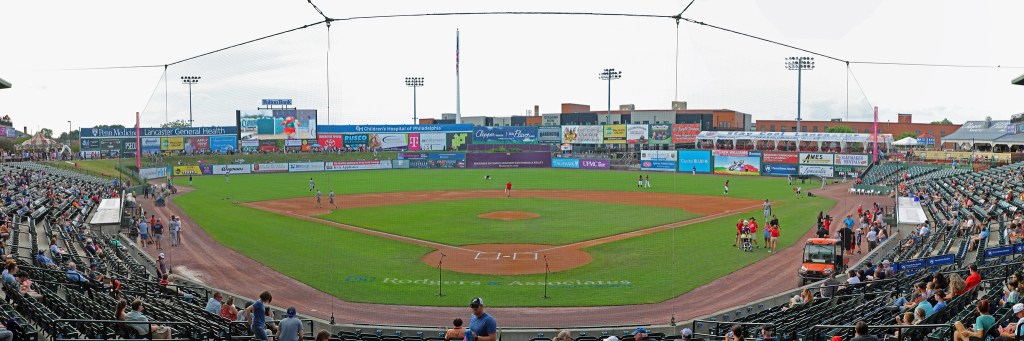
A composite image showing Clipper Magazine Stadium from behind home plate. (Photo credit: Jeff Hayes)

At first glance, the main gate of Clipper Magazine Stadium bore a resemblance to PeoplesBank Park in York, PA (the home of the York Revolution, another member of the ALPB). Eventually, we worked our way back toward an entrance in centerfield. Having seen what we could from the outside, we decided to enter the park at this entrance. While waiting to enter the ballpark, I thought I heard a cow mooing coming from the other side of the wall. Upon entering the park, we were deposited onto the concrete concourse, where we were greeted by farm animals. It was Farm Show Night at the ballpark, and it turns out I DID here some mooing. Among the many types of farm animals on display along the concourse in center and left field, we saw some baby cows as we made our way toward home plate.
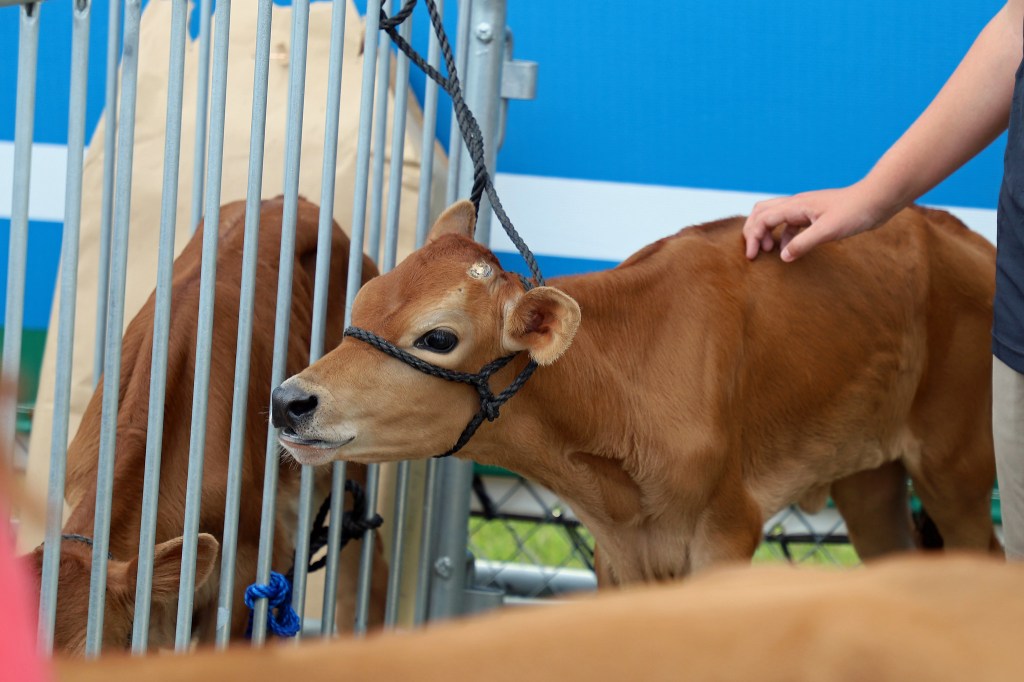
One of the visitors to Clipper Magazine Stadium on Farm Show Night. Was this the cow I heard moo entering the park? (Photo credit: Jeff Hayes)

Following the concourse down the left field line toward the home plate area, we encountered a kids zone near the pink left field foul pole, complete with a carousel, a climbing wall, and assorted games. Being Farm Show Night, we also saw farm equipment for kids to explore scattered along the concourse in the outfield. Passing through the covered portion of the concourse near home plate, we noticed two concession areas, serving the normal baseball fare. Lines were long, which was not surprising considering how many people we saw entering the ballpark. We made a mental note of the line, since we would not obtain our baseball dinner until after we concluded out tour of the inside of the stadium.

Walking down the right field concourse, we found various places to get food and drink. Not being much of a drinker, I did not imbibe, but the selection of local craft beers seemed impressive. Further along the concourse behind the right field foul pole (a mere 300 feet from home plate) we found the Pavilion. It was closed for a private event this night, but there were many places to sit while eating and drinking, in addition to watching the game. Our tour complete, we headed back toward our seats, located on the third base side.
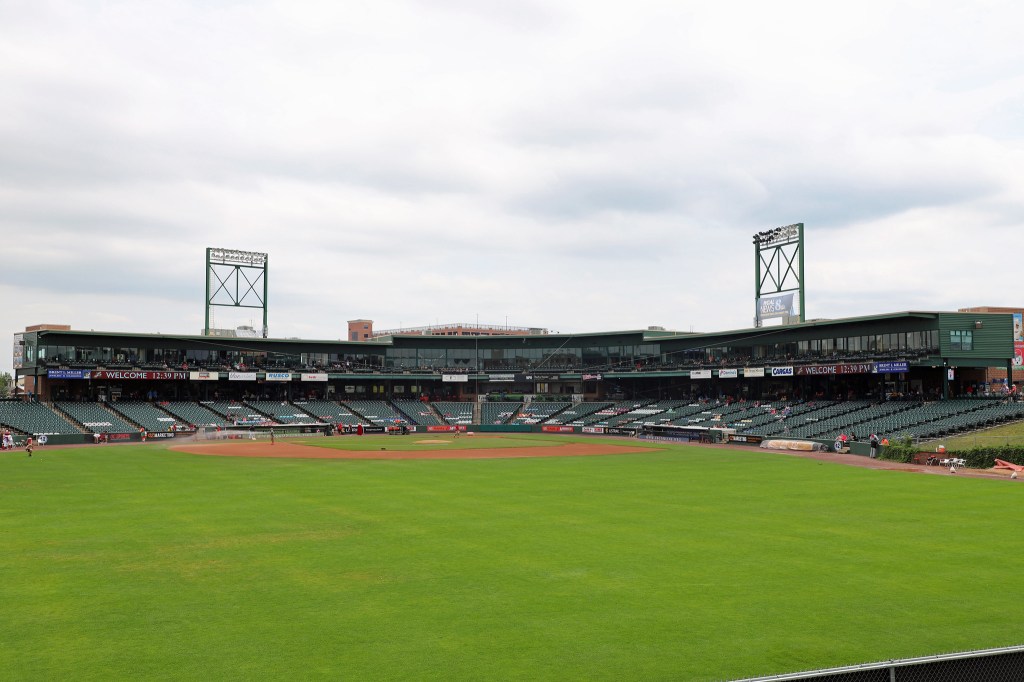
A composite image showing Clipper Magazine Stadium from centerfield, showing the bulk of the seating at the ballpark. (Photo credit: Jeff Hayes)

From our seats, we had a great view of the entire park. Perhaps the most noticeable feature was the scoreboard/videoboard in left field, behind the grass berm. A decent size for the venue, not many videos were played (other than some brief clips of the broadcast of the game). However, the board did have a nearly continuous display of the score, the count, and the pitch speed. In addition, there were auxiliary scoreboards on the second deck behind first and third base, showing this information, as well as the name of the pitcher. Most fans probably did not notice, but being the true baseball fan that I am, I was grateful for the information. In many minor league and ALPB games, there is a dearth of information about the game, which dulls the experience for me to some extent.

Being an ALPB game, there were some important rules differences from the MLB and minor leagues. First, balls and strikes were called by the Automated Ball-Strike System (ABS), with the output from the system relayed to the home plate umpire, who then makes the call to the players and fans. The second rule change was the continued use of larger bases (18 inches), in hopes of reducing injuries on the base paths. Finally, when a starting pitcher is removed from the game, that team loses its DH from the lineup. Dubbed the Double Hook, the rule is intended to inject some strategy back into the game, perhaps encouraging managers to stick with starting pitchers longer. Each of these “experiments” were at the behest of MLB, with which the ALPB has a developmental agreement. It is possible some or all of these rules could someday become part of the MLB game.

The Trackman radar based technology provides the information for automated ball and strike calls in the ALPB, as well as data about launch angle, exit velocity off the bat, as well as spin rate of the pitches. (Photo credit: Jeff Hayes)

As for the game itself, we saw what appears to be a trend in the ALPB; a poorly pitched game by both sides. At one time, the ALPB pitchers were ahead of hitters when it came to talent and experience, but that is no longer the case. Through the first three innings, both teams traded runs amid a plethora of walks and errors, and by the end of the third inning, the score was 8-6 in favor of Gastonia. Typically, the first three innings of a baseball game are completed in an hour or less. On this evening, it took more than an hour and 45 minutes to reach that mark. Luckily for us, there was a treat at the end of the third inning. Rather than holding a contest for fans, there was an alpaca race on the warning track in center and right field, to the delight of all.
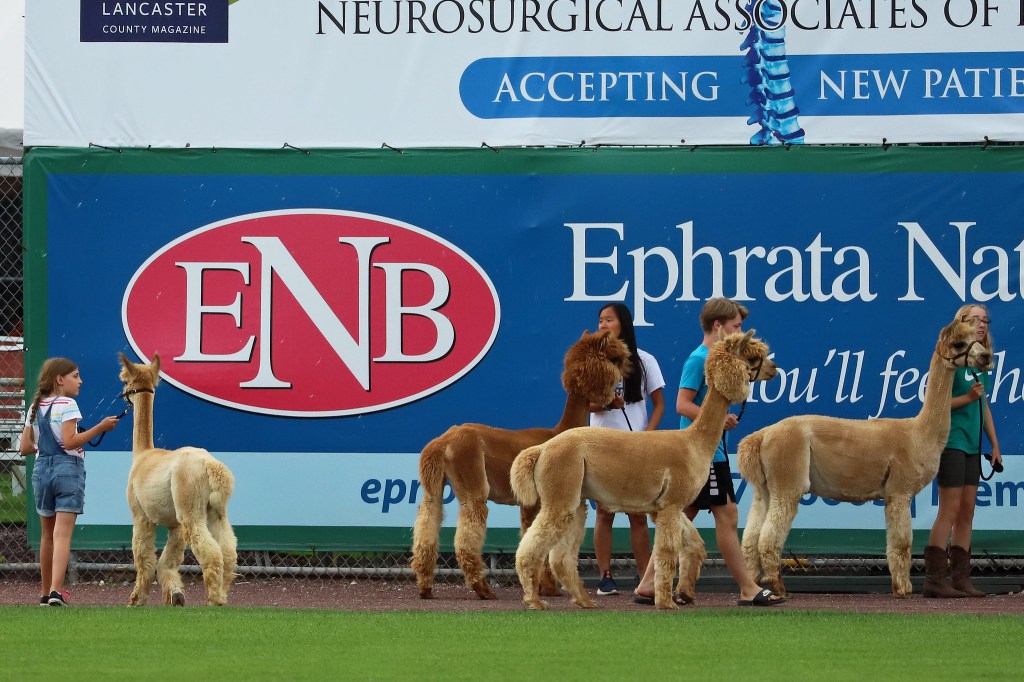
Participants readying themselves for the alpaca race in centerfield. (Photo credit: Jeff Hayes)

While the Barnstormers pitching held the Honey Hunters’ offense in check in the middle innings, Lancaster scored eight unanswered runs to take a lead they would not relinquish. In the bottom of the sixth inning, the home plate umpire took a fastball to the face mask, sending him reeling backward before hitting the ground. Lying motionless, it appeared as though he was seriously injured, as the entire crowd held its collective breath. To my amazement, the umpire climbed to his feet, and continued to umpire the game. Eventually he was replaced, as it was evident he was still feeling the effects of the beaning. Before he left, a Gastonia pitcher was ejected for ridiculing the umpire. Ostensibly the ridicule was about ball/strike calls (which the umpire was NOT making; see above), but it likely was an attempt to intimidate the umpire due to his diminutive physical size.
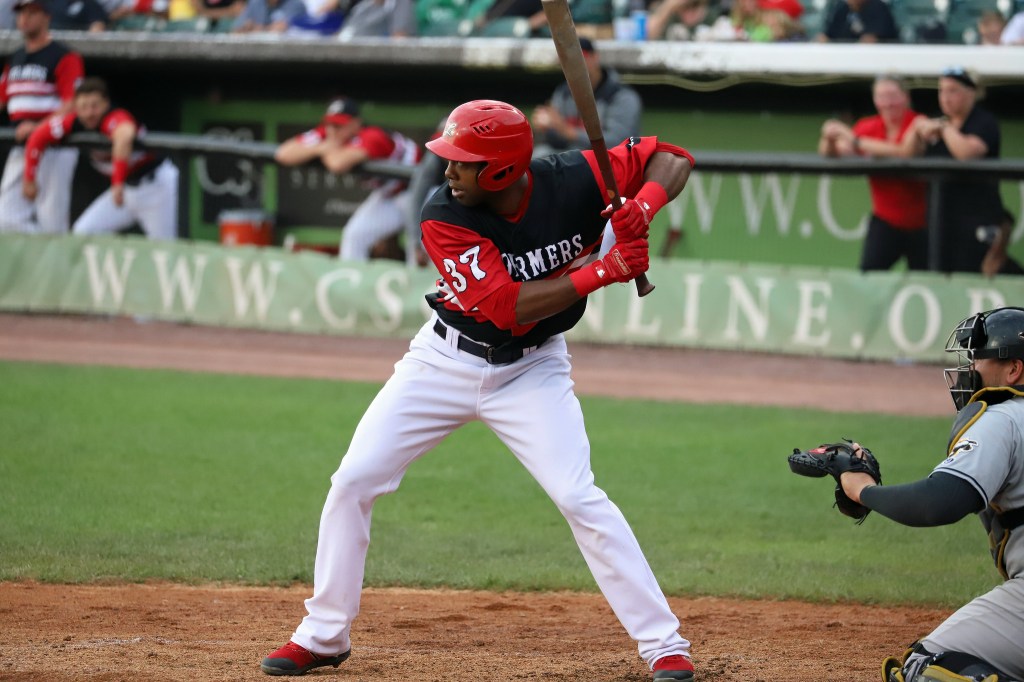
Alejandro de Aza of the Lancaster Barnstorms at bat. de Aza played for the New York Mets in 2016. (Photo credit: Jeff Hayes)

Once evening blended into night, it was clear that some of the lights at Clipper Magazine Stadium were out. Darkness descended on the outfield, and at times it was tough to track the flight of the ball. Both teams continues to pitch poorly, and scoring occurred until the very end of the game. It took four hours and four minutes to complete the contest, during which there were 25 hits and 17 walks, as Lancaster outlasted Gastonia 15-12. While most of the crowd stayed for the fireworks display, we chose that time to exit.


Large puddles are evident on the left field line after early morning showers doused Clipper Magazine Stadium. (Photo credit: Jeff Hayes)


We were back a mere 13 hours later for the finale of the three game series between the Lancaster Barnstormers and the visiting Gastonia Honey Hunters. Rain showers in the morning left the field soggy, especially on the warning track, where it seemed that the rainwater that collected on the tarp was emptied. In the wake of the showers were clouds and very humid conditions. We arrived even before the gates opened for the 1 pm contest so that we could have a game of catch on the field. Despite the wet and humid conditions, there were a number of people playing catch in centerfield as the players prepared for the game. This marked the third occasion during which were played catch on a minor league field, and after about 20 minutes, we left the field and prepared for the start of the game.

Fans playing catch on the field before the Sunday afternoon game at Clipper Magazine Stadium. (Photo credit: Jeff Hayes)

Sunday was Princess Day at Clipper Magazine Stadium, with several of the staff of the ballpark, a well as many fans, dressing for the occasion. There were contests with princess themes throughout the game, with some impressive knowledge demonstrated by a young lady not far from us. Though not my cup of tea, the fairly sparse crowd (which is not unusual for a Sunday afternoon game, particularly during the heat of summer) seemed to thoroughly enjoy the theme of the day.
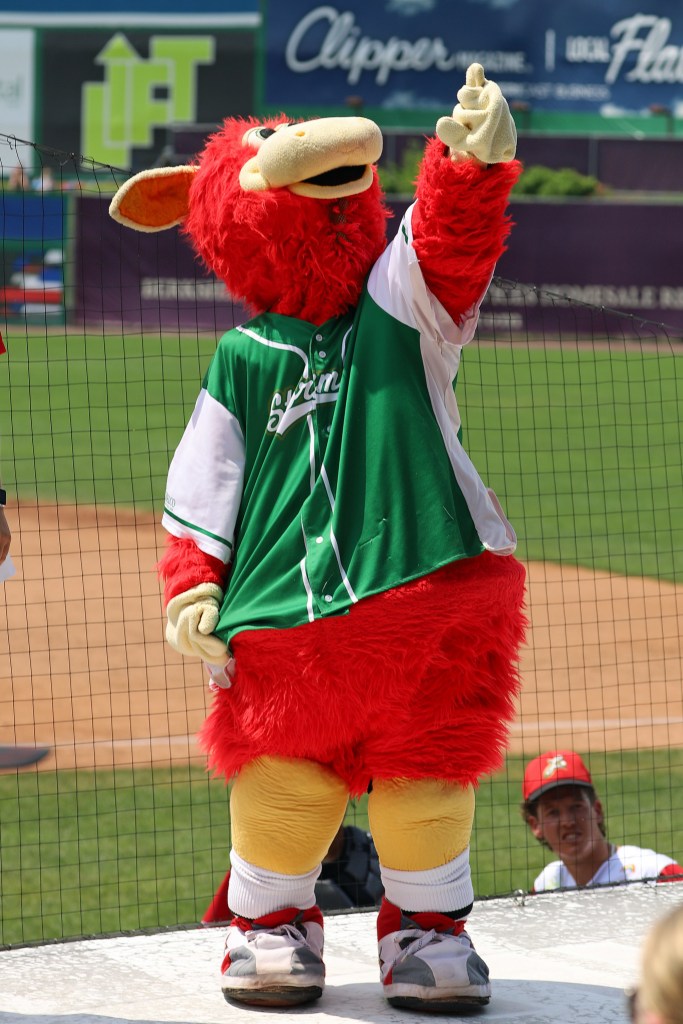
Cyclo, the Lancaster Barnstormers mascot, trying to fire up the sparse crowd on Princess Day at Clipper Magazine Stadium. (Photo credit: Jeff Hayes)

Not long after the start of the game, the sun broke free of the clouds, and conditions become hot fairly quickly. Hot and humid conditions sent fans scurrying for cover soon after the first pitch. It seemed as though we would once again have a slugfest, as Gastonia scored early and often. This time, though, the Honey Hunters pitching was more than up for the task, yielding runs toward the end of the contest, when the outcome had already been decided. The time of the game was a more merciful three hours, as the heat and humidity drained me much more quickly than expected.

The Gastonia dugout on the third base side of Clipper Magazine Stadium. Note the puddles in front of the dugout, a consequence of the early morning rain showers. (Photo credit: Jeff Hayes)

Overall, I was impressed with Clipper Magazine Stadium. Despite being a modular ballpark, it possesses its own charm, which came through particularly well during Farm Show Night. It reminded me of PeoplesBank Park in York, though this park did not seem to be as well kept as the stadium in York. In any event, this ballpark is within striking distance of home for me, so I intend to visit when my schedule allows.
Whitaker Bank Park, Lexington Kentucky June 26th 2021

A composite image of Whitaker Bank Park, home of the Lexington Legends. (Photo credit: Jeff Hayes)

Following a day of exploring Louisville (including Churchill Downs and the Louisville Slugger Museum), we drove east on Interstate 64 for an hour to attend a baseball game in Lexington. As part of the restructuring of the minor leagues, Lexington lost their South Atlantic league affiliation. Left without a baseball team, the Atlantic League of Professional Baseball (ALPB) announced that they would add Lexington as a member for the 2021 baseball season. Since we have an affinity for the ALPB (as each of us had ALPB franchises close to us), we decided to visit this park, as well as Louisville Slugger Field as part of our first baseball trip since the onset of the pandemic.

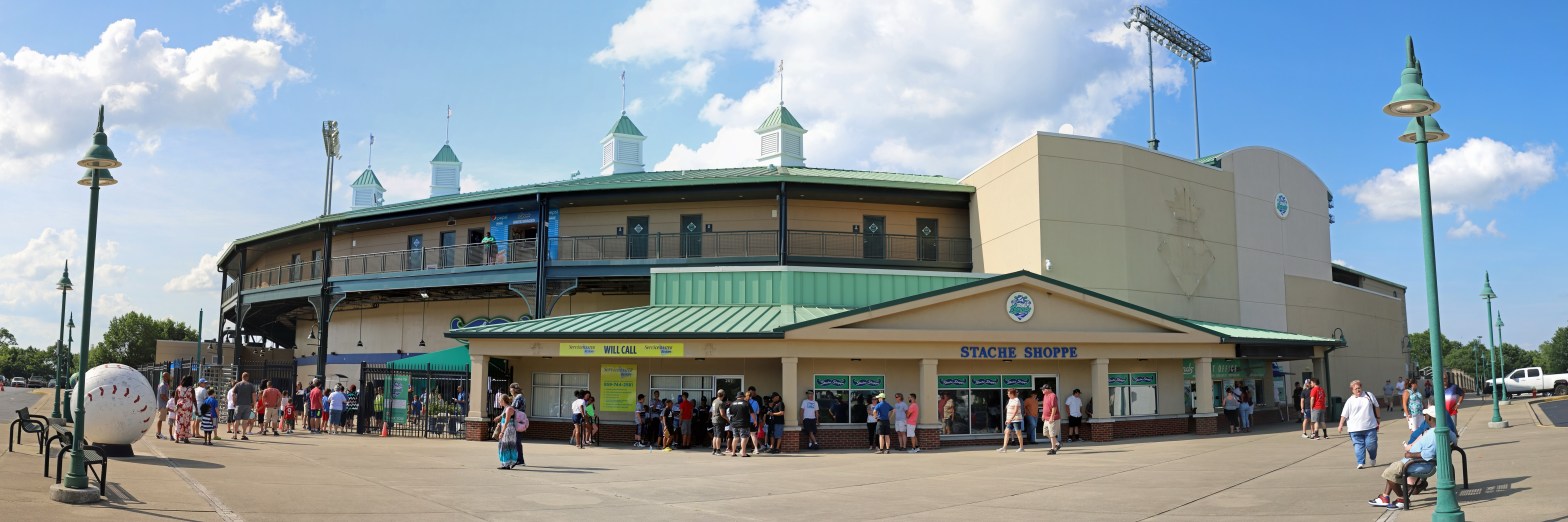
About 70 miles from Louisville (where we were headquartered for the Kentucky visit), the trip took about an hour and was unremarkable as traffic was generally light. Upon arrival, we found onsite parking that was very close to the park, though at $6, a bit higher than we usually see at minor league or ALPB parks. Per our usual method of operation, we toured the outside of the park. Debuting in 2001, Whitaker Bank Park had the appearance of a modular ballpark, equipped with some add-ons (including the Stache Shop near the main gate).

This message appears on the outside wall of Whitaker Bank Park, along the first base side. “Pass the Baton” is good advice, in sports and in life. (Photo credit: Jeff Hayes)

There were reminders that we were not far from the home of the Kentucky Derby. Steeples similar to those at Churchill Downs adorned the top of the stadium, and murals of race horses graced the outside wall behind third base. Perhaps the most interesting was artwork on the outside wall behind first base. It took me a moment to read the lettering, but the message was crystal clear. Being hot and humid, we did not spend much more time viewing the outside of ballpark, entering through the main gate behind home plate.

A composite image showing Whitaker Bank Park from behind home plate. (Photo credit: Jeff Hayes)

My first impression of the inside of Whitaker Bank Park was that it had a wide open feel, with a small videoboard adjacent to bleachers in left field, and a larger scoreboard/videoboard in right centerfield. In between the two, next to the batter’s eye in centerfield, stands a small white transmission tower, complete with a dome on top. Research concerning the dome indicated that it once was part of a Doppler radar weather, but I have not been able to substantiate that claim. Nonetheless, I enjoyed the wide open feel of the ballpark, and in this case, I believe that less is more.

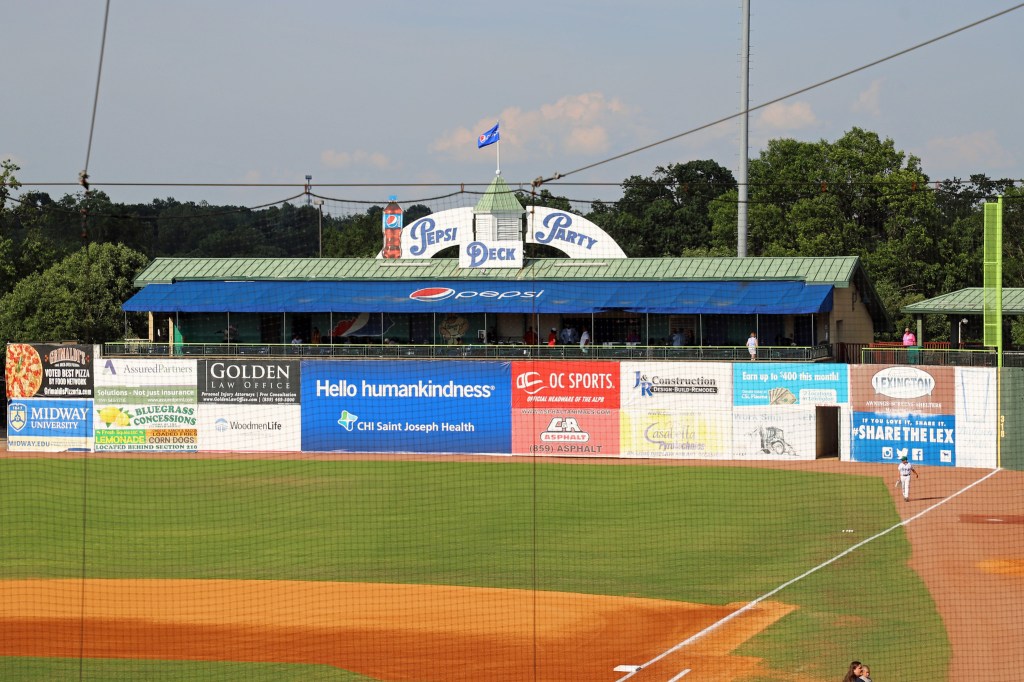
Walking along the main concourse toward right field, we encountered the Budweiser Stables down the first base line. Beer and food can be ordered here while fans watch the game. On this evening, the Budweiser Stables was hosting a private party, so we did not explore this area much. Next to the right field foul pole we found the Pepsi Party Deck. Covered by a canvas roof, the Pepsi Party Deck contained a large number of benches for fans to view the game while eating and drinking. As was the case with the Budweiser Stables, the Pepsi Party Deck was closed for a private event. However, a kind security person allowed me to take some pictures from the deck before politely asking me to leave.

The Pepsi Party Deck in right field at Whitaker Bank Park. (Photo credit: Jeff Hayes)

Backtracking on the concourse behind home plate into left field, we found picnic benches covered from the hot late June sun by a canvas roof. A small kids zone adjacent to the left foul pole was empty, as it was likely too hot to play directly in the sun. Finally, we briefly explored the rather large bleacher section in left field, which was comprised of aluminum seating. As we headed back toward our seats, we were better able to visualize the seating area. Two decks of seats stretch from mid right filed behind home plate to mid left field. The lower deck, which is much smaller, encompasses the first few rows closest to the field, while the upper deck contained the bulk of the seating. Above the upper deck, private boxes extended along the length of the seating area. All told, Whitaker Bank Park can accommodate just under 7,000 fans, but it was clear fairly early that the crowd size this evening would be nowhere near that number.

Our seats for the game were situated in the lower portion of the upper deck, directly behind first base. These seats were chosen for their proximity to the action around first base, and eventually this section filled to about half of its capacity. After locating our seats, we headed up to the concession stands for a baseball dinner. The line at the concession stand was surprisingly long, and it took about 10 minutes to order and receive our food. Prices at the concession stand were much higher than I expected, and higher than we have seen in other minor league and ALPB parks we have visited. Food and drinks in hand, we settled in for the game.

The view from our seats for the game. (Photo credit: Jeff Hayes)

Before the first pitch, we were treated to a mashup of the National Anthem and the Black National Anthem, as part of the I Was Here project. When the Black National Anthem portions of the mashup were sung, I noticed some of the crowd near me being less than respectful, and I did my best not to let this affect my experience of the performance. On this evening, the home Lexington Legends played host to the High Point Rockers. As a nod to the Negro Leagues, Lexington donned uniforms with the name Hustlers emblazoned on the jersey. While there were a few familiar names in the lineups, no name was bigger than Brandon Phillips. Playing second base for the Hustlers, Phillips had recently become a part owner of the Hustlers/Legends. Phillips seemed to be enjoying the experience, as he seemed almost joyful in his approach the game that night.

Hustlers second baseman and part owner of the team, Brandon Phillips. (Photo credit: Jeff Hayes)

Being an ALPB game, there were some important rules differences from the MLB and minor leagues. First, balls and strikes were called by the Automated Ball-Strike System (ABS), with the output from the system relayed to the home plate umpire, who then makes the call to the players and fans. More than a few players, thinking they had walked, started off for first base, only to be called out. The second rule change was the continued use of larger bases (18 inches), in hopes of reducing inquires on the base paths. Finally, when a starting pitcher is removed from the game, that team loses its DH from the lineup. Dubbed the Double Hook, the rule is intended to inject some strategy back into the game, perhaps encouraging managers to stick with starting pitchers longer. Each of these “experiments” were at the behest of MLB, with which the ALPB has a developmental agreement. It is possible some or all of these rules could someday become part of the MLB game.

Lexington struck first with four runs in the first two innings, but the Hustlers starter lasted only two innings. High Point responded with two runs of their own in the bottom of the second, and the score was 4-3 going into the bottom of the sixth inning. Lexington scored fours runs as the Rockers committed two costly errors. Though the sun has been in my eyes for much of the game, it became nearly blinding at about this time, and continued that way until sunset (around 905 pm EDT) finally provided some relief. Though fans around me (including my brother, who as seated next to me) were affected, my sun angle seemed to be the worst, making watching the game virtually impossible.

Mercifully, the setting sun put an end to the nearly blinding light I experienced for a good portion of the game. (Photo credit: Jeff Hayes)

Being near first base, we were treated to the enthusiasm of Hustlers’ first base coach Ben Revere. Playing for a handful of MLB teams during the 2010s, Revere was animated much of the night, assuming a batting stance while timing pitchers, as well as chatting up Hustlers and Rockers players alike. Watching Revere and his unabashed zeal was almost as much fun to watch as the game itself.

My brother’s picture of a close play at the plate. (Photo credit: Jeff Hayes)

Typically when my brother and I go to games, we keep mostly to ourselves, engaged in conversation about the game. On occasion, nearby fans have mistaken us for scouts, as they follow our banter, my brother taking pictures and me keeping score (which seemingly only old fans still do). On this night, fans around us openly engaged us, sensing our passion for the game. A woman in front of us told us her husband was the first base umpire, while a fan behind us, apparently friends with some of the players, told us about the unfamiliar players we were seeing. Finally, an amateur photographer approached my brother, and they engaged in discourse about taking pictures at the ballgame. Perhaps it was the area that influenced the interactions, as we are unaccustomed to talking to fans near us, other than to comment briefly on what is happening on the field.

The main scoreboard/videoboard at Whitaker Bank Park, as day dissolves into evening. (Photo credit: Jeff Hayes)

Lexington tacked on two more runs in the bottom of the seventh inning, and the Hustlers bullpen held the Rockers’ offense in check on the way to a 10-3 victory. The action on the field, as well as the interaction with fellow fans kept us busy, and we enjoyed the experience at Whitaker Bank Park. We exited during the post game fireworks, as many of the fans stayed to watch the show. This allowed us to navigate the parking lot quickly, and we made the trip back to Louisville in less than an hour. The ballpark was more or less what I expected, though the rather paltry crowd for a Saturday night game worried me that the Legends may not draw well enough for the franchise to survive in Lexington. Living so far away, it is unlikely we will return.

Louisville Slugger Field, Louisville Kentucky – June 27th 2021

Entrance to Louisville Slugger Field, complete with a statue of Pee Wee Reese. (Photo credit: Jeff Hayes)

After exploring downtown Louisville on a warm and humid morning, we headed to the second ballpark on our first baseball trip of 2021. Arriving well before the gates opened at Louisville Slugger Field, we parked next to the stadium in a public parking lot adjacent to the right field wall. Since parking (a rather hefty $8) was presumably for the day, we left the car in the lot and wandered around nearby Louisville. Gates at the ballpark opened about an hour before game time (scheduled for 100 pm), and we returned just as fans were entering.

As is typical for a new ballpark, we walked around the outside of Louisville Slugger Field (home of the Louisville Bats, the Triple A affiliate of the Cincinnati Reds). Though the ballpark opened in 2000, the brick face on all sides of the stadium gave it a retro field, and it fit in well with the surrounding buildings. Located in front of the ballpark is a statue of Pee Wee Reese. Raised in Louisville from the age of eight, the Hall of Fame shortstop played his entire MLB career with the Brooklyn/Los Angeles Dodgers, where he won a world championship in 1955. Reese returned to Louisville after his playing career ended, and later in his life, he worked for the owners of the Louisville Slugger company. Louisville honored its “native” son with a symbol that greets fans as they enter the ballpark.

Louisville’s own Pee Wee Reese gracing the main entrance of Louisville Slugger Field. (Photo credit: Jeff Hayes)

Following our tour of the outside of the park, we entered through the side entrance (nearest the main parking lot). Greeted by smiling and helpful ticket attendants, we were reminded we were in Kentucky, where the hospitality was almost disarming to a couple of life long residents of the Northeast. Once inside, we were impressed with the inner concourse of Louisville Slugger Field. Reminiscent of Truist Park in Atlanta, the inner concourse had the look and feel of an MLB park, a feature not expected in a minor league stadium. In addition, a portion of the inner concourse was air conditioned, which was a welcome respite from the building northern Kentucky heat and humidity.

Walking along the concourse (which encircles the playing field), we wandered past the right field foul pole, where ongoing construction indicated additional seating in the right field corner, as well as a picnic area. While passing center field (and the batter’s eye), we found a grass covered seating berm stretched across left center field, in front of one of the two videoboards in the ballpark. We did not see anyone seated on the berm (it was probably too hot in the direct sunlight for that), but there were a few people milling around seats above the berm. Just beyond the berm was a left center entrance gate, for those fans entering from East Witherspoon Street.

A very MLB like inner concourse at Louisville Slugger Field, featuring banners of former players hanging from the rafters. (Photo credit: Jeff Hayes)

From the concourse in left field, we were treated to some outstanding views of Louisville’s Main Street, as well as the Ohio River and southernmost Indiana to the north. As we would discover later, this part of Louisville Slugger Field afforded the best view of both the city and the river. Interstates between the ballpark and the river would obscure the Ohio River, but the gold colored bridges were visible. From the remainder of the stadium, only the tallest buildings in Louisville were visible over the forest green aluminum roof.

Seating in the lower level of the park extended from left field behind home plate to the right field foul pole, offering more than 10,000 green seats. There is a second level in Louisville Slugger Field, but unlike the vast majority of the ballparks we have visited in the US, we were not granted access (because we did not possess tickets stating our seats were located there). While we have become accustomed to exclusivity in MLB parks, this was one of the first examples of it we have seen in a minor league (MiLB) stadium. Hopefully the exclusivity seen here does not become more widespread in the future. Including the second level and private suites, the ballpark can accommodate over 13,000 fans, which makes it possibly the largest MiLB stadium we have visited (with regard to capacity).

The view of downtown Louisville from right centerfield concourse at Louisville Slugger Field. (Photo credit: Jeff Hayes)

To my mild surprise, there were plenty of seats available for the early afternoon contest. We have found that Sunday afternoon games are generally more lightly attended than Saturday night games, but the assembled crowd seemed smaller than might be expected. Perhaps the heat (with temperatures at game time near 90 degrees, with moderate humidity) or the small threat of thunderstorms kept the attendance light, but we were able to secure great seats just two rows behind the first base dugout. Unlike most ballparks, the home team occupied the third base dugout, placing us close to the visiting team, the Indianapolis Indians (the Triple A affiliate of the Pittsburgh Pirates).

Unfortunately, our seats put us in direct sunshine, though intermittent clouds helped take the edge off the heat at times. After finding our seats, we sought out a baseball lunch at the concession stands scattered across the inner concourse. There were several places to eat within Louisville Slugger Field, but we were content with standard fare, along with plenty of cold drinks to combat the heat and humidity. Surprisingly, the cost of the concessions was much higher than I expected, at least when compared to ballparks in other portions of the US. These prices would become significant, as we attempted to keep well hydrated during the game. During the first pitch ceremony, three siblings threw out first pitches to the catcher, who turned out to be their father returning from active duty.

A composite image of Louisville Slugger Field from centerfield. (Photo credit: Jeff Hayes)

Our seats provided great sight lines for the entire park. Two moderately sized videoboards located in left center and right centerfield provided all of the essential information for serious baseball fans, and played videos and replays as well. The left videoboard displayed the hitter’s information, while the right videoboard showed the pitcher’s stats, as well as the score. Auxiliary scoreboards located above the second deck beyond the dugouts kept fans informed on the count, the inning and the score. As a dedicated baseball fan, I appreciated the multiple sources of data.

Crisp starting pitching from both sides kept the game moving, and only 41 minutes had elapsed by the end of the third inning. Clouds that had been building since late morning started to produce showers and thunderstorms, most of which bypassed Louisville Slugger Field. However, we did not escape unscathed, as mainly light rain showers (lasting about 20 minutes) did affect the ballpark, though it did not require a stoppage of play. Despite the rain, conditions did not cool off much, and by the middle innings, I began to feel the effects of the heat. In fact, many of the fans in the seats around us eventually sought refuge from the sun by heading to seats out of the sun, or into the cooler inner concourse.

A view from behind home plate on the lower level showing the videoboards in left center and right centerfield. (Photo credit: Jeff Hayes)

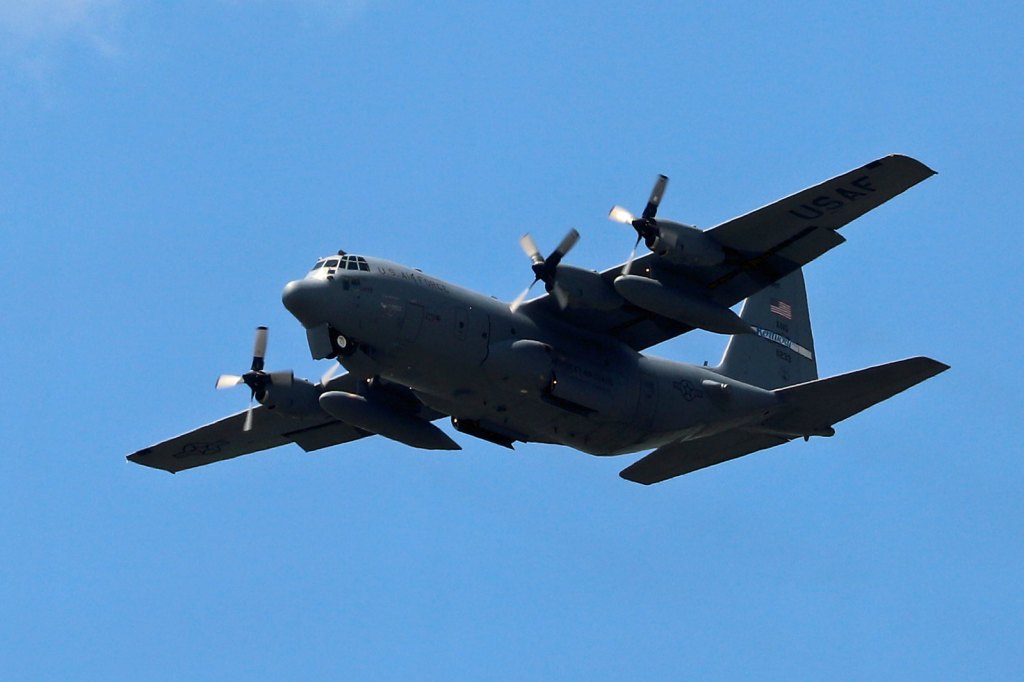
We quickly discovered that Louisville Slugger Field was very close to the flight path of nearby Muhammed Ali Louisville Airport. Though planes did not pass directly overhead, we did see planes every couple of minutes come very close as they took off from the airport. Being veterans of the air traffic out of LaGuardia Airport over Shea Stadium in New York, we were hardly phased by the nearly constant planes passing by, but I did find myself catching a glimpse of the aircraft as they climbed out to wherever they were going.

An Air Force aircraft passing near Louisville Slugger Field after taking off from the nearby airport. (Photo credit: Jeff Hayes)

In the bottom of the seventh inning of a scoreless game, we saw something of a rarity. Indians lefthander Braeden Ogle took too long to deliver a pitch, and the home plate umpire awarded the batter a ball. In the minor leagues (as well as the Atlantic League), pitchers are required to deliver a pitch to the plate within 15 seconds (20 seconds with runners on base), in an attempt to speed up the pace of play. Failure to do so can result in a ball being awarded to the hitter. Despite the presence of pitch clocks in most ballparks, this rule is rarely enforced, but I saw delighted that it was in this instance.

Indianapolis Indians pitcher being checked for illegal substances before the top of the inning. (Photo credit: Jeff Hayes)

A home run in the top of the eight inning gave the visiting Indians a 1-0 lead, and it appeared as though the Indianapolis bullpen would make the single run stand up going into the bottom of the ninth. The Louisville Bats, which had been largely dormant for much of the game, came to life in the bottom of that frame. The Bats used three singles and a walk to plate two runs to secure a 2-1 victory. Even with the heat and threat of rain, most of the Louisville faithful remained to celebrate the hard fought win.

After the game, kids were invited to run the bases (which is not unusual for weekend games). In a surprise to us, all fans were permitted on the field for a game of catch. Nearly three hours in the heat and and humidity of northern Kentucky essentially wiped me out, and I was not up for a game of catch. With a long drive awaiting us, we did something that would normally be unconscionable; we did not partake in the opportunity to walk on a professional baseball field.

Louisville Bats celebrating after a walk off single in the bottom of the ninth. (Photo credit: Jeff Hayes)

Louisville Slugger Field is a fine example of a Triple A ballpark, complete with all the amenities fans could need. The concourse area looks as though it was modeled after a MLB park, and ongoing construction indicated that the ownership was dedicated to improving the fan experience. Only limited access to the second deck, and the seemingly high concession prices, detracted from a great baseball atmosphere, and we were treated to an outstanding game as well. While I would recommend visiting the ballpark if you are in the vicinity during baseball season, being so far away, I am not sure we will return.