Day 9 of the 2018 Baseball Road trip began with us checkling out of the hotel just outside of Chatanooga Tennessee after 800 am. The plan for this day was to make the trip back to Maryland after a hugely successful tour of ballparks through the Southeast US. The day started sunny and relatively warm, and we expected traffic to be light, considering it was a Saturday. Conditions seemed ripe for an easy drive home.
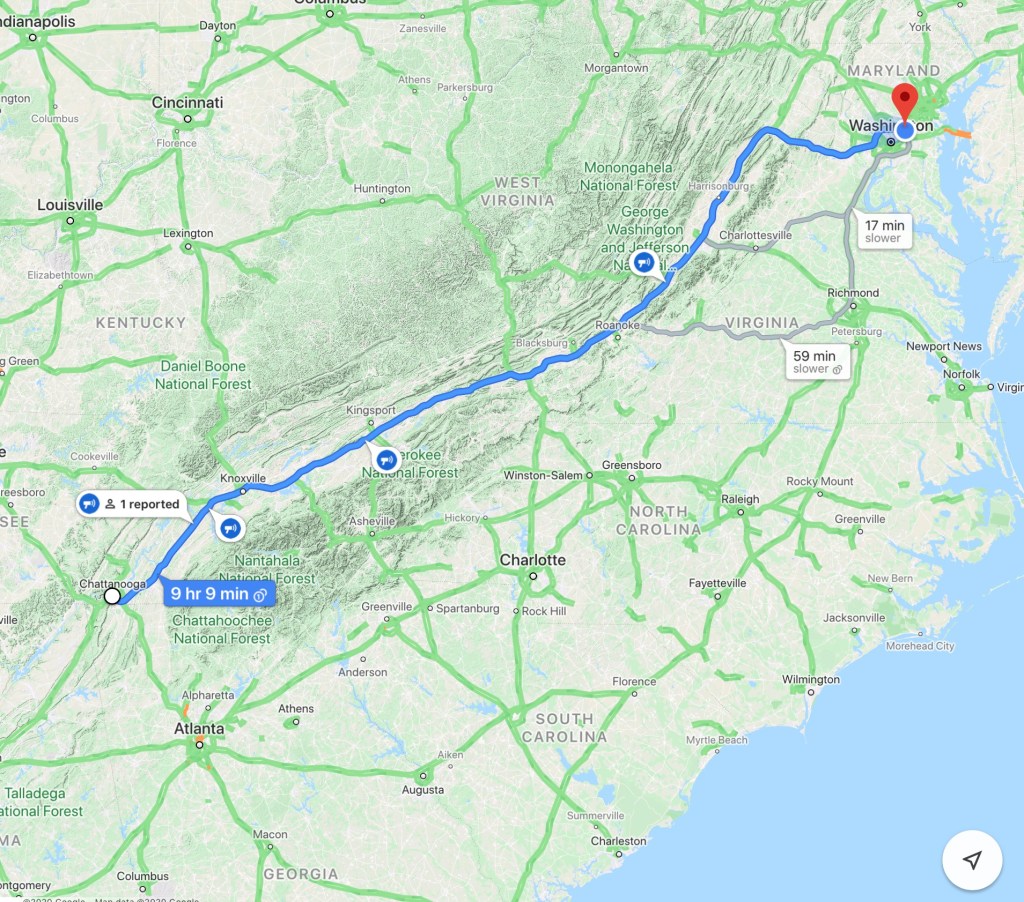
Google Maps depiction of the drive home.
Google Maps showed a drive time of 9 hours and 9 minutes with much of the drive on Interstate 81. In preparation for the trip, we knew that we would be passing by a couple of towns with minor league teams. The first was Knoxville, Tennessee, the home of the Tennessee Smokies. They were out of town, as we had just seen them in Chatanooga the night before. We also passed close to Kingsport, Tennessee, the home of the Kingsport Mets. The Mets, the advanced Rookie League team of the New York Mets, are a member of the Appalachian League. They play a short season, meaning their schedule did not start until the end of June.
About 5 hours into the trip, near Roanoke Virginia, I asked my brother if any of the minor league teams on our way back to Maryland had a home game that night. A quick searched showed that only the Richmond Flying Squirrels were home. Not quite ready to end the trip, we decided to make a relatively large detour, and headed for Richmond Virgina. While that destination did take us off the best path back, Richmond is only about 2 hours from home, so it was not as much of a detour as it seemed
We continued along Interstate 81 until we met Interstate 64, and about 2 hours later, we were in Richmond, Virginia. Our destination was The Diamond, the home of the Richmond Flying Squirrels. The AA afflilate of the San Francisco Giants, the Flying Squirrels hosted the Hartford Yard Goats. We arrived less than an hour before game time, having secured tickets for the 605 pm start via the web on the way to the ballpark. Not surprisingly, the game was well attended, and the best seats we could get were for the upper deck.
The Diamond, home of the Richmond Flying Squirrels. (Photo credit: Jeff Hayes)
Because of the sizeable crowd, we parked near the far edge of the parking lot, and made our way to the ballpark. We got to our seats about 20 minutes before the first pitch, which gave us just enough time to get something to eat. This was not our first visit to The Diamond. We came down to Richmond in May of 2017 to see a pair of games against the Harrisburg Senators. During those games, our seats were much better, but the weather that weekend was cloudy and cool.
Our seats for the game. (Photo credit: Jeff Hayes)
The first pitch occurred precisely at 605 pm. After a scoreless top of the first, the Flying Squirrels jumped on the YardGoats starter Parker French for three runs in the bottom of the first, adding two more in the bottom of the 3rd. The Flying Squirrels outburst continued in the bottom of the 5th, plating three more runs.
The Flying Squirrels Miguel Gomez reaches third without a throw following a wild pitch the bottom of the 1st inning. (Photo credit: Jeff Hayes)
Though the Yard Goats scored three run in the in the bottom of the 3rd, Hartford would not pull much closer. As the evening wore on, with the outcome of the game all but assured, the crowd started thinning out after 6th inning. By the end of the game, more than half the crowd had left. Considering we still had a two hour drive home after the game, a dwindling crowd would make exiting much easier.
The Diamond at night. Note that the crowd had thinned out considering that the Flying Squirrels had put the game out of reach. (Photo credit: Jeff Hayes)
As mentioned earlier, this was not our first trip to the Diamond. A much more extensive review of the stadium can be found later in this blog. Overall, it was a pleasant experience at a nice AA stadium. It was also a great way to end the trip, squeezing in one more game before heading home.
Luckily for us, the exit from the Diamond was swift, and we headed north of Interstate 95 toward Maryland. The trip was smooth until we approached Maryland. The combination of traffic and rain slowed our progress, as it took closer to three hours to finally reach home
Day 2 of our Japanese baseball tour moved us to Kyoto. We chose to stay in Kyoto for a few days, since it was the ancient capital of Japan and would afford us an up close view of Japan the way it used to be. My brother chose a hotel close to Kyoto Station, as we would be traveling on the Shinkansen the next three days.
After the rainy and humid conditions in Tokyo, the sunshine in Kyoto was a welcome relief. Following an early breakfast, we went out exploring nearby Kyoto. The hotel was located within walking distance of MANY temples, as well as parks. Walking through local neighborhoods on the way to see the temples, we could not help but notice vending machines nearly everywhere. As we later find out, vending machines are ubiquitous throughout Japan.
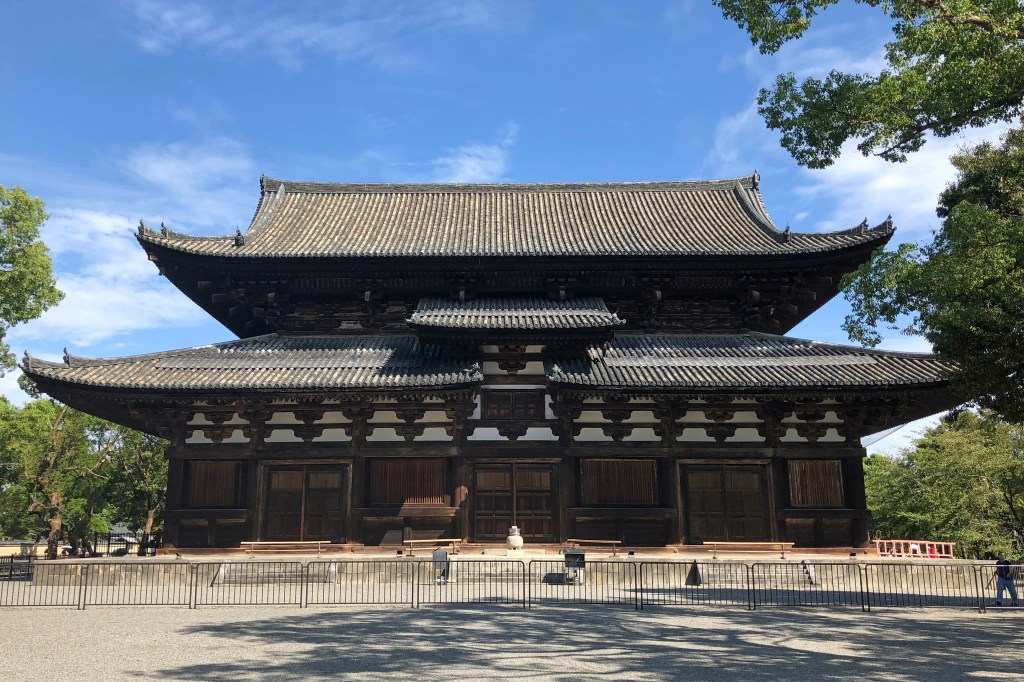
Kondo Hall, the largest structure at the Toji Temple complex.
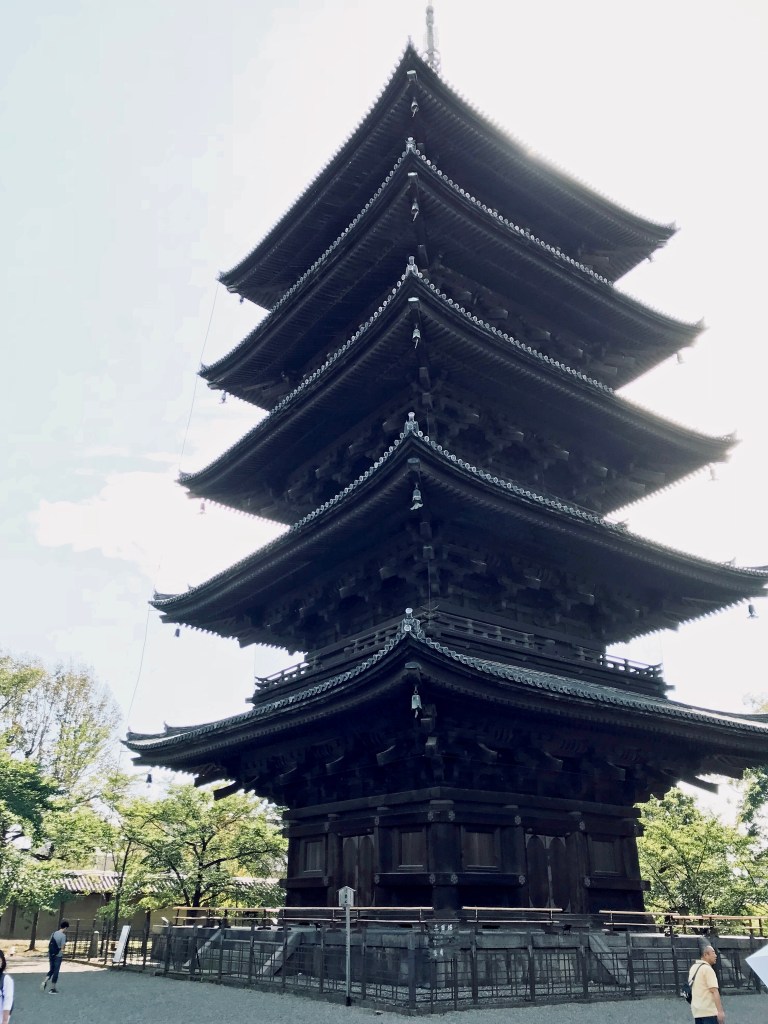
About ten minutes from the hotel, we found the grand complex of Higashi Hongan-ji. There are several temples and shrines in the complex, spread out over a few city blocks. A UNESCO World Heritage site, the complex contains the largest wooden tower in Japan, the five story Pagoda. This structure may be one of the most recognizable in Kyoto, and is spotlighted at night.
The Pagoda on the grounds of the Toji Temple. (Photo credit: Jeff Hayes).
The largest structure in the complex is Kondo Hall (pictured above). Not accessible to the public (like most of the structures here), the Hall is the centerpiece of the temple. Strolling through the complex, we could almost feel the spirituality. It didn’t take long to see why Kyoto is so popular with tourists and Japanese alike.
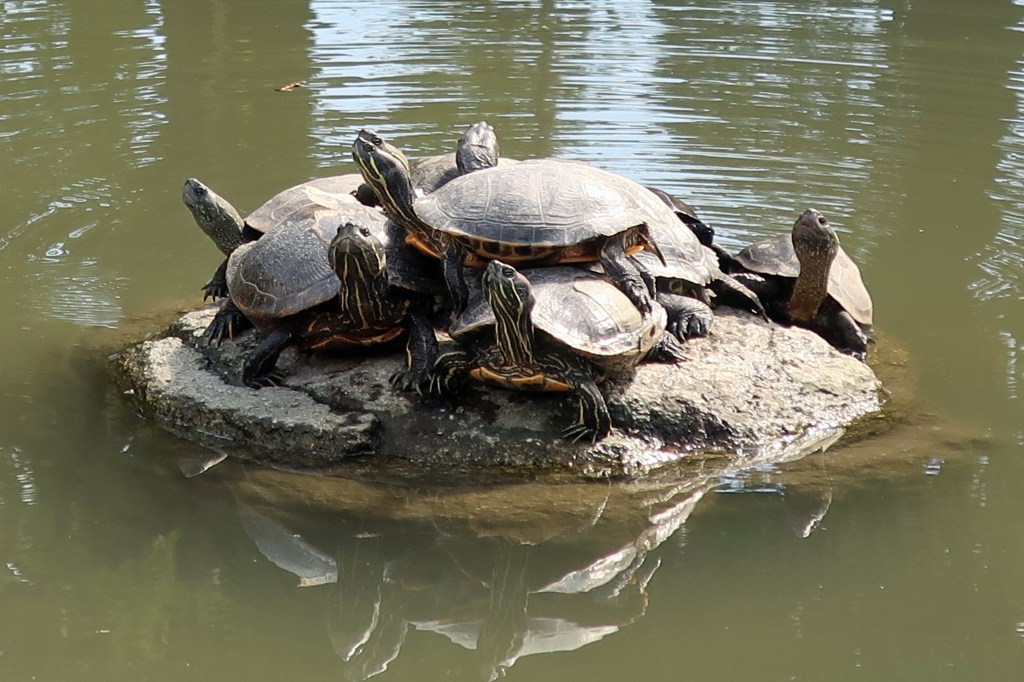
Ambling through the complex, we came upon a manmade pond. Within the pond we saw some of the locals, soaking up the late September sun. Having spent more than two hours at the temple, we headed back to the hotel before leaving for Nishinomiya. The visit to the temple had me looking forward to what else we might see in Kyoto in the coming days.
Toji Template residents sunning themselves on a rock in a manmade pond. (Photo credit; Jeff Hayes)
1. Getting to Nishinomiya
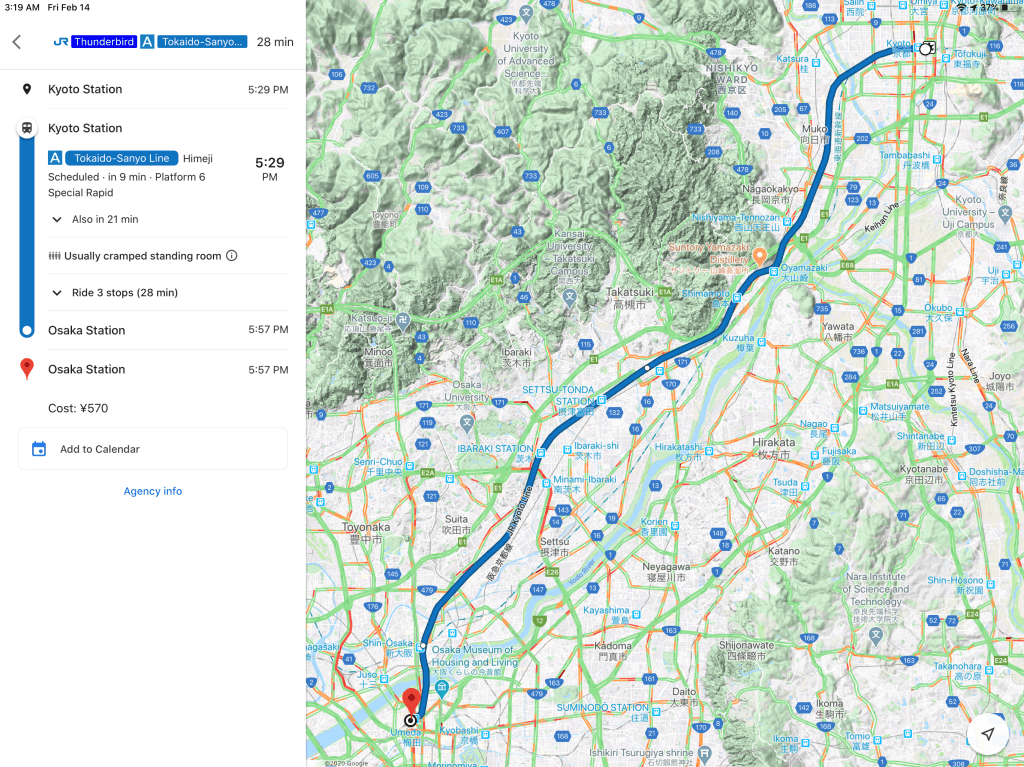
Going to see the Hanshin Tigers take on the Yomiuri Giants at historic Koshien Stadium, we would need to take the Tokaido-Sanyo Shinkansen from Kyoto Station to Osaka Station. The trip took roughly 30 minutes, with three stops. After arriving at Osaka Station, we walked across the street to the Osaka-Umeda Station to catch the local train to Koshen Stadium.
Getting from Kyoto to Osaka, as depicted by Google Maps.
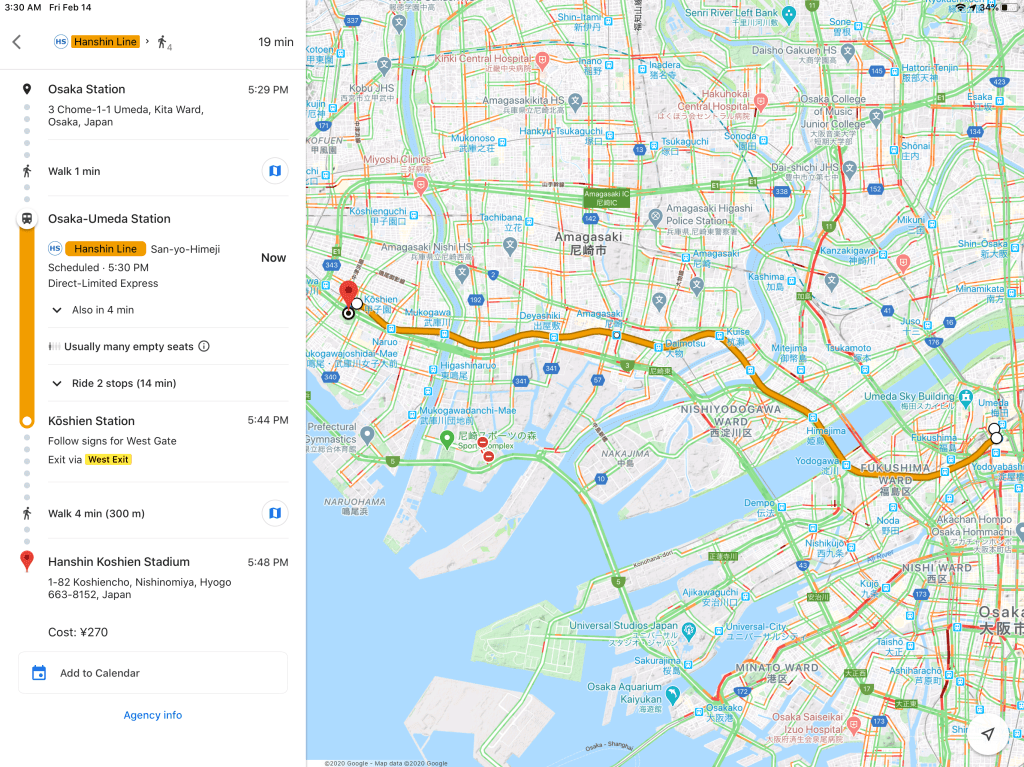
Like many train stations in Japan, the Osaka-Umeda Station seemed like a labyrinth of platforms and escalators. While we knew we had to take the Hanshin Line to the stadium, it wasn’t immediately clear where that was in the station. In addition to the Hanshin Line, there was the Hanshin Railway (a private line). The distinction caused some consternation, but once we determined where we needed to get Hanshin Line, we were ready to head to the stadium.
Not surprisingly, the train was packed with Tigers fans headed to the stadium. The trip to Koshien Station took about 20 minutes, with a walk of just a couple of minutes from there to the stadium.
The direct train line to Koshien Stadium took about 20 minutes on a very crowded train.
2. Koshien Stadium
Koshien Stadium is a unique ballpark in many ways. It is the oldest ballpark in Japan, having opened in 1926. It is one of only four major league stadiums still in use in which Babe Ruth played (the others being Meiji Jingu Stadium in Shinjuku, Fenway Park in Boston and Wrigley Field in Chicago). Koshien Stadium is the only remaining NPB ballpark with an all dirt infield.
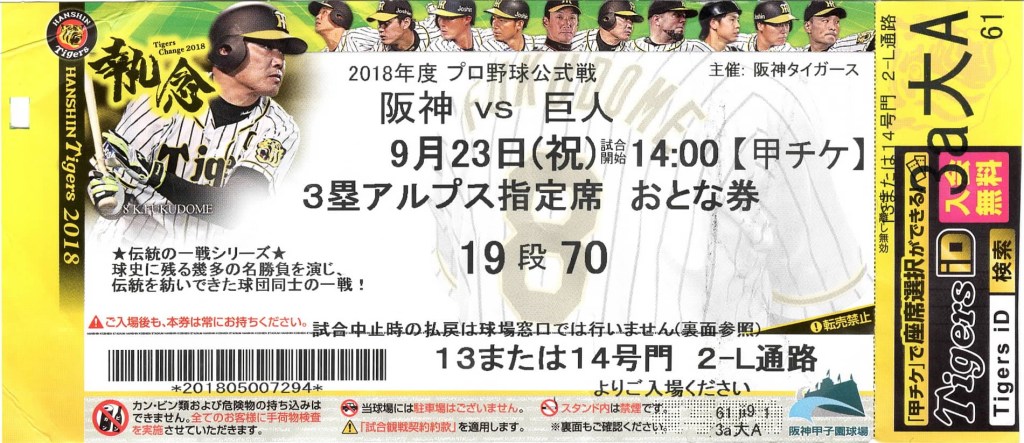
It was against this backdrop that we entered Koshien Stadium. My brother had a QR code for our game tickets, and obtained our tickets via QR scanner at the stadium. Unlike the tickets we had in Tokyo, these tickets were more difficult to read. We asked a stadium employee which gate we should enter, and the answer was not clear. In order to find the gate, we had to nearly circle the stadium.
A ticket for the Hanshin Tigers game on a September, 23, 2018. It took some time to decipher the vital information in order to find our seats.
When visiting the TokyoDome the day before, we were able to walk around from section to section, taking pictures. This was not the case at Koshien Stadium. Security made it clear that we were to stay in our area, which limited our ability to take pictures of the stadium.
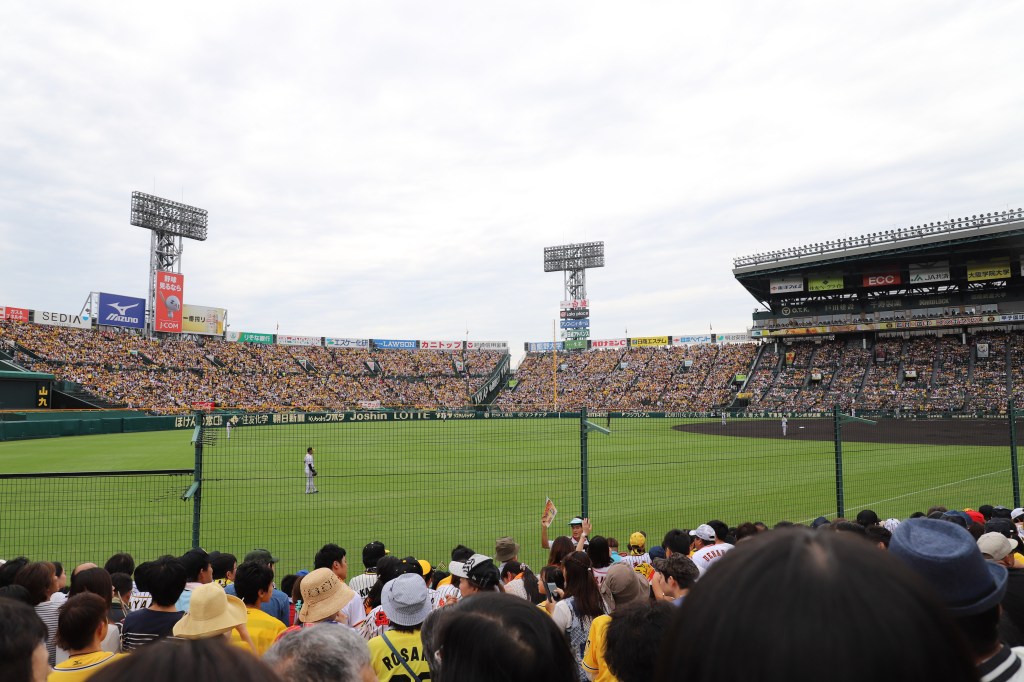
The view from our seats. Note the all dirt infield to the right. (Photo credit: Jeff Hayes)
The stadium was packed, with a sold out crowd there to see the Tigers take on the Tokyo Yomiuri Giants. Clouds gradually filled in during the early afternoon, and by the 1400 start, skies were overcast, but seemingly no threat of rain. Even with cloudy skies, the beauty of the ballpark shined through. The stadium dates back to the 1920s, and possessed some of the charms of an older ballpark. Koshien Stadium has a feel similar to that of Wrigley Field (before its modernization). However, the stadium did not show its age, being maintained and groomed well. From the first look, it was clear that this was a classic ballpark; a great place to see a ballgame.
Our seats were located near the left field corner, less than 10 rows from the action. We were located next to the visitors section in Koshien Stadium. As we would learn, there is a visitors section in each NPB ballpark, but not all are in the same part of the park. It was interesting to be so close to the Giants fans, who were indefatigable throughout the game. You can experience the Giants fans chanting here.
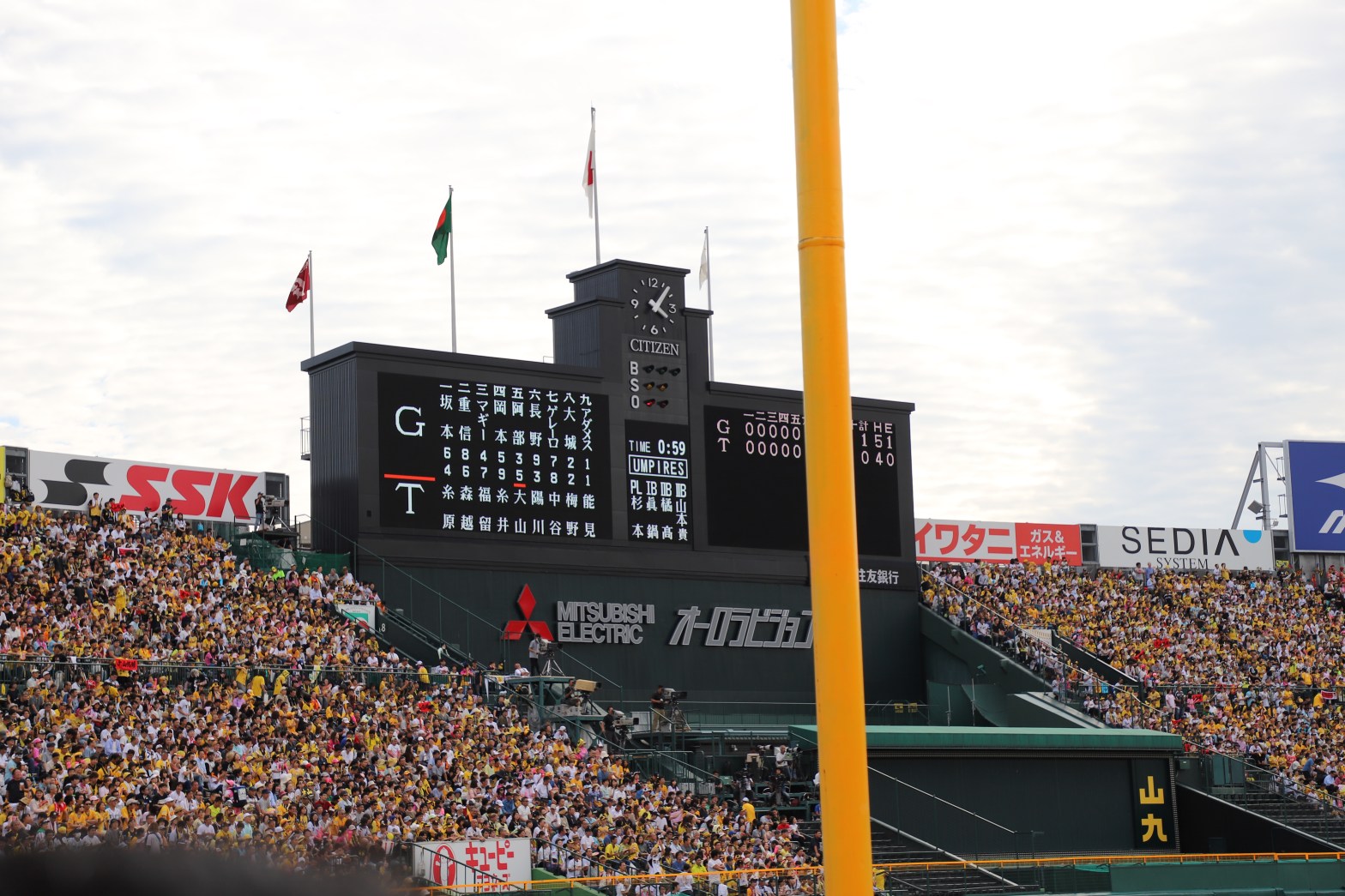
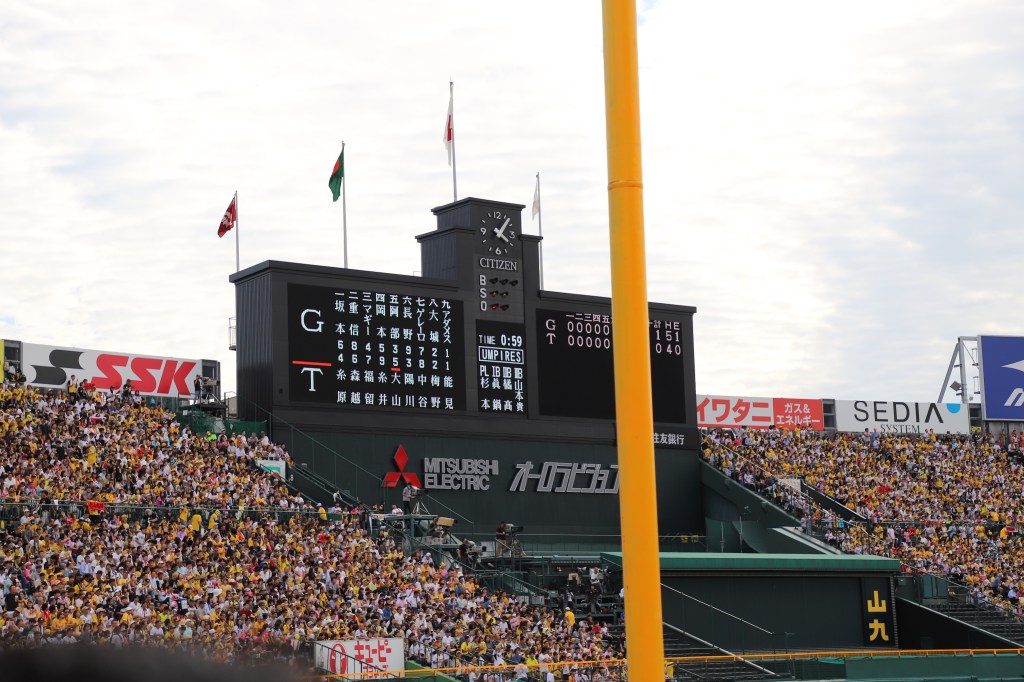
The scoreboard at Koshien Stadium. The scoreboard bares a vague resemblance to the old scoreboard at Wrigley Field. (Photo credit: Jeff Hayes)
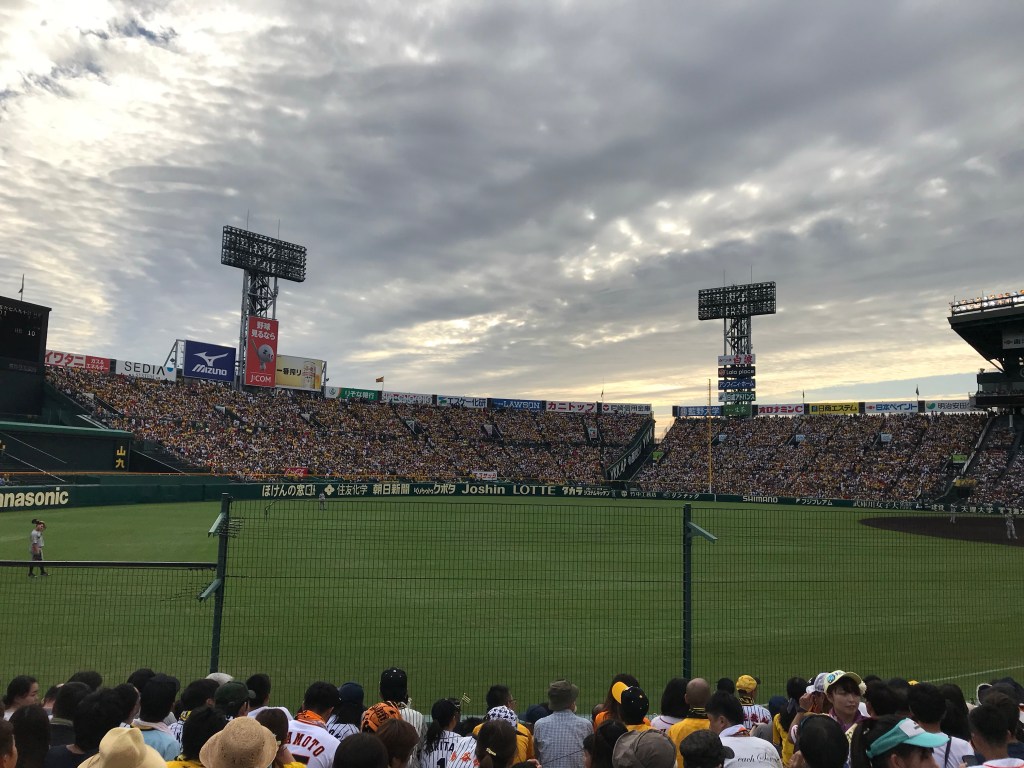
The game itself was a tight affair, scoreless after 5 innings. The Giants opened the scoring with a run in the top of the 6th, with the Tigers answering in the bottom of the 7th. A single run in the top of the 8th provided to be the winning run for the Giants, who triumphed 2-1. Toward the end of the game, the sun tried to break out, resulting in a very striking cloud pattern late.
Sunshine trying to break through the clouds at Koshien Stadium toward the end of the game.
The game time was about three hours and 30 minutes. Unlike MLB games, nobody seemed to be concerned about the pace of play. In fact, we saw a fan served a beer with two out in the bottom of the 9th inning. As we left the stadium, we noticed fans still milling around their sections, slow to exit the ballpark. Clearly, NPB fans see the game as more of an event, and these fans were in no hurry to leave.
Koshien Stadium proved to be a classic ballpark, in the vein of Fenway Park and Wrigley Field. My brother commented this was the stadium he wanted to see on this trip, and it was well worth the effort. Should I ever find my way back to Osaka, I’ll do my best to revisit this place.
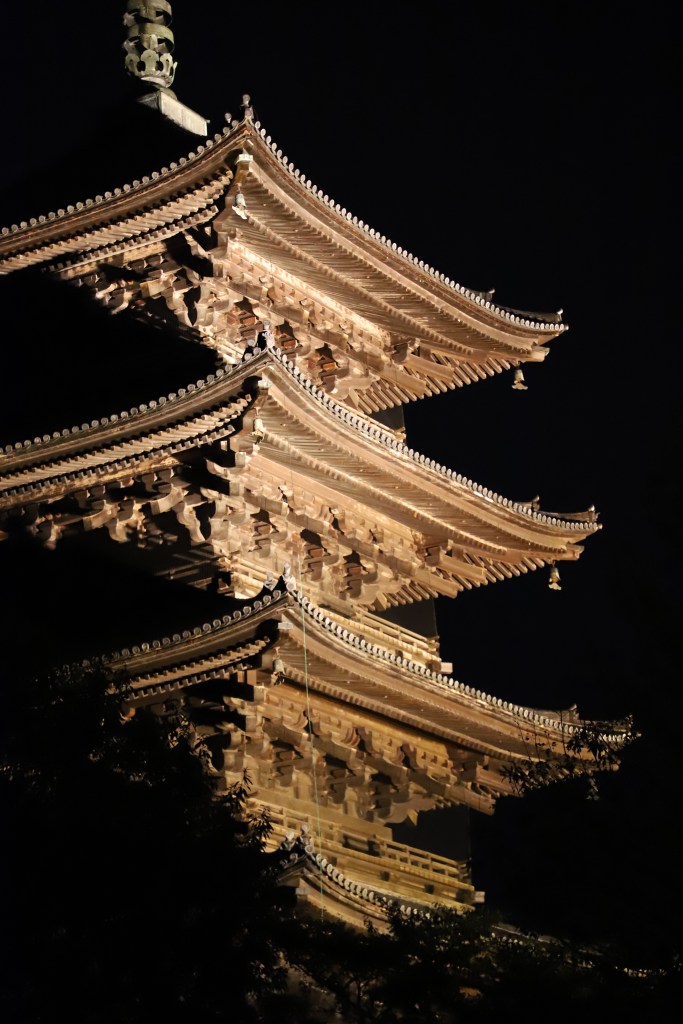
The train ride back to Osaka was not quite as crowded as the trip to Nishinomiya, a benefit of a lingering fan base. After arriving in Osaka, a quick walk across the street brought us to the Shinkansen and the ride back to Kyoto. Arriving after dark, we walked back toward the Toji Temple to get a look at the Pagoda at night.
The top of the Pagoda at the Toji Temple. (Photo credit: Jeff Hayes)
The third stop on our 2018 Japanese baseball tour took us to Hiroshima. Our main purpose was to see the Carp in action at Mazda Zoom Zoom Stadium. However, the trip itinerary also included a visit the the Atomic Peace Dome and Peace Memorial Park. Having seen the plane that delivered the first atomic weapon, it seemed appropriate to see the remains of the destruction it helped create.
1. Getting to Hiroshima
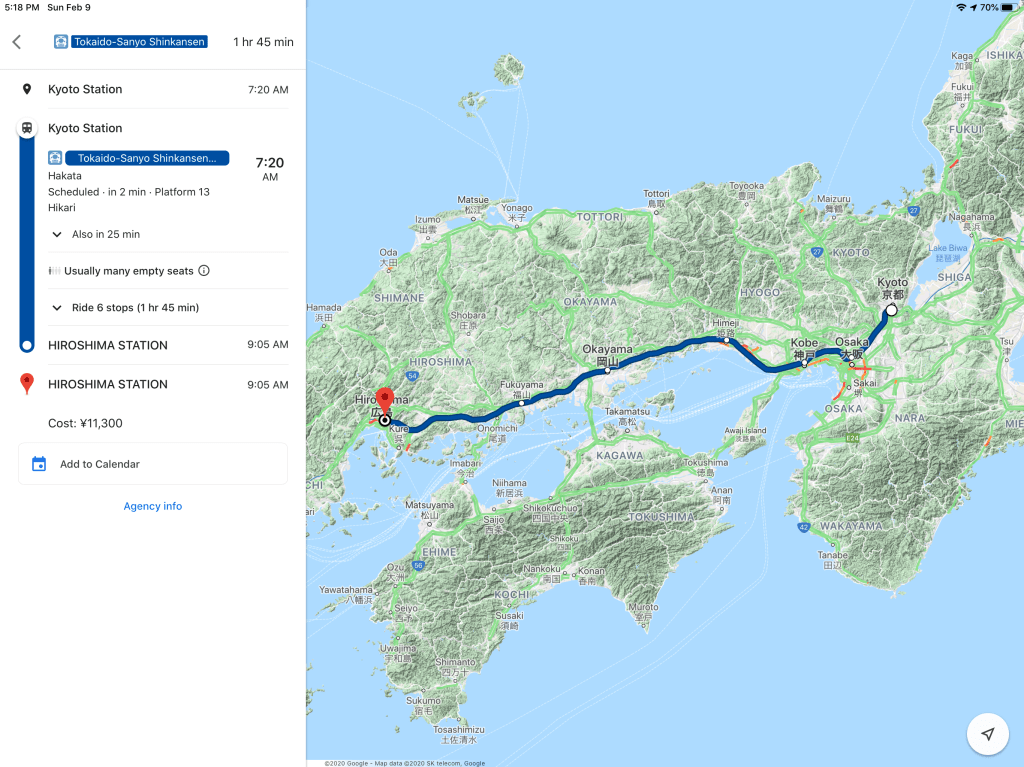
From our base of operations in Kyoto, we walked from the hotel across the street to the Kyoto Station. We took the Tokaido-Sanyo Shinkansen to Hiroshima Station, covering the 350 km distance in about one hour and 45 minutes (including six stops). Morning sunshine in Kyoto faded behind cloudiness as we traveled southwest.
The Kyoto-Hiroshima trip depicted in Google Maps.
The trek covered mainly rural areas, with cities interspersed with the rice paddies and mountains to the north. We noticed many solar farms along the way, but given the weather so far on the trip, I’m not sure useful they were this week.
As we approached Hiroshima Station, we passed close to Mazda Zoom Zoom Stadium. Even though we arrived in Hiroshima more than three hours before the 1330 game start time, there were fans already lining up to enter the ballpark. Most NPB ballparks open their gates about two hours before game time, meaning fans were willing to wait an hour or more in line to get inside. We didn’t know why at the time, but we would find out later.
2. Hiroshima and the Atomic Peace Dome
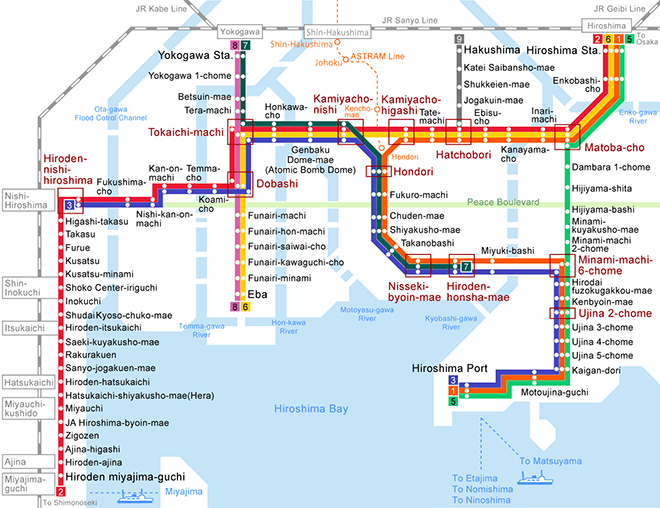
After arriving at Hiroshima Station, we took the Hiroshima Streetcar to the Peace Memorial Park. Though we paid cash for the trip, you can purchase a one day pass (which might be a nice souvenir), or use the Suica card you bought earlier in your trip.
A map of the Hiroshima Streetcar stops. In addition to getting you where you’d like to go, it afforded a great way to view Hiroshima.
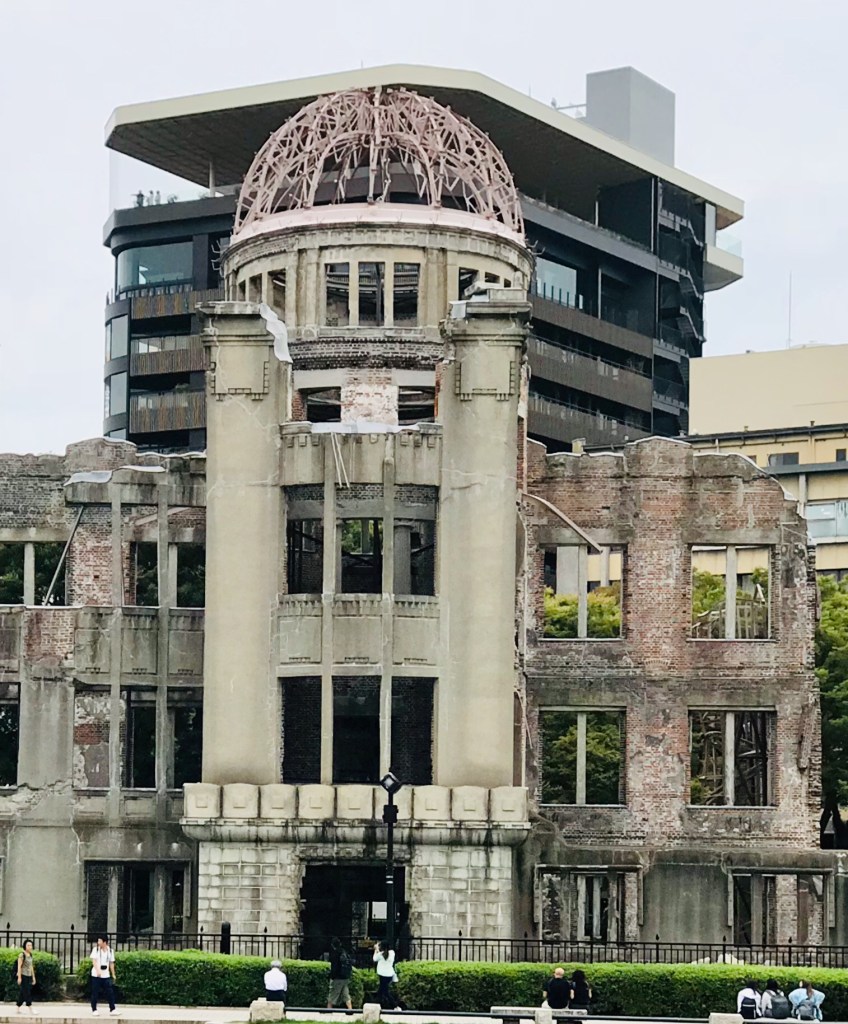
The streetcar stop for the Peace Memorial Park is less than 10 minutes from Hiroshima Station. Upon exiting the streetcar, the Atomic Peace Dome is immediately visible. A somber reminder of the first use of an atomic weapon, the overcast conditions seemed a fitting dreary backdrop. The Dome is the only remaining structure remaining from that day, as it was directly beneath the air blast.
The Atomic Peace Dome. A UNESCO Heritage site, this vantage point superimposes the Dome on the modern Hiroshima in the background.
Upon closer inspection, even the rubble from the blast was left in place. As might be expected, the Atomic Peace Dome drew significant interest, even on this cloudy and humid afternoon. Being in the presence of the Dome was a sobering experience, conjuring images of unimaginable destruction and chaos.
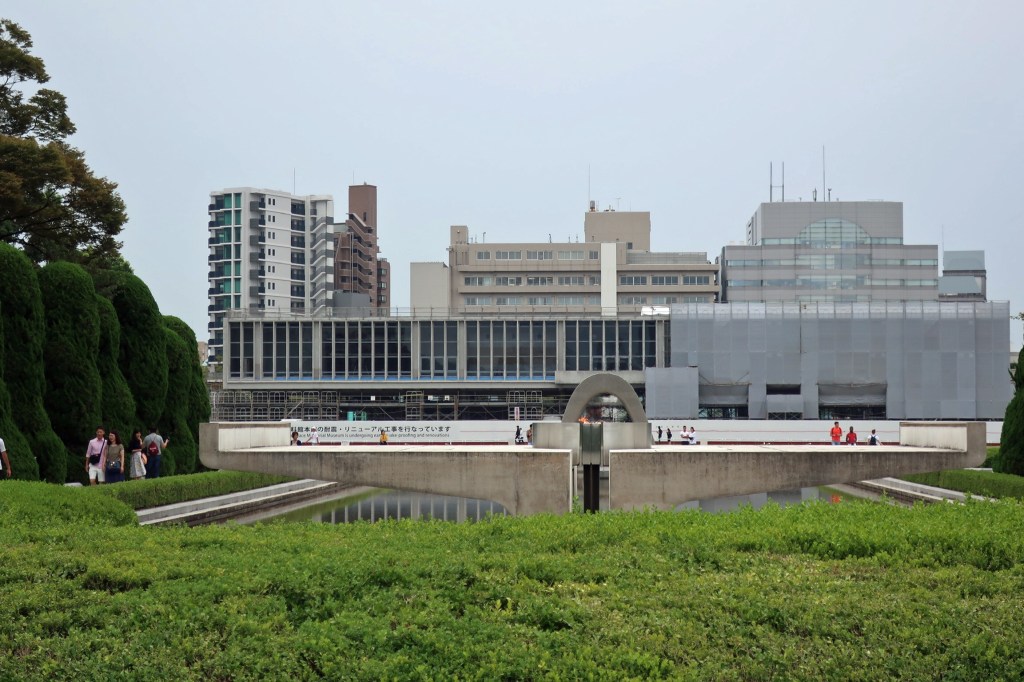
The Atomic Peace Dome is the focal point of the Peace Memorial Park, which stretches along the banks of the Motoyasu River. South of the Atomic Peace Dome is the Peace Memorial Museum. Time was a limiting factor when visiting the museum, which has a Japanese section on one side, and an English section on the other. Among the photographs in the museum is a picture from 1947, in which Hiroshima still lies in ruins. The image shows Emperor Hirohito addressing the citizenry, with the Dome in the background. This is reportedly the first time the Emperor had addressed the nation in person.
The Peace Museum from a distance. The Atomic Peace Dome is to the left in this picture. (Photo credit: Jeff Hayes)
2. Getting to Mazda Zoom-Zoom Stadium
With game time fast approaching, we headed toward Mazda Zoom-Zoom Stadium for the 1330 game start. From the Peace Memorial Park, we caught the streetcar back toward Hiroshima Stadium. The streetcar stop was about 1.3 km from the stadium. Walking through a suburban area following the streetcar ride, we followed a long asphalt walkway toward the stadium. Clouds were lowering and thickening, with rain threatening at any moment.
Along the walkway, we noticed groups of people sitting or standing, watching TVs broadcasting the pre game activities. Though it seemed a bit odd, especially with rain approaching, we didn’t think much of it at the time.
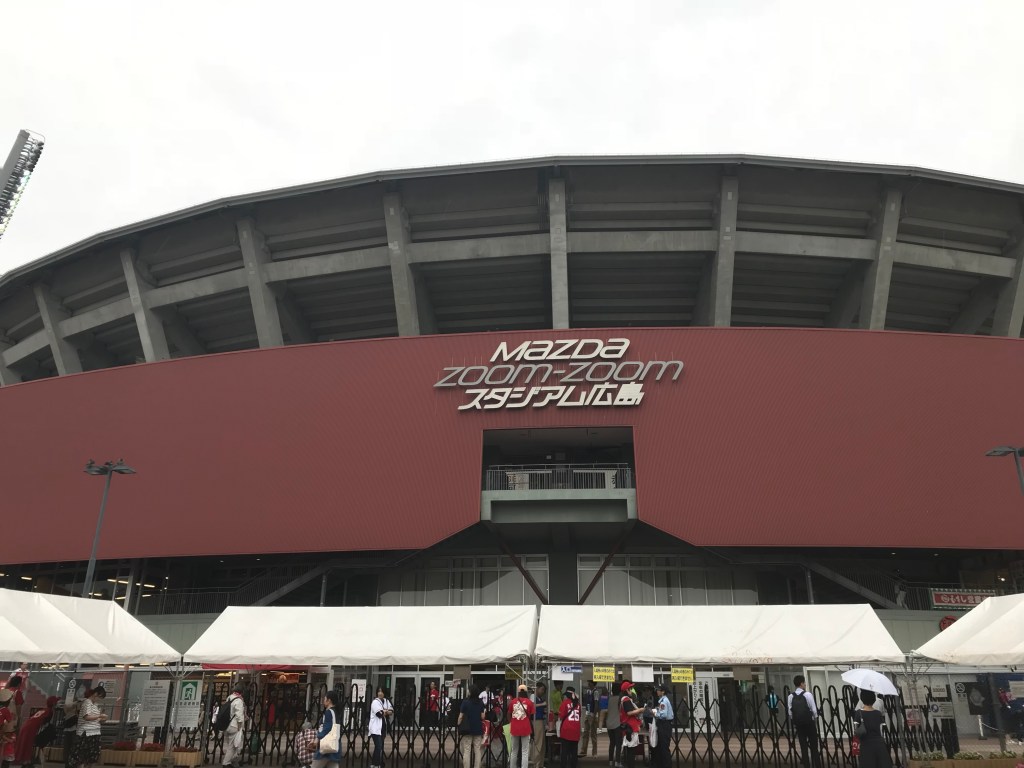
Mazda Zoom-Zoom Stadium in Hiroshima
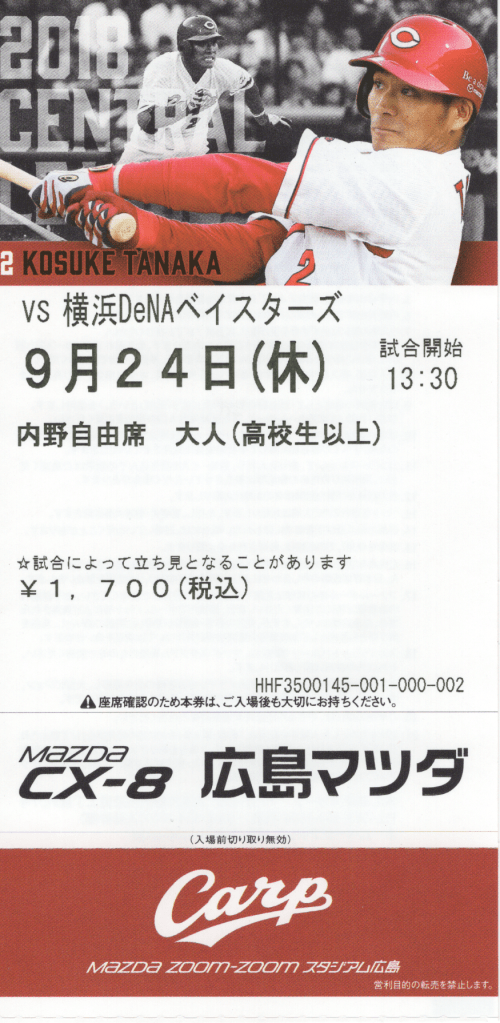
A quick walk around the stadium showed nothing remarkable, though there were food and souvenir stands around the park. Much like other NPB tickets, the seating information was difficult to decipher. Typically, we can at least glean the gate number from the ticket, but in this case, we were stumped concerning where to enter the ballpark. Eventually we tracked down a staff member, who graciously showed us where to enter.
My Hiroshima Carp ticket. Almost all of the vital information is in Japanese.
Our tickets were general admission, which meant we would have to view the game from wherever we could. Soon after arriving, we realized why there were lines to enter the stadium three hours before game time. The general admission seating was long gone. To watch the game, we would need to stand. Unfortunately for us, all of the railing around the ballpark was ringed with fans, sometimes four or five deep. It became clear that our view of the game would be tenuous at best.
The Hiroshima Toyo Carp have perhaps the most enthusiastic fans in the NPB. The team often sells out the entire season (70 home games) just hours after tickets go on sale, so this is definitely a tough ticket to secure. Since it didn’t seem to matter from where we saw the game, we sought out the Carp Team Store. The store was comparatively small, when compared to other team stores we’ve seen. There was not much of interest to us, so I purchased a Carp cap and a program.
Following the trip to the store, we walked around the stadium. The game as a sellout, of course, and we didn’t see many empty seats, even with rain on the way. One thing that struck me about the park was its resemblance to the Great American Ballpark in Cincinnati OH. Of course, the Carp modeled their uniforms after the Reds, so I suppose it shouldn’t be surprising the stadium would have a familiar feel. In any event, we got as close to the railing as we could to see the start of the game.
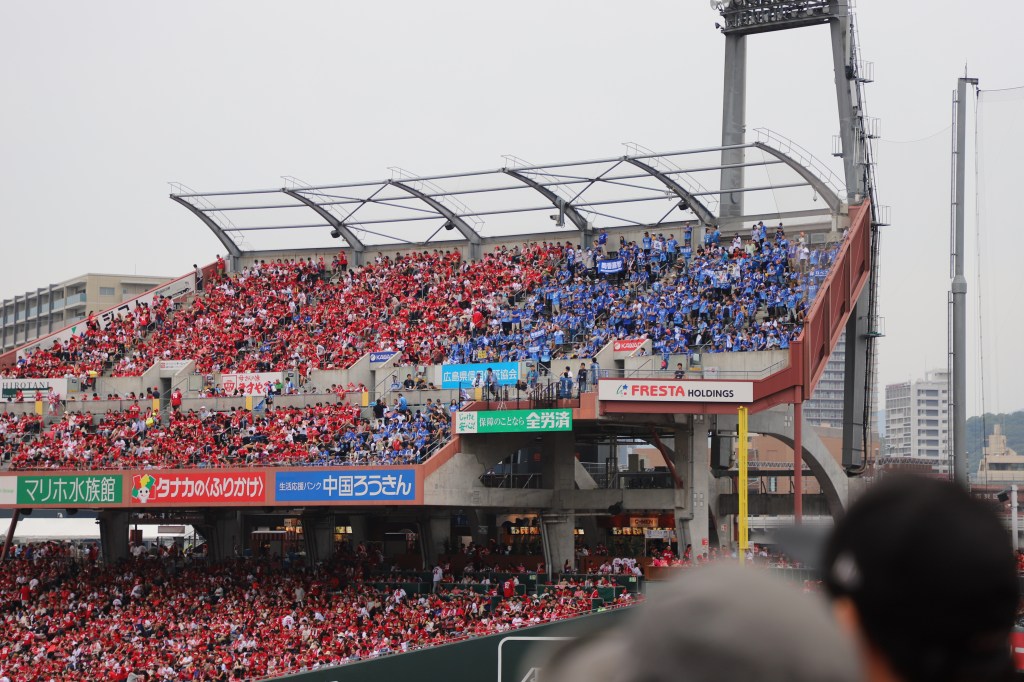
DeNA BayStars fans in the upper deck in right field at Mazda Zoom-Zoom Stadium. (Photo credit: Jeff Hayes)
The Carp’s opponent this afternoon was the Yokohoma DeNA BayStars. A light rain starting falling as the game started, and the afternoon was becoming murkier by the moment. Since we could not get close to the rail to see much of the action, we decided to circle the field, popping in occasionally to watch the action.
Following our trip around the park, the rain began to fall more steadily. Conditions were becoming less conducive to watching a game, especially since we did not have seats. Having seen the stadium, we decided to leave before conditions became worse. Heading back to Hiroshima Station, we saw fans in the rain, huddling around TVs along the asphalt walkway we took coming to the park. The devotion of the Carp fans was impressive, to say the least.
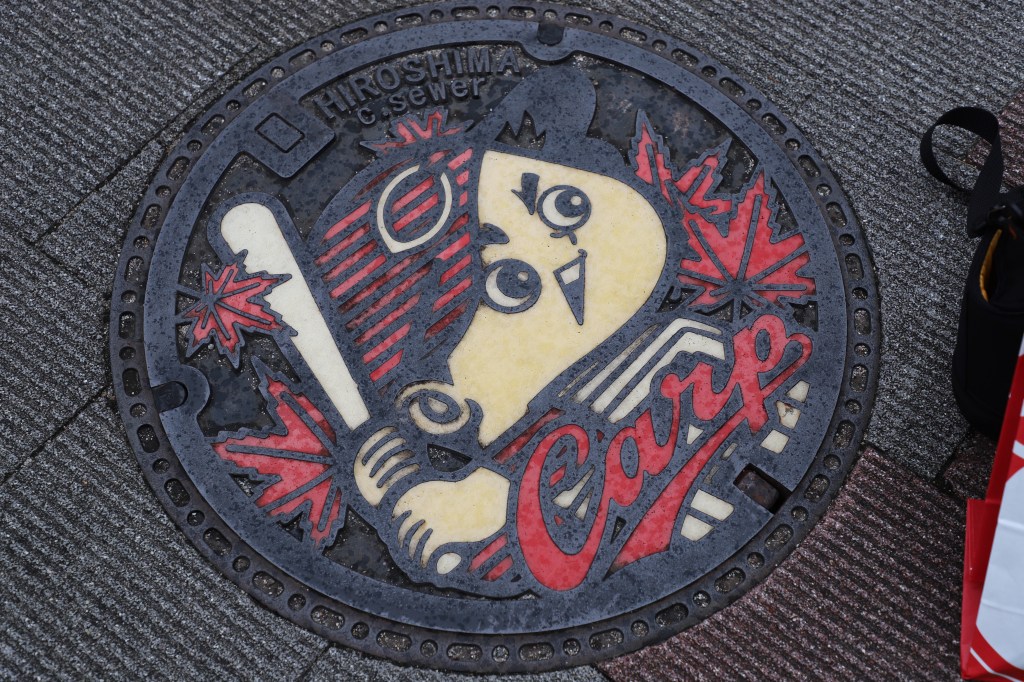
A manhole cover seen on the asphalt walkway back to Hiroshima Station. (Photo credit: Jeff Hayes)
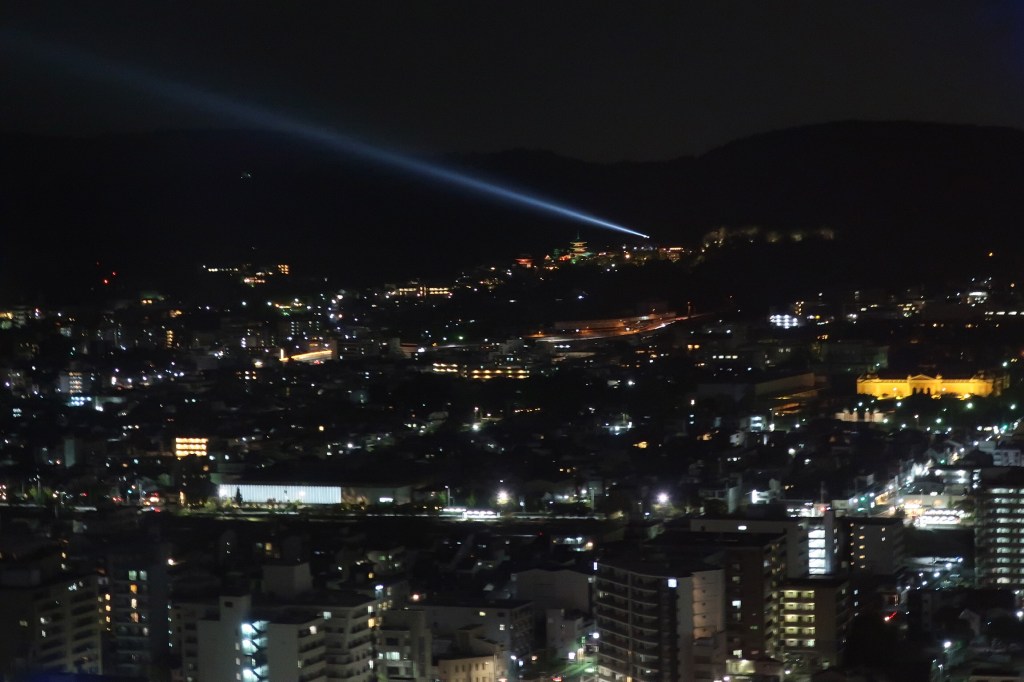
With the weather taking a turn for the worse, we cut short our visit to Hiroshima, and caught the next Shinkansen for Kyoto. Arriving in Kyoto after dark, we decided to visit the Kyoto Tower. Located across the street from Kyoto Station, we had seen it during the day, and thought it might afford a nice view of Kyoto at night.
Kyoto Tower is located in a commercial building, along with shops and restaurants. A quick elevator ride took us to the observation deck. The deck was crowded, which limited the amount of time we could spend in any one location. The view of the city lights was impressive, though low clouds may have obscured some of the lights from nearby cities.
Kyoto at night, from the Kyoto Tower. Even with the clouds, the mountains are visible to the west. (Photo: Jeff Hayes)
Following the visit to the tower, we headed back to the hotel, exhausted from a long but fun day in Hiroshima.




 Baseball Travels