Florida Baseball Trip 2014 – Miami

Google Earth view of Marlins Park in Miami, FL.

Our only Major League Baseball trip of 2014 was focused on the teams in Florida (Miami and St Petersburg). We chose early May for the trip, since it is just before the heat and humidity typically descend on the Peninsula. Because we were starting the trip in New Jersey (which is just out of range for a road trip, given the time constraints we had for the visit), we chose to fly to Miami, our first stop.

1. New Jersey to Miami, Tuesday May 6th 2014

While preparing for the trip, we discovered that it was more economical to fly into Ft Lauderdale, then drive to Miami, than to fly into Miami International Airport. In addition to being a cheaper flight, there were many more flights to Ft Lauderdale than Miami on the day we wished to travel. This could be due to the fact that Ft Lauderdale is a major port for cruise ships.

We chose to fly out the afternoon before the game in Miami. Even including the nearly three hour flight from New Jersey to Ft Lauderdale, we believed we’d built in enough time to get to Marlins Park before the 705 pm first pitch.
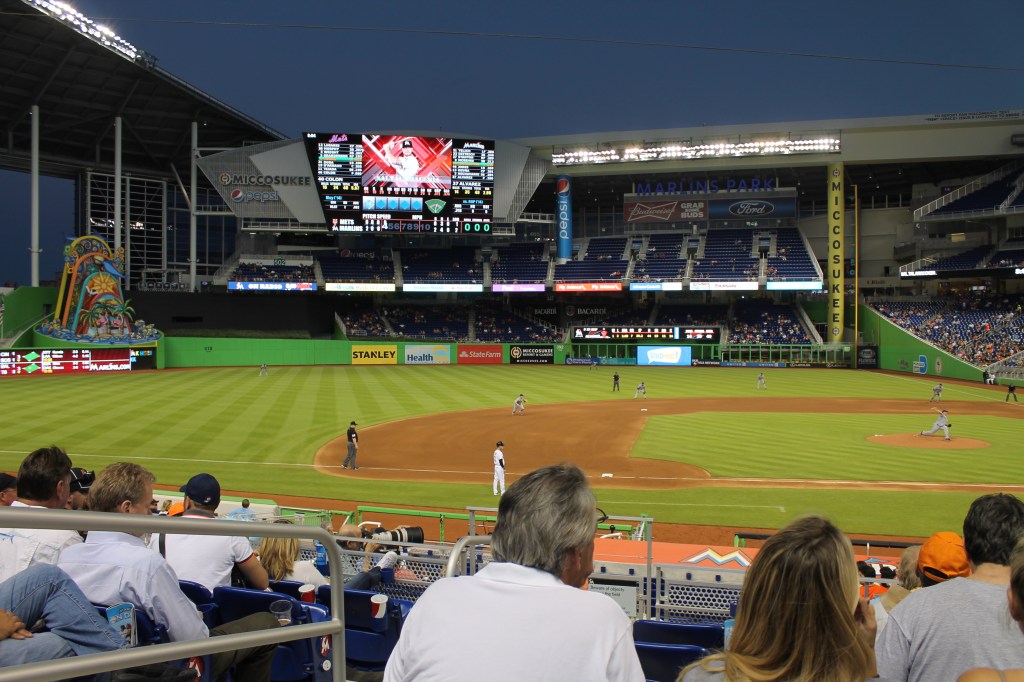
The view from our seats at Marlins Park in Miami, FL. (Photo credit: Jeff Hayes)

However, shortly after boarding the flight, our carefully planned (and admittedly tight) timing was derailed by a problem with the plane. We have encountered mechanical issues with planes before, but the problem with this plane was new: toilet malfunction. Both toilets in economy were unavailable, though the first class toilet was functional. With just one toilet available for a nearly three hour flight, we were forced to deplane and wait for a replacement.

The delay ensured that we would miss the first pitch in Miami. Disappointed but undaunted, we eventually left New Jersey more than an hour late. After landing in Ft Lauderdale, we rushed to pick up our rental car and sped toward the park. Slackening evening traffic allowed us to get to the park in under 30 minutes. Parking was ample (after all, this WAS a Marlins home game), but still we arrived in the top of the second inning.

Bartolo Colon delivers a pitch against the Miami Marlins on May 6th, 2014. (Photo credit: Jeff Hayes)

The weather in Miami was delightful, with clear skies, temperatures in the 70s and low humidity (at least for Miami). The weather afforded us a view of Marlins Park with the roof open. Built in an area where thunderstorms are common (typically peaking right around 700 pm), getting to see a game with the roof open was a treat. There had been controversy concerning the roof, as the Marlins apparently had a much better record against the Mets with the roof closed. Tonight, however, that was not an issue.

The Marlins’ opponent for this evening was the New York Mets, and the starting pitcher for the Mets was ageless Bartolo Colon. The Marlins scored two runs against Bartolo before we had arrived, but he settled down for the next few innings. Meanwhile, the Mets offense sputtered against Marlins starter Henderson Alvarez III (who had thrown a no-hitter in 2013).
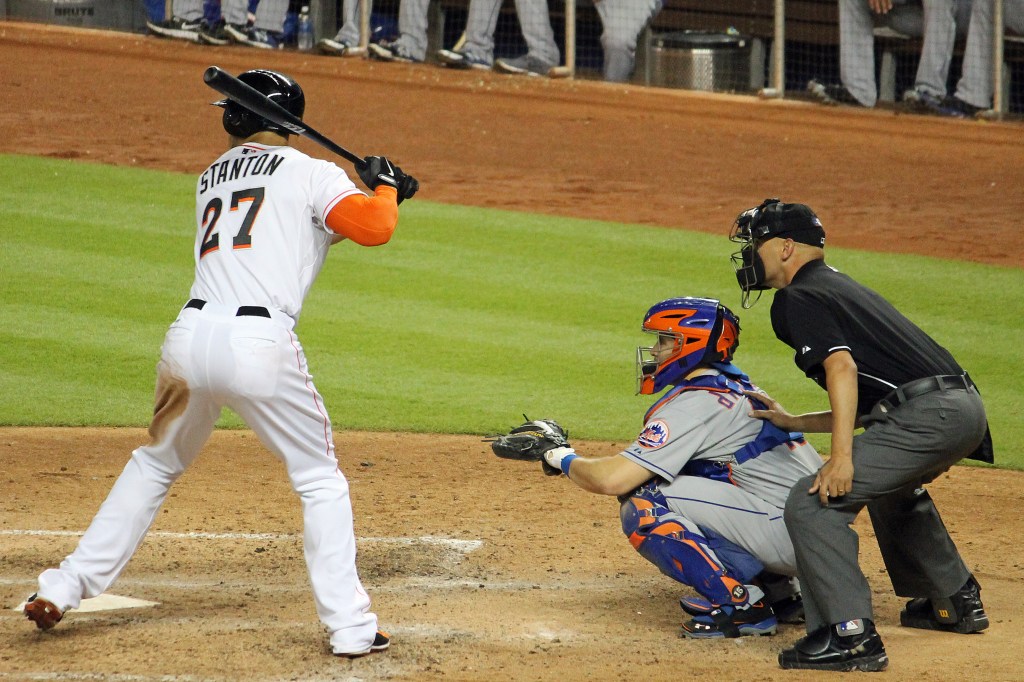
Giancarlo Stanton (going by Mike Stanton at the time) standing in against Bartolo Colon. (Photo credit: Jeff Hayes)

Overall, it wasn’t a bad appearance for Colon, who allowed three runs in seven innings. However, the Mets were no match for Alvarez, who tossed a six hit shutout in a 3-0 Marlins win. With both pitchers throwing efficiently, the time of the game was a mere two hours and eight minutes, one the shortest games we had seen in years.

Our late arrival did not allow us any time to explore the park, and the speed of the game kept our attention on the field, not the park itself. The initial impression of the park was that is was perfect for South Florida, with warm colors and an Art Deco feel. Fortunately, we would have much more time to investigate the park and it surroundings the next afternoon. Shortly after the end of the game, we headed to the hotel and settled in for the night.


2. Miami, Wednesday May 7th 2014
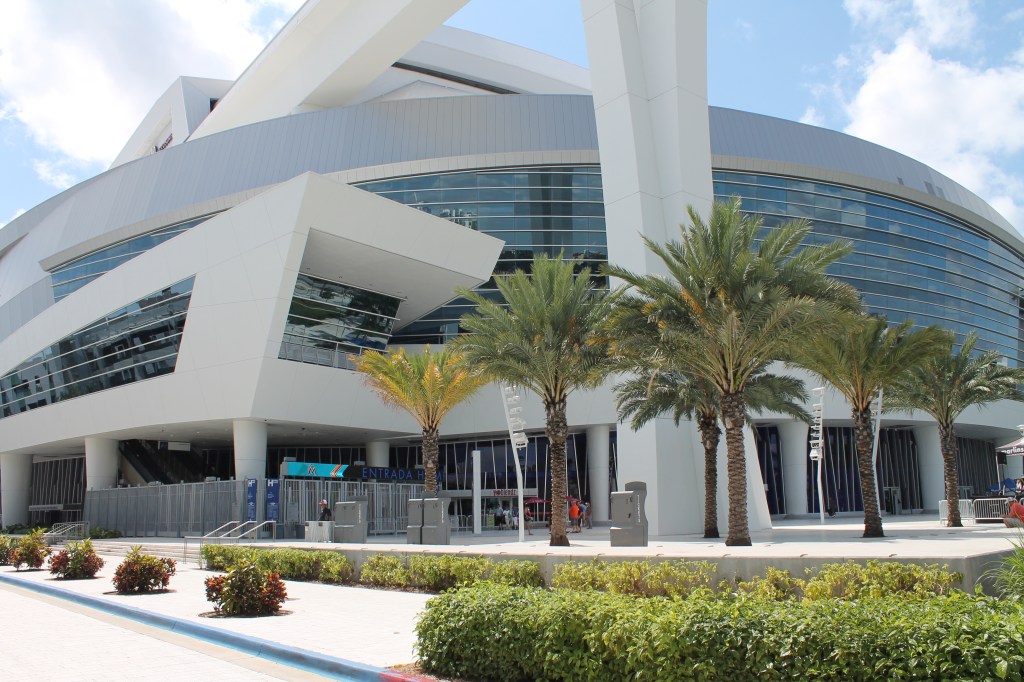
Outside Marlins Park, Miami, FL. (Photo credit: Jeff Hayes)

Following breakfast at the hotel just outside Miami, we headed to the ballpark early to explore the area. Unbeknownst to me, Marlins Park was constructed on the site of the former Orange Bowl, in Little Havana just west of downtown Miami. Unlike the trend in ballparks of the past couple of decades, Miami eschewed the “retro” look in favor of a more contemporary feel. From my perspective, the outside of the park was more reminiscent of an art gallery than a ballpark, but seems to fit in well in Miami

Strolling around the ballpark, we quickly discovered that there wasn’t much in the vicinity, outside of parking garages. However, the combination of architecture and landscaping (replete with palm trees) provided a very attractive environment, perhaps one of the finest we’d visited. Waiting outside for the gates to open, it seemed many of the fans we encountered were Mets fans, no doubt some of them transplants from the New York City metro area.

Marlins Park with the roof closed. (Photo credit: Jeff Hayes)

Walking into the park, it became evident that the roof was closed. Like most ballparks with retractable roofs, Marlins Park looked cavernous with the roof closed. It wasn’t clear why the roof was closed; sunshine and temperatures in the 70s made for an ideal early May afternoon in Miami. There was a breeze, but it didn’t seem as though the wind was strong enough to warrant closing the roof. The fact that the Marlins were again hosting the Mets for the Wednesday matinee may have been part of the decision. While I’m not sure there is enough evidence to implicate the Marlins in unsportsmanlike conduct, it DOES make a Mets fan like me wonder.

Arriving well before the first pitch, we had plenty of time to explore Marlins Park. Walking the concourse in the upper deck, we ran into a uniformed Florida State trooper, presumably working security. Since we were walking alone near centerfield, I thought he might give us trouble. After asking us what we were doing, he then followed us halfway across the concourse toward home plate, talking baseball.
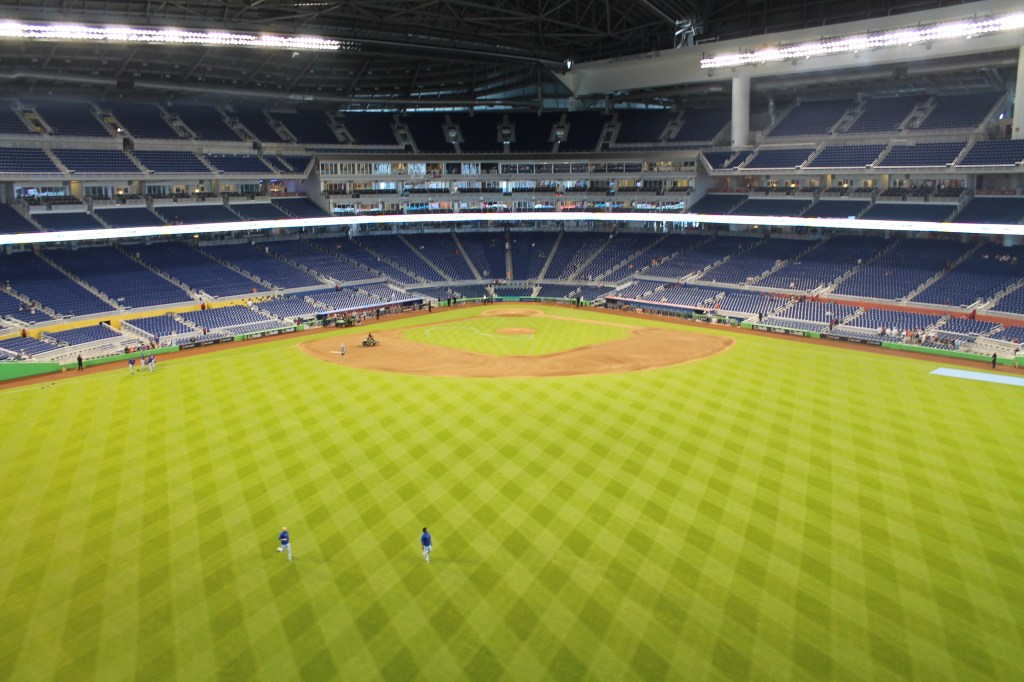
Marlins Park from the upper deck in centerfield. (Photo credit: Jeff Hayes)

Following our tour of the inside of Marlins Park, we hit the concession stand on the lower level before finding our seats. As might be expected, there were more than a dozen eateries and bars scattered throughout the park, not counting the more traditional concession stands. Perhaps the most famous is the Clevelander in left center field, adjacent to the Marlins bullpen. Not surprisingly, there was a fair amount of Cuban and Hispanic food available, but we stuck closer to the standard fare for ballparks.

The view from our seats behind the first base dugout. (Photo credit: Jeff Hayes)

The closed roof changed the feel of the park, robbing it of whatever charm it possessed the previous night with the roof open. It seemed dark against the light streaming through the glass behind the left field wall, giving Marlins Park an almost drab feeling. It was against this backdrop that the Marlins hosted the Mets for an early afternoon game. The contest was a lightly attended affair, with far less than the announced crowd of 18,000 actually in the park.

On the mound for the Mets right hander Zack Wheeler, who was in the midst of his first full season with the Mets. A highly touted prospect acquired from the San Francisco Giants in 2011, Wheeler finally joined a promising Mets rotation. Unfortunately, after a encouraging 2014, Wheeler underwent Tommy John surgery in 2015. Recovery from the surgery, and subsequent setbacks, took over two years.
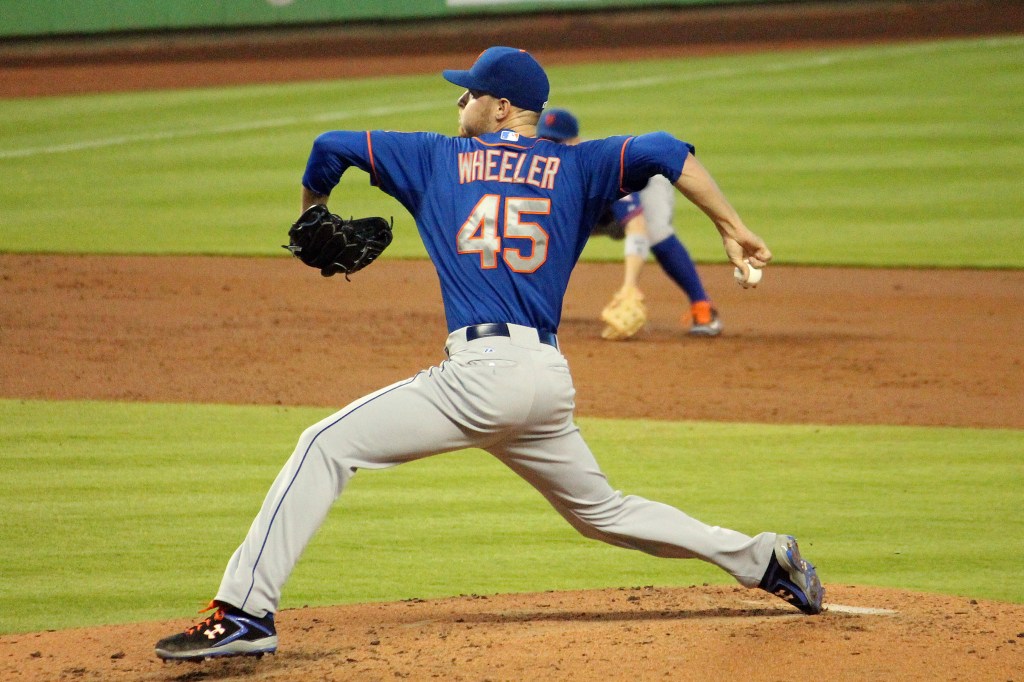
Zack Wheeler delivering a pitch at Marlins Park on May 7th, 2014. (Photo credit: Jeff Hayes)

On this day, however, Wheeler was on top of his game. Wheeler threw six shutout innings, striking out seven but walking five, reaching 100 pitches before exiting. Not to be outdone, Marlins starter Tom Koehler matched Wheeler nearly pitch for pitch in what evolved into a classic pitcher’s duel.

Interestingly, the best play of the day was not made by a Met or a Marlin. During the top of the third, the Mets’ Reuben Tejada lined a fastball down the left field line. With the ball headed toward the seats in foul territory , a Marlins ball boy made a lunging catch of the screaming liner, diving into the seats to make the outstanding grab. The catch seemed even better in person, and the sparse crowd gave the kid a warm ovation.

A sea creature themed mascot race during the seventh inning stretch at Marlins Park. (Photo credit: Jeff Hayes)

The score remained tied 0-0 going into the bottom of the ninth of the briskly paced game, with each team mustering only two hits. The Marlins scored with one out in the ninth on a sacrifice fly, a seemingly fitting end to a game dominated by pitching (or was it inept offense?).
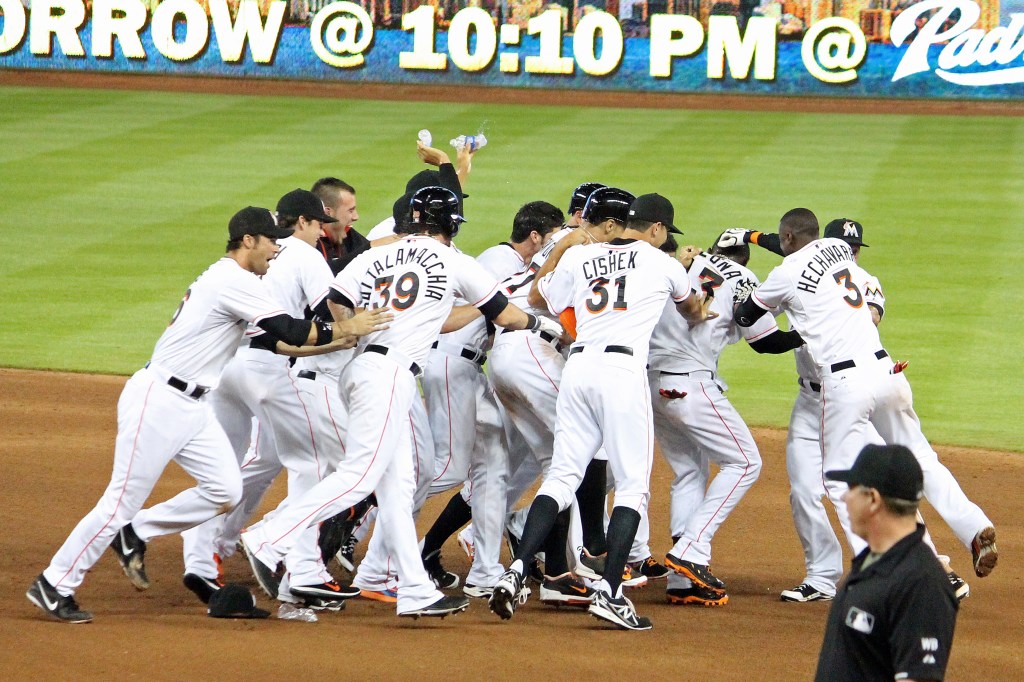
The Marlins celebrating their 1-0 walk off win over the Mets. (Photo credit: Jeff Hayes)

As the crowd filed out of the stadium following the game, the roof was opened. The timing was curious, which made me wonder further about the conspiracy involving the closed roof and Mets’ losses. Marlins Park was a nice place to see a game, though the closed roof put a damper on its feel. While there was not enough to make me want to visit again in the future, Marlins fans should be thankful they have such a good home ballpark.
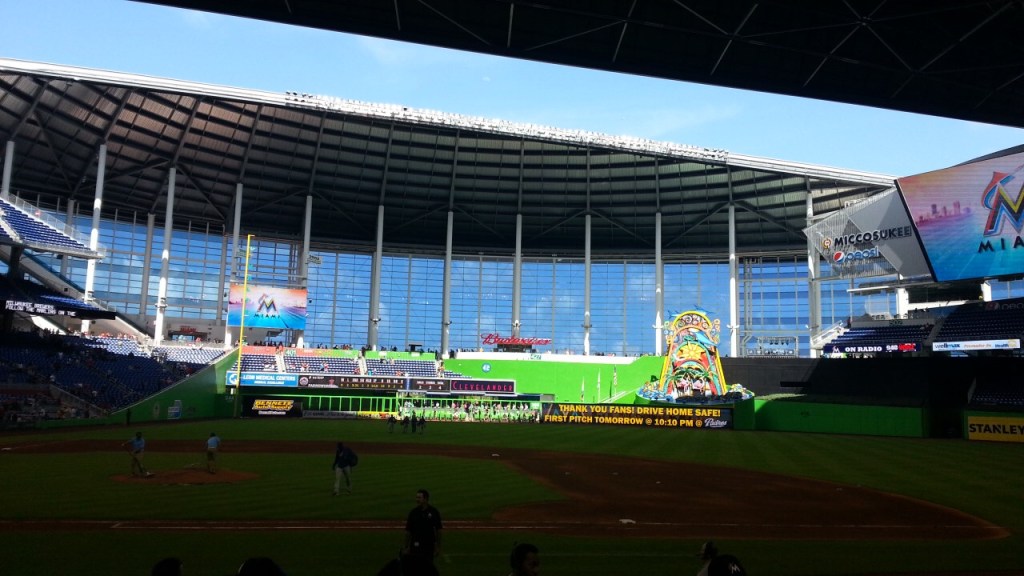
The roof of Marlins Park opening AFTER the game ended. (Photo credit: Jeff Hayes)

Following the game, we made a quick trip to South Beach. Ocean Drive, the main strip along the beach, was lined with bars and restaurants on one side, and a white sandy beach on the other. The ocean was rough that late afternoon, preventing people from entering the water. The setting sun and refreshing sea breeze made the visit enjoyable, but we left before the area got too crazy.

To my great dismay, neither my brother or I could locate our pictures of South Beach. Surely those pictures would have told a better story than me about the area.
Portland, ME July 20th 2015

Portland Head Light, reputedly the most photographed lighthouse in the world. (Photo credit: Jeff Hayes)

The middle stop our three day baseball tour of New England was Portland, Maine. Having lived in southern Maine for 12 and 1/2 years, it was almost like coming home. We arrived in the Portland area the night before, and the morning brought sunshine and temperatures in the 70s, much cooler than the 90s we endured the previous day in southern New Hampshire. Game time in Portland was slated for 705 pm, giving us plenty of time to visit some my favorite places in the area.

1. Freeport/Yarmouth/Portland

Following breakfast at our hotel, a Holiday Inn Express in Freeport, Maine (though I didn’t feel any smarter for the experience), we headed for my favorite place in Maine: Fort Williams Park in Cape Elizabeth. A former Army base, active during World War I and World War II, the main attraction of the 90 acre park is the Portland Head Light. Completed in 1791 (built on the order of George Washington), the lighthouse is said to be the most photographed lighthouse in the world. Considering that I personally have taken hundreds of pictures of the lighthouse, that claim is easy for me to believe.

Viewing Portland Head Light from the north. The complex (which includes a small museum and a gift shop) sits near the edge of a granite cliff. (Photo credit: Jeff Hayes)

This sunny and pleasantly warm late morning drew a large number of sightseers, focusing mainly on the lighthouse. However, being very familiar with the park, I headed straight for the rocks behind the lighthouse. Facing Casco Bay, the rocks provide a great view of the bay, as well as the Halfway Rock Lighthouse.

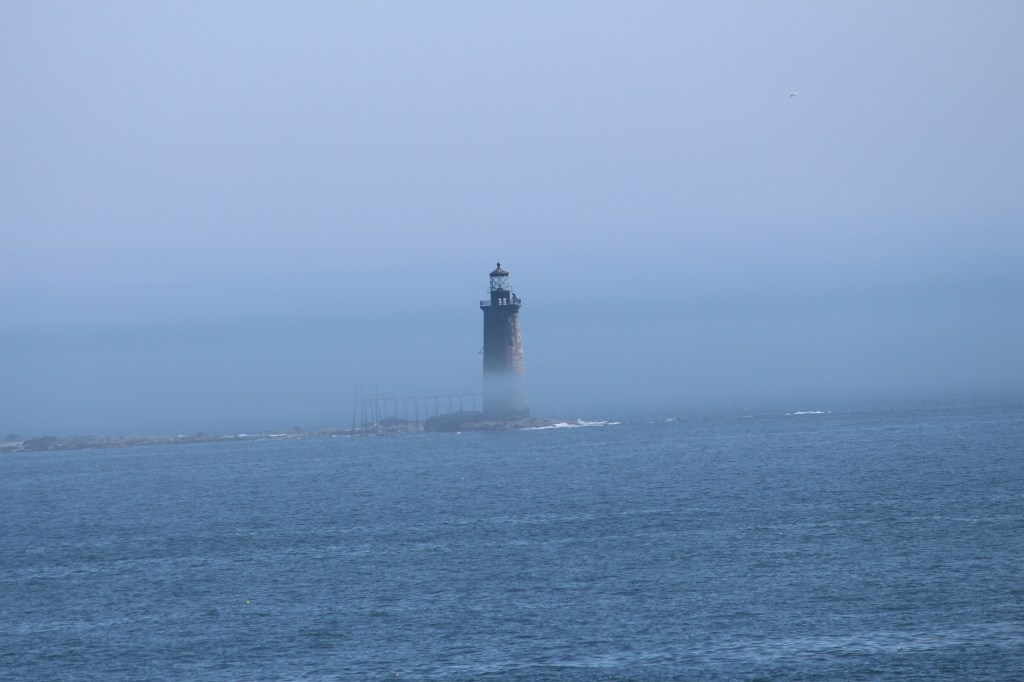
On this morning, as is common during the warm months, the seemingly ever present fog partially shrouded the lighthouse. Located about halfway between Portland and the Atlantic Ocean, Halfway Rock stands approximately where the sea fogs recesses during the day, only to surge inland after the warmest part of the day.

Halfway Rock Lighthouse, partially obscured by sea fog. (Photo credit: Jeff Hayes)

The rocks adjacent to Portland Head Light present a very real hazard to boat traffic moving through Casco Bay, as strong storms and dense fog can obscure the coastline. Perhaps the most famous example of the hazards of the rocky Maine coast was the wreck of the Annie C Maguire on Christmas Eve 1886. The wreck has been immortalized on the rocks of the lighthouse.

The commemoration of the wreck of the Annie C Maguire on the rocks near the Portland Head Light. (Photo credit: Jeff Hayes)

The morning flew by visiting the park, and after more than two hours there, we headed north into nearby Falmouth for lunch at Richetta’s Brick Oven Ristorante. Featuring possibly the best brick oven pizza in Maine, we dined alfresco under brilliant sunshine with a cooling sea breeze.

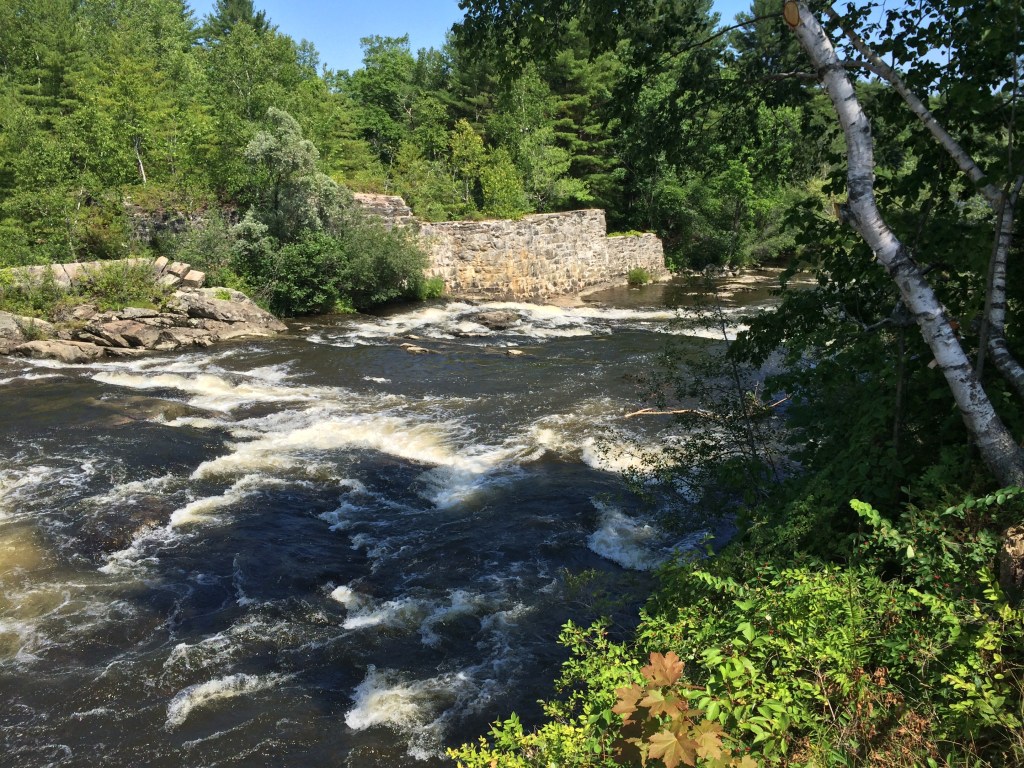
Following lunch, we visited my second favorite place in Maine: Royal River Park in Yarmouth. Living less than a mile from the park for more than 12 years, it is a beautiful place to visit all times of year, but especially so during the summer. The Royal River was once the home of paper mills, and the river provided power for the mills. Though the mills are long gone, the foundations are still visible.

Paper mill foundations are still evident on the banks of the Royal River Park in Yarmouth, ME. (Photo credit: Jeff Hayes)

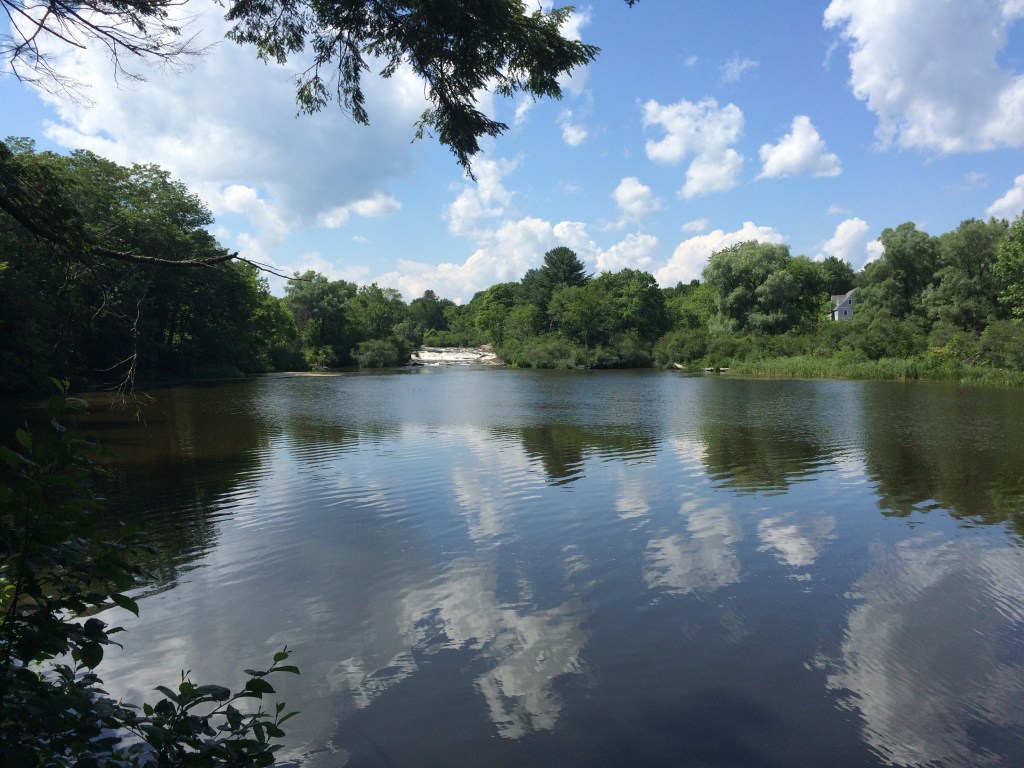
Rapids over the northern stretch of the river transition to still waters closer to Route 1. A tire swing along the banks of the river here provides recreation for the locals, and dogs often dive into the river to swim in the calm waters. Though it is tucked away west of Interstate 295, it is worth a visit if you are in the area, as it affords a view into the natural beauty Maine has to offer.

Calmer waters on the Royal River. (Photo credit: Jeff Hayes)

2. Hadlock Field, Portland Maine

After a brief repair to the hotel in Freeport to relax before the game, we made the 20 minute drive to Hadlock Field, the home of the Portland Sea Dogs. Located on the edge of downtown Portland, Maine, parking was at a premium near the stadium. Fortunately, we were able to park just down the street from the park in a commercial lot; during the warm months, available parking is often more than a mile away. Access to the field from these lots is provided via shuttle bus.

Outside Hadlock Field in Portland, ME. (Photo credit: Jeff Hayes)

My first game at Hadlock Field was back in 1998, when the Sea Dogs were the Double A affiliate of the Florida Marlins. A lot had changed over the years, as the Sea Dogs became the Double A affiliate of the Boston Red Sox. Shortly after the change, the stadium underwent a fairly substantial remodeling, adding changes that reminded fans of Fenway Park.

A replica of the Green Monster at Hadlock Field in Portland, ME. (Photo credit: Jeff Hayes)

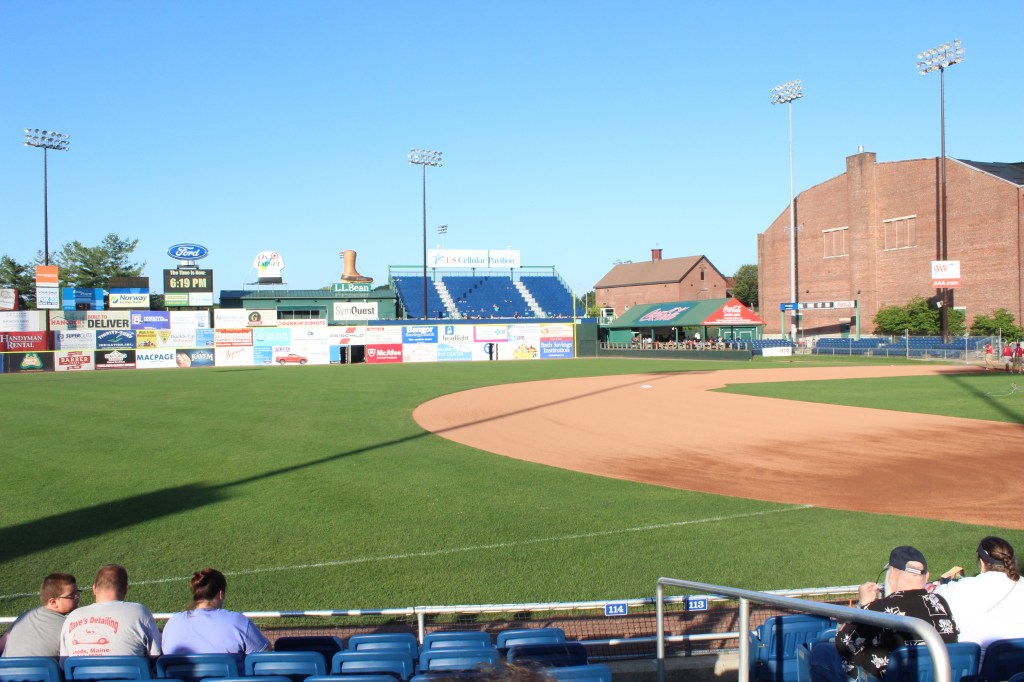
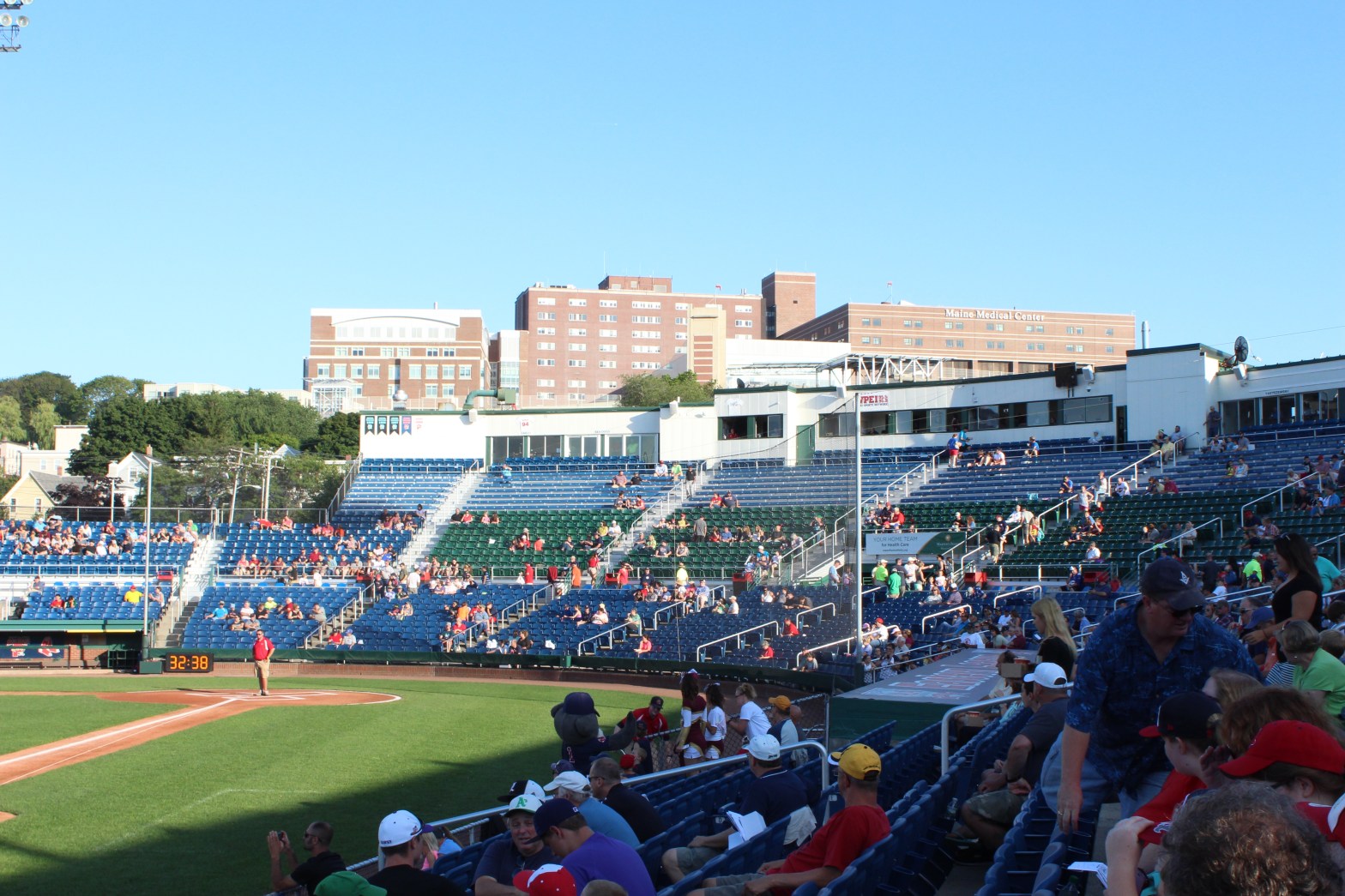
Nestled between the hills of downtown Portland and Interstate 295 to its west, the view of Portland is one of the best attractions of the park. Since my last visit to the field, there were a number of additions, including a huge boot from LL Bean on the right field wall. While the additions may have enhanced the popularity of the park, I found that the changes may have detracted from the charm of the place.

The view from our seats. Note the buildings of downtown Portland in the distance. (Photo credit: Jeff Hayes)

Hadlock Field is a modular stadium, with aluminum grandstands along the left field line. During the summer months, a Sea Dogs ticket can be a hot commodity, and seats for this game were at a premium. Because of the demand for tickets, our seats were located more than halfway down the left field line, offering a less than ideal view of home plate.

The view of right field at Hadlock Field, including the bleachers and the LL Bean boot over the home team bullpen. (Photo credit: Jeff Hayes)

The design of Hadlock Field brings the left field foul line very close to the seats, allowing for a more intimate feel for the fans. However, bringing the fans that close to the line had an unintended side effect. Line drives off the bats of left hand hitters reach the seats at high velocity, making some of the seats flat out DANGEROUS. We saw two fans hit by these line drives injured during this game, both seriously enough to require medical attention.

Being a veteran of the ballpark, I knew enough to stay alert for line drives. Still, I was surprised upon my return that this portion of the seating area was not protected by a net. Hopefully, this has been addressed, as fans not paying close attention are putting themselves at a risk they may not truly appreciate.

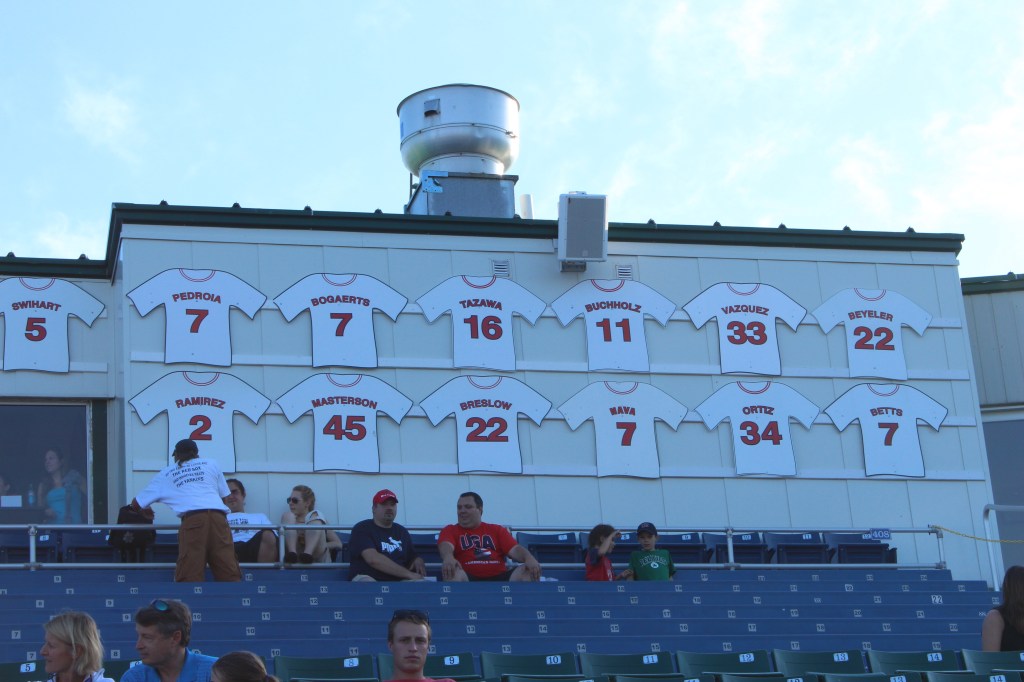
The Hadlock Field display of retired Sea Dogs numbers, replete with familiar names to Red Sox fans. (Photo credit: Jeff Hayes)

Concessions were located in the concourse below the seating area. The concessions were mostly standard fare, but included fish sandwiches, as well as a Maine favorite, fried dough covered with powered sugar. We briefly toured the ballpark before settling into our seats shortly before game time.

The Sea Dogs hosted the Trenton Thunder, the Double A affiliate of the New York Yankees. The Sea Dogs opened the scoring in the bottom of the first, scoring four runs on four hits and a walk off Thunder starter Brady Lail. Meanwhile, Sea Dogs starter William Cuevas kept the Thunder scoreless through five innings.

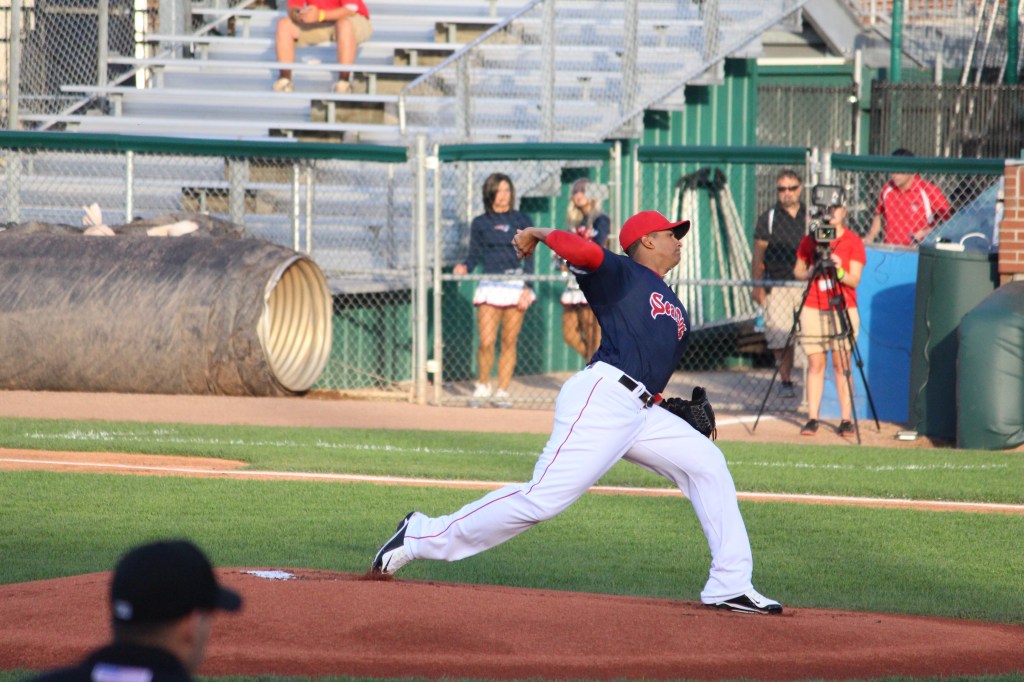
Sea Dogs starter William Cuevas delivers a pitch at Hadlock Field. (Photo credit: Jeff Hayes)

The four runs the Sea Dogs scored in the first inning capped for the scoring for the home team. Meanwhile, the Thunder clawed their way back into game, scoring a run in the sixth and two more in the seventh. The Thunder threatened in the ninth, as RF Danny Oh delivered a run scoring double, making the score 4-3. However, the game ended as Oh was thrown out trying to steal third base.

Thunder RF Danny Oh scoring in the sixth inning. (Photo credit: Jeff Hayes)

Though there were many changes to Hadlock Field since my last visit, it still ranks as one of my favorite minor league ballparks, the problem with foul balls in left field not withstanding. The great feel of the park, augmented by the vistas of downtown Portland, make this field worth the visit, if you can score tickets during the summer months.

Portland, ME to New Britain, CT July 21st 2015

New Britain Stadium, New Britain, CT. (Photo credit: Jeff Hayes)

The last day of the three-stop New England minor league tour started in Portland, Maine, following a game at Hadlock Field the previous night. Following breakfast in nearby Freeport, we headed for New Britain, Connecticut for an evening ball game at New Britain Stadium, home of the Rock Cats.

The weather had been spectacular across southern Maine the previous day, but as we drove south, we drew closer to a heat wave that was underway from southern New England into the Mid Atlantic states. By the time we reached New Britain in the mid afternoon, we traded temperature in the 70s in Portland for the lower 90s in Connecticut. In addition, the humidity levels were markedly higher, setting the stage for active weather later in afternoon.

Google Maps showing the three and one-half hour drive from Portland, ME to New Britain, CT

Having arrived in New Britain well before game time, we decided to explore the city. However, the hot and humid conditions were hardly conducive to walking, and after a quick tour of Walnut Hill Park, we took shelter in the New Britain Museum of American Art. Established in 1903, it was the first museum in the US dedicated to American art. Much of the art displayed during our visit was impressionist, as well as post-contemporary.

After about an hour in the museum, we headed toward the ballpark. While in the museum, hazy sunshine had given way to clouds, which were yielding scattered showers and thunderstorms. Conditions improved as we reached the park, with more hazy sunshine as we arrived. There was onsite parking for $5 (for better parking) and $3 (for the rest of the lot), and we got to the stadium early enough so that parking was ample.

New Britain Stadium from the left field concourse, adjacent to the picnic area. (Photo credit: Jeff Hayes)

Though it opened in 1996, the brick facade of New Britain Stadium gave the park an older, almost throwback feel. Once inside, it was clear that the ballpark was modular. Unlike most modular ballparks, there were no aluminum grandstands; instead, there were nearly 6,000 pine green seats. A concrete concourse spanned from left field to right field, with covered picnic areas near each foul line.

Storm clouds started gathering over the park, and suddenly a thunderstorm enveloped over the stadium. Thunder, lightning and pouring rain accompanied the storm, sending fans under the stands and toward the concession areas. While we waited for the rain to slacken, we visited the team store. As might be expected, the store was busy with bored fans killing time while the storm raged. The store possessed standard fare, and I indulged in a hat, a yearbook and a Rock Cats tote.

This is NEVER a good sight when hoping to see a ballgame. The rain delay pushed back the start time of the game by one hour and twenty minutes. (Photo credit: Jeff Hayes)

Just as the first storm ended, another followed on its heel. At that point, I became increasingly pessimistic that we would get the game in. Fortunately, the second storm dissipated almost as quickly as it formed, leaving just some drizzle as the darkness approached. Finally, the tarp was removed, and the game started about 830 pm, almost 90 minutes after the scheduled first pitch.

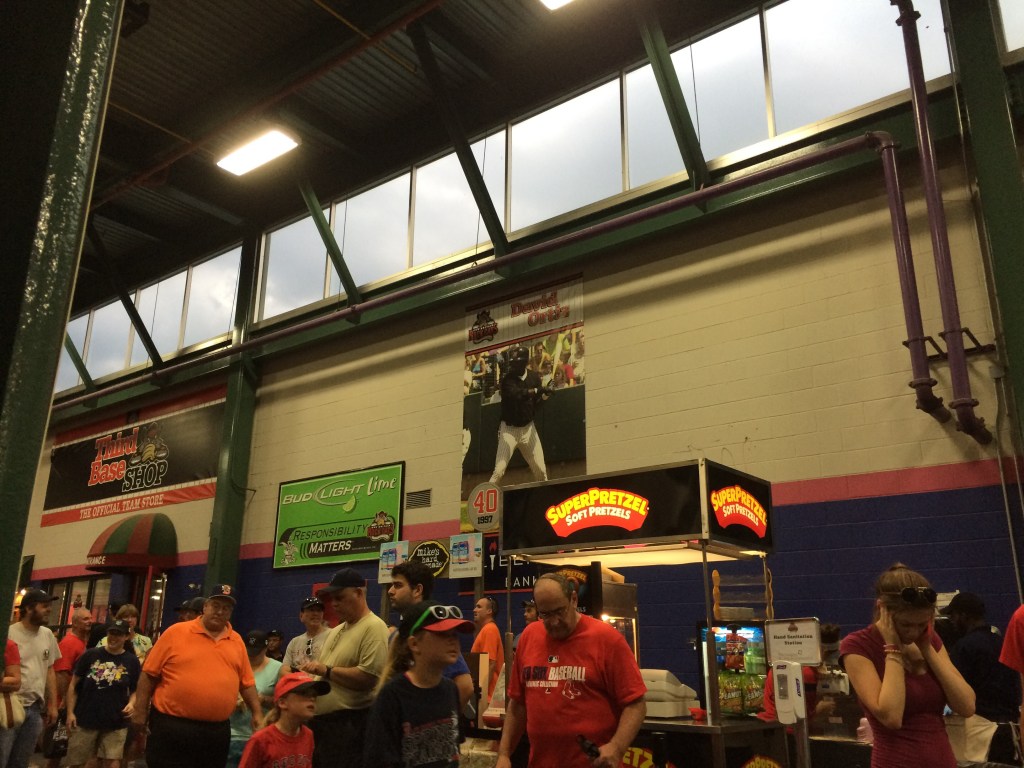
Fans milling around the inner concourse, waiting for the storms to end. (Photo credit: Jeff Hayes)

For tonight’s game, the Rock Cats (the Double A affiliate of the Colorado Rockies) hosted the Binghamton Mets. In the lineup for the Mets was LF Michael Conforto. The left handed hitting Conforto had been swinging a hot bat for much of the season, though he had cooled off some heading into this series. Despite the dry spell, Conforto would make his MLB debut three days later.

Also in the lineup was CF Brandon Nimmo, a former number one draft pick, who was working his was through the Mets’ system. Finally, LJ Mazzilli started at 2B. Mazzilli, the son of former Met Lee Mazzilli, had been in the Mets system for a couple of years, trying to break through to AAA.

The sweet left handed swing of Michael Conforto. (Photo credit: Jeff Hayes)

Our seats for the game were adjacent to the Mets’ dugout, affording us a unique view of the Mets on the bench. Some of the hijinks in the dugout was nearly as entertaining as the action on the field. We were also treated to a close up look at players we would see in the big leagues in years to come.

Apparently, the weather delay chased away all but the heartiest of baseball fans. The sparse crowd that remained made the 6,000 seat stadium seem almost empty as the first pitch was thrown. Once the rain ended, the remainder of the night was dry, but clouds remained for the balance of the game.

The view from our seats gave us a direct look into the Mets’ dugout. (Photo credit: Jeff Hayes)

The B-Mets offense got going early, scoring three runs in the top of the first, featuring a run-scoring triple by Brandon Nimmo. Mets starter Gabriel Ynoa made those runs stand up, yielding a single run in his seven innings of work. Ynoa, who would eventually reach the MLB with the Mets, had possibly his best outing of the season.

Mets starter Gabriel Ynoa delivers a pitch at New Britain Stadium. (Photo credit: Jeff Hayes)

Ynoa, along with two relievers, held the Rock Cats to five hits while striking out 11. The quick-paced game clocked in at two hours and 30 minutes. Toward the end of the game, the sparse crowd thinned out even more. Among the remaining fans was LJ Mazzilli’s father, Lee Mazzilli.

It seemed that only a few in the remaining crowd recognized him, but his presence was brought to our attention by murmuring fans near his seat. Mazzilli seemed gracious, but his facial expression indicated that perhaps he just wanted to watch the game. After the final out, we saw him in the concourse, but left him alone.

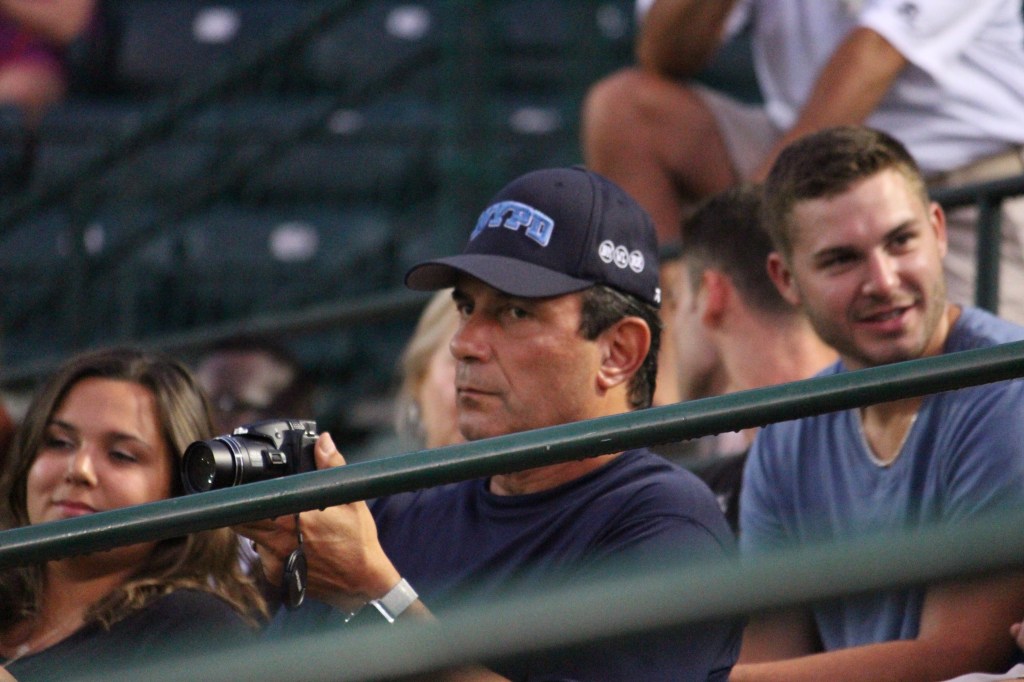
Lee Mazzilli, donning an NYPD cap, shooting video, presumably of his son’s at-bats. (Photo credit: Jeff Hayes)

At the conclusion of the game, we exited quickly, with a three hour drive ahead of us. New Britain Stadium was the epitome of a modular stadium, complete with a unassuming but functional video board. The 2015 season was the last for the Rock Cats, as the would become the Hartford Yard Goats in 2016, scheduled to move into the brand new Dunkin’ Donuts Park.