Looking at home plate from right center field at Target Field as the sun broke through the clouds.
Following a late night at Target Field the night before, we had breakfast at the Denny’s adjacent to our hotel, then relaxed until it was time to leave for the ballpark. Game time was 1210 pm, leaving little time to do much before arriving at the park as the gates opened.
We got a good look at Target Field during a cloudy evening, but hoped for a better look during the day. Unfortunately, the morning dawned cloudy, and remained so as we caught the Metro Blue Line from the Mall of America (which was adjacent to our hotel). Temperatures in the 40s reminded us that we were indeed in Minnesota in late September, which is a fall month this far north.
Our trip to Target Field via light rail took us past the old home of the Twins, the Hubert Humphrey Metrodome.
The trip took about 40 minutes, seemingly slow for the distance covered. That being said, the trip was pleasant, unlike mass transit we have seen in others cities. The Metro dropped us off right in front of Target Field, forgoing the need to drive and park at the stadium. There were few people milling around as the gates opened, suggesting that the game might be lightly attended, as the season was winding down for a team that wasn’t playing very well.
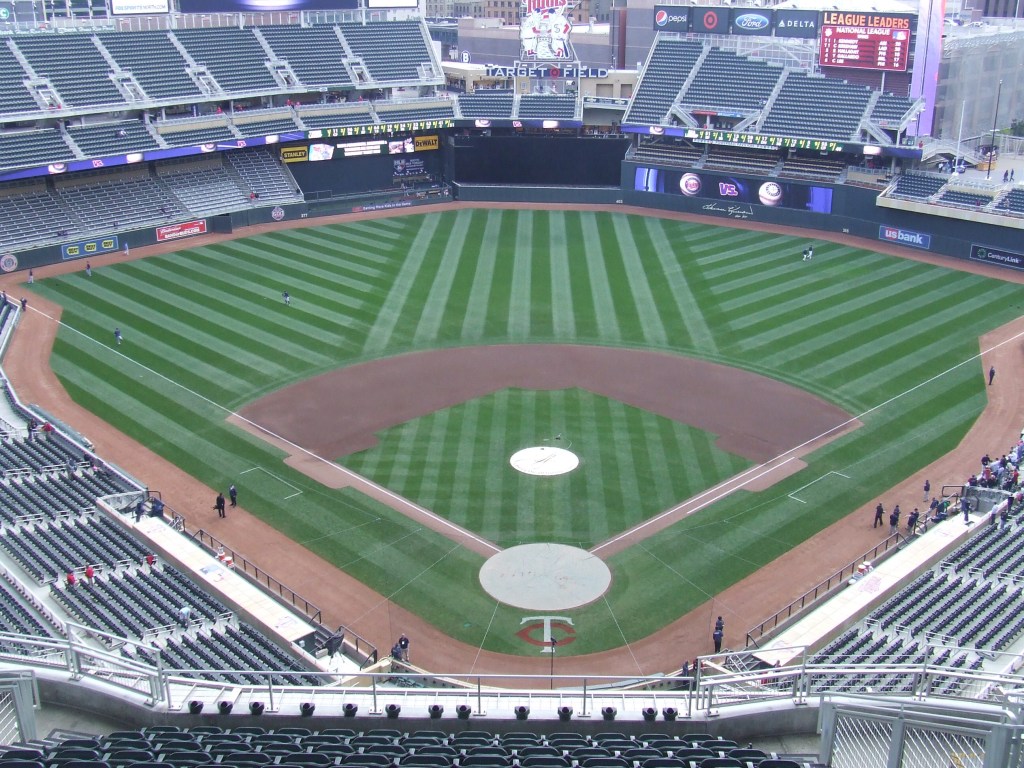
There was a distinct nip in the air at Target Field as we wandered throughout the seating areas. A gusty wind and temperatures struggling to reach 50 degrees was very different from the 80s and humidity we had been experiencing back home. In the light of day, we discovered that Target Field was quite photogenic, blunted only by the low clouds hanging over the city.
View of Target Field from the upper deck behind home plate. The sun lost its battle with the clouds for this picture.
Fans passed through the turnstiles as the stadium starting waking from its early autumn slumber. After encircling the stadium taking pictures, we hit the concession stand on the lower level for hot chocolate and hot dogs, which served as our lunch. Because the Twins were playing sub .500 baseball, tickets for the matinee with the Seattle Mariners were plentiful. As result, we obtained possibly the best seats we’ve ever had at an MLB game.
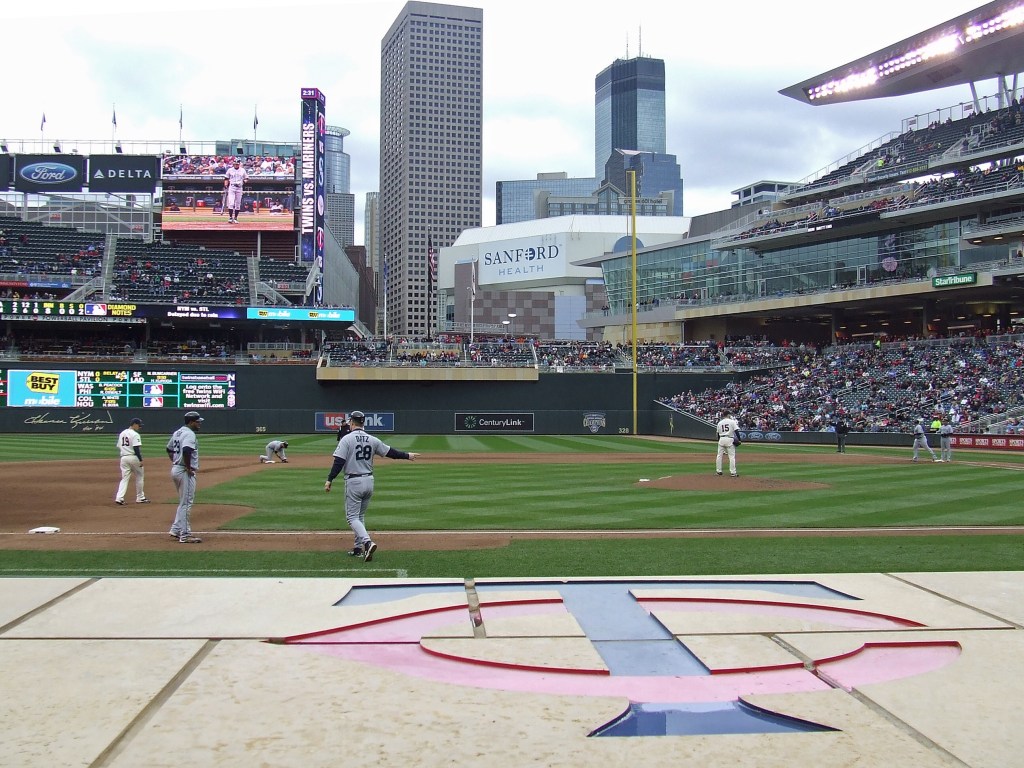
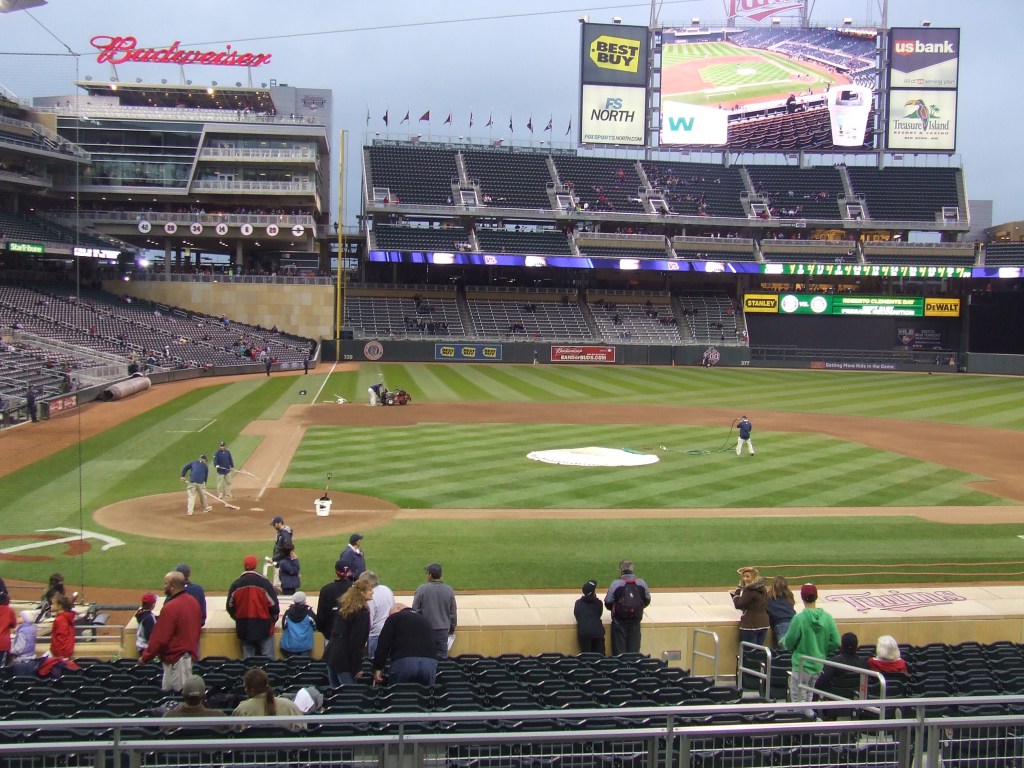
Our seats for the game, which offered a view of downtown Minneapolis.
The amazing seats gave us access we normally only get at minor league games. Our proximity to the field, as well as the sparse crowd, allowed us to hear chatter on the field. That is something we’ve never experienced in an MLB stadium. The announced crowd for the game was 37,000+, which was laughable. At most, there were 7500 souls in the park braving the early afternoon chill by the time the first pitch was thrown.
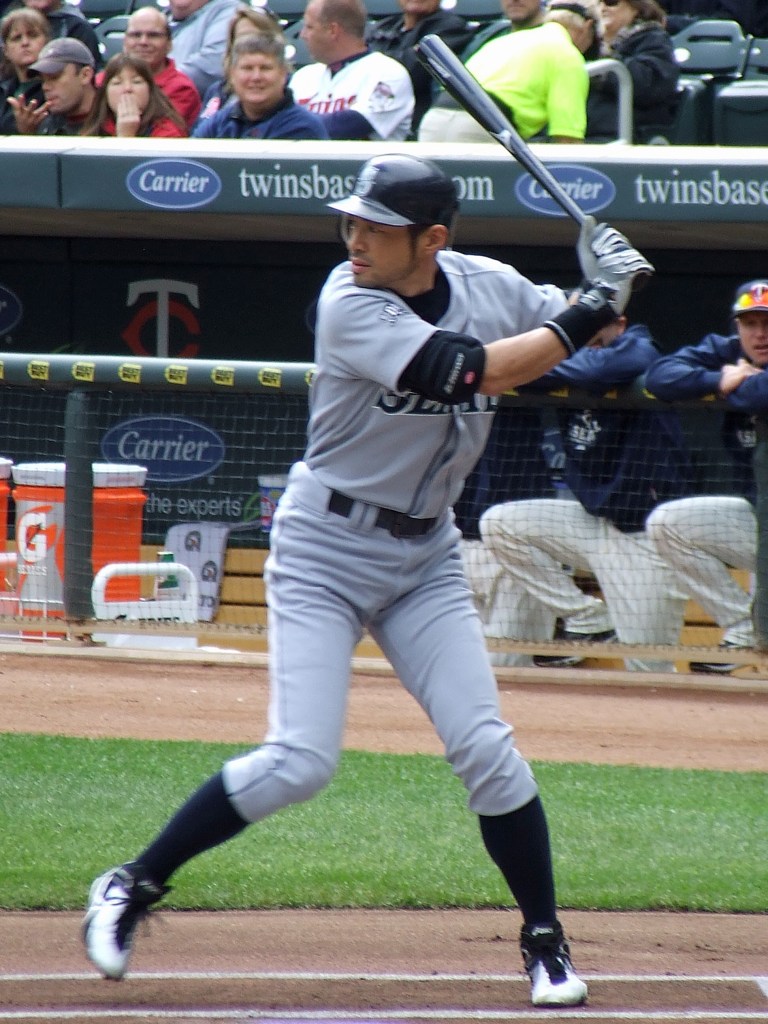
Leading off for the Mariners was Ichiro Suzuki. We’ve seen him a few times during our baseball travels, but never this close. Even among the Twins faithful, Ichiro was a fan favorite, receiving scattered applause as his name was announced. Ichiro was 3 for 9 in the two games we saw at Target Field, but each at bat was a thing of beauty from one of the best hitters in my lifetime.
Ichiro Suzuki at bat against the Twins at Target Field on September 22nd, 2011.
The pitching matchup for the final game of the series featured Anthony Swarzak for the Twins and Blake Beaven for the Mariners. Both starters were in their first full season with their teams, and each had a fairly mediocre campaign. The matchup seemed to be fitting for teams that were simply playing out their 2011 schedules, with little left to accomplish save evaluating young talent for the future.
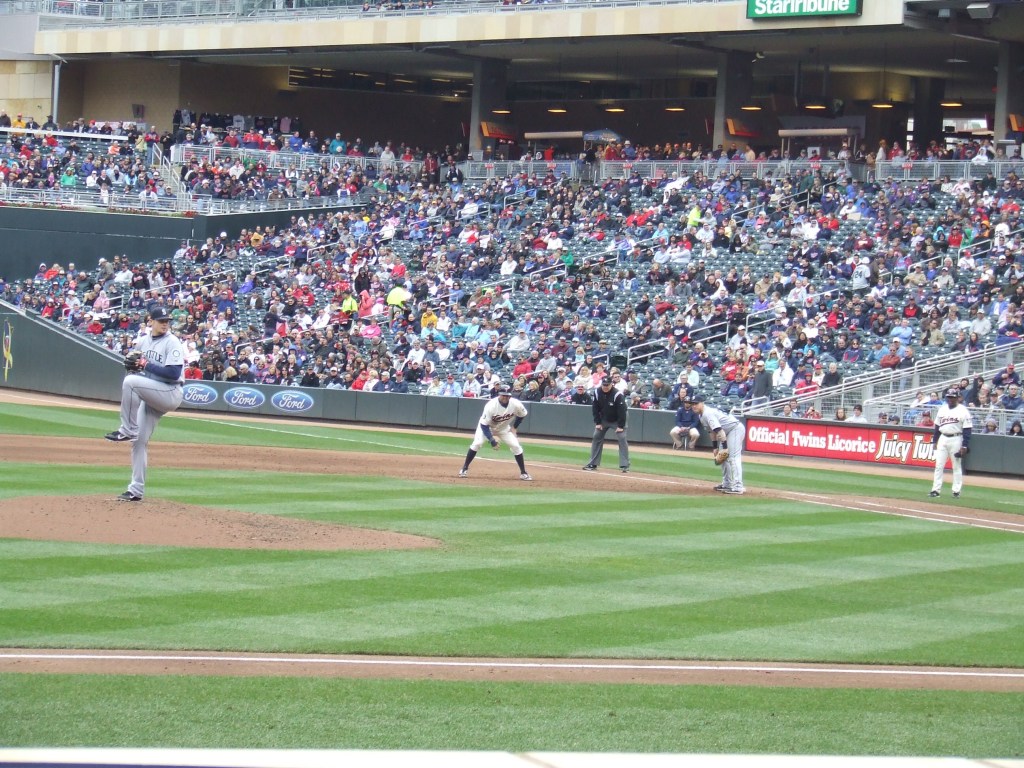
The sun made a brief appearance shortly after we arrived at Target Field, but since that time the sky maintained a slate gray overcast, ensuring little warming during the game. The Mariners scored single runs in the first and second innings to take an early lead. The Twins tied it up with runs in the third and fifth innings. Despite the starters having little MLB experience, they each performed admirably.
Mariners starter Blake Beaven delivers a pitch at Target Field.
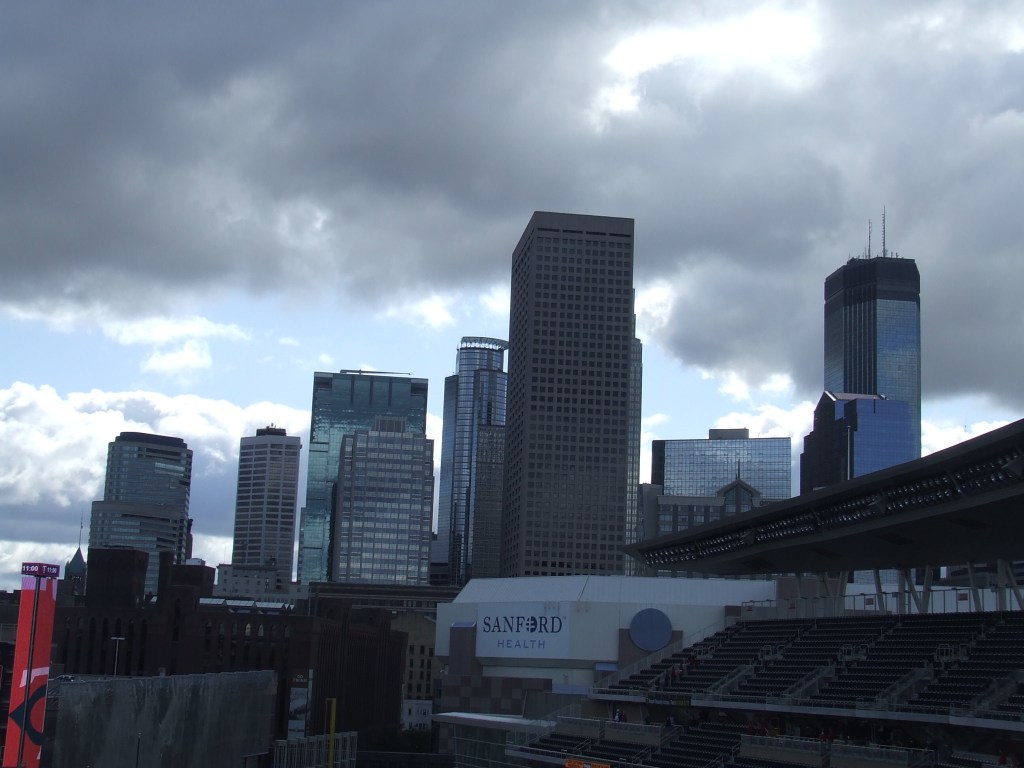
Breaks in the clouds after the fifth inning allowed a few rays of sun to sneak through, giving us a better view of downtown Minneapolis over the right field wall. Though there wasn’t enough sunshine to warm the air much, just seeing it through the overcast seemed to modify the fall chill firmly entrenched over the stadium.
A look at skyline of downtown Minneapolis as breaks in the overcast allowed the sun to make a brief appearance.
The Twins’ and Mariners’ bullpens shut down the opponent’s offense through the Mariners’ at bat in the top of the ninth. The Twins scored with two outs in the bottom of the ninth to seal a 3-2 victory. Despite the lack of scoring in the game, the contest clocked in at about three hours, which seemed longer in the late September chill.
The hometown Twins celebrate a walk off win at Target Field.
As we filed out of Target Field following the game, I turned around to take one final look at the ballpark. It had a clean, new feel to it, though I still couldn’t understand why a stadium in a place where snow can occur in May did not have a dome. It was a great place to see a game, and I may be back here someday, especially when the Mets are in town.
Strangely enough, this sign may have been my favorite part of Target Field.
Our second MLB trip of the 2011 season took us to Minneapolis to see the Twins at Target Field. Planning the trip for late September, we knew there was a chance that the night game we would attend could be cold, with temperatures in the 30s. Circumstances dictated the timing of our visit, and we were delighted to get a chance to visit Minnesota. Though I have been to the Minneapolis airport (to change planes), this visit would be the first “real” trip to Minnesota for each of us.
In a perfect world, we would have driven to from central NJ to Minneapolis, as road trips allow us to see some much of the US. However, there simply wasn’t time, since the drive would have been 2400 miles round trip, taking 34 hours. With the drive not a viable choice, we flew from Newark, NJ to Minneapolis, MN. With the flight clocking in at two hours and 30 minutes, we arrived too late to catch the game that night (September 20th). Instead, we checked into our hotel in Bloomington and settled in for the night.
1. Minneapolis, Wednesday September 21st
The morning dawned cloudy, with temperatures in the 40s. That might not qualify as cold in September for Minnesotans, but considering we came from a place where it was still warm and humid, it felt as though we skipped fall and went straight into early winter. Luckily, we knew this was possible and dressed accordingly.
Following breakfast at the Denny’s that was part of the hotel complex, we drove to Minniehaha Regional Park, along the banks of the Mississippi River. A bucolic retreat from urban Minneapolis, the park reminded me to some degree of Central Park in New York City. A stroll along the Mississippi River in the late September chill made it feel more like football weather, but we enjoyed the fall like conditions, despite the lack of sunshine.
Waterfall in Minniehaha Park. (Photo credit: Jeff Hayes)
Based on the rock formations in the park, it seemed as though at least some of the features were carved out by glaciers. We’ve seen similar rock formations at the Delaware Water Gap on the border of New Jersey and Pennsylvania. In fact, Minniehaha Park was very reminiscent of the Water Gap, from the rocks to the forest primeval. After following the river for a while, we decided to drive further up the river, closer to downtown Minneapolis.
Rapids in Minnehaha Park. (Photo credit: Jeff Hayes)
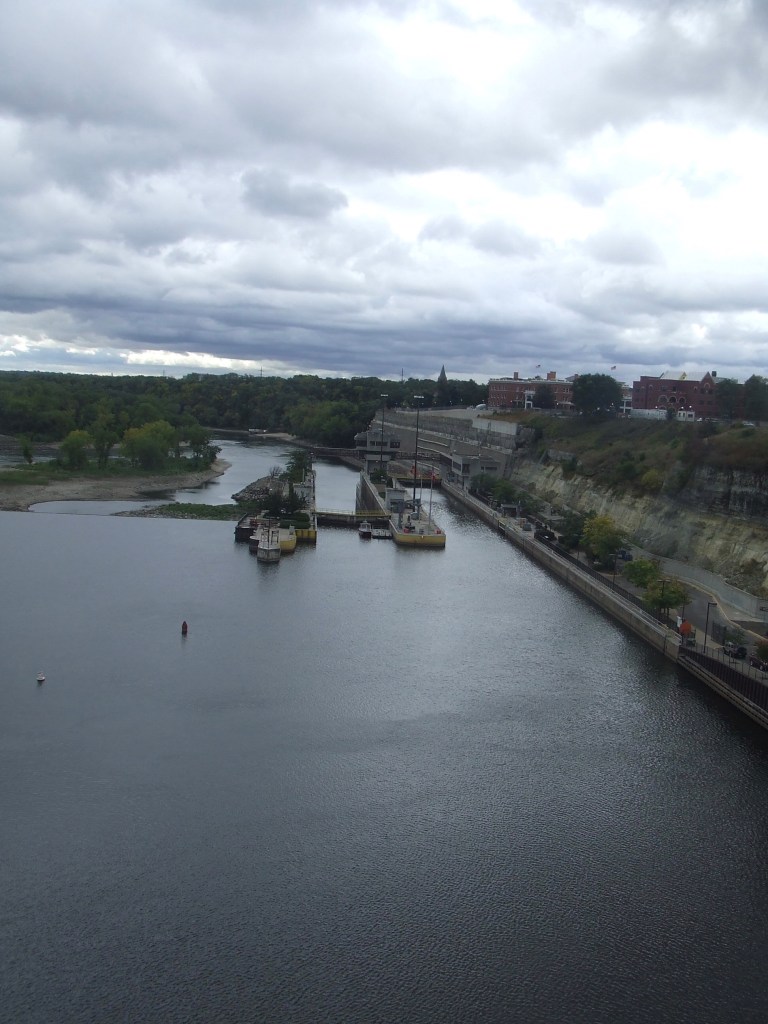
Parking near the locks on the Mississippi River, we walked up to Lock No. 1. Over the years, we have seen the Mississippi from different locations, but this view was special; we were near at the start of the mighty river. As we walked along the river side, we were surprised by a visitor; a bald eagle. The beautiful visitor caught us completely off guard, so we didn’t manage to get any pictures.
The view looking north along the Mississippi River from Minneapolis. The trees in the foreground left reminded us what is was indeed autumn here. (Photo credit: Jeff Hayes).
Even though the sun never did peek out that day, the refreshingly cool autumn air made our exploration quite enjoyable. On the way back to the car, we wandered through some of downtown Minneapolis. Despite the tall buildings, the vibe of the place was more like a medium sized city. Remarkably clean for an urban area, Minneapolis possessed a charm that cities of its size do not have back East. My first impression of Minneapolis was overwhelmingly positive.
Mississippi River Lock No. 1 on a cloudy autumn day. (Photo credit: Jeff Hayes)
2. Target Field
Rather than drive to Target Field and search for parking in an unfamiliar urban area, we opted to take public transportation to the game. Walking to a Metro stop from the hotel, we passed the Mall of America, which was just down the street from our hotel. Strangely, we did not visit the Mall during our stay, even though it is a top tourist destination.
Catching the Metro Blue Line near the Mall, the light rail took us to a stop just across the street from Target Field. Since the trip was on a local line with several stops, it took about 40 minutes to reach our destination. With trip being a mere 10 miles, the ride seemed fairly long, similar to that of the train ride from Manhattan to Citifield, the home of the Mets. However, that’s where comparison ends, since the light rail in Minneapolis was MUCH nicer than the New York City subway system.
Target Field on a cloudy and cool night. (Photo credit: Jeff Hayes)
After getting off the train, we got our first view of Target Field. The curves and the glass on the exterior gave the park a futuristic look, yet the brick siding exuded a more retro vibe. Walking around the stadium, we discovered several bronze statues of Twins’ legends. Each statue seemed to capture the essence of the player, from the crouched batting stance of Rod Carew to the quiet dignity of Harmon Killebrew.
My favorite, however, was the statue of Kirby Puckett. It perfectly caught the fist pump of Puckett rounding the bases following the home run that won Game Six of the 1991 World Series. Glimpsing the statue took me back to that night, reliving the moment as if it happened yesterday. In my opinion, that image epitomizes Twins baseball.
“We’ll see you tomorrow night”. (Photo credit: Jeff Hayes)
The cloudy skies that night did not afford us the best view of the interior of Target Field, though we did wander the concourse snapping pictures and taking in the atmosphere. Target Field felt like a modern ballpark, with great sight lines throughout the stadium. Though the stadium seemed bigger in person than I expected (due primarily to the four deck seating layout, which included the press level), the seating capacity is just under 40,000. Yet, despite its size, there seemed to be some sense of intimacy that does not come through at home on TV.
Following our tour of the stadium, we searched for food before heading to our seats. Like most big league parks, there were many places to grab something to eat. The featured restaurant within the park was Hrbeck’s Restaurant, named for the Twins first baseman during the glory days of the 1980s and early 1990s. Open even when the Twins aren’t playing, it seems to be popular in the community, though Yelp reviews are not particularly flattering. As is our custom, we opted for more standard baseball fare, grabbing hot dogs and sodas before finding our seats.
The view from our seats. (Photo credit: Jeff Hayes)
Sitting in our seats in the autumn chill before the first pitch, I couldn’t understand why a ballpark in Minneapolis would be an open air stadium. Having seen all of the current MLB stadiums, it is clear to me that an outdoor stadium offers a better fan experience. However, when you play baseball in a place where snow is not that uncommon into May, pragmatism may have to have some place in the decision making process. Perhaps Twins fans are accustomed to the chillier conditions, but at least some baseball fans would trade comfort for ambiance in this situation.
The Twins hosted the Seattle Mariners on this night. Both teams were limping to the finish at the conclusion of disappointing seasons, and seemed to be playing out the schedule. Starting for the Mariners was the young right hander Michael Pineda, completing his rookie year. Following the season, Pineda underwent surgery to repair a right shoulder labrum tear, and it would take two full seasons for him to return the mound. For the home team, the starter was Kevin Slowey, suffering through a brutal 2011. This would be his last season in Minnesota.
Efficient use of space in left field at Target Field. (Photo credit: Jeff Hayes)
On this cloudy and cool evening, there were far fewer fans in the park than the announced crowd of 36,000 by the time the first pitch was thrown. The Twins scored runs in the first two innings off Pineda, whose night ended after four innings, and Slowey was pitching as though he would make the slim lead hold up.
The view from the lower level in left field with Ichiro Suzuki coming to the plate. (Photo credit: Jeff Hayes)
The Mariners’ offense awoke in the fifth inning, scoring two runs, followed by thee more runs in the sixth. That ended Slowey’s night after six innings. Though the Twins would score single runs in the 8th and 9th innings, the Mariners held on for the 5-4 victory. Even with the scoring, the game time clocked in at about two hours and 45 minutes, which is not bad for an American League contest. We left Target Field that night with a favorable impression of the park, and we would get a look at the stadium in the daylight the following day.
Goodnight from Target Field. (Photo credit: Jeff Hayes)
Google Earth view of Tropicana Field, St Petersburg, FL.
1. Miami to St Petersburg, Florida Thursday May 8th 2014
The next and final stop of our 2014 MLB tour was St Petersburg, Florida, home of the Tampa Bay Rays. The three hour and 45 minute drive led us across the northern portion of the Everglades National Park, as well as the Big Cypress National Preserve. Never having seen an alligator in the wild (not many gators in the Northeast), we welcomed the opportunity to seek them out in their natural habitat.
Google Maps showing the drive from Miami to St Petersburg FL.
As might be expected, each stop along the way yielded no gator sitings. Granted, we did not venture far from the road, as we were not prepared to trek into the swamp. This greatly reduced our chances of seeing gators in the water. Disappointed, we abandoned our attempts and followed Interstate 75 North toward St Petersburg.
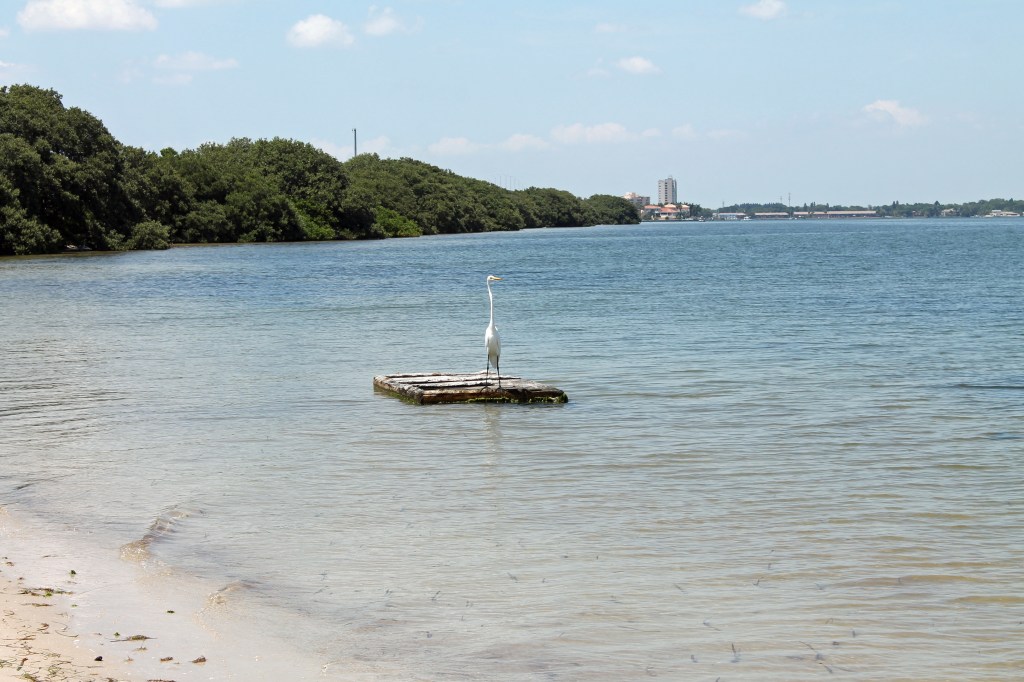
Along the way, we stopped shortly after crossing the Sunshine Skyway to get pictures of the bridge. While taking pictures along the waterline, we caught the attention of the local wildlife. A great egret, standing tall on a wooden pallet, made no attempt to hide her contempt for our presence near HER shallows. Even while taking pictures of her, she did her best to intimidate us. Not wanting to aggravate her further, we left as soon as we were finished with our picture taking.
A great egret looking us over with a jaundiced eye while perched on a wooden pallet near St Petersburg, FL. (Photo credit: Jeff Hayes)
Arriving at our hotel in St Petersburg well ahead of the 705 pm first pitch at Tropicana Field, we relaxed at the hotel before heading out to the ballpark.
2. Tropicana Field
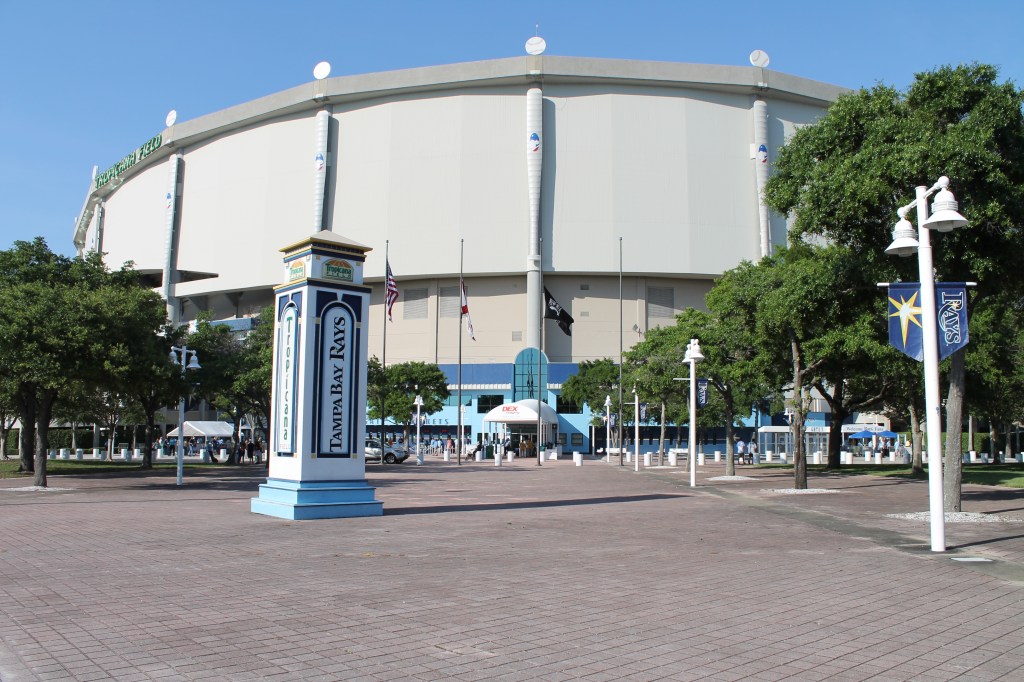
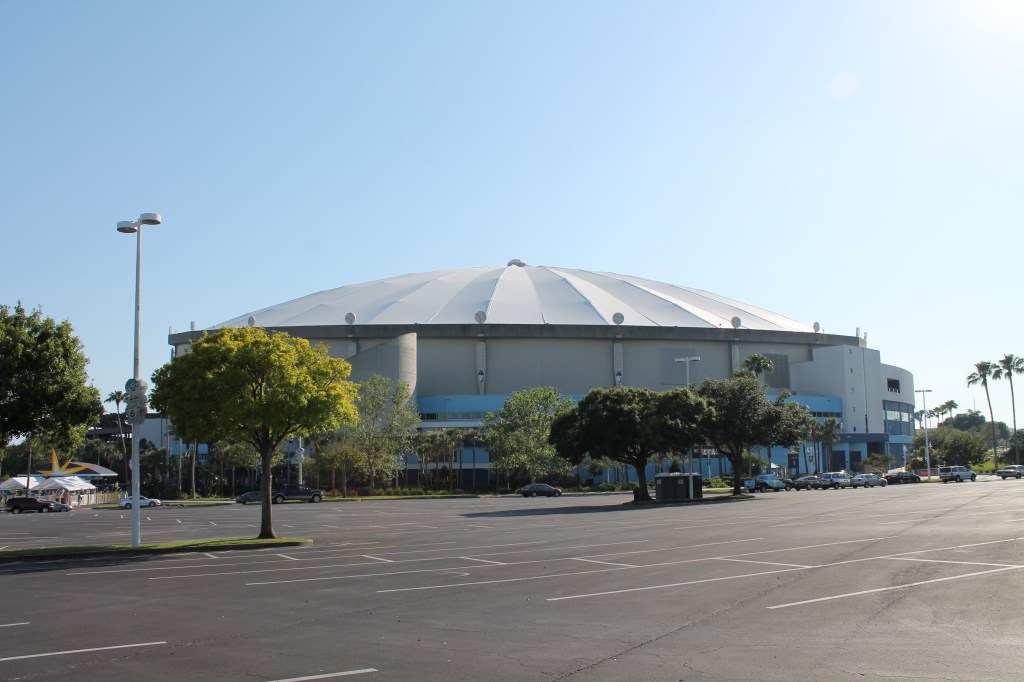
Tropicana Field, St Petersburg, FL. (Photo credit: Jeff Hayes)
We arrived at Tropicana Field about 90 minutes before game time, just as the gates were opening. There was ample parking in the general vicinity of the stadium, much of which is one-quarter of a mile or less from the stadium. On this night, with a fairly light crowd expected, parking was $15, but parking can vary between $15 and $30.
Upon arriving at the park, we walked around the stadium. Being a domed stadium, there was not much to see outside. Entering the park behind home plate, the brightness outside was replaced by the dimness of the translucence of the roof of Tropicana Field. Having seen what appeared to be a drab interior on TV, I was pleasantly surprised to discover that is was not as dark nor dank as I imagined. Fun fact; Tropicana Field is the only remaining MLB Park with a fixed roof.
The roof of Tropicana Field. (Photo credit: Jeff Hayes)
Perhaps the most noticeable feature of the roof is that is slants from home plate down toward center field. While the slant is discernible from outside, it is much more exaggerated inside the park. Suspended from the roof are catwalks. They are part of the support structure of the roof, specifically the lighting and speaker system. There are four rings of catwalks, some of which are in play. Many times over the years, the catwalks have giveth and taketh away, resulting in confusion and loathing. Because of this, the catwalks have been a lightning rod for criticism since the opening of the park.
With plenty of time before the scheduled 710 pm start, we wandered inside the stadium. Outside of the roof, the stadium was a nondescript domed ballpark. Like most domed stadiums, the place seemed cavernous, with three levels of seats spanning from foul pole to foul pole. Much of the stadium was accessible via concourses, allowing us to take pictures of virtually the entire park.
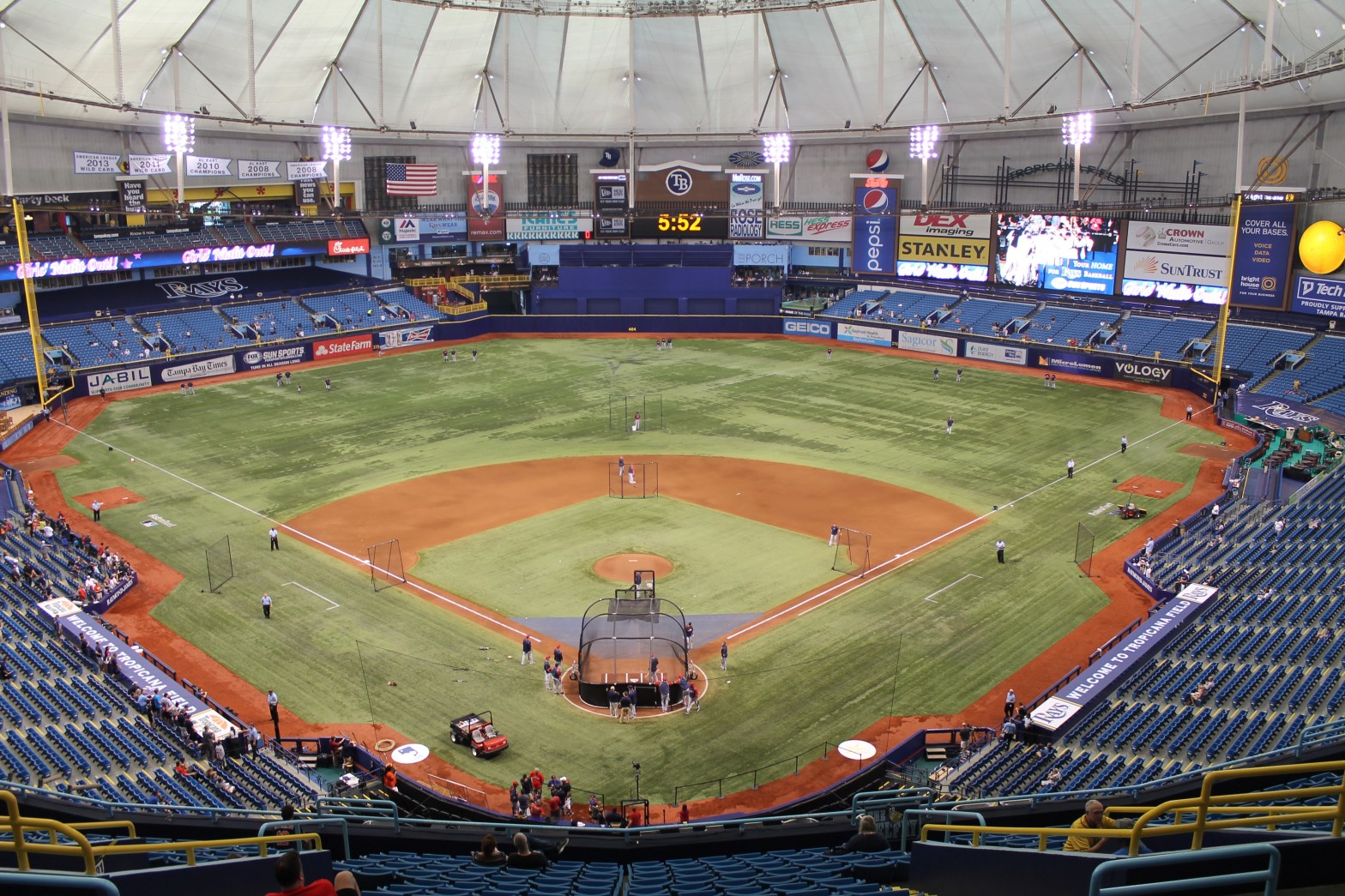
Tropicana Field from the upper deck behind home plate. (Photo credit: Jeff Hayes)
Wandering the lower level in center field, we discovered the fabled ray tank. Arriving as early as we did, there was almost nobody around the tank, meaning we were able to pet the rays at will. Knowing very little about rays, I was unsure whether they were bothered by human contact. Of course, the rays are probably accustomed to the interaction, and petting them likely did not cause any additional stress. However, in deference to the animals, I chose not to pet them, instead admiring them from a respectful distance.
Viewing the ray tank at Tropicana Field from above. (Photo credit: Jeff Hayes)
Like most major league ballparks, there were more than a dozen locations from which food was available, including standard concession stands. Despite the large selection available, we chose to indulge in more standard ballpark fare before seeking out our seats for the game.
David Price delivering a pitch at Tropicana Field. (Photo credit:Jeff Hayes)
The Rays hosted the Baltimore Orioles this evening, the last game in a three game set. The announced crowd for this game was just over 11,000, which made Tropicana Field (with its 42,735 seat capacity) seem almost empty. The Orioles sent Umbaldo Jimenez against the Rays’ David Price in what promised to be a pitcher’s duel. Our seats for the contest were behind the Orioles dugout in the lower level.
The view from our seats. (Photo credit: Jeff Hayes)
The Rays opened the scoring with a run in the bottom of the first, with the Orioles scoring in the second and third innings to take a 3-1 lead. That was the extent of the scoring, as both starters and respective bullpens kept the promise of a potential pitcher’s duel. Despite being a low scoring affair, the game clocked in at just over three and one-half hours.
Front end of a double play at Tropicana Field. (Photo credit: Jeff Hayes)
The extra time have us the opportunity to take in the feel of the park. While Tropicana Field was not as dungeon-like as I expected (based on what I’d seen on TV), the park lacked any significant charm or presence. It’s no wonder the franchise has been seeking another home, one that might provide fans with a warmer environment.
1. St Pete Beach, Friday May 9th 2014
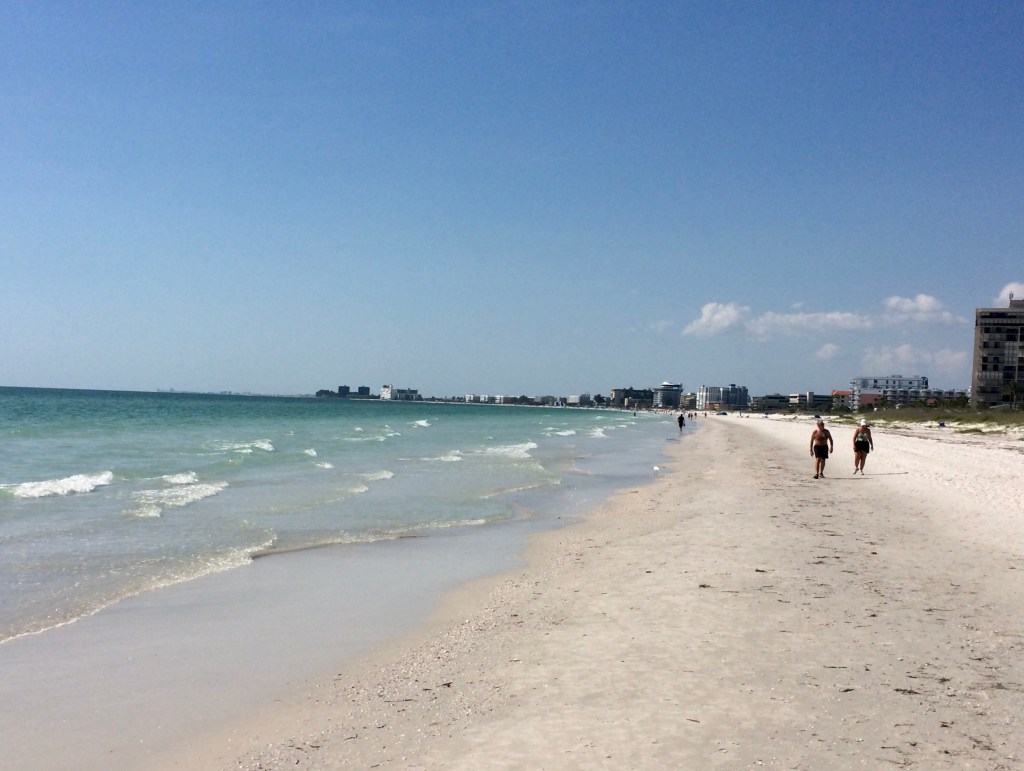
St Pete Beach under sunny skies. (Photo credit: Jeff Hayes)
Following breakfast at the hotel, we had plenty of time to explore the region ahead of the 705 pm game time at Tropicana Field. Our first stop was St Pete Beach. Located on Long Key, a barrier island a few miles west of St Petersburg, St Pete Beach is consistently voted one of the top beaches in the United States.
Wall to wall sunshine and temperatures climbing into the 80s during the late morning resulted in a perfect beach day. The white sandy beach reminded me of those we saw at South Beach the day before. However, unlike the rougher surf we saw near Miami, the crystal clear waters along St Pete Beach were nearly calm.
Black skimmers walking along St Pete Beach.
Though the weather was conducive for beach going, there were surprisingly few people on the beach, and none in the water. However, there were plenty of birds on the sand and fishing in the shallow water of the Gulf. In fact, there were many more black skimmers (a bird I’d never seen before) than people on the beach that morning. Great egrets roamed the surf, occasionally pulling a fish out of the water.
Strolling along the beach, we saw much of the architecture had some connection to Art Deco, much like we noticed in Miami. Though it was only early May, the sun angle was high enough to give me a mild sunburn. As the temperature headed toward 90 degrees, we cut short our walk along the beach to find some shelter and lunch.
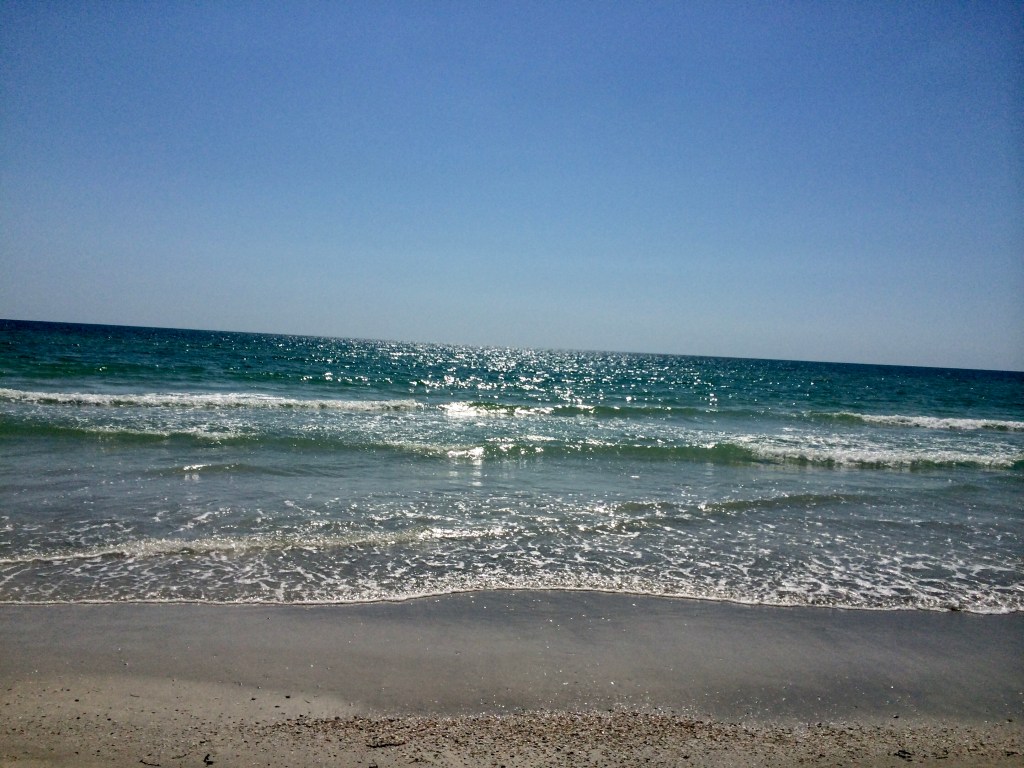
The Gulf of Mexico along St Pete Beach.
2. Sawgrass Park
Following lunch, we headed into St Petersburg. We happened upon Sawgrass Park, which looked like a good place to spend some time before riding back to the hotel to relax before the game.
Almost immediately after leaving the car, we became acutely aware of the lizard population. Brown anoles were everywhere; in fact, I had to actively avoid the lizards for fear of stepping on them. We started our exploration of the park near Sawgrass Lake, following a dirt path to an elevated boardwalk. Along the way, we passed a large variety of birds forging in the marshes.
A great egret using some ingenuity to catch fish in the marshes of Sawgrass Park. (Photo credit: Jeff Hayes)
We stopped to watch a great egret stomping his way through marshes along the dirt path leading to the boardwalk. At first, it wasn’t clear why the egret was stomping. However, after stomping a few times, the egret pulled a fish out of the marsh. The bird was stomping until it found a fish and pounced on it. We watched this happen a few times before moving on.
Following the elevated boardwalk brought us to a viewing platform on the edge of the lake. A sign posted in the gazebo covering the viewing platform warned that we were in gator country. Gazing out across the lake, it seemed as though there were no alligators to be found. Being early to mid afternoon, I thought they were basking in the sunshine elsewhere, someplace less conspicuous.
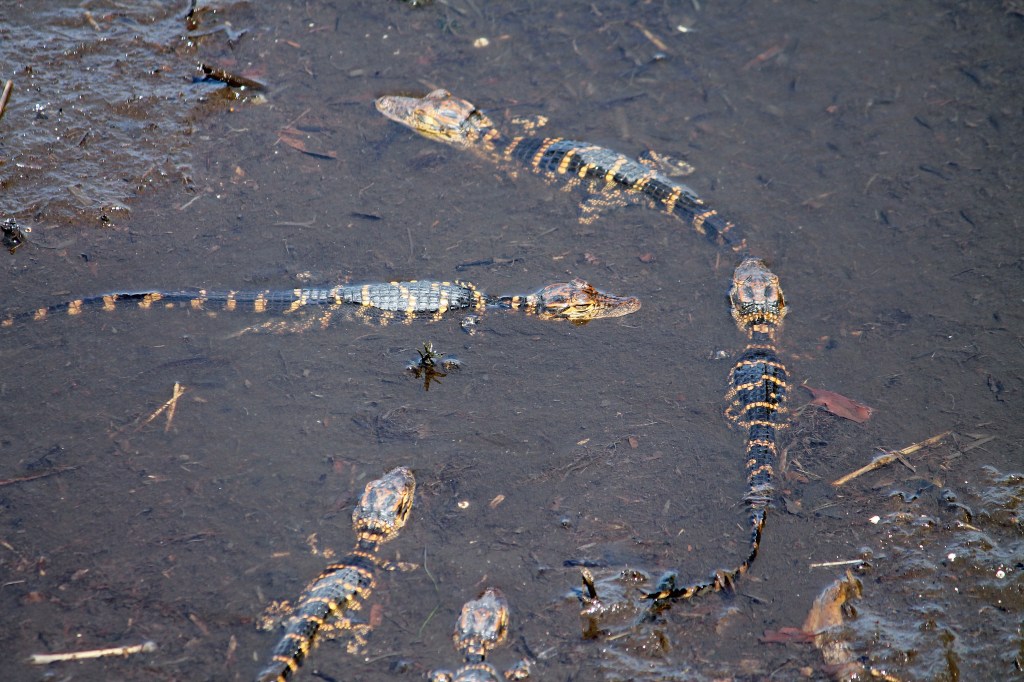
Baby alligators lounging in the mud on the edge of the lake. (Photo credit: Jeff Hayes)
My brother signaled to me that he found something in the mud on the edge of the lake; baby alligators. The hatchlings were partially submerged in the mud, numbering about a dozen (though there could have been others deeper in the mud). Despite being small and arguably cute, the hatchlings possess little but sharp teeth that could inflict some pain, if harassed.
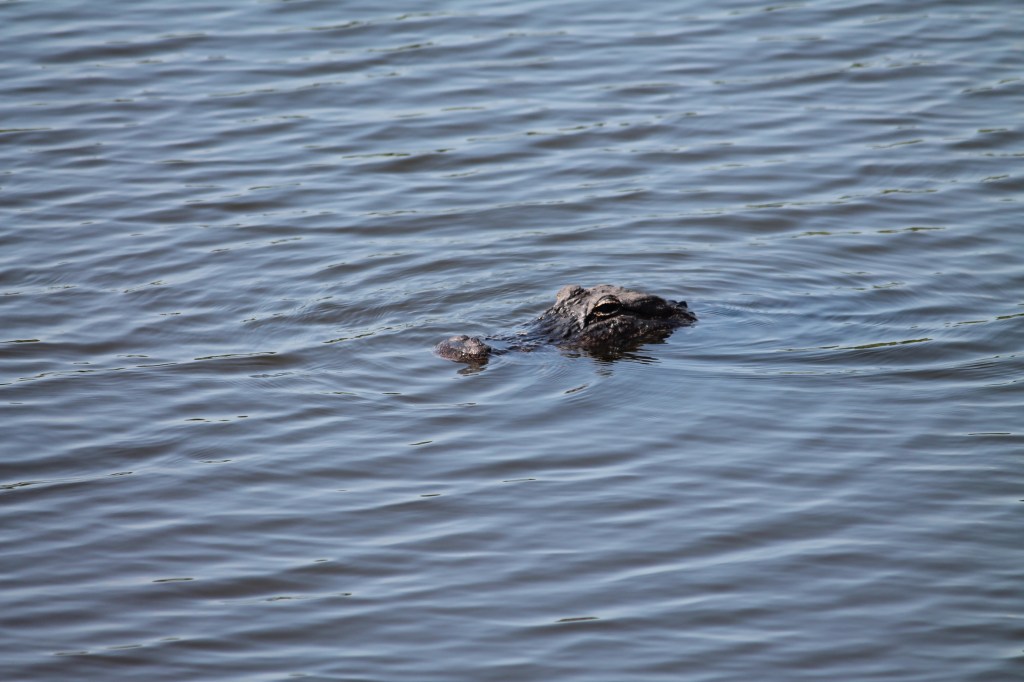
Lurking not far offshore we finally spotted the mama gator. Like mothers of other species, this cow was keeping a sharp eye on her babies. Though she was a distance away, I had no doubt that if her young were threatened, she would take swift and definitive action to protect them. It seemed, though, that she was not particularly agitated, as if she had become accustomed to people being close to her young.
Mama alligator maintaining a watchful eye on her hatchlings. (Photo credit: Jeff Hayes)
Spending far more time in the park than anticipated, we left the park shortly after finding the gators, and headed back to the hotel to relax before the game. Wanting to see alligators while in Florida, I didn’t expect to find them in a park in St Petersburg. If you find yourself with some time near Sawgrass Park, I’d recommend a visit, if only to track down some gators.
3. Tropicana Field
Tropicana Field from the third base side. (Photo credit: Jeff Hayes)
Having been to Tropicana Field the night before, we did not arrive as early for this contest. With little to see outside the park, and exploring much of the park with the Orioles in town, we arrived about an hour before the first pitch, scheduled for 710 pm. The Rays’ opponent this evening was the Cleveland Indians, who were beginning a weekend series in St Petersburg.
For this game, our seats were on the first base side behind the Rays’ dugout in the lower levels. Once again, the announced crowd of 17,455 for the series opener seemed like an overestimate. The sparse crowd made the domed stadium feel nearly empty. Granted, the Rays were not playing well so far this season, but without fan support, the environment almost felt drab.
Our seats for the series opener against the Cleveland Indians. (Photo credit: Jeff Hayes)
Starting for the home team was right hander Jake Odorizzi, and right hander Corey Kluber took the ball for the visiting Indians. For Corey Kluber, 2014 was a breakout season which ended with him winning his first Cy Young award. Odorizzi was in his first full season with the Rays, and tonight’s matchup was promising to be a pitcher’s duel.
The game started out just that way, with both pitchers tossing three scoreless innings. The Rays scored single runs in the fourth and fifth innings, and as well as Odorizzi was pitching, two two runs looked as though they might be enough to ensure a Rays’ victory.
The Tribe completing a double play supporting the outstanding start made by Corey Kluber. (Photo credit: Jeff Hayes)
Jake Odorizzi struck out 11 Indians in five innings of work, but in doing so, threw over 100 pitches. With Odorizzi out of the game, the Indians torched the bullpen for a run in the sixth and five runs in the seventh. That outburst was more than enough to support Kluber, who struck out nine in six innings of work.
By the seventh inning stretch, the sparse crowd began to file out, all but assured of yet another Rays’ loss. A team with promise at the start of the season, a loss would drop them six games under the .500 mark. The Rays’ managed to score a run in the bottom of the ninth, but it wasn’t enough to prevent an Indians’ 6-3 win.
The Tropicana Field scoreboard tells the tale of an Indians victory. (Photo credit: Jeff Hayes)
Leaving Tropicana Field, I understood why some refer to this stadium as the least attractive in MLB. While the place lacks an discernible charm, and seems almost tomblike with small crowds in the cavernous building, it was not the dungeon I imagined it to be. Having said that, I get why fans stay away; should they return, they deserve a better home for their team.
















 Baseball Travels