Baseball Tickets

A smattering of tickets for games at Shea Stadium, Queens, NY, during an era when all tickets were torn.

Full disclosure: I am a couple of years short of my 60th birthday, and some of the views here are consistent with those of an American man of that age. Considering during my career I made considerable use of computers and other electronics, I would classify myself as tech savvy, and I understand the importance of progress from a technical standpoint. That having been said, I do believe that some things could remain the way they were, at least as an option in a world where technology changes quickly.

As the title stays, the blog entry deals primarily with baseball tickets, and how access to the ballpark has changed during my years as an avid baseball fan. Unfortunately, I was not aware enough in my younger days to keep the ticket stubs from baseball games, as I did not then understand the importance they would play later in my baseball life. My brother and I went to MANY ball games together during the 1980s, but none of the tickets from that time survived. We did collect yearbooks and scorecards from the 1980s, but tickets were an afterthought.
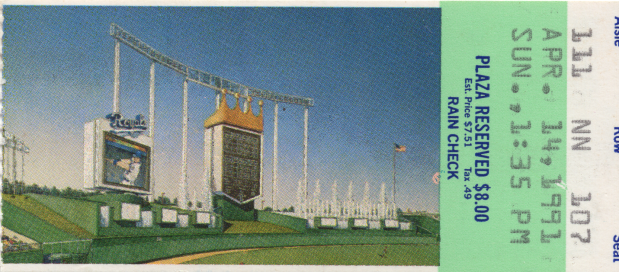
The oldest ticket stub in the collection dates back to 1991, when I saw the Kansas City Royals host the New York Yankees.

During the 1990s, we did have enough forethought to keep some of the tickets from the games we attended. At that time, we were attending only Major League (MLB) games, so that was the whole of our knowledge of baseball. Most of the tickets we had while attending games in New York City or Philadelphia were rather mundane (like the image of tickets above), but the ticket I received in Kansas City was very colorful (for the time), featuring an image of the iconic scoreboard and fountain. As was the case back in the early 1990s, this ticket was torn, as the ushers kept a portion of the ticket to verify the attendance for that game.

This simple transaction piqued my interest regarding tickets as memorabilia, and I became more vigilante keeping my tickets stubs. In the 1980s and 1990s, purchasing tickets at the gate or directly from the team ensured a genuine ticket. Buying tickets from a third party vendor (like Ticketmaster) almost guaranteed a drab, corporate looking thing that was hardly worth keeping once the game was complete. In fact, that is what happened to many tickets during this era, as many tickets were procured tickets from vendors and not the teams themselves.
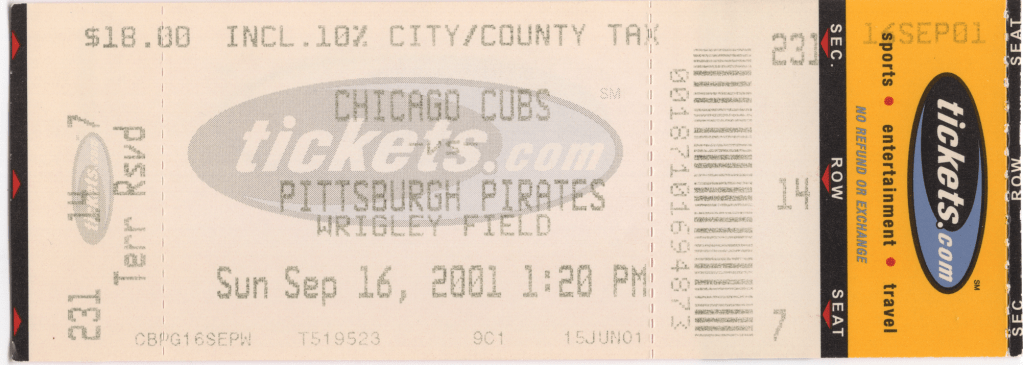
A ticket purchased through tickets.com, not nearly as pleasing as a ticket from the team. This ticket was for a game on September 16th, 2001. Because of the national emergency following 9/11, this game was not played on that date.

We started traveling a bit more in the mid to late 1990s, when circumstances (and finances) allowed it. Whenever possible, I would buy a ticket at the box office, which was a risky proposition depending on how well the home team drew. Coming back from a work trip, I passed by Boston just before the evening commute, when one of my colleagues indicated that the Red Sox were home. Not yet as popular as they would be in the upcoming years, we diverted to Fenway Park to see the game. It was my first trip to that hallowed ground, and I was able to get a ticket from the box office. That trip to Fenway Park also opened my eyes to the exorbitant amount people were charging for parking, as we paid $30 to park in a Sunoco gas station lot.
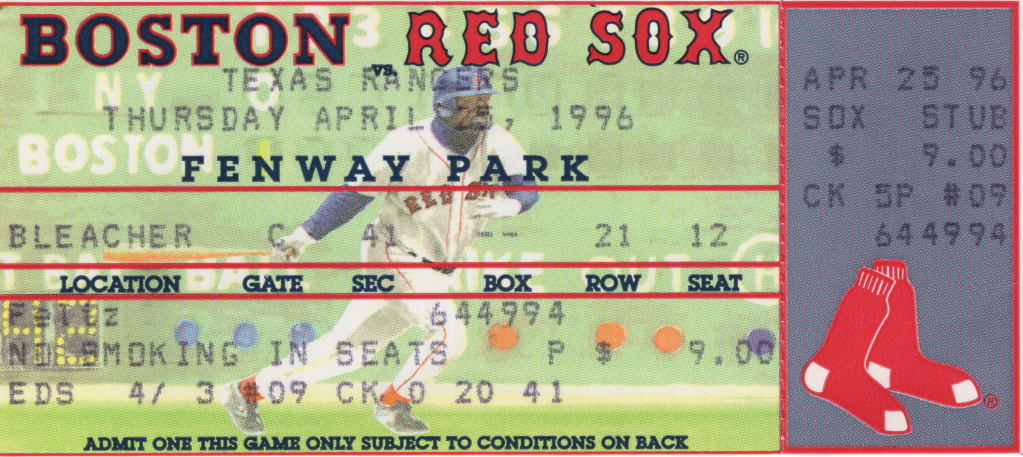
My ticket for Fenway Park in 1996, with the Green Monster in the background. Note that the ticket says no smoking, a relic from what seems to be the distance past.

Crossing into the new millennium, technology for ticket taking was undergoing change, and some ballparks were embracing the future by no longer tearing tickets. This change first caught my eye when we were in San Francisco in 2002. Buying the tickets ahead of time, I was concerned that the tickets would be drab documents from a third party provider. Imagine my surprise (and delight) when we received the tickets in advance of our first West Coast trip.

Our tickets had barcodes at both ends, making it unnecessary to deface them. The tickets themselves were beautiful, and it was clear that the Giants organization not only brought their services into the new century, they took some pride in the artistic flare the tickets exhibited. Though these tickets were much longer than typical, my brother and I took great care to keep them intact, as they were as much a souvenir as an admission to a ballgame in the newly minted Pac Bell Park.
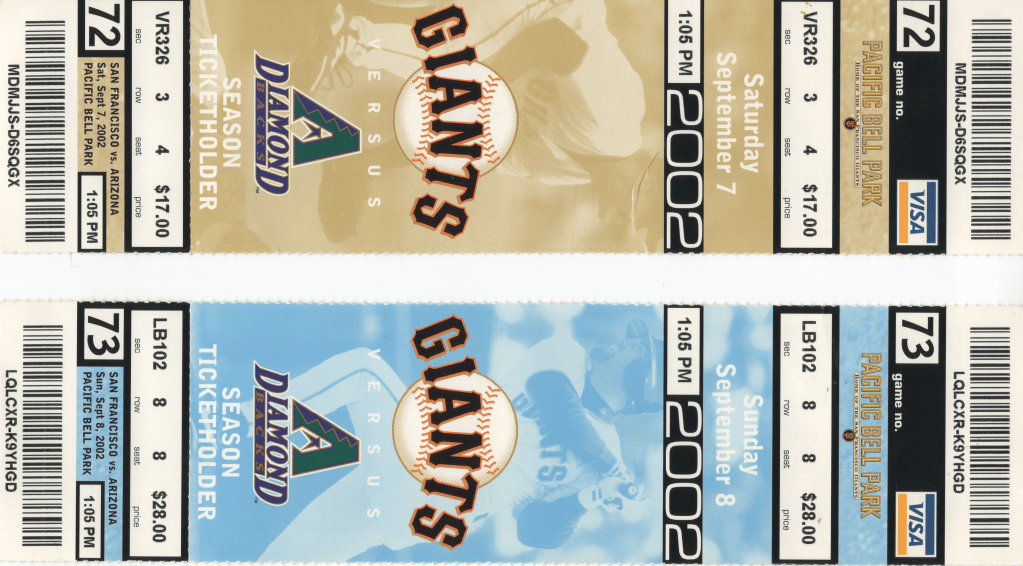
Tickets for games at Pac Bell Park in San Francisco during September 2002.

How tickets were handled at MLB ballparks was still widely varied, as we went to Montreal to see the Boston Red Sox take on the Expos. Clearly the Montreal front office was caught in the past (which may not have been their fault, as the team was rumored to be sold and moved for years), sending us tickets that were torn at the gate. Though the game was played in Quebec (where French is the official language, and the locals were unwilling to deal with English speakers), luckily there was enough English to help us get to our seats. The ticket from that game was printed primarily in French, but the vital information was discernible. Those tickets were keepsakes not only because that might have been the last season in Montreal for the franchise (as we thought it might be; the move to DC did not occur until 2005), but because they were our first tickets displaying a foreign language.
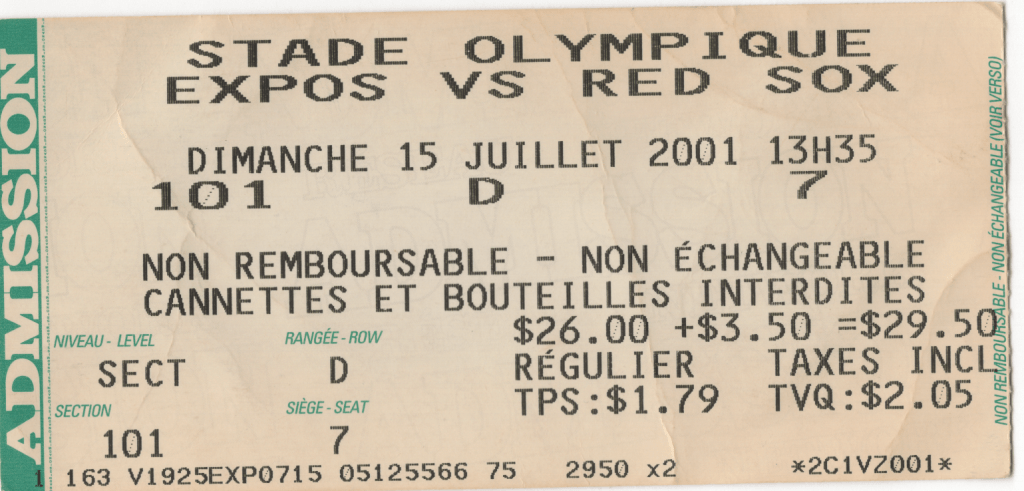
A ticket from Montreal in 2001. Note that most of the information is displayed in French.

As the number of MLB parks we needed to visit started dwindling, we added minor league (MiLB) and Atlantic League (ALPB) ballparks to our schedule. Like the MLB, there was a variety of ways to obtain tickets, with some parks still tearing tickets, and others using the barcode approach. Moving to the DC area in 2013, I adopted the Bowie BaySox (the Double A affiliate of the Baltimore Orioles) as my home team, seeing as many as 30 games a year. In my entire tenure there, the BaySox did little to change they way they handled tickets, tearing at first, and then scanning. All the while, they had turnstiles, even as some ballparks were eliminating from the process.
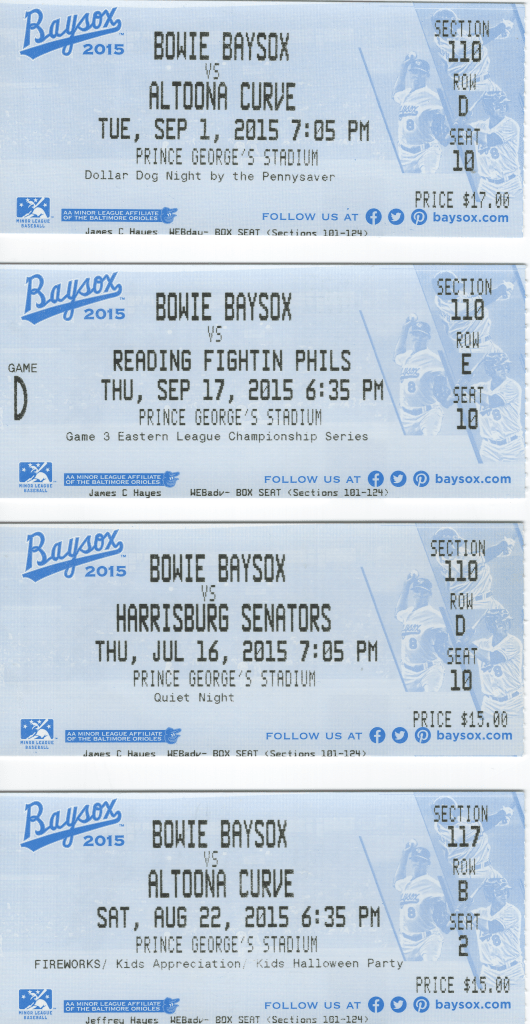
Other MiLB teams, perhaps taking a page from their MLB team, began to make their tickets more artistic, something that could be treasured as much as any other souvenir. It took some time for that change to occur, but we started noticing the change when we traveled further from home. By this time, printing tickets at home had become a preferred way to obtain tickets when ordering online, I had to make certain I chose a physical ticket, even if it cost more.

Though the online tickets had the same artistic images, it was not the same as holding the ticket in your hand. Almost all print at home tickets we used managed to find their way to the trash, as the ticket itself was much less durable. Barcodes made sure that these tickets were unadorned, and we took great care to keep them that way. These were memorabilia in my opinion, and should be treated as such (perhaps my age is starting to poke through here).
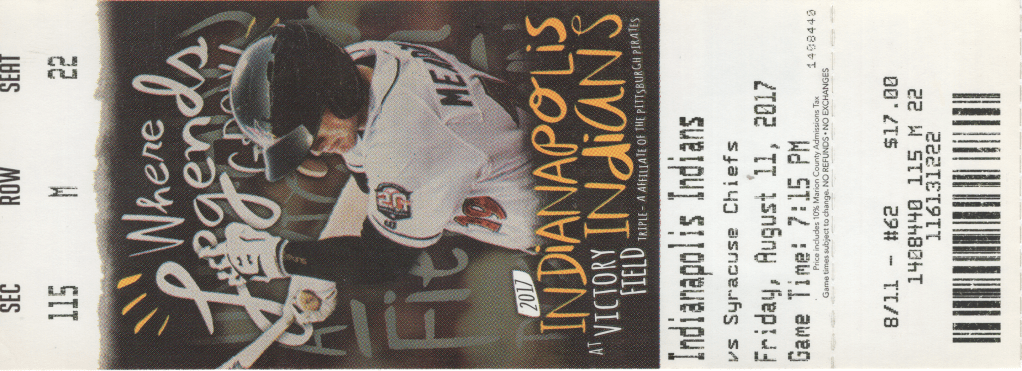
A ticket for an Indianapolis Indians game in 2017. Physical tickets were becoming harder to obtain by this point.

By the late 2010s, getting physical tickets, especially for MLB games, was becoming more and more difficult. Even print at home tickets were being discouraged; teams preferred fans load their tickets on their phones for easy scanning. Bringing a ticket to a game on my phone presents no problems for me, other than the fact that I miss an opportunity for a souvenir from the game. This approach however, is far from infallible, even to this day. There have been times I needed to step out of line to make sure my ticket was displayed on my phone, and even doing this was no guarantee of admittance. In Houston during 2018, my brother had serious issues attempting to enter Minute Maid parking because of persistent scanning problem at the gate.

Last, and not least, the technology can be formidable for aging fans, particularly if they are uncomfortable with the mobile devices. As I mentioned at the start, I consider myself tech savvy, but I understand that not everyone is, especially if connectivity is a problem at the venue. This is why I would like to see getting physical tickets remain a feasible method for seeing a ballgame.
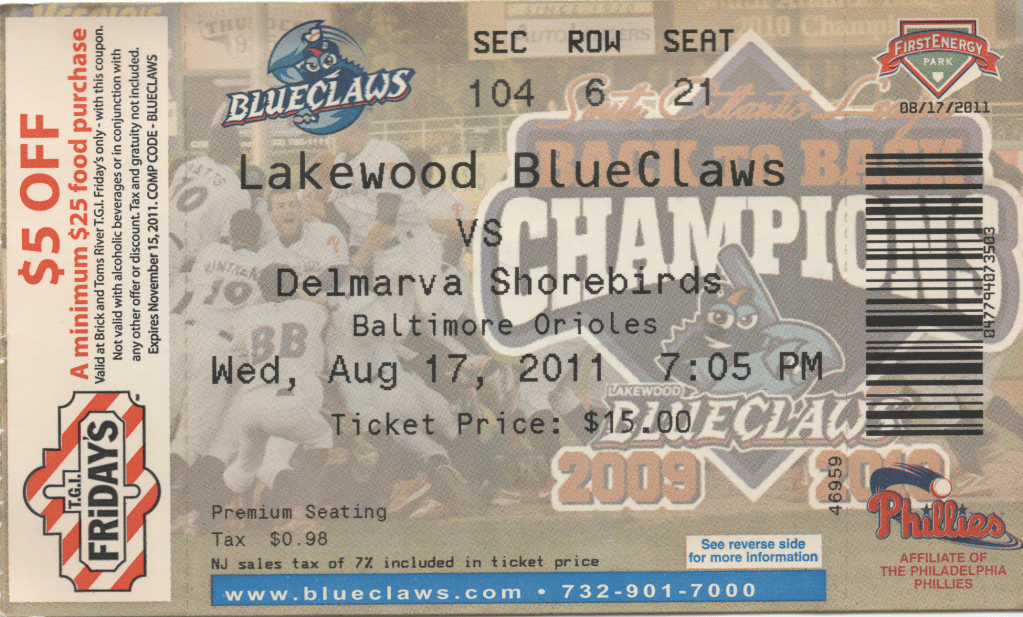
We can still get physical tickets for Jersey Shore BlueClaws (High A affiliate of the Philadelphia Phillies) games in Lakewood, NJ. The tickets are HUGE, and may be my favorite MiLB ticket.

In the US and Canada, baseball tickets are fairly easy to decipher, even in French, but we experienced something much different in our travels to Japan. Though there is generally enough English to help you navigate the urban areas in Japan, outside of these areas things become a bit more challenging. Visiting the TokyoDome presented no challenges, as there were plenty of English speakers and the tickets were relatively easy to read.

However, our next stop in Nishinomiya (near Osaka), getting to our seats proved more problematic. My brother used a QR code (which was still fairly new to me) to print out our tickets. Unlike our Tokyo tickets, little of the information was printed in English, and it took some time and help from the stadium personnel to finally arrive at our seats. Even with the mild inconvenience, it was worth it, as the ticket we received was a physical ticket, a beautiful souvenir from the event.
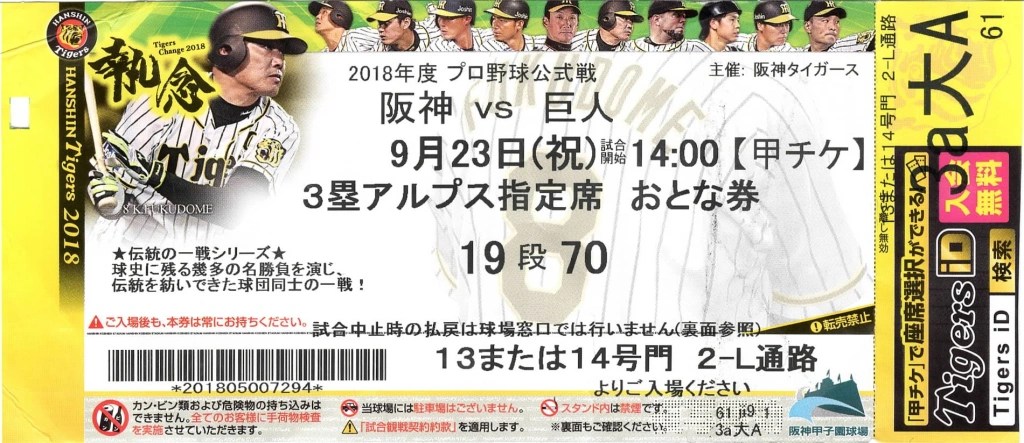
One of our tickets for Koshen Stadium, located near Osaka, Japan. The information was barely discernible, unlike the ticket for the TokyoDome . However, the ticket is quite beautiful as a souvenir.

We had roughly the same experience in Hiroshima, where tickets are exceedingly difficult to secure, as the entire season sells out mere hours after going on sale. A disappointing transaction meant that the tickets were ordered were unable for the game, and the general admission tickets we had in hand did NOT guarantee us seats for the game. Like the tickets for Koshen Stadium, the tickets for Hiroshima were also quite beautiful, even if ultimately useless to us at the ballpark.

Our seats for Mazda Zoom Zoom Stadium in Hiroshima, Japan were beautiful, if not useful at the stadium.

Encouraged by some of the tickets we received for our Japan trip in 2018, I looked forward to our 2019 baseball trip. We used a highly regarded ticket broker in Japan to secure seats for our trip. While the seats themselves were quite good, they were disappointing visually. In Japan, tickets can be purchased at any 7-11 store, but you need to understand Japan to retrieve them. Our ticket broker used the 7-11 approach for the tickets, which looked much like the vendor tickets we have received in the US (minus the Japanese writing, of course). In addition, the 7-11 tickets can be very difficult to read, so most of the time we relied on the ushers at the ballparks to get us to our seats.
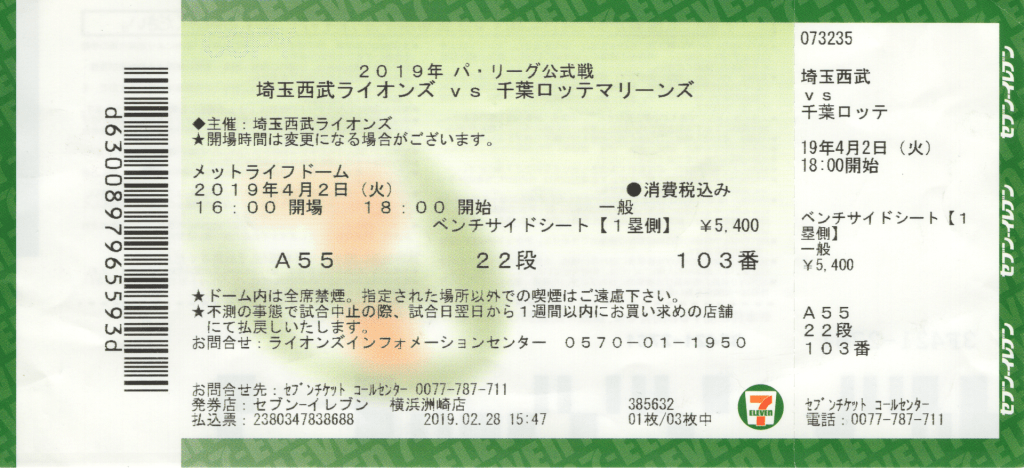
Our ticket to see the Sendai Golden Eagles. The tickets are, in my opinion, visually unappealing and difficult to discern.

This has been a short history of our history with tickets going to baseball games over the past 40 years. While the current prevailing method of distributing and using tickets has proven to be mainly hassle-free, there is something missing. Hopefully, getting and using physical tickets will remain a viable option for as long as I go to see games.
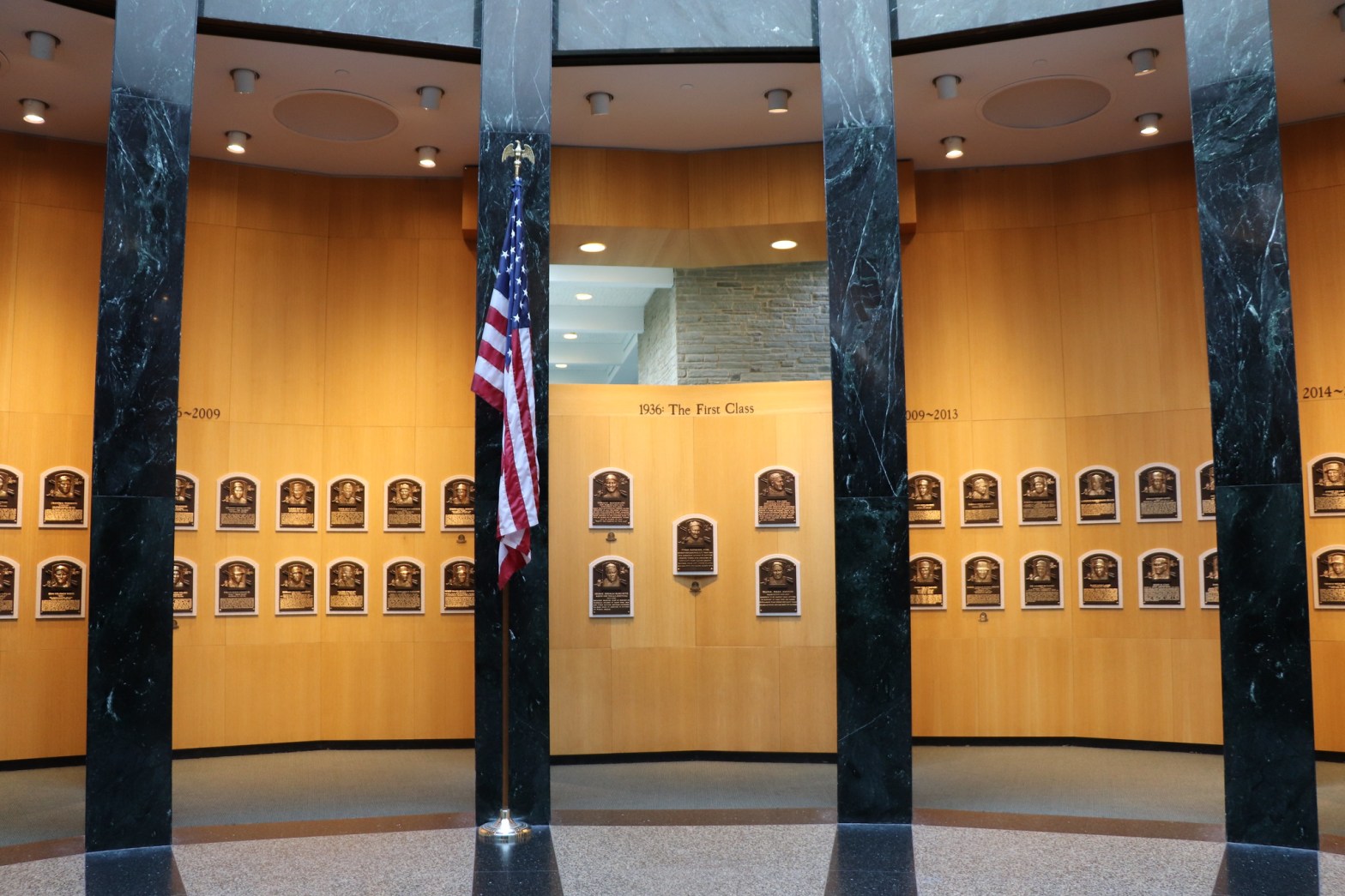
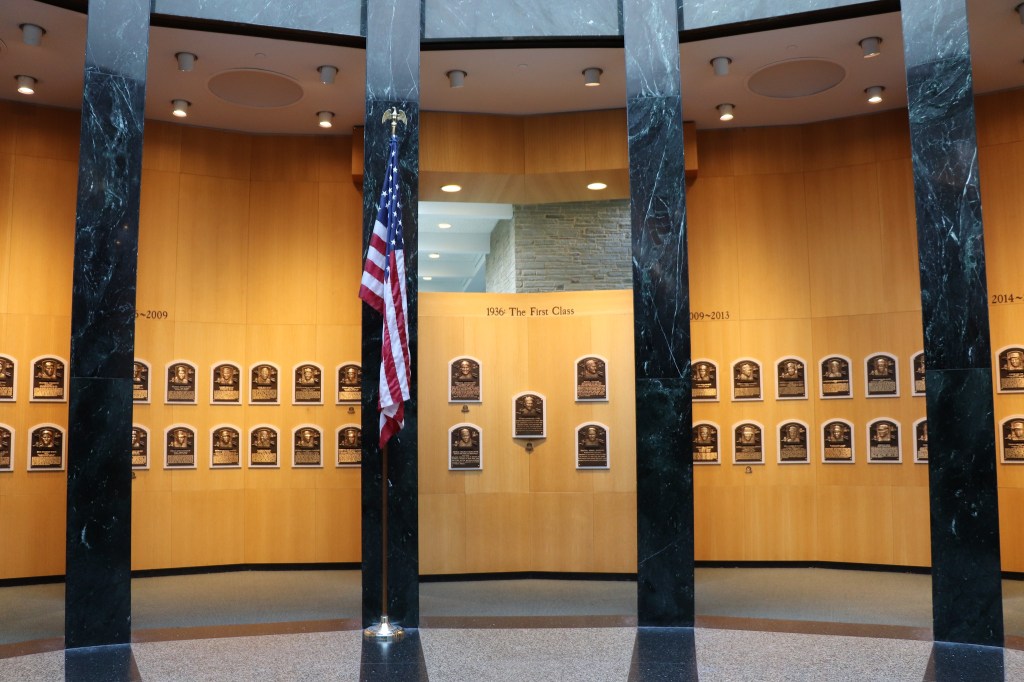
National Baseball Hall of Fame

Inside the National Baseball Hall Of Fame (Photo credit: Jeff Hayes)

The National Baseball Hall Of Fame, located in the picturesque village of Cooperstown, NY, represents baseball Mecca to many fans, including my brother and me. Arguably the most famous sports hall of fame, the Hall keeps alive the past, as well as integrating the present, making it a prime target for any passionate fan. For years we talked about going, but transportation issues, and coordinating work schedules proved formidable for planning a trip. At that time, I was living in southern Maine, further complicating the situation. All of these factors resulted in us putting off the trip early 2000. We have made two subsequent trips to the Hall, and each visit occurred in different times of year, lending a unique perspective to the museum and village of Cooperstown.

First visit : Sunday, March 12, 2000

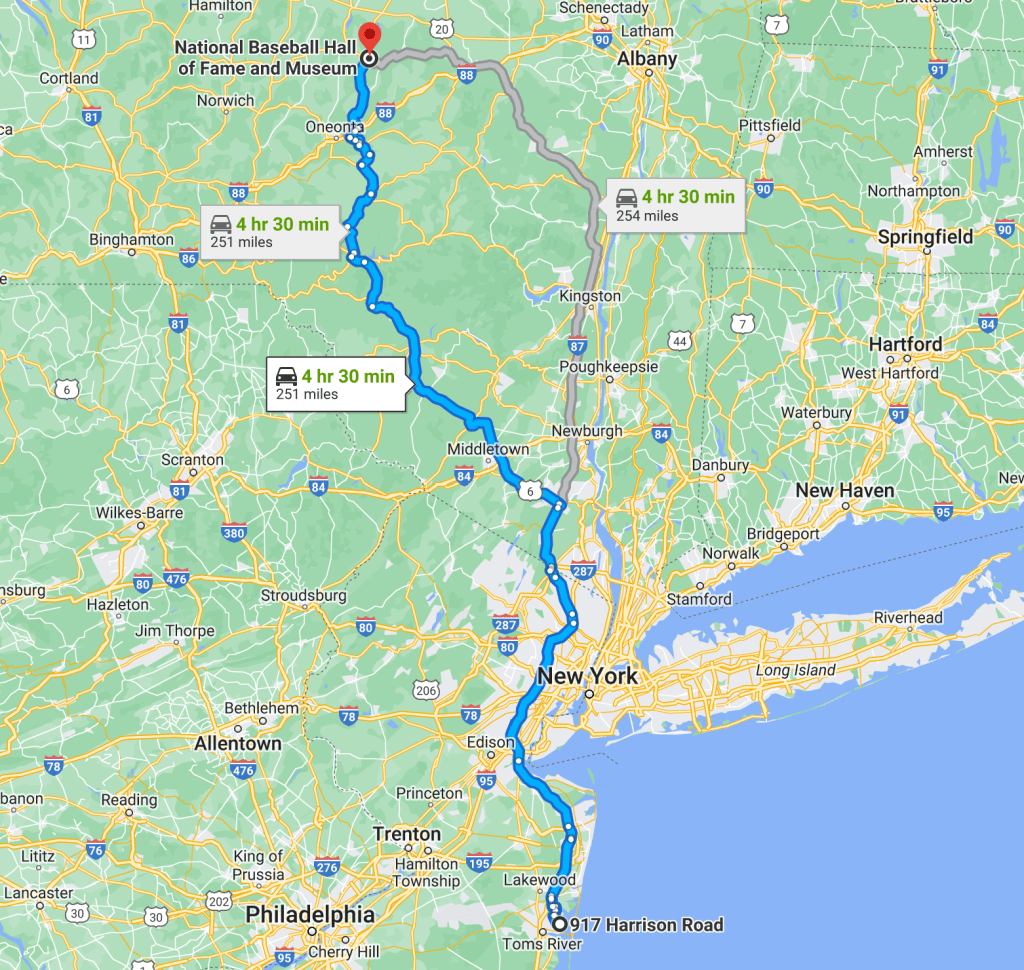
Our first visit occurred on Sunday, March 12th 2000. Though we were only about 10 days from spring, the weather was decidedly winterlike, with cloudy skies and cold temperatures in central NJ, where our trip began. Not unexpectedly, weekend traffic afforded us some relief from the normal commuting issues in NJ, and the drive was rather uneventful. From central NJ to the village of Cooperstown measured about 250 miles, which we covered in a bit less than four and one-half hours. Since our visit was out of season, Cooperstown was quiet, as was the Hall. It was so quiet that we were able to park just across the street from the museum, a pleasure we would not have in subsequent visits.

Google Maps showing our trip from central NJ to Cooperstown NY.

After purchasing tickets in the the Main Lobby, we headed almost immediately to the Plaque Gallery, located on the first floor. The Gallery houses the famous plaques for each member of the Hall of Fame, and the view was better than I had imagined. During much of my life, I had seen pictures of the plaques, but now here we were in their presence. At first, my brother and I walked through the Gallery together, but soon we split up, as each of us gravitated to our favorite players and eras. Time passed incredibly quickly, and since we had only carved out enough time for a brief visit, it seemed all too soon that we had to move on and see the main part of the museum, referred to as the Baseball Timeline., located on the second floor.

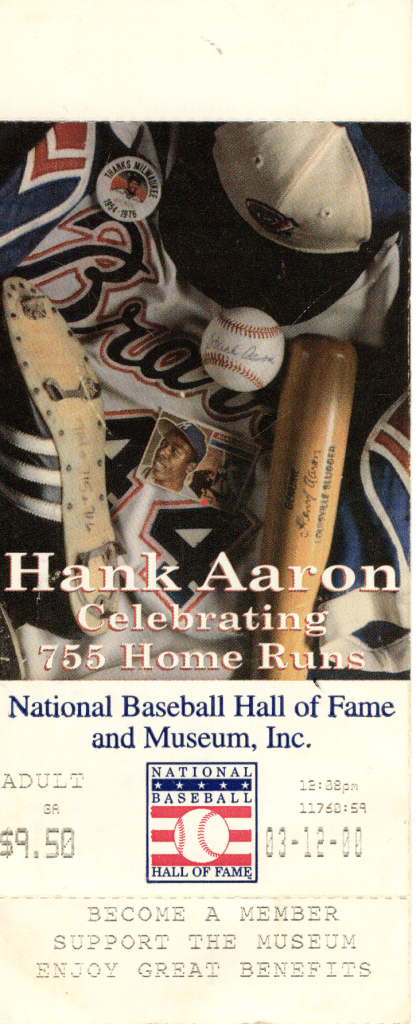
A ticket from the National Baseball Hall of Fame.

Baseball came alive for me in the Baseball Timeline. In this section of the Hall lies the vast majority of the historical items and memorabilia collected over the past 150 years. Being Mets fans, we searched for the Tom Seaver display, as he is the only Mets player to be enshrined in the Hall. We spent most of our time here, as the history of baseball was laid out before us. Because of time constraints, we were limited to visiting only a fraction of the Hall. Unfortunately, we either did not take pictures during our visit, or those photos have been lost. Either way, we did not have much in the way of visuals to display here. Nonetheless, it was a trip all true baseball fans should make at some point, as I do not believe there is a greater collection of baseball history in any one place. We left in the mid afternoon, as I needed to be back in Maine in less than 24 hours. There was so much to see, and we did not give ourselves nearly enough time to see it. We will return again, as the call will be too strong to ignore.

Unfortunately, our trip back to the central NJ shore shaped up to be much trickier than the trip here. Shortly after leaving the Hall, snow began falling, and as we reached the NY Thruway, it became heavier, covering the road. There was not much traffic, which was a blessing, as we needed to reduce speed in order not to end up on the side of the road. Snow ended as we crossed back into NJ, with an uneventful trip ahead of us the remainder of the way.

Second visit: July 23/24, 2014

Apparently, the call of the Hall was not as loud or enticing as I expected, because our second visit occurred more than 14 years after our first. To be fair, we were crisscrossing the US visiting major league ballparks, checking off all but Oakland-Alameda County Stadium in Oakland CA in the process. Though we had begun visiting minor league ballparks, we managed to carve out time to return to Cooperstown, this time in the heat of the summer. We were unaware that the following weekend was Induction Weekend, but in all honesty, I am glad we were not present at that time. Cooperstown is small, and resources (like parking) become stretched when large crowds are present.

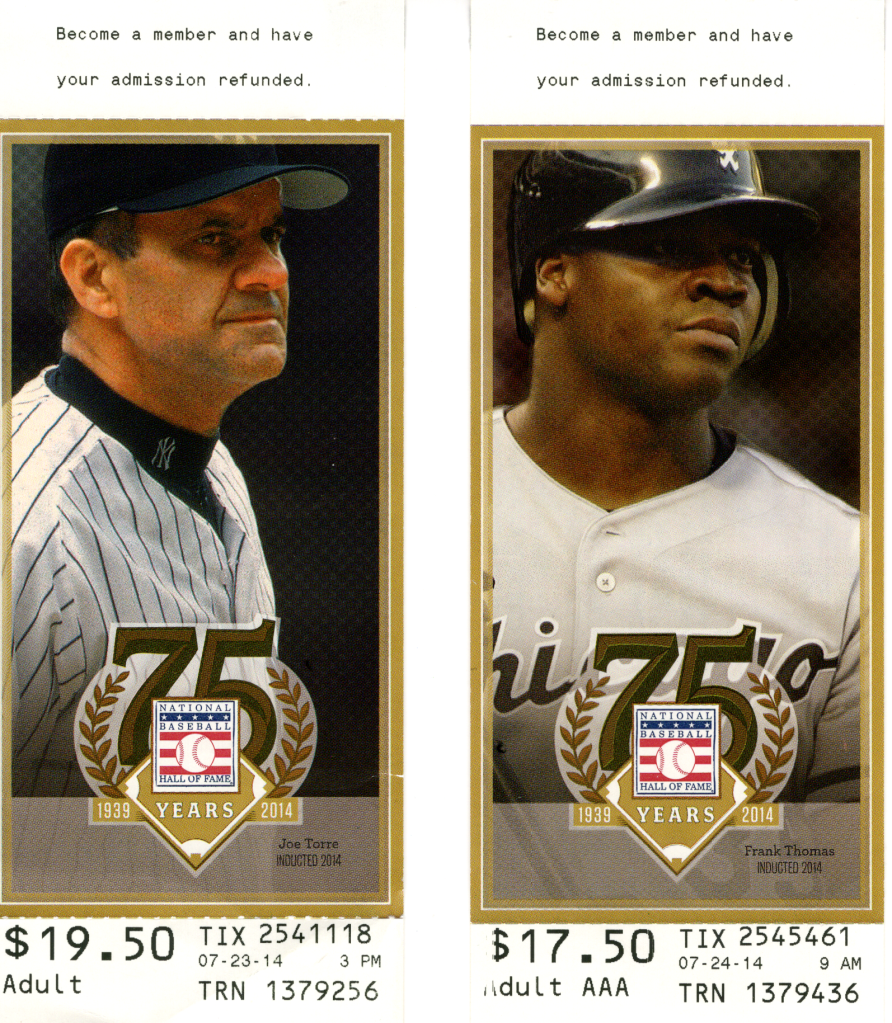
Tickets from our Hall visit in 2014. The price of admission had near doubled since the last time we were here.

This time, we devoted two days to the visit, traveling from central NJ to Cooperstown on Wednesday morning, July 23rd. Warm and sunny weather made the trip uneventful, though the GPS we employed chose a peculiar route for us, taking us through what appeared to be a working farm as we approached the Hall. After finding our hotel and dropping off our bags, we went in search of lunch. As might be expected, Cooperstown and environs offer mainly American cuisine in local diners. and we chose one not far from the Hall.

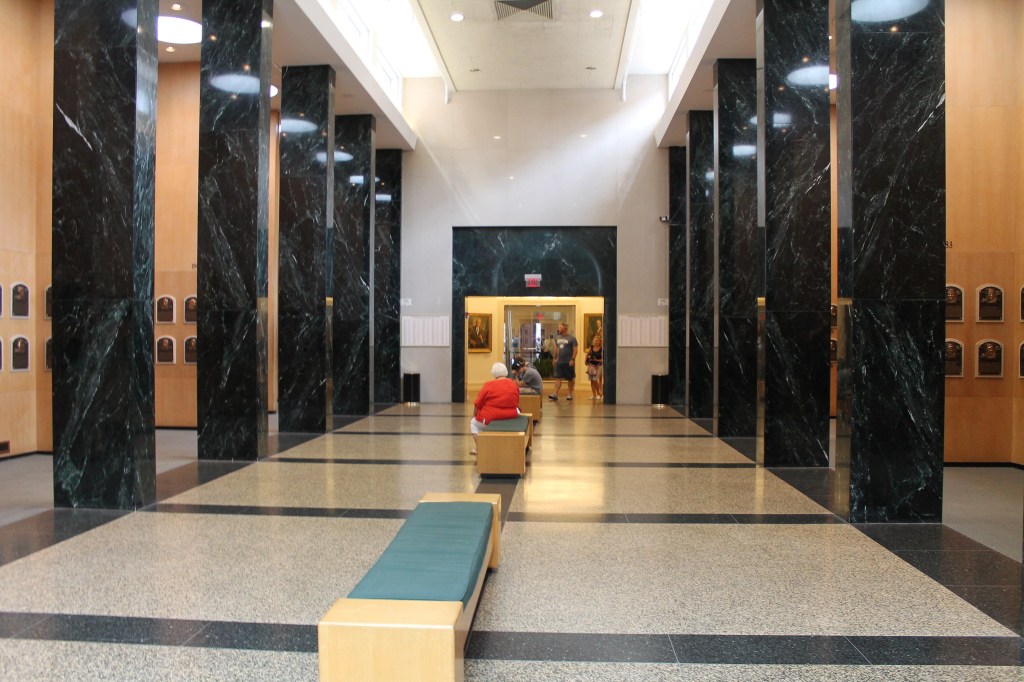
Not surprisingly, the Hall was much busier than our last visit, as Induction Weekend was just days away. Ticket prices had risen considerably since 2000, which should not have been a surprise, but I must admit I was taken aback by the steep increase. Like our last visit, he headed straight for the Plaque Gallery. To my mild surprise, the Gallery was not crowded, which suited us just fine. Unlike our last time here, we had the luxury of time, and we took much more time to appreciate the simple but distinguished tribute the members of the Hall.

Plague Gallery at the National Baseball Hall of Fame, during a relatively quiet moment. (Photo credit: Jeff Hayes)

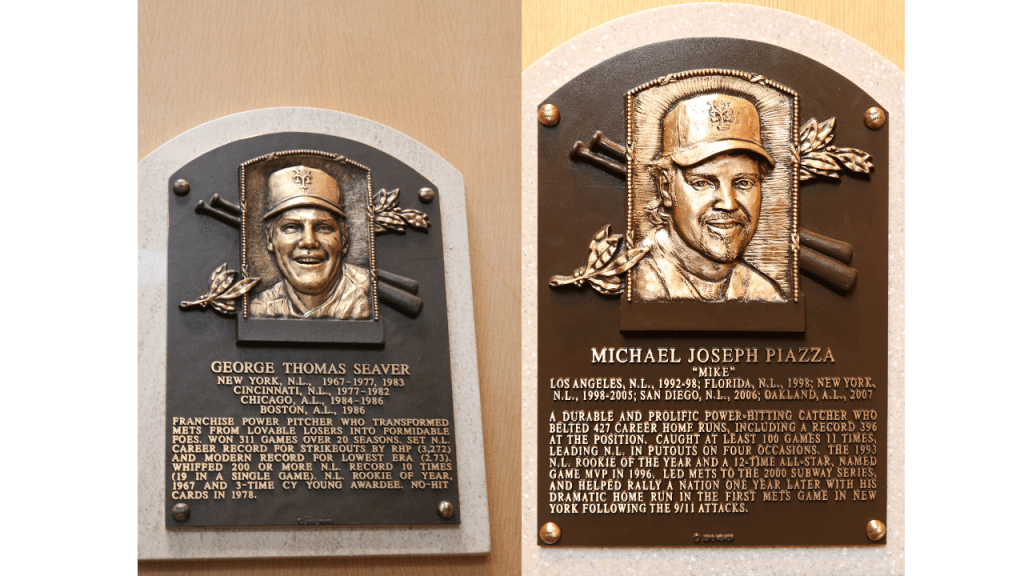
Since our last visit, another New York Met was enshrined into the Hall of Fame. Mike Piazza, traded to the Mets during the 1998 season, arguably had his best seasons as a member of the Los Angeles Dodgers, winning the Rookie of the Year award with them in 1993. Though Piazza never topped his best offense seasons with the Dodgers, he led the up and coming Mets to the playoffs in 1999, and the World Series in 2000. However, Piazza’s home run against the Atlanta Braves in the aftermath of 9/11 cemented his place in Mets history. Piazza was just the second Hall of Famer inducted as a New York Met, so seeing his plaque was a must.

The two Mets enshrined in the Hall of Fame: Tom Seaver (left) and Mike Piazza (right). (Photo credit: Jeff Hayes)

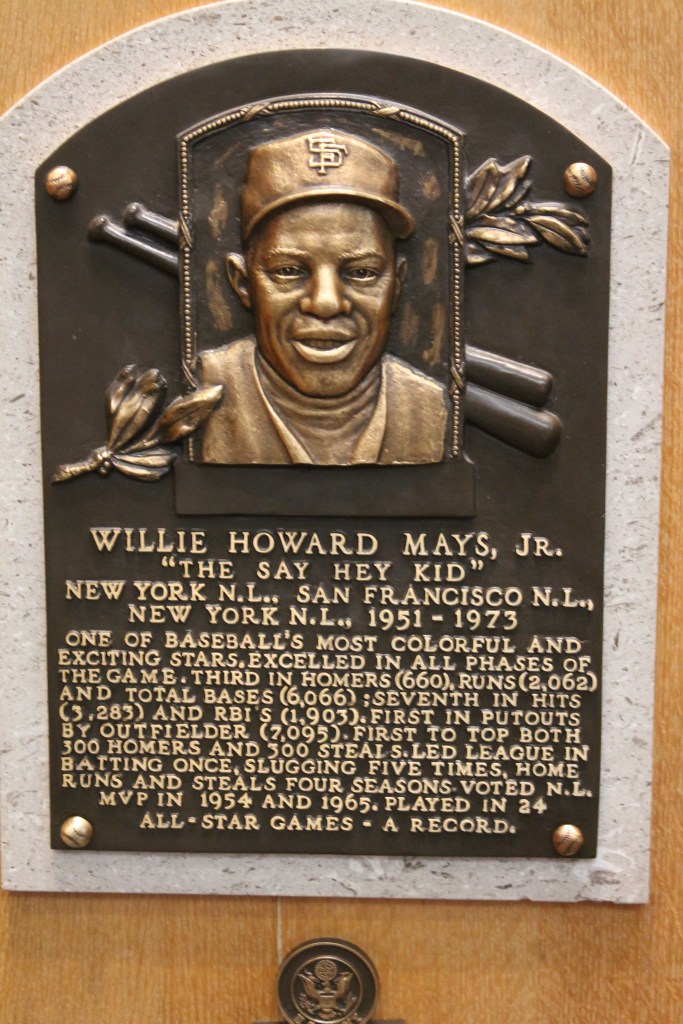
Few of the plaques contained names we did not recognize, but the plaques are ordered by the year the dignitary was inducted, so there were a couple surprises when it came to chronology. After tracking down the plaque of Mike Piazza, I looked for the plaque of Willie Mays. Considered by many (including myself) to be the greatest player ever to lace up spikes, I caught a fleeting glimpse of Mays’ career, as a New York Met in 1973. Only a shadow of his former self by that time. Mays still seemed to possess a love for the game, as if time itself had come to a stand still. Despite his subpar play in the 1973 World Series, Mays remains my favorite player, even if his best days occurred before I was born.

The plaque for Wille “Say Hey” Mays at the National Baseball Hall of Fame. (Photo credit: Jeff Hayes)

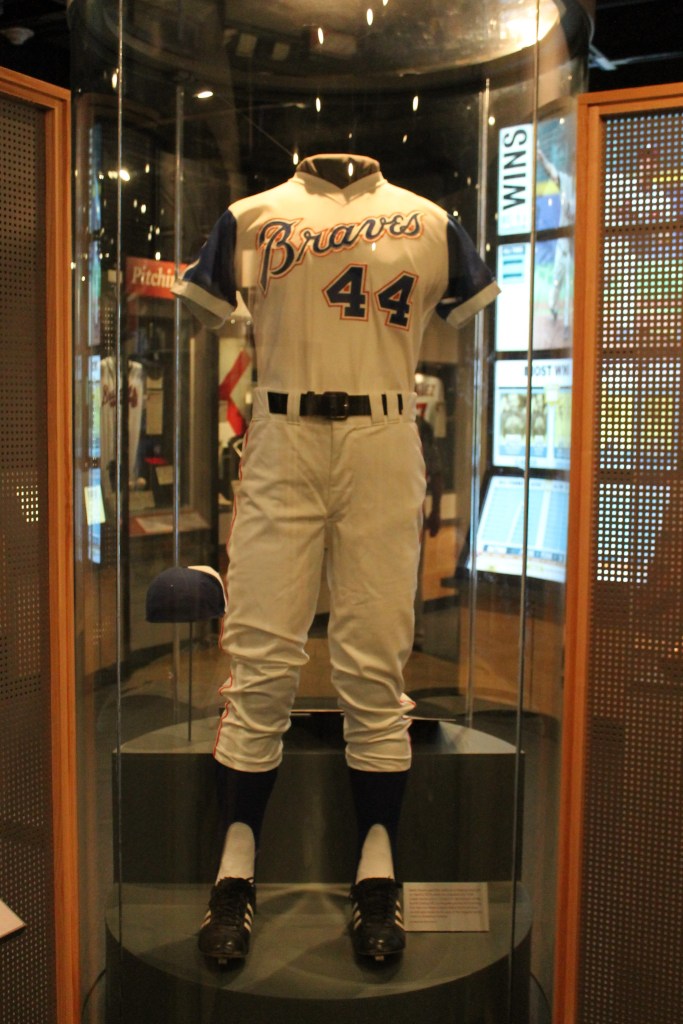
Following our stint in the Gallery, we headed for the Baseball TimeLine. Naturally, there were many new items added, but perhaps the most interesting was the ball from home run number 756 by Barry Bonds. The ball itself was defaced with an asterisk, clearly by someone unhappy with the crowning of a dubious new home run king. Rather than honor Bonds for the feat, the Hall constructed an elaborate display featuring Hank Aaron. Whether you believe Bonds is indeed the home run champ or not, it is clear that the Hall was sending an unambiguous message by celebrating Aaron over Bonds. During our tour we spotted a glove worn by Gary Carter. A member of the Hall, Carter was enshrined as an Expo, which was a personal disappointment. Like Piazza, Carter may have had his best years with the another team, but his impact on the Mets teams in the 1980s cannot be overstated. Carter was generally regarded as the final piece of a team that would win the World Series in 1986.

Uniform worn by Hank Aaron in the early 1970s with the Atlanta Braves. (Photo credit: Jeff Hayes)

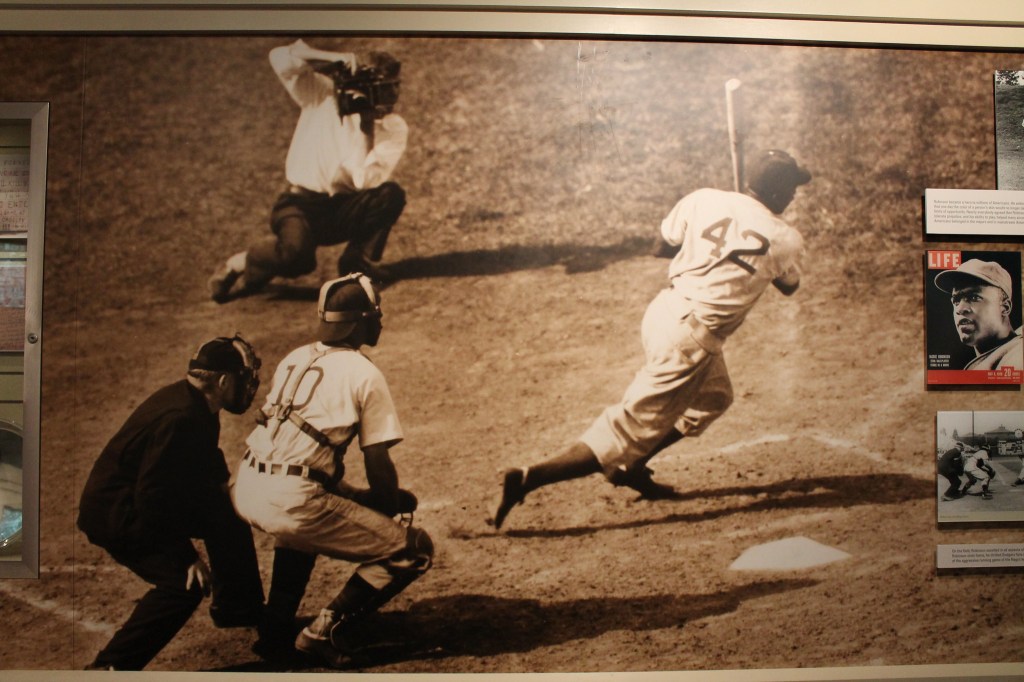
Perusing the seemingly endless stream of displays, I was drawn to a picture of Jackie Robinson at bat. Having seen many pictures of Robinson, this photo did not appear to offer much about the player that I did not already know. However, it did have something in it that is no longer seen, and in fact has probably not been seen since the 1950s or 1960s. The image that drew my interest in the picture was a photographer in the field of play, barely on the foul side of the third base line. Camera equipment was not nearly as sophisticated as it is today, and to get good action shots, photographers needed to be on the field. That image reminded me that the coverage of the game has changed so much that something this subtle would catch my notice.

Notice the photographer on the field snapping a picture of Jackie Robinson during an at bat, just feet away from the batter’s box. (Photo credit: Jeff Hayes)

We called it a day after working our way through the Timeline. Following a local dinner, we headed back to the hotel to rest following a long day.

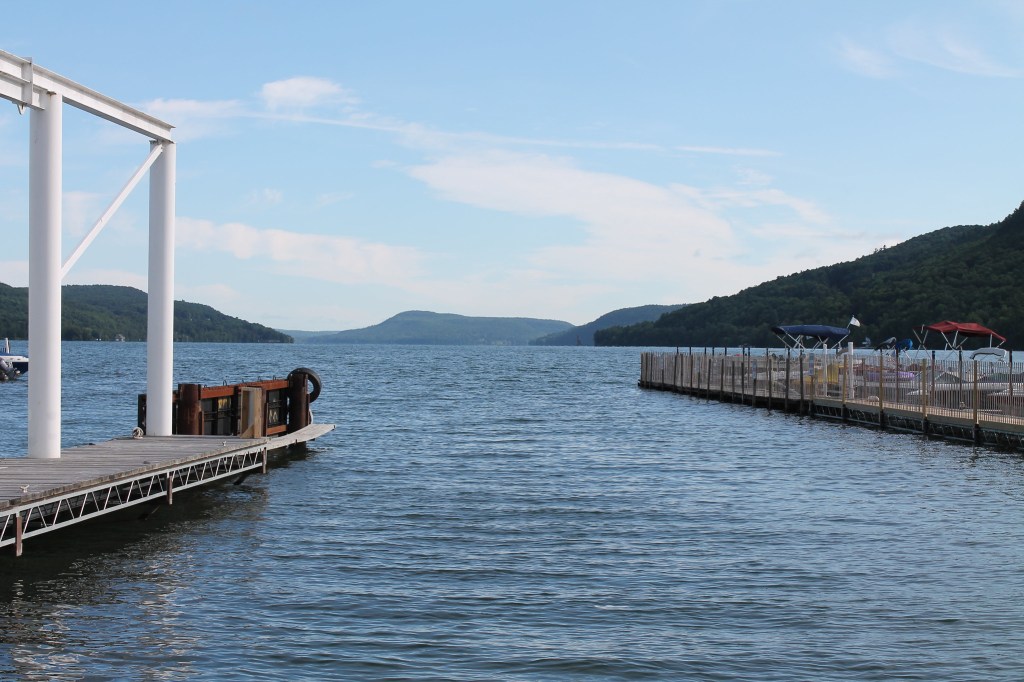
Sunshine and moderate temperatures for late July greeted us the next morning, tempting us to get outside before heading back to the Hall. Our target that morning was Lake Otsego, the nearest point of interest. Cooperstown lies on the southern end of the lake, which meant is was just minutes away from the hotel. Being a workday, the area was nearly deserted, which meant the dock area was ours alone. We spent nearly an hour exploring the southernmost end of the lake, as well as its environs. The heat and humidity began to increase, signaling to us that it was probably time to get moving and head back to Cooperstown.

The southern end of Otsego Lake, located just minutes from the Hall of Fame, on a warm and increasing humid morning. (Photo credit: Jeff Hayes)

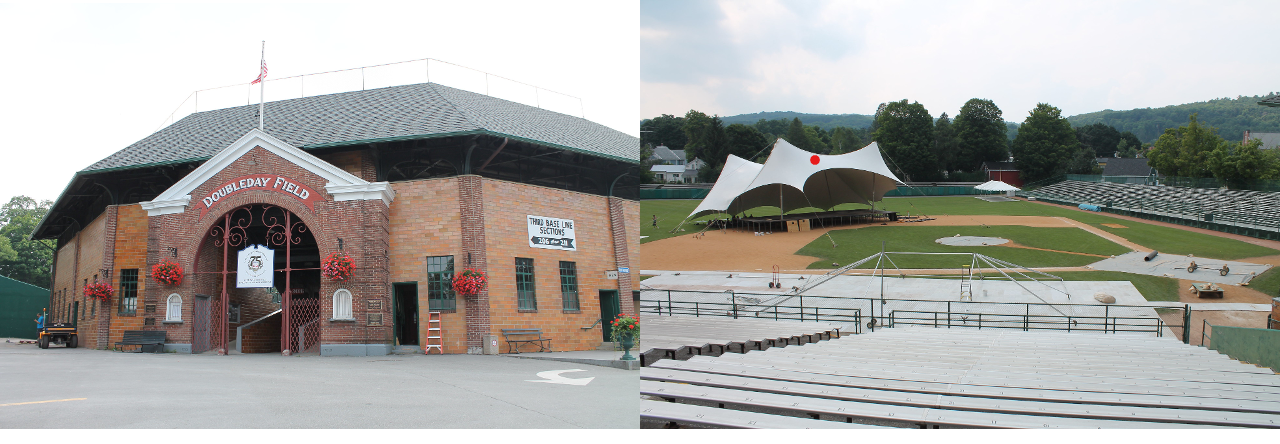
Returning shortly after the Hall opened, we scanned the museum for treasures we had missed. Our next stop was Doubleday Field, the baseball field and complex located adjacent to the Hall. Once the home to the Hall of Fame Classic, we saw the field as it was being prepared for the Induction Ceremony just days away. At first glance, Doubleday Field closely resembled many of the low Class A ballparks we had visited in the previous few years. It came as quite a surprise to learn that the capacity of the stadium was approximately 9,700, far more than expected.

On this day, there were no ball games being played, nor were any scheduled. We watched as the playing field was slowly transformed into the shape it would serve for the induction ceremony. Clouds began to thicken, blotting out the sun, and it was clear that thunderstorms would follow shortly thereafter. We took this as a hint to make our escape back to central NJ before the weather became a problem during our four and one-half hour drive home. Our second visit to the Hall was much more satisfying than the first, and allowing ourselves additional time made all of the difference. At the time, we were not sure we would visit again, so I was glad we made the trip.

Doubleday Field in Cooperstown, NY being transformed into a venue for the upcoming Induction Weekend. (Photo credit: Jeff Hayes)

Third visit: October 7th/8th, 2017

My brother and I found ourselves back in Cooperstown in early October 2017, as the MLB baseball playoffs were underway. Expecting the region to be undergoing a transition from summer to fall, we were mildly disappointed, as there was not nearly as much color as expected for the time of year. Much of the Northeast was in the midst of a return to summer with high heat and humidity covering the region. Instead of finding refreshingly cool air with billowy clouds, we were greeted upon our arrival with temperatures near 90 degrees, and thunderstorms in the area!

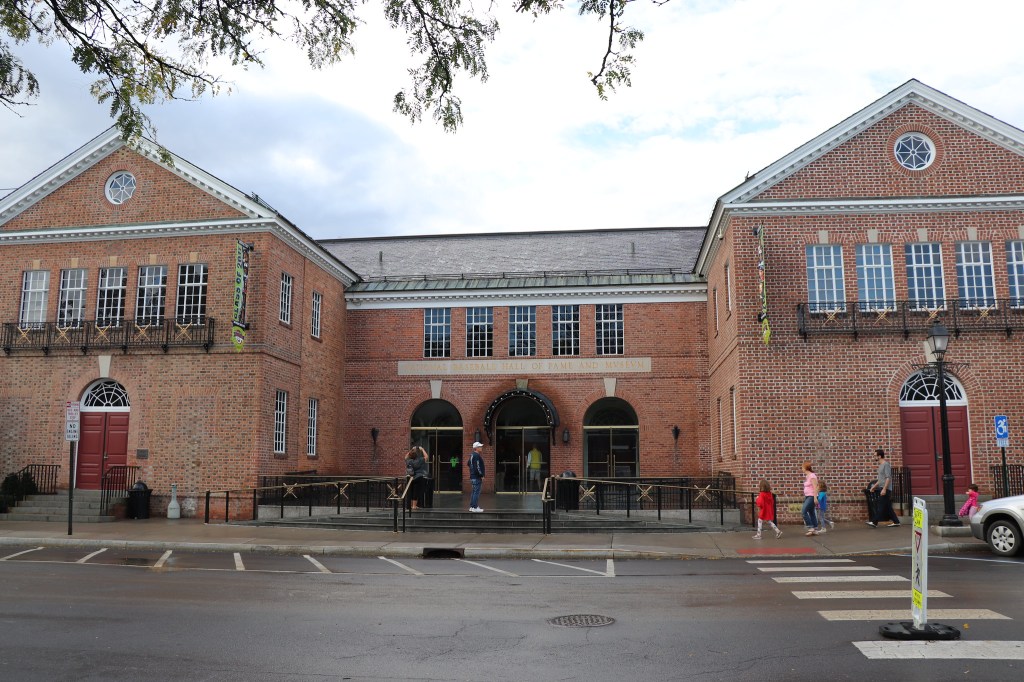
Having learned from the mistakes of our first visit, we scheduled the weekend around exploration of the National Baseball Hall of Fame, leaving plenty of time to acquaint ourselves with the haven of baseball fans worldwide. Arriving in the early afternoon of Saturday, October 7th, we found that the area was much more active that usual, especially considering football season (both college and the NFL) was well underway. When paying for out tickets to the Hall, a nice woman at the desk convinced it was cheaper to become members of the Hall, particularly because we were visiting twice that weekend. One of the perks of membership was a reduced price of admission, but the best perk was a membership card, which quickly became one of my most prized possessions.

Outside the National Baseball Hall of Fame in Cooperstown, NY. (Photo credit: Jeff Hayes)

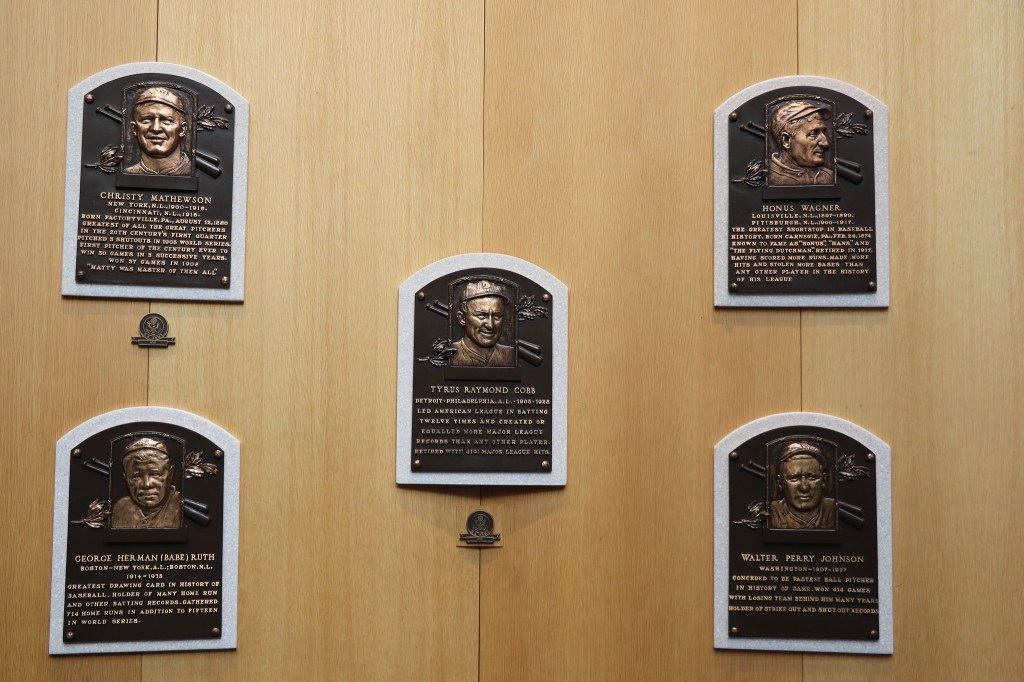
As had become our custom, we visited the Plaque Gallery first. Something about this exhibit screams the Hall to me, where the greats of the game have been immortalized. Every time I visit the Gallery I notice something I had previously missed; this time, it was that the initial induction class had been give a section to themselves. In 1936, the Hall of Fame enshrined Ty Cobb, Walter Johnson, Christy Mathewson, Honus Wagner and Babe Ruth, though the Hall would not formally open until nearly three years later. Being a history buff as well as a lifelong baseball fan, I appreciated the special treatment these greats were afforded, among the very best baseball had to offer from its first 75 years.

The National Baseball Hall of Fame’s inaugural class, enshrined in 1936. (Photo credit: Jeff Hayes)

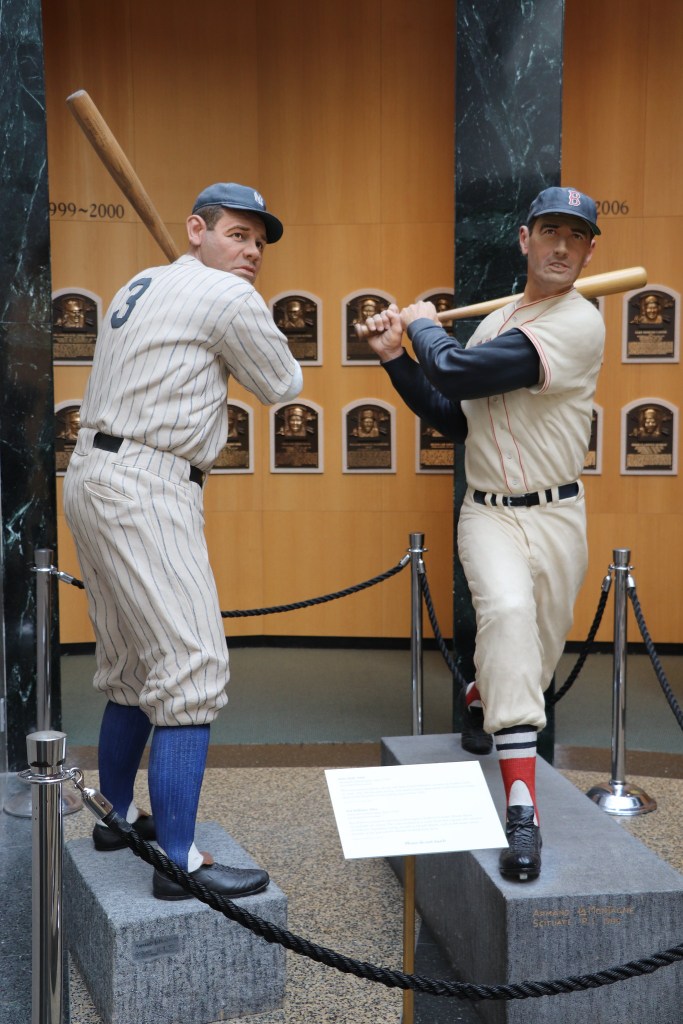
Viewing the plaques, it is clear that the New York Yankees were well represented. From Ruth and Gehrig through DiMaggio and Mantle, the Hall is replete with examples of the dominance of the Yankees. Being a die hard Mets fan, I confess to a certain amount of envy, but it is difficult to debate the profound impression the storied franchise has left on baseball history. Just as we were exiting the Gallery to head to the Baseball Timeline, I noticed wax figures of Babe Ruth and Ted Williams. While it was here during our last visit, it did not receive the proper attention from me at that time. Aside from Ty Cobb, these two are arguably the greatest left handed hitters in the history of the game. Sadly, their careers did not overlap, but they are here together at the Hall.

Babe Ruth and Ted Williams, side by side near the Plaque Gallery in the National Baseball Hall of Fame. (Photo credit: Jeff Hayes)

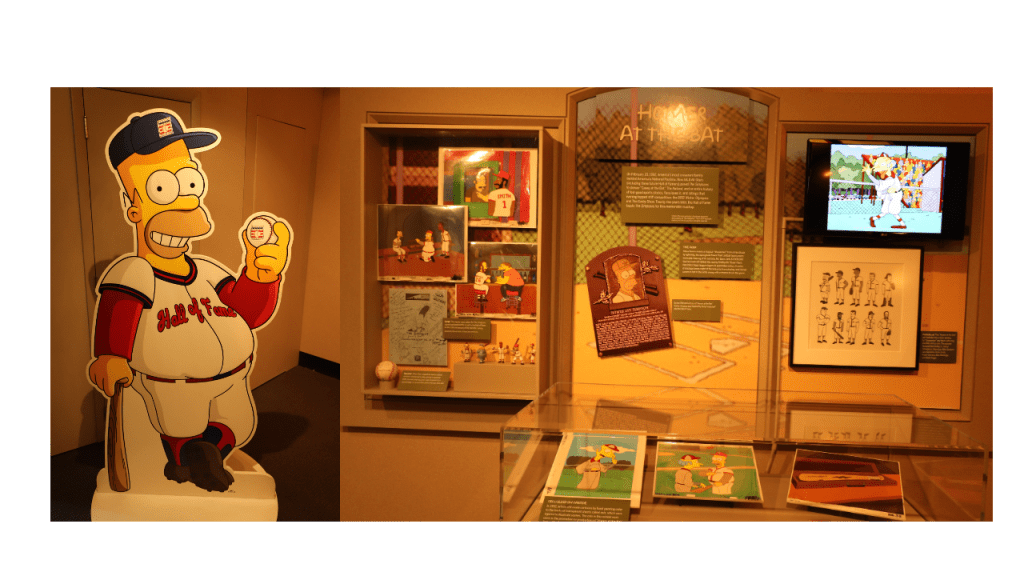
While there was not much new in the Baseball Timeline, we did spend a fair amount of time studying jerseys and equipment from various eras of the game. There is a large enough age spread between us so that we have a different perspective of the game (my love for baseball was based in the 1970s; my brother’s love for the game is rooted in the 1980s). We wandered among the relics, enjoying the history of the game with the aid of items from those eras. One of the newer displays was based on The Simpsons and their take on the game. Many players from the 1970s and 1980s did voiceover work in this episode, so there was plenty for the both of us to enjoy in this display.

Almost as iconic in the culture of America as baseball, The Simpson paid tribute to the National Pastime. (Photo credit: Jeff Hayes)

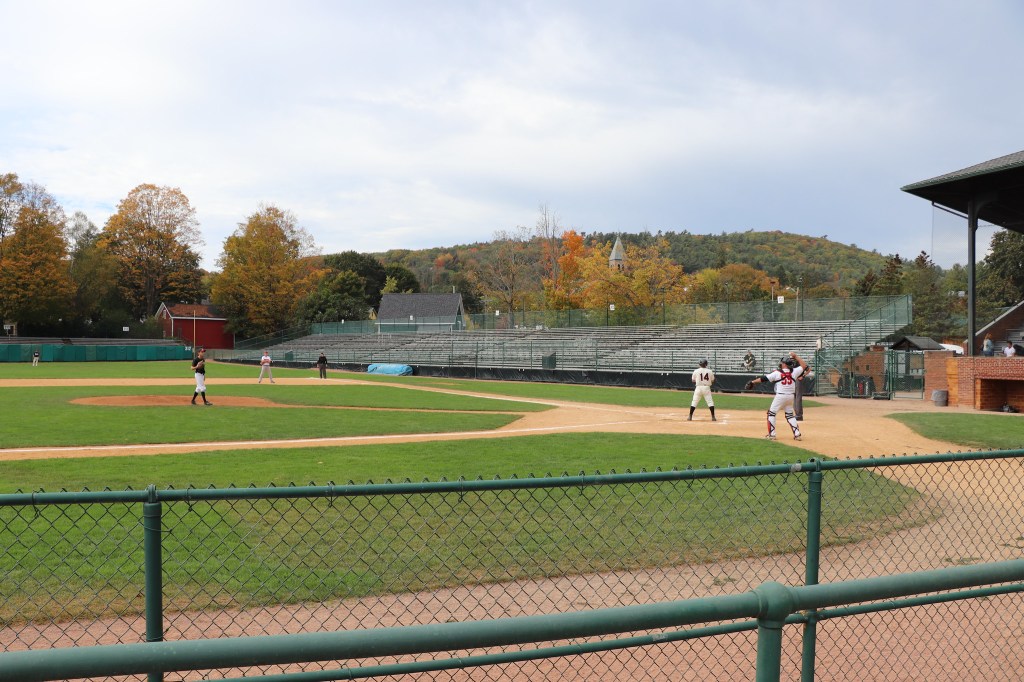
Following our initial pass through of the Hall, we walked over to Doubleday Field. Unlike the last time we were here, there was some actual baseball being played. A collection of players (seemingly from different teams) were playing, and with umpires being present, I suppose this was a fall league game. Clouds were building ahead of a cold front and its attending showers and thunderstorms, but we did explore the park for a bit. Heat and humidity cut our visit to the field short, as the conditions felt more like mid July than early October.

Fall League baseball at Doubleday Field in Cooperstown, NY. (Photo credit: Jeff Hayes)

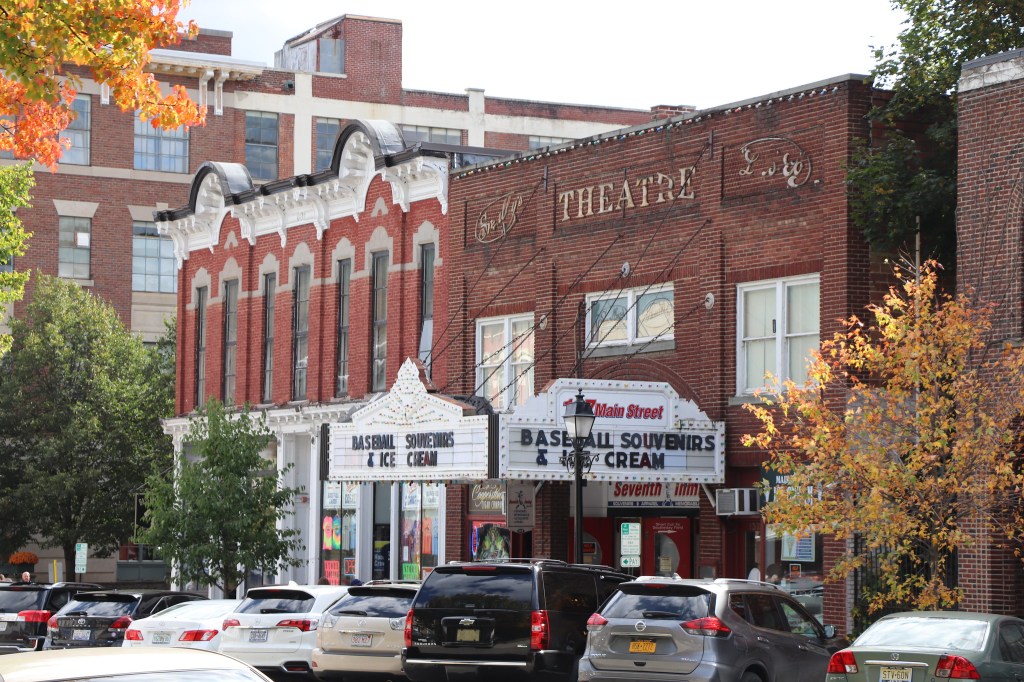
Showers and thunderstorms during the evening and early overnight changed the season from summer back to fall as we began Day Two of our visit. There were many, many people in the streets of Cooperstown that morning, and the breeze almost felt cool when compared to Saturday. It was almost a festival like setting, with many vendors hawking their wares on the sidewalk on Main Street. Supposedly Pete Rose was signing autographs at a sports shop down the street, but we did not have enough interest in him to battle the crowd to glimpse a view of one of the most controversial players in MLB history.

A view along Main Street in Cooperstown, NY. (Photo credit: Jeff Hayes)

As we prepared to bid adieu to the Hall, we spent some time walking around the museum. We found sculptures outside of the Hall, mainly in the back of the museum. From a distance, it was difficult to discern the identity of the people in the sculpture, but as we got closer, we could identify at least a few. In the center of the courtyard, Johnny Podres was delivering a pitch to Roy Campanella, with Satchel Paige to the right of Podres, as well as an unidentified “Woman at Bat”, a tribute to the All American Girls Professional Baseball League.

Sculptures outside of the National Baseball Hall of Fame in Cooperstown, NY (Photo credit: Jeff Hayes)

Finally, it was time to go, and we left Cooperstown during the mid afternoon, listening to the Jets lose to the Browns on the way home. It is not clear whether we will visit Cooperstown again anytime soon, but considering the 14 year gap between our first and second visits, we could come back again. If you have never been to the National Baseball Hall of Fame, GO! Not only is the Hall worth the trip from anywhere, Cooperstown NY is a charming village, worthy of exploring as well.

Sahlen Field, Buffalo NY, July 16th 2021

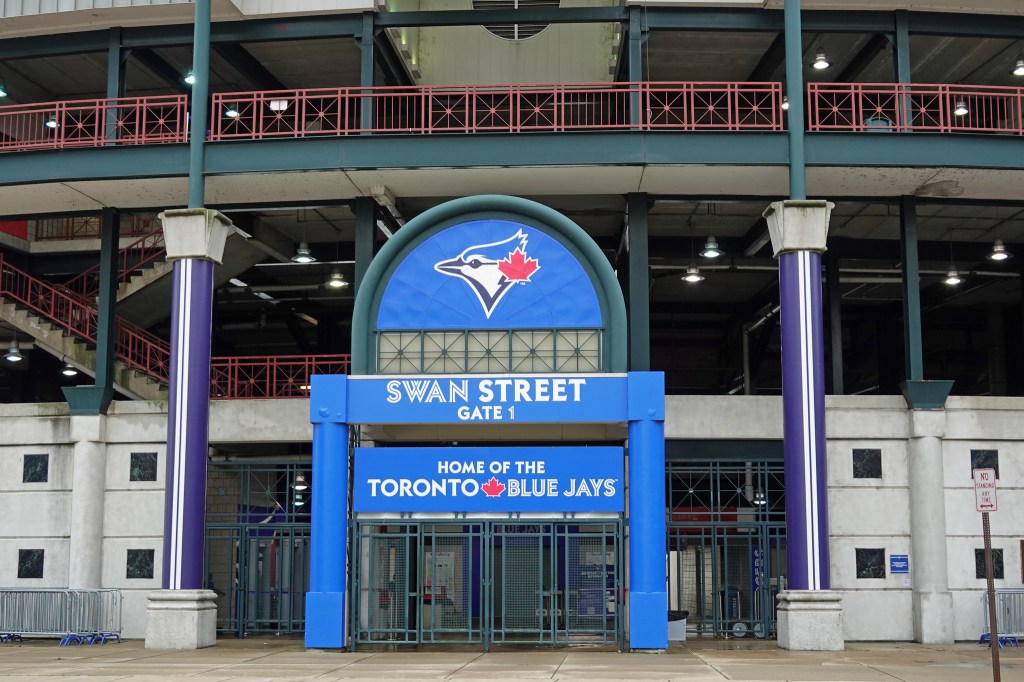
Outside the Swan Street gate at Sahlen Field, Buffalo NY. (Photo credit: Jeff Hayes)

Rain threatened to wash away our baseball weekend in weather New York and northwest Pennsylvania, as the forecast was very wet and cool. My brother and I traveled from my home near Harrisburg to Buffalo on Friday, July 26th, with the intent of seeing a game on Saturday at Sahlen Field (to see the “Buffalo” Blue Jays host the Texas Rangers), then taking in a game at UPMC Field in Erie on Sunday. Since the drive to Buffalo took only five hours, we found ourselves with some time Friday afternoon to do some sightseeing. Niagara Falls was only 30 minutes away, so we went there for our first glimpse of the natural beauty from the American side.

An overcast sky yielded occasional light showers and drizzle, which resulted in us cutting our visit to the Falls short. Before leaving, my brother suggested that we visit Sahlen Field that night, since the forecast for Saturday afternoon was bad, almost assuring a rain out. Not wanting to miss our opportunity to see an MLB game in Buffalo, we quickly purchased tickets for the game, which was slated for a 707 pm start. We were 30 minutes from the hotel, so we had to race back to change and prepare for the game, and headed by up Interstate 90 back toward Buffalo in time to make the game.

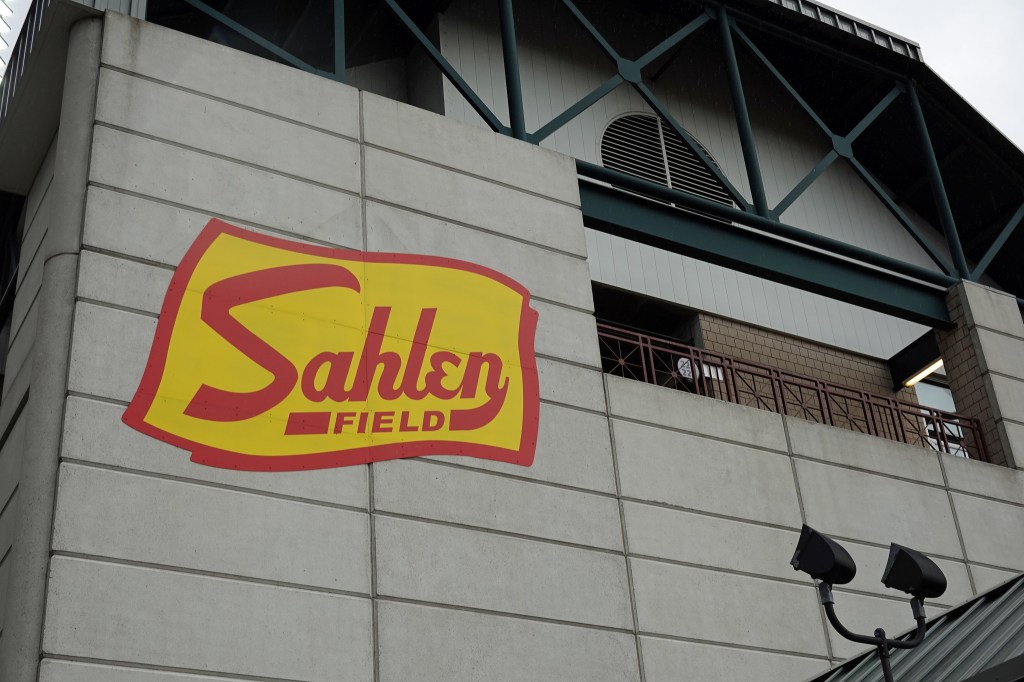
Welcome to Sahlen Field! (Photo credit: Jeff Hayes)

Though there is no onsite parking at Sahlen Field (the reason for which was obvious once we arrived), we had little trouble finding parking within a couple of blocks of the stadium. Not surprisingly, parking was generally $20 that distance from the park, and as high as $35 right next to the ballpark. It seems as though parking prices for MLB games found there way to Buffalo! Once we reached Sahlen Field, we wandered around the outside of the park taking pictures. The outfield area was largely inaccessible from the outside, due to the proximity of Oak Street in left field, and restricted parking outside centerfield and right field. However, along Washington and Swan Streets, we found what appeared to be a recently refurbished look, complete with Toronto Blue Jays signage along the way. We also discovered that this portion of downtown Buffalo contained some older buildings with some interesting architecture. If the weather was kinder than forecast on Saturday, perhaps we would investigate this area further.

Returning to the home plate entrance, we entered the ballpark. Security was unsurprisingly tighter than minor league ballparks, but the process was much smoother than most MLB parks, as the staff was cheerful and helpful. Walking through the tunnel to the interior concourse, we felt as though we were in an MLB stadium, with a large and enthusiastic crowd milling around. It was clear that the ballpark had received a significant upgrade for the MLB games played there in 2020 and 2021. Sahlen Field was covered in Blue Jay blue, from the padded outfield walls to the trim on both the lower level and the private suites.

Sahlen Field from behind home plate in the lower level. This image is featured in the Wiki page for Sahlen Field. (Photo credit: Jeff Hayes)

Typically, we explore the interior of a new stadium shortly after arriving, but the bustling crowd inside the inner concourse made that a bit more difficult than usual. Rather than encircle the playing field on the outer concourse (which was more challenging than other ballparks), we ducked into the tunnels between the inner and outer concourses, taking pictures, and repeating the process from the right field line back toward the left field line. Unlike some stadiums, the concourse did NOT extend around the outfield, as Sahlen Field was tucked in between streets in downtown Buffalo, leaving little room for maneuvering beyond those confines.

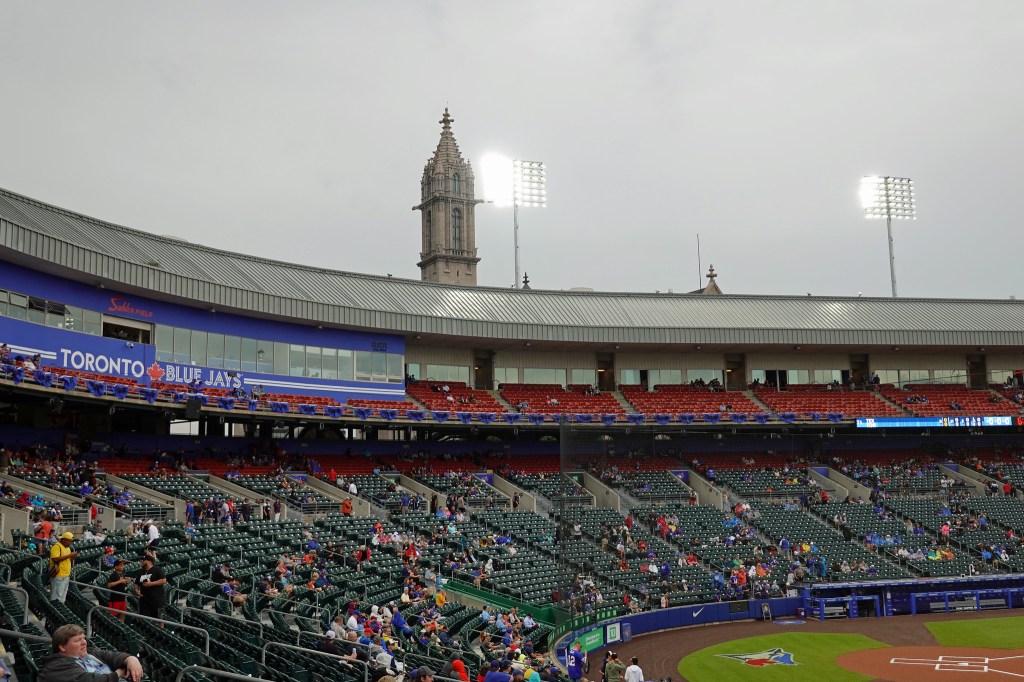
As we further explored Sahlen Field, we discovered that it consisted of two decks of seating. The lower deck (separated into two sections by a concrete concourse) extends from the left field foul pole behind home plate to the right field foul line, with the upper portion of the lower deck protected from the elements by the deck of red seats and private suites located above. Seats near the foul poles were angled for a better view of home plate, something we have not seen in many minor league parks, and a nice touch for fans in those locations. In total, the ballpark holds about 16,600 fans, which made it the largest minor league park we have yet visited.

A view of Sahlen Field, centered on the home plate area. This view shows the green seated lower deck, red seated upper deck, some of the private suites, the press box, and the tower at the Old Post Office in Buffalo. (Photo credit: Jeff Hayes)

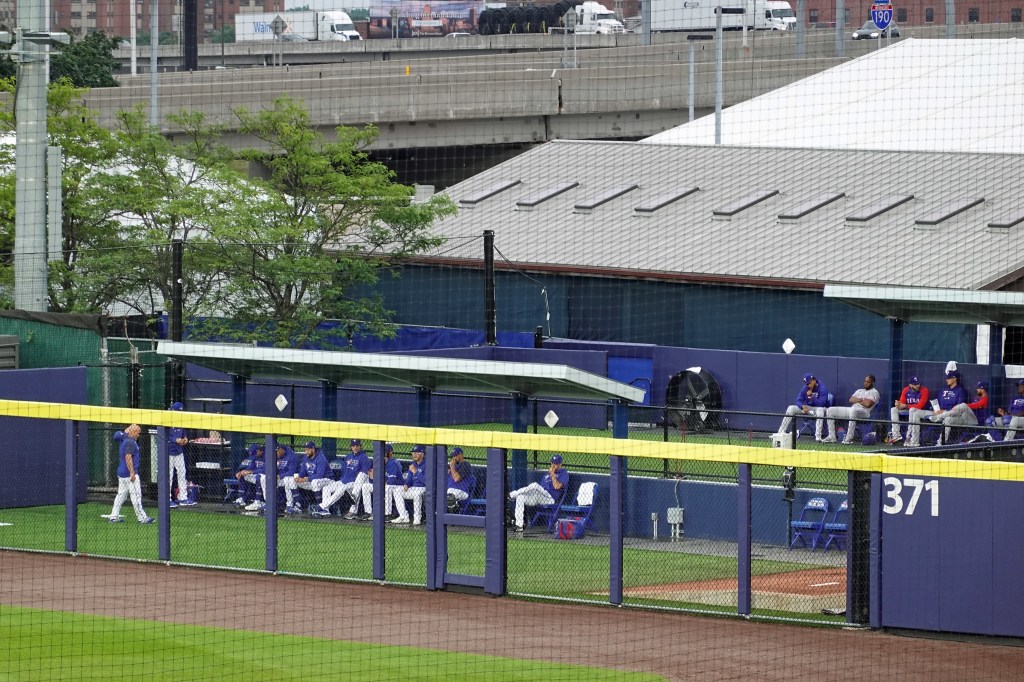
Down the right field line we found the Party Zone, a multi tiered collection of picnic table style benches, covered at the top by a canvas roof. Just to the right of the Party Zone are the bullpens. Constructed shortly before we arrived, the dual leveled bullpen houses the home team on the top tier, and the visiting Texas Rangers on the lower level. Because of the alignment of Sahlen Field, there was only a short wall and a large mesh netting strung across left into centerfield, with Oak Street acting as a barrier. We would later discover that, due to the height of the netting, that it would be difficult for a home run ball to actually land on Oak Street (as its trajectory would more likely deposit in on the other side of the road).

The dual layered bullpen at Sahlen Field, Buffalo NY. (Photo credit: Jeff Hayes)

Finished with our exploration of the park, we ducked back into the inner concourse, in search of a baseball dinner. While there were many places to obtain food and drinks, all of the lines were long, as it seemed that many in the large crowd had the same idea. Skipping this option for now, we headed toward our seats. Securing seats only 90 minutes earlier, we opted for section 118, which was down the right field line; a pessimistic forecast precluded us from getting better seats, for fear of a rainout tonight AND Saturday. Though the seats we scored did not offer the best view of home plate, it did give us great sight lines for the rest of the park. As the time of the first pitch arrived, clouds continued to produce intermittent light rain and drizzle, but not enough to delay the game (which was slated for a 707 pm start).

From our seats, we could see some of the larger buildings of Buffalo, most notably the Old Buffalo Post Office. However, the scoreboard in centerfield seems to be the most prominent feature in Sahlen Field. Not quite as sophisticated as scoreboards/videoboards in MLB parks, the scoreboard/videoboard here is an upgrade from what we typically encounter in minor league stadiums (with possibly the exception of Arm&Hammer Park in Trenton, NJ). For the most part, the space was used as a scoreboard, with only a few video replays shown during the game. As mentioned earlier, there were a number of upgrades made to the park to accommodate the Blue Jays in their tenure here, including new LED lights (which are MUCH better than standard lighting), a resurfaced outfield, and the aforementioned bullpens.

The scoreboard in centerfield at Sahlen Field in Buffalo, NY. (Photo credit: Jeff Hayes)

While not a sellout, Sahlen Field was about two-thirds full shortly after the first pitch was thrown, with intermittent light rain and drizzle falling (as it would for the balance of the game). In the bottom of the first inning, we were treated to a home run by Vladimir Guerrero, Jr. The Blue Jays tacked on four more runs in the third inning, with two more home runs. Rainy and cool weather at night are not normally conducive to balls flying out of the ballpark, but the smaller dimensions of this park may have been a factor in each of the home runs hit. Meanwhile, the Texas bats remained quiet for the first six innings, as the Blue Jays maintained a sizable lead through that time.

The view from our seats at Sahlen Field in Buffalo, NY. (Photo credit: Jeff Hayes)

The Blue Jays put the game away in the bottom of the sixth inning, which featured another home run by Guerrero Jr. This time he blasted the ball well over the net in left field and across Oak Street to the parking lot on the other side of the road. With the Jays taking a 10-0 lead at the end of the frame, some of the fans started to file out of Sahlen Field, if for no other reason that to escape the cool and wet conditions. Like many MLB games, there were loud, intoxicated fans around us, but unlike many MLB, they were not particularly obnoxious. It was clear to me that the fans in Buffalo had accepted the Blue Jays as their own, and I noticed several “Buffalo Blue Jays” shirts and signs in the stadium. These signs had me wondering how the Buffalo fans would react if/when the Blue Jays returned to Toronto.

Vladimir Guerrero hitting a home run at Sahlen Field in Buffalo NY. (Photo credit: Jeff Hayes)

During the morning hours of Saturday, the Blue Jays management issued a press release stating that the Jays would be returning to Toronto, starting with the next home stand on July 30th. Although I am sure the fans were aware of an eventual return to Toronto, I wonder if Buffalo was ready to let them go so soon. Our timing could not have been better to see an MLB game here, as waiting any longer would have meant missing a golden opportunity to see MLB players in such an intimate setting. These were my thoughts as we filed out of Sahlen Field. Leaving the building proved more difficult than I anticipated, as there were logjams at each gate. Eventually, we walked back to the car, headed back to the hotel after a long day on the road.

Sahlen Field at night. (Photo credit: Jeff Hayes)

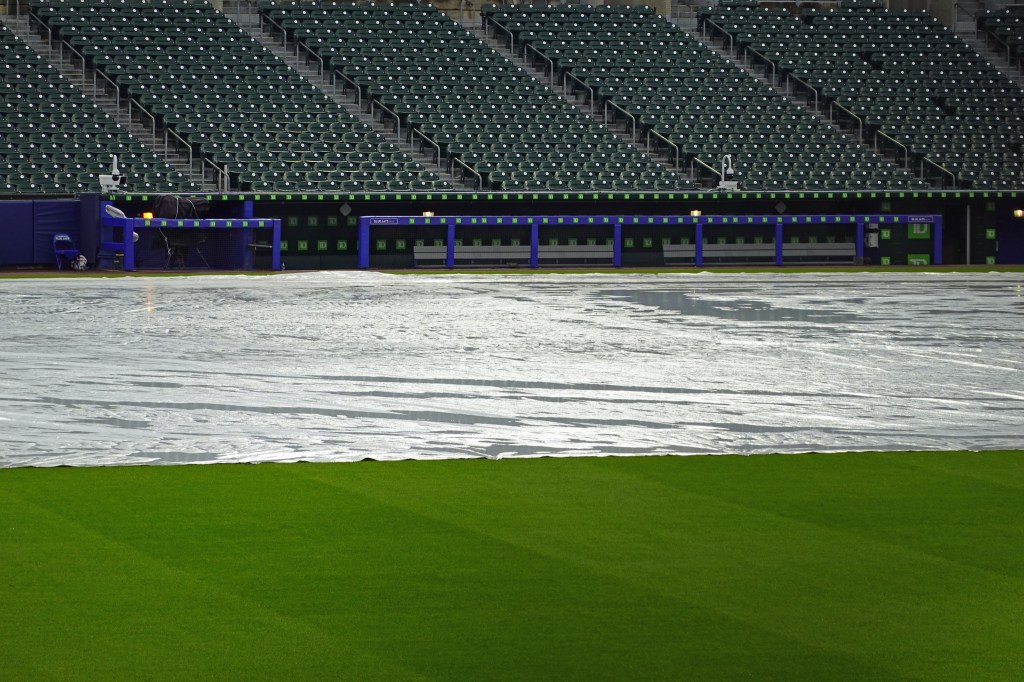
My brother’s suggestion to see the game at Sahlen Field on Friday night rather than Saturday afternoon loomed large, as heavy rainfall plagued the Buffalo area through mid to late afternoon. After visiting Niagara Falls again in the morning, we encountered flooded roads on our way back to the hotel. Not surprisingly, the game was rained out, even as the heaviest rainfall was exiting the region. Apparently the field was unplayable, and considering how much rain fell into mid afternoon, that was not a shock. Once the heavy rainfall exited, we walked around downtown Buffalo to view the architecture, and we found ourselves face to face with the ballpark. Peering through the chain link in centerfield, we got one last look at the interior of the stadium, with the tarp still firmly in place over the infield.

Puddles on the tarp over the infield at Sahlen Field on Saturday told the story; no baseball today. (Photo credit: Jeff Hayes)

Once the Blue Jays leave for Toronto, the main tenants of Sahlen Field, the Bisons, will return from their stay in Arm&Hammer Park in Trenton NJ. Buffalo has attempted to obtain a MLB team in the past, and I wonder, after hosting the Blue Jays, if there will be a clamoring from the faithful for an MLB team of their own. If that happens, and a MLB ready stadium is constructed, perhaps we will return. Otherwise, having seen Sahlen Field hosting MLB games, I am not sure we will be back.