- First visit: unknown, sometime in the summer of 2013
- Most recent visit: Friday, September 13 2019
A job change in early 2013 brought me to the Washington DC area, and I was pleasantly surprised to see the wide array of baseball options that came with the move. The Washington Nationals were only a 20 minute train ride from home, and the Baltimore Orioles were just a 45 minute car ride north along Interstate 95. There was also a number of minor league options an hour away or less, with the Bowie Baysox (the AA affiliate of the Baltimore Orioles) the closest, a mere 20 minute car ride away (as long as traffic on the Beltway cooperated). Since the ballpark was easily accessible, I adopted the Baysox as my team in the new surroundings.
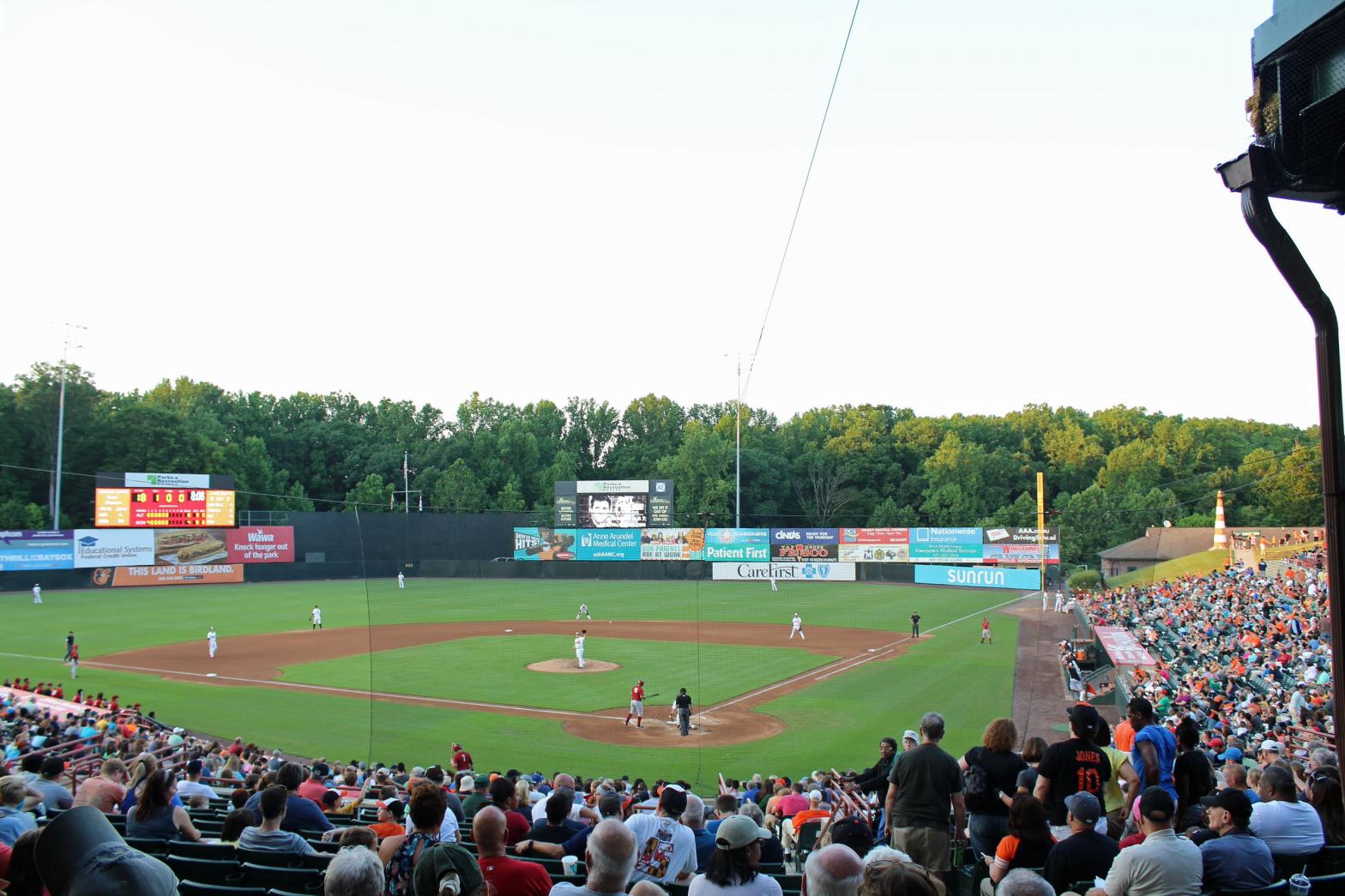
Though I do not recall the exact date of my first visit to Prince George’s County Stadium (the home of the Bowie Baysox) in 2013, I do remember a few surprises from the trip. The first surprise was parking. Because Prince George’s County Stadium holds about 10,000 fans, the parking lot for the stadium is huge. Not knowing where to park, I flagged down an attendant and asked him the cost of parking. With a wry smile, he told me that parking was free. If memory serves, this was first stadium I’d visited that had that perk. Arriving about an hour before game time, I was able to park right next to the ballpark. Not having a ticket for the game, I feared that I would not be able to secure a good seat so close to game time.

Asking for the best available seat, I received my second surprise. Despite arriving close to game time, there were great seats available. Not knowing anything about the layout of the park, I took seats near the on deck circle just to the left of home plate, about six rows from the field. At the time, I could not believe my luck, but after going to a few games, I realized that, despite easy access off Route 50 in Bowie, attendance was generally fairly light. That was both shocking and disappointing to me, but I eventually learned that Bowie did not aggressively advertise, which could a contributing factor to the low attendance. Quickly I learned to enjoy the relatively sparse attendance, as it virtually guaranteed me great seats any time I went to the ballpark.
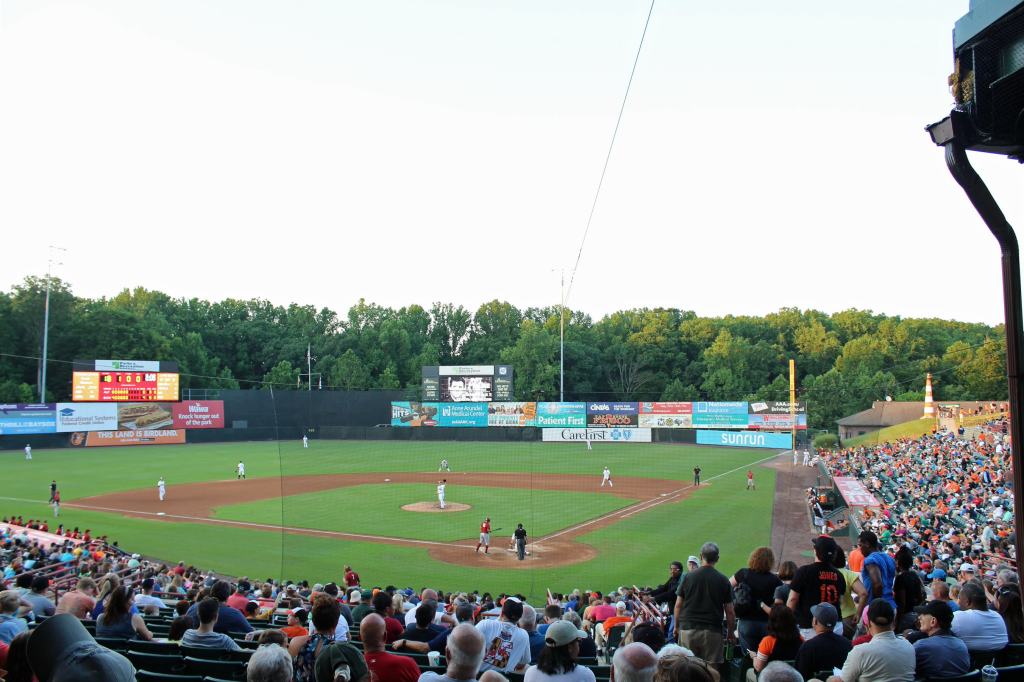
Passing through an old styled turnstile, my ticket was torn by a friendly and knowledgeable ticket taker, leading me into the lower concourse. A quick walking tour of the stadium followed. Like most minor league ballpark from the 1990s, the ballpark was a cookie cutter prefabricated stadium, with seats in the lower levels, and aluminum bench seating in the upper sections. There were also enclosed club suites at the top of the stadium, stretching from the home dugout behind home plate to the visitor’s dugout (we never saw a game from these seats). Down the right field line is a kid-friendly play area, complete with a carousel, as well as other attractions. A lighthouse located near the play area blared following a Baysox home run.

Like most minor league parks, Prince George’s County Stadium featured a grass playing field, as well as series of wooden advertising signs perched above and just behind the outfield wall. In left centerfield there was a scoreboard, which seemed out of date and a bit worse for wear. At this time, there was no video board, which I found odd, as most AA stadium have at least a small but functional videoboard. Finishing my tour of the ballpark, I stopped for a baseball dinner before heading to my seat. Standard concession stands were available on the lower concourse, as well as specialty food and drink carts along the lower concourse. On this night, only the right field concession stand was operating, but the small crowd meant a short wait time. Walking back on the concourse toward my seat I discovered a table that offered scorecards and rosters for both the Baysox and the visiting team. Being an old-timer, I keep score at games, and I found these offerings very useful.

My first visit to Prince George’s County Stadium was an evening contest, which led to my third surprise. The lightning for the playing field seemed woefully underpowered, leaving portions of the outfield (especially centerfield) fairly dark. My brother and I would joke later that outfielders, rather than losing balls in the lights, would lose ball in the dark. Overall, Prince George’s County Stadium seemed like an average minor league park, with signs of aging that indicate that the park was older than its 20 years. Despite its shortcomings, I would grow accustomed to the “charm” the ballpark offered, and much like the old Shea Stadium in New York, it became like an old friend.

Sparse crowds like the one on that night gave me access to the action like I’d never seen. In fact, I was so close to the action that I couldn’t speak badly about the batter in the visitor’s on deck circle; he might hear me! My proximity to the field also allowed to see and hear the game in a way that isn’t possible in an MLB park. In general, minor league baseball is more about evaluating talent and less about strategy. It is not unusual to see players (especially pitchers) leave ballgames seemingly without a logical reason; we would later learn that once a manager had seen what he needed from a player, that player could be removed from the game. Pitching changes during innings are scarce, as teams are interested in seeing what players do under pressure, rather than making moves designed to win games.
As a result, minor league games tend to move along more quickly that their MLB counterparts. In between most innings, the Baysox offered games and contests in foul territory (typically in front of the dugouts), plucking fans out of the stands to participate in the contests. Despite the obvious attempt to make the games there more family friendly, there were a strange lack of kids in the park. Perhaps with myriad options for entertainment in the DC area, and MLB baseball as little as 20 minutes away, families were opting for choices other than Baysox baseball. My recall of the first game itself is fuzzy at best, but it did remember that exiting Prince George’s County Stadium was made simple, as cones and attendants made sure that the traffic flow was smooth. In about 20 minutes time, I went from the parking lot to my home with little difficulty. Even with the shortcomings offered by the home of the Baysox, I knew that I would frequent this place often, as it appeared to be a fine way to spend a summer evening.

Over the years, my brother and I would frequent Prince George’s County Stadium often, particularly on weekends when the AA affiliates of the New York Mets (the Binghamton Mets/Rumble Ponies) and New York Yankees (the Trenton Thunder) were in town. All told, I probably saw about 100 games at the ballpark between 2013-2019, usually near the on deck circle. Going as often as I did, I befriended many of the staff members, with whom I would swap baseball tales, talking about players we liked or ballparks we visited. My brother and I would be mistaken for scouts more often than you might expect, as I kept score, my brother took pictures, and we chatted almost non stop about the game. The only things (other than my job, which required shift work) that would keep me away when I could manage to go were rain and heat. DC and environs generally experience hot, humid summers, and this would occasionally keep me home. Thunderstorms were a nearly daily occurrence in the summer, and it seemed we had to endure rain delays more than any other place I had been.
Even with these distractions, we attended games at the park whenever possible, as prices were reasonable, great seats were almost always available, and fireworks occurred most summer nights (when weather permitted). Still, I was sad to see so few fans at the park. Occasionally, Orioles players would complete their injury rehabilitation at Prince George’s County Stadium, but attendance on these days/nights were surprisingly light. Perhaps my greatest memory of the ballpark was when the Baysox allowed fans to play catch on the field following a Sunday matinee. My brother and I brought our gloves and eagerly took the field when instructed. We were both surprised how good the turf in the field looked and felt, and we spent about 30 minutes on the field before being shooed away by management so that they could close the stadium for the day. That was only the second time I’d stepped foot on a professional baseball field, and despite being 52 years old, I was as excited as some of the kids playing catch with their parents.

During my time at Prince George’s County Stadium, I became an ardent fan of minor league baseball. In addition to the more intimate experience offered by the smaller ballparks, I found myself becoming invested in the younger players as they passed through Bowie. Many players I saw in Bowie would eventually make an appearance with the Orioles, or other MLB teams, and I felt a certain satisfaction in knowing I saw these players on the way up. My experiences at Prince George’s County Stadium rekindled what was flagging relationship with baseball, and because of that, now I prefer minor league games over MLB games. Thanks Bowie!



 Baseball Travels