Prince George’s County Stadium, Bowie Maryland

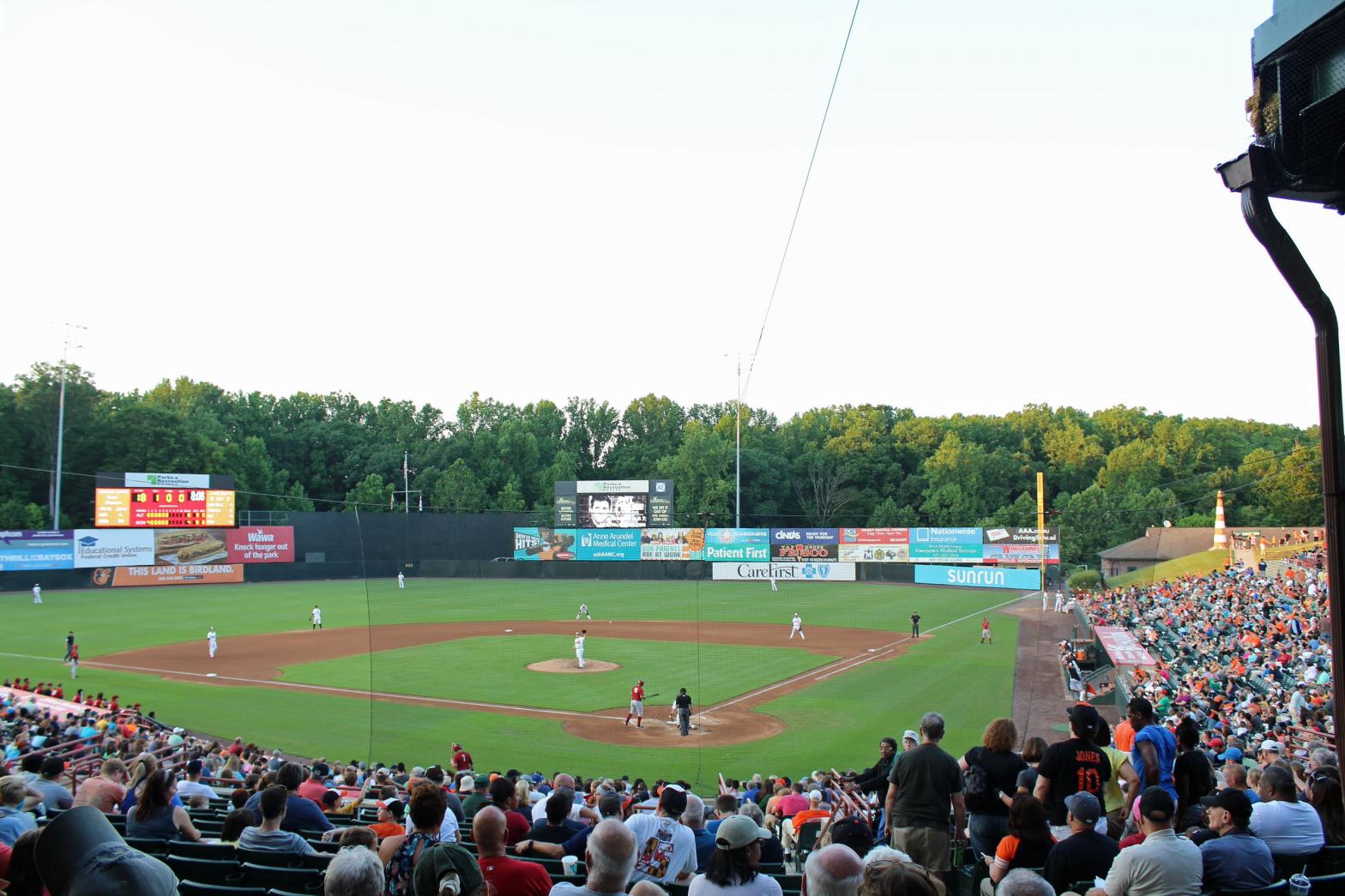
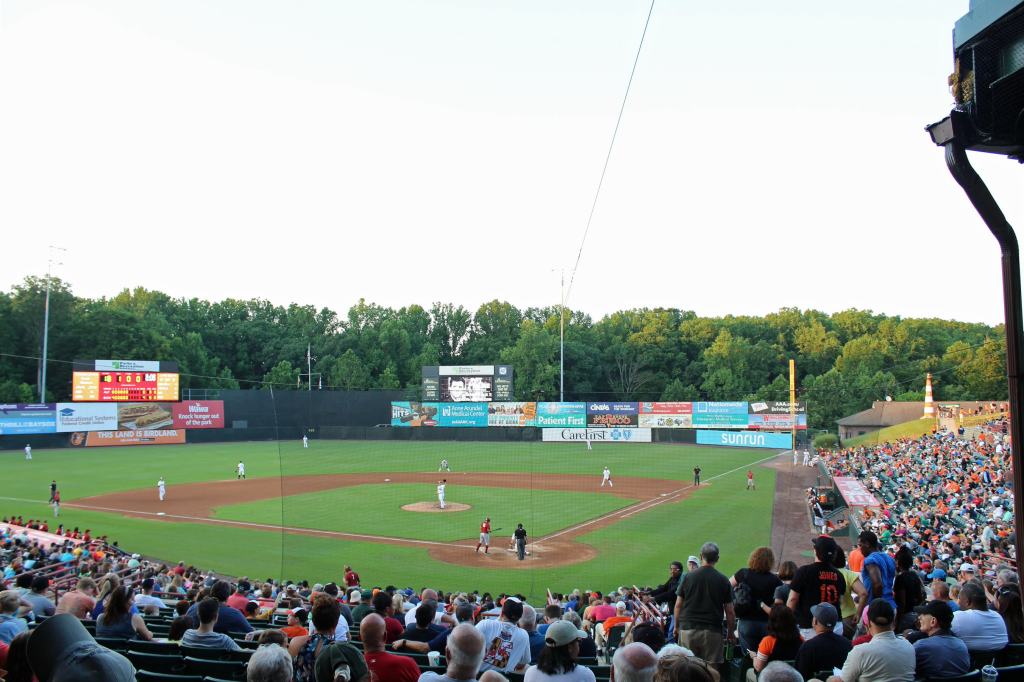
Prince George’s County Stadium from behind home plate in the lower level. (Photo credit: Jeff Hayes)
  • First visit: unknown, sometime in the summer of 2013
  • Most recent visit: Friday, September 13 2019

A job change in early 2013 brought me to the Washington DC area, and I was pleasantly surprised to see the wide array of baseball options that came with the move. The Washington Nationals were only a 20 minute train ride from home, and the Baltimore Orioles were just a 45 minute car ride north along Interstate 95. There was also a number of minor league options an hour away or less, with the Bowie Baysox (the AA affiliate of the Baltimore Orioles) the closest, a mere 20 minute car ride away (as long as traffic on the Beltway cooperated). Since the ballpark was easily accessible, I adopted the Baysox as my team in the new surroundings.

Though I do not recall the exact date of my first visit to Prince George’s County Stadium (the home of the Bowie Baysox) in 2013, I do remember a few surprises from the trip. The first surprise was parking. Because Prince George’s County Stadium holds about 10,000 fans, the parking lot for the stadium is huge. Not knowing where to park, I flagged down an attendant and asked him the cost of parking. With a wry smile, he told me that parking was free. If memory serves, this was first stadium I’d visited that had that perk. Arriving about an hour before game time, I was able to park right next to the ballpark. Not having a ticket for the game, I feared that I would not be able to secure a good seat so close to game time.

The view from seats we typically occupied for Baysox games at Prince George’s County Stadium (Photo credit: Jeff Hayes)

Asking for the best available seat, I received my second surprise. Despite arriving close to game time, there were great seats available. Not knowing anything about the layout of the park, I took seats near the on deck circle just to the left of home plate, about six rows from the field. At the time, I could not believe my luck, but after going to a few games, I realized that, despite easy access off Route 50 in Bowie, attendance was generally fairly light. That was both shocking and disappointing to me, but I eventually learned that Bowie did not aggressively advertise, which could a contributing factor to the low attendance. Quickly I learned to enjoy the relatively sparse attendance, as it virtually guaranteed me great seats any time I went to the ballpark.

Passing through an old styled turnstile, my ticket was torn by a friendly and knowledgeable ticket taker, leading me into the lower concourse. A quick walking tour of the stadium followed. Like most minor league ballpark from the 1990s, the ballpark was a cookie cutter prefabricated stadium, with seats in the lower levels, and aluminum bench seating in the upper sections. There were also enclosed club suites at the top of the stadium, stretching from the home dugout behind home plate to the visitor’s dugout (we never saw a game from these seats). Down the right field line is a kid-friendly play area, complete with a carousel, as well as other attractions. A lighthouse located near the play area blared following a Baysox home run.

Prince George’s County Stadium at sunset on a warm summer evening.

Like most minor league parks, Prince George’s County Stadium featured a grass playing field, as well as series of wooden advertising signs perched above and just behind the outfield wall. In left centerfield there was a scoreboard, which seemed out of date and a bit worse for wear. At this time, there was no video board, which I found odd, as most AA stadium have at least a small but functional videoboard. Finishing my tour of the ballpark, I stopped for a baseball dinner before heading to my seat. Standard concession stands were available on the lower concourse, as well as specialty food and drink carts along the lower concourse. On this night, only the right field concession stand was operating, but the small crowd meant a short wait time. Walking back on the concourse toward my seat I discovered a table that offered scorecards and rosters for both the Baysox and the visiting team. Being an old-timer, I keep score at games, and I found these offerings very useful.

The scoreboard at Prince George’s County Stadium. A video board was added in right centerfield to supplement the aging scoreboard. (Photo credit: Jeff Hayes)

My first visit to Prince George’s County Stadium was an evening contest, which led to my third surprise. The lightning for the playing field seemed woefully underpowered, leaving portions of the outfield (especially centerfield) fairly dark. My brother and I would joke later that outfielders, rather than losing balls in the lights, would lose ball in the dark. Overall, Prince George’s County Stadium seemed like an average minor league park, with signs of aging that indicate that the park was older than its 20 years. Despite its shortcomings, I would grow accustomed to the “charm” the ballpark offered, and much like the old Shea Stadium in New York, it became like an old friend.

Lineup card exchange at home plate just before game time. Note the lack of fans in the seats minutes before the start of the game. This image also shows the kids play area at the top of the picture, as well as Louie, the Baysox mascot in front of the Baysox dugout. (Photo credit: Jeff Hayes)

Sparse crowds like the one on that night gave me access to the action like I’d never seen. In fact, I was so close to the action that I couldn’t speak badly about the batter in the visitor’s on deck circle; he might hear me! My proximity to the field also allowed to see and hear the game in a way that isn’t possible in an MLB park. In general, minor league baseball is more about evaluating talent and less about strategy. It is not unusual to see players (especially pitchers) leave ballgames seemingly without a logical reason; we would later learn that once a manager had seen what he needed from a player, that player could be removed from the game. Pitching changes during innings are scarce, as teams are interested in seeing what players do under pressure, rather than making moves designed to win games.

As a result, minor league games tend to move along more quickly that their MLB counterparts. In between most innings, the Baysox offered games and contests in foul territory (typically in front of the dugouts), plucking fans out of the stands to participate in the contests. Despite the obvious attempt to make the games there more family friendly, there were a strange lack of kids in the park. Perhaps with myriad options for entertainment in the DC area, and MLB baseball as little as 20 minutes away, families were opting for choices other than Baysox baseball. My recall of the first game itself is fuzzy at best, but it did remember that exiting Prince George’s County Stadium was made simple, as cones and attendants made sure that the traffic flow was smooth. In about 20 minutes time, I went from the parking lot to my home with little difficulty. Even with the shortcomings offered by the home of the Baysox, I knew that I would frequent this place often, as it appeared to be a fine way to spend a summer evening.

A close up view of the centerfield fence at Prince George’s County Stadium. Once darkness falls, this area would become a problem for outfielders trying to track down fly balls.

Over the years, my brother and I would frequent Prince George’s County Stadium often, particularly on weekends when the AA affiliates of the New York Mets (the Binghamton Mets/Rumble Ponies) and New York Yankees (the Trenton Thunder) were in town. All told, I probably saw about 100 games at the ballpark between 2013-2019, usually near the on deck circle. Going as often as I did, I befriended many of the staff members, with whom I would swap baseball tales, talking about players we liked or ballparks we visited. My brother and I would be mistaken for scouts more often than you might expect, as I kept score, my brother took pictures, and we chatted almost non stop about the game. The only things (other than my job, which required shift work) that would keep me away when I could manage to go were rain and heat. DC and environs generally experience hot, humid summers, and this would occasionally keep me home. Thunderstorms were a nearly daily occurrence in the summer, and it seemed we had to endure rain delays more than any other place I had been.

Even with these distractions, we attended games at the park whenever possible, as prices were reasonable, great seats were almost always available, and fireworks occurred most summer nights (when weather permitted). Still, I was sad to see so few fans at the park. Occasionally, Orioles players would complete their injury rehabilitation at Prince George’s County Stadium, but attendance on these days/nights were surprisingly light. Perhaps my greatest memory of the ballpark was when the Baysox allowed fans to play catch on the field following a Sunday matinee. My brother and I brought our gloves and eagerly took the field when instructed. We were both surprised how good the turf in the field looked and felt, and we spent about 30 minutes on the field before being shooed away by management so that they could close the stadium for the day. That was only the second time I’d stepped foot on a professional baseball field, and despite being 52 years old, I was as excited as some of the kids playing catch with their parents.

My brother posing in front of the centerfield wall at Prince George’s County Stadium.

During my time at Prince George’s County Stadium, I became an ardent fan of minor league baseball. In addition to the more intimate experience offered by the smaller ballparks, I found myself becoming invested in the younger players as they passed through Bowie. Many players I saw in Bowie would eventually make an appearance with the Orioles, or other MLB teams, and I felt a certain satisfaction in knowing I saw these players on the way up. My experiences at Prince George’s County Stadium rekindled what was flagging relationship with baseball, and because of that, now I prefer minor league games over MLB games. Thanks Bowie!

Seattle/Vancouver, Saturday September 29th, 2007

Ferry crossing the Puget Sound, Seattle WA.

1. Seattle

Unlike the clear skies Friday night, Saturday morning dawned with milky sunshine fading behind thickening clouds. The lowering clouds threatened rain later in the day, so we knew we had to get out as soon as possible to see as much of Seattle as we could before the rains came. Though we had a rental car at our disposal, experience has taught us that if we wanted to get a true sense of our surroundings, a walk was our best approach.

After breakfast at the hotel (very close to the Space Needle), we walked toward downtown Seattle. The seasonably cool conditions made walking pleasant, even as the sun continued to fade over us. On the way out, we turned to admire the Space Needle. Towering above its surroundings, the iconic structure looked every bit the majestic symbol of the Pacific Northwest. We made plans to visit the Needle more closely after returning from our sojourn.

Our view of the Space Needle from the hotel. The needle was beginning to blend into the cloudiness lowering and thickening behind it. (Photo credit: Jeff Hayes)

On our way, we headed down Broad Street on our way to Alaskan Avenue and the shore of the Elliot Bay. The view was somewhat reminiscent of that scene in the opening sequence of War Games, with ferries and freighters criss crossing the lower end of the Puget Sound. The clouds prevented us from glimpsing even a fleeting view of Mount Rainier, some 40 miles south southeast of us. Even during late September, Mount Rainier is snow capped, making it perhaps the most prominent feature on the skyline. However, today just wasn’t our day, and considering clouds and rain were in the forecast for the remainder of our stay, it seemed we were destined not to see it at all.

As we ambled along Alaskan Avenue, we came upon a landmark most others might dismiss. The Edgewater Hotel, as its name implies, sits on the edge of Elliot Bay. Besides a great view of the Sound, the hotel ‘s location allows guests to fish from their rooms. Hotel guests in the past include the Beatles, Neil Young and Led Zeppelin in their early trips to the Pacific Northwest. Being diehard Zeppelin fans, we felt obligated to catch a glimpse of the famous hotel, where stories of the band’s excesses may have gotten their start.

The Edgewater Hotel, Seattle WA. (Photo credit: Jeff Hayes)

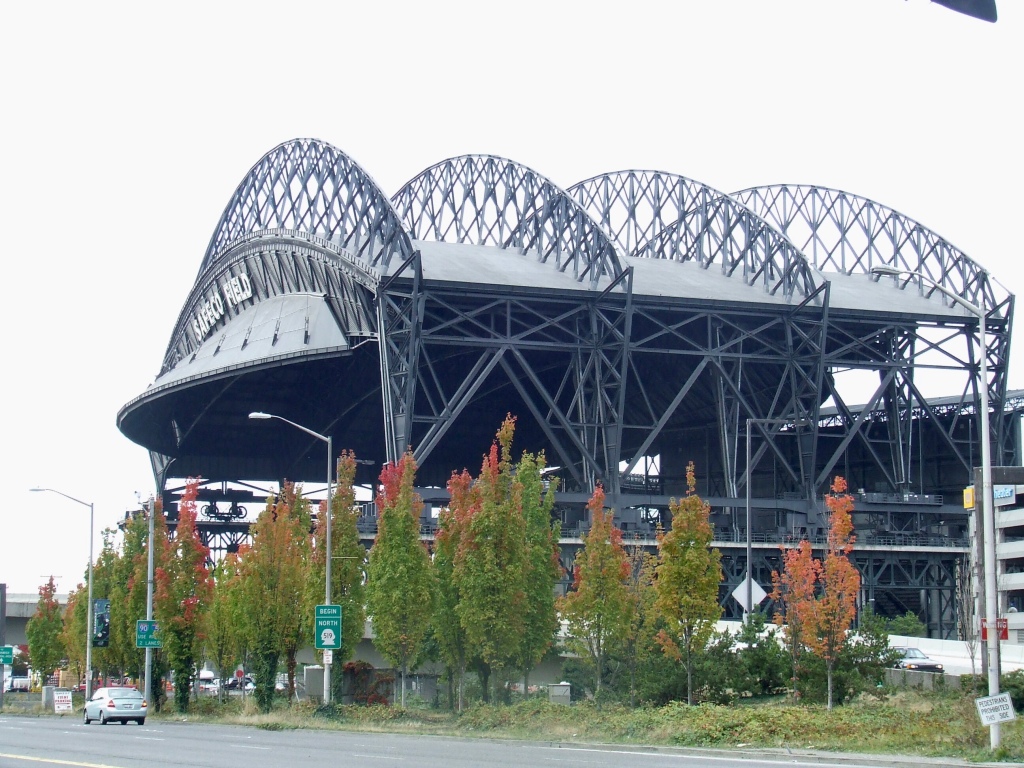
Further on up the road, we approached downtown Seattle. The view from Alaskan Avenue afforded us a different perspective of the city, which was dominated by domiciles and businesses alike. Given that the weather conditions were sliding downhill as the morning progressed, there were few people in the area. Sooner than I expected, we had reached the sports complex. We were free to walk around and between the stadiums, which provided us some insight as to how the Safeco Field dome operated. When the dome is open, it slides back over a train track, rather than retracting (like other MLB domed stadiums). This might have been a view we would have missed had we not found our way to the park on our journey.

The roof at Safeco Field slides out of the way when not covering the playing field. (Photo credit: Jeff Hayes)

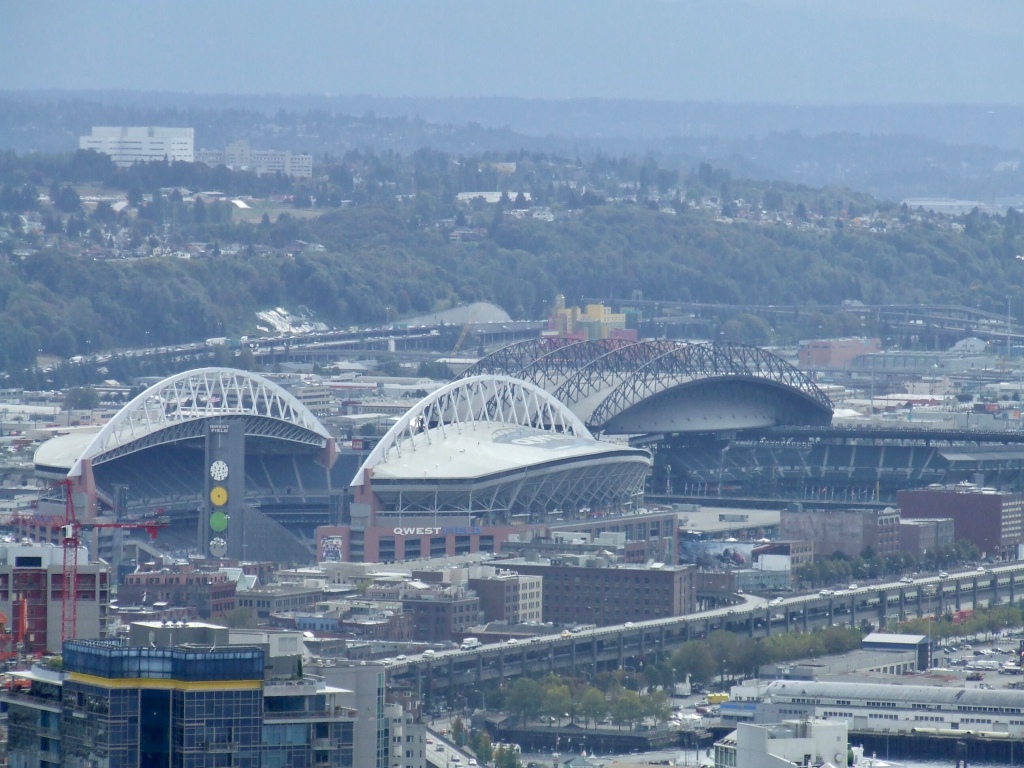
Feeling as though we were losing in the struggle to beat the rain back to the hotel, we did not linger long around the stadiums. Both parks were physically impressive, and unfortunately our timing did not allow us to take in a Seahawks game at Qwest Field. As much fun as the fan experience was at Safeco Field, I imagine the experience is amplified during a tight Seahawk or Sounders contest at Qwest.

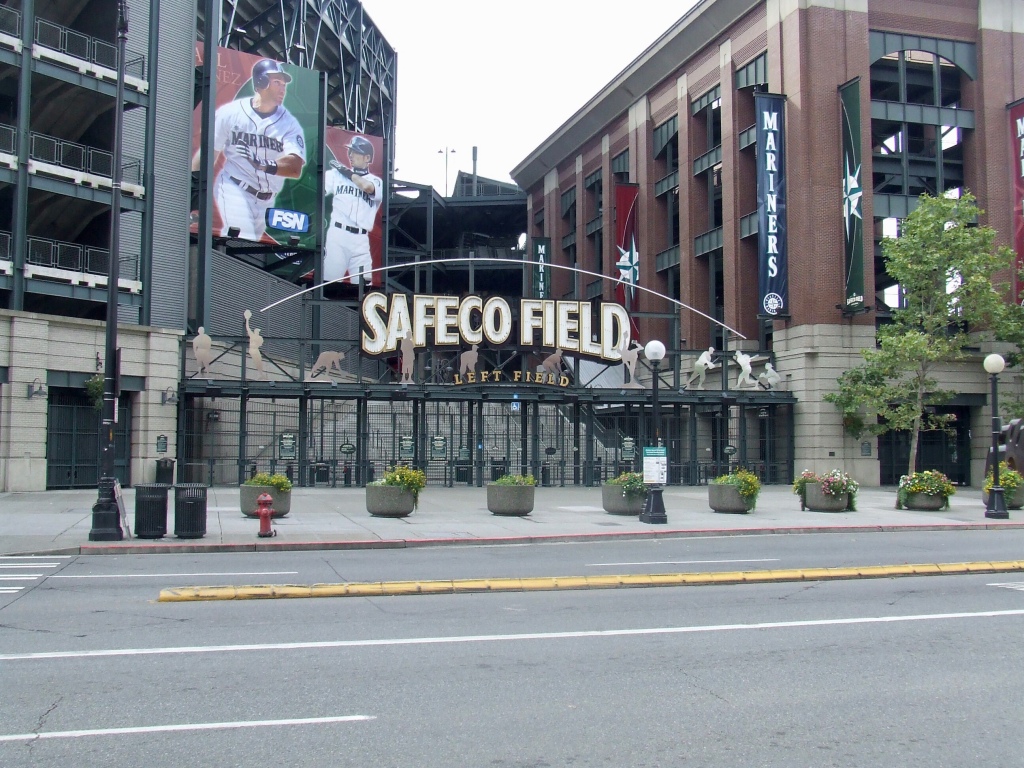
Just outside Safeco Field, Seattle WA. (Photo credit: Jeff Hayes)

Picking up the pace along Western Avenue toward the hotel, we came across a place of which I had never heard: The Museum of Pop Culture. We entered the museum, not knowing what we might encounter. What we found was an eclectic assortment of art and science, arranged in a way I wouldn’t have ever considered.

My favorite was the Science Fiction and Fantasy Hall of Fame. Being huge science fiction fans, we were enthralled with the displays and exhibits. There was a focus on science fiction of the 1950s, which many fans of the genre (including me) consider its golden age. It was a collector’s heaven, and we spent a considerable amount of time among the treasures.

Cover of the map of the Science Fiction Museum and Hall of Fame. (Photo credit: Jeff Hayes)

Next we explored the Sound Lab. The lab had a small recording studio, as well as various musical instruments. Being a sometimes guitarist, I jumped at the chance to play in a recording studio, and banged out the best version of Foxey Lady I could. Fortunately, the lab was nearly deserted, and the only person tortured by my rendition of the Jimi Hendrix classic was my poor brother.

Remembering that the weather was closing in on us, we left before thoroughly examining everything this strange and wonderful place. Should I find myself in the vicinity, I need to see what else the Hall has to offer.

While this sign sends a serious message, I couldn’t help but see cartoonish humor in it. (Photo credit: Jeff Hayes)

On the way back to the hotel, we found a very unusual street sign. Just when I thought I’d seen every type of sign the US has to offer, we came upon the sign above. Clearly, the sign is trying to convey the deadly implications of not giving a wide berth to pedestrians. However, in my mind, the sign crossed a line that separates public service announcements from maudlin satire.

Following our return to the hotel, we ate a quick lunch, then headed toward the Space Needle. Perhaps the most famous landmark in Seattle, it is known worldwide and very popular with tourists. After a short wait, we were whisked up two the observation deck, some 520 feet above ground, in less than a minute.

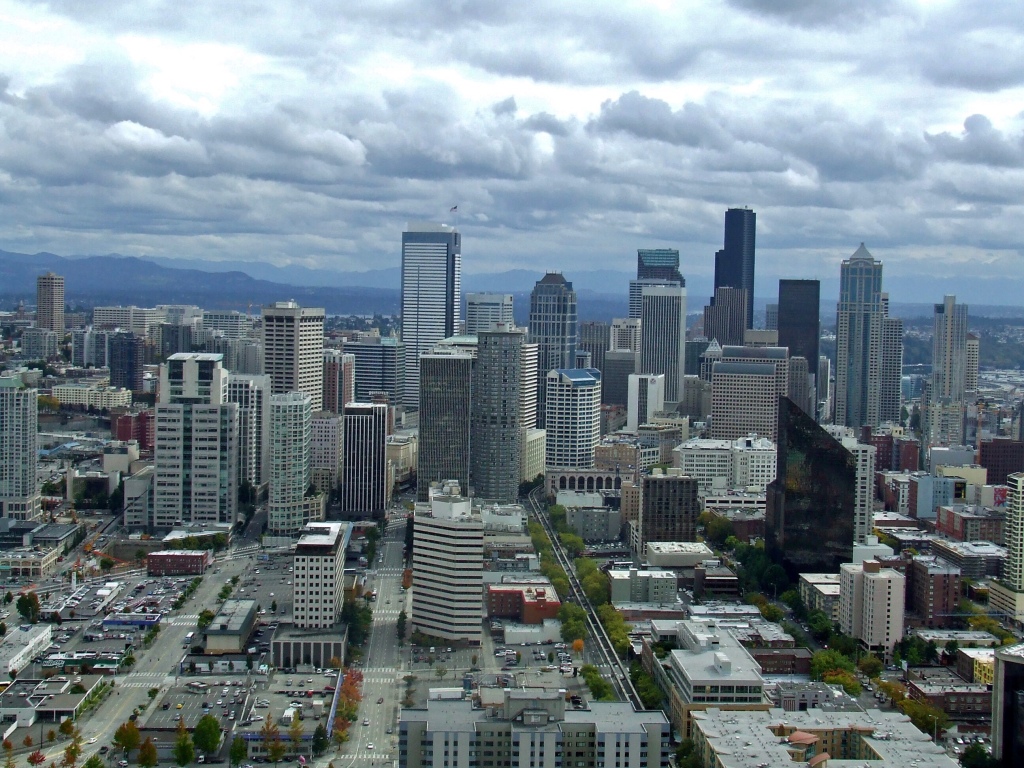
The view of the Seattle skyline from the observation deck of the Space Needle. (Photo credit: Jeff Hayes)

The observation deck of the Space Needle offers a 360 degree view of its surroundings, spanning the Puget Sound, downtown Seattle, Mount Baker and Mount Rainier. The lowering cloud deck limited our field of view, and we were unable to see Mount Baker or Mount Rainier. Despite these disappointments, the view of Seattle was well worth the visit.

Though we didn’t not indulge, there were restaurants on the observation deck (which have since closed). Because our visibility was limited, we ended up spending less time there than expected. Hopefully, someday I’ll will return to get a better view of the region from Space Needle.

Safeco Field and Qwest Field from the Space Needle. (Photo credit: Jeff Hayes)

2. Vancouver, British Columbia, Canada

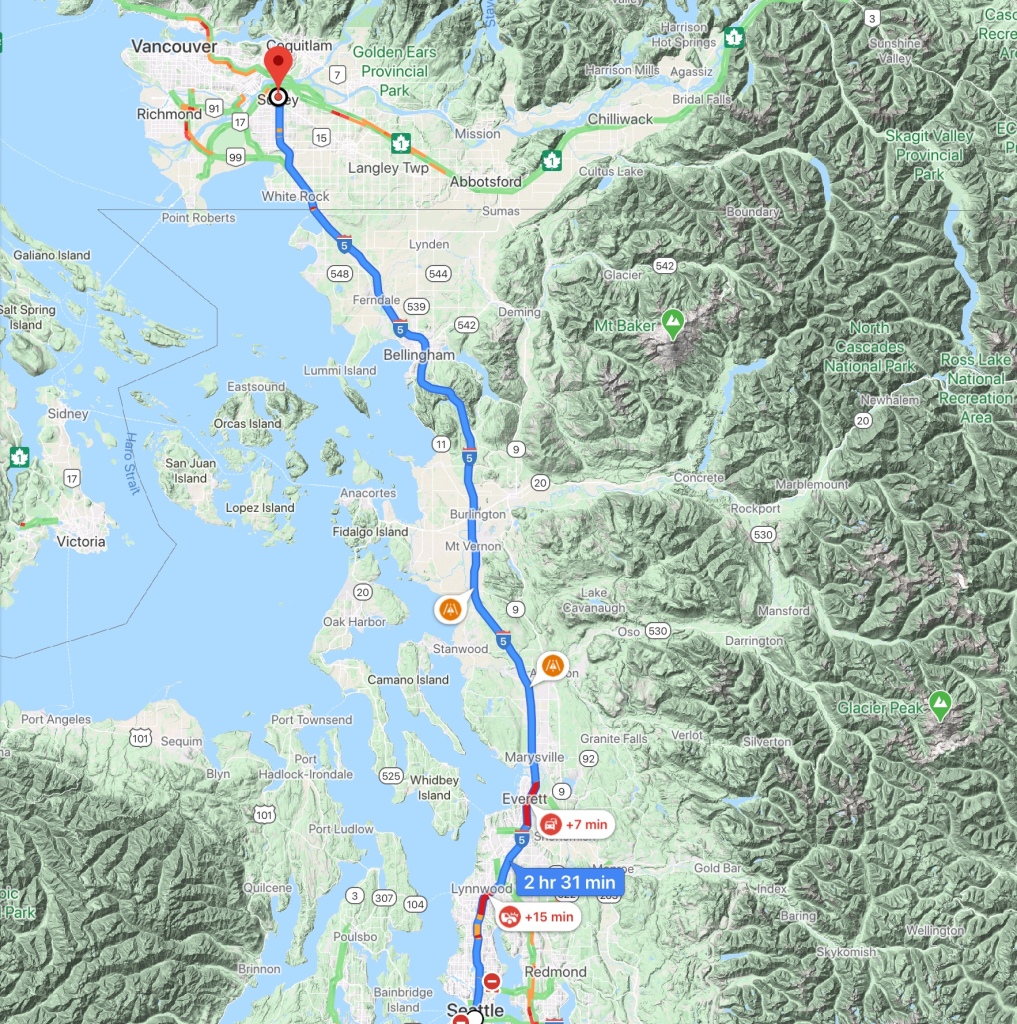
Google map depiction of the route from Seattle, WA to Vancouver, BC.

Rather than attend the Saturday night game at Safeco Field, we decided instead to take advantage of a sports themed opportunity across the border. The BC Lions, a member of the Canadian Football League (CFL), were home that evening, hosting the Calgary Stampeders at BC Place, a multipurpose stadium in Vancouver, British Columbia (BC). Never having seen a CFL game in person, I couldn’t resist the chance to see one.

Vancouver is about two and one-half hours from Seattle, and we set out after relaxing briefly at the hotel. A steady rain developed shortly after we departed Seattle, and the rain slowed our travel time a bit as we drove north on Interstate 5 toward the international border. The crossing was quiet, allowing us to proceed quickly (during a time when crossing the border did not require a passport). By the time we reached Vancouver, the rain turned heavy, making the city seem dark and washed out.

BC Place on a dark and wet Saturday night. (Photo credit: Jeff Hayes)

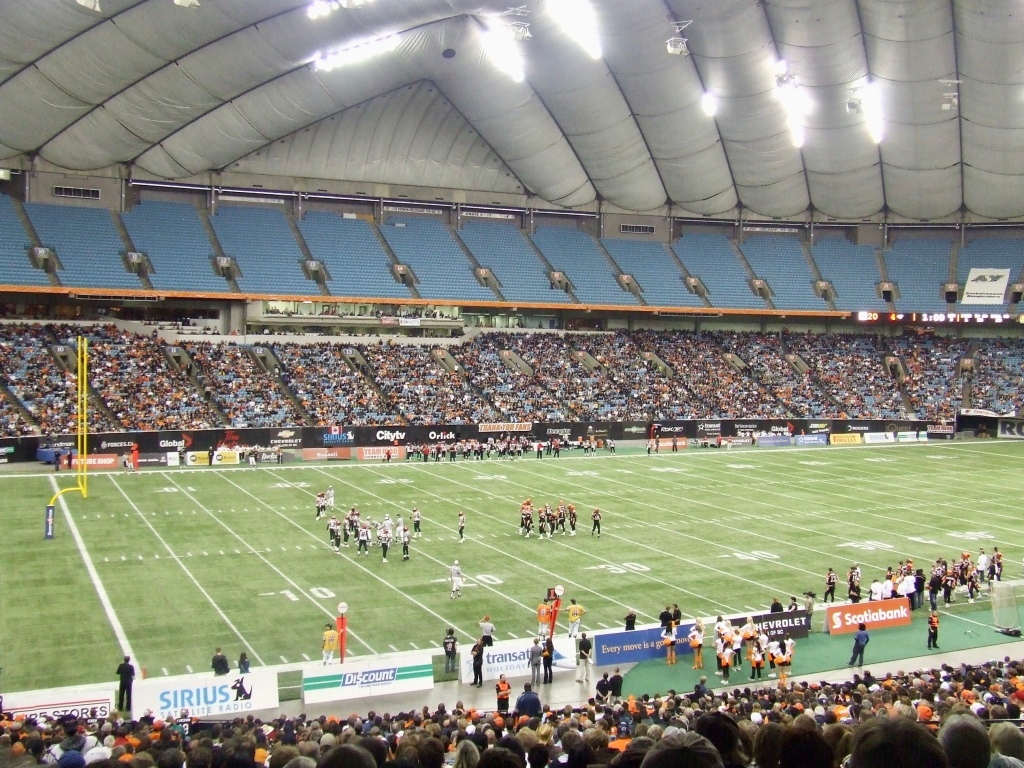
Parking onsite was plentiful, which fortuitous since pouring rain greeted as as we made our way into the venue. Located in a region that receives copious amounts of rain throughout the year, BC Place is a domed stadium; had it not been, the cool and wet conditions would have resulted in a miserable fan experience. Even with cover from the elements, the crowd size was surprisingly small.

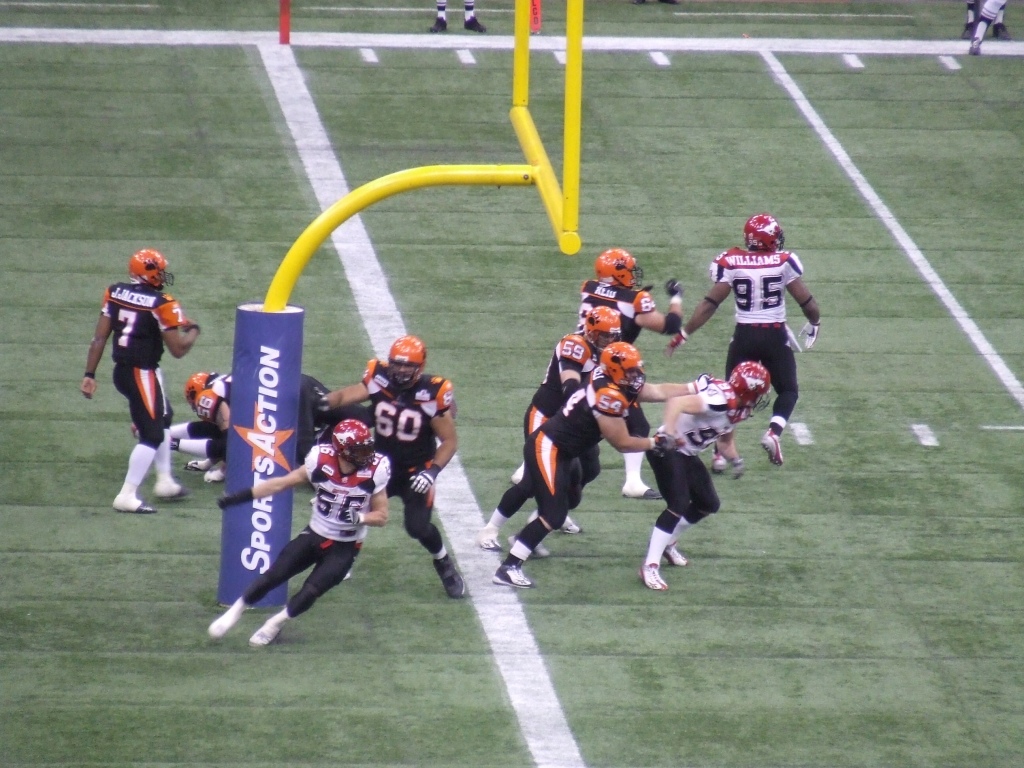
At first glance, the game appeared as though it would be a one-sided affair. The Lions were generally considered the best team in the CFL’s West Division, while the Stampeders were near the bottom of that bracket. However, not knowing much about the teams, I didn’t know exactly what to expect. There are a number of differences from the NFL, including a longer and wider field, three downs to reach a first down, and a rogue, a single point play involving a kick into the end zone.

The view from our seats. (Photo credit: Jeff Hayes)

With only three downs to reach a first down, and multiple players in motion prior to the snap, the CFL game showcases a wide open offense, with more passing than rushing. The high powered Lions offense scored early and often, amassing a sizable lead before halftime. The fast paced game was highly enjoyable, even if I did not fully understand all of the rule differences in the CFL.

While I did not see any ex-NFLers on the team rosters, there were a number of former American college players on each team. Even though I am not sure my company appreciated the different take on the American game, I fully appreciated the differences. The Lions continued the offensive assault, while the defense held the Stampeders in check. With the game fully in hand, we expected to see fans leaving, but the Lions fans remained during what had become a blowout.

Action near the goal line at BC Place. Note that the uprights are flush with the goal line, meaning that the post is in play. (Photo credit: Jeff Hayes)

The fast paced game ended in less than three hours, significantly quicker than a typical NFL game. The game was not as close as the final score of the game would indicate, as the Stampeders were never really in the game. Taking one more look at the field before exiting, I thoroughly enjoyed the Canadian version of the game. Because none of the franchises are nowhere close to where I leave, I’m not sure if/when I’ll see another CFL game.

The final score of the one-sided affair in Vancouver.

Portland, ME July 20th 2015

Portland Head Light, reputedly the most photographed lighthouse in the world. (Photo credit: Jeff Hayes)

The middle stop our three day baseball tour of New England was Portland, Maine. Having lived in southern Maine for 12 and 1/2 years, it was almost like coming home. We arrived in the Portland area the night before, and the morning brought sunshine and temperatures in the 70s, much cooler than the 90s we endured the previous day in southern New Hampshire. Game time in Portland was slated for 705 pm, giving us plenty of time to visit some my favorite places in the area.

1. Freeport/Yarmouth/Portland

Following breakfast at our hotel, a Holiday Inn Express in Freeport, Maine (though I didn’t feel any smarter for the experience), we headed for my favorite place in Maine: Fort Williams Park in Cape Elizabeth. A former Army base, active during World War I and World War II, the main attraction of the 90 acre park is the Portland Head Light. Completed in 1791 (built on the order of George Washington), the lighthouse is said to be the most photographed lighthouse in the world. Considering that I personally have taken hundreds of pictures of the lighthouse, that claim is easy for me to believe.

Viewing Portland Head Light from the north. The complex (which includes a small museum and a gift shop) sits near the edge of a granite cliff. (Photo credit: Jeff Hayes)

This sunny and pleasantly warm late morning drew a large number of sightseers, focusing mainly on the lighthouse. However, being very familiar with the park, I headed straight for the rocks behind the lighthouse. Facing Casco Bay, the rocks provide a great view of the bay, as well as the Halfway Rock Lighthouse.

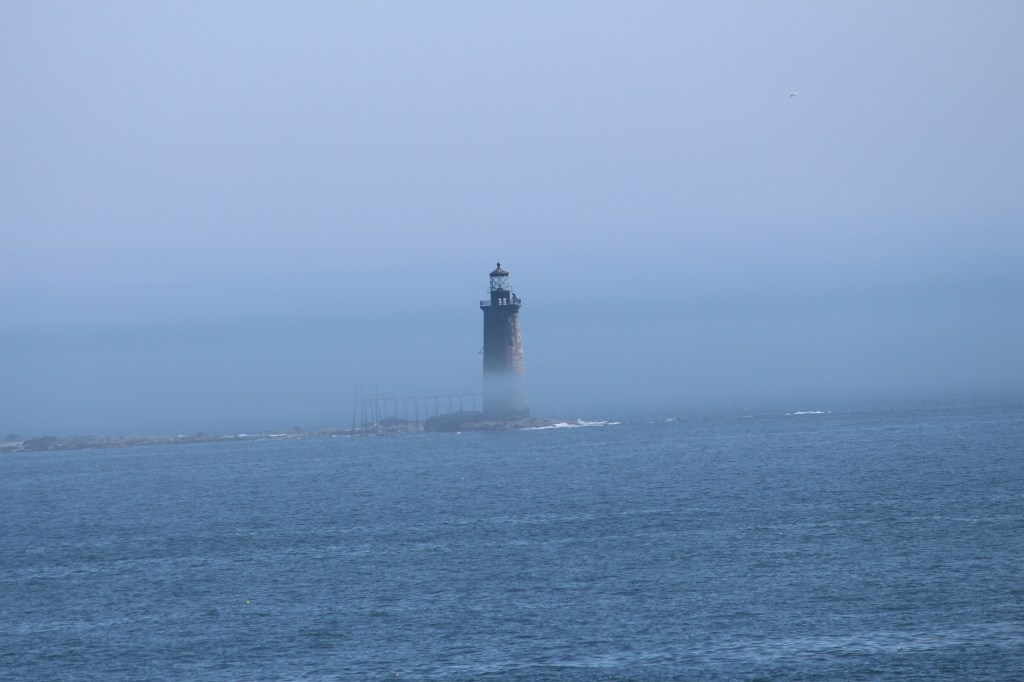
On this morning, as is common during the warm months, the seemingly ever present fog partially shrouded the lighthouse. Located about halfway between Portland and the Atlantic Ocean, Halfway Rock stands approximately where the sea fogs recesses during the day, only to surge inland after the warmest part of the day.

Halfway Rock Lighthouse, partially obscured by sea fog. (Photo credit: Jeff Hayes)

The rocks adjacent to Portland Head Light present a very real hazard to boat traffic moving through Casco Bay, as strong storms and dense fog can obscure the coastline. Perhaps the most famous example of the hazards of the rocky Maine coast was the wreck of the Annie C Maguire on Christmas Eve 1886. The wreck has been immortalized on the rocks of the lighthouse.

The commemoration of the wreck of the Annie C Maguire on the rocks near the Portland Head Light. (Photo credit: Jeff Hayes)

The morning flew by visiting the park, and after more than two hours there, we headed north into nearby Falmouth for lunch at Richetta’s Brick Oven Ristorante. Featuring possibly the best brick oven pizza in Maine, we dined alfresco under brilliant sunshine with a cooling sea breeze.

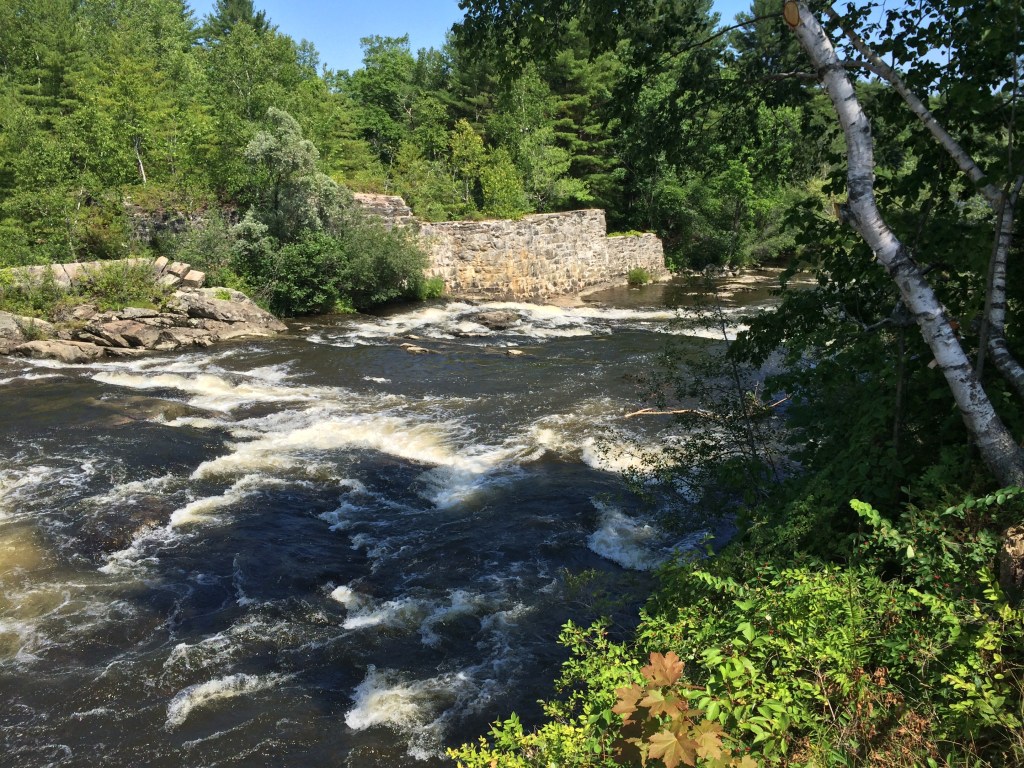
Following lunch, we visited my second favorite place in Maine: Royal River Park in Yarmouth. Living less than a mile from the park for more than 12 years, it is a beautiful place to visit all times of year, but especially so during the summer. The Royal River was once the home of paper mills, and the river provided power for the mills. Though the mills are long gone, the foundations are still visible.

Paper mill foundations are still evident on the banks of the Royal River Park in Yarmouth, ME. (Photo credit: Jeff Hayes)

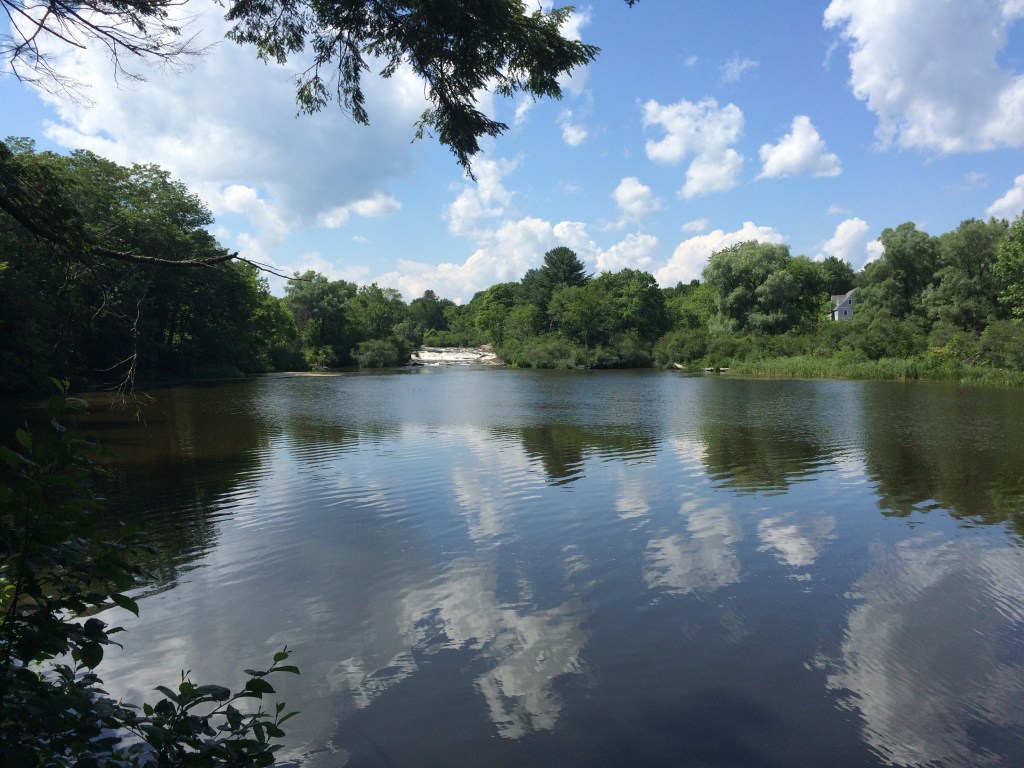
Rapids over the northern stretch of the river transition to still waters closer to Route 1. A tire swing along the banks of the river here provides recreation for the locals, and dogs often dive into the river to swim in the calm waters. Though it is tucked away west of Interstate 295, it is worth a visit if you are in the area, as it affords a view into the natural beauty Maine has to offer.

Calmer waters on the Royal River. (Photo credit: Jeff Hayes)

2. Hadlock Field, Portland Maine

After a brief repair to the hotel in Freeport to relax before the game, we made the 20 minute drive to Hadlock Field, the home of the Portland Sea Dogs. Located on the edge of downtown Portland, Maine, parking was at a premium near the stadium. Fortunately, we were able to park just down the street from the park in a commercial lot; during the warm months, available parking is often more than a mile away. Access to the field from these lots is provided via shuttle bus.

Outside Hadlock Field in Portland, ME. (Photo credit: Jeff Hayes)

My first game at Hadlock Field was back in 1998, when the Sea Dogs were the Double A affiliate of the Florida Marlins. A lot had changed over the years, as the Sea Dogs became the Double A affiliate of the Boston Red Sox. Shortly after the change, the stadium underwent a fairly substantial remodeling, adding changes that reminded fans of Fenway Park.

A replica of the Green Monster at Hadlock Field in Portland, ME. (Photo credit: Jeff Hayes)

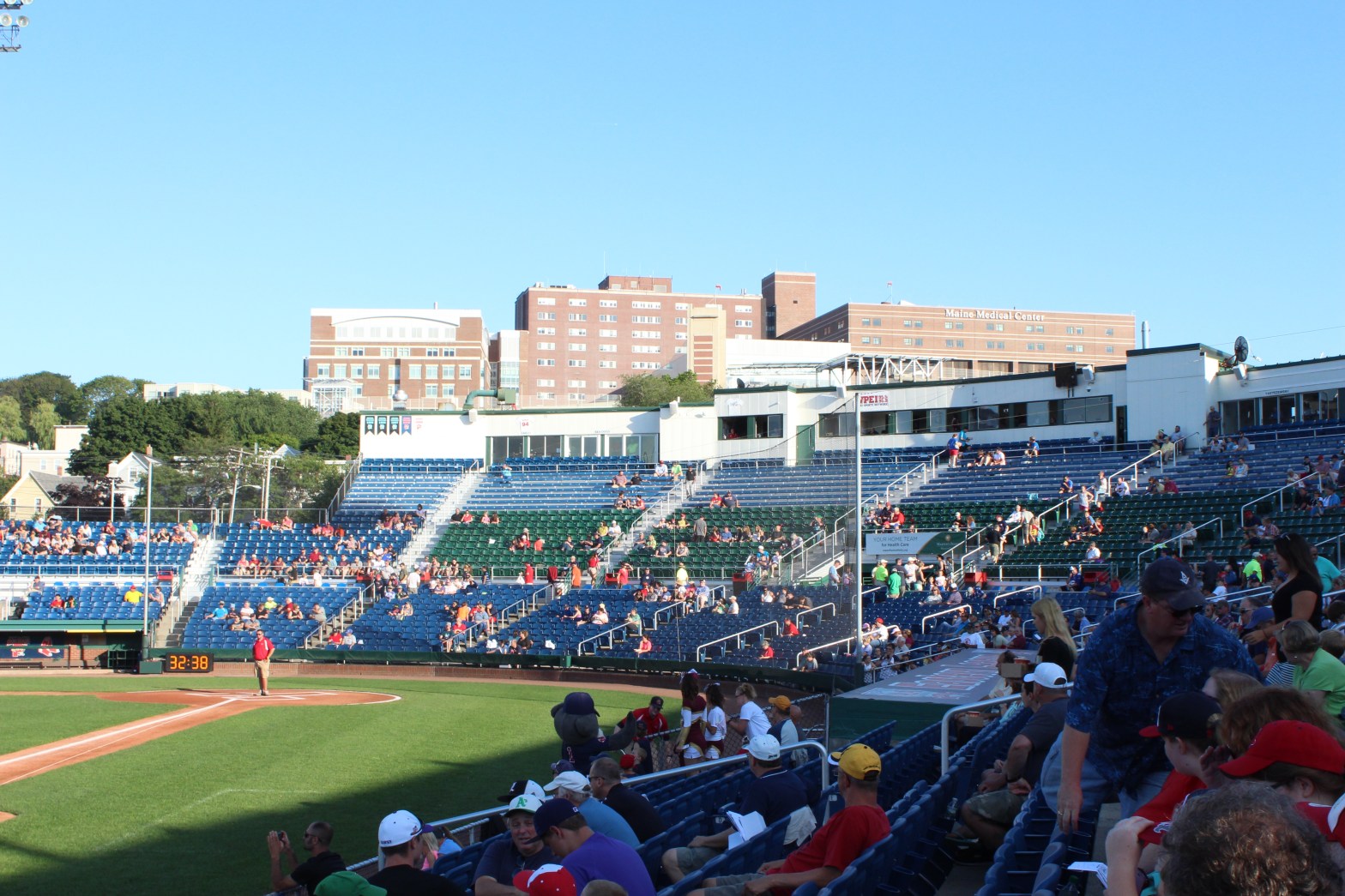
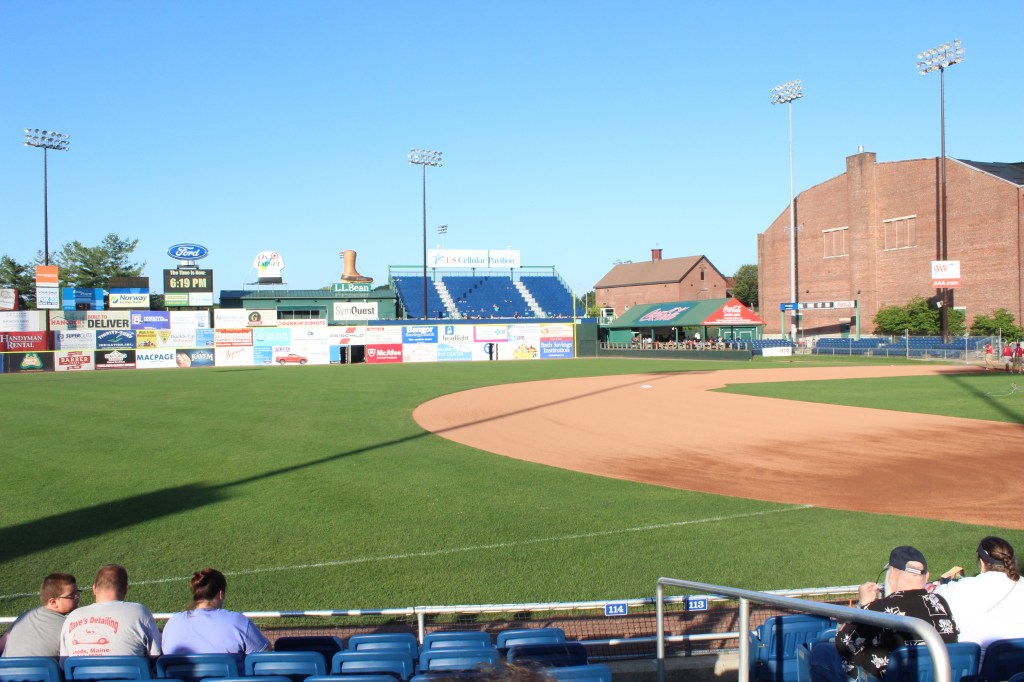
Nestled between the hills of downtown Portland and Interstate 295 to its west, the view of Portland is one of the best attractions of the park. Since my last visit to the field, there were a number of additions, including a huge boot from LL Bean on the right field wall. While the additions may have enhanced the popularity of the park, I found that the changes may have detracted from the charm of the place.

The view from our seats. Note the buildings of downtown Portland in the distance. (Photo credit: Jeff Hayes)

Hadlock Field is a modular stadium, with aluminum grandstands along the left field line. During the summer months, a Sea Dogs ticket can be a hot commodity, and seats for this game were at a premium. Because of the demand for tickets, our seats were located more than halfway down the left field line, offering a less than ideal view of home plate.

The view of right field at Hadlock Field, including the bleachers and the LL Bean boot over the home team bullpen. (Photo credit: Jeff Hayes)

The design of Hadlock Field brings the left field foul line very close to the seats, allowing for a more intimate feel for the fans. However, bringing the fans that close to the line had an unintended side effect. Line drives off the bats of left hand hitters reach the seats at high velocity, making some of the seats flat out DANGEROUS. We saw two fans hit by these line drives injured during this game, both seriously enough to require medical attention.

Being a veteran of the ballpark, I knew enough to stay alert for line drives. Still, I was surprised upon my return that this portion of the seating area was not protected by a net. Hopefully, this has been addressed, as fans not paying close attention are putting themselves at a risk they may not truly appreciate.

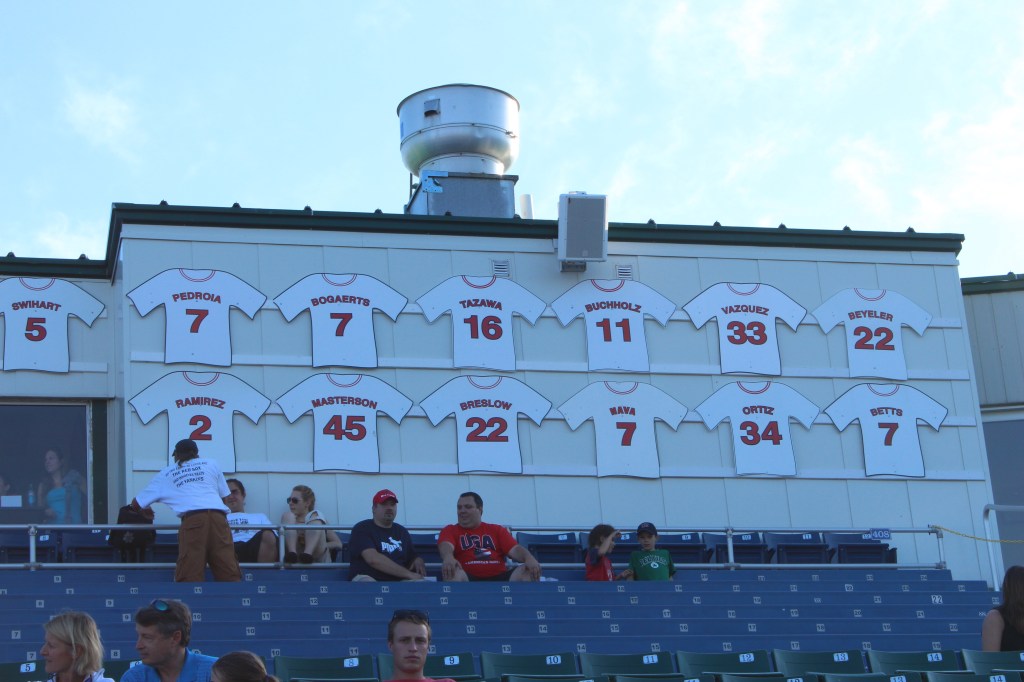
The Hadlock Field display of retired Sea Dogs numbers, replete with familiar names to Red Sox fans. (Photo credit: Jeff Hayes)

Concessions were located in the concourse below the seating area. The concessions were mostly standard fare, but included fish sandwiches, as well as a Maine favorite, fried dough covered with powered sugar. We briefly toured the ballpark before settling into our seats shortly before game time.

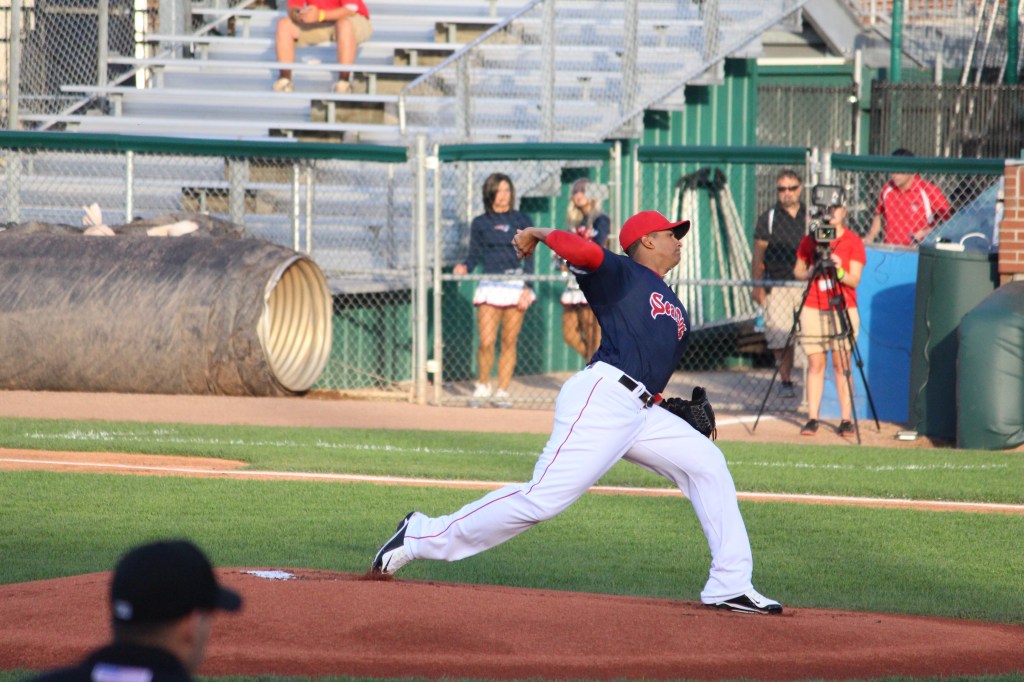
The Sea Dogs hosted the Trenton Thunder, the Double A affiliate of the New York Yankees. The Sea Dogs opened the scoring in the bottom of the first, scoring four runs on four hits and a walk off Thunder starter Brady Lail. Meanwhile, Sea Dogs starter William Cuevas kept the Thunder scoreless through five innings.

Sea Dogs starter William Cuevas delivers a pitch at Hadlock Field. (Photo credit: Jeff Hayes)

The four runs the Sea Dogs scored in the first inning capped for the scoring for the home team. Meanwhile, the Thunder clawed their way back into game, scoring a run in the sixth and two more in the seventh. The Thunder threatened in the ninth, as RF Danny Oh delivered a run scoring double, making the score 4-3. However, the game ended as Oh was thrown out trying to steal third base.

Thunder RF Danny Oh scoring in the sixth inning. (Photo credit: Jeff Hayes)

Though there were many changes to Hadlock Field since my last visit, it still ranks as one of my favorite minor league ballparks, the problem with foul balls in left field not withstanding. The great feel of the park, augmented by the vistas of downtown Portland, make this field worth the visit, if you can score tickets during the summer months.