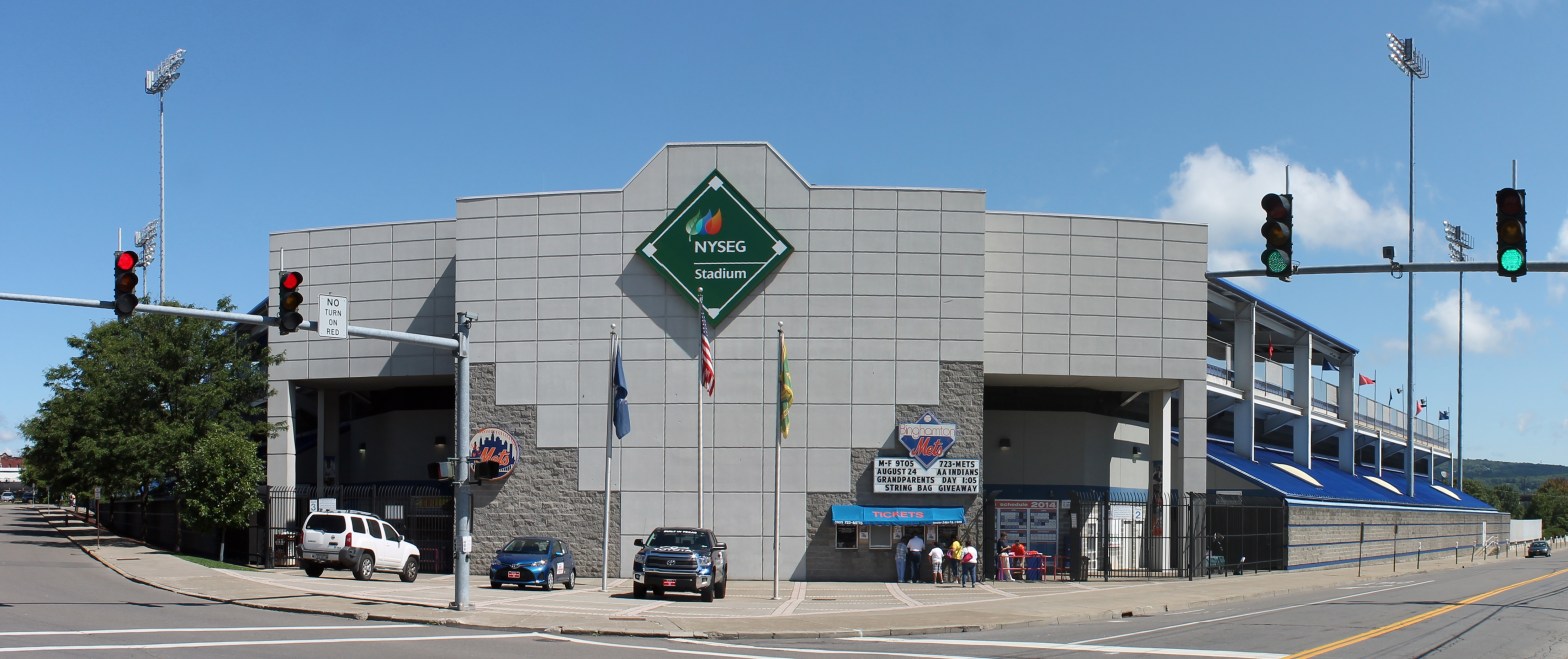
NYSEG Stadium, home of the Mets AA affiliate in Binghamton NY. (Photo credit: Jeff Hayes)
Since the list of MLB stadiums to visit was becoming increasingly small, we decided to branch out and start visiting minor league (MiLB) stadiums. At first, the radius for visiting MiLB ballparks was limited to places within a three or four hour drive from central NJ. Being avid Mets fans, we set our sights on Binghamton, NY, the home of the Mets AA affiliate. Our first visit occurred in August of 2014, and rather than make it a day trip, we planned our weekend trip to cover the last two games of a three game set with the Akron RubberDucks. The drive from central NJ to NYSEG Stadium, the home of the Mets AA affiliate, was fairly easy, taking about three hours following a mostly interstate route.
After checking into our hotel, we headed out toward the ballpark ahead of a 705 pm game start. NYSEG Stadium is located in the southern part of Binghamton, nestled between the Chenango River to the west and the Susquehanna River to the southeast, about a mile from our hotel. Arriving an hour before game time, we parked in a private lot across from the stadium on Henry Street. With the businesses apparently closed for the day, parking here was plentiful, and the price was certainly right (a mere $5). This was not our only option, but it appeared first as we approached the stadium. There is a Binghamton team-run lot behind the right field wall of NYSEG Stadium (which is closed on Fireworks Nights). Parking there is also $5, and the walk to the ballpark is only a little bit longer than the private lots just across the street.
NYSEG Stadium from just behind the dugout on the first base side. (Photo credit: Jeff Hayes)
Located in a mainly residential area, there is not much in the way of activities or places to eat in the immediate vicinity of the park. As a consequence, our normal tour of the outside of a new ballpark was fairly short, and we entered the stadium through the home plate entrance.
NYSEG Stadium is a modular ballpark whose appearance is similar to the majority of the modular MiLB parks we have seen in our travels. There are two decks of seats extending from just beyond the third base to just beyond the first base dugout. The lower deck stretches from the main concourse down to the first seven to 10 rows, and the second deck rises up from the concourse to near the apex of the park. Atop the seating area are luxury boxes and the press level, which are covered by a small roof (as is the top of the second seating deck behind home plate). In total, NYSEG Stadium hold about 6,000 fans, which is on par with other AA stadiums.
The scoreboard/video board at NYSEG Stadium in Binghamton NY (Photo credit: Jeff Hayes)
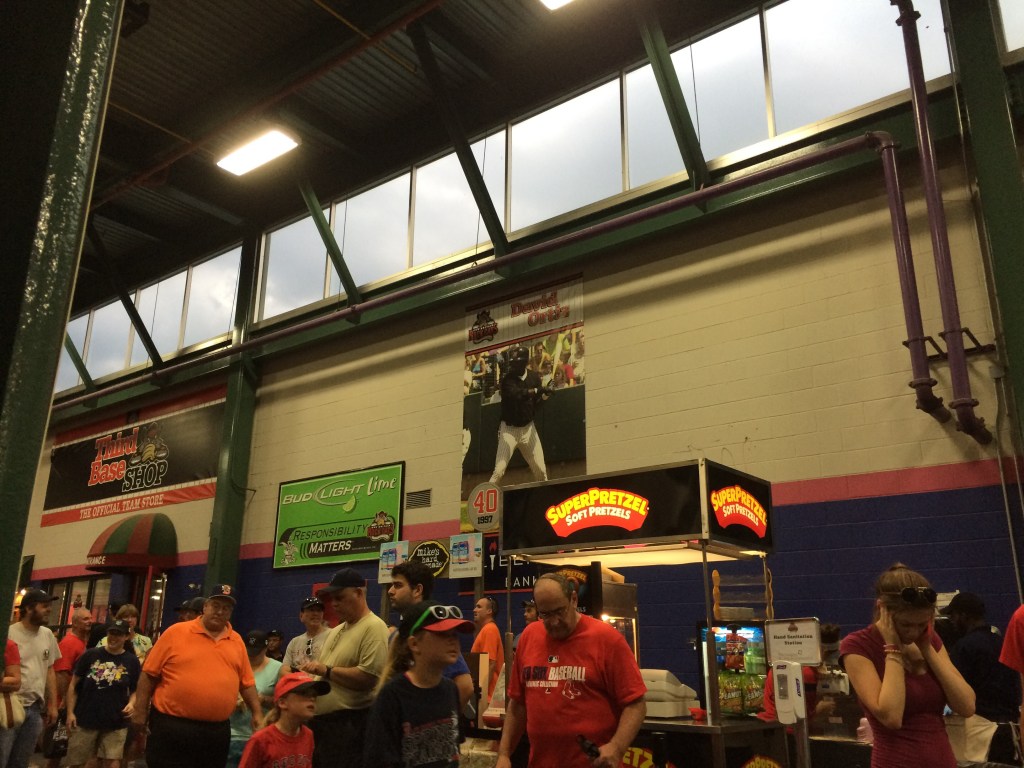
Like most MiLB parks, wooden advertising signs span the outfield walls, and there is a relatively small video board/scoreboard in right center field. The layout of the video board/scoreboard is vaguely reminiscent of the old Shea Stadium scoreboard, and perhaps the likeness was intentional, as the Mets are the parent club. Overall, the ballpark itself seemed unassuming. It was surprising to learn that NYSEG Stadium opened in 1992, because in some respects the ballpark seems older. This was especially true of the park’s inner concourse, where the bulk of the concessions are located. After walking around the inside of the park (which is typical for a first visit), we obtained a baseball dinner and headed toward our seats.
Akron had been playing well for much of the season, and seemed to be a lock for a playoff spot. However, leading up the series with the Mets, they had been playing uneven baseball, allowing Binghamton to move to within striking distance of the RubberDucks for a playoff spot. Starting for the Mets that night was 26 year old righthander Greg Peavey. Leading the Binghamton staff in wins and ERA during the 2014 campaign, Peavy pitched well enough to keeping the suddenly struggling RubberDucks down for much of the game, with the Mets beating Akron 5-2.
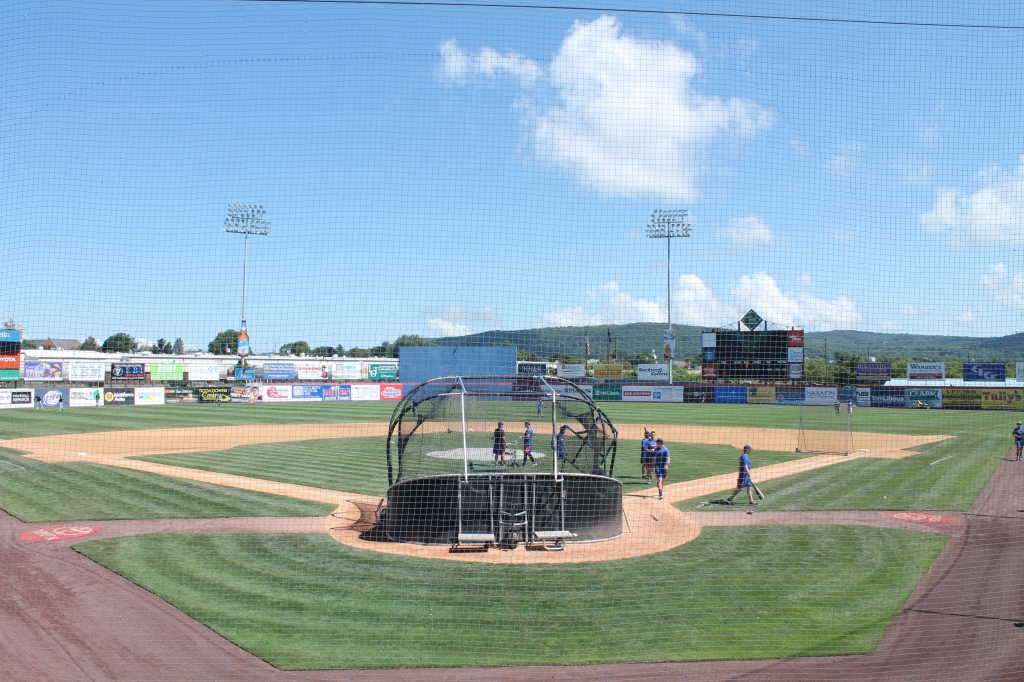
The view of NYSEG Stadium from behind home plate at the end of batting practice. (Photo credit: Jeff Hayes)
In the Mets’ portion of the sixth inning, we saw something I had never seen before in person. With runners on first and second, a line drive off the bat of Mets second baseman Dilson Herrera was nabbed in right field on a great catch by the RubberDucks’ Jordan Smith. The Mets runners were on the move, thinking the ball would find a gap in the outfield, and both runners were unable to return to their bases after the catch, resulting in the first triple play I’d seen live. Later in the game, when RubberDucks manager Dave Wallace made a pitching change, we were close enough to see the desperation in eyes, as though he was witnessing the season slipping away. When the Mets pitching coach Glenn Abbott questioned a procedural error by Wallace, we could hear him say ” What the f**k? Just let it go!”
Following the game, we headed across the street to retrieve the car and head back to the hotel for the night. My first impression of the stadium was that is was fairly non descript, and that the crowd was tiny (far less than the announced attendance of 3,800) for a team that was fighting for a playoff spot. We would get a much better look at NYSEG Stadium during the Sunday matinee, the third and last contest of the three game set. Not surprisingly, the streets in Binghamton were nearly deserted as we made out way back for a good night’s sleep after a long day of travel.
My scorecard from the game.
We had some time on our hands on a bright sunny Sunday morning after breakfast at the hotel, so we walked along the the Chenango River (which runs alongside the Holiday Inn in Binghamton). We then walked the streets of Binghamton on the warm and dry morning. It was obvious that the city had seen better times, and Binghamton was beginning to show its age. With that said, I was impressed by some of the architecture of the city. There were hints of Art Deco, Neoclassic design and even some Modernism in the churches and government buildings, some of which were built during the Great Depression. Never having been here before, I had no idea what to expect, but I was impressed with the part of the city we explored before heading out to the ballpark.
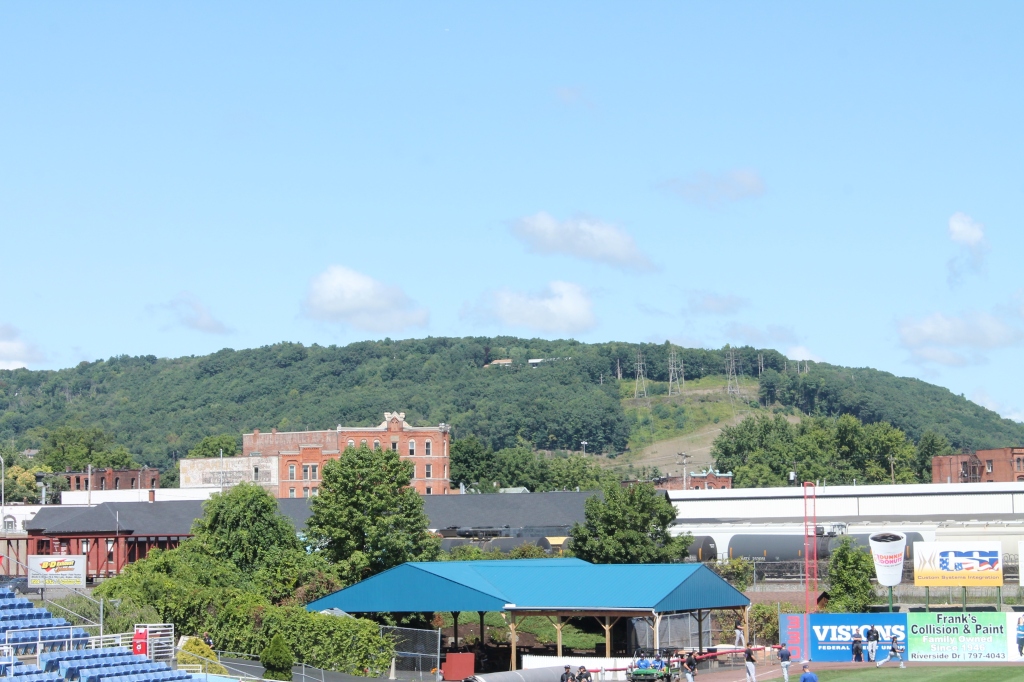
The view over the left field fence ay NYSEG Stadium. showing the tree covered hills, as well as the train track just behind the outfield wall. (Photo credit: Jeff Hayes)
Once again we arrived about an hour before game time, and we were able to secure parking across the street in a private lot. We wandered around the park a bit more than the night before, and discovered that there were some souvenir stands near the right field foul line, as well as some games for the kids. As is often the case for a Sunday afternoon game following a Saturday night game, the crowd promised to be fairly thin, despite wall to wall sunshine, pleasant temperatures and low humidity. Our seats for this game were very good, near the front row of the lower section just behind first base. From that vantage point, we were treated to a good view of the beautiful hills to the northwest of the ballpark, and the train track lying just behind the left field fence.
Steven Matz pitched well for the Binghamton Mets, a game Binghamton would win 5-0. (Photo credit: Jeff Hayes)
Part of the attraction of coming to Binghamton (along with seeing the ballpark) was seeing rising stars in the Mets minor league system up close and personal in their home setting. Fortunately for us, much heralded left handed starter Steven Matz was on the mound for Binghamton, and our seats gave a great look at someone who would be a member of the 2015 National League Champion New York Mets. Matz was impressive in the start, lasting five innings, and allowing no runs on three hits with six strikeouts. Akron struggled against Matz and a trio of relievers, as the Mets took the last game of the series 5-0.
With the win, the Binghamton Mets edged closer to an Eastern League playoff spot. This team loaded with young talent that would at least make an appearance with the parent club in the near future, and would ultimately win the 2014 league championship. As we were leaving for our three hour trip home, I reflected on what we had seen. Because NYSEG Stadium did not have any single outstanding attribute, I felt as though the ballpark took a back seat to the Mets AA team. Having seen the park and the city of Binghamton, I felt as though we had seen all there was to see there, and did not anticipate a return visit.
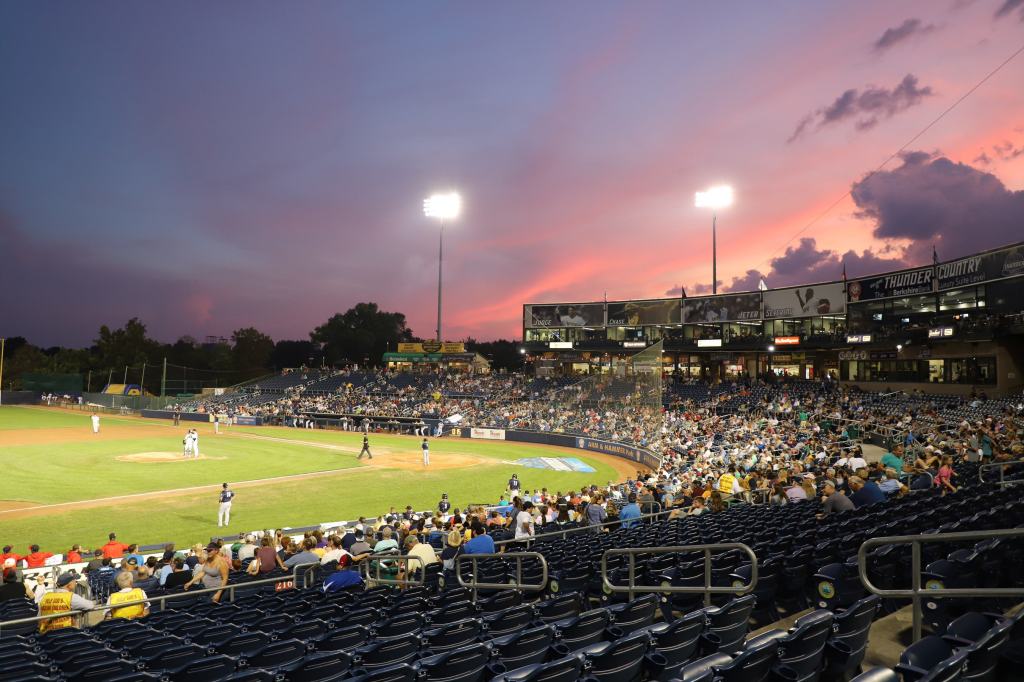
Arm & Hammer Park at sunset: (Photo credit: Jeff Hayes)
First visit: exact date unknown, probably during the 2011 season
Most recent visit: July 25th, 2021
Following a job change that took me from southern Maine (where I saw the Portland Sea Dogs at Hadlock Field) to southern New Jersey in 2010, I found that I had landed in an area that was teeming with baseball. The Philadelphia Phillies were 30 minutes away, and two minor league teams were within 45 minutes or so (the Trenton Thunder, the AA affiliate of the New York Yankees, and the Lakewood Blue Claws, the low A affiliate of the Philadelphia Phillies). Since my brother lives closer to Trenton, I chose to make the Trenton Thunder my new favorite minor league team.
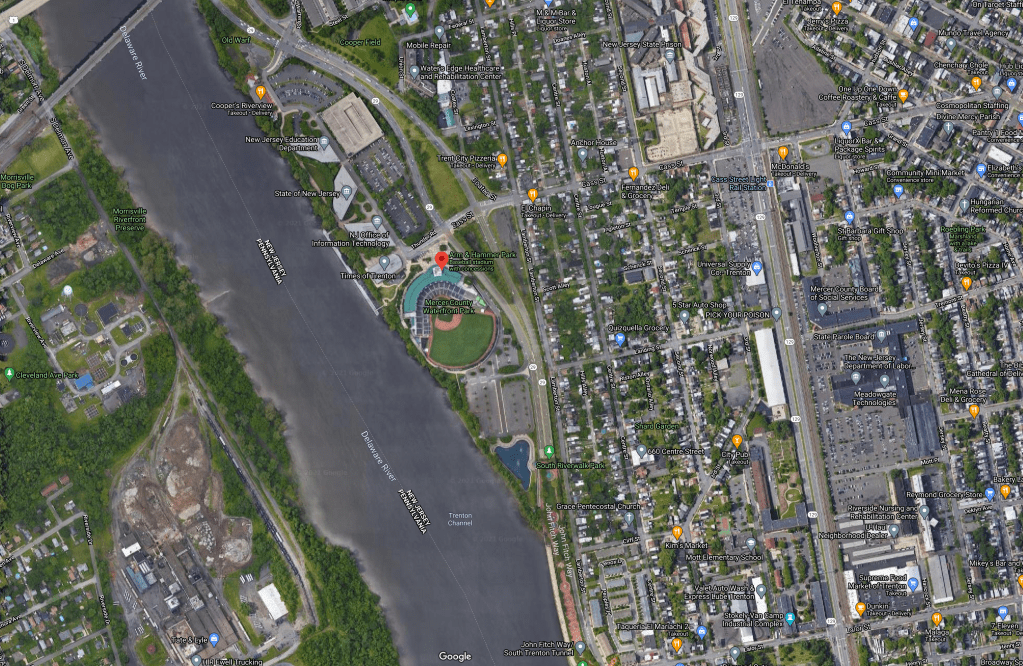
Trenton plays their games at Arm&Hammer Park. Opening behind schedule in 1994 (as cold and snow the previous winter hampered construction efforts), the stadium was part of a larger complex containing office buildings and a night club, known as the Mercer County Waterfront Park. Though the ballpark is technically within Trenton city limits, it is located on the southern edge, away from the influence of downtown. Its location (just off Route 29, on Thunder Road) makes ingress and egress much easier than if the stadium was located downtown.
A view of the Delaware River from Arm&Hammer Park in Trenton. (Photo credit: Jeff Hayes)
Parking at Arm&Hammer Park is fairly straightforward. After entering the complex, the first parking area encountered is a surface lot to the right. Most times, these spaces are unavailable to baseball fans, as they are either occupied by state employees working at the complex, or by fans with mobility issues. Just down the street from the surface lot is a three-tiered parking deck, which most times offers an orderly exit after games. However, we have learned through bitter experience that most people don’t know how to exit a parking deck, and that fact can add a considerable amount of time when trying to leave the complex. Parking is a very reasonable $5.00, and the walk from the deck to the stadium is about one-quarter of a mile or so.
As the name of the complex implies, Arm&Hammer Park lies along the Delaware River, which divides New Jersey from Pennsylvania. Before games, we occasionally walk along a path paralleling the river, a stark contrast to the urban area not too far away, providing a view most people outside of the area would not expect to see in New Jersey. There are three entrances into the ballpark (each of which has a not inconsequential set of concrete stairs to navigate): one adjacent to the river walk on the first base side, behind home plate and behind third base. Arm&Hammer Park has two seating decks that extend from just beyond third base behind home plate to just beyond third base, as well as suites near the top of the stadium, bringing to the capacity of 6,150 (which is typical of a AA ballpark). Bullpens are located along the left field line (visitor) and the right field line (Thunder), and the outfield is nearly ringed by wooden advertising signs located above and just behind the outfield wall.
A Google satellite image of Arm&Hammer Park, nestled between the Delaware River to the left and Route 29 to the right.
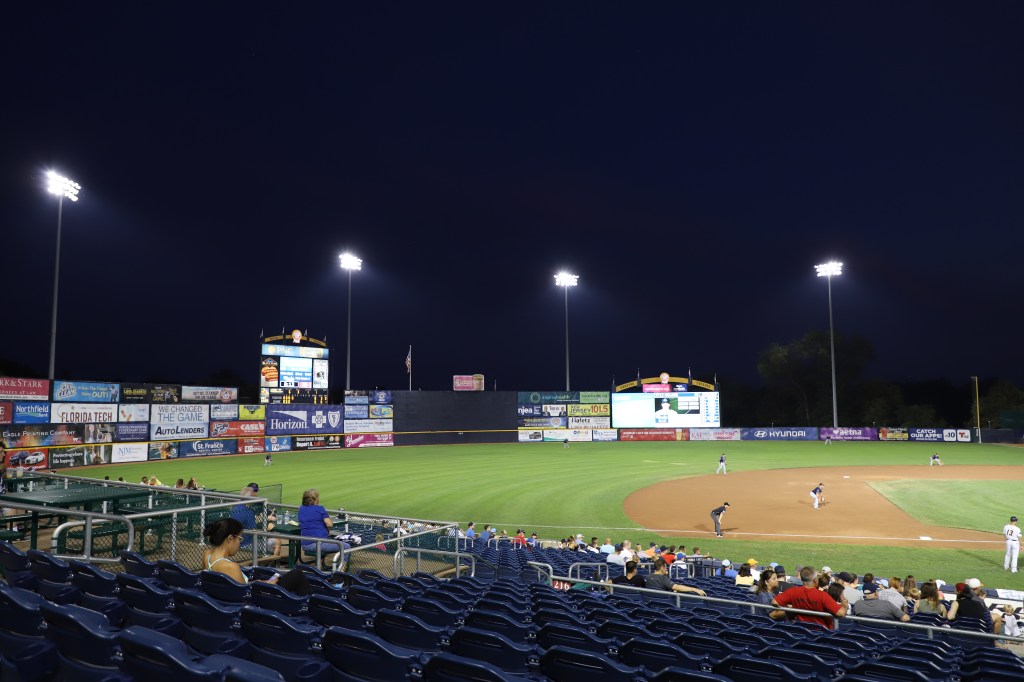
While Arm&Hammer Park is a fairly typical minor league ballpark, it does possess what might be the largest video board in the minors. Located in right centerfield, the size and resolution of the video board is more reminiscent of a Triple A ballpark. Being an affiliate of New York Yankees probably factored into the decision to place such a large video board in the ballpark, and it is the most prominent feature of the stadium. Just to the right of the video board, the outfield wall is low enough to allow home runs to leave the park and head toward the river. Actually, it IS possible to hit a fair ball down the right field line that can land in the Delaware River. Though I am not sure it has been done, it might be possible to hit a home run far enough across the river to have the ball land in the Pennsylvania portion of the river.
Arm&Hammer Park offers the standard fare when it comes to concessions, though there are a couple of places worth noting. My favorite is Chickie’s & Pete’s, located on the main concourse on the first base side. Chickie’s & Pete’s serves crab house food, and I rarely pass up the opportunity to indulge in a cup of crab fires (large French fries covered with Old Bay seasoning). They also offer excellent cheese steaks, brats and hot dogs, which are cooked to order. On the third base side is Boomer’s BBQ, which, as the name implies, offers an array of barbeque meals. Personally, I do not frequent this place as often, but when I do, I usually get the chicken sandwich. Most times, though, I elect to get a baseball lunch or dinner (which generally includes hot dogs) before heading to our seats.
A view of Arm&Hammer Park from the lower deck to the right of home plate. The video board is featured in right centerfield. (Photo credit: Jeff Hayes)
When attending a Thunder game, you definitely want to be in your seats for the bottom of the first inning. During that half of the frame, after each Thunder hitter discards of his bat, the Thunder bat dog retrieves it. Currently, the bat dog is Rookie, but he was preceded by Chase and Derby in the recent past. While Rookie sometimes has difficulty grabbing the bat in his mouth to bring back to the dugout, he is successful most of the time, to the delight of the crowd. After the end of the first inning, Rookie returns to the clubhouse, his task for the day completed. As a side note, when the Thunder played the Bowie Baysox for the Eastern League championship in 2019, Rookie made the trip to Maryland, retrieving bats in the first inning. Probably because he was in a new environment, rather than retrieve the bat after a Thunder player walked, Rookie instead followed the player to first base. Murmurs permeated the air when Rookie did his thing, and the Baysox faithful were enamored with the visitor.
The Trenton bat dog enthusiastically carrying out his duties at Arm&Hammer Park in Trenton, NJ. (Photo credit: Jeff Hayes)
One of the biggest perks of seeing Thunder games is the potential to see MLB players on rehabilitation stints. Being a Yankees affiliate, many past and present Yankees have made appearances at Arm&Hammer Park, and more than 9,000 fans were present when Derek Jeter did his rehab assignment during the Fourth of July weekend in 2011. In 2013, when Alex Rodriguez appeared with the Thunder, Trenton drew in excess of 8,000 fans for each of his two games there. More recently, perennial fan favorite Curtis Granderson made an appearance.
The Philly Fanatic makes an appearance at Arm&Hammer Park. (Photo credit: Jeff Hayes)
In addition to rehab appearances, my brother (who goes to many more Thunder games than me) and I have seen many current Yankees as they came up through the minor league system. Since the Mets AA affiliate Binghamton Rumble Ponies are in the same division of the Eastern League as the Thunder, they come to Arm&Hammer Park a couple of times a year. My brother and I do our best to wrap our plans around these times, and that allows us to see future Mets up close. In the past, we have seen Matt Harvey and Noah Syndergaard on the mound, as well as many position players (like Michael Conforto and Ahmed Rosario) on the field in Trenton. There is something satisfying about seeing future stars in the MLB in such an intimate setting, before they become household names. We were fortunate enough to see Michael Conforto play in Trenton before making the jump to the New York Mets the next day in July 2015.
Curtis Granderson (left) making a rehab appearance at Arm&Hammer Park, and a young and clean cut Noah Syndergaard (right) pitching for the visiting Binghamton Mets. (Photo credit: Jeff Hayes)
Being such a big Mets fan, my best memories of Arm&Hammer Park are tied to visits by the Binghamton Mets/Rumble Ponies. Perhaps the most vivid memory occurred on Friday July 24, 2015. We had just finished a tour of New England minor league ballpark in time to attend all of the four games of the weekend series between the Mets and the Thunder. On that night, Robert Gsellman started for the Mets, who tossed seven and one-third innings of one run ball. The run Gsellman allowed tied the game at 1-1, and eventually the game went into extra innings. Trading scoreless innings, the Mets finally pushed across a run in the top of the 17th inning, defeating the Thunder 2-1.
A total of 13 pitchers were used that night (seven by the Mets and six by the Thunder), and the Thunder sent two position players to the mound (DH Taylor Dugas and 2B Danny Oh) for the 17th inning. Dugas allowed a run in the top of the frame before recording an out, and Oh mopped up, allowing no runs and no hits. The 17 inning game (the longest I have ever seen personally) took four and one-half hours to complete, and we left the ballpark just short of midnight. Fatigue from the road trip, combined with the long game that night, made me grateful we weren’t far from my brother’s home.
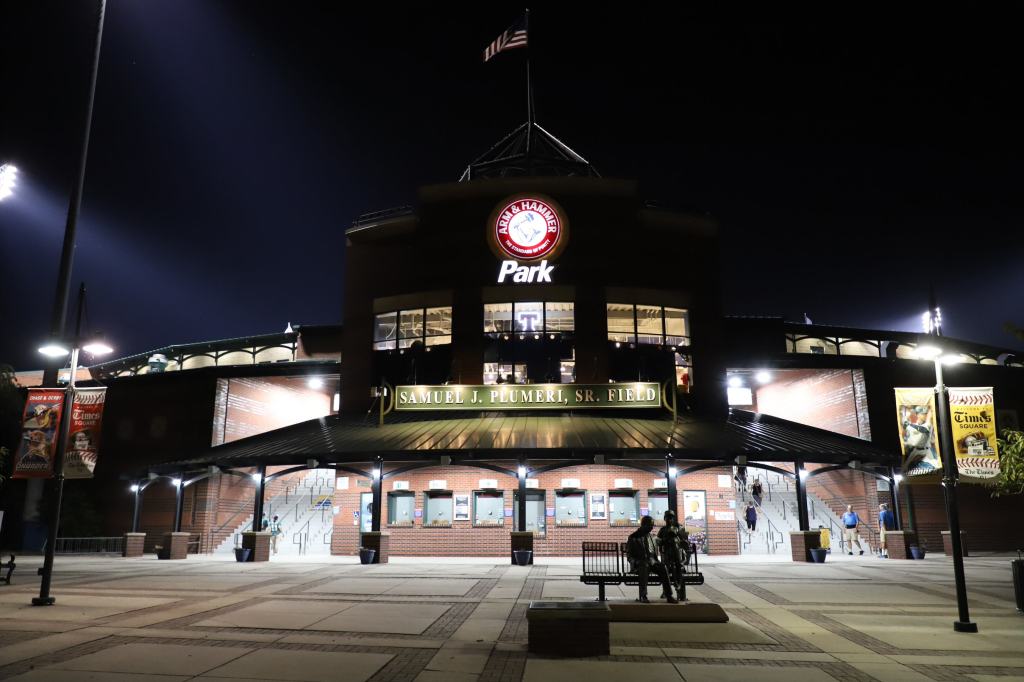
Arm&Hammer Park at night. (Photo credit: Jeff Hayes)
Arm&Hammer Park also hosted the only professional no-hitter I have seen in person, as the Binghamton took on Trenton in an Eastern League playoff game on September 9th, 2017. After the Thunder took a 1-0 lead in the bottom of the first inning, Rumble Ponies catcher Tomas Nido reached on a ground ball to third baseman Dante Bichette Jr in the top of the second. Initially, the play was ruled an infield single. Trenton left hander Dustin Sheffield then shut the Rumble Ponies down in a short but dominant performance.
In the sixth inning, a nearby fan asked me about the hit by Nido, since I was keeping score of the game. When I told him about the hit, he directed my attention to the scoreboard. At some point, the official scorer changed the hit to an error, and suddenly we were witnessing a possible a no-hitter. Once the change was recognized by the crowd, there was an audible response at the prospect of seeing a no-hitter. Sheffield was lifted from the game after four innings (before the hit was changed to an error), and Taylor Widener threw five hitless innings to complete the no hitter. Because the scoring change occurred so late in the game, there was not the anticipation in the crowd that might have been expected to seeing a no-hitter, which was disappointing as a fan.
Though not attached to any particular story about Arm&Hammer Park, I included what I consider to be my brother’s best baseball action shot. Note the ball in the glove , robbing the batter of a home run. (Photo credit: Jeff Hayes)
Though Arm&Hammer Park is a typical AA facility, it has grown on me over the years. Being able to see future Yankees (and occasionally future Mets when Binghamton visit) in such an intimate setting is enjoyable, and my experience in parks just like this has raised my appreciation of the minor league game over the MLB product. However, a disturbing change brought about by the New York Yankees organization has stripped the park of its association with the team. Instead, the Trenton Thunder will play the 2021 season as a founding member of the MLB Draft League. Even with the change, if you find yourself near Trenton NJ on a summer day, check to see if the Thunder are playing. You will be glad you did.
Good night, Arm&Hammer Park! (Photo credit: Jeff Hayes)
Due to the continuing COVID-19 pandemic, it was determined that the Toronto Blue Jays could not play their home games to start the 2021 MLB season. As they did in 2020, the Blue Jays would play their 2021 home games at Sahlen Field in Buffalo NY. Home to their AAA affiliate (the Buffalo Bisons), suddenly Sahlen Field would NOT be available for the Bisons 2021 campaign.
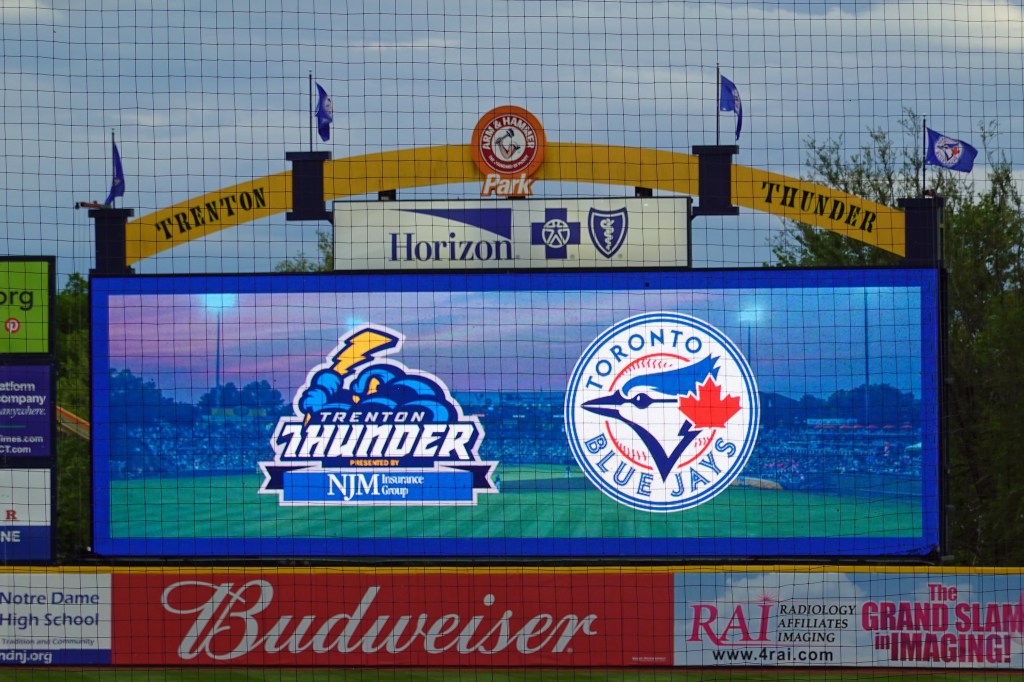
Numerous press reports indicated that there was something of a scramble to find a home for the Bisons. Eventually, MiLB decided on Arm&Hammer Park in Trenton. Having lost their primary tenants to Somerset, the stadium was available for use. To my surprise, the Bisons would play in Trenton as the Thunder (the previous name of the franchise). Since the decision to place the Buffalo team in Trenton occurred quickly (and without much fanfare), it was not clear how many baseball fans knew about the relocation of the Bisons to Arm&Hammer Field.
The scoreboard in Arm&Hammer Field tells the story of the return of the Trenton Thunder. In this incarnation, they are the AAA affiliate of the Toronto Blue Jays. (Photo credit: Jeff Hayes)
My first visit to the see the new Trenton Thunder occurred on Saturday, May 8th 2021, as they hosted the Worcester Red Sox (the AAA affiliate of the Boston Red Sox) on a rainy and cool night. In accordance with New Jersey’s COVID-19 protocol, fans were seated in “pods” (groups of fans surrounded by empty seats), which ensured proper social distancing. To their credit, the fans followed the guidelines set forth by the Thunder and MiLB, and because of the guidelines, attendance was limited to about 25 percent capacity for the game. For the most part, there was not much different about the park, despite the new occupants taking residence with little notice.
It was strange to see the Trenton Thunder in action again at Arm&Hammer Field, this time as a AAA affiliate. Occasional rain during the first part of the contest put a damper on the evening, but since this was my first live baseball game in nearly 20 months, the weather was hardly a concern. Because of the pandemic, there were small but noticeable differences at the ballpark. First and foremost was the absence of Rookie, the Thunder bat dog. Rookie normally retrieves bats for the Thunder half of the first (to the great delight of the home fans), but he did not dispatch his primary duty this evening. Also, there were no bat boys/girls. This meant players had to retrieve bats near home plate, secure foul balls on the field, as well as keep the home plate umpire’s ball supply up to date. There were no on field games for fans between innings, a family favorite at minor league baseball parks.
Our seats for the Saturday night game. Our seats for the Sunday afternoon contest were very similar. (Photo credit: Jeff Hayes)
Though the teams were now AAA, the level of play overall seemed a step down from the AA baseball we had seen at Arm&Hammer Park in the past. Despite scoring eight runs on 14 hits, the Worcester Red Sox struck out 18 times during the Saturday night game. Clearly the obsession with launch angle and hitting home runs has trickled its way down in the minor leagues. In addition, play in the field was not as crisp as it should be at this level, which was even more apparent during the Sunday afternoon game. Granted, the weather was inclement, and could have been a proximate cause for the sloppier than usual fielding, but I was surprised by what appeared to be a lack of concentration on defense. Even with the perceived deficiencies in the play, I was VERY happy to have live baseball back!
For now, it appears as though the team will play its home games in Trenton as the Thunder for the balance of the 2021 season. However, this is contingent on whether the government in Ontario continues to ban the Blue Jays from their home. Should that decision change, it is possible that the Thunder become the Bisons again in Buffalo later in the season. The Ontario provincial government lifted the travel ban for the Blue Jays effective July 30th, 2021, and the Thunder played their final game as the Triple A affiliate of the Blue Jays on Sunday, July 25th. This change allowed the REAL Trenton Thunder (a member of the MLB Draft League) to finish their inaugural season at Arm&Hammer Field in early August.
The revival of the Thunder gives Boomer another chance to entertain the fans at Arm&Hammer Park. (Photo credit: Jeff Hayes)
New Britain Stadium, New Britain, CT. (Photo credit: Jeff Hayes)
The last day of the three-stop New England minor league tour started in Portland, Maine, following a game at Hadlock Field the previous night. Following breakfast in nearby Freeport, we headed for New Britain, Connecticut for an evening ball game at New Britain Stadium, home of the Rock Cats.
The weather had been spectacular across southern Maine the previous day, but as we drove south, we drew closer to a heat wave that was underway from southern New England into the Mid Atlantic states. By the time we reached New Britain in the mid afternoon, we traded temperature in the 70s in Portland for the lower 90s in Connecticut. In addition, the humidity levels were markedly higher, setting the stage for active weather later in afternoon.
Google Maps showing the three and one-half hour drive from Portland, ME to New Britain, CT
Having arrived in New Britain well before game time, we decided to explore the city. However, the hot and humid conditions were hardly conducive to walking, and after a quick tour of Walnut Hill Park, we took shelter in the New Britain Museum of American Art. Established in 1903, it was the first museum in the US dedicated to American art. Much of the art displayed during our visit was impressionist, as well as post-contemporary.
After about an hour in the museum, we headed toward the ballpark. While in the museum, hazy sunshine had given way to clouds, which were yielding scattered showers and thunderstorms. Conditions improved as we reached the park, with more hazy sunshine as we arrived. There was onsite parking for $5 (for better parking) and $3 (for the rest of the lot), and we got to the stadium early enough so that parking was ample.
New Britain Stadium from the left field concourse, adjacent to the picnic area. (Photo credit: Jeff Hayes)
Though it opened in 1996, the brick facade of New Britain Stadium gave the park an older, almost throwback feel. Once inside, it was clear that the ballpark was modular. Unlike most modular ballparks, there were no aluminum grandstands; instead, there were nearly 6,000 pine green seats. A concrete concourse spanned from left field to right field, with covered picnic areas near each foul line.
Storm clouds started gathering over the park, and suddenly a thunderstorm enveloped over the stadium. Thunder, lightning and pouring rain accompanied the storm, sending fans under the stands and toward the concession areas. While we waited for the rain to slacken, we visited the team store. As might be expected, the store was busy with bored fans killing time while the storm raged. The store possessed standard fare, and I indulged in a hat, a yearbook and a Rock Cats tote.
This is NEVER a good sight when hoping to see a ballgame. The rain delay pushed back the start time of the game by one hour and twenty minutes. (Photo credit: Jeff Hayes)
Just as the first storm ended, another followed on its heel. At that point, I became increasingly pessimistic that we would get the game in. Fortunately, the second storm dissipated almost as quickly as it formed, leaving just some drizzle as the darkness approached. Finally, the tarp was removed, and the game started about 830 pm, almost 90 minutes after the scheduled first pitch.
Fans milling around the inner concourse, waiting for the storms to end. (Photo credit: Jeff Hayes)
For tonight’s game, the Rock Cats (the Double A affiliate of the Colorado Rockies) hosted the Binghamton Mets. In the lineup for the Mets was LF Michael Conforto. The left handed hitting Conforto had been swinging a hot bat for much of the season, though he had cooled off some heading into this series. Despite the dry spell, Conforto would make his MLB debut three days later.
Also in the lineup was CF Brandon Nimmo, a former number one draft pick, who was working his was through the Mets’ system. Finally, LJ Mazzilli started at 2B. Mazzilli, the son of former Met Lee Mazzilli, had been in the Mets system for a couple of years, trying to break through to AAA.
The sweet left handed swing of Michael Conforto. (Photo credit: Jeff Hayes)
Our seats for the game were adjacent to the Mets’ dugout, affording us a unique view of the Mets on the bench. Some of the hijinks in the dugout was nearly as entertaining as the action on the field. We were also treated to a close up look at players we would see in the big leagues in years to come.
Apparently, the weather delay chased away all but the heartiest of baseball fans. The sparse crowd that remained made the 6,000 seat stadium seem almost empty as the first pitch was thrown. Once the rain ended, the remainder of the night was dry, but clouds remained for the balance of the game.
The view from our seats gave us a direct look into the Mets’ dugout. (Photo credit: Jeff Hayes)
The B-Mets offense got going early, scoring three runs in the top of the first, featuring a run-scoring triple by Brandon Nimmo. Mets starter Gabriel Ynoa made those runs stand up, yielding a single run in his seven innings of work. Ynoa, who would eventually reach the MLB with the Mets, had possibly his best outing of the season.
Mets starter Gabriel Ynoa delivers a pitch at New Britain Stadium. (Photo credit: Jeff Hayes)
Ynoa, along with two relievers, held the Rock Cats to five hits while striking out 11. The quick-paced game clocked in at two hours and 30 minutes. Toward the end of the game, the sparse crowd thinned out even more. Among the remaining fans was LJ Mazzilli’s father, Lee Mazzilli.
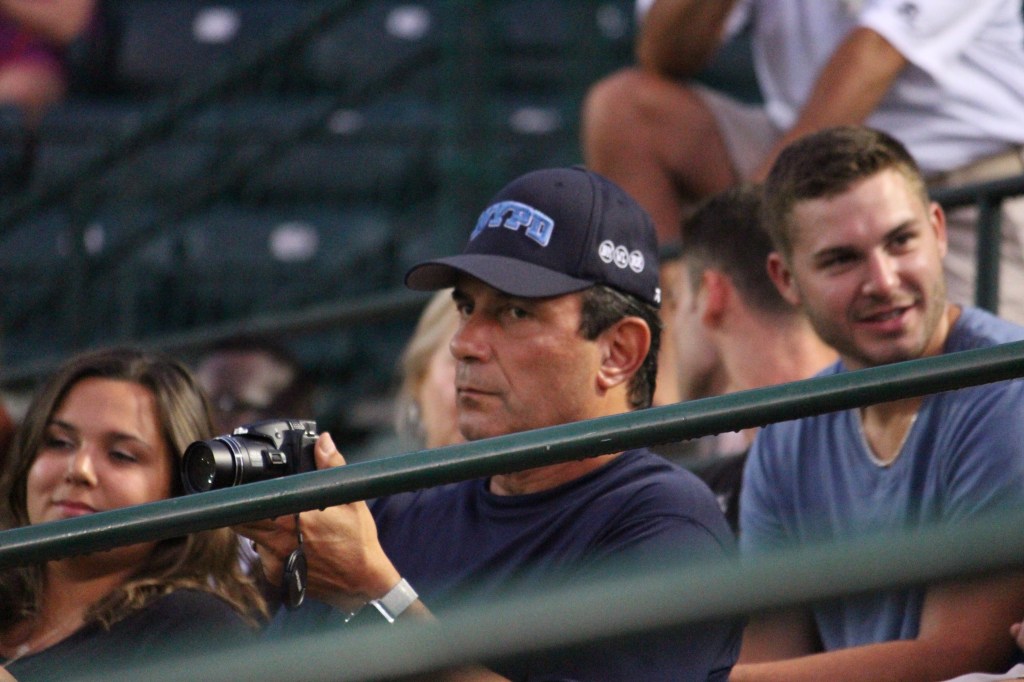
It seemed that only a few in the remaining crowd recognized him, but his presence was brought to our attention by murmuring fans near his seat. Mazzilli seemed gracious, but his facial expression indicated that perhaps he just wanted to watch the game. After the final out, we saw him in the concourse, but left him alone.
Lee Mazzilli, donning an NYPD cap, shooting video, presumably of his son’s at-bats. (Photo credit: Jeff Hayes)
At the conclusion of the game, we exited quickly, with a three hour drive ahead of us. New Britain Stadium was the epitome of a modular stadium, complete with a unassuming but functional video board. The 2015 season was the last for the Rock Cats, as the would become the Hartford Yard Goats in 2016, scheduled to move into the brand new Dunkin’ Donuts Park.













 Baseball Travels