New Jersey/Canton OH/Detroit MI September 10-11th 2009

Google Maps showing the seven hour plus drive from NJ to Canton OH.

1. New Jersey to Canton, Ohio September 10th 2009

Our lone 2009 MLB trip took us from New Jersey to Detroit, Michigan by way of Canton, Ohio from September 10th through the 13th. The first day of the trip (Thursday, September 10th) was dedicated to the drive from central New Jersey to Ohio. We assumed that we could not expect to get from New Jersey to Detroit, Michigan in one day (though we did exactly that in 1999), so we consciously chose Canton as a destination. Our plan was to stay overnight and visit the Pro Football Hall of Fame Friday morning, September 11th, before heading to Detroit for a game that evening.

The trek itself was rather non-descrip, driving along Interstate 76 for the entirety of the state of Pennsylvania. That route took us from near Philadelphia just after the morning commute across the Susquehanna River in Harrisburg (the state capital), where we could see the nuclear reactor cooling towers of the Three Mile Island facility. Following a short stop for lunch, we got back on the road.

Between Harrisburg and Pittsburgh Pennsylvania, we witnessed the heartland of America. On one side of the interstate, we saw acres and acres of corn, which was mature and ready to be harvested. On the other side, we saw acres and acres of cows standing and laying among the rolling hills. From that slice of Americana, we passed north of Pittsburgh before crossing into Ohio. After about an hour, we reached Canton, checked into our hotel, and ate a quick dinner before settling in after a long day of driving.


2. Pro Football Hall of Fame, Canton Ohio, Friday September 11th 2009

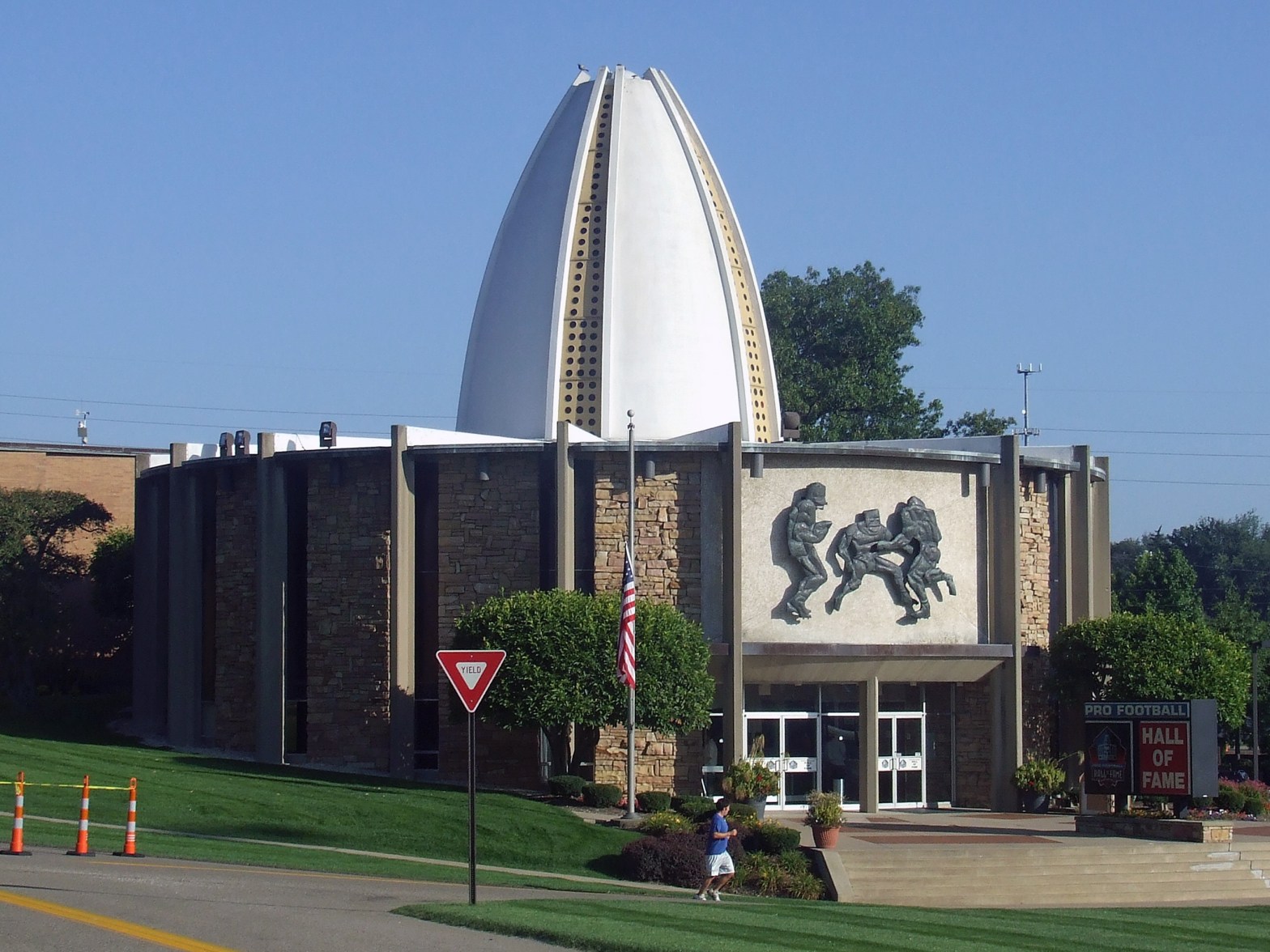
Pro Football Hall of Fame, Canton OH. (Photo credit: Jeff Hayes)

Checking out of our hotel on the cloudless, relatively cool morning in Canton, we headed for the Pro Football Hall of Fame. Arriving about the time the doors opened at the Hall, we were able to secure parking adjacent to the museum, rather than have to parking offsite and catch a shuttle bus. Having gotten there early, we had much of the Hall to ourselves, save a crew filming for a local or national news broadcast.

Our visit began in the Hall of Fame Gallery. Home of the plaques describing the current Hall members, it was reminiscent of the busts at the Baseball Hall of Fame. Since the Pro Football Hall of Fame elects new six entrants each year, there are many more members of the Pro Football Hall. Examining each plaque consumed a considerable amount of time, especially since there were a large number of members from the early days with whom I was not familiar.

The Dallas Cowboys exhibit in the NFL Gallery at the Pro Football Hall of Fame. (Photo credit: Jeff Hayes)

Our next stop was the Hall theatre, which showed a loop of famous games and clips. The loop was interesting, but disappointingly short. Following the main presentation, we wandered into the NFL Gallery. The Gallery contained exhibits for each NFL team, as well as multimedia displays telling the history of the game. For the casual and die hard fans alike, this gallery contained the heart and soul of the game, stepping us through time as the game evolved.

In addition to the history of the NFL, the gallery chronicled the American Football League (AFL). Founded in 1960 as a rival league to the NFL, the AFL featured a more wide open offensive game, a sharp contrast to what the NFL had to offer. Despite a more exciting game, the AFL was widely derided among football fans as inferior to the NFL. However, the AFL signed Joe Namath out of Alabama in 1965. Shocked by the signing, the NFL pursued merger talks with the AFL shortly thereafter.
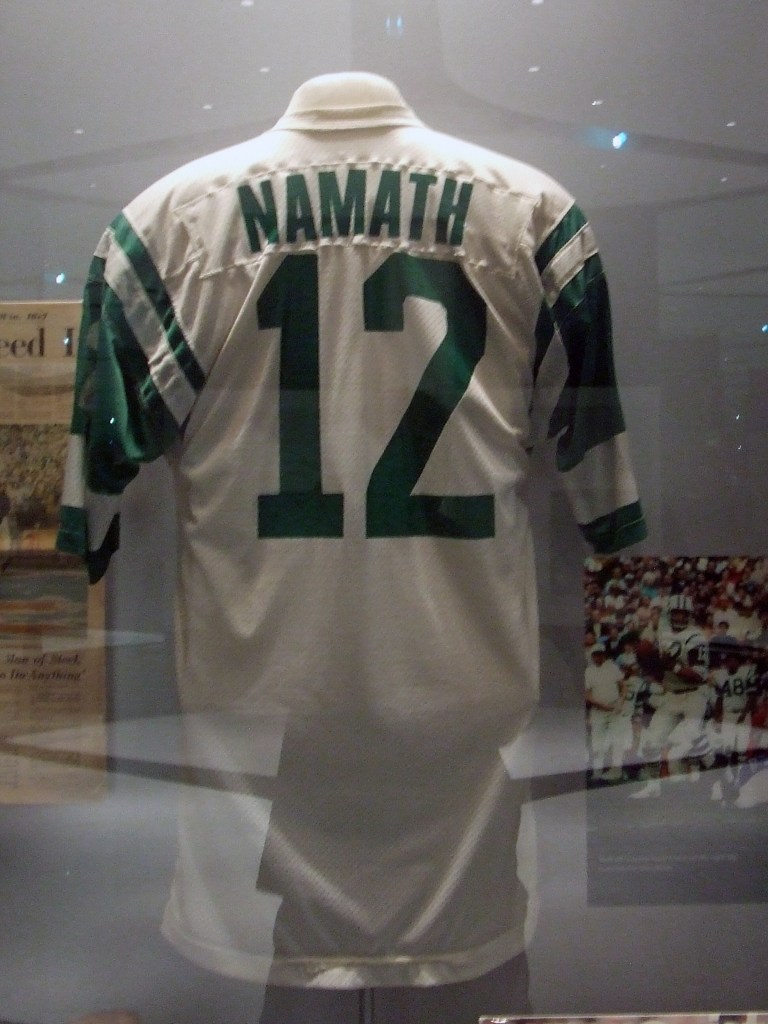
The signing of Joe Namath in 1965 brought instant credibility to the American Football League. (Photo credit: Jeff Hayes)

To my surprise, the gallery contained a small exhibit dedicated to the World Football League (WFL). Developed in the mid 1970s as a direct rival to the NFL, it featured a team in Hawaii, and encouraged NFL stars (such as Larry Csonka and Paul Warfield of the Miami Dolphins) to jump to the new league. Featuring key rule differences, the new league enjoyed a fairly successful first season, but the lack of a national TV contract and overzealous spending doomed the WFL before the end of the second season.
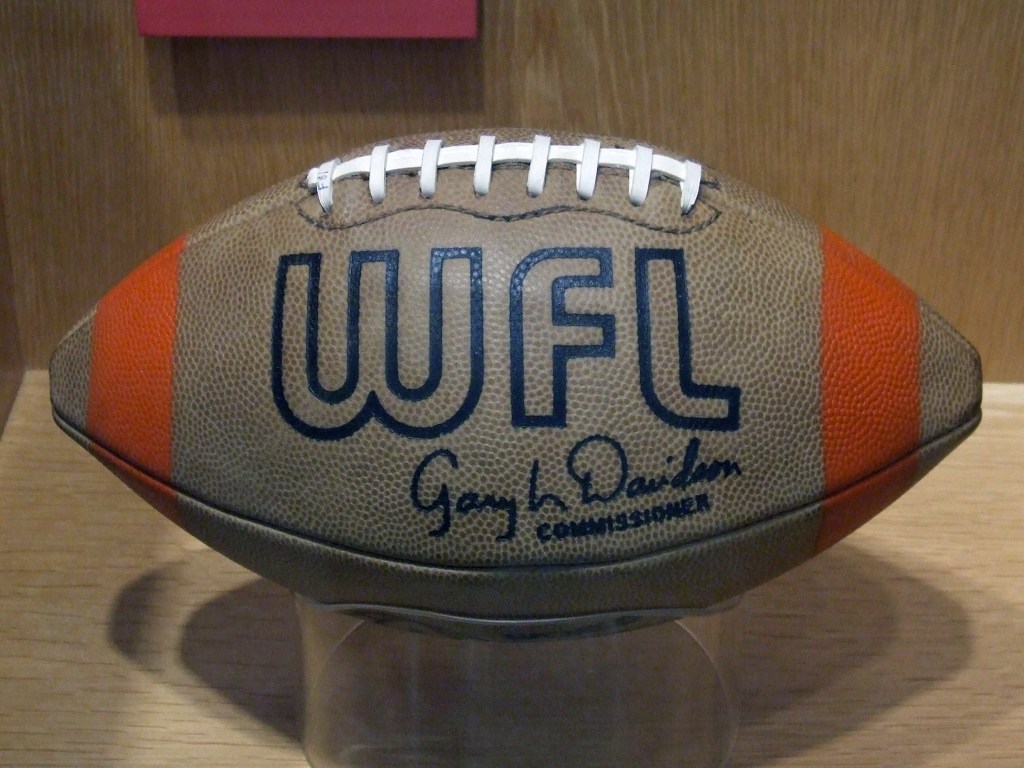
An official WFL football, featuring orange stripes, ostensibly for better visiblity during night games. (Photo credit: Jeff Hayes)

Perhaps the most interesting features in the gallery were the wax figures of NFL legends. Life sized versions Jim Brown, Walter Payton and Lynn Swann were among the greats immortalized in the wax museum. Finally, we walked through the Super Bowl gallery, which featured multi media displays of each Super Bowl. Being New York Jets fans, we were attracted to the Super Bowl III exhibit, as the Jets beat the heavily favored Baltimore Colts. That victory legitimized the AFL in the eyes of many NFL fans, and represents the lone Jets Super Bowl appearance.

Walter Payton immortalized in wax at the Pro Football Hall of Fame. (Photo credit: Jeff Hayes)

All told, we spent more than two and one-half hours in the Pro Football Hall of Fame, including the obligatory visit to the Hall store for souvenirs. Though I consider myself a knowledgeable pro football fan, I learned quite a bit about the game, and enjoyed the exhibits greatly. If you are just a casual fan, and you find yourself in the Canton, Ohio area, you owe it to yourself to visit the Hall. You won’t be disappointed.
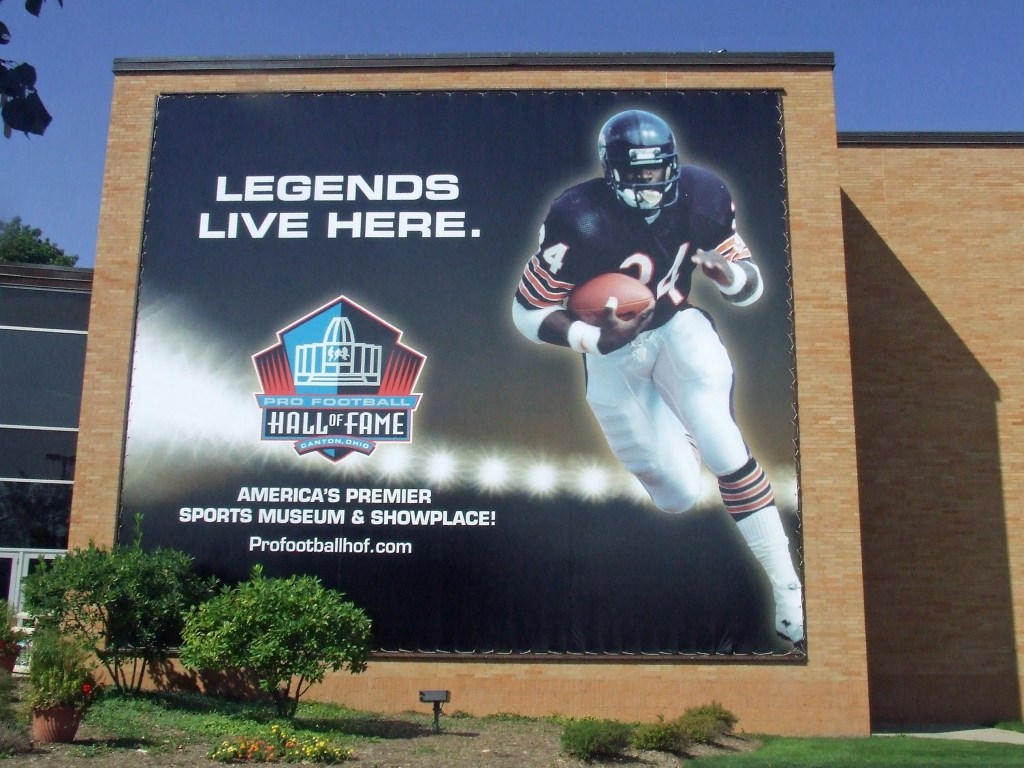
Goodbye Pro Football Hall of Fame. Hope to see you again soon. (Photo credit: Jeff Hayes)

3. Canton, Ohio to Detroit Michigan/Comerica Park

Comerica Park, Detroit MI. (Photo credit: Jeff Hayes)

Following lunch near the Pro Football Hall of Fame, we hit the road for Detroit, Michigan in order to catch the game that evening against the Toronto Blue Jays. The 210 mile, three and one half our trip took us south of Cleveland, Ohio around the western edge of Lake Erie into the southeast portion of the lower peninsula of Michigan. The trip itself was uneventful, with generally light midday traffic working in our favor.

We reached our hotel south of Detroit off Interstate 75 a couple of hours before the gates opened at the ballpark, allowing us time to relax before the game. Approaching the hotel, our GPS unit informed us that the hotel was a left turn off the interstate, though visually we could see that the hotel was actually to the right of the exit. Back then, the GPS units did not often update their maps, and clearly this unit was out of date.

Arriving at Comerica Park about the time the gates opened, we had little difficulty finding parking. There were five main parking lots around the ballpark (including parking near Ford Field, located across the street), reasonably priced at about $10. Had the main lots been full, there are many parking options within a short walk (generally less than one-half mile) of the stadium, with varying prices.

The Renaissance Center from just outside of Comerica Park. (Photo credit: Jeff Hayes)

Like many newer MLB ballparks, Comerica Park was located downtown. Walking around the park, we glimpsed the colossal Ford Field across the street. The domed stadium (home to the NFL Lions )dominated the skyline in this portion of Detroit, seemingly much larger than Comerica Park. On the other side of the stadium, we could see the Renaissance Center, located on the banks of the Detroit River.

The environment surrounding the ballpark was unexpected. Stories of Detroit has me expecting a war zone, yet downtown Detroit had a distinctive architecture that held a charm that exceeded my expectations. Having caught my interest, we would have to explore downtown Detroit further.
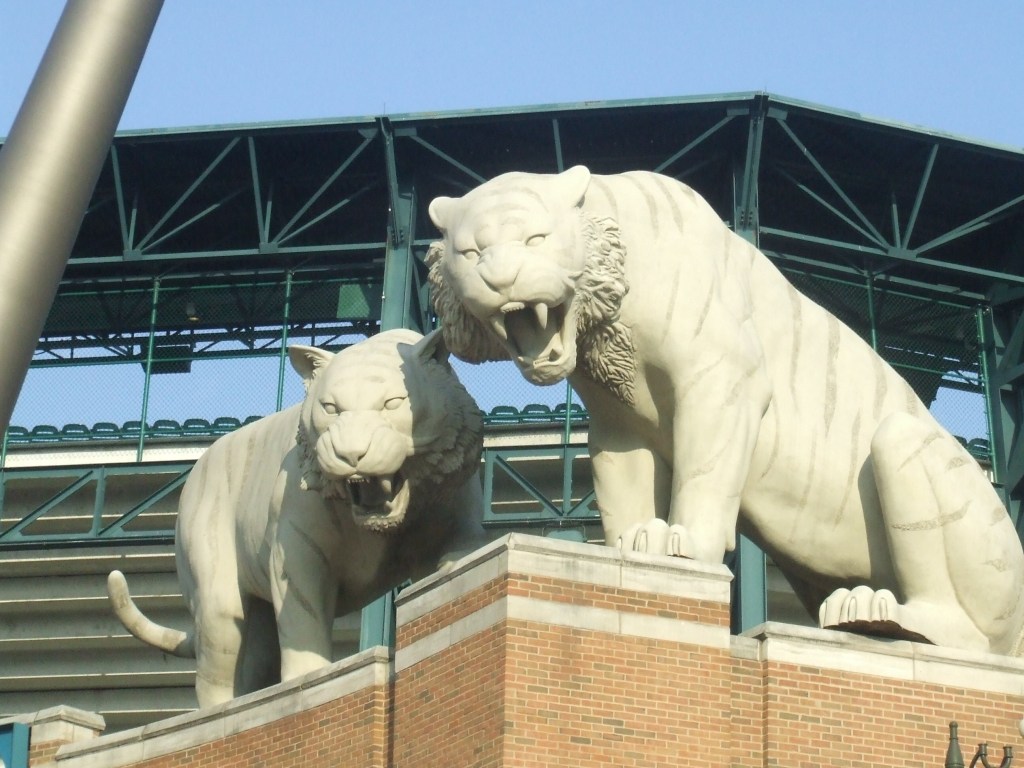
Stone tigers lurking over Comerica Park. (Photo credit: Jeff Hayes)

Since we were not sure that would would arrive in Detroit for the start of the 705 pm game, we did not obtain the best seats possible for the game. Instead, we sat in right center, just to the left of home plate. The view gave us a great view of the stadium, as well as an unobstructed look at home plate.
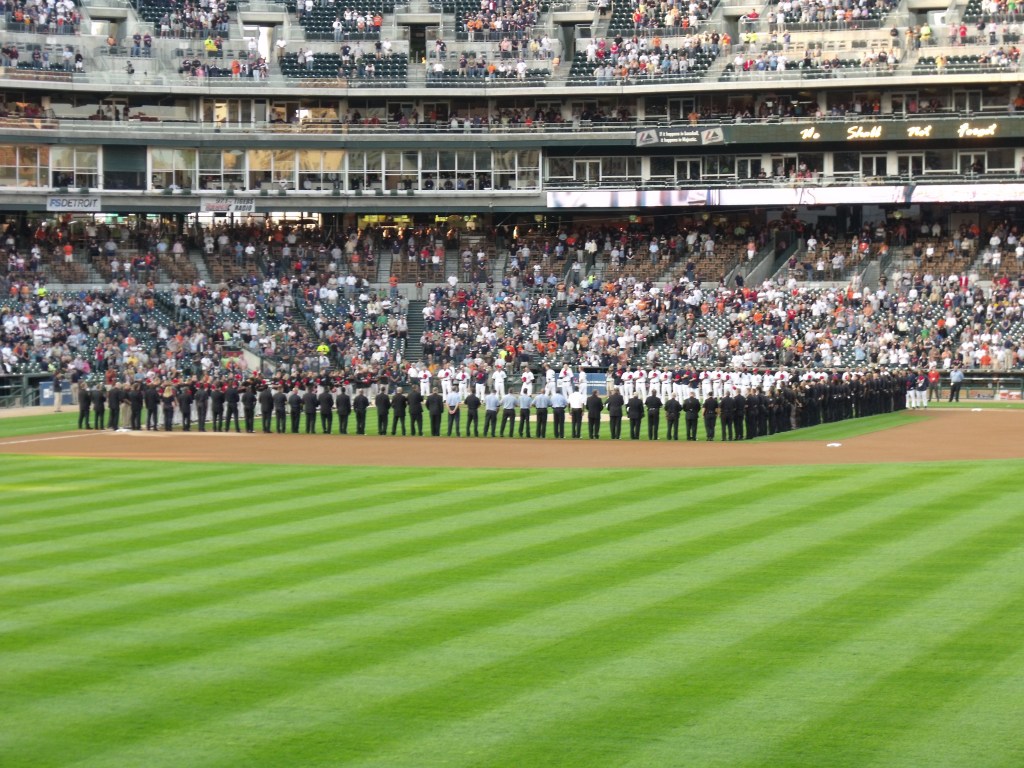
The view from our seats of the 9/11 ceremony prior to the start of the game. (Photo credit: Jeff Hayes)

Being September 11th, the Detroit Tigers held a short but dignified ceremony marking the eighth anniversary of the attacks in 2001. To be honest, I hadn’t given the date much thought (outside of a cursory acknowledgement), so the somber ceremony caught me somewhat by surprise. Following a moment of silence to remember the fallen on that fateful day, the players took the field, with the first pitch thrown at 707 pm.

The Tigers opponent that evening was the Toronto Blue Jays, a regional rival, even though the teams are in different divisions in the American League. The Tigers held a five and one-half game in the AL Central over the Minnesota Twins, while the Blue Jays were mired in fourth place in the AL East, 26.5 games behind the division leading New York Yankees. It was against that backdrop that the Tigers sent left hander Nate Robertson against the Blue Jays starter, left hander Nate Tallet.
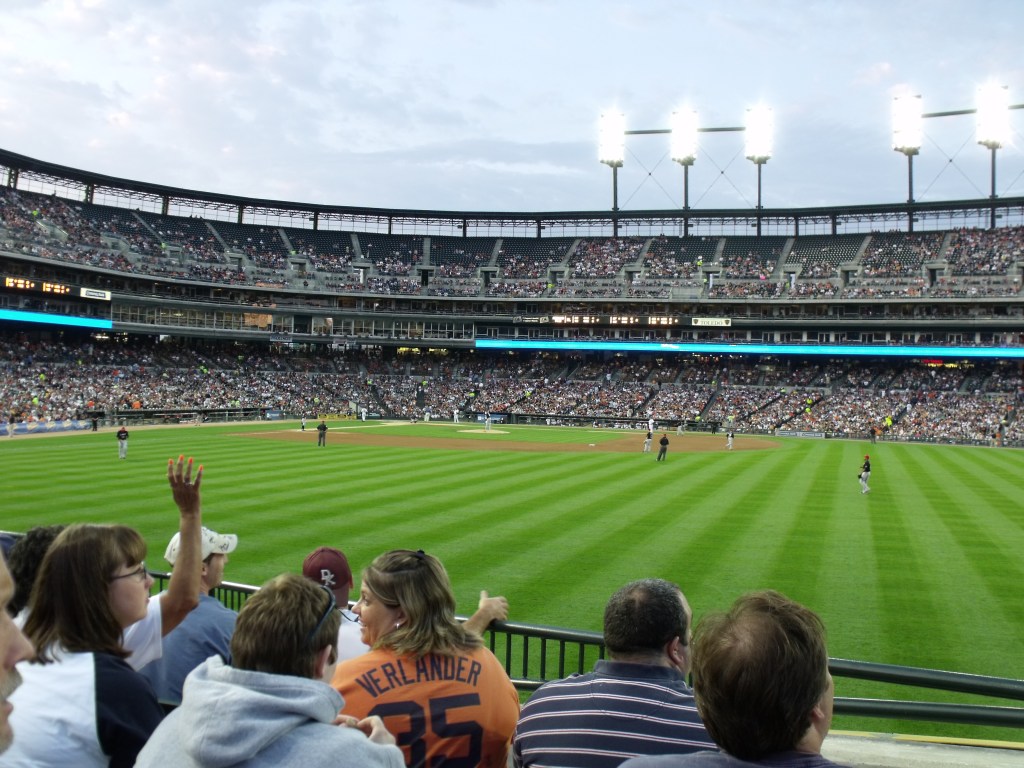
This is how the action looked from our seats. The game was better attended that I expected, perhaps since the teams form a regional rivalry. (Photo credit: Jeff Hayes)

With the game featuring back of the rotation starters struggling through their 2009 campaigns, the circumstances seemed ripe for a slugfest, as both teams had power in their lineups. However, the score was close through the first half of the game, with the teams trading runs through the first five innings.

As the evening blended into evening, the wind died down, leading to comfortably cool conditions for the middle of September. With the Blue Jays protecting a 3-1 lead entering the seventh inning, the teams both scored three times in that frame, which ended the scoring for the contest.

A tiger with laser beams for eyes, prowling just to the left of the main scoreboard at Comerica Park. (Photo credit: Jeff Hayes)

Toward the end of the game, a light breeze off Detroit River brought a light fog to Comerica Park. The fog allowed for an amazing effect on the laser eyes of the bengal tigers perched on the scoreboard. The scattered light from the tiger’s eyes gave it a more menacing appearance. Fortunately, the fog remained light enough not to affect play, as the Blue Jays took the first game of the three game weekend set 6-4.

Following the game, we experienced little difficulty exiting the area before heading back to the hotel to relax after a long day that started with football and ended with baseball.
Colorado, Sunday June 13th 2010

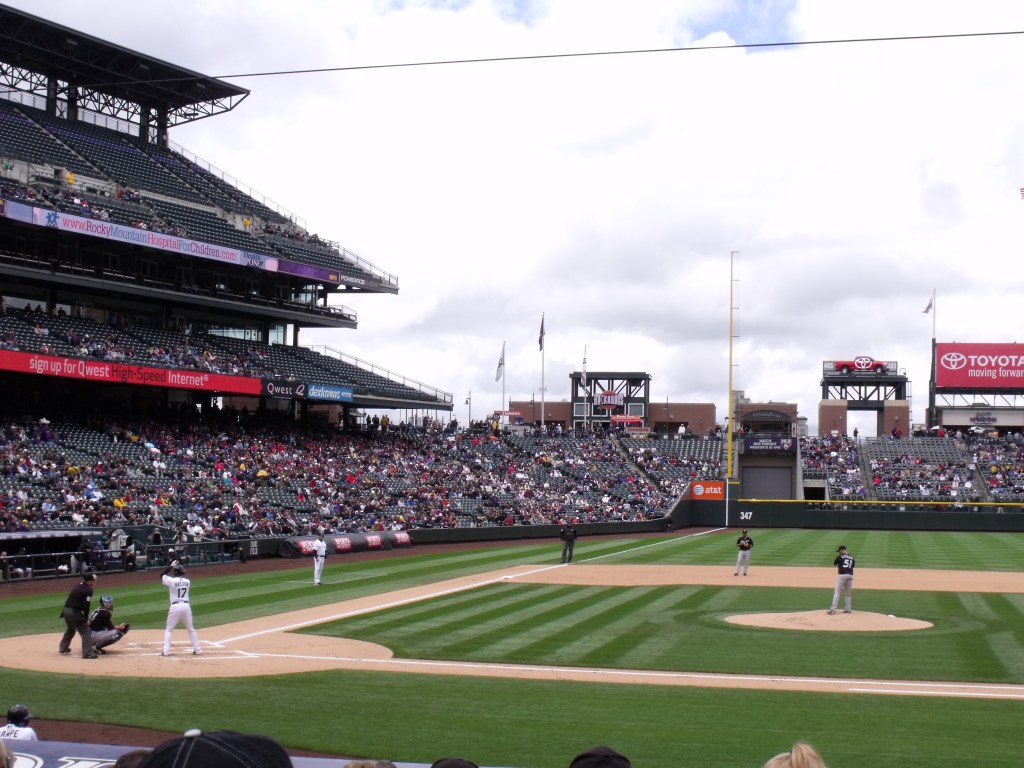
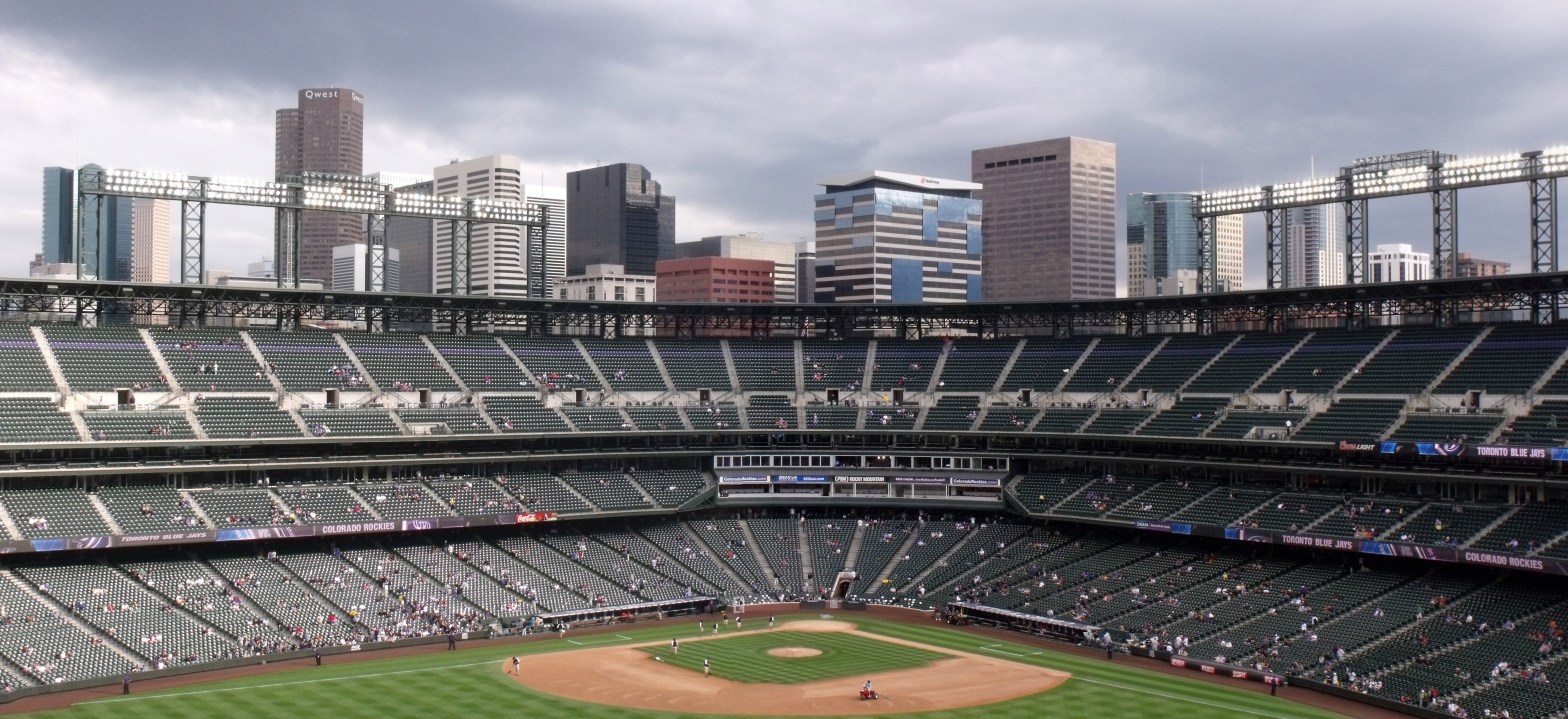
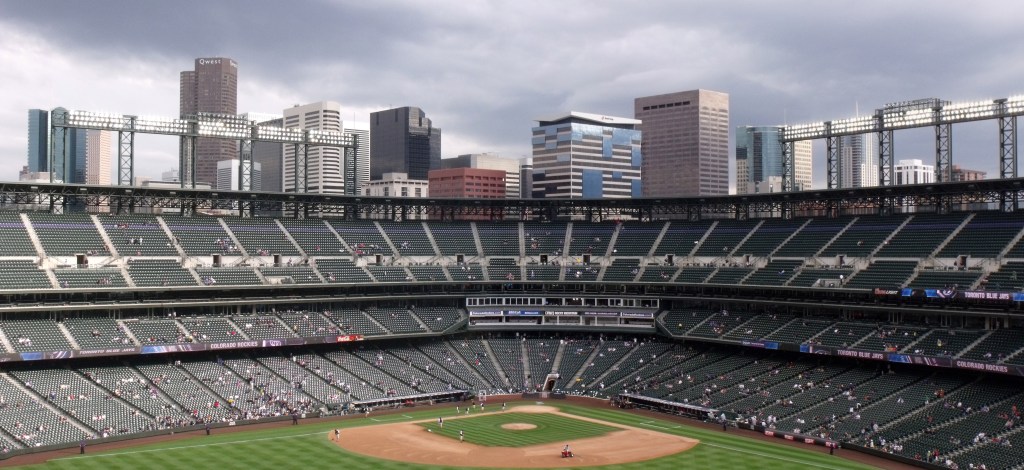
Coors Field, Denver CO. (Photo credit: Jeff Hayes)

Once again, the morning dawned dark and cool across Eastern Colorado. Considering Denver enjoys 24 sunny days a month (especially during the warm season), getting three gray and wet days in a row is an unusual string of bad luck. Rather than experiencing highs temperatures in the toasty upper 70s and lower 80s (which is normal for mid June), we were “treated” to highs in the 50s under slate gray skies.

1. Coors Field

With the weather remaining uncooperative, we decided to stay close to the hotel following breakfast. The 110 pm start meant that the gates opened shortly after 11 am, and we arrived at the ballpark around that time. For the third game in a row, we were able to park onsite, as the cloudy skies and cool temperatures promised another light crowd.

Fountains in center field of Coors Field. ( Photo credit: Jeff Hayes)

Arriving early finally allowed us to explore Coors Field in more detail. The ballpark is huge, with a capacity of more than 50,000, with three decks and grandstand seating in left field. The park was designed and built during the team’s initial years in Denver, when the Rockies played at Mile High Stadium, home of the Broncos. During their tenure in that park, the Rockies set an MLB attendance record, drawing more than four million fans a year.

While the Rockies still draw well, the large crowds at Mile High Stadium didn’t translate to the new ballpark. Consequently, Coors Field lacks the intimacy of some of the newer MLB parks. That’s not to say it doesn’t have its own charm; flora and water falls in center field, as well as a purple aura throughout the park (due to the Rockies color scheme). Still, the large dimensions of the park remind me of the ballparks of the 70s, though Coors Field has more character than the multi purpose behemoths of the past.

Downtown Denver from Coors Field. (Photo credit: Jeff Hayes)

Wandering the entire ballpark, we counted no less than two dozen places to eat and drink. As seemed to be the norm in this park of Colorado, there were several microbrews available at Coors Field, as well as a few restaurants serving specialty cuisine. Not possessing a sophisticated palette, my tastes are drawn to more standard ballpark fare, and there were no shortages of these locations. Following out trek through the stadium, we got lunch before seeking out our seats.

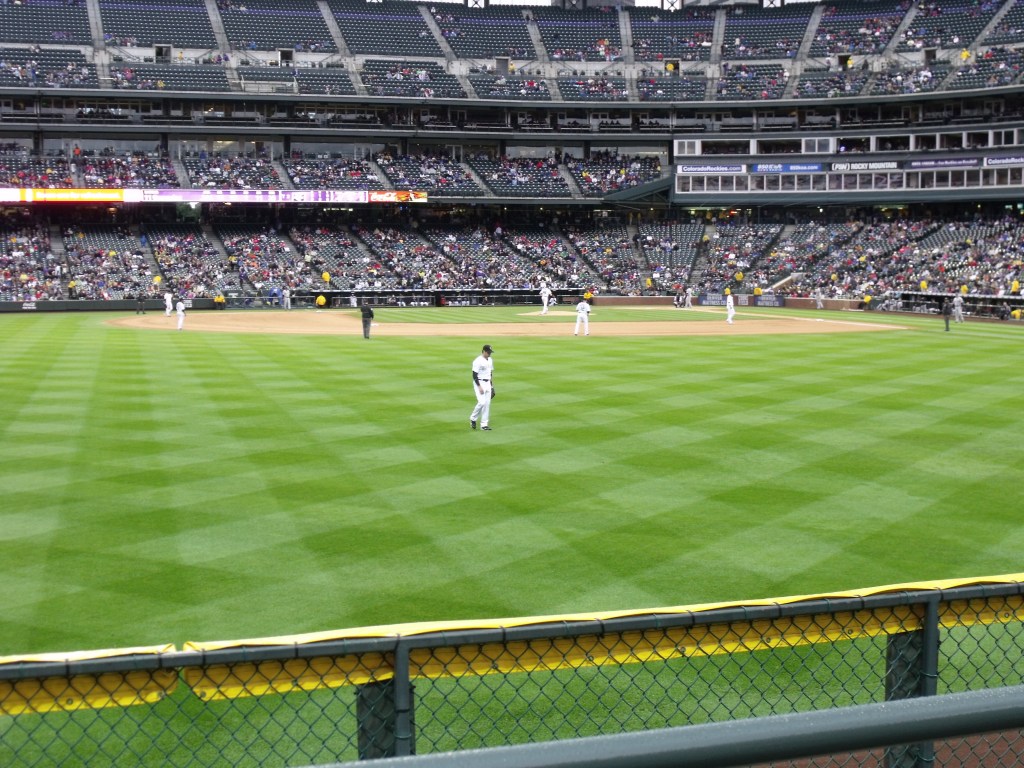
The view from our seats. (Photo credit: Jeff Hayes)

The small crowd for the matinee made Coors Field look nearly empty as game time approached. While skies occasionally lightened up, the sun never did make an appearance, and the crowd was dressed for a game in April, rather than June. The pitching matchup for the final game of the series featured right hander Jesse Litsch for the Jays, and left hander Jeff Francis for the home town Rockies.

The low clouds started lifting shortly after the game started, raising the prospect of a few rays of sun. Alas, that didn’t happen, but brightening skies after two days of cold and rain was a welcome respite from the conditions. The weather resulted in yet another lightly attended game, surely less that the announced crowd of 32,000 plus.

Jeff Francis delivers a pitch in the first inning against the Blue Jays. (Photo credit: Jeff Hayes)

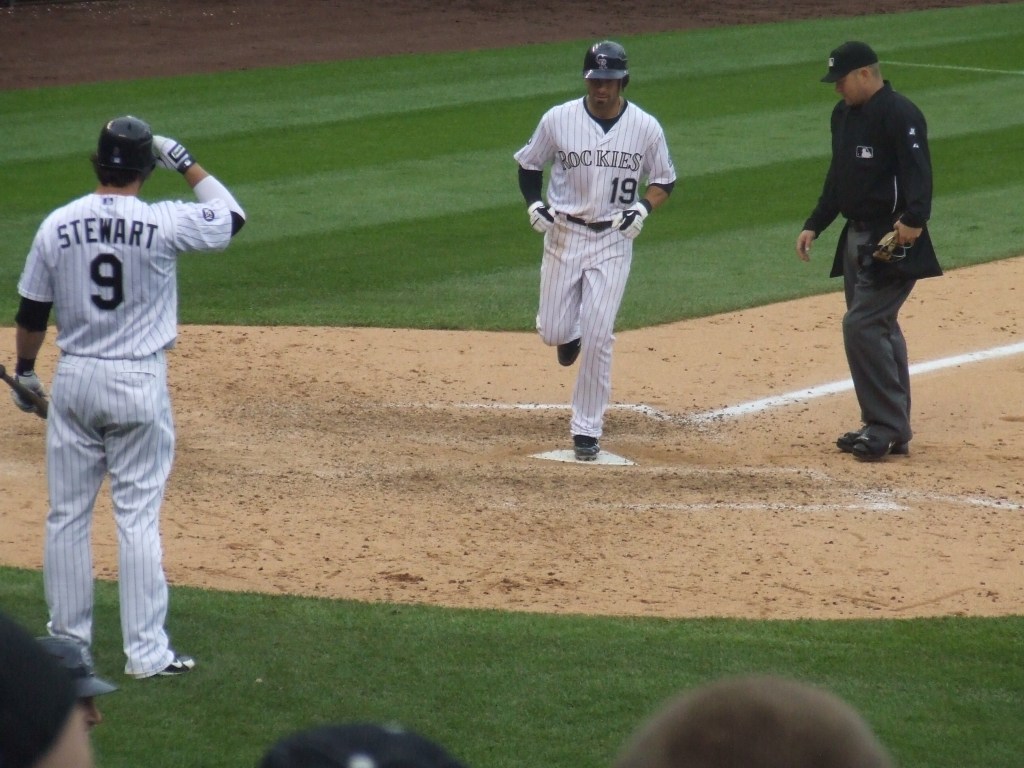
The Rockies pounced on Litsch in the first inning, batting around while scoring for four runs on five hits. The Blue Jays responded with three runs of their own in the third, drawing within a run. However, the Rockies answered with three runs of their own in the bottom of the third, ending Jesse Litsch’s afternoon. The first run of the inning came from LF Ryan Spilborghs, hitting the first of his two home runs that afternoon.

The Rockies’ LF Ryan Spilborghs scoring after the first of his two home runs. (Photo credit: Jeff Hayes)

As the game went on, a few breaks in the clouds developed, helping it feel warmer on this cool afternoon. The breaks didn’t last long, as the Rockies continued their offense barrage, scoring three more runs in the sixth inning (featuring Spilborghs’ second home run of the afternoon). That outburst put the game out of reach for the Blue Jays, and capped the scoring for the game.

Despite the best conditions of the weekend, I suspect that we did not get the true flavor of Coors Field. Having spent some time in eastern Colorado in the past, my experience tells me that the clouds and rain obscured the true charm the field possesses. However, the charm was not fully present during this visit, and the smaller crowds undoubtedly had something to do with that as well.

Dinger, the Rockies’ mascot, trying to entertain the crowd on this cloudy and cool afternoon. (Photo credit: Jeff Hayes)

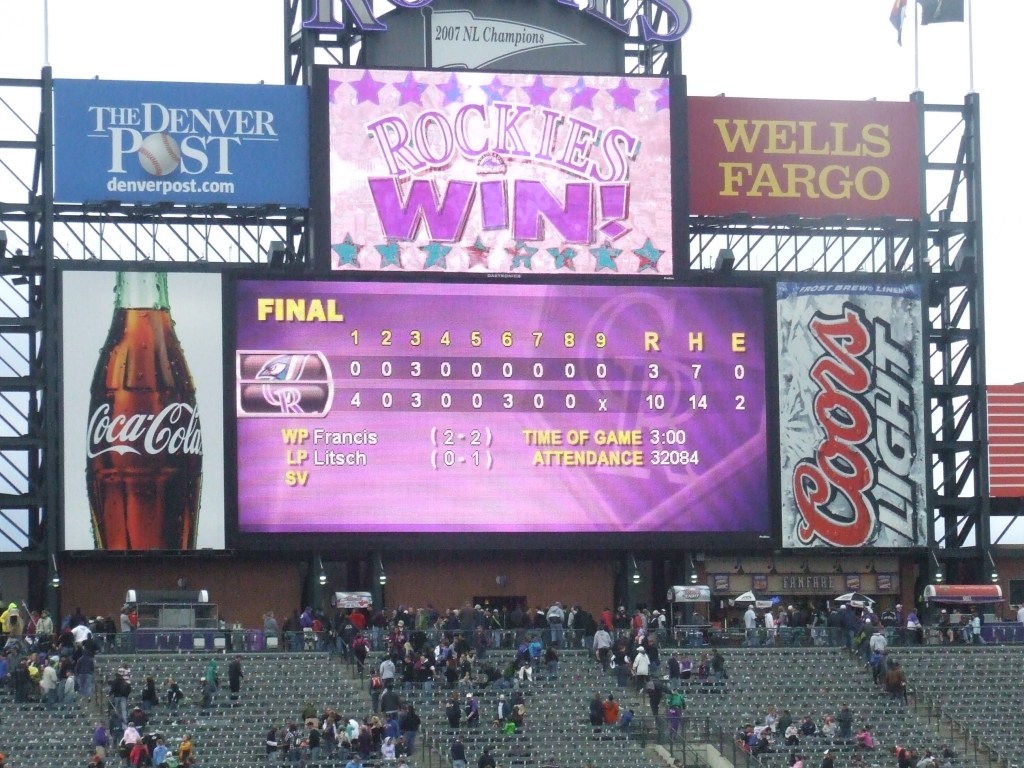
The Rockies 10-3 victory took about three hours to complete, as the home team swept the Jays in three straight. Following the game, we decided to take a ride up to Boulder, perhaps my favorite place in Colorado.

The Coors Field scoreboard tells it all. (Photo credit: Jeff Hayes)

2. Boulder Colorado

Google Maps showing the 35 minute drive from Denver to Boulder.

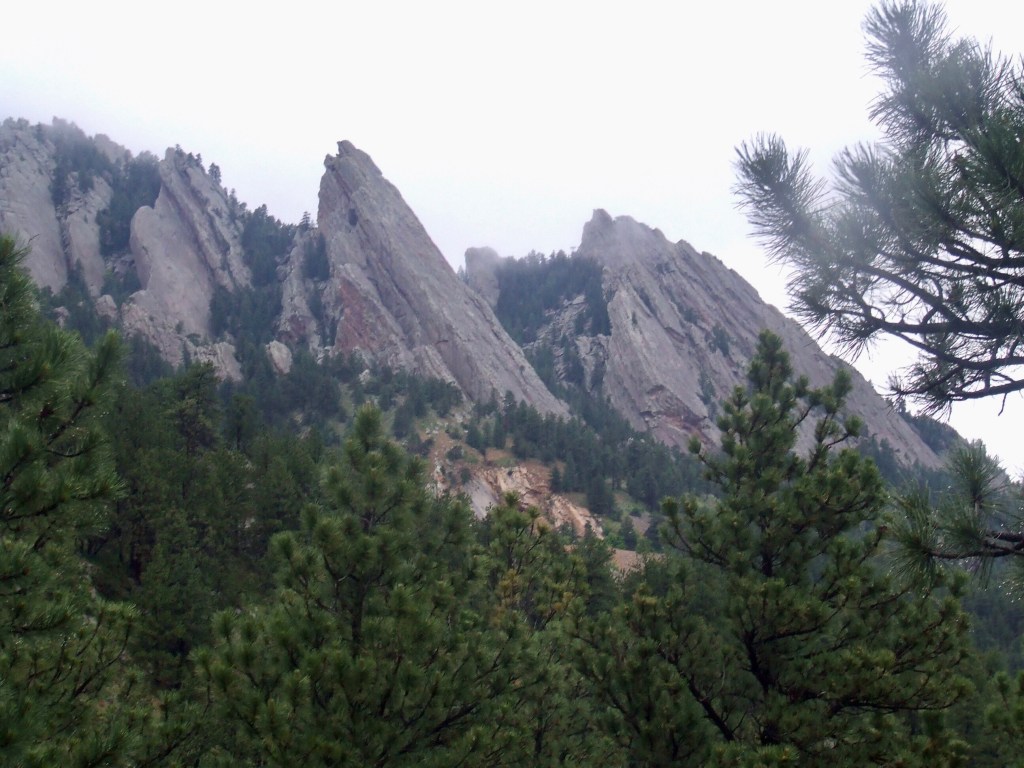
Hoping for better conditions as we headed toward Boulder, we were disappointed to discover the same clouds over Denver were present in Boulder. Professional training opportunities have allowed me to visit Boulder several times, and each time I discovered something new to appreciate. My favorite part of Boulder is the Flatirons, a rock formation in the foothills of the Rockies unique to the area. There are five flatirons in the formation, and wandering among the flatirons has always been the highlight of my trips to Boulder.

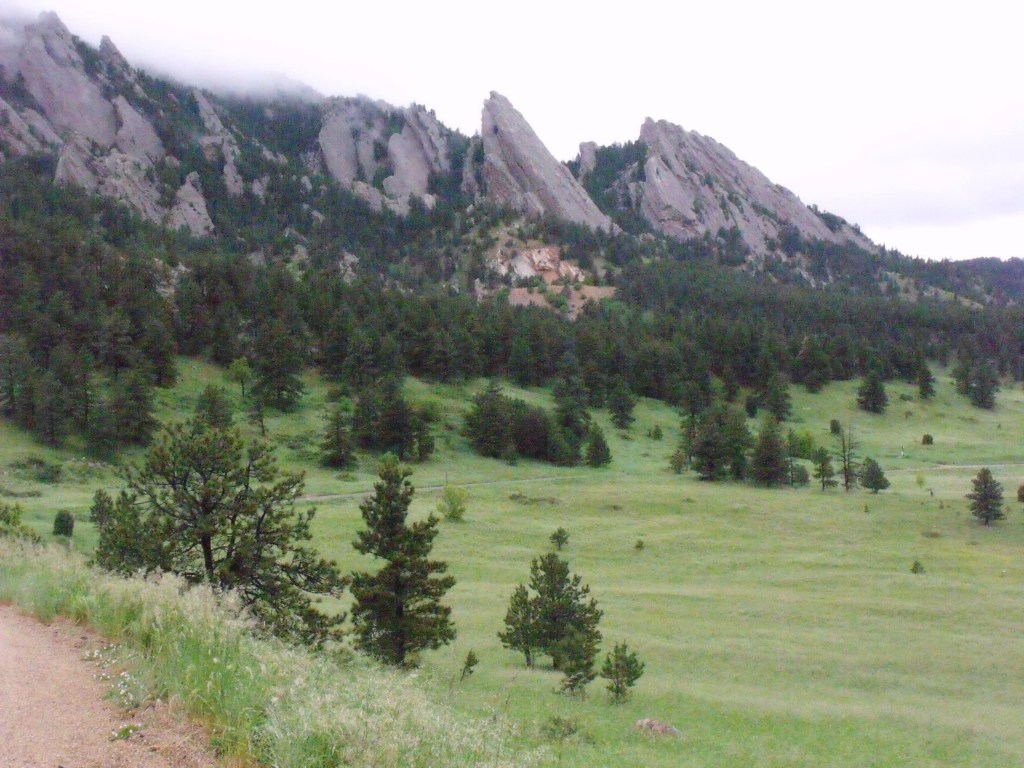
Arriving at Table Mesa in the late afternoon, we began to wander in the meadows and trees just in front of the FlatIrons. The recent rains left the area greener than I had ever seen it, which helped counteract the ever present clouds. It reminded me of the rolling green hills I’d seen over eastern Nova Scotia years before, and of picture I’ve seen of Ireland (though I have not yet been there)

Rolling hills at the foot of the Flatirons, looking to the east toward Boulder. (Photo credit: Jeff Hayes)

The clouds obscured the top of the Flatirons, rendering the colors in the terrain almost indiscernible. Still, the majesty of the Flatirons shone through the mist. The ground immediately adjacent to the terrain was too wet to walk on comfortably (as we did not have the right shoes for the conditions). That meant we were unable to hike the trails that lead to the higher hills overlooking Boulder, and possibly catch a glimpse of a mountain lion along the way.

The FlatIrons, looking northeast.

Not seeing another soul wandering the area for more than an hour, it seemed as though we had this part of Boulder to ourselves. The only other creatures in sight were a few deer and a noisy magpie, apparently enjoying the lack of human presence. Even with the gloom, some of the color of the region was evident. The FlatIrons are composed of conglomerated sandstones, with some of the sandstone present along the trails.

Sandstone boulders near the FlatIrons in Boulder. (Photo credit: Jeff Hayes)

Lingering near Table Mesa in the hopes that some of the clearing we saw to the east would magically materialize over Boulder, we waited until nearly dark before heading back to Denver. This was my brother’s first visit to Boulder, and I was disappointed that he didn’t get to experience Boulder the way I have in the past. Perhaps we will return, if for no other reason that to see the FlatIrons in all their glory, and to hike the trails among the formations.

The FlatIrons from a distance. Goodbye for now, Boulder. Hope to see you again soon. (Photo credit: Jeff Hayes)

Colorado, Saturday June 12th 2010

Rocky Mountain National Park, CO (Photo credit: Jeff Hayes)

The day began with cloudy skies and cool temperatures for the middle of June in Denver for the second day of our trip. Denver features 300 days of sunshine each year, making it one of the sunniest cities in the US. So it was unusual to have clouds and rain two consecutive days. It was against this backdrop that we decided to visit Rocky Mountain National Park near Estes Park, CO.

Google Maps showing the 75 minute drive from Denver to Rocky Mountain National Park.

1. Rocky Mountain National Park

Located about an hour and 15 minutes from the hotel, we passed through the foothills into the mountains via the Big Thompson Canyon, the site of devastating flash flooding in 1976. Traveling along the steep walled highway, it wasn’t difficult to imagine how dangerous this place could be when heavy rains falls in the mountains. As we gained altitude on the mountain road, the impressive topography became increasingly shrouded in the persistent cloudiness until we reached the park itself.

After checking in at the Beaver Meadows Visitors Center, we decided to follow the Trail Ridge Road. Unfortunately, clouds obscured much of the viewing along the highway, leaving us with shadows of mountains as we wound our way toward the higher peaks, in search of clearer vistas.

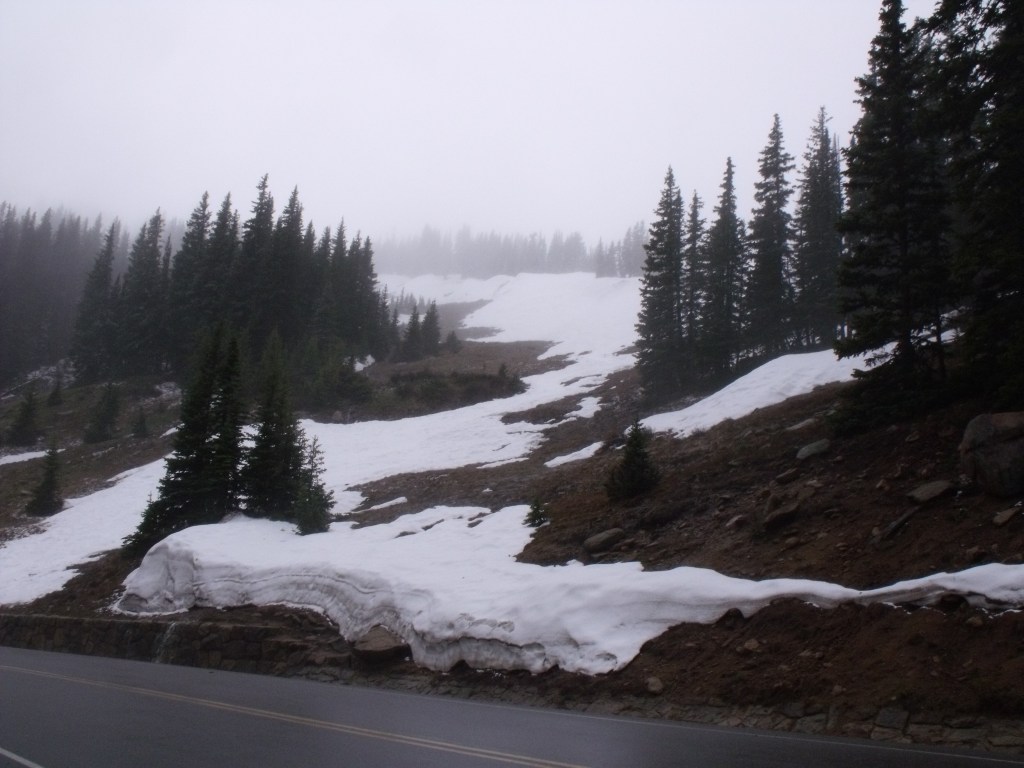
This view was typical of our trek through the lower elevations of Rocky Mountain National Park. (Photo credit: Jeff Hayes)

As we drove above 10,000 feet snow became more prevalent. Along the way, we would occasionally pull to the side of the road to take pictures. We could only imagine the views we were missing as the clouds kept them out of our sight. Instead, we had to be contented with the natural beauty the park would unveil through the bleakness.

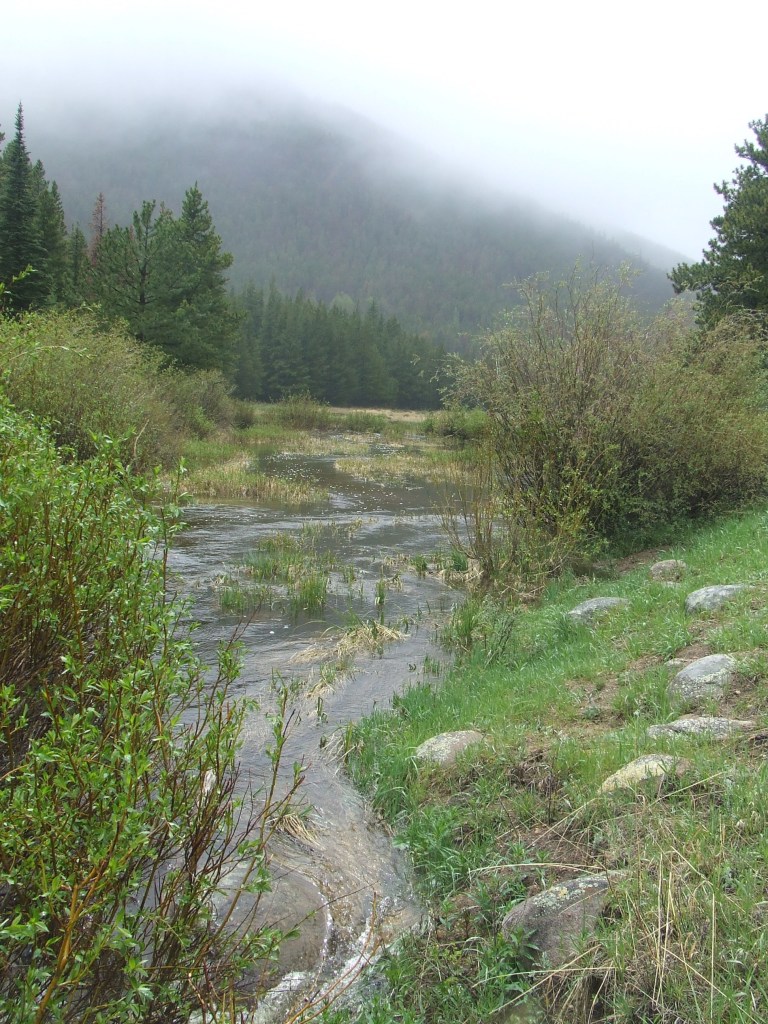
Caught between seasons at two miles above sea level, we saw fields of snow melting into alpine creeks that flooded the side of the road as we climbed ever higher in our rented Toyota Prius. Eventually, though, winter won out, and we were faced with snow covered roads, for which the Prius was clearly no match. Thwarted by conditions once again, we were forced to seek lower elevations to explore.

One of the myriad alpine streams fed by melting snow in Rocky Mountain National Park. (Photo credit: Jeff Hayes)

On our way back down the road, we pulled into one of the many turnouts we found along the way. Despite the dismal weather conditions, there were many people visiting the park, as evidenced by the number of cars in the turnout. The view at the turnout was no better than anywhere along the road, but the stop did provide us with a close up look at one of the parks full time residents.

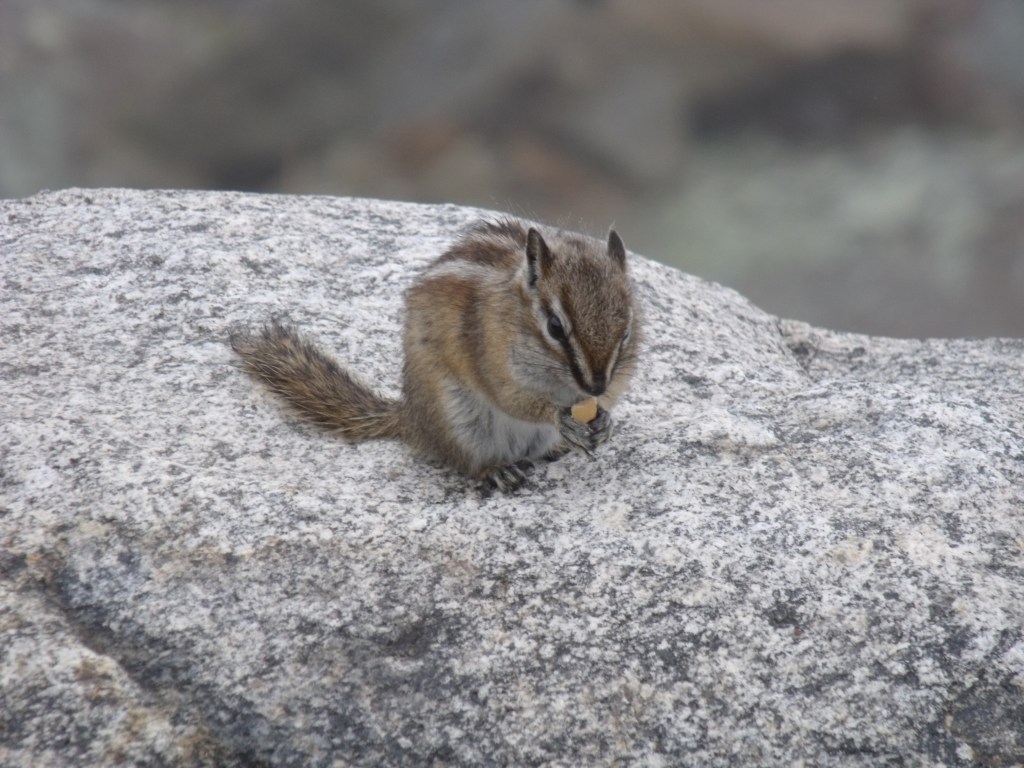
A chipmunk feasting on a cashew I tossed to it. (Photo credit: Jeff Hayes)

Scurrying along the granite parking barriers was a chipmunk, one of many weaving their way through the people in the parking lot. Though there was a sign that clearly stated that we were NOT to feed the wildlife, virtually nobody was heeding that command. Stopping for snacks in Denver, we had pockets full of food for the wildlife, and in direct violation of federal law, we tossed nuts for the chipmunks. Based on the reaction of the chipmunks, they were accustomed to people flouting the rules and keeping them supplied as winter slowly changed to spring.

Once the chipmunks were sated, they scattered into the rocks and crevasses surrounding the parking lot, so we headed back down the mountain road. The view on either side of the road was dominated by fields of melting snow and cloud covered peaks. Descending the mountain was a much slower process than ascending it, as we intermittently stopped to allow the car’s brakes to cool. Failure to tend to the condition of the brakes could lead to the failure of said brakes, so we took our time dropping out of the clouds back toward the visitors center.

This view was typical of our ride back down the mountain road toward the visitor center. (Photo credit: Jeff Hayes)

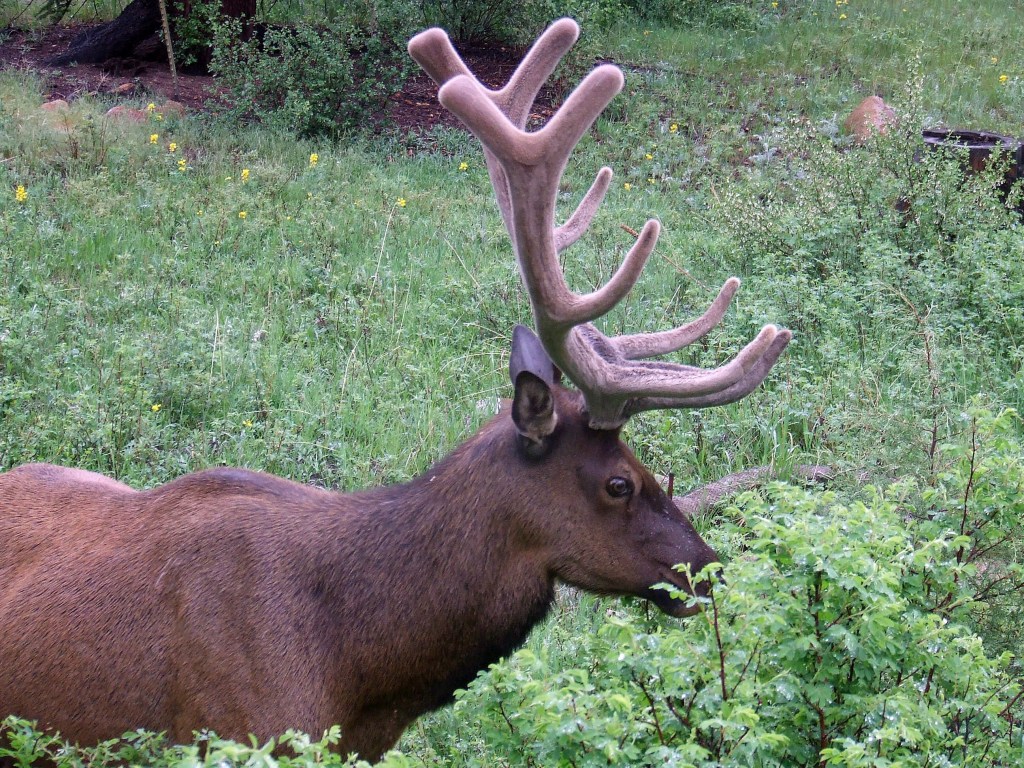
As we were approaching more level ground near the visitors center, we spotted some larger wildlife along the side of the road. Just behind a row of trees that obscured a small meadow, we spotted a pair of elk. Parking the car along the side of the road, we walked toward the elk in hopes of a close up picture. Surprisingly, the elk (which appeared to be a male and a female) paid little attention to us as we slowly approached them, seemingly more interested in munching on the greenery all around them.

While my brother took pictures of the female elk, I closed in on the male. Not thinking about the danger in which I was putting myself, I got within an arm’s length of the elk, who was still paying me no particular attention. Foolishly, I leaned in with the intent of touching the elk. That movement finally got his attention. Rather than react aggressively, he simply snorted, which was enough to make me recoil.

This picture does not accurately depict how close I was to this elk before he made it clear that I was TOO close.

Thinking back, not only did I put myself in danger coming that close to the elk, I disrespected the animal. That lesson remains with me until this day, changing my approach when photographing wildlife. While we were taking pictures of the elk, others driving along the road saw what was transpiring, and stopped to get their our pictures of the elk. Of course, the increased human presence spooked the elk, who slowly but deliberately walked away, ending the encounter.

Spending more time in the park than originally anticipated, we left in search of a late lunch before heading back to the hotel to change for the game. On the way back, we passed Broncos Stadium at Mile High, the home of the NFL’s Denver Broncos. Light rain and drizzle prevented us from exploring the stadium beyond a cursory pass, after which time we headed to the hotel to dry off and relax before the game.

Broncos Stadium at Mile High on a cloudy, dismal late afternoon. (Photo credit: Jeff Hayes)

2. Coors Field

Coors Field on yet another cool and wet evening. (Photo credit:Jeff Hayes)

Once again, clouds, rain and drizzle put a damper of our Coors Field experience. Though the weather was more reminiscent of springtime in the Northeast US, it wasn’t so bad as to threaten the game, and we arrived not too long before the first pitch. Conditions were less than optimal for exploring the ballpark, but we did manage to wander more this evening than the previous one, allowing us a better look at the large ballpark. However, the cool raw late afternoon cut short our exploration. Looking to escape the weather, we sought a ballpark dinner in the lower concourse, then settled into our seats.

The view from behind home plate in the upper deck. (Photo credit: Jeff Hayes)

In an attempt to get a different feel of the ballpark, we sat in the left field bleachers, in the lower level toward the fence. There was no protection from the weather here, but it afforded us some perspective when it came to the size of the outfield at Coors Field. The crowd was once again held in check by the weather, and had much of the left field section almost to ourselves.

The view from our seats in left field. (Photo credit; Jeff Hayes)

The rain stopped just before the first pitch (which occurred at 610 pm), but temperatures dropped into the 40s, giving the late afternoon/early evening a raw feel to it. Hardly feeling like baseball weather, we settled in for the second game of the three game series between the visiting Blue Jays and the hometown Rockies.

The pitching matchup for the evening’s contest featured right hander Brandon Morrow for the Blue Jays against right hander Jason Hammel for the Rockies. Both pitchers were in the midst of mediocre seasons for their respective clubs. However, the cool and damp conditions seemed as though it might dictate the scoring in the game, rather than the starting pitching. This was, of course, Coors Field, and expecting a low scoring game, even with less than ideal weather conditions, could be asking for too much.

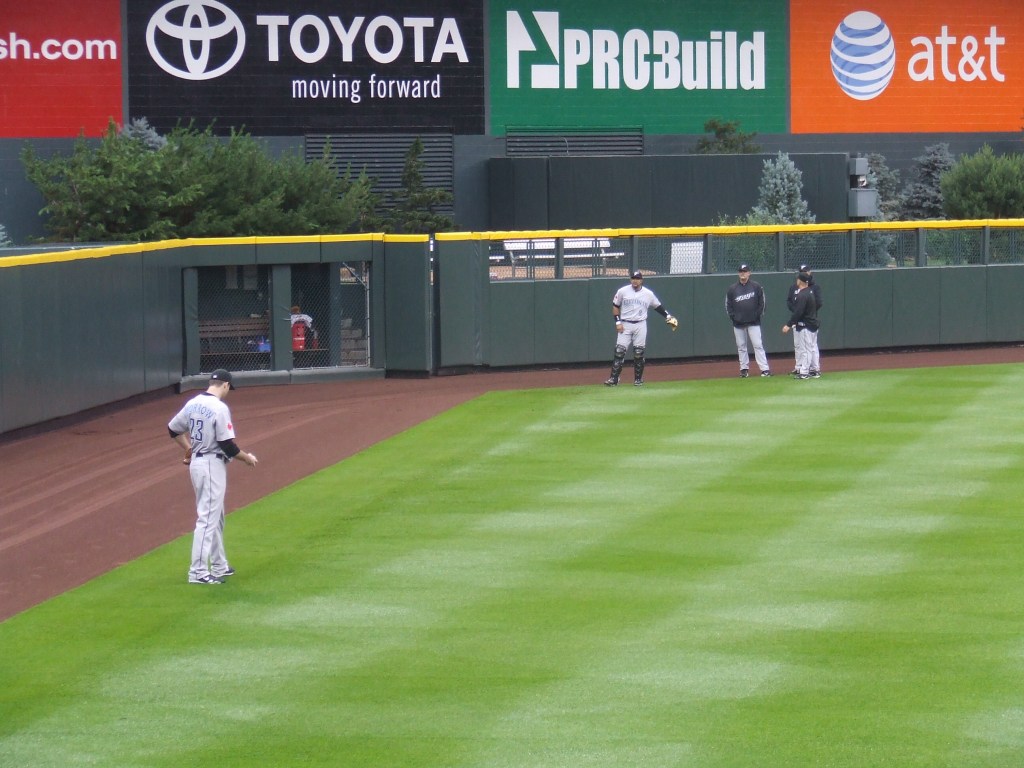
Blue Jays’ starter Brandon Morrow warming up in the outfield before the game. (Photo credit: Jeff Hayes)

Both starters were sharp, mowing down the opposing lineups through the first five innings, as the game pace kept the fairly light crowd (certainly less than the announced crowd of 26,000+) engaged. The quick paced game was appreciated by those in attendance, as intermittent drizzle fell through the game, and temperatures dropped through the 40s.

The Rockies scored a single run in the bottom of the sixth, as a Todd Helton double was followed by a Carlos Gonzalez RBI single. That was the only blemish on the otherwise impressive evening for Brandon Morrow. The Rockies’ Jason Hammel was just as impressive, tossing eight shutout innings in the Rockies 1-0 victory. Following the game, the small crowd made exiting easy, and we returned to the hotel to relax after a long day.