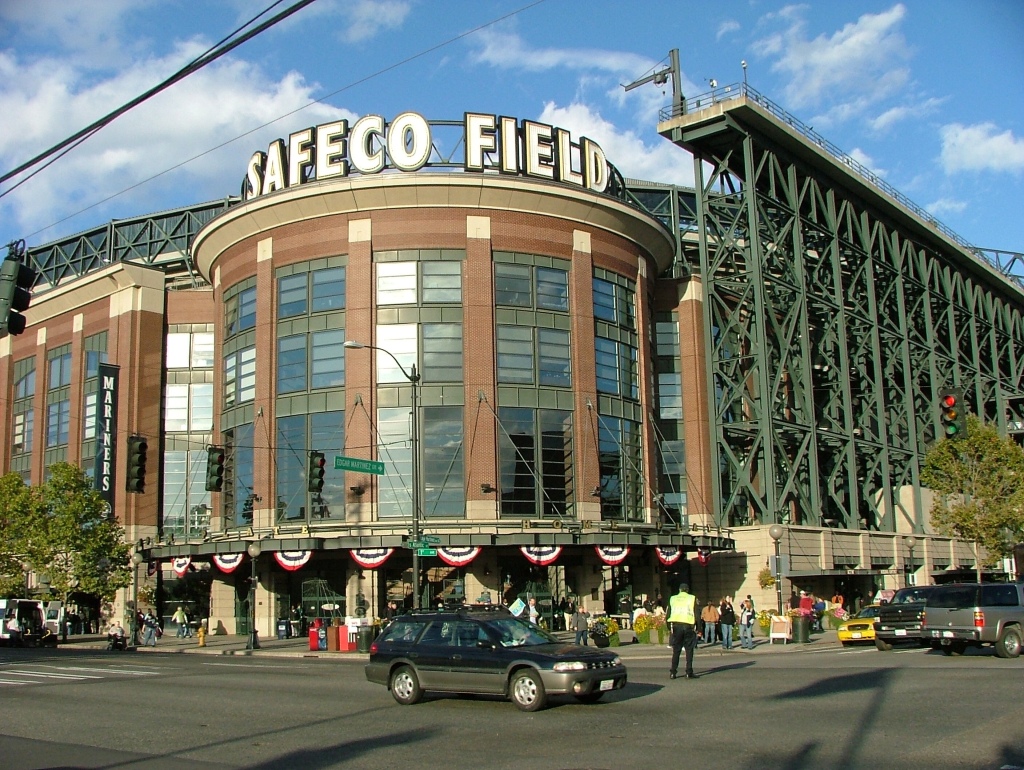
Seattle WA, Friday September 28th, 2007

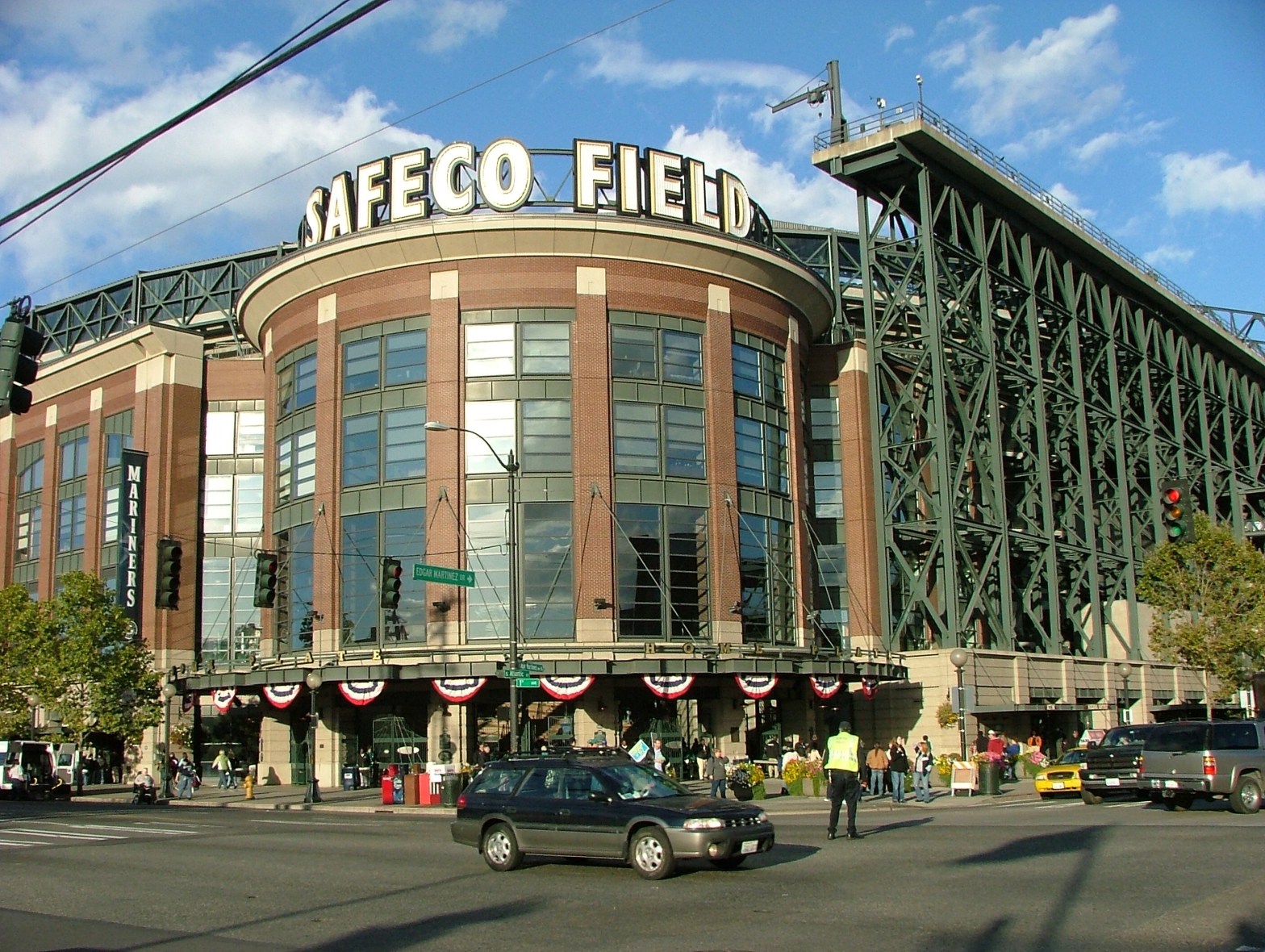
Safeco Field, Seattle WA. (Photo credit: Jeff Hayes)

We managed to squeeze in one more baseball trip at the tail end of the 2007 season, visiting the Pacific Northwest for the first time. The trip was planned around the final series of the season for the Seattle Mariners, but we were just as interested in seeing Seattle, a place I long wished to visit. For this trip, an old friend of mine joined us, as we explored Safeco Field (now known as T-Mobile Park) and beyond.

We left from Newark NJ on a non-stop flight to Seattle-Tacoma Airport, and the six hour flight was long but uneventful. At the airport, we met up with my friend Mike, who flew in from Boston and arrived not long after us. A fellow Met fan, Mike finally took the opportunity to join us on one of our baseball excursions. We didn’t know it at the time, but being as far from the travesty that would occur in Queens NY that weekend spared us from having to witness it.

Strong storms just missing Safeco Field. (Photo credit: Jeff Hayes)

Heading toward the hotel in Seattle, we were greeted by a severe thunderstorm, something of a rarity in the Pacific Northwest, especially in late September. Luckily, the storm passed us by, leading into a clear and comfortably cool evening at Safeco Field. Finding parking at the stadium was not difficult; there were at two lots at the field, with many offsite options available with walking distance (generally less than one-half mile). However, the prices for the offsite locations were not cheap.

As is the case when we visit a stadium for the first time, we walked around Safeco Field to get a feel for the place. Though I was aware that Qwest Field (now known as CenturyLink Field) was close to Safeco, I didn’t realize that they were across the street from each other. Adjacent to Safeco Field down the street is WaMu Theatre, home to live music.

The view of Seattle from just outside Safeco Field. (Photo credit: Jeff Hayes)

In fact, there was quite a bit to do and see around the sprawling sports complex. Even among the points of interest within walking distance, the most striking was the view of downtown Seattle. From the ballpark, the skyline was spectacular, and it dawned on me that I hadn’t considered how large Seattle was. That view stuck with me long after the trip ended.

Following our exploration of the environs, we headed into the park. Despite being a relatively new ballpark (which opened its gates for the first time in June 1999), it had a vintage look and feel, as evidenced by the rotunda that serves as the main entrance. Once inside, Safeco Field seemed huge, departing from the “newer” ballpark trend for smaller, more intimate experience. Not as large as the multi purpose colossuses from the 1960s and 1970s, it nonetheless was bigger in person that I thought seeing it on TV.

Safeco Field from on high. Note the roof over right field, and Qwest Field beyond the left field seats. (Photo credit: Jeff Hayes)

While we were able to cover much of Safeco Field via the lower level concourse, it did not allow us access to the entire field. Still, our initial impression of the stadium was largely positive, and the clear and relatively cool late afternoon/evening added to the ambiance of the park. Ducking back into the main concourse, we discovered the Seattle Mariners Hall of Fame.

Celebrating the rich baseball history of the Pacific Northwest, the Hall contained multi media exhibits chronicling baseball’s beginning in the 1870s, the Seattle Pilots and their lone MLB season in 1969, as well as Mariner greats through the years. Luckily for us, the Hall was not crowded, and we were able to appreciate the understated display. While not as expansive or detailed as Halls we’ve explored in other MLB ballparks, fans will appreciate the expression of appreciation of baseball in Washington.

Edgar Martinez and his classic stance on display at the Seattle Mariners Hall of Fame. (Photo credit: Jeff Hayes)

The Mariners hosted the Texas Rangers for the first game of the last series of the season, slated for a 710 pm start. Before heading to our seats, we went in search of baseball style dinner. As might be expected, there was myriad places to eat and drink, featuring local favorites as well as classic ballpark standards. Rather than indulge in some of the more exotic offerings, we chose the standard fare, and headed to our seats.

We witnessed something unique in my experience at the food court. Typically, the US dollar is stronger than the Canadian dollar, and I have never seen Canadian dollars accepted in US stores. However, during our visit to Seattle, the US dollar and Canadian dollar were about equal, and the food courts and team stores within Safeco Field were accepting Canadian dollars for payment.

The view from our seats. (Photo credit: Jeff Hayes)

The view from our seats was spectacular, as the weather was good enough for an open roof. As the sun was setting toward game time, the lights from the stadium were just taking effect, unveiling the beauty of Safeco Field. Much like Minute Maid Park in Houston, the massive roof towered over the right field stands. Clearing skies and seasonably cool temperatures set the stage for a great evening for taking in a ball game.

Both teams were finishing out the 2007 schedule with little to play for, other than pride. Neither team was headed to the playoffs, completing mediocre seasons. The Mariners sent veteran right hander Jeff Weaver to the hill, and the Rangers countered with 23 year Edison Volquez, making his sixth and final start of the season. Both teams sported relatively potent offenses, so a high scoring affair was in the offing, especially with the roof open.
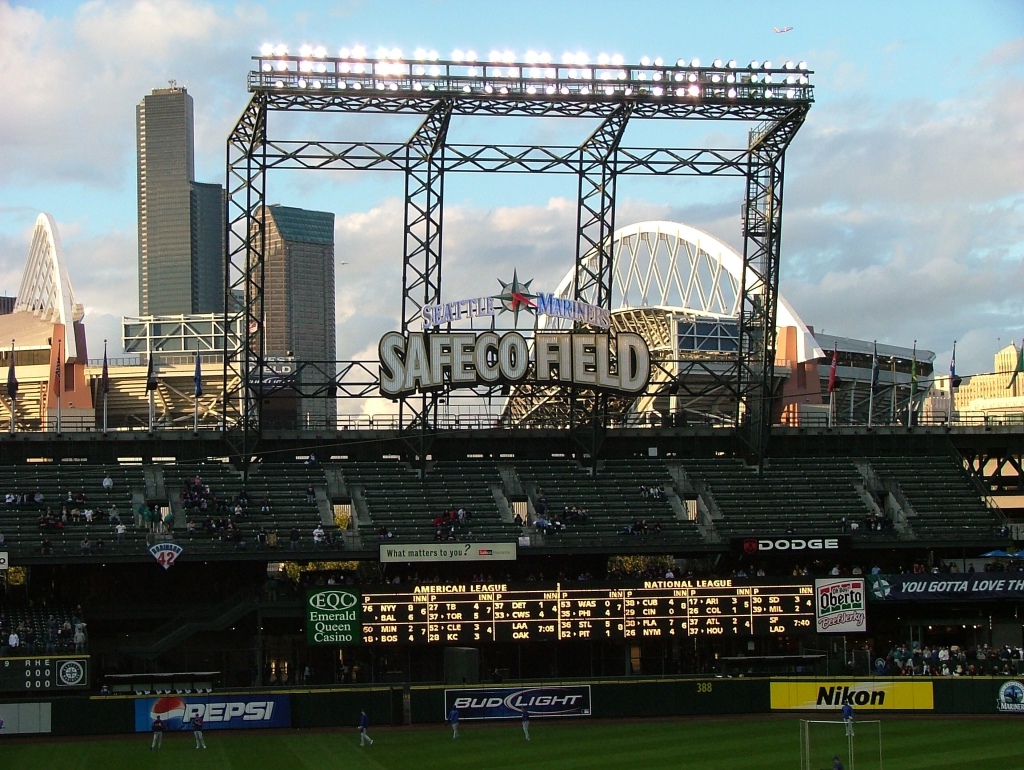
Safeco Field with the Seattle skyline as a backdrop. (Photo credit: Jeff Hayes)

Beyond the stadium, the main baseball attraction was Ichiro Suzuki. Finishing yet another outstanding season, Ichiro led the AL in hits and at bats, his .351 batting average second in the AL to Magglio Ordonez. Leading off and playing right field for the hometown Mariners, Ichiro was definitely THE fan favorite, receiving a rousing ovation before his at bat in the bottom of the first inning.

Ichiro Suzuki leading off in the Mariners half of the first inning. (Photo credit: Jeff Hayes)

The Rangers struck for two runs in the top of the third inning, while Edison Volquez mowed down the Mariners through the first five innings, effectively dispelling the notion of a slugfest at Safeco Field this evening. Though the game was fairly well attended, there did not seem to be anywhere near the 31,000 plus fans announced for the game. The less than capacity crowd should have been expected, since neither team has much left to prove at the tail end of the 2007 campaign.

Volquez’ s start unraveled in the bottom of the sixth, as the Mariners scored three runs before he could record an out. A phalanx of Rangers relievers managed to contain the damage. The Rangers offense pushed two runs across on the top of the seventh to take a 4-3 lead into the seventh inning stretch.

Safeco Field at night with the roof open. (Photo credit: Jeff Hayes)

Even with little left to play for in 2007, I was impressed by the passion of the Mariners fan. The combination of the venue and the fans instantly made this one of my favorite places to see a ball game, and we had just reached the bottom of the seventh! The Mariners bats woke up in the bottom of the eight to tie the game at 4-4, and the crowd responded according.

Mariners’ closer J.J Putz held the Rangers scoreless in the top of the ninth. In the bottom of the ninth, Rangers’ pitcher Mike Wood yielded a single to Mariners 3B Adrian Beltre, then retired the next two batters, seemingly dodging a bullet. However, 2B Jeff Clement ended the game with a walk off HR to center field, giving the Mariners a 6-4 victory. The raucous hometown crowd reveled in the victory as the filed out the Safeco Field. The walk off HR was a fitting ending to the end of a highly enjoyable baseball experience at a great ballpark.
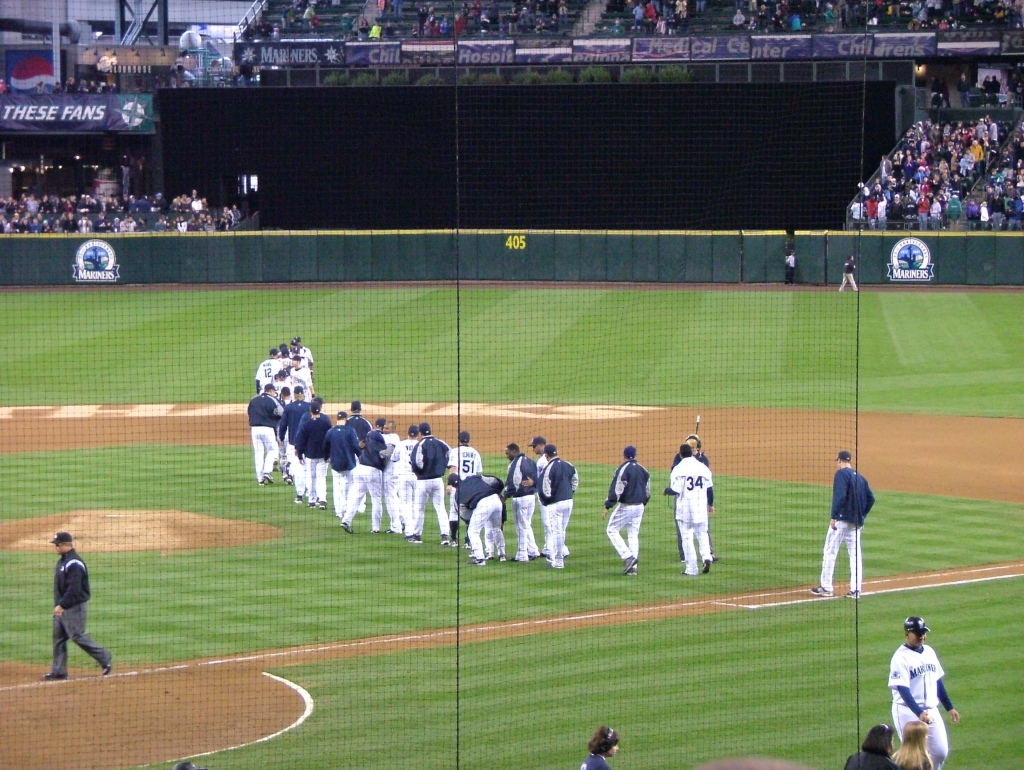
The Mariners celebrate a walk off victory! (Photo credit: Jeff Hayes)

Detroit, MI September 13th, 2009

Comerica Park, Detroit MI. (Photo credit: Jeff Hayes)

A warm and dry late summer day greeted us for the last game of the series at Comerica Park. Having seen much of what we wished to see in downtown Detroit the day before, we ate a late breakfast before heading directly to the park. However, it seemed as though the landmarks in Detroit were not quite done with us.

After parking the car in a lot away from the ballpark, we passed by a church along the way. St John’s Episcopal Church, built in 1859, was constructed in the Gothic Revival style, which we saw throughout Detroit. The belfry, the tallest section of the church, rises to 105 feet. It is the last remaining church on Woodward Avenue, an area once well known for its large number of religious buildings. The church was yet another example of the wonders I simply didn’t expect to find on this baseball trip.

St. John’s Episcopal Church, Detroit MI. (Photo credit: Jeff Hayes)

As we arrived at the main gate of Comerica Park, clouds started to filter the sunshine, and there was a noticeable increase in humidity, making the early afternoon feel more like summer than early fall. The warmth and humidity did not negatively impact our exploration of the park, as we wandered throughout the stadium.

Spending more time on the outfield side of the ballpark, we got a better look at the statutes just above the Tigers Wall of Fame. All of the statues showed Tiger greats in action poses, which was much more impressive in person than the images I had seen on the Tigers website. While it was not Monument Park at Yankee Stadium, the statues were a fitting tribute to the Tiger legends.

Statues near the Tigers Wall of Fame at Comerica Park. (Photo credit: Jeff Hayes)

Walking back from center field toward our seats, we got a great view of the seating area of the stadium. In order to keep the ballpark seating capacity lower, there are just three decks (including the luxury boxes and press area on the middle deck) at Comerica Park. Though not as large as some parks, the stadium had a larger feel from the outfield than from home plate.

Comerica Field from the left field concourse. (Photo credit: Jeff Hayes)

Before finding our seats, we headed to the Big Cat Food Court for lunch. There were other food options at Comerica, such as the Brushfire Grill or Blue Moon Brewhouse, but the food court near the main entrance suited our needs quite well. Sunday afternoon games following Saturday night contests are typically not as well attended, which allowed us to procure excellent seats for the series finale. With lunch in hand, we headed to our seats and awaited the start of the game.

The view from our seats. (Photo credit: Jeff Hayes)

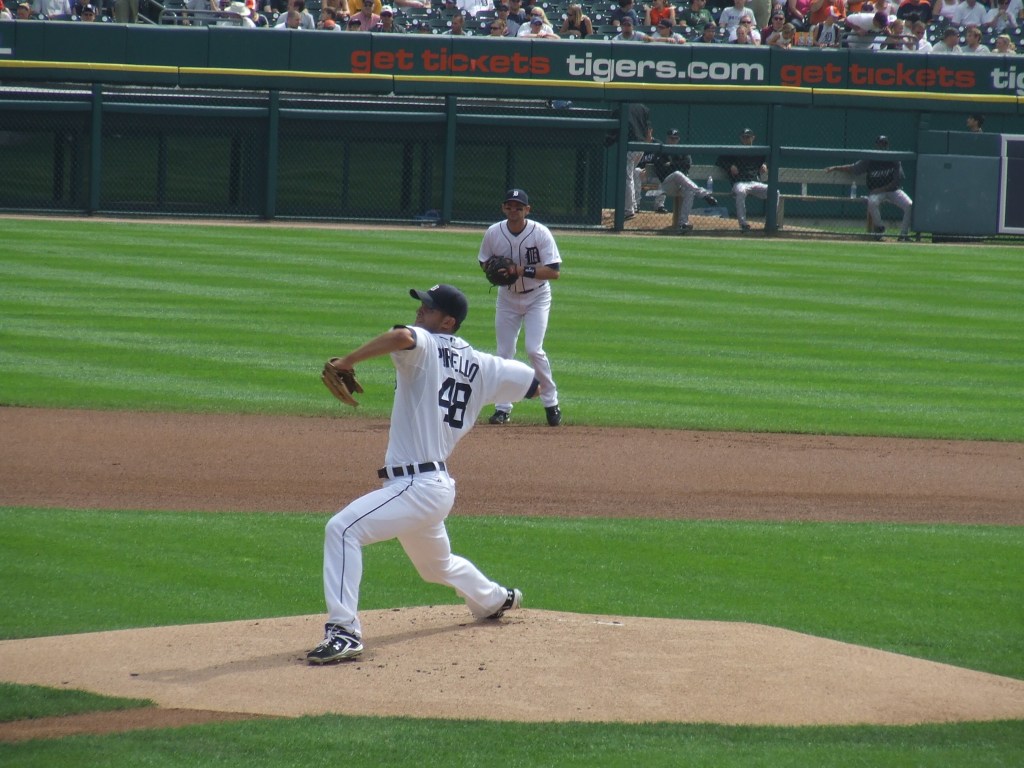
The pitching matchup for the Sunday matinee pitted rookies against each other. The visiting Jays sent 24 year old left hander Ricky Romero to the mound. Romero was concluding a very successful rookie season, finishing third in the 2009 Rookie of the Year balloting. His opponent for this afternoon contest was 20 year old right hander Rick Porcello. The Tiger rookie had an equally impressive rookie season, during which he compiled a 14-9 record. The matchup suggested a pitcher’s duel, despite the fact that both offenses were potent.

Ricky Romero delivers a pitch in the second inning versus the Tigers at Comerica Park. (Photo credit: Jeff Hayes)

After a scoreless first inning, the Tigers roughed up Romero for four runs in the second and third innings. Romero settled down following the outburst, finishing his afternoon after six innings, allowing 10 hits while walking three. By contrast, Rick Porcello held the Jays scoreless through three innings before allowing a pair of runs before exiting after six innings. While the pitching matchup was not as impressive as expected, it was clear that both starters were burgeoning starts with bright futures.

Rick Porcello delivers a pitch against the Blue Jays at Comerica Park. (Photo credit: Jeff Hayes)

Our seats gave us a great view of the playing field. Comerica Park has a strip of dirt between the mound and home plate. Known as a keyhole, Chase Field in Phoenix and Comerica Park are the only MLB parks to feature one. Additionally, the dirt area around home plate is shaped like a home plate. Both of these features are nods to the past, especially the keyhole, which was once a common feature at ballparks.

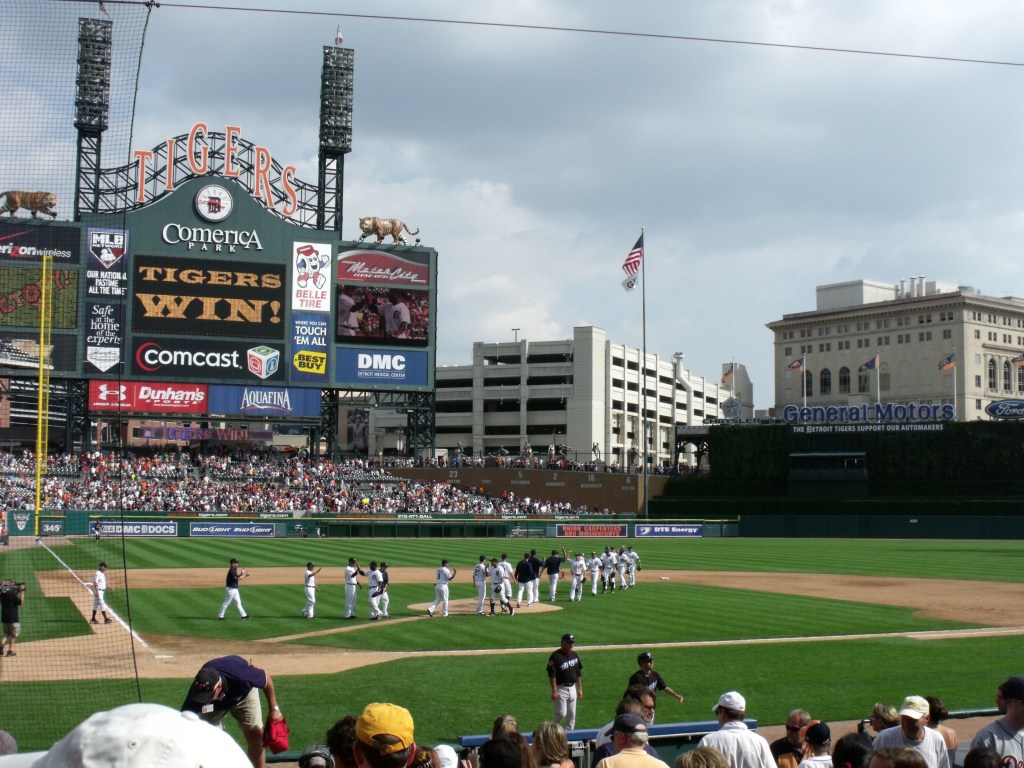
Tigers win! (Photo credit: Jeff Hayes)

The Tigers tacked on three more runs in the eighth inning, closing the scoring and handing the Tigers a 7-2 victory. The game time as a very reasonable 2 hours and 40 minutes, in front of an announced crowd of 32,000+ fans. Taking in the ballpark all afternoon, I decided that Comerica Park had become my second favorite MLB Park (just behind PNC Park in Pittsburgh, PA). The combination of old school features and new ballpark amenities made this an ideal place to see a ballgame. Though it is a long drive (or relatively short flight) to Detroit, I hope to return here soon.

Goodbye Comerica Park. I hope to be back soon! (Photo credit: Jeff Hayes)

Detroit, MI September 12th 2009

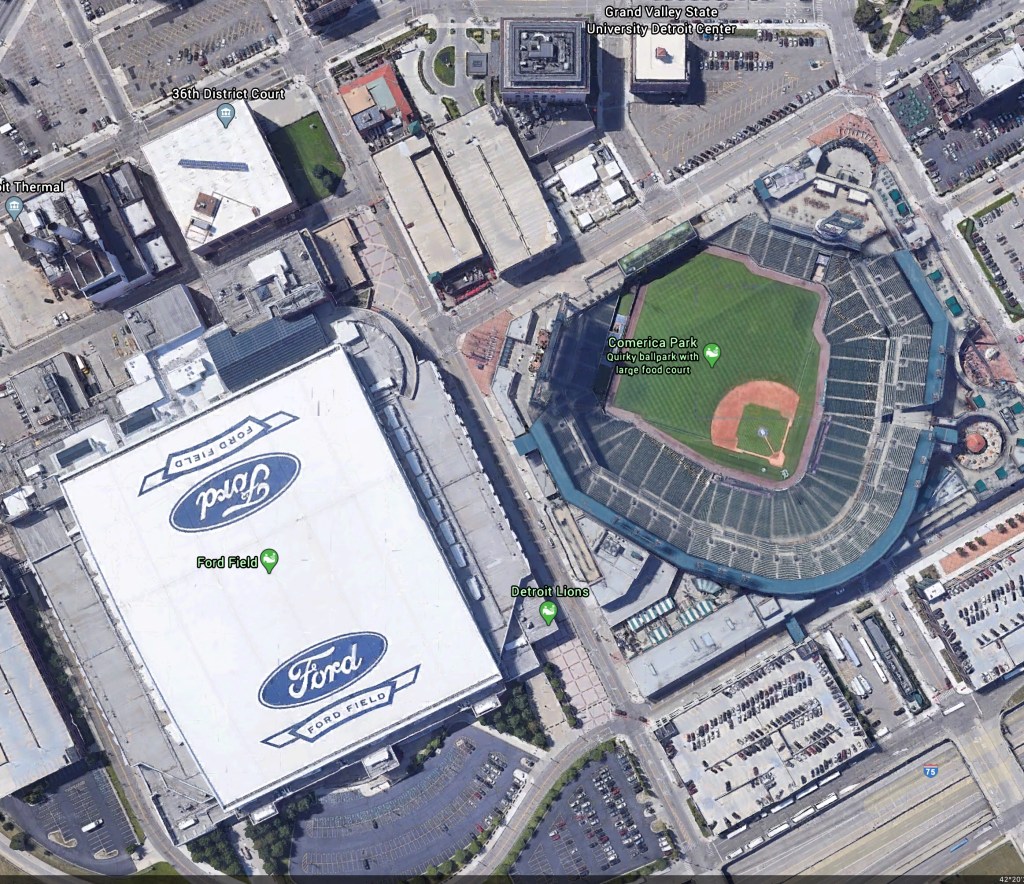
Google Earth view of Comerica Park and Ford Field, Detroit MI.

1. Downtown Detroit

Following breakfast near the hotel, we decided to explore downtown Detroit. The few glimpses I had yesterday before the game piqued my curiosity, as the glimpses challenged my preconception of the city. Visions of Detroit from the news and the movie 8 Mile danced in my head. In our previous visit to Detroit (in 1999 to see Tiger Stadium before it closed for good), we didn’t venture from from the park, and did not see much of the city.

We found parking near the Joe Louis Arena for $5, which covered our exploration of Detroit AND the game in the evening. Rather than consult a map and plan our day, we instead started near Comerica Park and wandered from there. My initial impression was that downtown Detroit had architecture and building materials similar to those we’ve seen in Newark, NJ and Baltimore, MD.

Fox Theater in Detroit, MI. (Photo credit: Jeff Hayes)

The first landmark we encountered was across the street from Comerica Park: the Fox Theatre. One of five Fox theaters built across the US in the 1920s, the ten story theater in Detroit was completed in 1928. The theater portion of the building holds 5,000+ patrons, the largest of the original Fox theaters, and remains the lone surviving theater from the 1920s. Restored in 1988, the third through tenth floors host office space.

Walking along Woodward Avenue toward Michigan Avenue, we saw the Michigan Soliders’ and Sailors’ Monument. A Civil War monument, the landmark was unveiled in 1872, containing the names of all Michigan residents who gave their lives for their country. The monument was added to the National Register of Historic Places in 1984.

The Michigan Soliders’ and Sailors’ Monument in Detroit, MI. (Photo credit: Jeff Hayes)

We walked among the skyscrapers of downtown Detroit on our way to the Detroit River, which serves as the international border between Michigan and Ontario. The buildings reminded me of older cities of the Northeast, both in architecture and age. Though I’d never been to this portion of the city, it definitely had a familiar feel.

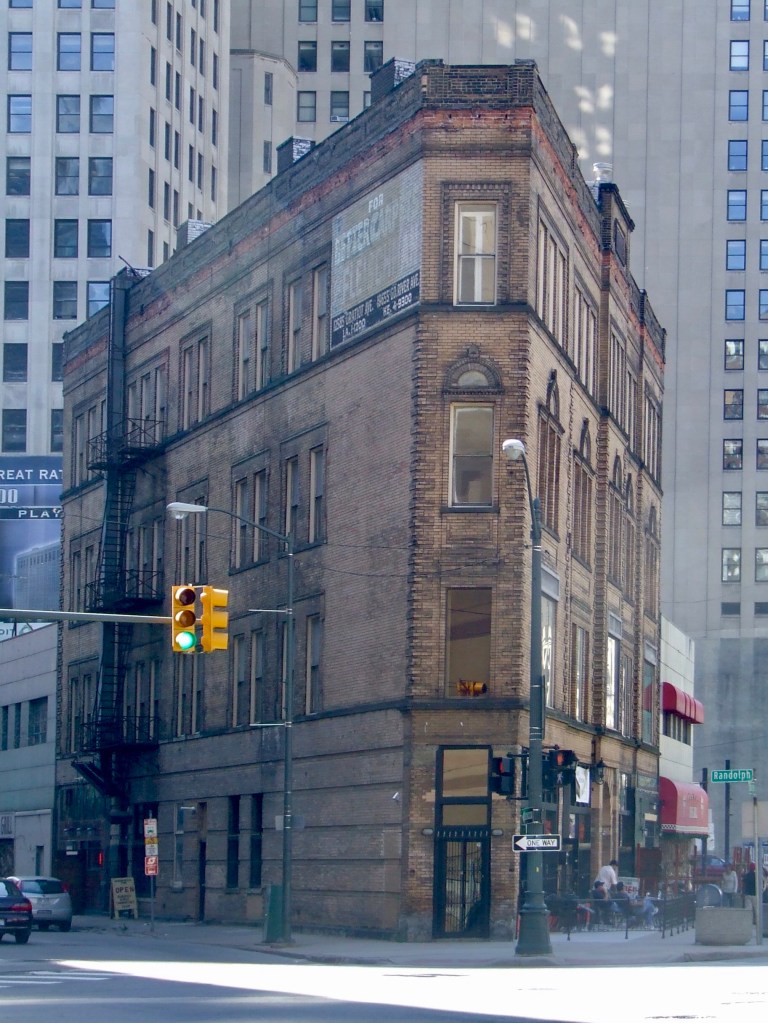
As we headed toward the river, we encountered a building that looked very familiar. While this building was not a skyscraper (in fact, it was not even the tallest building in its vicinity), it had a very distinctive shape and coloring. Dubbed the Flatiron building of Detroit, the structure bore an amazing resemblance to its namesake in New York City. Had I not known about the building in Manhattan, I might have missed this gem.

The FlatIron building among the skyscrapers in downtown Detroit. (Photo credit: Jeff Hayes)

Crossing the walkway over the Detroit-Windsor Tunnel, we encountered the Mariner’s Church. Founded in 1842, it was designed as a mission for maritime travelers of the Great Lakes. Constructed of lannon stone, the design of the church was Gothic Revival (which is seen elsewhere in Detroit). The church was a stop on the Underground Railroad, the final one before former slaves reached freedom in Canada. The church was moved 880 feet to the east in 1955 to accommodate the construction of the Detroit-Windsor Tunnel.

The Mariners Church in Detroit, MI. (Photo credit: Jeff Hayes)

We found ourselves on the Detroit Riverwalk, a concrete walkway which includes parks, plazas and pavilions that afforded a great view of the river on one side, and the skyscrapers of Detroit on the other. Located along the river was the Gateway to Freedom International Memorial to the Underground Railroad. Dedicated in 2001, the memorial commemorates Detroit’s role in the Underground Railroad. Though I was aware that Great Lakes states were active in the Underground Railroad, I had no idea how important Detroit was in the process

Gateway to Freedom International Memorial to the Underground Railroad, Detroit, MI. (Photo credit: Jeff Hayes)

Our final stop on our impromptu tour of downtown Detroit was the Renaissance Center. Often referred to as “a city within a city”, the Center is a collection of seven interconnected cylindrical buildings. Perhaps the most famous is the Detroit Marriott at the Renaissance Center; at 73 stories, it is the largest of the seven buildings. It dominates the Detroit skyline, and is visible from a great distance.

We stopped at a cafe near the Center for lunch, sitting outside to enjoy the fantastic weather. On the walk back to the car, we passed over the Detroit-Windsor tunnel before reaching the Joe Louis Area. We barely scratched the surface when it came taking into the myriad landmarks in Detroit, yet I felt we saw so much. There was far more to see in Detroit than I could ever have imagined.

The Renaissance Center, Detroit MI. (Photo credit: Jeff Hayes)

2. Comerica Park

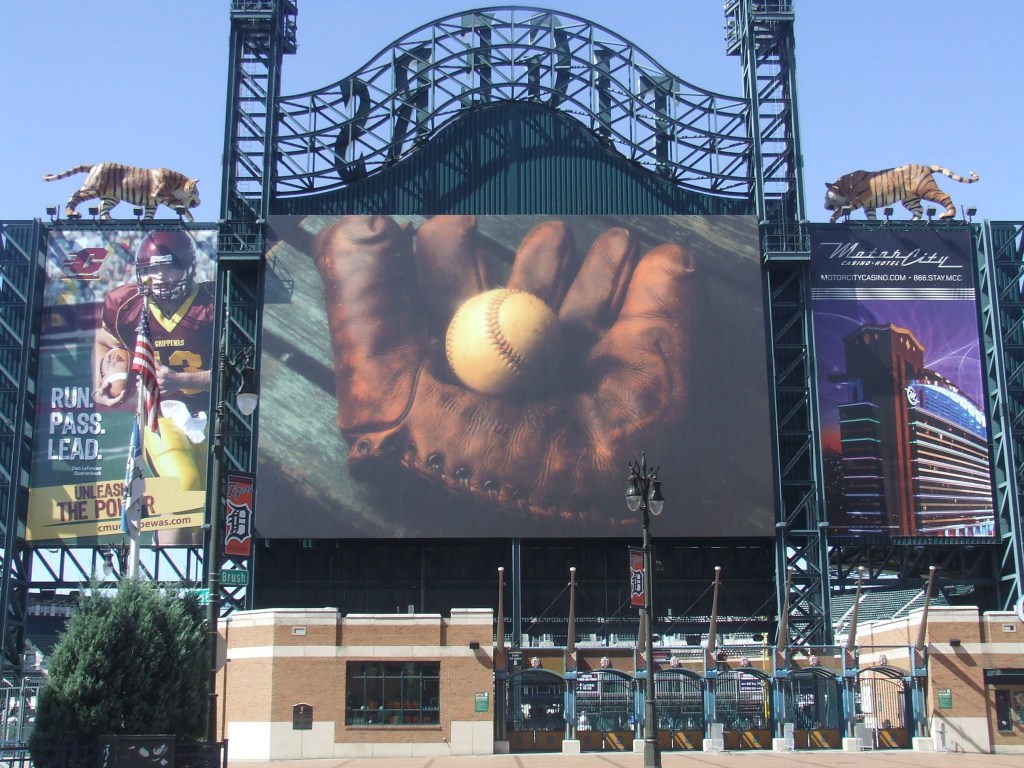
A giant glove lurked behind the scoreboard in left field. (Photo credit: Jeff Hayes)

Walking to the park from the lot near the Joe Louis Arena, we arrived just as the gates opened. Having more time to explore, we wandered around the outside of the ballpark first. Comerica Park is very much an urban ballpark, not far from the skyscrapers to east and northeast. Though there wasn’t much to see in the immediate area around the park, we did get a good look at the giant glove on the back of the left field stands.

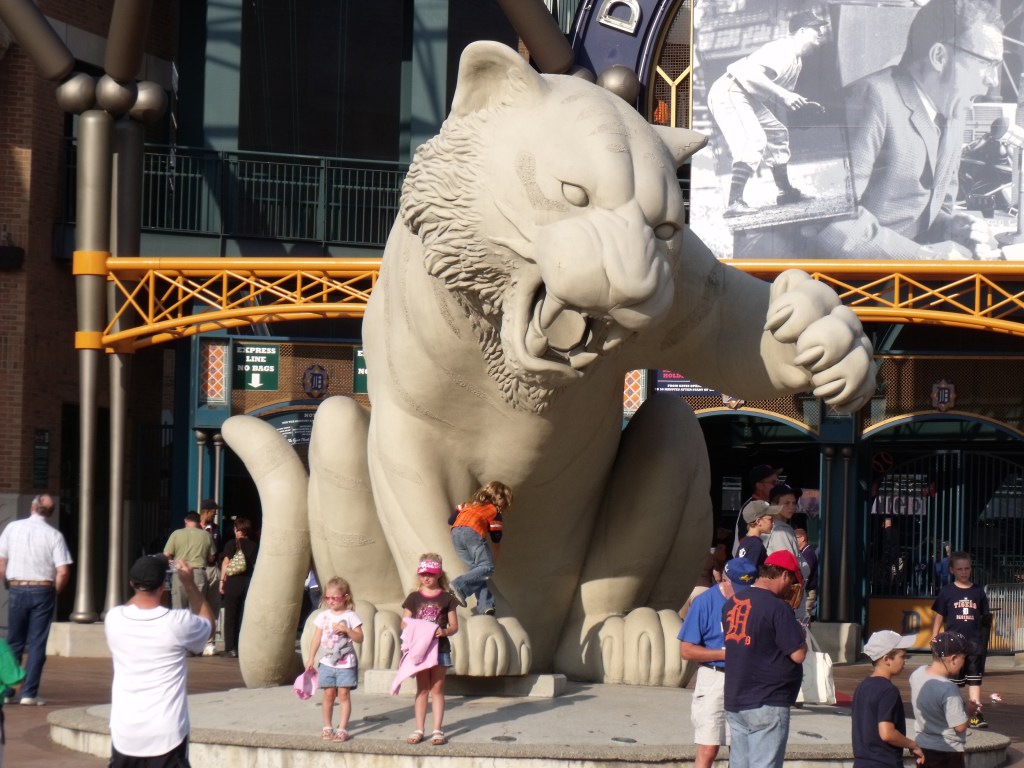
Finding our way back to the main entrance, we were again greeted by the huge tiger. As might be expected, the tiger drew quite a bit of attention, and it was exceedingly difficult to get a picture of the feline without people in it. Normally, such things at ballparks do not impress me, but this tiger was very photogenic, and a decided fan favorite.

The stone tiger is certainly a kid favorite. (Photo credit: Jeff Hayes)

Once inside, we strolled through the concourse. Getting a better look at ballpark in the sunlight revealed that it had a great baseball atmosphere, one that rivaled the old Tiger Stadium. Opening in 2000, it was one of the “newer” MLB ballparks, which meant it had a slightly smaller capacity (about 41,000). The smaller capacity gave the park a more intimate feeling, which was evident almost immediately,

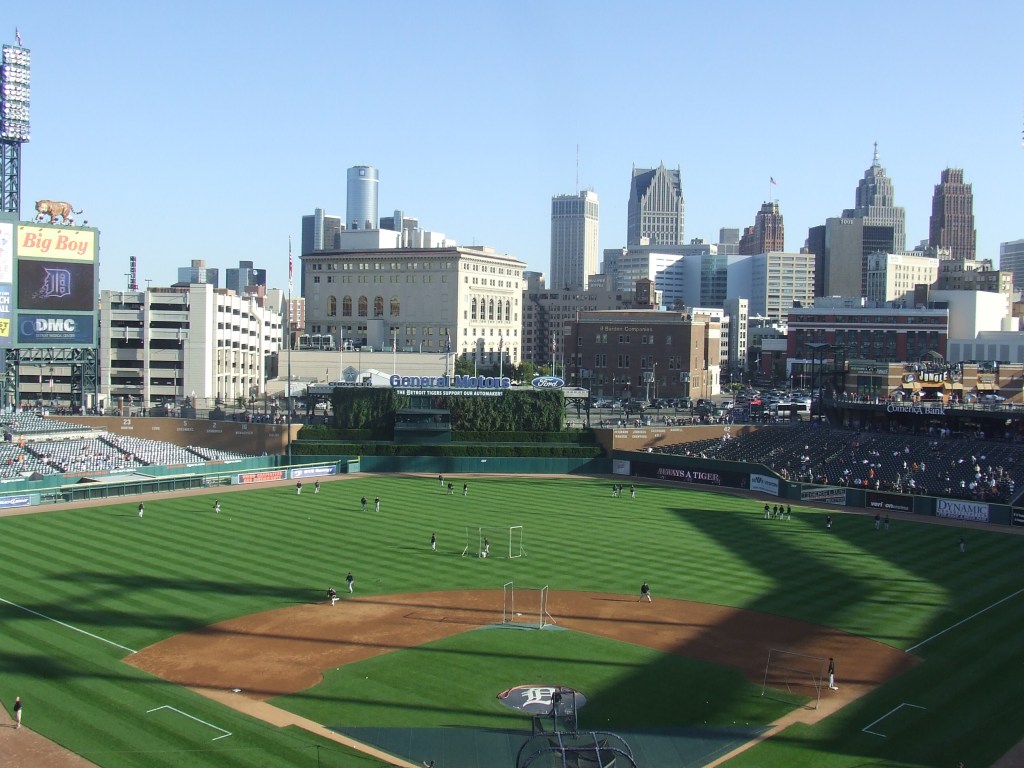
Like many of the newer MLB ballparks, Comerica Park was constructed to showcase the downtown area. This was evident when we toured the upper deck, where the Renaissance Center dominated the skyline of Detroit beyond center field, which reflected the setting sun to the west. Over the left field fence, the mammoth Ford Field towered over Comerica.

The Detroit skyline from the upper deck at Comerica Park. (Photo credit: Jeff Hayes)

In left field was the massive scoreboard, which was the largest in baseball when the park opened in 2000. Roaming the top of the scoreboard were two large bengal tigers, whose eyes light up following Tigers wins. Walking toward center field, we discovered the Tigers Wall oF Fame. Retired Tigers players’ number adorn the wall in center field (except for Ty Cobb, who did not wear a number). On the concourse above the wall stood statues of the players in action.

Tigers Wall of Fame in center field at Comerica Park. (Photo credit: Jeff Hayes)

We completed our walk at the main gate behind home plate, where we found the Big Cat Food Court. Not surprisingly, there was a wide variety of food from which to choose, with dishes from around the world. Next to the food court was a carousel, featuring bengal tigers for kids to ride. Per usual, my palette dissuaded me from experimenting, and I chose fare more typical of a baseball stadium.

From the Big Cat Food Court we went in search of our seats. For tonight’s game, we obtained better seats than the night before. Despite the regional rivalry between the teams, there were still good seats available. Sitting just to the left of home plate in the lower level, we had an excellent view of the field, as well as the skyline of Detroit.

The view from our seats. (Photo credit: Jeff Hayes)

The Tigers again hosted the Blue Jays in the second game of a three game set. Starting for the hometown Tigers was 25 year old right hander Edwin Jackson, who was reaching the end of a mostly successful 2009 campaign. On the hill for the visiting Jays was right hander Scott Richmond, who was limping toward the end of a decidedly disappointing season. Given the pitching matchup, and warm and dry evening, suggested that we could in store for an offensively driven ball game.

Sitting very near the Tigers dugout, we caught a glimpse of Jim Leyland, the Tigers manager. Leyland was a baseball legend, having led the Pittsburgh Pirates in the 1980s and 1990s. Leyland took the Tigers to the World Series in 2006, where they lost to the St Louis Cardinals. Leyland briefly popped out of the Tigers dugout just before the game, allowing my brother to snap a picture of the storied Tigers skipper

Tigers Manager Jim Leyland. (Photo credit: Jeff Hayes)

As expected, the ball was carrying that night, as Curtis Granderson led off the Tigers first inning with a home run, and the offensive display was on. After the teams traded runs in the second inning, the Tigers scored three runs in the fifth inning, ending the night for the Jays’ Scott Richmond.

However, that ended the scoring for the Tigers, as the Blue Jays’ bullpen shut down the potent Detroit offense the rest of the way. Meanwhile, the Jays scored in the last five innings of the game to earn an 8-6 victory.

The giant scoreboard in left field tells the story. Unfortunately, with the Tigers losing, we didn’t get to see the green lasers from the tigers eyes. (Photo credit: Jeff Hayes)

The time of the game was a shade over three hours, which is typical of an American League game. During the content, I became enamored with Comerica Park. The ballpark has old school charm with a new ballpark feel. We would get a chance to see the park in full sunshine tomorrow afternoon, and following what I saw tonight, I couldn’t wait for the series finale.