Louisville Slugger Field, Louisville Kentucky – June 27th 2021

Entrance to Louisville Slugger Field, complete with a statue of Pee Wee Reese. (Photo credit: Jeff Hayes)

After exploring downtown Louisville on a warm and humid morning, we headed to the second ballpark on our first baseball trip of 2021. Arriving well before the gates opened at Louisville Slugger Field, we parked next to the stadium in a public parking lot adjacent to the right field wall. Since parking (a rather hefty $8) was presumably for the day, we left the car in the lot and wandered around nearby Louisville. Gates at the ballpark opened about an hour before game time (scheduled for 100 pm), and we returned just as fans were entering.

As is typical for a new ballpark, we walked around the outside of Louisville Slugger Field (home of the Louisville Bats, the Triple A affiliate of the Cincinnati Reds). Though the ballpark opened in 2000, the brick face on all sides of the stadium gave it a retro field, and it fit in well with the surrounding buildings. Located in front of the ballpark is a statue of Pee Wee Reese. Raised in Louisville from the age of eight, the Hall of Fame shortstop played his entire MLB career with the Brooklyn/Los Angeles Dodgers, where he won a world championship in 1955. Reese returned to Louisville after his playing career ended, and later in his life, he worked for the owners of the Louisville Slugger company. Louisville honored its “native” son with a symbol that greets fans as they enter the ballpark.

Louisville’s own Pee Wee Reese gracing the main entrance of Louisville Slugger Field. (Photo credit: Jeff Hayes)

Following our tour of the outside of the park, we entered through the side entrance (nearest the main parking lot). Greeted by smiling and helpful ticket attendants, we were reminded we were in Kentucky, where the hospitality was almost disarming to a couple of life long residents of the Northeast. Once inside, we were impressed with the inner concourse of Louisville Slugger Field. Reminiscent of Truist Park in Atlanta, the inner concourse had the look and feel of an MLB park, a feature not expected in a minor league stadium. In addition, a portion of the inner concourse was air conditioned, which was a welcome respite from the building northern Kentucky heat and humidity.

Walking along the concourse (which encircles the playing field), we wandered past the right field foul pole, where ongoing construction indicated additional seating in the right field corner, as well as a picnic area. While passing center field (and the batter’s eye), we found a grass covered seating berm stretched across left center field, in front of one of the two videoboards in the ballpark. We did not see anyone seated on the berm (it was probably too hot in the direct sunlight for that), but there were a few people milling around seats above the berm. Just beyond the berm was a left center entrance gate, for those fans entering from East Witherspoon Street.

A very MLB like inner concourse at Louisville Slugger Field, featuring banners of former players hanging from the rafters. (Photo credit: Jeff Hayes)

From the concourse in left field, we were treated to some outstanding views of Louisville’s Main Street, as well as the Ohio River and southernmost Indiana to the north. As we would discover later, this part of Louisville Slugger Field afforded the best view of both the city and the river. Interstates between the ballpark and the river would obscure the Ohio River, but the gold colored bridges were visible. From the remainder of the stadium, only the tallest buildings in Louisville were visible over the forest green aluminum roof.

Seating in the lower level of the park extended from left field behind home plate to the right field foul pole, offering more than 10,000 green seats. There is a second level in Louisville Slugger Field, but unlike the vast majority of the ballparks we have visited in the US, we were not granted access (because we did not possess tickets stating our seats were located there). While we have become accustomed to exclusivity in MLB parks, this was one of the first examples of it we have seen in a minor league (MiLB) stadium. Hopefully the exclusivity seen here does not become more widespread in the future. Including the second level and private suites, the ballpark can accommodate over 13,000 fans, which makes it possibly the largest MiLB stadium we have visited (with regard to capacity).

The view of downtown Louisville from right centerfield concourse at Louisville Slugger Field. (Photo credit: Jeff Hayes)

To my mild surprise, there were plenty of seats available for the early afternoon contest. We have found that Sunday afternoon games are generally more lightly attended than Saturday night games, but the assembled crowd seemed smaller than might be expected. Perhaps the heat (with temperatures at game time near 90 degrees, with moderate humidity) or the small threat of thunderstorms kept the attendance light, but we were able to secure great seats just two rows behind the first base dugout. Unlike most ballparks, the home team occupied the third base dugout, placing us close to the visiting team, the Indianapolis Indians (the Triple A affiliate of the Pittsburgh Pirates).

Unfortunately, our seats put us in direct sunshine, though intermittent clouds helped take the edge off the heat at times. After finding our seats, we sought out a baseball lunch at the concession stands scattered across the inner concourse. There were several places to eat within Louisville Slugger Field, but we were content with standard fare, along with plenty of cold drinks to combat the heat and humidity. Surprisingly, the cost of the concessions was much higher than I expected, at least when compared to ballparks in other portions of the US. These prices would become significant, as we attempted to keep well hydrated during the game. During the first pitch ceremony, three siblings threw out first pitches to the catcher, who turned out to be their father returning from active duty.

A composite image of Louisville Slugger Field from centerfield. (Photo credit: Jeff Hayes)

Our seats provided great sight lines for the entire park. Two moderately sized videoboards located in left center and right centerfield provided all of the essential information for serious baseball fans, and played videos and replays as well. The left videoboard displayed the hitter’s information, while the right videoboard showed the pitcher’s stats, as well as the score. Auxiliary scoreboards located above the second deck beyond the dugouts kept fans informed on the count, the inning and the score. As a dedicated baseball fan, I appreciated the multiple sources of data.

Crisp starting pitching from both sides kept the game moving, and only 41 minutes had elapsed by the end of the third inning. Clouds that had been building since late morning started to produce showers and thunderstorms, most of which bypassed Louisville Slugger Field. However, we did not escape unscathed, as mainly light rain showers (lasting about 20 minutes) did affect the ballpark, though it did not require a stoppage of play. Despite the rain, conditions did not cool off much, and by the middle innings, I began to feel the effects of the heat. In fact, many of the fans in the seats around us eventually sought refuge from the sun by heading to seats out of the sun, or into the cooler inner concourse.

A view from behind home plate on the lower level showing the videoboards in left center and right centerfield. (Photo credit: Jeff Hayes)

We quickly discovered that Louisville Slugger Field was very close to the flight path of nearby Muhammed Ali Louisville Airport. Though planes did not pass directly overhead, we did see planes every couple of minutes come very close as they took off from the airport. Being veterans of the air traffic out of LaGuardia Airport over Shea Stadium in New York, we were hardly phased by the nearly constant planes passing by, but I did find myself catching a glimpse of the aircraft as they climbed out to wherever they were going.
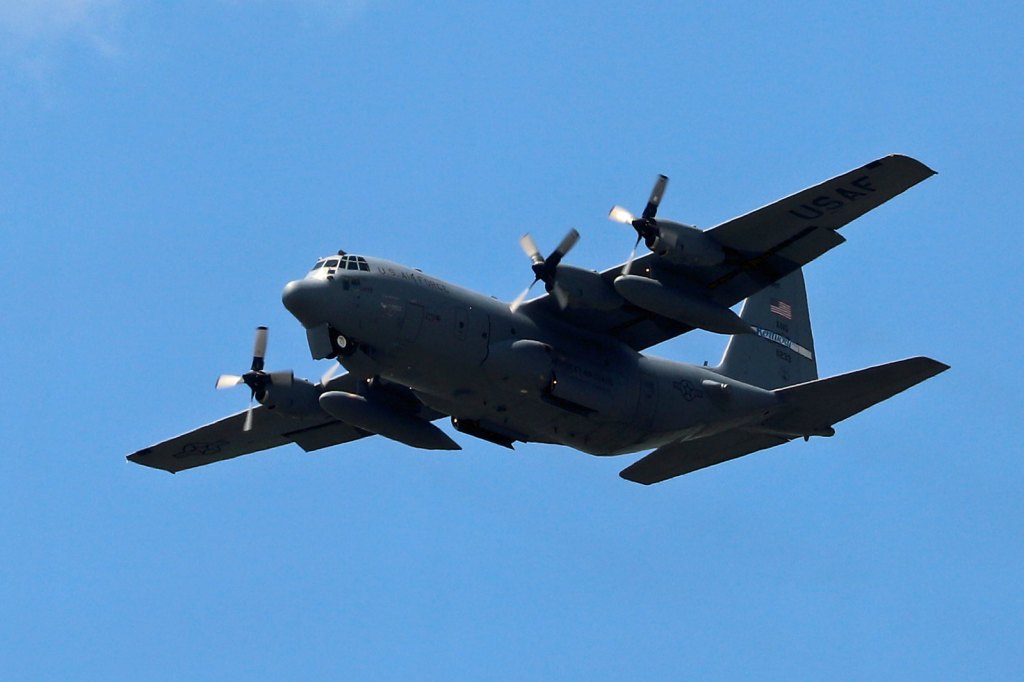
An Air Force aircraft passing near Louisville Slugger Field after taking off from the nearby airport. (Photo credit: Jeff Hayes)

In the bottom of the seventh inning of a scoreless game, we saw something of a rarity. Indians lefthander Braeden Ogle took too long to deliver a pitch, and the home plate umpire awarded the batter a ball. In the minor leagues (as well as the Atlantic League), pitchers are required to deliver a pitch to the plate within 15 seconds (20 seconds with runners on base), in an attempt to speed up the pace of play. Failure to do so can result in a ball being awarded to the hitter. Despite the presence of pitch clocks in most ballparks, this rule is rarely enforced, but I saw delighted that it was in this instance.

Indianapolis Indians pitcher being checked for illegal substances before the top of the inning. (Photo credit: Jeff Hayes)

A home run in the top of the eight inning gave the visiting Indians a 1-0 lead, and it appeared as though the Indianapolis bullpen would make the single run stand up going into the bottom of the ninth. The Louisville Bats, which had been largely dormant for much of the game, came to life in the bottom of that frame. The Bats used three singles and a walk to plate two runs to secure a 2-1 victory. Even with the heat and threat of rain, most of the Louisville faithful remained to celebrate the hard fought win.

After the game, kids were invited to run the bases (which is not unusual for weekend games). In a surprise to us, all fans were permitted on the field for a game of catch. Nearly three hours in the heat and and humidity of northern Kentucky essentially wiped me out, and I was not up for a game of catch. With a long drive awaiting us, we did something that would normally be unconscionable; we did not partake in the opportunity to walk on a professional baseball field.

Louisville Bats celebrating after a walk off single in the bottom of the ninth. (Photo credit: Jeff Hayes)

Louisville Slugger Field is a fine example of a Triple A ballpark, complete with all the amenities fans could need. The concourse area looks as though it was modeled after a MLB park, and ongoing construction indicated that the ownership was dedicated to improving the fan experience. Only limited access to the second deck, and the seemingly high concession prices, detracted from a great baseball atmosphere, and we were treated to an outstanding game as well. While I would recommend visiting the ballpark if you are in the vicinity during baseball season, being so far away, I am not sure we will return.

PNC Park, Pittsburgh PA

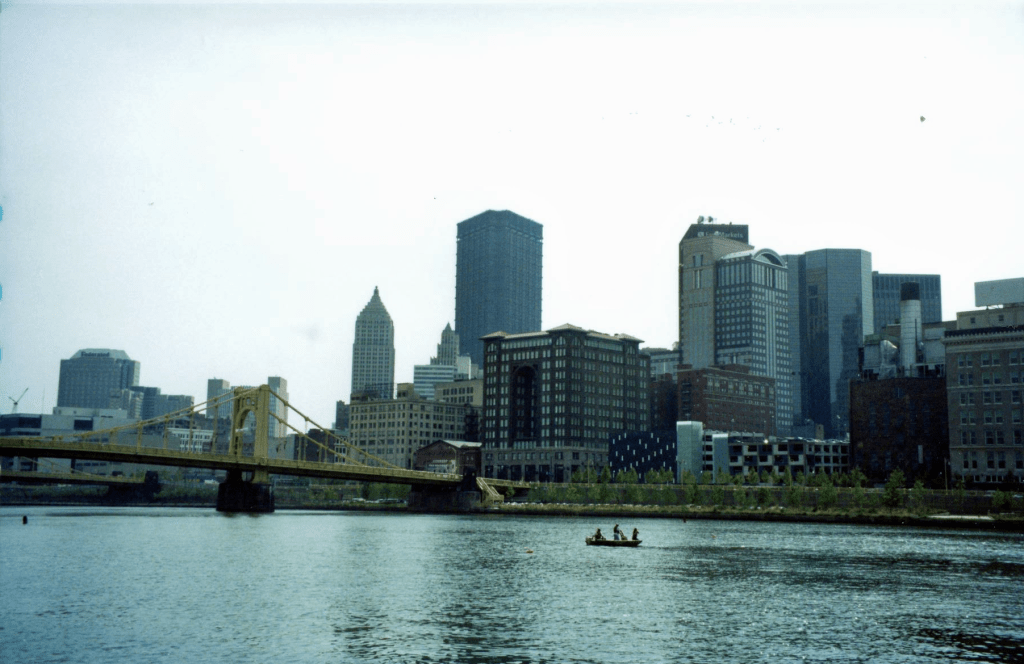
Looking at PNC Park in Pittsburgh across the Allegheny River. (Photo credit: Jeff Hayes)
  • First visit: Wednesday September 19th 2001
  • Most recent visit: Sunday September 17 2006

Our first visit to PNC Park was not supposed to happen. This game was originally scheduled to be played at Shea Stadium in New York City, but following the attacks on September 11th 2001, the parking lot at Shea was used as a staging area to deal with the aftermath of the attacks. Since Shea Stadium would not be available for baseball in the near term, the games were moved to PNC Park in Pittsburgh PA. After a short break, baseball resumed on September 17th 2001, and the Mets played a three game set against the Pirates, starting on that date.

Since we had travel plans scrapped after the attacks (we were flying to Chicago to see the Pirates take on the Cubs, but the games and flights were cancelled), we both had some time off. We chose to attend the last game of the series, a Wednesday matinee on September 19th. Getting an early start from central NJ, we made the 365 mile drive in about five and one-half hours, arriving at the ballpark before noon. Because the game was supposed to be played in New York, there was not much demand for parking, which allowed us to park just across the street from the stadium for a reasonable price.

The view of downtown Pittsburgh from the walking path along the Allegheny River adjacent to PNC Park.

With time before the game, we briefly wandered around the park. Along the right field wall, we discovered a walking path adjacent to the Allegheny River. Dubbed Three Rivers Heritage Trail, the concrete path snakes along the river for about one and one-half miles. Given our time constraints, we did not amble nearly that far, but we did enjoy the view of downtown Pittsburgh from the riverside. Even if we were not taking in a ballgame that day, a simple trek along the river would have provided an early afternoon of peaceful vistas. Its proximity to the river enhanced the appeal of PNC Park, and we had not even seen the inside of the stadium yet!

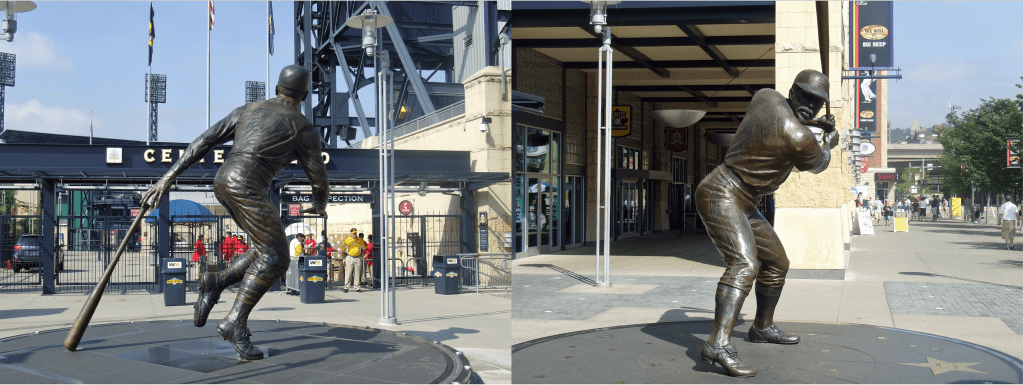
During our exploration of the environs of the the stadium, we found a pair of Pirates greats immortalized in bronze. Both Roberto Clemente and Willie Stargell were on display outside the park, with each statue larger than life. Roberto Clemente was just a bit before my time, as I was a toddler when he had his best years in Pittsburgh. Conversely, I was much more familiar with Stargell, with his trademark “windmill” bat twirl just before the arrival of the pitch. Two other statutes stood outside the ballpark (Honus Wagner and Bill Mazeroski) eluded our search, but perhaps we would view them on another visit.

Pirates greats Roberto Clemente (left) and Willie Stargell (right) are immortalized outside of PNC Park in Pittsburgh PA. (Photo credit: Jeff Hayes)

PNC Park is a baseball only stadium, at the end of its inaugural season in September 2001. Since the game was not supposed to be played in PNC Park, there were few fans present was we ended our tour of the outside of the stadium before heading into the park. It seemed that, based on the number of New York jerseys we saw on people milling around near the home plate entrance, those who did attend the matinee were mainly Mets fans, making a drive similar to ours. Apparently a five hour drive did not deter the New York faithful, who seemed determined to see the game. Unfortunately, the weather was less than cooperative, with warm and humid conditions under mainly cloudy skies.

Once inside, we could immediately see that the view of downtown Pittsburgh was the focus of the new ballpark. Unlike its predecessor (Three Rivers Stadium), PNC Park was open in centerfield, providing a sweeping vista of the city and Allegheny in front of it. Rather than AstroTurf, the field was covered with Kentucky bluegrass, which looked a bit worse for wear after a hot Pittsburgh summer. As we started to walk along the lower concourse toward right field, I couldn’t tear myself away from the view beyond the centerfield wall! Beyond the ballpark, several of the bridges connecting the north shore of the Allegheny River to downtown Pittsburgh were painted Aztec gold. At the time, I did not understand why they were painted this hue, but research later indicated that the bridges connected surrounding areas to the Golden Triangle section of the city. In any case, even the overcast of the day could not hide the luster of the bridges, and I discovered that I’d found my new favorite MLB ballpark!

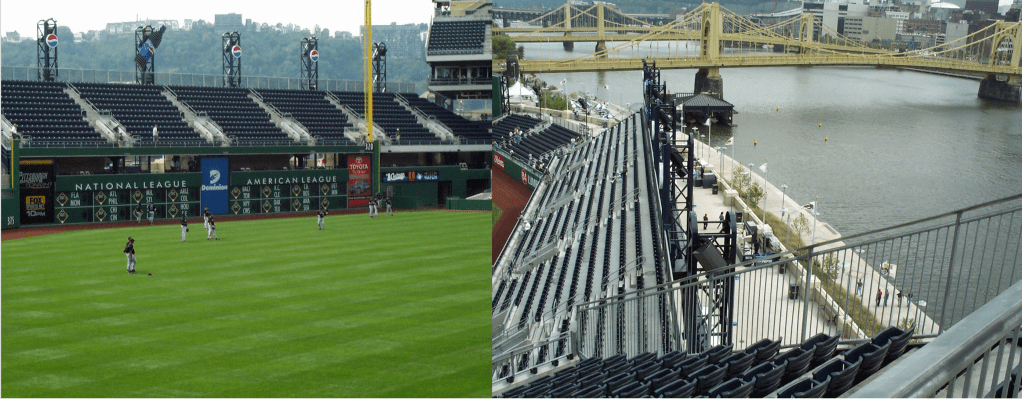
The view of PNC Park and surroundings from the upper deck. (Photo credit: Jeff Hayes)

Following the lower concourse to the right field line brought us to the detached bleacher area, which extends from the foul pole to the 375 foot sign in right centerfield (where a hand operated scoreboard runs the length of the 21 foot high fence). Venturing up into the bleachers gave us a great view of the river and the city. Each seat provided a clean view of the action, due primarily to the elevated nature of the bleachers. Continuing counter clockwise on the lower concourse, we encountered a smaller bleacher area adjacent to the green batter’s eye in centerfield. Since the crowd was small, there were very few fans here, but given the sight lines here (as all seats in PNC Park are angled to produce the best view of home plate), these seats appear as though they would be almost as good as the seats in the right field bleachers.

Standing on the lower concourse behind the batter’s eye gave us an amazing view of the bridges and downtown Pittsburgh. Even the pictures we took on the cloudy and humid day (resulting in haze that partially obscured the city) could not do justice to the backdrop for PNC Park. Even if we did not see a game here, the view alone was worth the time and expense. Proceeding toward home plate, we got a close up view of the video board, which stood atop two tiered seating in left field. The video board seemed curiously small for a brand new park, which is not necessarily a bad thing. Light stands bracketing the video board were wrought steel, and looked similar those at Comerica Park. In fact, the placement and size of the video board at Comerica Park bore a striking resemblance to what we saw at PNC Park.

The right field bleachers at PNC Park, with a great view of the riverfront at the top of the section. (Photo credit: Jeff Hayes)

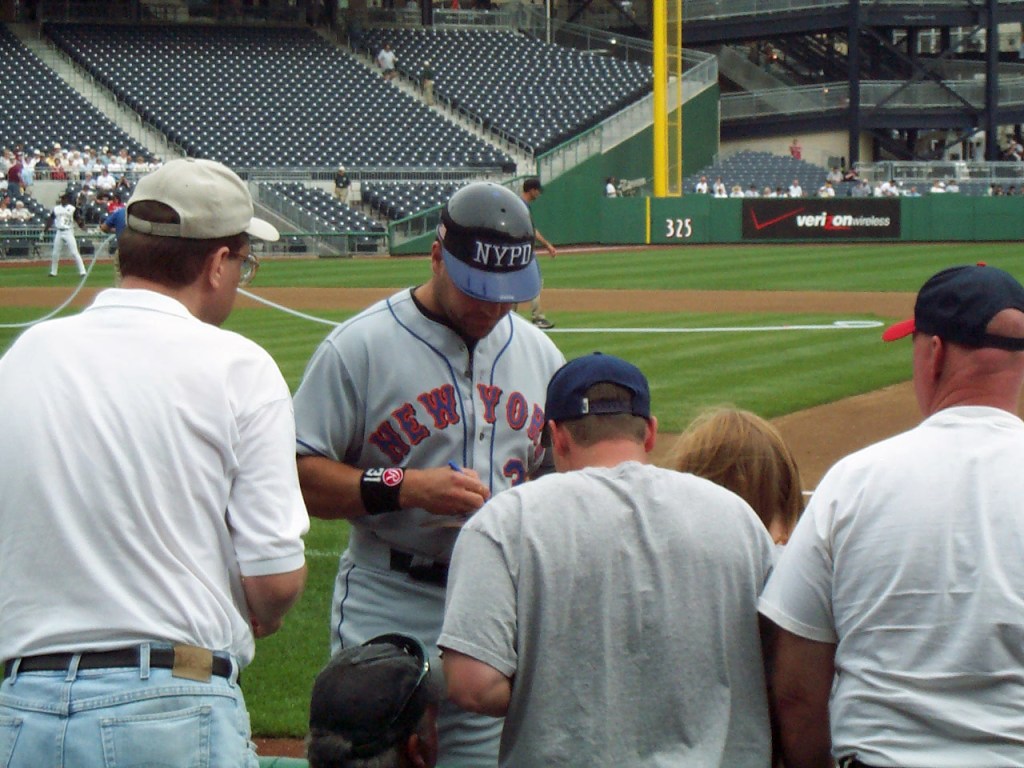
We completed the loop around the stadium on the lower concourse behind home plate, and went in search of a baseball lunch. Like most “newer” MLB stadiums, PNC Park has many places to eat, including outlets of many popular local restaurants, with premium services available in the club level provided by Levy’s Restaurant. Per my usual, I eschewed these choices, instead choosing hot dogs and drinks to bring to our seats. In keeping with the somber nature of the situation following the attacks on 9/11, there was a sense of sullenness in the crowd, and even the typically boisterous Mets fans kept their enthusiasm in check for the game. Mets players were wearing hats of the various first responder services (like the NYPD, NYFD, etc.) that gallantly answered the call during and after the attacks.

Mets catcher Mike Piazza, donning an NYPD helmet, signing autographs for fans at PNC Park. (Photo credit: Jeff Hayes)

Despite the air of melancholy in the air at PNC Park that afternoon, Mets players did sign autographs and interact with the crowd. Because the game was moved to Pittsburgh with little advance notice, we were able to get seats along the right field line just beyond the Mets dugout (PNC Park is one of the few MLB parks where the home team dugout is on the third base side). Though I was mesmerized by the ballpark and its surroundings, we were there to see a game. Following a World Series berth in 2000, New York, facing a depleted Pirates squad, overcame an early deficit to win the game, 9-2. We were treated to a Mike Piazza home run, and the game time was under three hours. Facing a long drive home, we headed straight to the parking lot. PNC Park was as advertised and much more, leaving me dazzled. We would have to return, if only to the the park and its views in better weather conditions.

My scorecard from the game.

Our second visit to PNC Park was not as hurried, as we planned a weekend visit to Pittsburgh to once again see the New York Mets. Unlike our previous stay, clear skies and pleasantly warm and dry conditions were expected for Saturday and Sunday. Our trip from central NJ to Pittsburgh was uneventful, and we drop off our bags at the hotel before heading to the park. Leaving ourselves plenty of time to explore, we crossed the Allegheny River on one of the bridges, where my brother got some excellent shots of the stadium, with the river in the foreground. Given the great late summer weather, we strolled along the riverfront, where we encountered scores of people walking, biking and sitting along the banks of the river.

A view of the Roberto Clemente Bridge just north of PNC Park. (Photo credit: Jeff Hayes)

Following our extended tour of the area, we headed into PNC Park through the home plate entrance. Of course, we wandered through the ballpark, though we didn’t spend as much time doing so, as we would get a better look at the park the next afternoon. After visiting the concession stand in the lower level behind home plate for a baseball dinner, we headed to our seats. Because the Pirates were playing out a disappointing season, tickets for the game were plentiful, and we were fortunate enough to secure good seats just to the right of home plate in the lower level.

Sunshine, though decreasing with time, afforded us a better look at PNC Park and downtown Pittsburgh. The Aztec gold of the bridges crossing the Allegheny seemed more vivid in the waning daylight, and the overall feel of the park was much lighter, a stark contrast to our previous visit, when skies were gray and the country was still reeling from the attacks on 9/11. PNC Park has a two tiered seating area extending from the left field foul pole behind home plate to the right field foul pole (minus the luxury boxes and the press level). When combined with the bleachers, there were just over 38,000 seats in the ballpark (which is the second smallest capacity in MLB), and almost all of the seats in the stadium offer a view of downtown Pittsburgh.

The view from our seats for the Saturday night game. (Photo credit: Jeff Hayes)

PNC Park offers one of the smallest distances from home plate to the backstop (51 feet), giving fans nearly unprecedented closeness to the action. Clearly, the stadium was designed with a maximum fan experience in mind. When combined with the spectacular views of the city and the river, my opinion that PNC Park was the best park in MLB (though my brother would disagree, as he is partial to Comerica Park) was cemented. Even after the game started, I found myself scoping out the park and scenery beyond it, instead of paying more attention to the action on the field. More than once, I found myself envious of the Pirates home, wishing and hoping that the Mets would construct a ballpark with similar magic.

View of the Pittsburgh skyline from out seats in PNC Park. (Photo credit: Jeff Hayes)

Though 25 games under .500 coming into the game, the Pirates kept pace with the visiting Mets (who were destined for a division championship and a trip to the 2006 NLCS), as evening blended into night. Surprisingly, there were few lights emanating from the buildings in downtown Pittsburgh, as I expected the coming of night might allow the downtown area to shine. That was probably the only negative we encountered on our visit to the park that evening. Had the game been a nationally televised broadcast, it is possible that the city might have obliged with more lights from the structures, producing a spectacle for the fans in attendance and those on TV.

Between the time we entered the ballpark before the game and the third inning, the crowd filled out nicely. Even the four level steel rotunda in left field, used primarily for standing room only, was filled with fans. Officially, there were more than 37,000 people in the ballpark that night (nearly a sellout), but the actual count was almost certainly less. In any event, the fans in attendance made their presence felt, and the game was deadlocked at two going into the bottom of the ninth. Pittsburgh scratched out a run in the bottom of the frame, beating the Mets and their closer, Aaron Heilman 3-2. As the jubilant Pirate fans filed out of PNC Park that night, I quickly scanned the ballpark while we waited to exit. As we left, I remember thinking that I hoped the Pittsburgh fans appreciated the park they were lucky enough to call home.

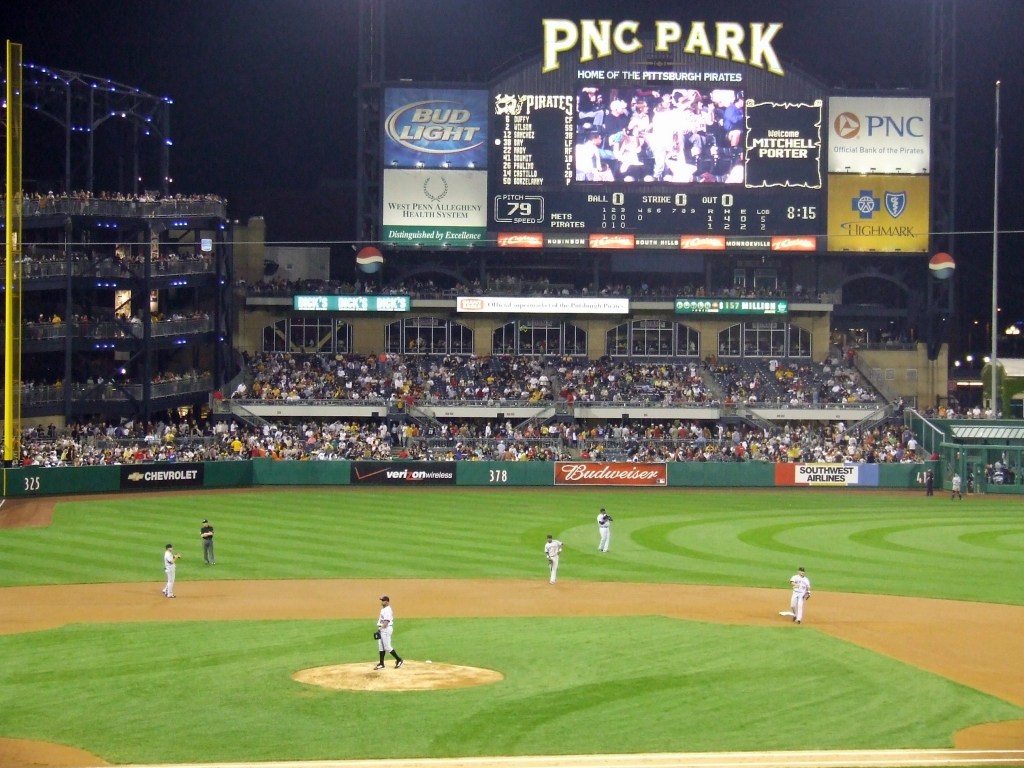
PNC Park at night. (Photo credit: Jeff Hayes)

Sunday September 17 2006 was a mainly sunny and pleasantly warm late summer day, and after breakfast we headed out to PNC Park to see the finale of the series. Early morning fog was begin transformed into cumulus clouds as the sun shone over the park, and the filtered sunshine showed that we were indeed headed toward fall, despite the warm weather. We did not spend as much time outside of the park as the previous day, but we did focus our attention on the river. Much like we saw in Cincinnati in 2004, there was quite a bit of river boat traffic this Sunday morning, and it reminded me what life might have been like on the river long ago. Leftover haze gave the river and its surroundings a softer hue, and somehow this seemed to add to the appeal of the area.

A passing river boat tour on the Allegheny River. (Photo credit: Jeff Hayes)

Upon entering the park, we conducted one final walkthrough of the stadium with the best conditions we had seen so far. Based on the number of fans milling around outside, the crowd promised to be much smaller than the game the previous night. Our experience has taught that Sunday afternoon games were usually more lightly attended than Saturday night games, and it seemed that trend would hold for the afternoon contest. In addition, we had entered football season, which meant the part of the crowd that might have come to see a poorly performing Pirate team instead stayed home to watch gridiron action. Regardless of the reason, we expected to have more elbow room for the matinee contest.

Before getting a baseball lunch and heading for our seats, we headed up the upper deck to get some pictures of the stadium with downtown as the backdrop. From that vantage point, my brother took some of my favorite ballpark pictures, and even those picture did not do the scenery justice. Though we did not have pristine conditions, the panorama my brother constructed from those pictures qualify (in my opinion; his may vary) as his best work at baseball stadiums, and helps to shape my opinion of PNC Park being the best ballpark in MLB.

This is it: my favorite picture of PNC Park, courtesy of my brother. (Phot credit: Jeff Hayes)

Our seats were very similar to those of the previous night, in the lower level just to the right of home plate. For the New York Mets, the game was not particularly meaningful, as they were on their way to the NL East title, but most of the regular starters were in the lineup. On the mound for the Mets was right hander John Maine, who was the number five starter in the New York rotation. For the hometown Pirates, left hander Zach Duke took the mound. Duke was the ace of the Pittsburgh staff, and we were not quite sure what to expect out of either team, with so little at stake for either team this late in the season.

Pittsburgh scored two runs against the Mets in the bottom of the first inning, and as it would turn out, that would be more than enough for Duke, who tossed eight shutout innings against a formidable New York lineup. Despite the second straight flat performance by the Mets, the game was again almost superfluous, as the fine late summer conditions made PNC Park shine even more than the night before. In between innings, I spent my time shifting my attention from one feature to the other, while my brother’s camera was busy capturing the nearly perfect baseball environment. As we suspected, the crowd was quite thin, nowhere near the announced crowd of nearly 30,00. Later I would learn that the Pirates’ attendance in 2006 was 1.8 million, which was next to last in the NL. Apparently, a poorly playing team trumped the beautiful ballpark, which had been racking up accolades since it opened its doors in 2001.

The view from our seats. (Photo credit: Jeff Hayes)

Time passed quickly during the low scoring game, which clocked in at about two hours and 30 minutes, which was shorter than the league average. Before I knew it, we were leaving this baseball palace, headed out for a five hour drive back home to central NJ (during which we would listen to the Jets lose another game). To say we thoroughly enjoyed the ballpark would be a great understatement. Though we were split as to whether we thought that PNC Park was the best MLB park, we did agree that it was a great baseball experience that we would have to repeat as soon as possible. If you find yourself near Pittsburgh during baseball season, check to see if the Pirates are home. If they are, GO! You will be glad that you did.

Goodbye PNC Park. Hope to see you again soon! (Photo credit: Jeff Hayes)

Cleveland OH/Pittsburgh PA, Saturday May 20, 2000

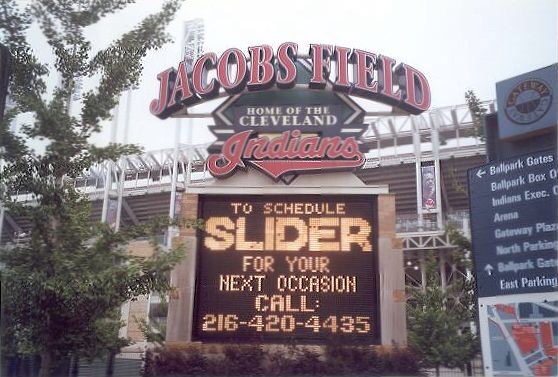
Welcome to Jacobs Field!

Our only baseball trip of 2000 took us to western PA and northeast OH in late May. Since the trip by car was in excess of five hours from central NJ, we drove out to northeast OH on Friday, May 19th, staying just outside of Cleveland for the night.

Saturday, May 20th dawned cloudy and chilly, much cooler than one might expect in late May across northeast OH. With a few hours before the 105 PM contest between the visiting New York Yankees and the hometown Indians, we decided to visit the Rock and Roll Hall of Fame, located adjacent to the southern shore of Lake Erie. Uncharacteristically, we visited the Hall without a camera, so we don’t have a visual record of our visit.

To my delight, the crowd at the Hall was thin, perhaps due to the weather and the relative early hour (as the doors opened at 1000 AM). As a result, we were treated to nearly unobstructed views of the myriad exhibits. Though we moved fairly quickly through the artifacts, we were able to appreciate the history of rock and roll (as well as pop music). Not surprisingly, the Beatles exhibit was the largest in the Hall, and our favorite band, Led Zeppelin, was well represented.

Not wanting to miss an opportunity to explore Jacobs Field, we left the Rock and Roll Hall of Fame after about 90 minutes. Even with the limited time spent there, we were impressed by the museum, and plan to return in the future for a better look. If you are a rock and roll fan, and plan to be in the vicinity of the Hall, leave yourself some time for a visit: you won’t be disappointed.

1. Jacobs Field

Venturing back out in the cool and breezy conditions, we completed the short drive from the Rock and Roll Hall of Fame to Jacobs Field. Had the weather been better, we might have walked the distance, but the cool and damp air ruled that out. We were able to secure parking just across the street from the ballpark in a private lot at a reasonable price.

We performed our typical tour around the outside of the park, but the weather curtailed our walk. Ducking inside the stadium at the home plate entrance, we were greeted by a nearly empty park. Once inside, we had access to the entire seated area, exploring while taking pictures. Unfortunately, the low overcast made the stadium appear drab, but the images capture the conditions on the cool and cloudy early afternoon perfectly.

Jacobs Field from the upper deck behind home plate.

Since both teams were playing well, tickets for the Saturday matinee were scarce, and our seats were located in the last row of the upper deck on the first base side of the field. Just before game time, temperatures hovered in the 40s, and the persistent breeze off the lake made it feel even colder. Despite an announced crowd of 42,000+, the unseasonably cool weather held the actual attendance far below that number.

Starting for the visiting New York Yankees was veteran right hander David Cone. Thus far in 2000, Cone was struggling (with an ERA over 5.50), though he was less than a season from his perfect game in 1999. On the mound for the Indians was left hander Chuck Finley, who was in his first campaign for the Tribe. Each team featured a potent offense, but the combination of good starting pitching and cool weather raised the specter on a low scoring contest.

Indians starter Chuck Finley featured on the cover of the scorecard/magazine.

New York scratched out a single run in the first inning against Finley, then tacked on another run in the fourth inning (with Yankee right fielder Paul O’Neill driving in the run with a single), giving the visitors a 2-0 lead. Meanwhile, David Cone kept the Cleveland bats at bay through the first six innings. Each pitcher worked deliberately, slowing their approaches with runners on base. In spite of the lack of scoring, the pace of the game was glacial, punctuated by the cold and damp conditions.

During the slow play, we were able to get a better feel for Jacobs Field. Dreary weather made the six year old stadium seem drab, with little contrast between the field and the slate gray overcast that seemingly encased it. Because of the conditions, Jacobs Field did not shine, and the lack of fans made the ballpark seem larger than it appeared on TV. Clearly we were not seeing the park at its best. Though the crowd was sparse, one of the more memorable parts of our visit was the persistent drumming in the left field stands. With a typical crowd, the drumming may not have been as noticeable, but with little else happening in the largely empty stadium, it echoed almost to the point of distraction.

The view from our seats. Note that the tops of the buildings were obscured by low clouds.

Cleveland broke through against David Cone in the bottom of the seventh inning, as Richie Sexson led off the frame with a solo home run. Scoring another run in the seventh, the Indians tied the game, while simultaneously knocking the Yankees starter out of the game. Each bullpen then kept the game tied heading into the bottom of the ninth inning. Yankees Jeff Nelson surrendered four walks during the frame, forcing in the winning run with two outs to give the Indians a 3-2 victory.

Despite the low scoring affair, the nine inning contest took three hours and 38 minutes to complete, which seemed even longer in the cold and wind. We filed out Jacobs Field quickly, as we planned to attend a game at Three Rivers Stadium in Pittsburg that evening. Disappointed that we didn’t get to experience the ballpark in better weather, we would have to return in the future to get a better feel for the stadium and environs.

My scorecard for the game

2. Three Rivers Stadium, Pittsburgh PA

Google Maps depiction of the route from Cleveland to Pittsburgh.

Spending more time at Jacobs Field than expected, we were left with about two and one-half hours to get to Three Rivers Stadium in Pittsburgh. Though it would be tight, we were optimistic that, with light traffic, we would arrive before the first pitch at 710 PM. However, events would conspire to make arriving on time impossible. A bit more than an hour into the trip, we encountered thunderstorms that hampered our progress. As we got closer to Pittsburgh, traffic slowed to a crawl.

Finally, we reached the parking lot next to the ballpark, located on the north shore of the Allegheny River (north of downtown Pittsburgh). Arriving well after the first pitch, we parked in a dark area under an overpass of Interstate 385. While there were plenty of fans in the area, it seemed fairly remote, and I had an uneasy feeling about leaving the car there.

Because we arrived in the second inning, we had no time to wander and explore as we normally would at a new stadium. Instead, we rushed to our seats to enjoy the game. As we travelled from Cleveland to Pittsburgh, we went from early spring weather to early summer weather, as very warm and humid conditions greeting us at Three Rivers Stadium. While there were storms in the area, they managed to avoid us during the game.

Unfortunately, we did not take pictures at the stadium, as we left the camera in the car in our haste. Three Rivers Stadium was a typical multipurpose stadium, nearly identical to Veterans Stadium in Philadelphia. This season would be the last for the Pirates at this ballpark, and its condition seemed to reflect that fact. However, it was a pleasant place to see a Saturday night ballgame.

Pittsburgh hosted the St Louis Cardinals, who scored early and often. St Louis scored six runs in the first four innings, the scored 13 runs in the last three frames, on the way to a 19-4 drubbing of the hometown Pirates. With the game out of hand for the Pirates, they sent catcher Keith Osik to the mound to pitch the top of the ninth inning. As might have been expected, Osik fared poorly, surrendering five runs on five hits. This outing marked Osik’s second MLB pitching performance. In 1999, he also pitched an inning during a blow out, and his performance then was only slight better than this night.

Even with the high scoring, the game took less than three hours, a stark contrast to the affair in Cleveland. Fortunately, my car was still there following the game, and because of the late game finish, we stayed at nearby a nearby hotel, driving home Sunday morning.