PeoplesBank Park, York PA June 13th 2021

Welcome to PeoplesBank Park in York PA!

On a cloudy Sunday afternoon, with the threat of thunderstorms looming in the distance, my brother and I set out for PeoplesBank Park in York, PA, the home of the Atlantic League’s (ALPB) York Revolution. About 45 minutes from home for me, the ride was relatively simple, as traffic was generally light during the early afternoon. Parking at PeoplesBank Park is spread across the general area of the stadium, with the most popular lot across the Codorus Creek from the park at the Smalls Athletic Field (using Google Maps with this location should make finding parking fairly simple). At $4.00, parking was a bargain, with the walk from the lot to the stadium taking less than 10 minutes. For those fans with mobility issues, there is a parking lot next to the field, but you may want to check on availability.

My brother and I had been here once before, as we headed home following a trip to eastern OH/western PA to see ballparks out that way. Just ahead of some deteriorating weather, we walked around the outside of the ballpark, which did not afford much of a sense of the place. Leaving just as the rain began, we left without knowing much more than we did before we arrived. Since the ballpark was within range of both of us, we planned to visit PeoplesBank Park in 2020, but the pandemic resulted in the cancellation of the Atlantic League season. Our first proper visit to York would have to wait…until today

The view of PeoplesBank Park from the Smalls Athletic Field across the Codorus Creek in York PA. (Photo credit: Jeff Hayes)

PeoplesBank Park is located on the edge of a neighborhood in York, and we saw row houses somewhat reminiscent of those found in Philadelphia. We found the architecture similar to what we saw in Harrisburg as well, so it seems to be a common theme across southeast and central PA. In fact, I would have been interested in walking through the neighborhood to get a better feel for the area, but we did not leave sufficient time for a side trip. Perhaps if time permits in a subsequent trip, we will investigate this portion of York more thoroughly.

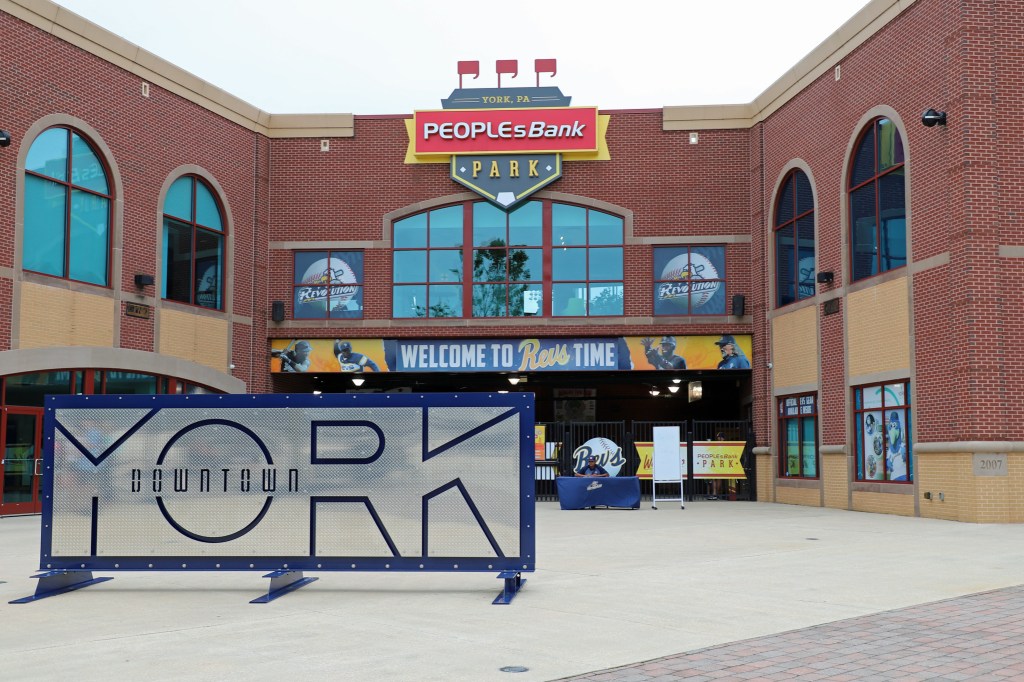
Though we were briefly here less than two years before, my memory of the event is fuzzy at best, so it was as if we were seeing the ballpark for the first time. PeoplesBank Park features Brooks Robinson Plaza, located to the right of the main entrance to the ballpark. A statue of Robinson graces the plaza, along with a plaque outlining information about the Hall of Famer’s storied career. Opening in 2007, PeoplesBank Park was constructed to resemble Orioles Park at Camden Yards, the favorite MLB team in this portion of PA. Without much to see on the outside of the park, we entered the stadium through the home plate gate.
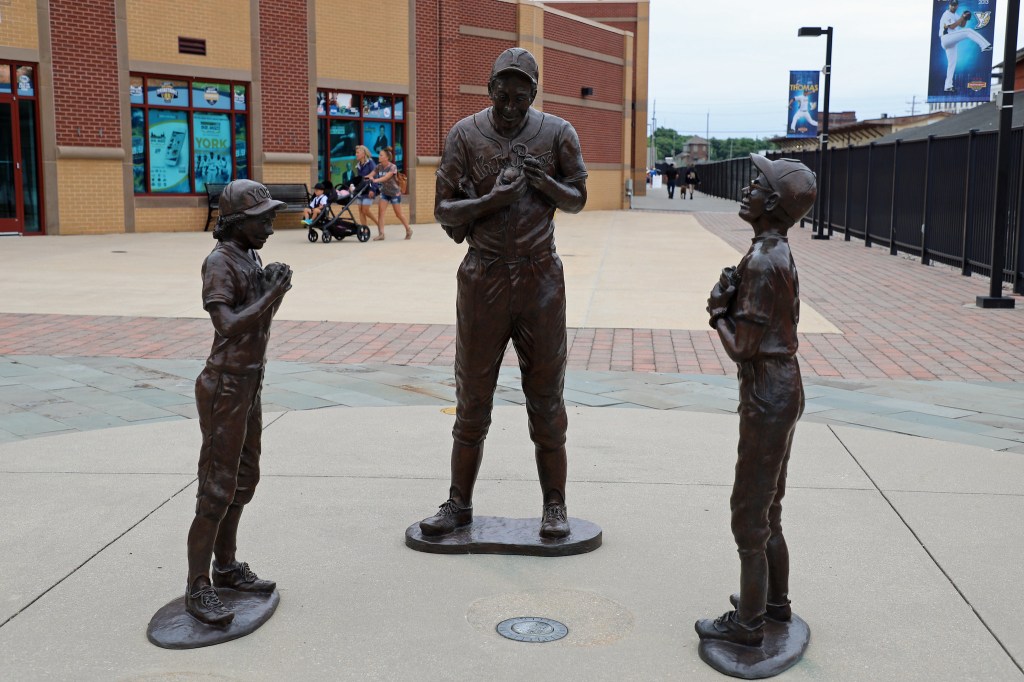
A statue of Brooks Robinson and young fans in Brooks Robinson Plaza at PeoplesBank Park. (Photo credit: Jeff Hayes)

Upon entering the stadium, we quickly walked around the lower concourse, which encircled the ballpark. Not knowing what to expect, I was immediately impressed with the park, which seemed colorful and vibrant, even on this cloudy Sunday afternoon. With only minutes before the first pitch, we quickly walked from right field to left field before finding our seats along the third base side. Though I did see why others thought PeoplesBank Park looked liked Camden Yards (especially the picnic area in right field), another ballpark came to mind: Regency Furniture Stadium, located in Waldorf, MD. Also home to an Atlantic League franchise (the Southern Maryland Blue Crabs), there was more than just a passing resemblance to that ballpark, which we would discover during the game.
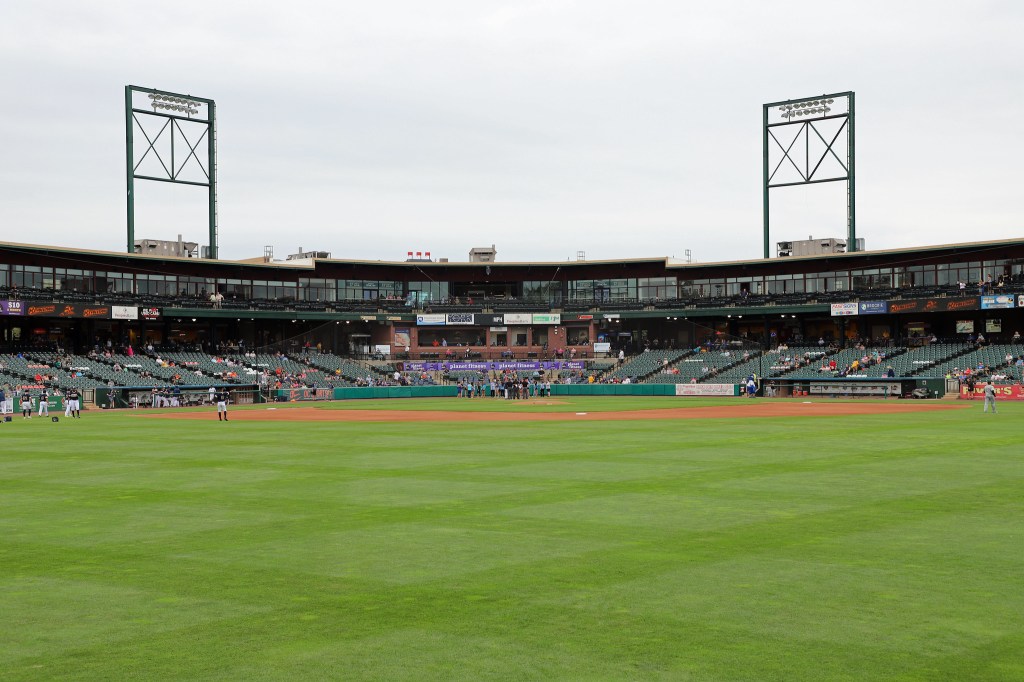
PeoplesBank Park from the centerfield concourse. (Photo credit: Jeff Hayes)

Perhaps the most prominent feature in PeoplesBank Park is the wall in left field. Known as Arch Nemesis, the forest green wall stands 37 feet 8 inches tall (six inches taller than the Green Monster in Fenway Park), making it the highest wall in professional baseball. Creation of the highest wall in baseball was apparently in response to the short distance from home down the left field (a mere 300 feet), due to the presence of train tracks just beyond the wall. We saw the wall in “action”, as the ballpark held a couple of balls that may have left other ballparks with shorter fences. There is also a manually operated scoreboard at the base of the Arch Nemesis, which bares some resemblance to the one in Fenway.
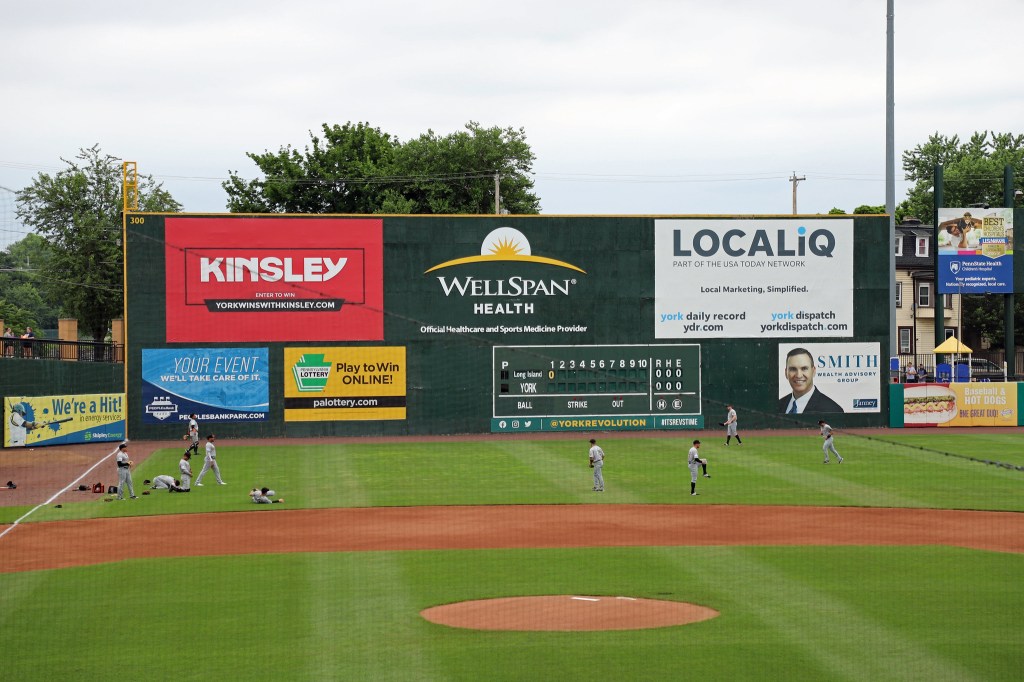
The Arch Nemesis, located in left field at PeoplesBank Park in York PA. Note the hand operated scoreboard at the base, like the one at Fenway Park in Boston MA. (Photo credit: Jeff Hayes)

We reached our seats in the lower level behind the dugout just as the first pitch was thrown. Minutes later, to our surprise, a beautiful sight appeared. A bald eagle passed nearly overhead, and it seemed as though the entire crowd noticed its passage. Based on the murmuring in the crowd, I got the impression that the eagle had been there before, and PeoplesBank Park could be on its normal route through the area. Quick reactions by my brother allowed him to capture the moment perfectly with his camera. Unfortunately, the eagle did not pass by again during the game.

This was not the first time we were graced by the presence of a bald eagle. While exploring Lock #1 on the Mississippi River in St Cloud MN on an overcast and cold late September afternoon, a bald eagle passed overhead, flying south along the river. That time, we were caught completely off guard by the eagle’s passage, and neither of us managed to snap a picture before it disappeared into the distance.

A bald eagle passing overhead on a cloudy Sunday afternoon at PeoplesBank Park in York PA. (Photo credit: Jeff Hayes)

Following the excitement of our unexpected visitor, we turned our attention back to the game. For this Sunday matinee, the York Revolution were hosting the Long Island Ducks for the finale of their series. There is a strong tie between the Ducks franchise and the New York Mets. Ducks manager Wally Backman was the starting second baseman for the the 1986 World Championship team, and the Ducks starting left fielder, L.J. Mazzilli, is the son of perennial Mets fan favorite Lee Mazzilli. Coming into the action this afternoon, the Ducks held a three game lead over the Revolution in the North Division of the ALPBA.

Settling into the game, I began to take a better look at PeoplesBank Park. As mentioned earlier, I felt as though it had more than a passing resemblance to Regency Furniture Stadium, and the more I examined my surroundings, the more I saw the similarities. Like the ballpark in Waldorf, MD, the bullpens were located in foul territory just behind the bases. Seating for the respective bullpens is near the railing, with line drive foul balls putting the relievers in a precarious spot. On this day, most relievers were either in the dugout or further down the line, a testament of the danger these players face sitting in prime line drive areas.

Most of the chairs in the Revolution bullpen area were empty, as line drive foul balls off the bats of right handed hitters puts the pitchers in danger. (Photo credit: Jeff Hayes)

In addition, the main seating area was structured similarly to Regency Furniture Park, with seats on the left and right field lines angled such that they faced the pitcher’s mound. When the seating in left and right field along the rail is considered, PeoplesBank Park hold about 7,500 fans, which is large for an ALPB stadium.

In addition to the hand operated scoreboard, there is a more modern scoreboard, located in centerfield, just behind the picnic area. Modest in size and resolution, this scoreboard was mainly informational, with occasional video replays presented. During the game, I noticed to auxiliary video boards near centerfield (that seemed to play mainly advertisements). Finally, sandwiched between the Arch Nemesis and the centerfield score board was a tightly packed kids zone. Complete with a carousel and several slides, these facilities offered something else for the kids to do while the adults enjoyed baseball.

The kids zone at PeoplesBank Park, nestled between the Arch Nemesis and the centerfield picnic area. (Photo credit: Jeff Hayes)

Though I did not exactly know what to expect as we drove toward York, PeoplesBank Park far exceeded my expectations. The more I saw of the park, the more I liked it. Placed along Arch Street (on the edge of a neighborhood), the ballpark has an urban feel to it, providing the stadium with an appealing backdrop. Not long after the first pitch, I felt as though PeoplesBank Park was possibly my favorite ALPB ballpark (sorry Southern Maryland Blue Crabs).

During our brief tour of the ballpark, we did notice places to eat, especially on the concourse in right field. Given our time constraints, we did not examine any of the cuisine at PeoplesBank Park, instead choosing standard baseball fare (sodas, hot dogs and pretzels) at the nearby concession stand. Considering that my palette is relatively unsophisticated (and I do not drink alcohol at ball games), it is likely that I would be unable to render an intelligent review of food and drink at the park. For that, you are on your own.
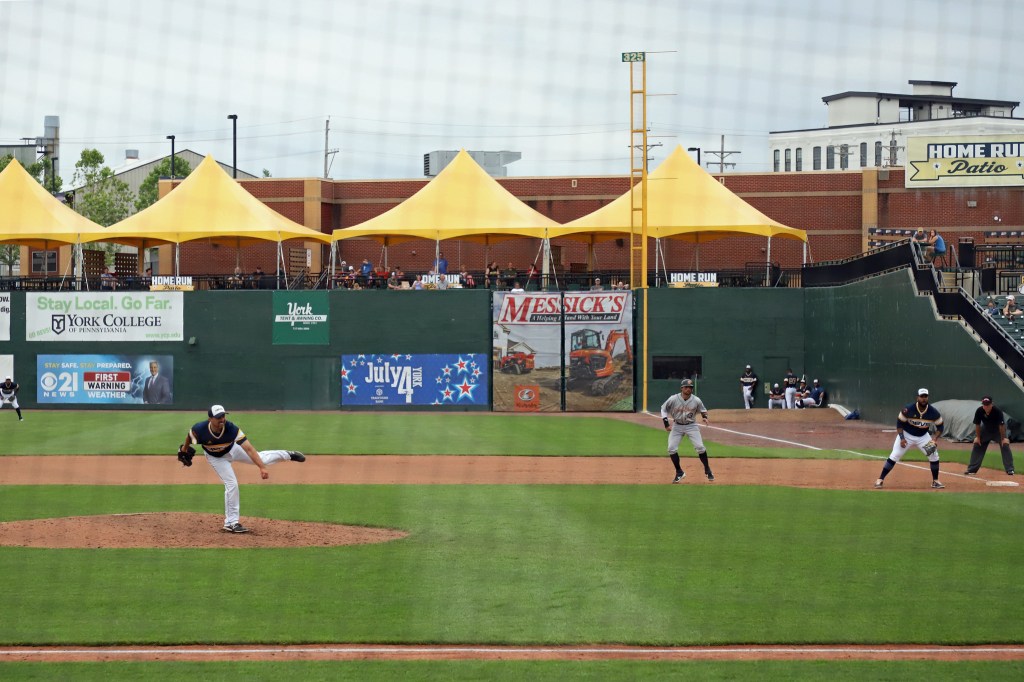
The view from our seats. (Photo credit: Jeff Hayes)

Following a quiet top of the first, the Revolution scored three runs in the bottom of the frame. After that outburst, the game did not see any more scoring until the top of the sixth inning. However, due to the 16 walks issued by both teams (as well as a number of deep counts), the pace of play slowed to a crawl at times. This is not atypical for an ALPB game, as the rosters mainly consist of ex MLB/MiLB players, as well as those that went undrafted. For comparison, the level of play in the ALPB is roughly similar to that seen at the Double A level in affiliated baseball, though players (with the notable exception of pitchers) are typically more polished in the ALPB, due to the experience level of the players.

It is not unusual for ALPB rosters to have familiar names on it, which helps with attendance in most cities, but many of these players are past their best days. Some hang onto the notion of being picked up by an affiliated team (which happens fairly often, given there is a player development deal in place between MLB and the ALPB), while others play baseball for as long as they can before hanging up their spikes for good. The ALPB also brings baseball to underserved areas, in places where there are no MLB or MiLB teams close by.
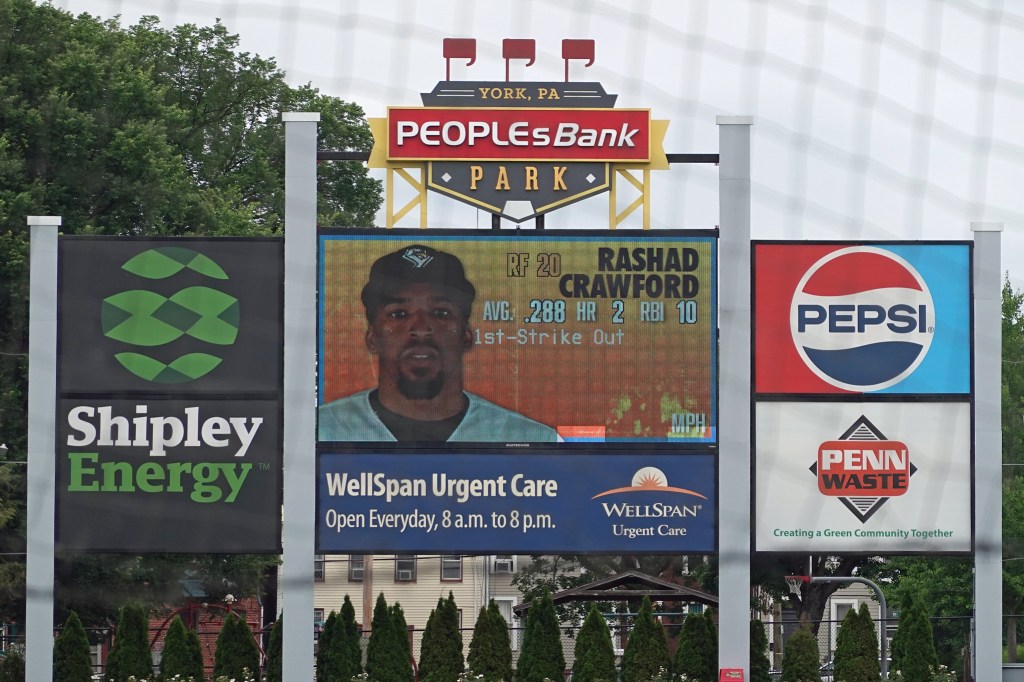
A view of the scoreboard/video board in centerfield. (Photo credit: Jeff Hayes)

Though the crowd was not particularly large (as often happens for Sunday afternoon games), the fans were vocal, especially those close to us. That enthusiasm was also evident on the field, as the Revolution third baseman pretended to swat at the York shortstop who got too close on an infield popup. Though the sample size is admittedly small, there seems to be a good repertoire between the fans and the team, and that is refreshing. All too often when teams play badly, so called fans seem to turn on them, but that does not seem to be the case here.
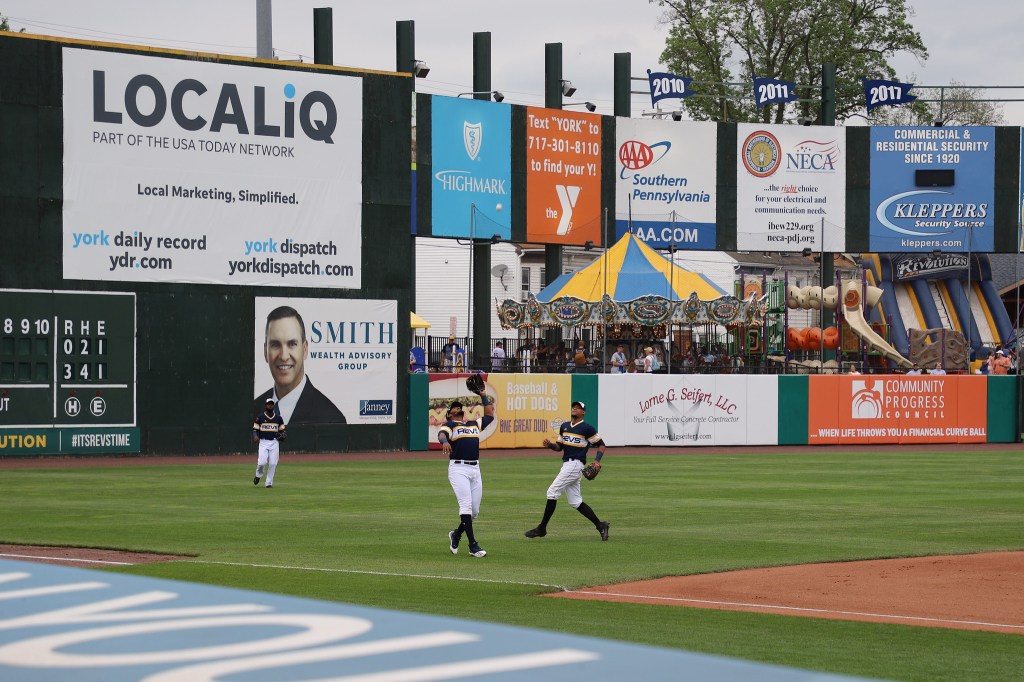
Revolution shortstop and third baseman converging on a popup. Feeling the shortstop got too close, the third baseman playfully swatted at him after making the catch. (Photo credit: Jeff Hayes)

In the top of the sixth inning, the Ducks scored two runs, drawing within a run of the Revolution. However, York tacked on another run in the bottom of the seventh inning, and a trio of Revolution relievers held off Long Island for a 4-2 victory. Unlike most crowds, many Revolution fans stayed until the last pitch. Thankfully, the threat of thunderstorms held off, providing a cloudy but dry experience at PeoplesBank Park. As we filed out of the park, I was still surprised how much I enjoyed the place. Obviously, a great deal of thought went into the design of the stadium, and the place still looks great years after first opening its gates. Being just 45 minutes away, I plan to visit this beautiful ballpark as often as it feasible.

Walking back to the parking lot after the game, I once again enjoyed the surroundings. Being relatively new to the area, I found this part of York fascinating, and could spend time here simply exploring. The entire visit was enjoyable, and PeoplesBank Park is worth a visit if you are within range during the ALPB season.
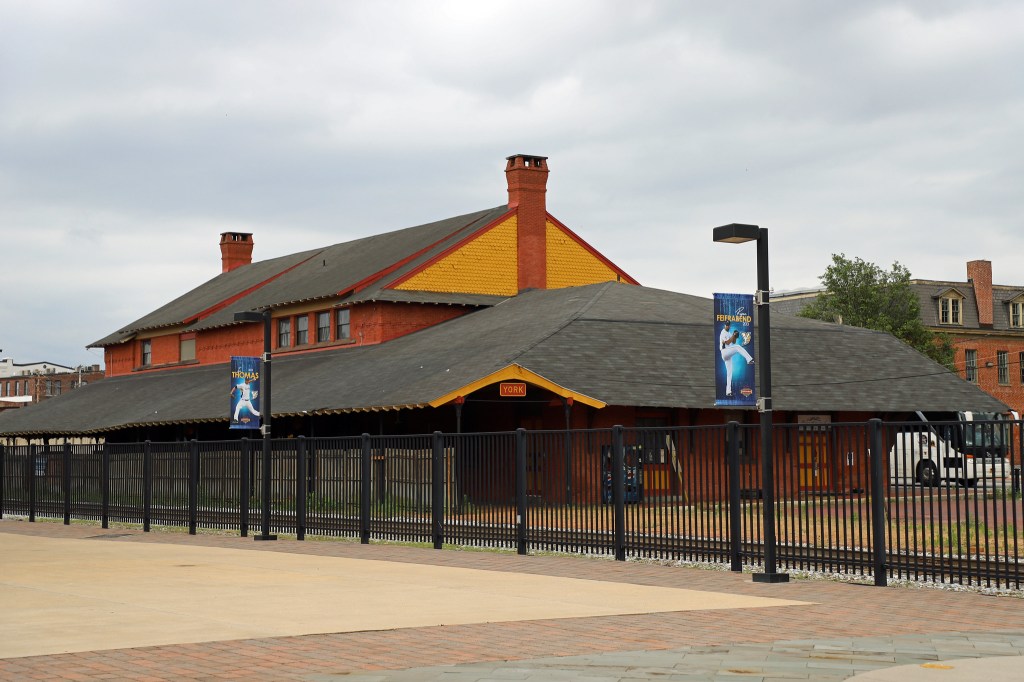
The York Train Station, just outside PeoplesBank Park. (Photo credit: Jeff Hayes)

First National Bank (FNB) Field – Harrisburg PA

FNB Field in Harrisburg PA. (Photo credit: Jeff Hayes)

Yet another move placed me near Harrisburg, PA this spring, and I am once again in a hot spot for baseball. Just 11 miles away is First National Bank (FNB) Field, the home of the Harrisburg Senators, the Double A affiliate of the Washington Nationals. My brother and I visited FNB Field once before, on our way back from a baseball trip that took us to eastern OH and western PA during August of 2019. There was no baseball that day (as the Senators were out of town), but we were able to wander through portions of the park. Of course, we could not get the true essence of the ballpark that day, but we vowed to come back here at some point in the future.

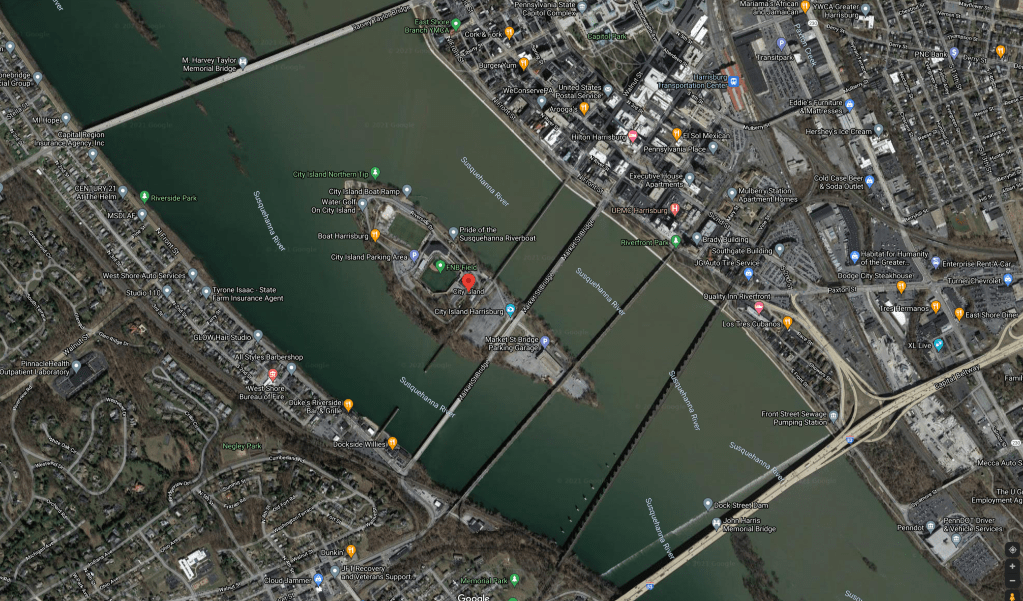
Fast forward nearly two years, and we did indeed return. Perhaps the most interesting aspect of FNB Field is that it is located on an island in the Susquehanna River. Known as City Island, the mile long island is home to the ballpark, as well as other attractions. We approached City Island from Harrisburg, taking the Market Street Bridge to the main parking lot adjacent to the ballpark. Concerned about the availability of parking on an island, we arrived well before the first pitch. Despite my trepidations, there was plenty of parking available in the main lot, as well as a lot just over the bridge.

Google Maps image showing the location of FNB Field on City Island in the middle of the Susquehanna River.

A short walk from the parking lot to FNB Field ensued, which involved climbing stairs and an uphill walk before reaching the gate. The trek could present some issues for those fans with mobility issues, but free rides from the parking lot to the gate are available via bicycles equipped with a rider seat. Though I did not see anyone take advantage of this service, I imagine it would be helpful for those in need. Per our usual approach, we walked outside the stadium taking pictures. About halfway across the outside of the park, we entered through a gate behind first base. Pleasant staff members working at the gate welcomed us warmly as we presented our mobile tickets, reminding me we were in neither the New York City Metro area nor Maryland/DC.

Once inside the park, we wandered taking pictures. Our visit occurred during the pandemic, and masks were worn by most fans. Because of the continuing pandemic, I was concerned that our movements within the ballpark would be restricted to limit exposure. However, we were able to encircle the playing field, as the main concourse wraps around the park. The layout of the outfield and the seating along the concourse vaguely reminded me of Regency Furniture Stadium in Waldorf, MD (home of the Atlantic League’s Southern Maryland Blue Crabs).

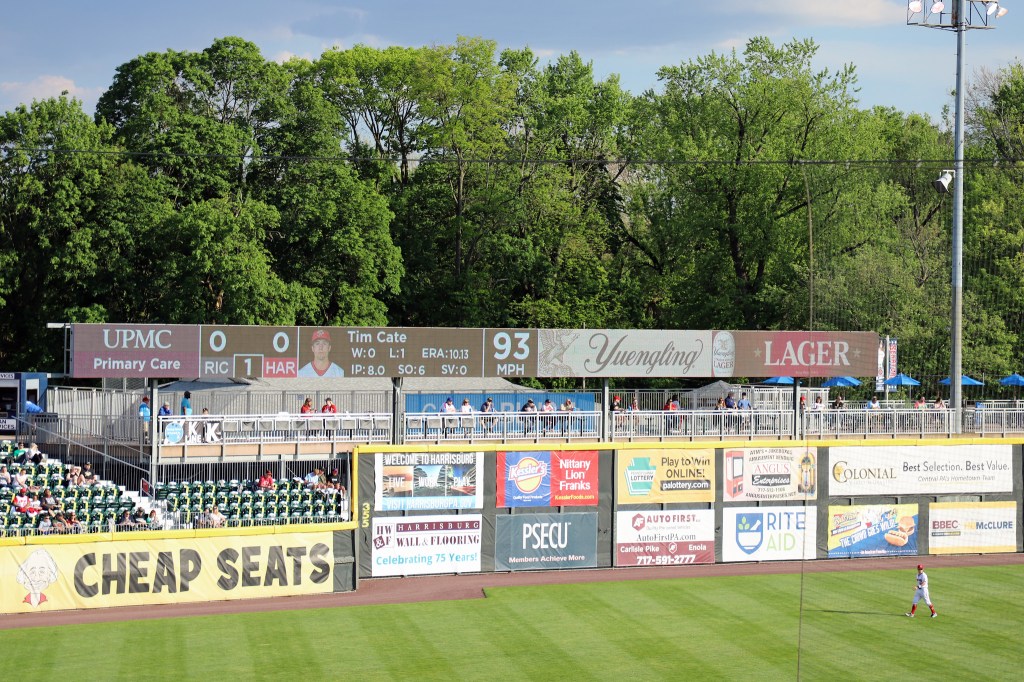
The view of the outfield in left center field. Note the seats above the wall. (Photo credit: Jeff Hayes)

As we walked from the right field line to the left field line, I was surprised to discover than FNB Field held more than 6,000 fans. Even with a sizable seating area behind home plate. at first glance, I would have thought the maximum capacity was closer to 5,000, which would have been on the smaller side for a Double A team. However, when the bleacher seating along the first base side, and the “Cheap Seats” in the left field corner are considered, the ballpark holds about the average number of fans for Double A ballparks.

Located on the concourse near the left field foul pole was the Senators Team Store. Seemingly smaller than most team stores, it contained most of the standard fare fans would expect, and had much more of an Expos presence than Nationals Park (the Montreal Expos moved to DC following the 2004 season). After browsing in the team store, we headed down the left field course to our seats

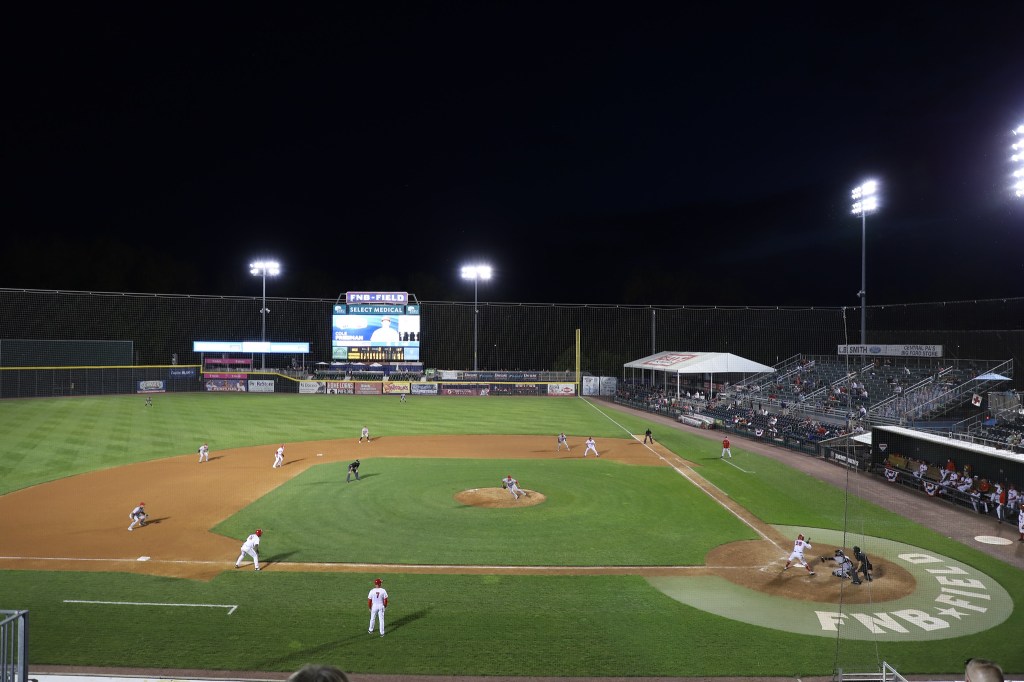
The main seating area of FNB Field from the right centerfield concourse. (Photo credit: Jeff Hayes)

Seating in FNB Field was arranged in pods to limit interaction among fans. Unlike the pods we occupied the week before in Arm&Hammer Park in Trenton NJ, seating here was not as restrictive. Being closer to fans, we wore our masks, removing them only to eat and drink. Sitting in section 201 (near third base), we had a great view of the entire park. Our vantage point afforded us a view of the hills to the north and northwest of the stadium, reminding me of our visit to FirstEnergy Stadium in Reading, PA. In addition to a standard videoboard/scoreboard in right centerfield, there was a supplemental horizontal videoboard in the left centerfield. This board contained information on the inning/score, the pitcher’s statistics, as well as the pitch speed. For avid baseball fans like us, the additional treasure trove of data was quite welcome.

The weather could not have been better, as remaining clouds melted away with the setting sun. Clear skies and pleasantly warm temperatures for mid May set the stage for a perfect evening for baseball. Though the crowd was necessarily small for the contest, that did not stop those in attendance from showing their affection for the Senators. Because of the pandemic, there was no minor league season in 2020, and the pent up frustrations of the faithful resulted in an almost raucous crowd.

The view from our seats. (Photo credit: Jeff Hayes)

Though there are a number of places to eat, we grabbed a standard baseball dinner at the concession stand on the concourse level behind the main seating area. Servers were friendly, prices were reasonable, and the service was relatively quick. After some of the BAD experiences we have had at other parks (especially MLB parks), cheerful faces were a welcome change of pace. Perhaps as I get a number of visits under my belt, I can comment further on the cuisine offered at FNB Field.

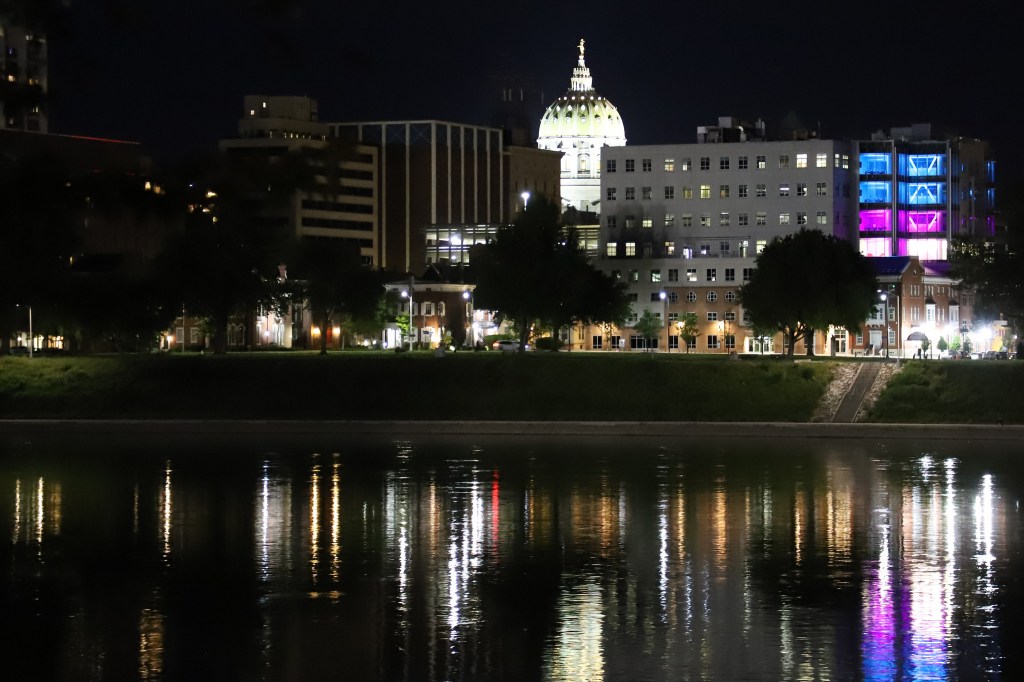
As evening blended into night, the view of the hills to the north and northwest disappeared, but the feel of the stadium unchanged. Unlike many Saturday night minor league games, the crowd did not leave early, as the game remained relatively tight until the end. Even with a small crowd, I became concerned that exiting an island from one parking area could take a considerable amounts of time. Reversing our course from the stadium to the parking lot, we took some time to admire the view of Harrisburg across the Susquehanna River. It was worth the detour; Harrisburg alit was quite a sight, especially since it was our first visit. If you have the time after a Senators night game, make sure to take in the skyline.

FNB Field at night. (Photo credit: Jeff Hayes)

As expected, exiting the parking lot was a slow process, as several lines that developed in the lot bottlenecked at the confluence of the lines near the turn onto the bridge. Having been in parking lots that were slow to clear in the past, we knew that patience was key, and eventually we managed to get out of the lot, heading back toward the east side of Harrisburg. FNB Field is an excellent minor league facility, providing a great fan experience among the passionate faithful. Since this facility is my new “home” ballpark, I was very pleased to find such a great stadium so nearby.

Harrisburg at night from the banks of the Susquehanna River just outside of FNB Field. (Photo credit: Jeff Hayes)

PNC Park, Pittsburgh PA

Looking at PNC Park in Pittsburgh across the Allegheny River. (Photo credit: Jeff Hayes)
  • First visit: Wednesday September 19th 2001
  • Most recent visit: Sunday September 17 2006

Our first visit to PNC Park was not supposed to happen. This game was originally scheduled to be played at Shea Stadium in New York City, but following the attacks on September 11th 2001, the parking lot at Shea was used as a staging area to deal with the aftermath of the attacks. Since Shea Stadium would not be available for baseball in the near term, the games were moved to PNC Park in Pittsburgh PA. After a short break, baseball resumed on September 17th 2001, and the Mets played a three game set against the Pirates, starting on that date.

Since we had travel plans scrapped after the attacks (we were flying to Chicago to see the Pirates take on the Cubs, but the games and flights were cancelled), we both had some time off. We chose to attend the last game of the series, a Wednesday matinee on September 19th. Getting an early start from central NJ, we made the 365 mile drive in about five and one-half hours, arriving at the ballpark before noon. Because the game was supposed to be played in New York, there was not much demand for parking, which allowed us to park just across the street from the stadium for a reasonable price.

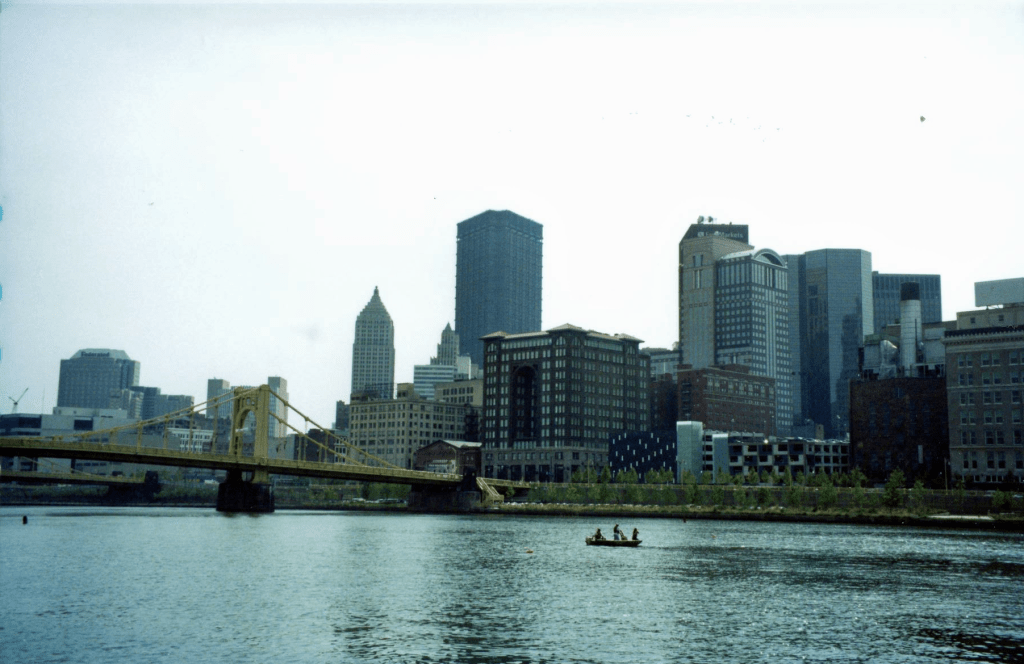
The view of downtown Pittsburgh from the walking path along the Allegheny River adjacent to PNC Park.

With time before the game, we briefly wandered around the park. Along the right field wall, we discovered a walking path adjacent to the Allegheny River. Dubbed Three Rivers Heritage Trail, the concrete path snakes along the river for about one and one-half miles. Given our time constraints, we did not amble nearly that far, but we did enjoy the view of downtown Pittsburgh from the riverside. Even if we were not taking in a ballgame that day, a simple trek along the river would have provided an early afternoon of peaceful vistas. Its proximity to the river enhanced the appeal of PNC Park, and we had not even seen the inside of the stadium yet!

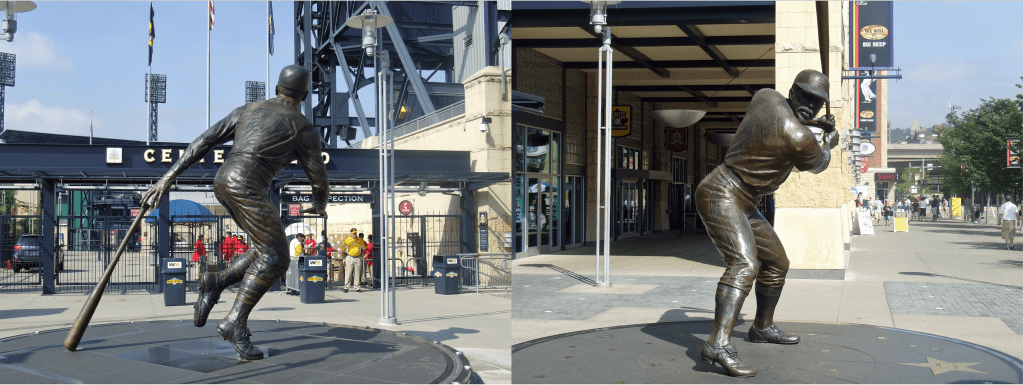
During our exploration of the environs of the the stadium, we found a pair of Pirates greats immortalized in bronze. Both Roberto Clemente and Willie Stargell were on display outside the park, with each statue larger than life. Roberto Clemente was just a bit before my time, as I was a toddler when he had his best years in Pittsburgh. Conversely, I was much more familiar with Stargell, with his trademark “windmill” bat twirl just before the arrival of the pitch. Two other statutes stood outside the ballpark (Honus Wagner and Bill Mazeroski) eluded our search, but perhaps we would view them on another visit.

Pirates greats Roberto Clemente (left) and Willie Stargell (right) are immortalized outside of PNC Park in Pittsburgh PA. (Photo credit: Jeff Hayes)

PNC Park is a baseball only stadium, at the end of its inaugural season in September 2001. Since the game was not supposed to be played in PNC Park, there were few fans present was we ended our tour of the outside of the stadium before heading into the park. It seemed that, based on the number of New York jerseys we saw on people milling around near the home plate entrance, those who did attend the matinee were mainly Mets fans, making a drive similar to ours. Apparently a five hour drive did not deter the New York faithful, who seemed determined to see the game. Unfortunately, the weather was less than cooperative, with warm and humid conditions under mainly cloudy skies.

Once inside, we could immediately see that the view of downtown Pittsburgh was the focus of the new ballpark. Unlike its predecessor (Three Rivers Stadium), PNC Park was open in centerfield, providing a sweeping vista of the city and Allegheny in front of it. Rather than AstroTurf, the field was covered with Kentucky bluegrass, which looked a bit worse for wear after a hot Pittsburgh summer. As we started to walk along the lower concourse toward right field, I couldn’t tear myself away from the view beyond the centerfield wall! Beyond the ballpark, several of the bridges connecting the north shore of the Allegheny River to downtown Pittsburgh were painted Aztec gold. At the time, I did not understand why they were painted this hue, but research later indicated that the bridges connected surrounding areas to the Golden Triangle section of the city. In any case, even the overcast of the day could not hide the luster of the bridges, and I discovered that I’d found my new favorite MLB ballpark!

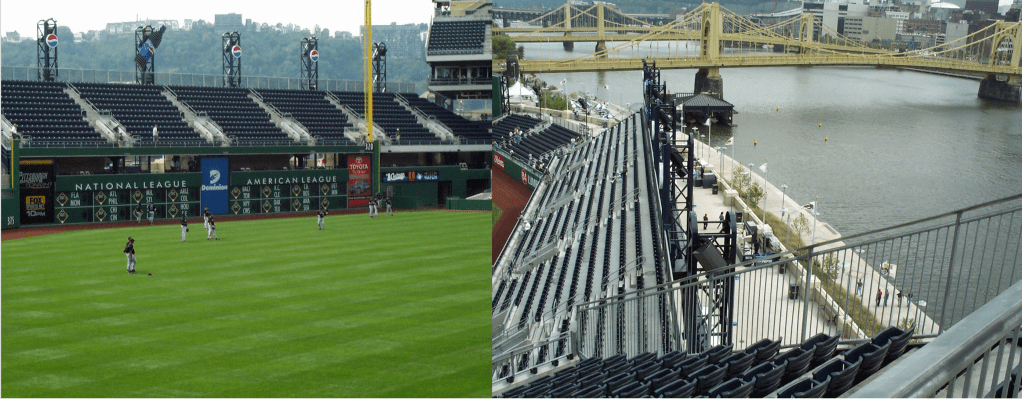
The view of PNC Park and surroundings from the upper deck. (Photo credit: Jeff Hayes)

Following the lower concourse to the right field line brought us to the detached bleacher area, which extends from the foul pole to the 375 foot sign in right centerfield (where a hand operated scoreboard runs the length of the 21 foot high fence). Venturing up into the bleachers gave us a great view of the river and the city. Each seat provided a clean view of the action, due primarily to the elevated nature of the bleachers. Continuing counter clockwise on the lower concourse, we encountered a smaller bleacher area adjacent to the green batter’s eye in centerfield. Since the crowd was small, there were very few fans here, but given the sight lines here (as all seats in PNC Park are angled to produce the best view of home plate), these seats appear as though they would be almost as good as the seats in the right field bleachers.

Standing on the lower concourse behind the batter’s eye gave us an amazing view of the bridges and downtown Pittsburgh. Even the pictures we took on the cloudy and humid day (resulting in haze that partially obscured the city) could not do justice to the backdrop for PNC Park. Even if we did not see a game here, the view alone was worth the time and expense. Proceeding toward home plate, we got a close up view of the video board, which stood atop two tiered seating in left field. The video board seemed curiously small for a brand new park, which is not necessarily a bad thing. Light stands bracketing the video board were wrought steel, and looked similar those at Comerica Park. In fact, the placement and size of the video board at Comerica Park bore a striking resemblance to what we saw at PNC Park.

The right field bleachers at PNC Park, with a great view of the riverfront at the top of the section. (Photo credit: Jeff Hayes)

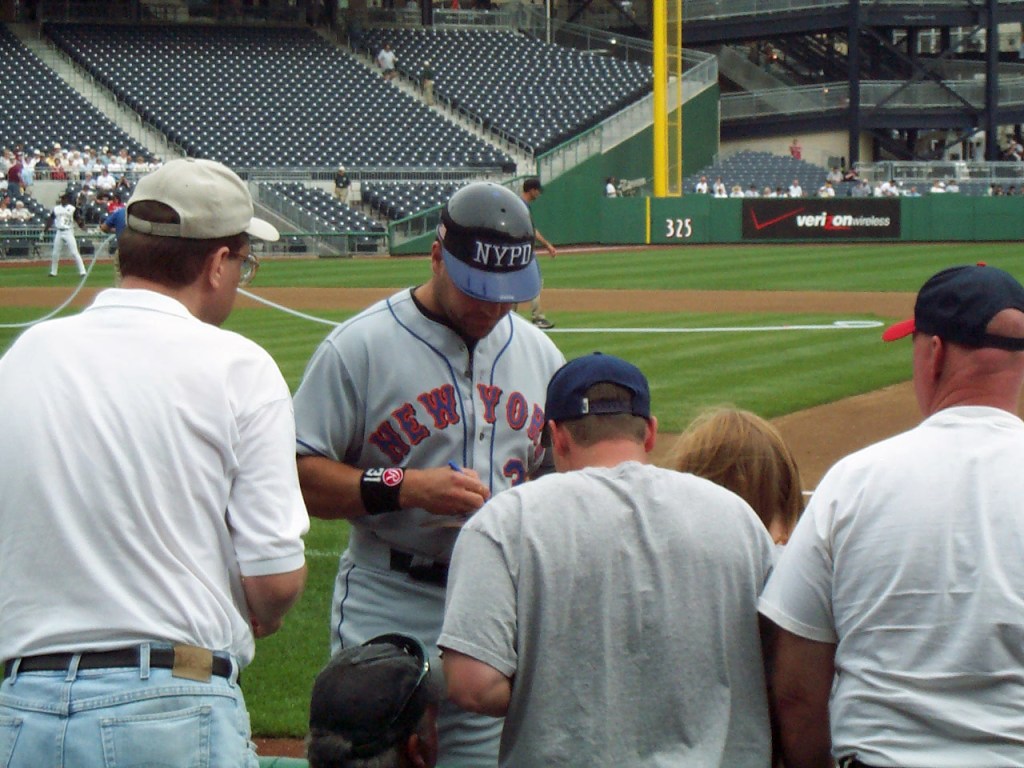
We completed the loop around the stadium on the lower concourse behind home plate, and went in search of a baseball lunch. Like most “newer” MLB stadiums, PNC Park has many places to eat, including outlets of many popular local restaurants, with premium services available in the club level provided by Levy’s Restaurant. Per my usual, I eschewed these choices, instead choosing hot dogs and drinks to bring to our seats. In keeping with the somber nature of the situation following the attacks on 9/11, there was a sense of sullenness in the crowd, and even the typically boisterous Mets fans kept their enthusiasm in check for the game. Mets players were wearing hats of the various first responder services (like the NYPD, NYFD, etc.) that gallantly answered the call during and after the attacks.

Mets catcher Mike Piazza, donning an NYPD helmet, signing autographs for fans at PNC Park. (Photo credit: Jeff Hayes)

Despite the air of melancholy in the air at PNC Park that afternoon, Mets players did sign autographs and interact with the crowd. Because the game was moved to Pittsburgh with little advance notice, we were able to get seats along the right field line just beyond the Mets dugout (PNC Park is one of the few MLB parks where the home team dugout is on the third base side). Though I was mesmerized by the ballpark and its surroundings, we were there to see a game. Following a World Series berth in 2000, New York, facing a depleted Pirates squad, overcame an early deficit to win the game, 9-2. We were treated to a Mike Piazza home run, and the game time was under three hours. Facing a long drive home, we headed straight to the parking lot. PNC Park was as advertised and much more, leaving me dazzled. We would have to return, if only to the the park and its views in better weather conditions.

My scorecard from the game.

Our second visit to PNC Park was not as hurried, as we planned a weekend visit to Pittsburgh to once again see the New York Mets. Unlike our previous stay, clear skies and pleasantly warm and dry conditions were expected for Saturday and Sunday. Our trip from central NJ to Pittsburgh was uneventful, and we drop off our bags at the hotel before heading to the park. Leaving ourselves plenty of time to explore, we crossed the Allegheny River on one of the bridges, where my brother got some excellent shots of the stadium, with the river in the foreground. Given the great late summer weather, we strolled along the riverfront, where we encountered scores of people walking, biking and sitting along the banks of the river.

A view of the Roberto Clemente Bridge just north of PNC Park. (Photo credit: Jeff Hayes)

Following our extended tour of the area, we headed into PNC Park through the home plate entrance. Of course, we wandered through the ballpark, though we didn’t spend as much time doing so, as we would get a better look at the park the next afternoon. After visiting the concession stand in the lower level behind home plate for a baseball dinner, we headed to our seats. Because the Pirates were playing out a disappointing season, tickets for the game were plentiful, and we were fortunate enough to secure good seats just to the right of home plate in the lower level.

Sunshine, though decreasing with time, afforded us a better look at PNC Park and downtown Pittsburgh. The Aztec gold of the bridges crossing the Allegheny seemed more vivid in the waning daylight, and the overall feel of the park was much lighter, a stark contrast to our previous visit, when skies were gray and the country was still reeling from the attacks on 9/11. PNC Park has a two tiered seating area extending from the left field foul pole behind home plate to the right field foul pole (minus the luxury boxes and the press level). When combined with the bleachers, there were just over 38,000 seats in the ballpark (which is the second smallest capacity in MLB), and almost all of the seats in the stadium offer a view of downtown Pittsburgh.

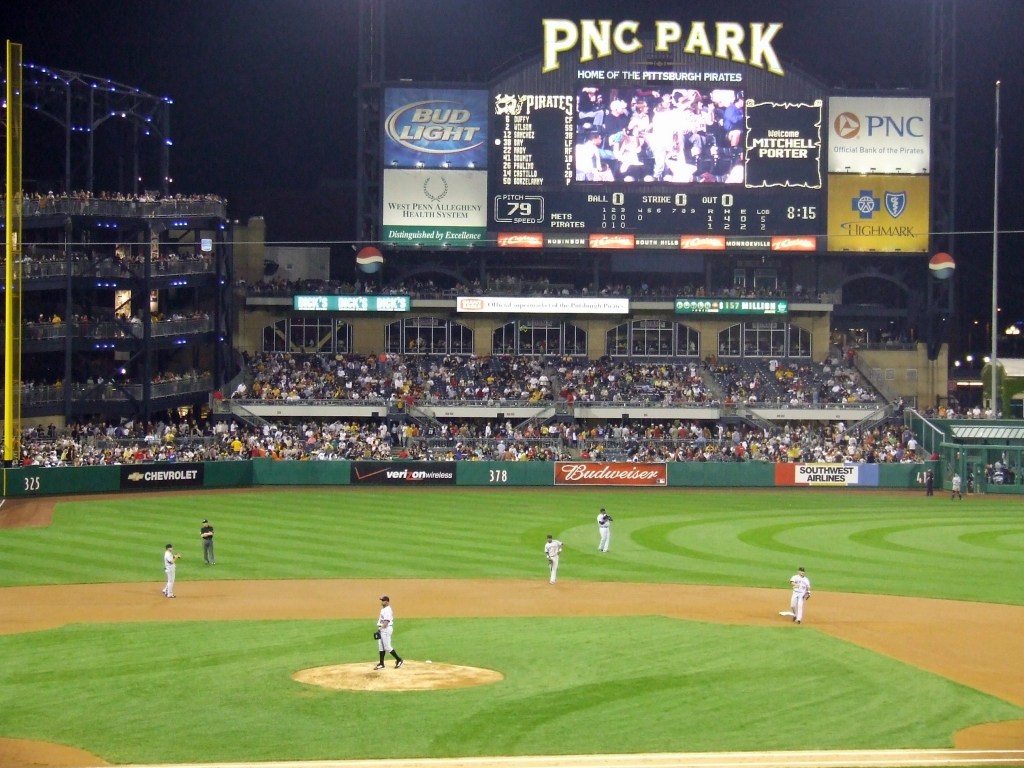
The view from our seats for the Saturday night game. (Photo credit: Jeff Hayes)

PNC Park offers one of the smallest distances from home plate to the backstop (51 feet), giving fans nearly unprecedented closeness to the action. Clearly, the stadium was designed with a maximum fan experience in mind. When combined with the spectacular views of the city and the river, my opinion that PNC Park was the best park in MLB (though my brother would disagree, as he is partial to Comerica Park) was cemented. Even after the game started, I found myself scoping out the park and scenery beyond it, instead of paying more attention to the action on the field. More than once, I found myself envious of the Pirates home, wishing and hoping that the Mets would construct a ballpark with similar magic.

View of the Pittsburgh skyline from out seats in PNC Park. (Photo credit: Jeff Hayes)

Though 25 games under .500 coming into the game, the Pirates kept pace with the visiting Mets (who were destined for a division championship and a trip to the 2006 NLCS), as evening blended into night. Surprisingly, there were few lights emanating from the buildings in downtown Pittsburgh, as I expected the coming of night might allow the downtown area to shine. That was probably the only negative we encountered on our visit to the park that evening. Had the game been a nationally televised broadcast, it is possible that the city might have obliged with more lights from the structures, producing a spectacle for the fans in attendance and those on TV.

Between the time we entered the ballpark before the game and the third inning, the crowd filled out nicely. Even the four level steel rotunda in left field, used primarily for standing room only, was filled with fans. Officially, there were more than 37,000 people in the ballpark that night (nearly a sellout), but the actual count was almost certainly less. In any event, the fans in attendance made their presence felt, and the game was deadlocked at two going into the bottom of the ninth. Pittsburgh scratched out a run in the bottom of the frame, beating the Mets and their closer, Aaron Heilman 3-2. As the jubilant Pirate fans filed out of PNC Park that night, I quickly scanned the ballpark while we waited to exit. As we left, I remember thinking that I hoped the Pittsburgh fans appreciated the park they were lucky enough to call home.

PNC Park at night. (Photo credit: Jeff Hayes)

Sunday September 17 2006 was a mainly sunny and pleasantly warm late summer day, and after breakfast we headed out to PNC Park to see the finale of the series. Early morning fog was begin transformed into cumulus clouds as the sun shone over the park, and the filtered sunshine showed that we were indeed headed toward fall, despite the warm weather. We did not spend as much time outside of the park as the previous day, but we did focus our attention on the river. Much like we saw in Cincinnati in 2004, there was quite a bit of river boat traffic this Sunday morning, and it reminded me what life might have been like on the river long ago. Leftover haze gave the river and its surroundings a softer hue, and somehow this seemed to add to the appeal of the area.

A passing river boat tour on the Allegheny River. (Photo credit: Jeff Hayes)

Upon entering the park, we conducted one final walkthrough of the stadium with the best conditions we had seen so far. Based on the number of fans milling around outside, the crowd promised to be much smaller than the game the previous night. Our experience has taught that Sunday afternoon games were usually more lightly attended than Saturday night games, and it seemed that trend would hold for the afternoon contest. In addition, we had entered football season, which meant the part of the crowd that might have come to see a poorly performing Pirate team instead stayed home to watch gridiron action. Regardless of the reason, we expected to have more elbow room for the matinee contest.

Before getting a baseball lunch and heading for our seats, we headed up the upper deck to get some pictures of the stadium with downtown as the backdrop. From that vantage point, my brother took some of my favorite ballpark pictures, and even those picture did not do the scenery justice. Though we did not have pristine conditions, the panorama my brother constructed from those pictures qualify (in my opinion; his may vary) as his best work at baseball stadiums, and helps to shape my opinion of PNC Park being the best ballpark in MLB.

This is it: my favorite picture of PNC Park, courtesy of my brother. (Phot credit: Jeff Hayes)

Our seats were very similar to those of the previous night, in the lower level just to the right of home plate. For the New York Mets, the game was not particularly meaningful, as they were on their way to the NL East title, but most of the regular starters were in the lineup. On the mound for the Mets was right hander John Maine, who was the number five starter in the New York rotation. For the hometown Pirates, left hander Zach Duke took the mound. Duke was the ace of the Pittsburgh staff, and we were not quite sure what to expect out of either team, with so little at stake for either team this late in the season.

Pittsburgh scored two runs against the Mets in the bottom of the first inning, and as it would turn out, that would be more than enough for Duke, who tossed eight shutout innings against a formidable New York lineup. Despite the second straight flat performance by the Mets, the game was again almost superfluous, as the fine late summer conditions made PNC Park shine even more than the night before. In between innings, I spent my time shifting my attention from one feature to the other, while my brother’s camera was busy capturing the nearly perfect baseball environment. As we suspected, the crowd was quite thin, nowhere near the announced crowd of nearly 30,00. Later I would learn that the Pirates’ attendance in 2006 was 1.8 million, which was next to last in the NL. Apparently, a poorly playing team trumped the beautiful ballpark, which had been racking up accolades since it opened its doors in 2001.

The view from our seats. (Photo credit: Jeff Hayes)

Time passed quickly during the low scoring game, which clocked in at about two hours and 30 minutes, which was shorter than the league average. Before I knew it, we were leaving this baseball palace, headed out for a five hour drive back home to central NJ (during which we would listen to the Jets lose another game). To say we thoroughly enjoyed the ballpark would be a great understatement. Though we were split as to whether we thought that PNC Park was the best MLB park, we did agree that it was a great baseball experience that we would have to repeat as soon as possible. If you find yourself near Pittsburgh during baseball season, check to see if the Pirates are home. If they are, GO! You will be glad that you did.

Goodbye PNC Park. Hope to see you again soon! (Photo credit: Jeff Hayes)