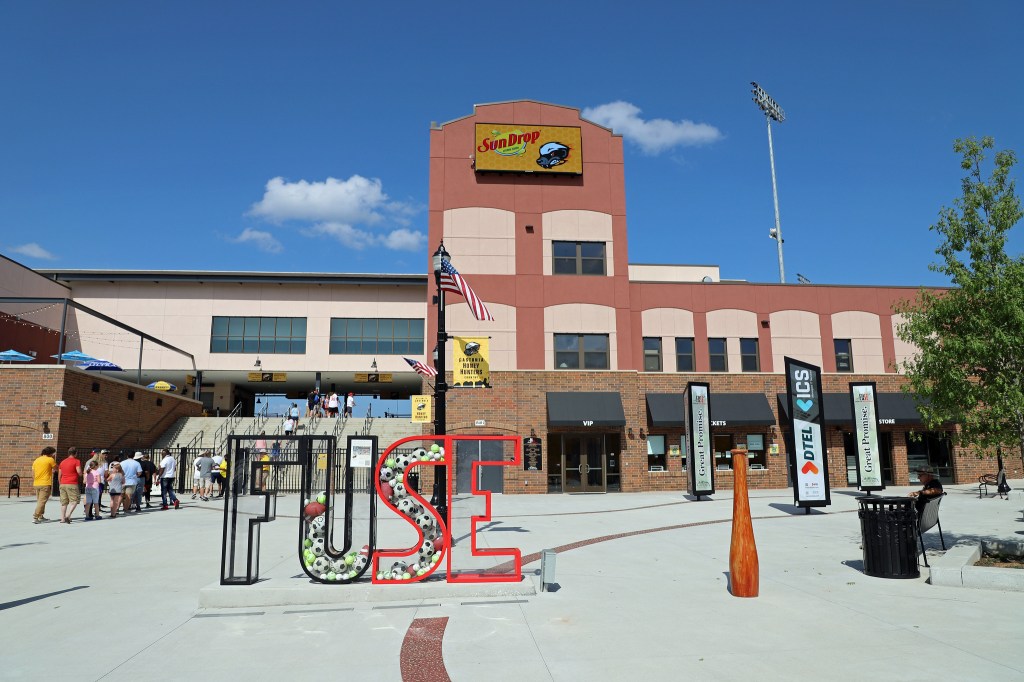
CaroMont Health Park, Gastonia NC, Sunday August 29th 2021

Outside CaroMount Health Park, Gastonia NC. (Photo credit: Jeff Hayes)

On the back end of a weekend baseball trip to North Carolina, we visited CaroMont Health Park in Gastonia, home of the Atlantic League’s (ALPB) Honey Hunters. Playing their inaugural season, Gastonia offered an opportunity to again visit the Tar Heel State (having done so before in 2017 and 2019). Following an eight hour drive on Friday, and after attending a Charlotte Knights game on Saturday night, we visited Gastonia on Sunday afternoon, in advance of their 450 pm game against the Lexington Legends.

Headquartered in Charlotte for the weekend, we took Interstate 85 south from there to Gastonia, a trip that lasted about 25 minutes. Arriving about 30 minutes before the gates opened at CaroMont Health Park, we parked on West Main Street, and walked through the downtown area. Along the strip, there were many storefronts that reminded me of a small town you might expect to find in North Carolina. In fact, we encountered a sign that stated Gastonia was named an All American City in 1979, 2000 and again in 2010. After walking for about 30 minutes in the hot late August sun, we headed back toward the vehicle and headed toward the ballpark.

A look at downtown Gastonia. (Photo credit: Jeff Hayes)

Located about a mile down West Main St is CaroMont Health Park. The ballpark is the centerpiece of the Franklin Urban Sports and Entertainment (FUSE) District , an economic zone developed to reinvigorate downtown Gastonia. Interestingly, there was only parking for season ticket holders onsite, but we were able to secure parking across the street from the stadium in the lot of a church. Parking was free, and just a couple minute walk to the main entrance of the ballpark. My brother wore his vintage Montreal Expos hat to the game, and that did not go unnoticed in Gastonia. The hat spurred a short conversation at the main gate, and later members of the Legends commented on the hat as well. Given that the Montreal Expos have not existed for 17 years, I was mildly surprised that the insignia was still so recognizable.
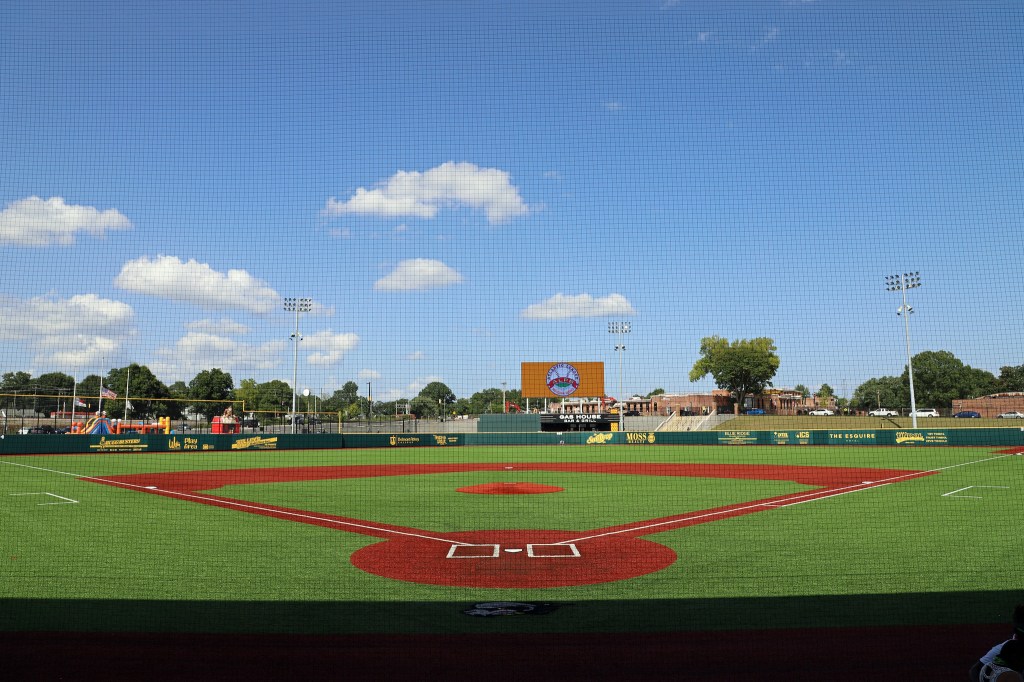
CaroMont Health Park from behind home plate. The entire playing surface is turf, including the mound. (Photo credit: Jeff Hayes)

It did not take long, after entering the ballpark, to see that there was something different about this place. Like BBT Point (home of the High Point Rockers), CaroMont Health Park has an all turf field, including the mound, home plate, and the bullpens (which have odd, wedge shaped mounds). Just as unique is the vast amount of foul territory on the first and third base lines. After studying the ballpark, it became clear that the stadium was designed for multi purpose use, and that we were seeing its baseball configuration. In fact, during the game, there were several announcements concerning a high school football game that was to take place later in the week.

Home bullpen at CaroMont Health Park. Note the wedge shaped bullpen mound, consisting of artificial turf. (Photo credit: Jeff Hayes)

Per our standard operating procedure, we toured the inside of the ballpark. The concrete concourse at CaroMont Health Park rings the stadium, providing us with unfettered access to the entire park. For the most part, the stadium is rather spartan. An entrance gate graces right field, with the Gas House Grill located in centerfield (located beneath the main scoreboard/videoboard). Though we did not actually eat anything at the park (it was simply too hot to eat), it was obvious that the Gas House Grill is meant to be the centerpiece of the dining and drinking experience in the ballpark. A Kids Zone sits between the Gas House Grill and the left field seats, filled with bouncy houses. When we passed, there were no kids playing, but later, from our vantage point down the first base line, we could see the bouncy houses bouncing.
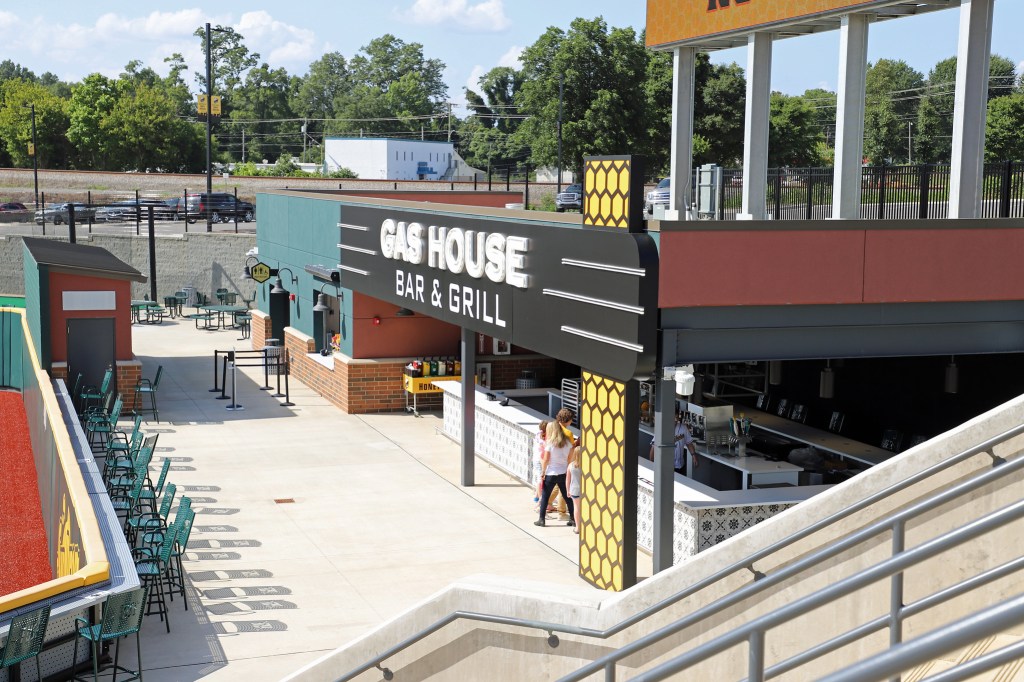
Gas House Grill at CaroMont Health Park, Gastonia NC. (Photo credit: Jeff Hayes)

Left field in CaroMont Health Park is yet another interesting element of the stadium. Because the left field wall is close to the plate (a mere 304 feet), a 20 foot net was placed in front the of the seats there, ostensibly to protect fans from balls leaving the playing field, and to prevent “cheap” home runs. Located beyond the netting is a covered picnic area. On this late afternoon, the area was closed for a private event. We have noticed that sadly, even in minor league and ALPB ballparks, exclusivity has become more prevalent. Working our way back toward home plate, we saw two additional covered picnic areas (complete with ceilings fans) before we reached the main concession stands behind home plate. As mentioned, we did not eat that night, but the concession stands offered standard baseball fare at reasonable prices. Loading up on cold drinks to combat the late August heat, we went in search of our seats.

The left field wall is extended by netting covering left field and the Kids Zone. (Photo credit: Jeff Hayes)

My brother chose great seats down the first base side, immediately adjacent to the visitor’s dugout (at CaroMont Health Park, the home team occupies the third base dugout). Those seats provided us with an unobstructed view of the Lexington Legends, and their antics in the dugout. Fortunately, there were no kids near the dugout, because the Legends players were spewing almost nonstop colorful metaphors. Our seats gave us a great view of the entire park, including the surprisingly large scoreboard in centerfield. Unlike most ballparks, clusters of seats were scattered throughout the ballpark, rather than having one or two large seating sections. Including the six luxury cabanas located in the second deck behind home plate, the stadium has a capacity of 5,000, though from my perspective, I would not have estimated a capacity quite that high.

Our view of the Lexington Legends dugout. (Photo credit: Jeff Hayes)

Being an ALPB game, there were some important rules differences from the MLB and minor leagues. Balls and strikes were called by the Automated Ball-Strike System (ABS), with the output from the system relayed to the home plate umpire, who then makes the call to the players and fans. During this game, many players were visibly upset by the calls. Another rule change included the use of larger bases (18 inches), in hopes of reducing inquires on the base paths. When a starting pitcher is removed from the game, that team loses its designated hitter from the lineup. Dubbed the Double Hook, the rule is intended to inject some strategy back into the game, perhaps encouraging managers to stick with starting pitchers longer. Finally, this was the first ALPB game we had seen since the pitching rubber was moved back one foot to 61 feet 6 inches (the change seemed to have negligible effects on the pitchers). Each of these “experiments” were at the behest of MLB, with which the ALPB has a developmental agreement. It is possible some or all of these rules could someday become part of the MLB game.
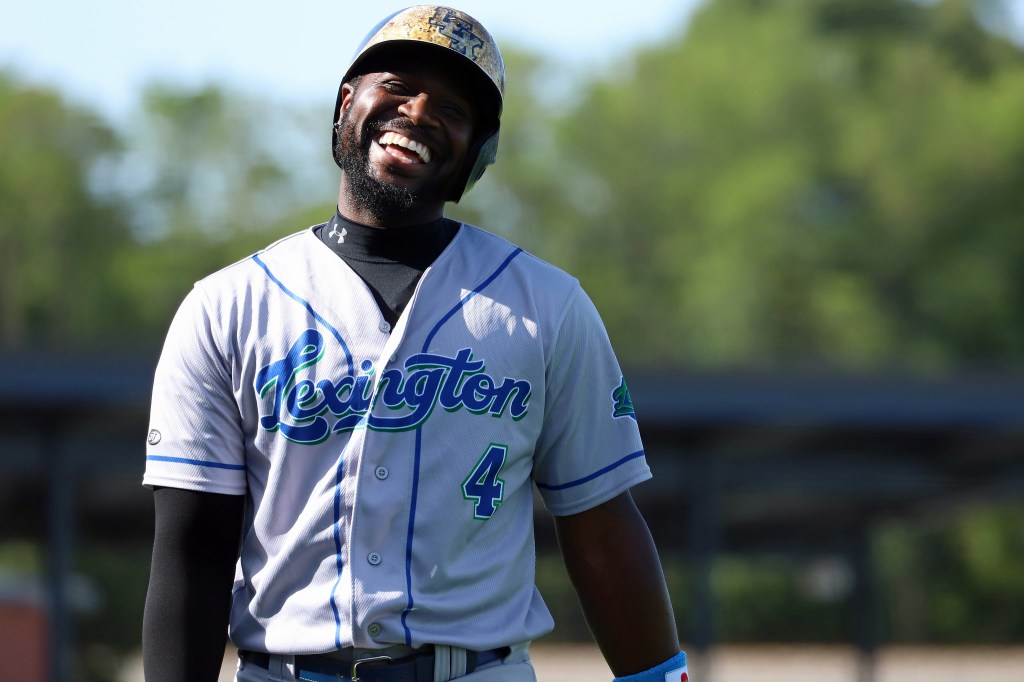
Brandon Phillips smiling after being called out on strikes. (Photo credit: Jeff Hayes)

Clearly the most recognizable member of either team was the Lexington Legends second baseman Brandon Phillips. A seven time All Star with the Cincinnati Reds, Phillips attracted quite a bit of attention as he crossed the field before the game. A part owner of the Legends, Phillips seemed to be enjoying his tenure in the ALPB, and had a smile for everyone he encountered that day. First pitch occurred at 455 PM, and the first inning saw only one run scored. However, from there, the game quickly got out of hand, as both teams scored runs by the bunch. Lexington scored nine runs in the top of the second inning, chasing the Gastonia starter from the game. Not to be outdone, the Honey Hunters scored five runs in the bottom of the third inning, and the slugfest was on!

A near collision between the Legends’ catcher and third baseman on an infield popup. The catcher made the play, and was none too pleased that the third baseman was so close. (Photo credit: Jeff Hayes)

Until recently, the ALPB was a league where the pitching was almost always better than the hitting. Since the beginning of the 2019 season, the quality of pitching in the league has dwindled, and the game in Gastonia was the quintessential case in point. Even the starting pitcher for Lexington (right hander JJ Hoover, the winner pitcher) surrendered nine runs in his five innings of work. Nearly continuous scoring slowed the pace of the game to a crawl, as late afternoon slowly faded into early evening. That time gave us a better opportunity to take in the environment. Though the crowd was fairly sparse (which is not usual for a Sunday game), they were vocal when the Honey Hunters scored, and were supportive when Lexington was running up the score. Eventually, the home team simply ran out of pitchers, sending outfielder Boog Powell to the mound for the top of the ninth inning. Predictably, Powell was tattooed as he threw batting practice fastballs that were swatted for home runs by the Lexington batters. Powell was replaced by center fielder Jake Sloke, who induced a double play to end the inning.
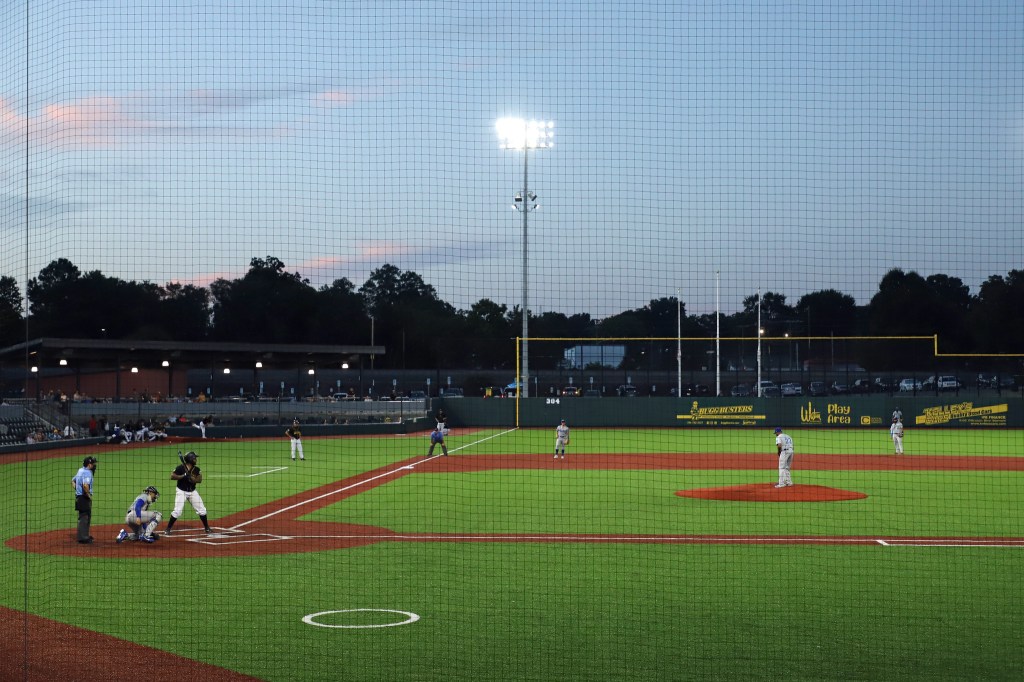
CaroMont Health Park as evening approaches. (Photo credit: Jeff Hayes)

Mercifully, the Honey Hunters went down relatively quietly to end the contest. The final score was 26-12 in favor of Lexington, who hit eight home runs during the game. My brother dubbed the game a “train wreck”, and I would be hard pressed to disagree. Watching an outfielder take the mound brought the game to a standstill, and I seriously considered leaving before the game concluded. As we exited the stadium, I took one last look at the ballpark. CaroMont Health Park is a bare bones, multi purpose community facility, something akin to what we saw in High Point. It is possible that lower levels of the minor leagues, as well as independent baseball, could follow this blueprint when constructing ballparks in the future. We left shortly after the game, heading back to our hotel in Charlotte. While I am glad we visited Gastonia during its maiden season, there is not enough to bring me back to this North Carolina town.

CaroMont Health Park after the game. (Photo credit: Jeff Hayes)

UPMC Field, Erie PA, Sunday July 18th 2021

Main gate at UPMC Park, home of the Erie SeaWolves. (Photo credit: Jeff Hayes)

Following monsoon-like rains in Buffalo the day before (resulting in a rainout of the Rangers/Blue Jays game at Sahlen Field), Sunday morning dawned mainly dry but cloudy. The last stop on our two ballpark tour laid ahead of us in Erie, PA, home to the SeaWolves (the AA affiliate of the Detroit Tigers). From Buffalo, the trip was about 90 minutes on Interstate 90 West. Outside of a few showers near Buffalo early, the drive was uneventful, and as we approached Erie, the sun broke free of the clouds. Unlike Buffalo, the forecast for this stop included sunshine and temperatures in the 70s, much warmer than our stay in western NY.

A rainout the previous night in Erie necessitated a doubleheader today, and the start time for the first game was scheduled for 1205 pm. Because of the accelerated timeline for our visit, we did not have an opportunity to explore Erie or the lakeside (as we had hoped to do before the rainout the previous evening). Driving into Erie, we could see that it was a city that had seen better days, long divorced from its rich history of shipping, fishing and railroad traffic. However, we did signs of construction away from the lake, especially near UPMC Park, perhaps the beginning of a rebirth. Never having been to Erie, we were unsure where to park, and we decided on a parking garage just down the street of the ballpark on 10th Street.

Walking up to UPMC Park from the parking garage. (Photo credit: Jeff Hayes)

Oddly, we paid the parking fee (which was $5.00) to a man sitting in a car just inside the entrance. Parking at the top of the first level, we took the back stairs to street level. Immediately it became apparent that was probably not the best choice, as the area seemed unsavory. Luckily, UPMC Park was just down the street, and we covered that distance in a matter of minutes. After arriving at the park, we noted parking across the street, though we did not know who controlled the lot, and whether we were permitted to park there. As is our custom, we walked the outside perimeter of the stadium. Due to the proximity of Erie Insurance Arena, there was little to see outside of the ballpark, other than the netting along Holland Street in right field.

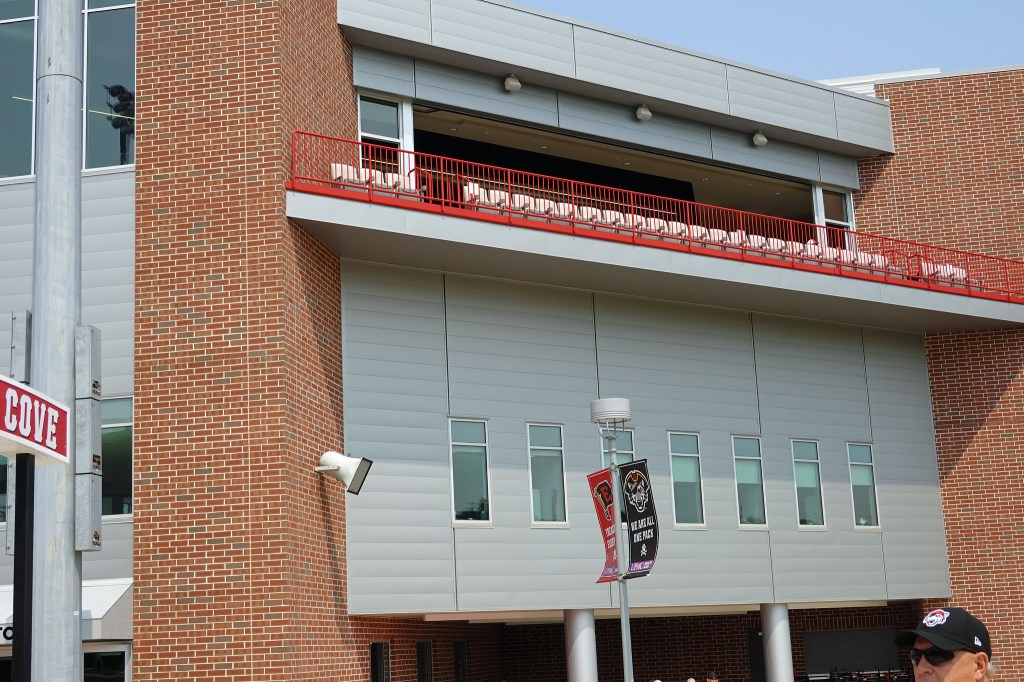
My preconceived notion of UPMC Park was that is was probably a run down ballpark in a region of northwest PA where baseball might not be that popular. My notion was wrong, to say the very least! Upon entering the main gate near home plate, I was pleasantly surprised by what I saw. Almost immediately, my eye was drawn to the high left field wall, provided by the Erie Insurance Arena. It is the most prominent feature in the ballpark, and in my estimation, represents a great use of an existing structure to enhance the park, like Camden Yards in Baltimore or Petco Park in San Diego. From the main entrance, we walked down the left field line (which was short due to the presence of the arena). Crammed into that space was the home team bullpen (the home team also occupied the third base dugout). Just to the left of the bullpen was a seating area above the entrance to the ballpark, located within the arena itself. Those seats seemed like a good place to watch a game, but I imagined they were likely unavailable to the general public. Walking back toward home plate, we passed in front of Flagship Funland, a space geared toward younger fans with games and activities, including a giant inflatable slide.

Seats near the top of Erie Insurance Arena. (Photo credit: Jeff Hayes)

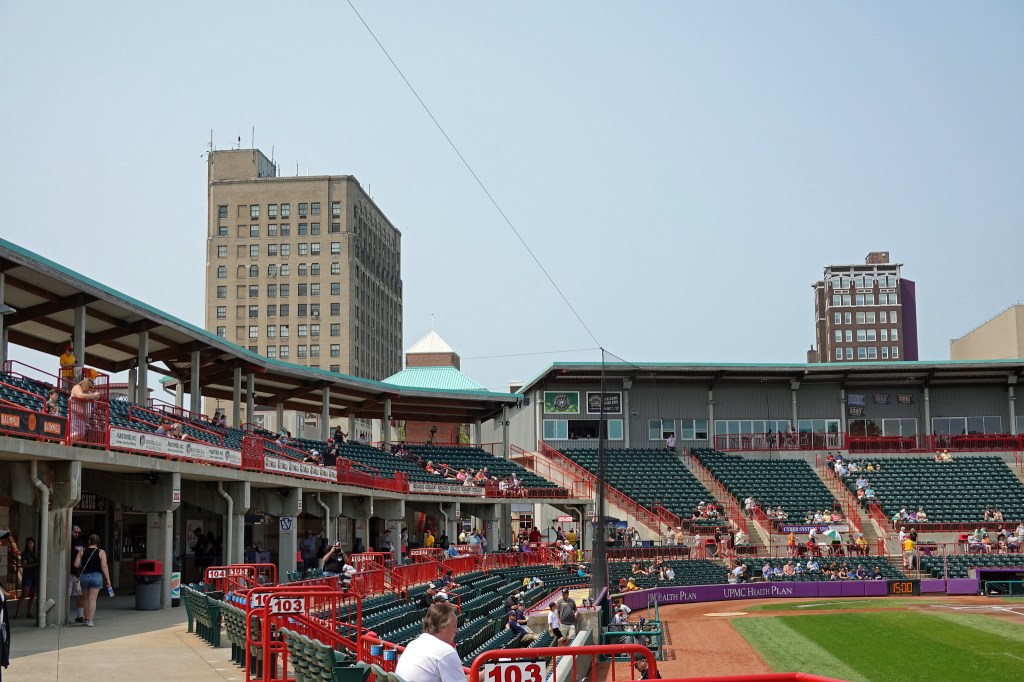
Seating at UPMC Park is divided into two main sections, as we discovered walking toward home. The lower section extends from just past third base behind home plate to just past first base. The upper section (the main concrete concourse divides the two sections) consisted of two distinct pieces, each different from the other. Behind third base is a large, contiguous section (almost like a grandstand) containing about 20 rows of forest green seats, with private suites sitting at the top of the section. Behind the first base lies a much smaller upper section, recessed from the lower section. Beyond the upper and lower seating areas in right field, a covered picnic area, complete with benches and tables, was under construction. From my perspective, this area will be mainly for dining, as the view of the action from this area would be limited, at best. All told, UPMC Park has a seating capacity of about 6,000, which is typical for AA baseball.

This view shows the two very different looks of the second deck at UPMC Park in Erie, PA. This configuration is unique in my experience. (Photo credit: Jeff Hayes)

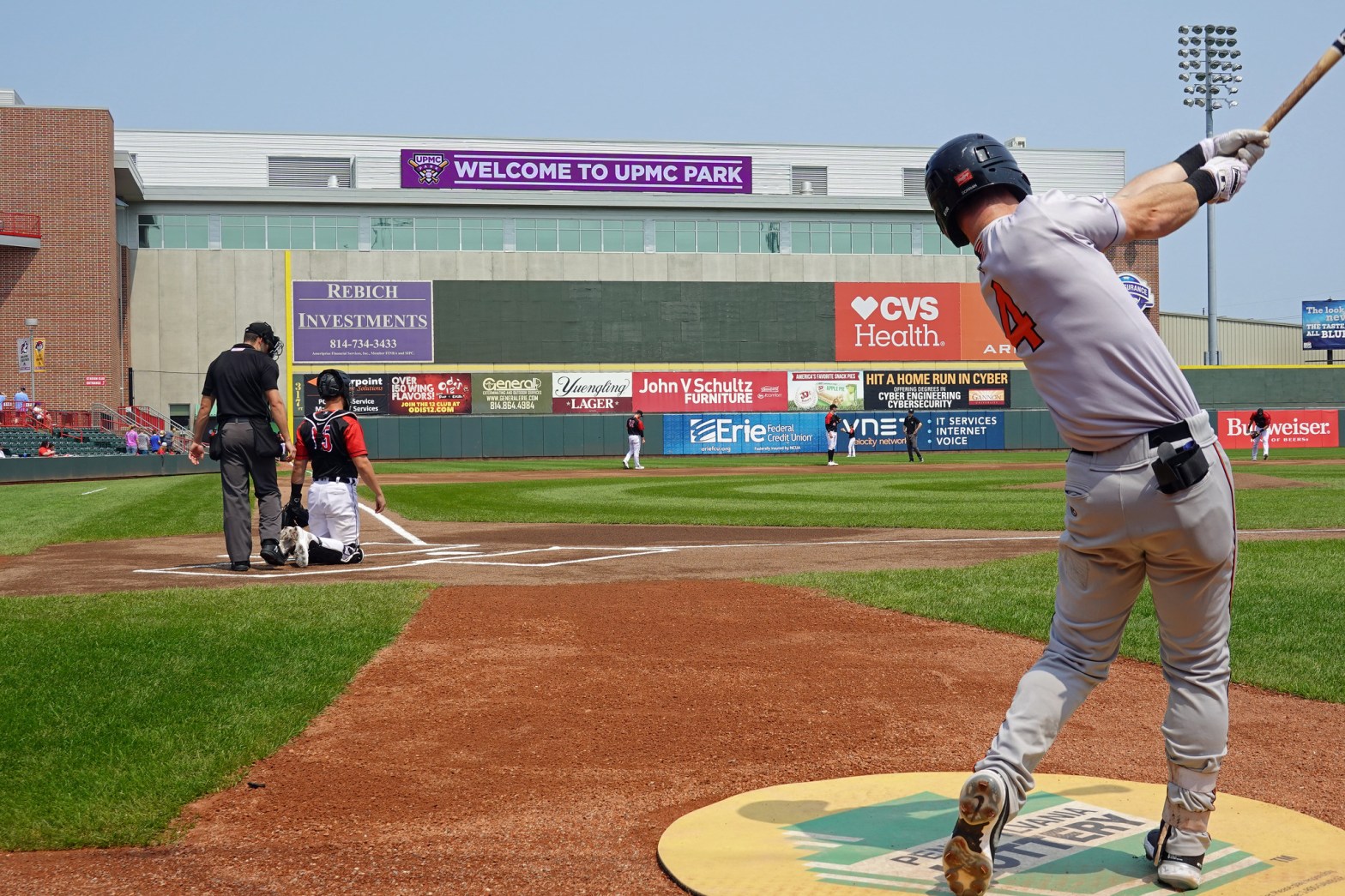
After viewing the bullpen tucked into the right field corner, we headed back toward our seats behind home plate. Along the way we encountered three concession stands on the main concourse, as well as a couple of speciality eateries, but we chose baseball lunches for the 1205 pm start, and found our seats. My brother purchased our tickets back in the spring, and I was astounded by the quality of the choice. Our seats were in the first row, just to the right of home plate. These seats were at ground level, providing us with our closest access to the action EVER. Though we were behind the protective net, my brother sneaked his camera into the holes of the netting, allowing him to get some of his best action shots. Occasionally, the batter in the on deck circle would obscure my view, but it was a small price to pay for such an amazing view of UPMC Park!

The view from our seats, putting closer to the action than we have ever been! (Photo credit: Jeff Hayes)

From our seats, we had great sight lines spanning the entire park. The huge left field wall (dubbed the “Gray Monster” by the locals) dominates the view, just 316 feet from home plate. In an attempt to prevent “cheap” home runs, a yellow line approximately 20 feet up the wall marks the line of demarcation between home runs and balls in play. At the top of the wall is an digital auxiliary scoreboard, showing information on the game in progress, as well as scores for the remainder of the AA Northeast games. UPMC Park also boasts a great scoreboard/videoboard. Located just beyond the right centerfield fence, its modest size was overshadowed by its crisp picture, providing a wonderful source of information for baseball diehards like myself. The outfield wall spanning from centerfield into right field was no more than about eight feet in height, allowing an expansive view of the neighborhood beyond it. Obviously, UPMC Park was designed to fit into the urban area in which it was built, providing a cozy feel to a beautiful ballpark, far exceeding my preconceived notion of the place.

Another view from our seats, providing a great look at the “Gray Monster”. (Photo credit: Jeff Hayes)

First pitch of the first game of the doubleheader occurred at precisely 1206 pm, as the hometown SeaWolves hosted the Bowie BaySox, my ersatz home team when I lived in MD. On the mound for the BaySox was right hander Grayson Rodriguez. Pounding the catcher’s glove with fastballs in the upper 90s, it was clear that Rodriguez was a unusual talent, with “stuff” better than most I have seen at this level. Rodriguez essentially shut down the SeaWolves offense, allowing only an unearned run in five innings of work, while striking out 12. Being directly adjacent to the BaySox dugout on the first base side, we could see the Bowie manager asking for balls to be taken out of play, saved for Rodriguez after his terrific start.

Bowie starting pitcher Grayson Rodriguez delivering a pitch at UPMC Park in Erie, PA. Rodriguez struck our 12 in five innings of work. (Photo credit: Jeff Hayes)

Though temperatures were only in the 70s, the unceasing sunshine started to sap me of energy, and at the end of the first game, we got out of our seats and walked around the ballpark a bit (as well as replenish our drinks). Being a Sunday, the crowd was relatively sparse (certainly less than the reported attendance of 3,100). However, it was a noisy crowd, and in some instances, unrelenting. Several fans made it clear they were NOT pleased with the umpiring crew (especially with the home plate umpire and his ball/strike calls). Rarely have I heard such prolonged abuse of an umpiring crew in the minor leagues, with the constant berating more fitting of an MLB crowd along the Interstate 95 corridor from Boston to Washington (you can listen to the heckling of the umpires here). It took me aback, since the umpire’s calls had little bearing with respect to the outcome of the first game.

After a 30 minute break, the second game of the doubleheader commenced, with each team wearing different jerseys than they did in the first game. This game was not quite as crisply played as the first, with more scoring, as the SeaWolves jumped out to an early lead. A slower pace of play was important, as we still had a five hour drive home ahead of us. Unfortunately, I had one eye on the clock and one eye on the game, as we quickly reached the time we needed to leave. Only four and one-half innings had been completed by 5 pm (each game of the doubleheader was seven innings). With still too much of the game left, we did something we have very rarely done; left a game early.

Scoreboard/videoboard at UPMC Park in Erie, PA. (Photo credit: Jeff Hayes)

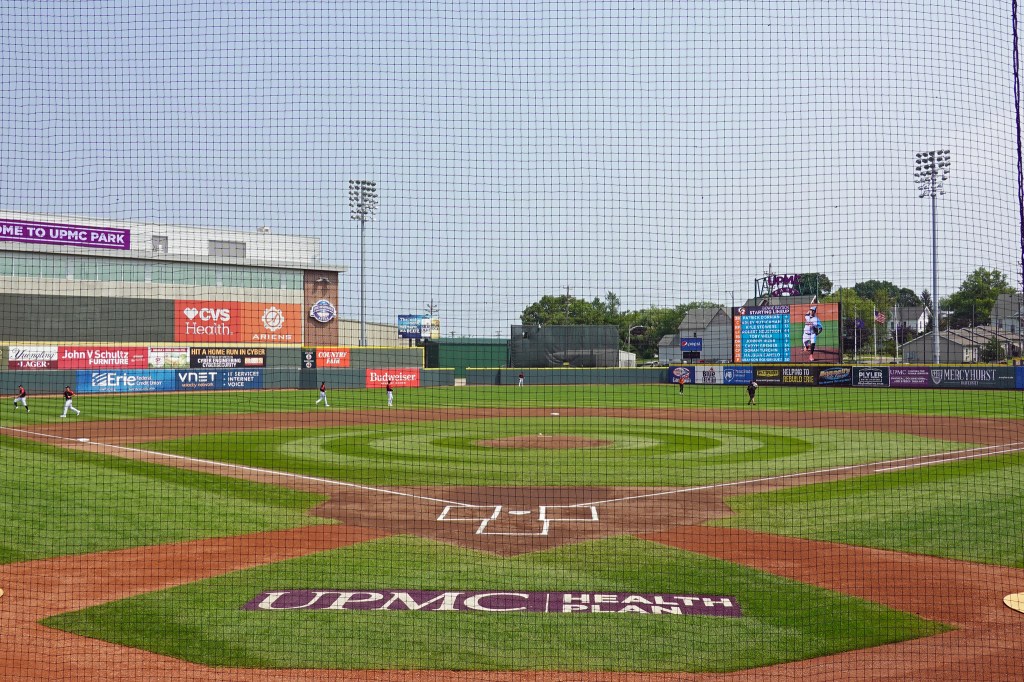
We did get to see 11 1/2 innings of baseball on a sunny day in this beautiful stadium. With UPMC Park being so far away from where we live, I did not imagine we would ever visit, but I feel most fortunate that we did. It quickly became one of my favorite minor league ballparks, nestled perfectly into a urban setting. Though I did enjoy the stadium experience thoroughly, its remoteness from home makes it unlikely we will visit again. If you find yourself within range of Erie during baseball season, pay a visit to UPMC Park. You will be glad you did.

UPMC Park from behind home plate. (Photo credit: Jeff Hayes)

Sahlen Field, Buffalo NY, July 16th 2021

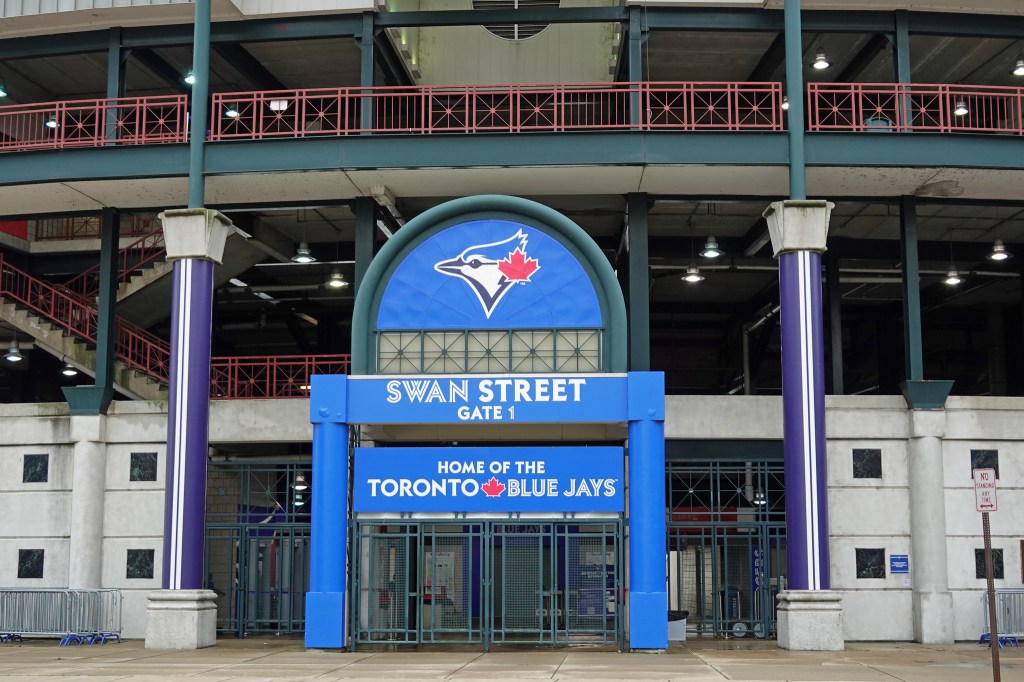
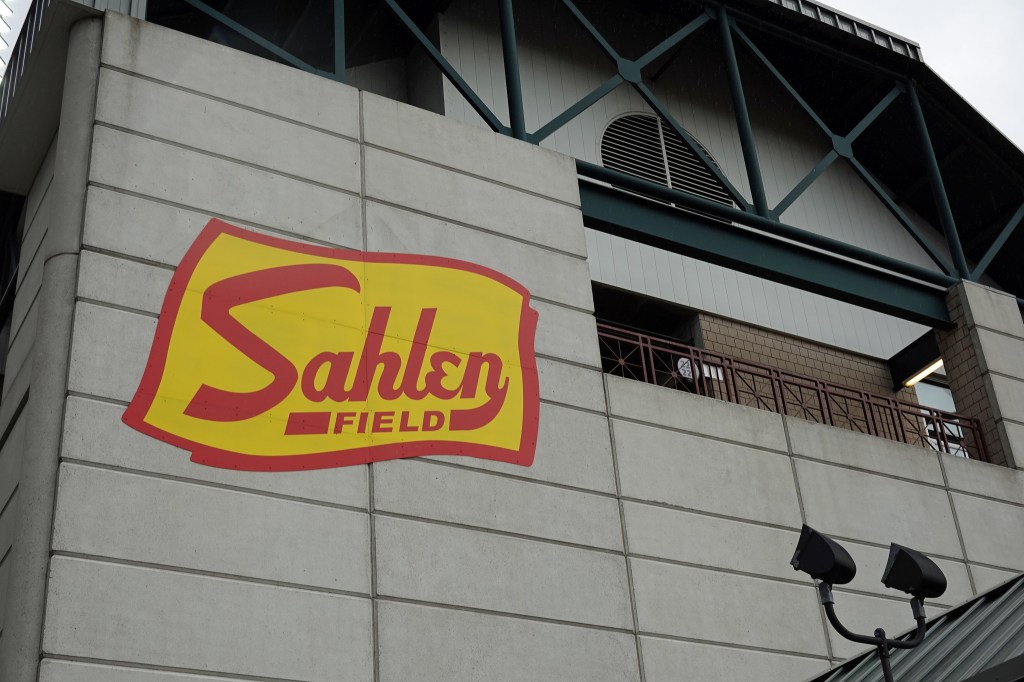
Outside the Swan Street gate at Sahlen Field, Buffalo NY. (Photo credit: Jeff Hayes)

Rain threatened to wash away our baseball weekend in weather New York and northwest Pennsylvania, as the forecast was very wet and cool. My brother and I traveled from my home near Harrisburg to Buffalo on Friday, July 26th, with the intent of seeing a game on Saturday at Sahlen Field (to see the “Buffalo” Blue Jays host the Texas Rangers), then taking in a game at UPMC Field in Erie on Sunday. Since the drive to Buffalo took only five hours, we found ourselves with some time Friday afternoon to do some sightseeing. Niagara Falls was only 30 minutes away, so we went there for our first glimpse of the natural beauty from the American side.

An overcast sky yielded occasional light showers and drizzle, which resulted in us cutting our visit to the Falls short. Before leaving, my brother suggested that we visit Sahlen Field that night, since the forecast for Saturday afternoon was bad, almost assuring a rain out. Not wanting to miss our opportunity to see an MLB game in Buffalo, we quickly purchased tickets for the game, which was slated for a 707 pm start. We were 30 minutes from the hotel, so we had to race back to change and prepare for the game, and headed by up Interstate 90 back toward Buffalo in time to make the game.

Welcome to Sahlen Field! (Photo credit: Jeff Hayes)

Though there is no onsite parking at Sahlen Field (the reason for which was obvious once we arrived), we had little trouble finding parking within a couple of blocks of the stadium. Not surprisingly, parking was generally $20 that distance from the park, and as high as $35 right next to the ballpark. It seems as though parking prices for MLB games found there way to Buffalo! Once we reached Sahlen Field, we wandered around the outside of the park taking pictures. The outfield area was largely inaccessible from the outside, due to the proximity of Oak Street in left field, and restricted parking outside centerfield and right field. However, along Washington and Swan Streets, we found what appeared to be a recently refurbished look, complete with Toronto Blue Jays signage along the way. We also discovered that this portion of downtown Buffalo contained some older buildings with some interesting architecture. If the weather was kinder than forecast on Saturday, perhaps we would investigate this area further.

Returning to the home plate entrance, we entered the ballpark. Security was unsurprisingly tighter than minor league ballparks, but the process was much smoother than most MLB parks, as the staff was cheerful and helpful. Walking through the tunnel to the interior concourse, we felt as though we were in an MLB stadium, with a large and enthusiastic crowd milling around. It was clear that the ballpark had received a significant upgrade for the MLB games played there in 2020 and 2021. Sahlen Field was covered in Blue Jay blue, from the padded outfield walls to the trim on both the lower level and the private suites.

Sahlen Field from behind home plate in the lower level. This image is featured in the Wiki page for Sahlen Field. (Photo credit: Jeff Hayes)

Typically, we explore the interior of a new stadium shortly after arriving, but the bustling crowd inside the inner concourse made that a bit more difficult than usual. Rather than encircle the playing field on the outer concourse (which was more challenging than other ballparks), we ducked into the tunnels between the inner and outer concourses, taking pictures, and repeating the process from the right field line back toward the left field line. Unlike some stadiums, the concourse did NOT extend around the outfield, as Sahlen Field was tucked in between streets in downtown Buffalo, leaving little room for maneuvering beyond those confines.

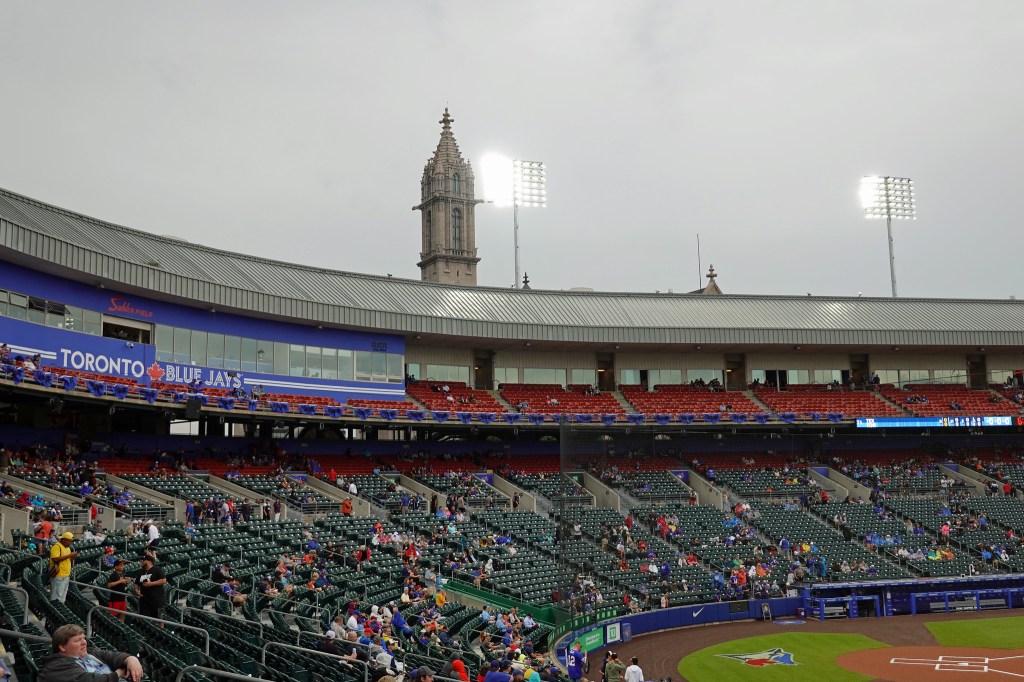
As we further explored Sahlen Field, we discovered that it consisted of two decks of seating. The lower deck (separated into two sections by a concrete concourse) extends from the left field foul pole behind home plate to the right field foul line, with the upper portion of the lower deck protected from the elements by the deck of red seats and private suites located above. Seats near the foul poles were angled for a better view of home plate, something we have not seen in many minor league parks, and a nice touch for fans in those locations. In total, the ballpark holds about 16,600 fans, which made it the largest minor league park we have yet visited.

A view of Sahlen Field, centered on the home plate area. This view shows the green seated lower deck, red seated upper deck, some of the private suites, the press box, and the tower at the Old Post Office in Buffalo. (Photo credit: Jeff Hayes)

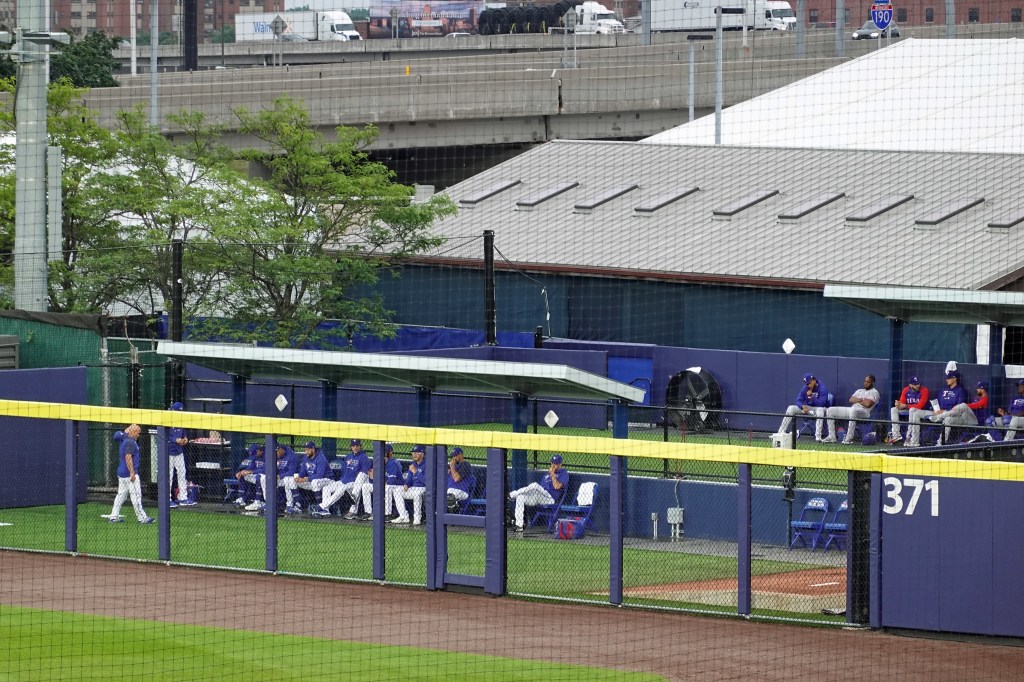
Down the right field line we found the Party Zone, a multi tiered collection of picnic table style benches, covered at the top by a canvas roof. Just to the right of the Party Zone are the bullpens. Constructed shortly before we arrived, the dual leveled bullpen houses the home team on the top tier, and the visiting Texas Rangers on the lower level. Because of the alignment of Sahlen Field, there was only a short wall and a large mesh netting strung across left into centerfield, with Oak Street acting as a barrier. We would later discover that, due to the height of the netting, that it would be difficult for a home run ball to actually land on Oak Street (as its trajectory would more likely deposit in on the other side of the road).

The dual layered bullpen at Sahlen Field, Buffalo NY. (Photo credit: Jeff Hayes)

Finished with our exploration of the park, we ducked back into the inner concourse, in search of a baseball dinner. While there were many places to obtain food and drinks, all of the lines were long, as it seemed that many in the large crowd had the same idea. Skipping this option for now, we headed toward our seats. Securing seats only 90 minutes earlier, we opted for section 118, which was down the right field line; a pessimistic forecast precluded us from getting better seats, for fear of a rainout tonight AND Saturday. Though the seats we scored did not offer the best view of home plate, it did give us great sight lines for the rest of the park. As the time of the first pitch arrived, clouds continued to produce intermittent light rain and drizzle, but not enough to delay the game (which was slated for a 707 pm start).

From our seats, we could see some of the larger buildings of Buffalo, most notably the Old Buffalo Post Office. However, the scoreboard in centerfield seems to be the most prominent feature in Sahlen Field. Not quite as sophisticated as scoreboards/videoboards in MLB parks, the scoreboard/videoboard here is an upgrade from what we typically encounter in minor league stadiums (with possibly the exception of Arm&Hammer Park in Trenton, NJ). For the most part, the space was used as a scoreboard, with only a few video replays shown during the game. As mentioned earlier, there were a number of upgrades made to the park to accommodate the Blue Jays in their tenure here, including new LED lights (which are MUCH better than standard lighting), a resurfaced outfield, and the aforementioned bullpens.

The scoreboard in centerfield at Sahlen Field in Buffalo, NY. (Photo credit: Jeff Hayes)

While not a sellout, Sahlen Field was about two-thirds full shortly after the first pitch was thrown, with intermittent light rain and drizzle falling (as it would for the balance of the game). In the bottom of the first inning, we were treated to a home run by Vladimir Guerrero, Jr. The Blue Jays tacked on four more runs in the third inning, with two more home runs. Rainy and cool weather at night are not normally conducive to balls flying out of the ballpark, but the smaller dimensions of this park may have been a factor in each of the home runs hit. Meanwhile, the Texas bats remained quiet for the first six innings, as the Blue Jays maintained a sizable lead through that time.

The view from our seats at Sahlen Field in Buffalo, NY. (Photo credit: Jeff Hayes)

The Blue Jays put the game away in the bottom of the sixth inning, which featured another home run by Guerrero Jr. This time he blasted the ball well over the net in left field and across Oak Street to the parking lot on the other side of the road. With the Jays taking a 10-0 lead at the end of the frame, some of the fans started to file out of Sahlen Field, if for no other reason that to escape the cool and wet conditions. Like many MLB games, there were loud, intoxicated fans around us, but unlike many MLB, they were not particularly obnoxious. It was clear to me that the fans in Buffalo had accepted the Blue Jays as their own, and I noticed several “Buffalo Blue Jays” shirts and signs in the stadium. These signs had me wondering how the Buffalo fans would react if/when the Blue Jays returned to Toronto.

Vladimir Guerrero hitting a home run at Sahlen Field in Buffalo NY. (Photo credit: Jeff Hayes)

During the morning hours of Saturday, the Blue Jays management issued a press release stating that the Jays would be returning to Toronto, starting with the next home stand on July 30th. Although I am sure the fans were aware of an eventual return to Toronto, I wonder if Buffalo was ready to let them go so soon. Our timing could not have been better to see an MLB game here, as waiting any longer would have meant missing a golden opportunity to see MLB players in such an intimate setting. These were my thoughts as we filed out of Sahlen Field. Leaving the building proved more difficult than I anticipated, as there were logjams at each gate. Eventually, we walked back to the car, headed back to the hotel after a long day on the road.

Sahlen Field at night. (Photo credit: Jeff Hayes)

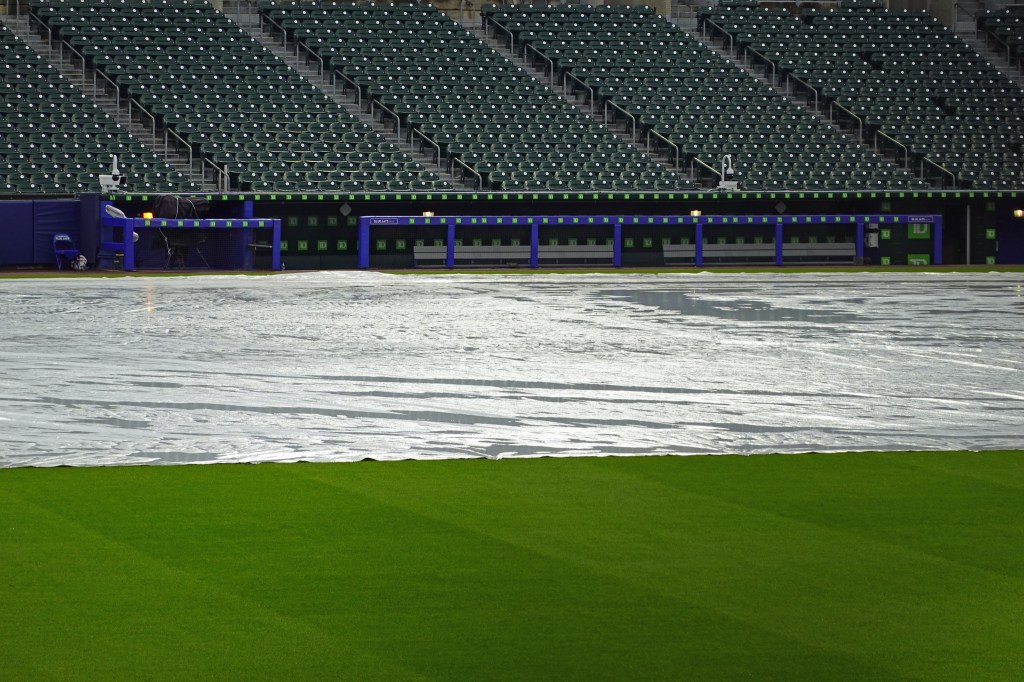
My brother’s suggestion to see the game at Sahlen Field on Friday night rather than Saturday afternoon loomed large, as heavy rainfall plagued the Buffalo area through mid to late afternoon. After visiting Niagara Falls again in the morning, we encountered flooded roads on our way back to the hotel. Not surprisingly, the game was rained out, even as the heaviest rainfall was exiting the region. Apparently the field was unplayable, and considering how much rain fell into mid afternoon, that was not a shock. Once the heavy rainfall exited, we walked around downtown Buffalo to view the architecture, and we found ourselves face to face with the ballpark. Peering through the chain link in centerfield, we got one last look at the interior of the stadium, with the tarp still firmly in place over the infield.

Puddles on the tarp over the infield at Sahlen Field on Saturday told the story; no baseball today. (Photo credit: Jeff Hayes)

Once the Blue Jays leave for Toronto, the main tenants of Sahlen Field, the Bisons, will return from their stay in Arm&Hammer Park in Trenton NJ. Buffalo has attempted to obtain a MLB team in the past, and I wonder, after hosting the Blue Jays, if there will be a clamoring from the faithful for an MLB team of their own. If that happens, and a MLB ready stadium is constructed, perhaps we will return. Otherwise, having seen Sahlen Field hosting MLB games, I am not sure we will be back.