Colorado, Saturday June 12th 2010

Rocky Mountain National Park, CO (Photo credit: Jeff Hayes)

The day began with cloudy skies and cool temperatures for the middle of June in Denver for the second day of our trip. Denver features 300 days of sunshine each year, making it one of the sunniest cities in the US. So it was unusual to have clouds and rain two consecutive days. It was against this backdrop that we decided to visit Rocky Mountain National Park near Estes Park, CO.

Google Maps showing the 75 minute drive from Denver to Rocky Mountain National Park.

1. Rocky Mountain National Park

Located about an hour and 15 minutes from the hotel, we passed through the foothills into the mountains via the Big Thompson Canyon, the site of devastating flash flooding in 1976. Traveling along the steep walled highway, it wasn’t difficult to imagine how dangerous this place could be when heavy rains falls in the mountains. As we gained altitude on the mountain road, the impressive topography became increasingly shrouded in the persistent cloudiness until we reached the park itself.

After checking in at the Beaver Meadows Visitors Center, we decided to follow the Trail Ridge Road. Unfortunately, clouds obscured much of the viewing along the highway, leaving us with shadows of mountains as we wound our way toward the higher peaks, in search of clearer vistas.

This view was typical of our trek through the lower elevations of Rocky Mountain National Park. (Photo credit: Jeff Hayes)

As we drove above 10,000 feet snow became more prevalent. Along the way, we would occasionally pull to the side of the road to take pictures. We could only imagine the views we were missing as the clouds kept them out of our sight. Instead, we had to be contented with the natural beauty the park would unveil through the bleakness.

Caught between seasons at two miles above sea level, we saw fields of snow melting into alpine creeks that flooded the side of the road as we climbed ever higher in our rented Toyota Prius. Eventually, though, winter won out, and we were faced with snow covered roads, for which the Prius was clearly no match. Thwarted by conditions once again, we were forced to seek lower elevations to explore.
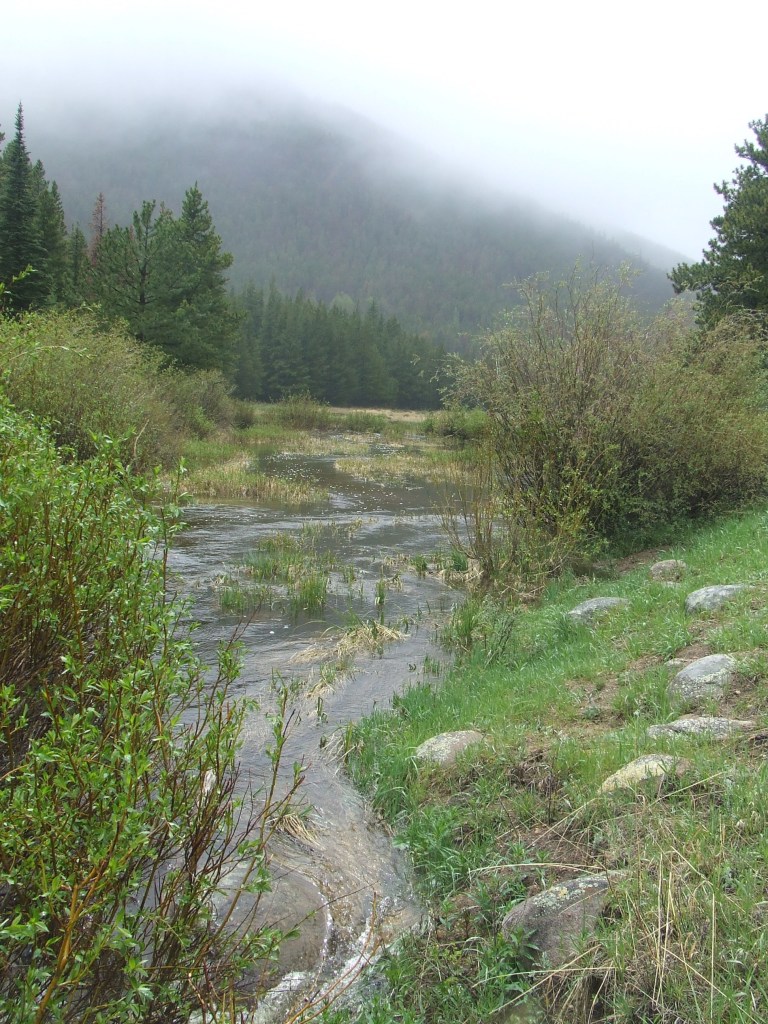
One of the myriad alpine streams fed by melting snow in Rocky Mountain National Park. (Photo credit: Jeff Hayes)

On our way back down the road, we pulled into one of the many turnouts we found along the way. Despite the dismal weather conditions, there were many people visiting the park, as evidenced by the number of cars in the turnout. The view at the turnout was no better than anywhere along the road, but the stop did provide us with a close up look at one of the parks full time residents.
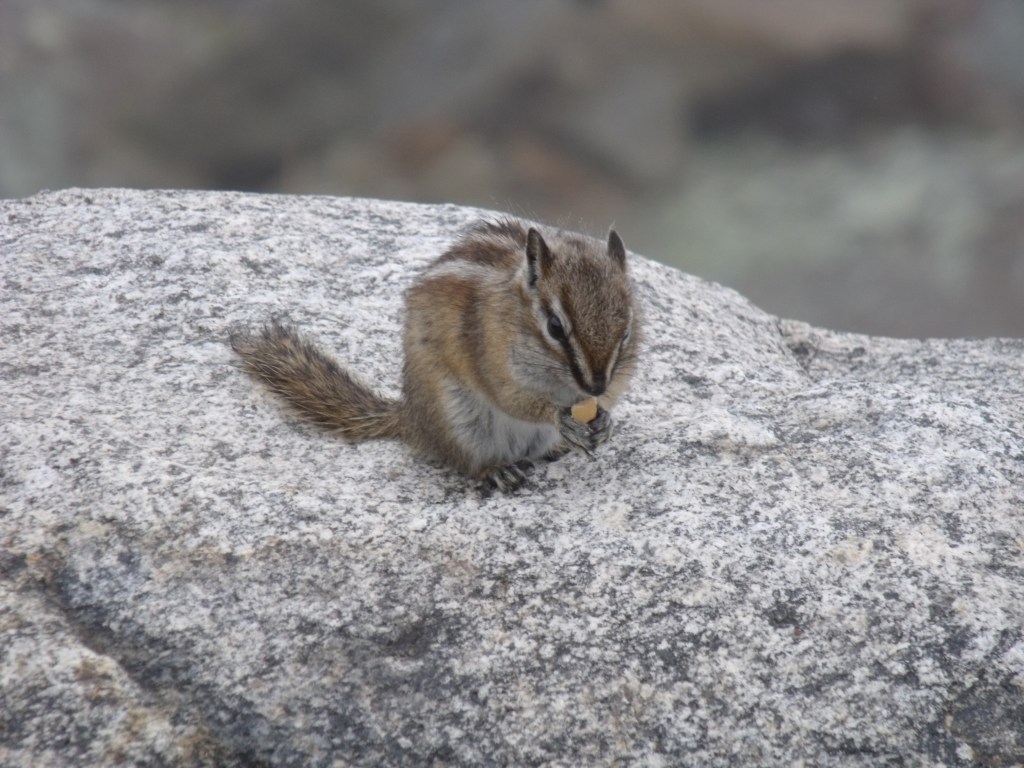
A chipmunk feasting on a cashew I tossed to it. (Photo credit: Jeff Hayes)

Scurrying along the granite parking barriers was a chipmunk, one of many weaving their way through the people in the parking lot. Though there was a sign that clearly stated that we were NOT to feed the wildlife, virtually nobody was heeding that command. Stopping for snacks in Denver, we had pockets full of food for the wildlife, and in direct violation of federal law, we tossed nuts for the chipmunks. Based on the reaction of the chipmunks, they were accustomed to people flouting the rules and keeping them supplied as winter slowly changed to spring.

Once the chipmunks were sated, they scattered into the rocks and crevasses surrounding the parking lot, so we headed back down the mountain road. The view on either side of the road was dominated by fields of melting snow and cloud covered peaks. Descending the mountain was a much slower process than ascending it, as we intermittently stopped to allow the car’s brakes to cool. Failure to tend to the condition of the brakes could lead to the failure of said brakes, so we took our time dropping out of the clouds back toward the visitors center.
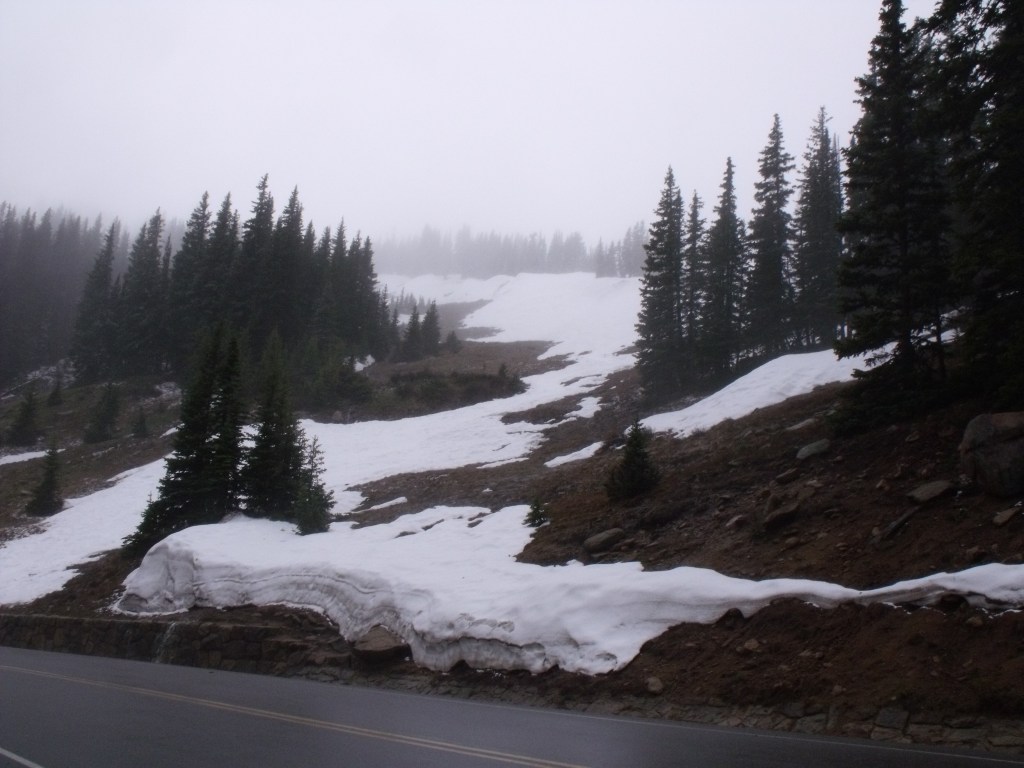
This view was typical of our ride back down the mountain road toward the visitor center. (Photo credit: Jeff Hayes)

As we were approaching more level ground near the visitors center, we spotted some larger wildlife along the side of the road. Just behind a row of trees that obscured a small meadow, we spotted a pair of elk. Parking the car along the side of the road, we walked toward the elk in hopes of a close up picture. Surprisingly, the elk (which appeared to be a male and a female) paid little attention to us as we slowly approached them, seemingly more interested in munching on the greenery all around them.

While my brother took pictures of the female elk, I closed in on the male. Not thinking about the danger in which I was putting myself, I got within an arm’s length of the elk, who was still paying me no particular attention. Foolishly, I leaned in with the intent of touching the elk. That movement finally got his attention. Rather than react aggressively, he simply snorted, which was enough to make me recoil.
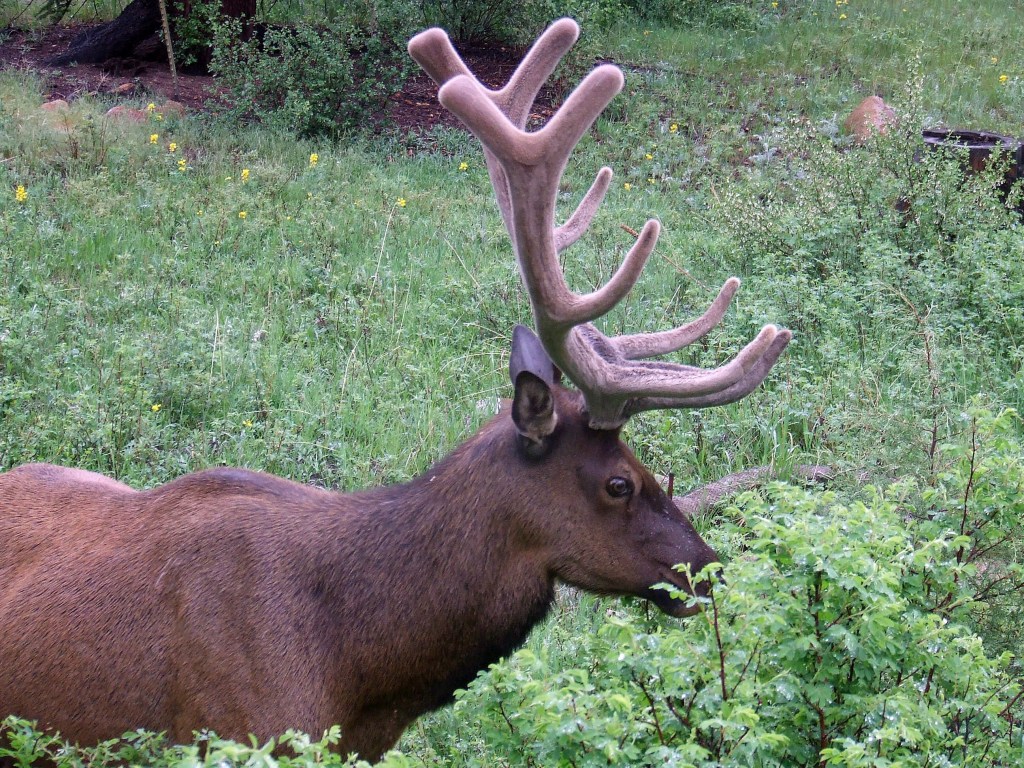
This picture does not accurately depict how close I was to this elk before he made it clear that I was TOO close.

Thinking back, not only did I put myself in danger coming that close to the elk, I disrespected the animal. That lesson remains with me until this day, changing my approach when photographing wildlife. While we were taking pictures of the elk, others driving along the road saw what was transpiring, and stopped to get their our pictures of the elk. Of course, the increased human presence spooked the elk, who slowly but deliberately walked away, ending the encounter.

Spending more time in the park than originally anticipated, we left in search of a late lunch before heading back to the hotel to change for the game. On the way back, we passed Broncos Stadium at Mile High, the home of the NFL’s Denver Broncos. Light rain and drizzle prevented us from exploring the stadium beyond a cursory pass, after which time we headed to the hotel to dry off and relax before the game.

Broncos Stadium at Mile High on a cloudy, dismal late afternoon. (Photo credit: Jeff Hayes)

2. Coors Field

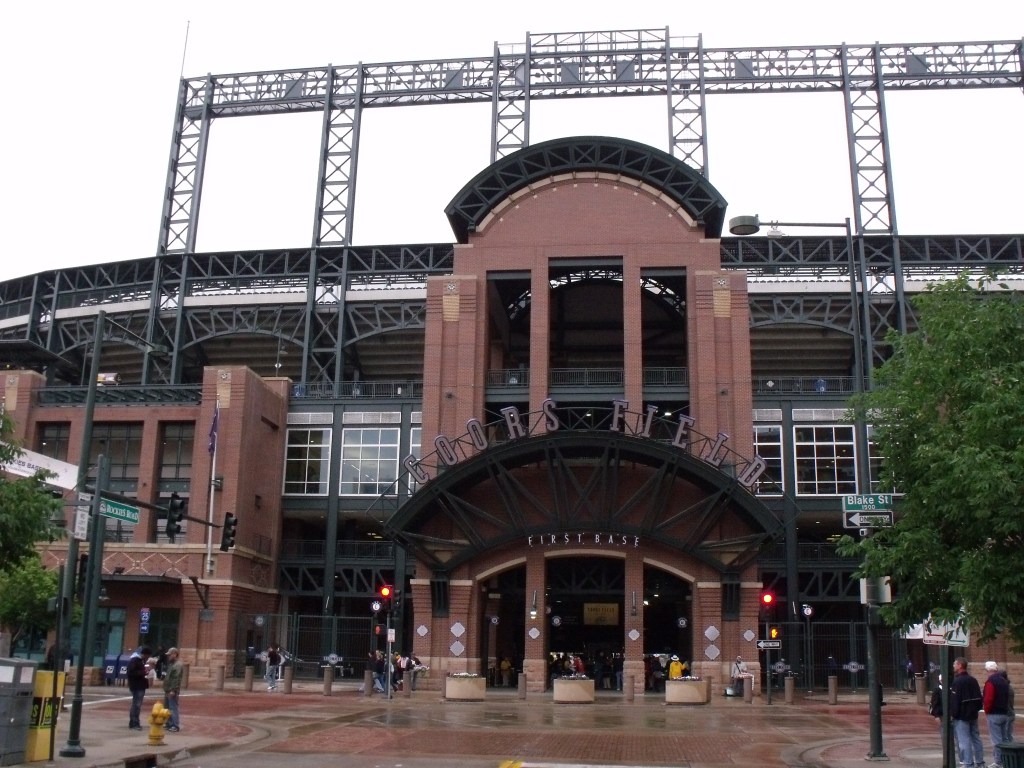
Coors Field on yet another cool and wet evening. (Photo credit:Jeff Hayes)

Once again, clouds, rain and drizzle put a damper of our Coors Field experience. Though the weather was more reminiscent of springtime in the Northeast US, it wasn’t so bad as to threaten the game, and we arrived not too long before the first pitch. Conditions were less than optimal for exploring the ballpark, but we did manage to wander more this evening than the previous one, allowing us a better look at the large ballpark. However, the cool raw late afternoon cut short our exploration. Looking to escape the weather, we sought a ballpark dinner in the lower concourse, then settled into our seats.

The view from behind home plate in the upper deck. (Photo credit: Jeff Hayes)

In an attempt to get a different feel of the ballpark, we sat in the left field bleachers, in the lower level toward the fence. There was no protection from the weather here, but it afforded us some perspective when it came to the size of the outfield at Coors Field. The crowd was once again held in check by the weather, and had much of the left field section almost to ourselves.
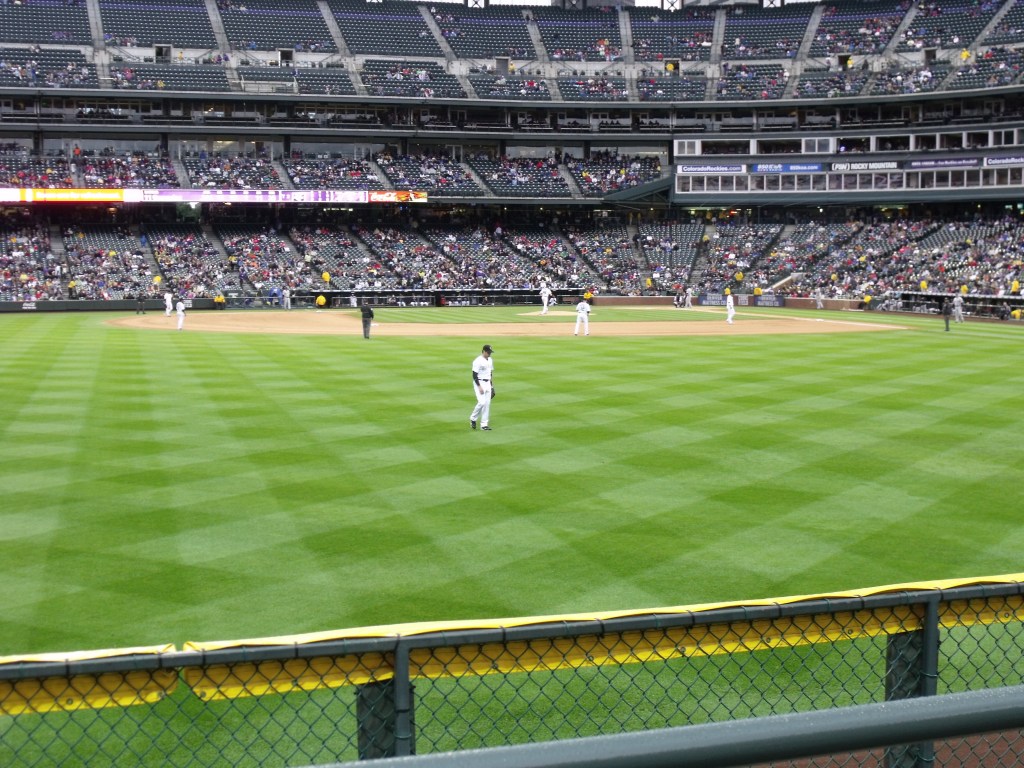
The view from our seats in left field. (Photo credit; Jeff Hayes)

The rain stopped just before the first pitch (which occurred at 610 pm), but temperatures dropped into the 40s, giving the late afternoon/early evening a raw feel to it. Hardly feeling like baseball weather, we settled in for the second game of the three game series between the visiting Blue Jays and the hometown Rockies.

The pitching matchup for the evening’s contest featured right hander Brandon Morrow for the Blue Jays against right hander Jason Hammel for the Rockies. Both pitchers were in the midst of mediocre seasons for their respective clubs. However, the cool and damp conditions seemed as though it might dictate the scoring in the game, rather than the starting pitching. This was, of course, Coors Field, and expecting a low scoring game, even with less than ideal weather conditions, could be asking for too much.
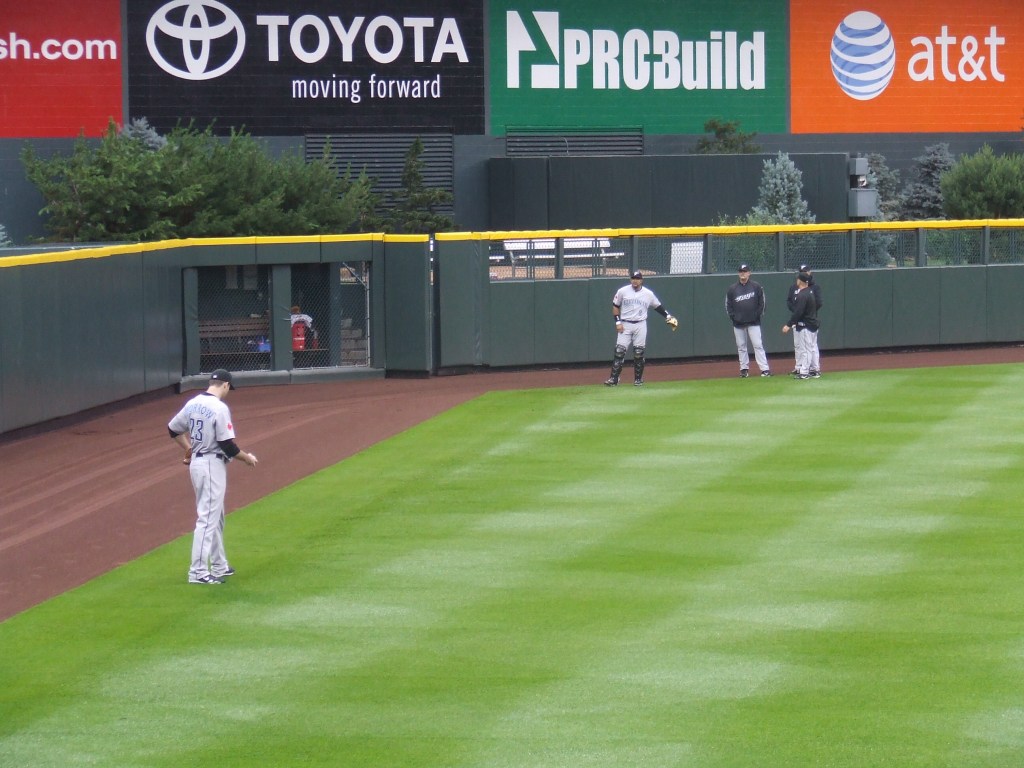
Blue Jays’ starter Brandon Morrow warming up in the outfield before the game. (Photo credit: Jeff Hayes)

Both starters were sharp, mowing down the opposing lineups through the first five innings, as the game pace kept the fairly light crowd (certainly less than the announced crowd of 26,000+) engaged. The quick paced game was appreciated by those in attendance, as intermittent drizzle fell through the game, and temperatures dropped through the 40s.

The Rockies scored a single run in the bottom of the sixth, as a Todd Helton double was followed by a Carlos Gonzalez RBI single. That was the only blemish on the otherwise impressive evening for Brandon Morrow. The Rockies’ Jason Hammel was just as impressive, tossing eight shutout innings in the Rockies 1-0 victory. Following the game, the small crowd made exiting easy, and we returned to the hotel to relax after a long day.

Colorado, Friday June 11th 2010

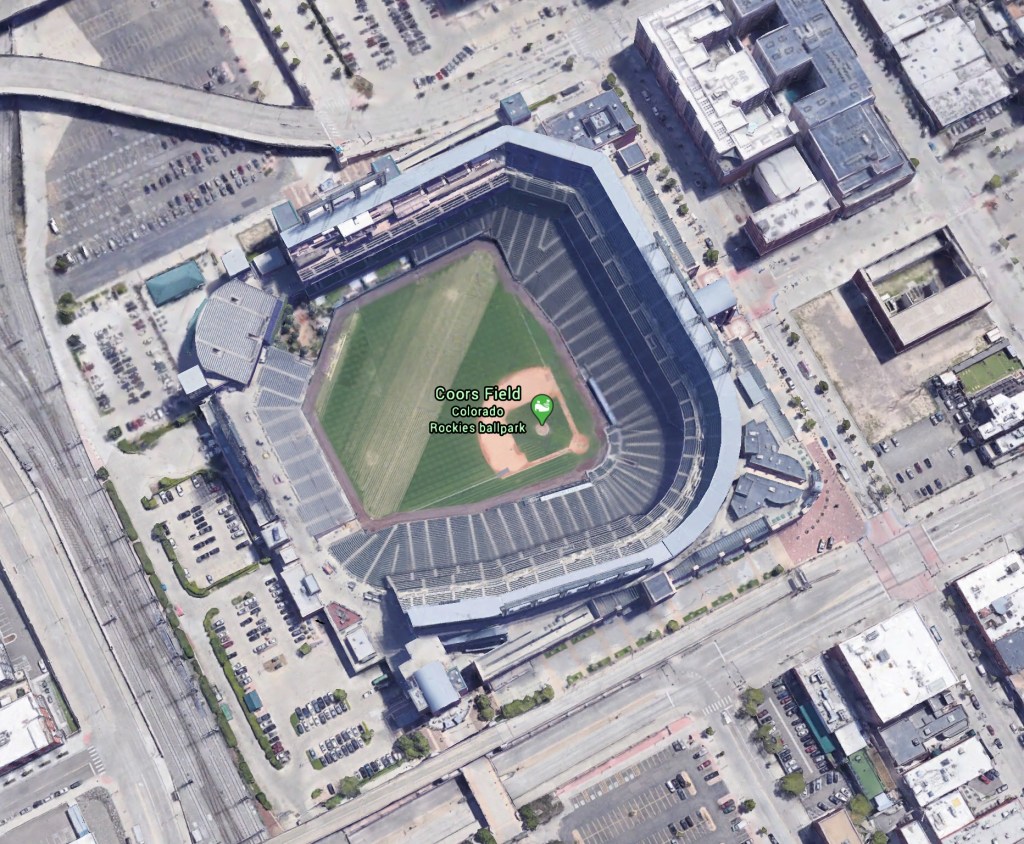
Google Earth view of Coors Field, Denver CO.

Our only MLB trip of 2010 took us to Denver, Colorado for the weekend of June 11-13th 2010, for our first visit to Coors Field, home of the Rockies. The flight from Newark, NJ to Denver CO took about three hours and 45 minutes, and after picking up our rental car, we arrived at our hotel not far from the airport around 400 pm local time.

There was a considerable amount of turbulence landing at Denver International Airport, which in itself was not unusual, as the airport is adjacent to the Rocky Mountains. Its proximity to the mountains makes the airport susceptible to strong and shifting winds, and all of my landings at Denver International Airport have been bumpy (even in good weather).

Thunderstorms bearing down on Denver, CO.

Unbeknownst to us, thunderstorms were scattered about eastern Colorado that afternoon. We became fully aware of the threat as we drove from the airport to the hotel. After checking in, we went down to the hotel bar to get sandwiches when the storms arrived. The manager of the bar came out and told us that, if necessary, we would move across the street to a bank to hunker down if a tornado was sighted.

There as an audible murmur among the few bar patrons when they were informed of the specter of fleeing ahead of a possible tornado. However, being a weather geek, I had other plans. If there was a tornado sighted, I was going outside to get pictures of the storm. Never having seen a tornado, I felt this opportunity was too inviting to let pass. Alas, the strongest part of the storm passed us by, leaving the bar patrons relieved and me disappointed.

Coors Field on a rainy early evening. (Photo credit: Jeff Hayes)

Behind the storm, the wind picked and the air turned noticeably cooler as we headed out to Coors Field, located just outside of downtown Denver. Arriving at the park about an hour before game time, we searched for parking. There are three official parking lots at the stadium (Lots A,B and C), with prices ranging between $15 and $25. On this night, due mainly to the unsettled weather, we sought to secure a spot near the stadium. Otherwise, there are many other parking options located within a short walk from the stadium, though prices vary considerably.

While we were waiting for the rain to end, another strong thunderstorm approaching the stadium prompted this warning by the Rockies. (Photo credit: Jeff Hayes)

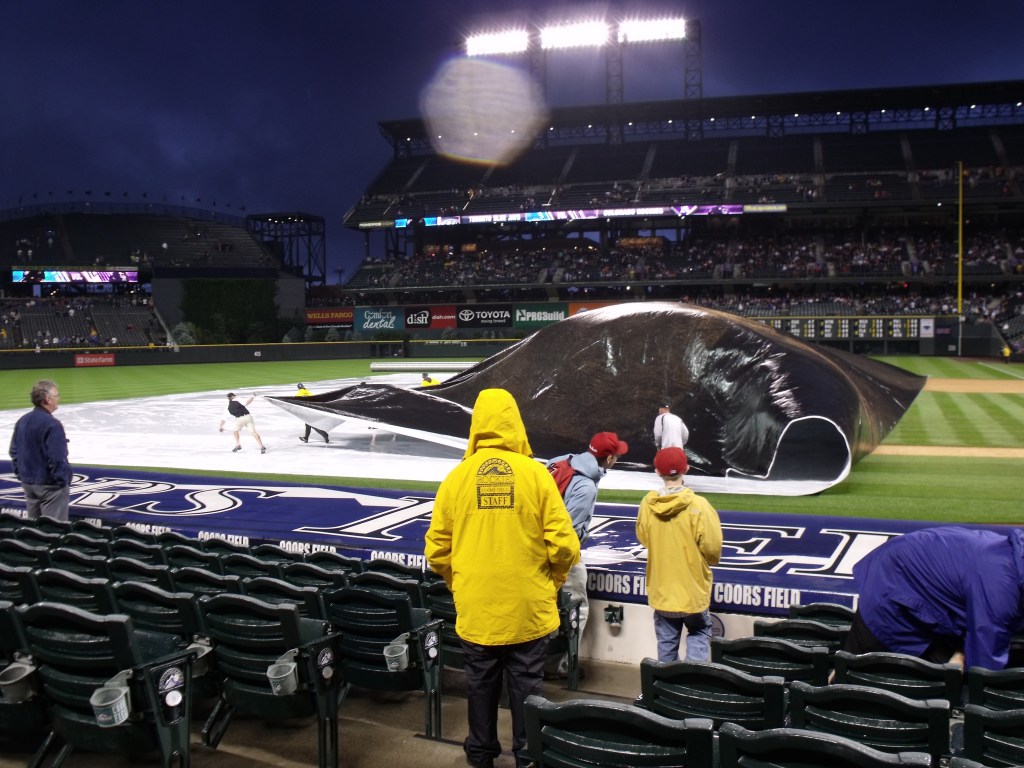
With a light rain falling, we skipped our normal walk around the stadium and went into the ballpark through the first base entrance. Entering the ballpark, we were greeted by a tarp covered field. Every baseball fans knows that tarp on the field before the first pitch is a bad sign. Trying to stay optimistic, we wandered around the park in the rain as long as practical, before ducking in under cover provided by the lower level concourse.

The ground crew adjusting the tarp as we waited for the rain to end. (Photo credit: Jeff Hayes)

The game time of 610 pm came and went, while the rain continued. Temperatures dropping into the 40s made a wet evening even more unpleasant, and I feared as though the game would be postponed without a single pitch being thrown. We took cover as the rain started to lighten up, giving us hope that there might be a game after all.

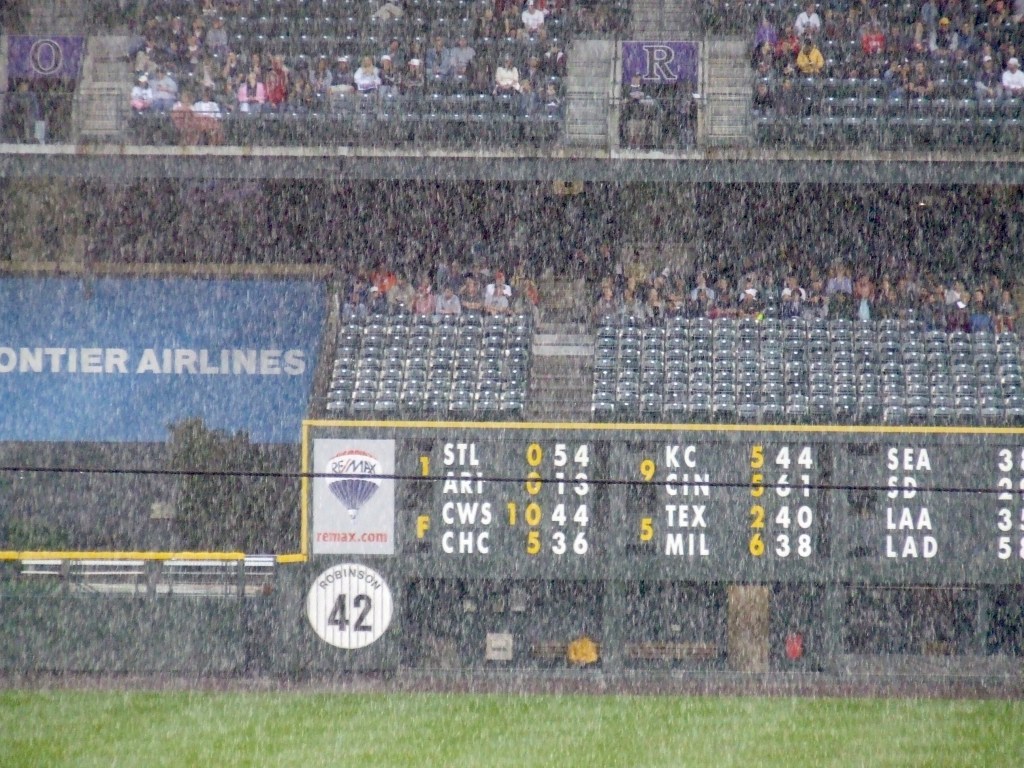
Steady rain (occasionally mixed with a little snow) kept fans under cover at Coors Field. (Photo credit: Jeff Hayes)

As the rain slackened, our hopes for a game were buoyed. After removing the tarp, it took the ground crew 45 minutes to ready the field, pushing back the game time to 855 pm. Much of the crowd left during the extensive rain delay, and there were less than 10,000 fans left in the park (which holds 50,000 fans) when the game started.

Cold and wet, we found our seats for the first pitch. Starting for the hometown Rockies was right hander Ubaldo Jimenez, who was enjoying a career year. Jimenez sported a 1.13 ERA in support of a 11-1 record. The starter for the visiting Toronto Blue Jays was left hander Ricky Romero, who we saw start for the Jays in Detroit in 2009. Not long after the first pitch, intermittent light rain returned, with the occasional snowflakes mixed in as temperatures dropped into the 30s.

Ubaldo Jimenez delivers a pitch in the second inning at Coors Field.

The Blue Jays opening the scoring in the second with a single run, and the Rockies responded with two runs in the bottom of that inning. The Blue Jays scored two more runs in the third to retake the lead, as Jimenez was experiencing his worst outing of the 2010 campaign. The intermittent rain was becoming steadier and heavier, chasing away most of the remaining fans. Having traveled 2,000 miles to see this game, we were determined to remain util the end.

Meanwhile, the Rockies scored single runs in the fourth, fifth and sixth in innings to take a 5-3 lead. Conditions continued to deteriorate, prompting umpires to call for the ground crew to cover the infield once again. Mercifully, the wait was relatively short before the game was called, handing Jimenez his league leading 12th win. With so few fans left in the building, exiting was easy. The late start and bad weather didn’t allow us to explore the park as much as we would have liked, but there were two more games in the series, so we would get another change to take in the feel of Coors Field.

Atlanta, GA Saturday August 13th 2011

Downtown Atlanta, GA. (Photo credit: Jeff Hayes)

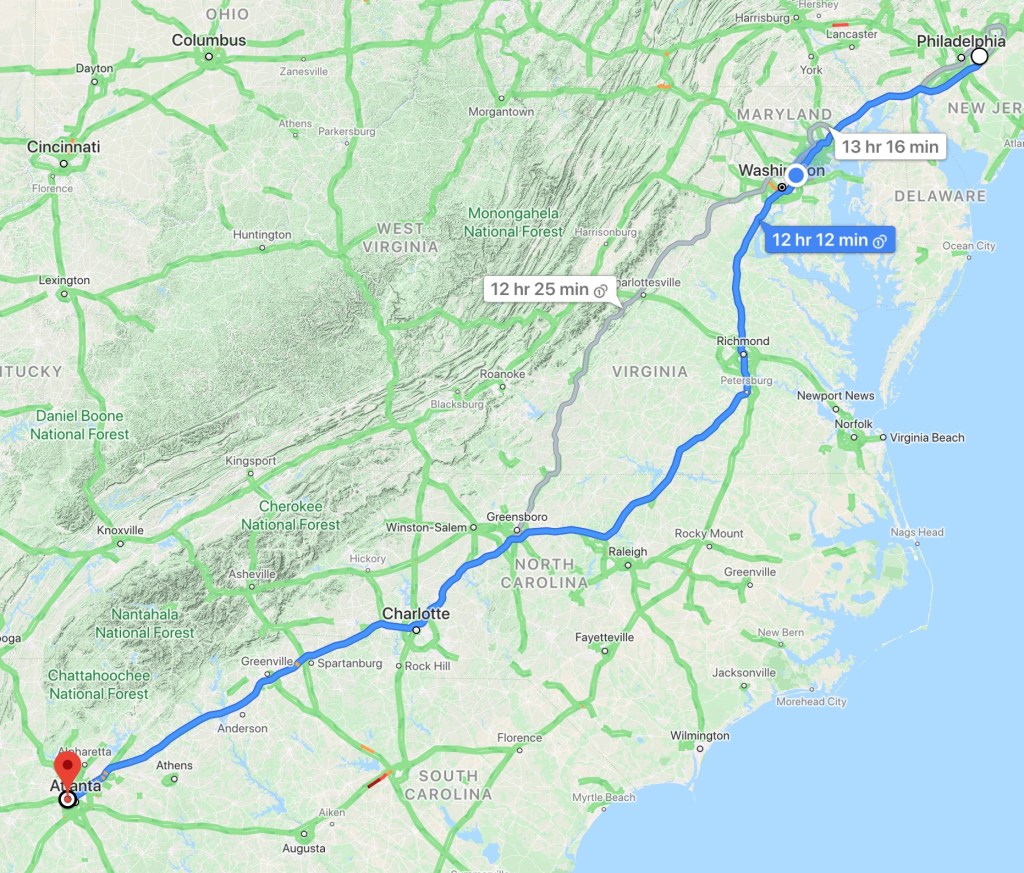
Following a long but uneventful drive from south Jersey to Atlanta on Friday (with us dodging thunderstorms from the DC area through South Carolina), we settled into our hotel in suburban Atlanta. We arrived too late to catch the Braves’ Friday night game vs the Chicago Cubs, but we expected that would occur, following a 13 hour drive.

Google Map depiction of our drive from NJ to Atlanta, GA.

1. Downtown Atlanta

After breakfast at our hotel, we decided to explore downtown Atlanta. Never having been to Atlanta (other than changing planes at Hartsfield-Jackson Atlanta International Airport), I wasn’t sure what to expect. For some reason, I believed that Atlanta was a jewel of the South, perhaps fostered by descriptions of the city from more than 100 years ago.

What I found, however, was something altogether different. Downtown Atlanta was in fact an urban area, much like any urban area in the US. Once we found parking, we walked around the Centennial Park area. It was a sun splashed and warm morning, not as humid as expected, making our walk more comfortable than anticipated.

Centennial Park, Atlanta GA.

While walking through the park, we were approached by a group of young men. They were obviously attempting to intimidate us, momentarily blocking our way. One of the young men gave my digital camera a long look, as though it was something he might want to take from me. Being from New Jersey, we simply ignored them, and they moved on. Any illusion I might have had of Atlanta being a jewel of the South was shattered in that moment.

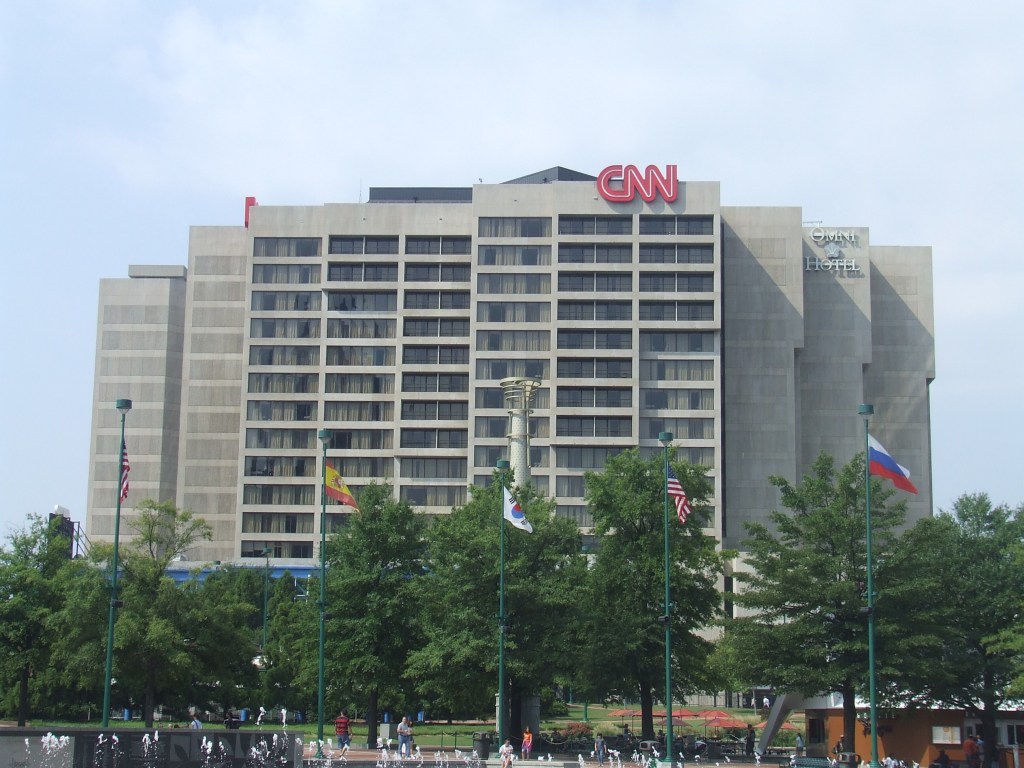
Annoyed but undaunted, we continued to explored the park. Views from the park included the CNN Building and the Georgia Aquarium. Unbeknownst to me at the time, the Georgia Aquarium is one of the largest in the Western Hemisphere. Having seen aquariums across the country, I didn’t believe this one was better than the others I’ve seen, and didn’t give much thought to visiting. After learning more about it, I wish I had stopped in for a look.

The Georgia Aquarium, Atlanta, GA.

Our next stop was the Underground City section of downtown Atlanta. Originally designed during the 19th century as a depot for bustling train traffic, the Underground City opened in what would be its new form in the late 1960s, becoming more of a center for shops and restaurants. For years, I’d heard of the Underground City, but visiting it showed us that it was little more than a sprawling mall, not unlike we’ve all seen in our own cities. Following a cursory visit, we exited to find some lunch.

The Underground City in Atlanta, GA.

After lunch near the Underground City, we continued to explore Centennial Park. Eventually, the heat and increasing humidity wore me down, and the tour of downtown Atlanta was cut short. My opinion of Atlanta was lowered during our short visit. In fairness to the city, we covered a very small portion of Atlanta, and probably did not represent the area as a whole. It was not my intention to denigrate the city; I simply reported what I saw.

“This is CNN”.

2. Turner Field

Prior to the scheduled 715 pm start of the Cubs/Braves game, there was a softball game commemorating the 1991 Braves squad. The celebration drew a large crowd to Turner Field that evening, resulting in parking adjacent to the park filling before we arrived. We were directed to a satellite parking lot a few blocks from the stadium. Quickly we discovered that the neighborhood surrounding the park was not so nice, though we didn’t feel particularly unsafe, as we were walking with a large group of people toward the stadium. However, we later learned that someone was shot in that very parking lot shortly after we left it.

A softball game between the 1991 Atlanta Braves and a team of legends at Turner Field. (Photo credit: Jeff Hayes)

Even though we arrived at the ballpark well ahead of the first pitch, we didn’t have much time to explore the park before the beginning of the softball game. The game pitted members of the 1991 Atlanta Braves (the first Atlanta baseball team to get to the World Series) against a team of “legends”. As might be expected, there were a number of players from the 1991 team on the field, with some playing and other simply there to join in the celebration.

On the field, John Smoltz hit a two run home run and made an over the should catch in support of a 7-7 time against a team of “legends” from that time frame. The 1991 Braves were managed by Bobby Cox, and there was a pre game video tribute to Ernie Johnson, a long time Braves’ TV and radio broadcaster, who passed the night before. Not surprisingly, the length of the softball games, as well as the preparation of the field, resulted in the MLB game starting late.

Celebration of the 1991 Braves. (Photo credit: Jeff Hayes)

At first look, Turner Field appeared to be a typical MLB stadium. Originally built for the 1996 Olympics, the stadium was converted for use as a baseball stadium in time for the 1997 season. Turner Field had three decks from foul line to foul line, resulting in a capacity of 50,000. The entire lower concourse was continuous, allowing us to take pictures during our brief walk.

Given our time constraints, we located the nearest concession stand to pick up food and drinks, then headed out to find our seats. Despite a nearly packed house, we were able to secure fairly good seats for the Saturday night contest. The hot and humid afternoon was transitioning into a warm and muggy evening with light winds; in other words, a typical August night in Atlanta.

The view from our seats. (Photo credit: Jeff Hayes)

The night’s pitching matchup featured Randy Wells starting for the visiting Cubs, with veteran Derek Lowe starting for the hometown Braves. Lowe was struggling through a brutal 2011 campaign, sporting a 5.05 ERA and on pace to lead the NL in losses. Wells’ season was mediocre at best, and would be out of the MLB in less that two seasons.

Considering the quality of the starting pitching, we expected a high scoring affair, especially in the heat, which fosters an environment in which the ball carries. However, we were pleasantly surprised that the score was 1-1 entering the top of the fifth inning. The Cubs scored three runs off Lowe in that frame, who then surrendered two more in the top of the sixth to end his night.

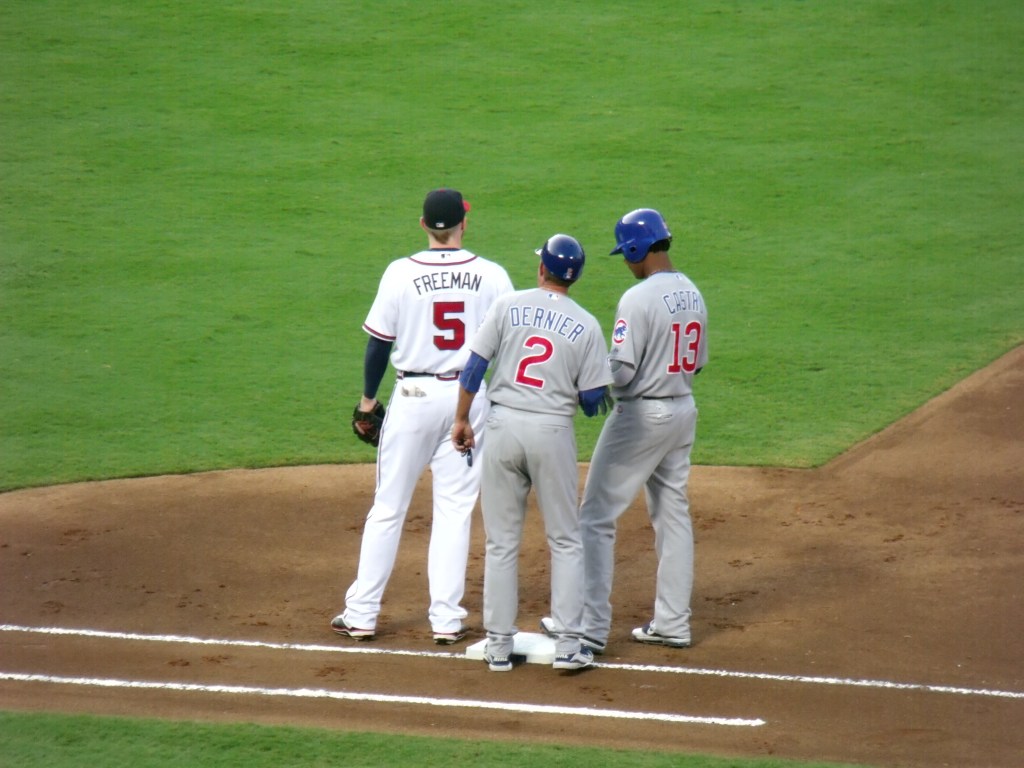
Starling Castro on first after a single. Castro has four hits in five at bats in this game. (Photo credit: Jeff Hayes)

Meanwhile, Randy Wells was effective, tossing six innings arms leaving on the long side of a 5-2 score. The Cubs tacked on three runs in the tops of the eight to seal the victory. The lone bright spot for the Braves was Chipper Jones, who has three hits in four at bats.

Many of the 49,000+ in attendance stayed for most of the game, which resulted in a slow exit from the ballpark. Though we didn’t get much of a chance to explore Turner Field this evening, my initial impression was that it was a typical MLB ballpark with no frills or extras. We would get a better look at the ballpark the next afternoon.

Good night from Turner Field. (Photo credit: Jeff Hayes)