TD Bank Park, Bridgewater NJ

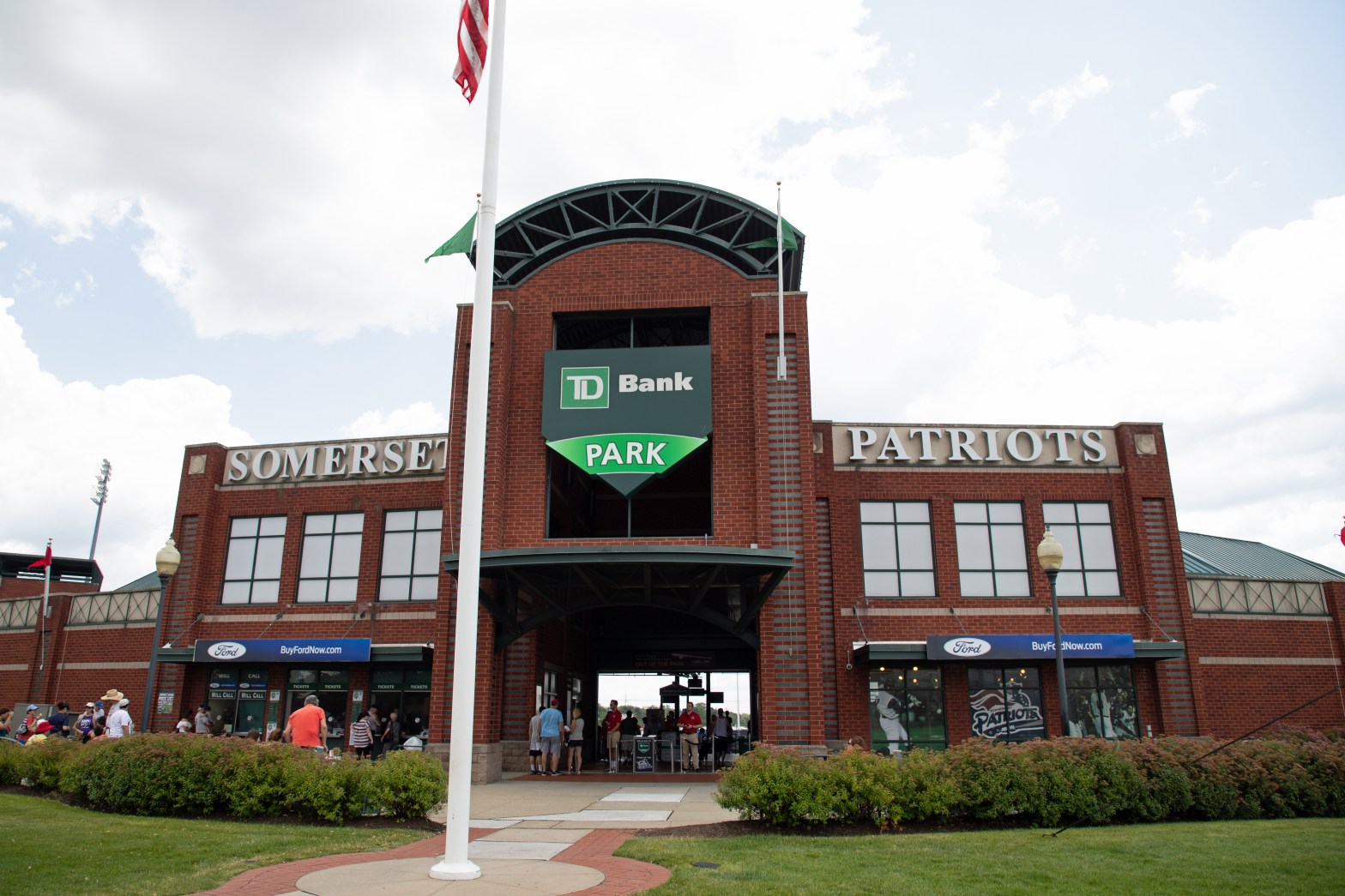
TD Bank Park, home of the Somerset Patriots. (Photo credit: Jeff Hayes)
  • First visit: exact date unknown; probably during the summer of 2013
  • Most recent visit: Sunday June 9th, 2019

Until my brother moved close to Bridgewater NJ in the early 2010s, I must admit I did not know much about the Atlantic League of Professional Baseball (ALPB). Established in 1998, the independent ALPBA saw many changes in the number and locations of teams in the league over the years, but the Somerset Patriots remained the flagship franchise from the inception of the league until 2019 (the 2020 ALPB season was scuttled by COVID-19). In fact, the Somerset Patriots (who played their home games at TD Bank Park) were the “New York Yankees” of the ALPBA, having won 13 division titles and six ALPB championships. To extend the New York connection to Somerset, the Patriots manager from 1998-2012 was Yankees great Sparky Lyle . Having Lyle manage the Patriots helped legitimize the team and the league, and though he no longer manages the team, he does still make occasional appearances at TD Bank Park as an ambassador for the ALPB.
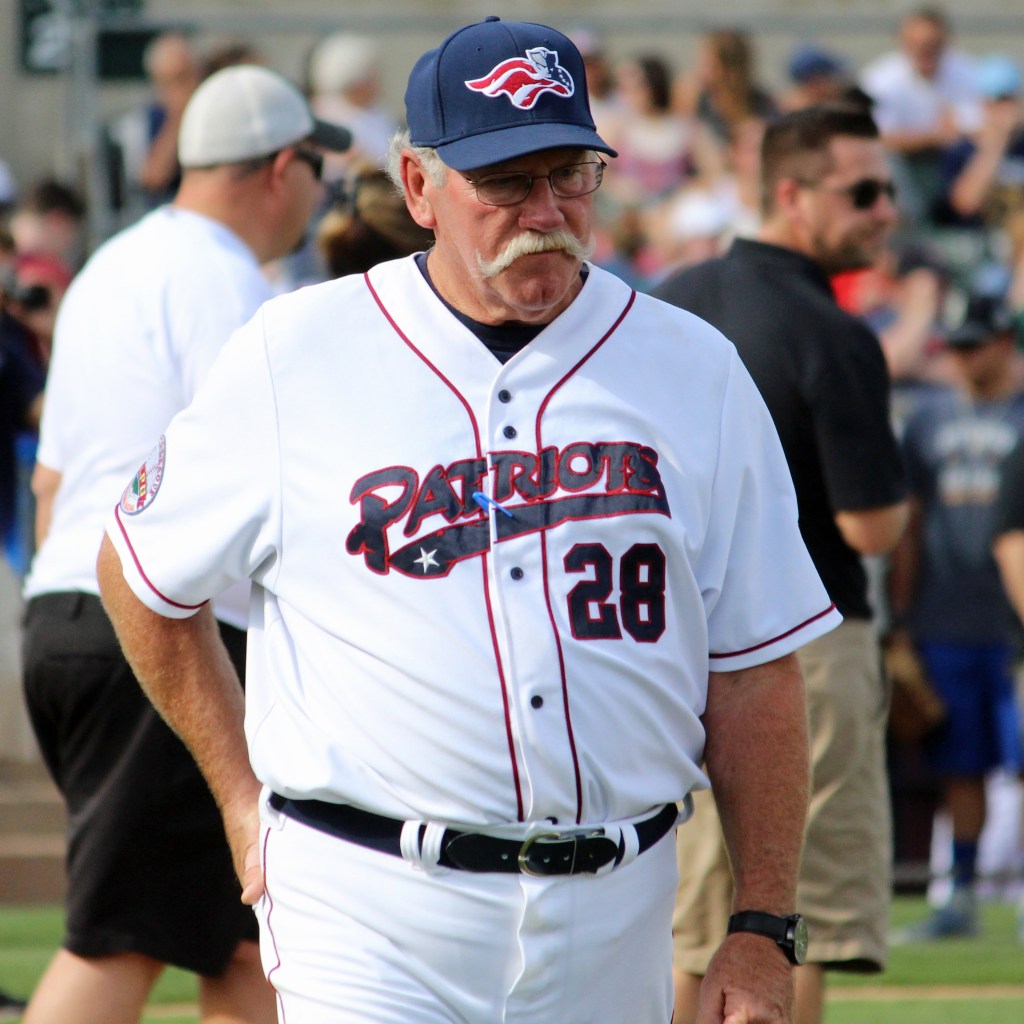
Yankees great and Somerset Patriots manager (1998-2012) Sparky Lyle. (Photo credit: Jeff Hayes)

Being an independent league, the ALPB does not have a steady stream of players shuttling through Somerset. Instead, rosters are typically filled with ex-MLB players, as well as some of the players we have seen in the minor leagues, and younger players that were not drafted into the MLB pipeline. From what we have seen, it is not unusual to have three to five players on each team that have MLB experience. Signing ex-MLBers can be a boon for the teams, as name recognition boosts attendance for home teams, as well as those coming to town. One of the more famous ex-MLBers to play for the Patriots was outfielder Endy Chavez. Mets fans fondly remember his tenure with the team, especially his spectacular catch in Game 7 of the 2006 NLCS. Chavez was a fan favorite for the Patriots as well, known for his gregarious style and willingness to engage with fans before the game.

Another ex-Met who played for the Patriots was left hander Bill Pulsipher. At the end of his playing career, Pulsipher would only play at home, not traveling with the team on the road. He showed up, made his start, left the game, and went home. Other players for the Patriots included teachers, and even front office officials. Though the ALPB does not pay very well, it can attract former MLB players trying to extend their careers, as well as young and hungry players utilizing the ALPB as a means to further their MLB aspirations. Given the mix of talent and experience, the level of play is actually quite good, about on par with AA teams in affiliated baseball. Being able to see these players in an intimate setting can be a big draw for die-hard baseball fans in areas with little in the way of other options.
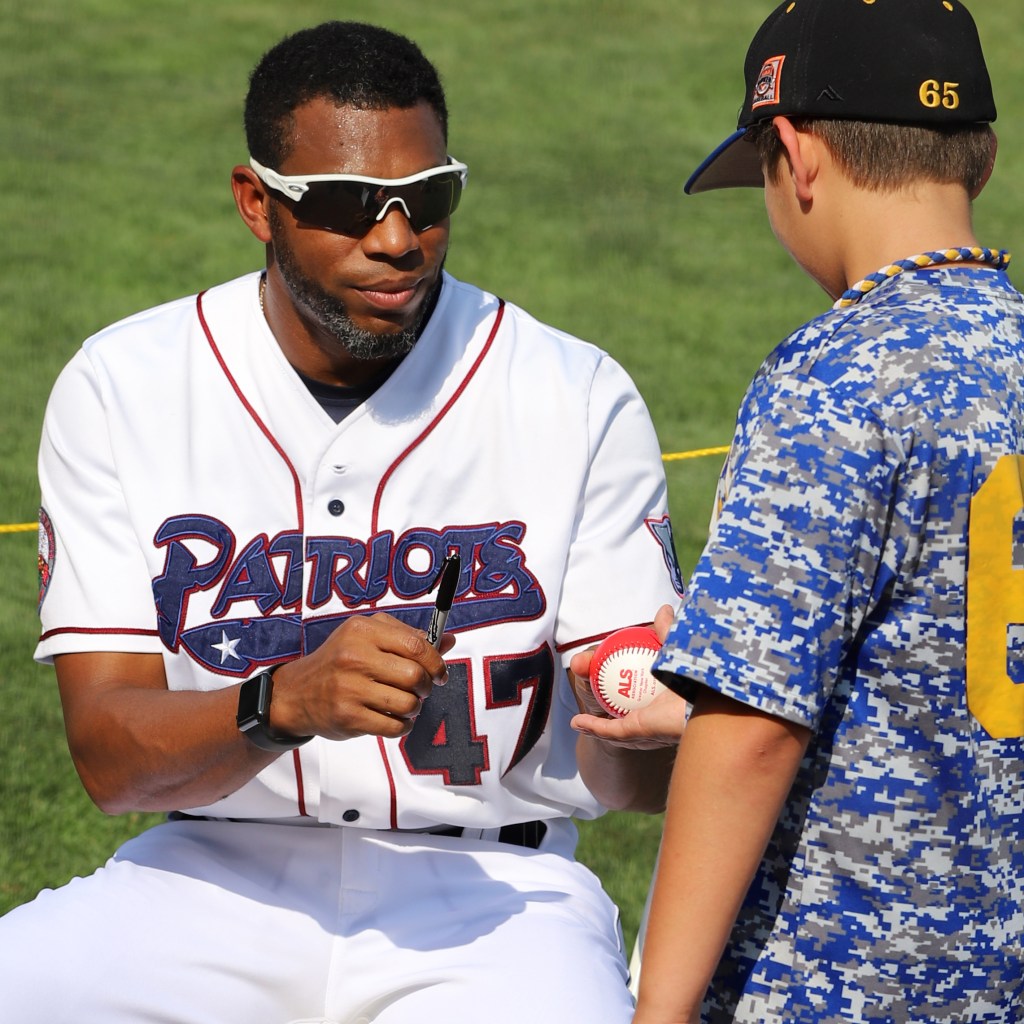
Endy Chavez signing autographs on the field during an organized event before the game. (Photo credit: Jeff Hayes)

My brother introduced me to the Somerset Patriots sometime during 2013, and I believe that we went to see games at TD Bank Park together that summer (though my brother has seen many more games there than me). From my brother’s home, the park is less than 20 miles away, but due to the volume of traffic in the area (especially near the evening commute), travel time to the stadium could easily reach 45 minutes. Because of scheduling (and the fact that I was living and working in Maryland during much of the 2010s), we typically attended games together on weekends, which eased the trek to some degree. The very end of the trip had us snaking through Bridgewater, crossing over the Peters Brook before reaching the stadium.

General parking is located just before the stadium, adjacent to the Bridgewater train stop of the NJ Transit Raritan Valley line (the train passes the left field wall, and is noticeable when it does) Parking is $2.00 (as it has been since the stadium opened), and typically there is plenty of parking available, particularly on weekends. Some people try to avoid paying for parking by leaving their vehicles in a store parking lot across the road from the stadium. This is a BAD IDEA, as the owners of the store parking lot will tow your vehicle if you are NOT shopping there. From the parking lot to the main gate of TD Bank Park, the distance is a manageable one-quarter of a mile, with sidewalks available for much of the walk.
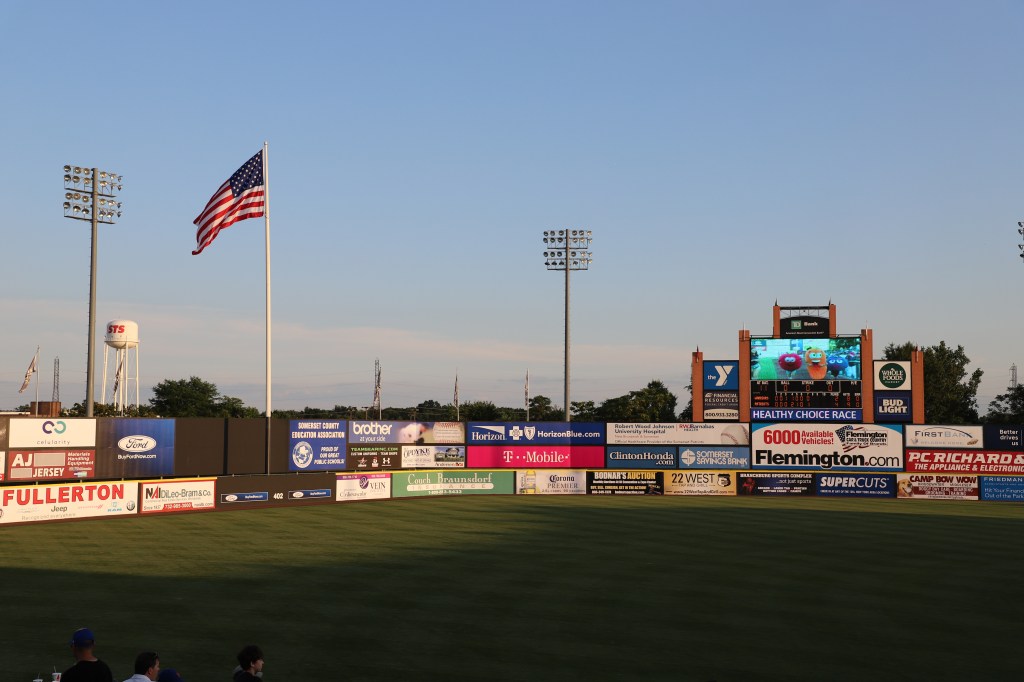
The outfield at TD Bank Park, as seen from the seating area down the left field line. (Photo credit: Jeff Hayes)

Entering through the main gate behind home plate (which includes old style turnstiles) brings you to the upper concourse of TD Bank Park. Concessions and the Patriots team store are located on the upper concourse, which stretches from mid right field behind home plate to mid left field. Concession stands, for the most part, offer standard baseball fare, at reasonable prices. Down the left field on the upper concourse is a picnic area (complete with tables), as well as National BBQ. Extending down the right field line are additional concession stands, as well as the Kids Zone, containing activities designed especially for younger fans. There is a large grass berm located further down the right field line, which is available for larger groups. Finally, luxury boxes are located at the top of the stadium, adjacent to the Party Zone. In total, TD Bank Park hold about 6,100 seated fans, with standing room only adding another 2,000 to that total.
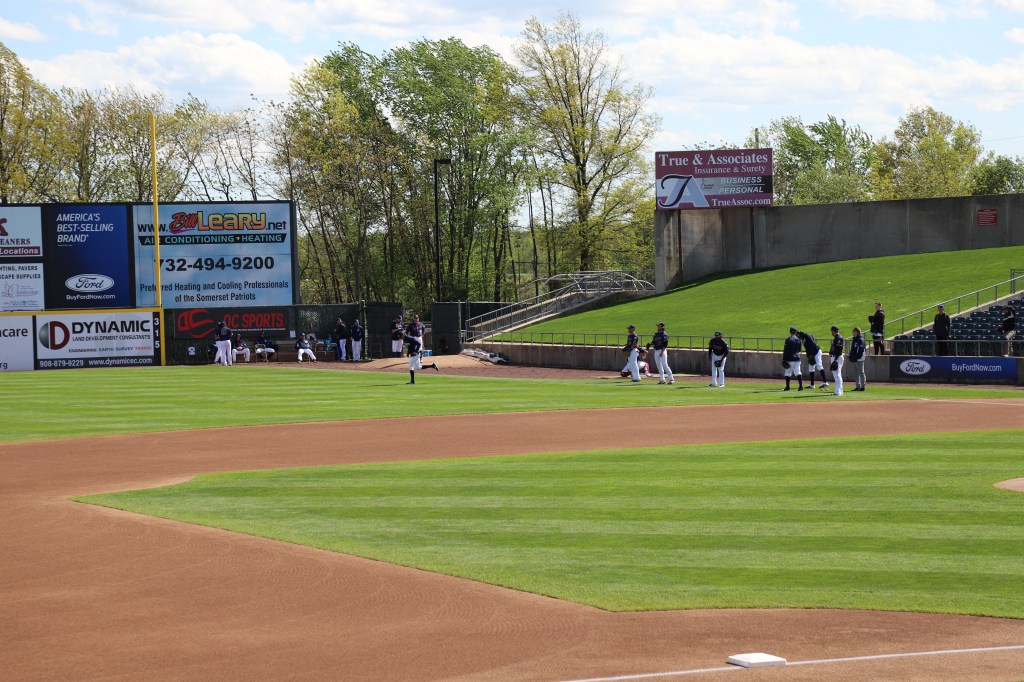
A view of the grass berm down the right field line, adjacent to the Patriots bullpen. (Photo credit: Jeff Hayes)

Like most minor league ballparks, visitor and home team bullpens lie down the left field and right field lines, respectively, easily within sight of most of the seats. Large advertising signs reach from the left field foul pole to the right field pole, and like many minor league parks, are stacked two high. A relatively small but functional scoreboard/videoboard combo rises up behind the wall in right centerfield. The scoreboard contains quite a bit of information for those fans who like it, and the videoboard is unobtrusive, used mainly for short video clips appropriate to the game situation. For a modular ballpark, TD Bank Park contains quite a bit of charm, while maintaining an understated feel absent in many new stadiums in baseball. Perhaps this is why the ballpark has won numerous awards, including Ballpark Digest’s Best Independent Minor League Ballpark, as well as best ballpark in the ALPB.
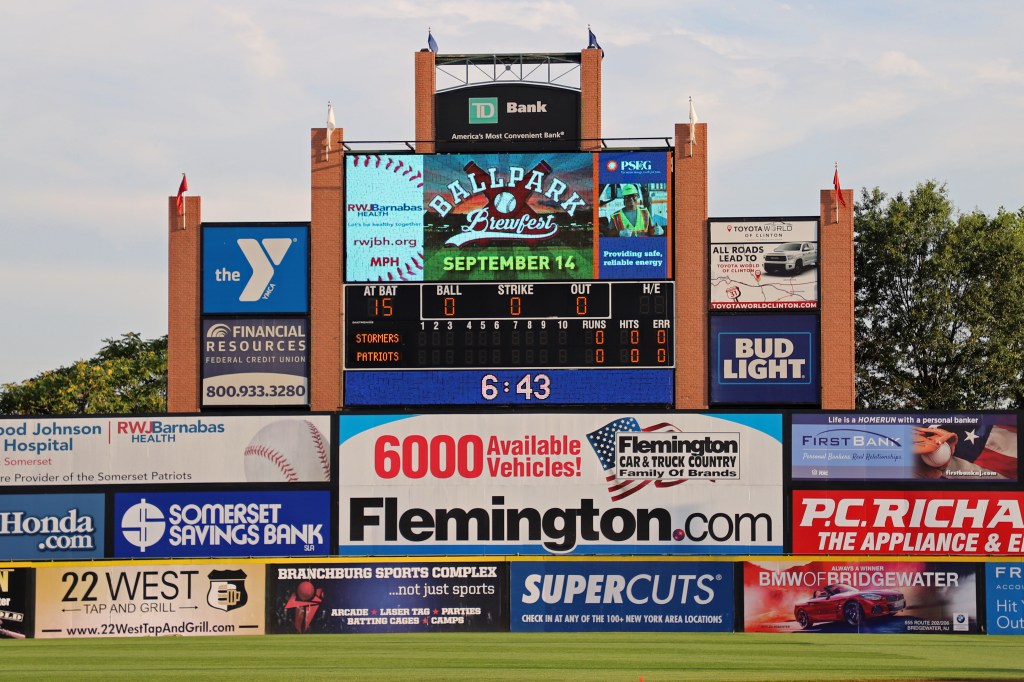
The scoreboard/videoboard combo in right centerfield at TD Bank Park. (Photo credit: Jeff Hayes)

Somerset has carefully cultivated a baseball experience focused on families and kids. In between innings, there are games and contests for kids on the field, and the Patriots’ mascot, Sparkee, entertains the crowd throughout the game. One of my favorite interactions is when the PA announcer shouts “Somerset”, and the kids respond with “Patriots”. Affordable tickets prices, good quality of play, and a suburban setting combine to make the Patriots an attractive family outing. As might be expected, attendance at TD Bank Park is among the highest in the ALPB, with near sellouts common during the warmer months. During the hottest part of the NJ summer, Somerset schedules night games as often as possible, even starting at 505 pm on Sunday, for the comfort of the fans.

TD Bank Park at night: (photo credit: Jeff Hayes)

Unfortunately, the 2020 ALPB season was scrapped due to the COVID-19 pandemic. However, the Patriots did play some games during the summer, taking on the NJ Blasters in a series games played on the weekend. A limited number of fans were permitted to see each game, and my brother was fortunate enough to see a number of games in the series. While another team in the ALPB played some games during 2020, other teams remained idle, and we were concerned that the ALPB might not survive the pandemic to play in 2021.

During the offseason, the Somerset Patriots accepted an offer from the New York Yankees to become their AA affiliate. New York chose a bizarre path for changing their AA affiliate, as the previous club, the Trenton Thunder, discovered they had been replaced in a tweet by the big league club. Affiliation with the New York Yankees meant that the Patriots would leave the ALPB, which is a blow to a league as it loses its flagship franchise. Another ALPB team (the Sugarland Skeeters) left the ALPB to become the AAA affiliate of the Houston Astros. We feared that the loss of the top two teams in the league could topple the ALPB, but the league announced replacements, and are planning to play the 2021 season.
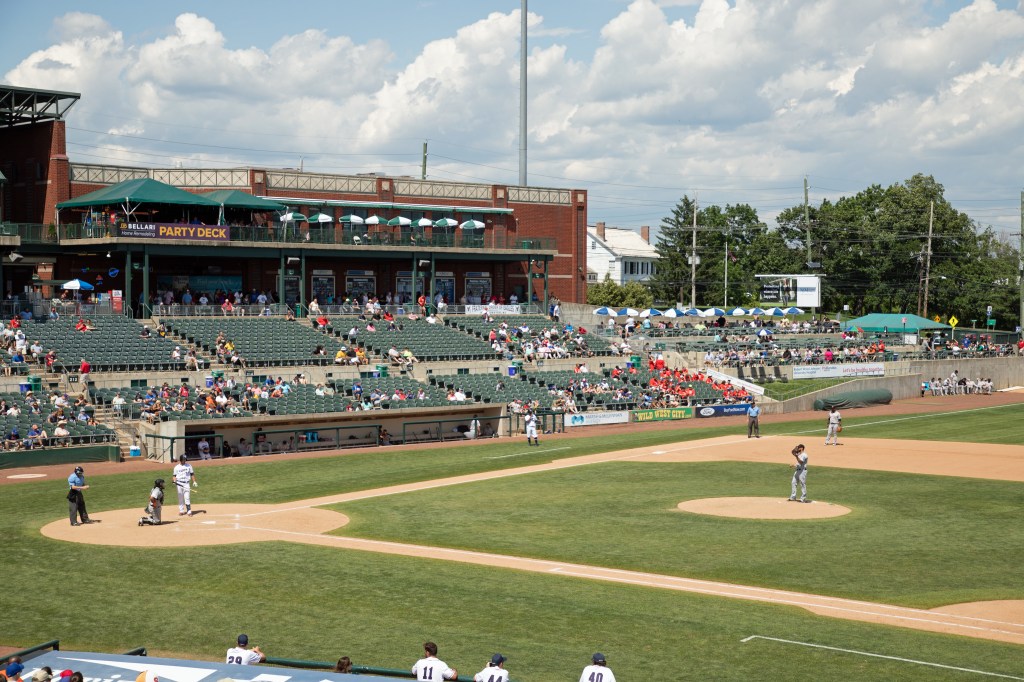
TD Bank Park will host AA ballgames for the 2021 season, as the Patriots become an affiliate of the New York Yankees. (Photo credit: Jeff Hayes)

Regardless of their status, we expect the same great baseball environment at one of the finest minor league stadiums in the Northeast during the 2021 season. A number of changes are expected at TD Bank Park as the Patriots become part of the New York Yankee family. Most of the changes will be to the internal portion of the park, such as an upgrade to player facilities. On the field, bullpens will move off the field, and new energy efficient lightning will be installed in time for the season opener. Some enhancements are planned to the videoboard, including better instant replay results. Depending on how quickly fans are allowed back into the stadium, we plan to attend games at TD Bank Park during the 2021 season. If you find yourself close to TD Bank Park during the summer, check to see if the Patriots are in town. You will be glad you did.
Coca Cola Park, Allentown PA, Sunday May 24th 2015

Coca Cola Park from behind the centerfield fence. (Photo credit: Jeff Hayes)

With most of the local teams on the road for the Memorial Day weekend, we stretched out into eastern Pennsylvania to attend our first AAA game in Allentown PA, to see the Lehigh Valley IronPigs at Coca Cola Park. Years ago, I read a book called Where Nobody Knows Your Name: Life In the Minor Leagues of Baseball, in which the author posits that no players actually want to be in AAA; players from below are waiting for their turn to move to “The Show”, while ex-MLB players are looking to get back there. Not having been to a AAA game, I wasn’t exactly sure what to expect, but I would have been surprised if we didn’t see some familiar MLB names in the lineup or on the mound in Allentown that afternoon.

From central NJ, the 80 mile drive to Coca Cola Stadium took about 90 minutes, with just some construction delays slowing us down on Interstate 78 in eastern PA. Arriving about 90 minutes before the scheduled first pitch (slated for 135 pm), we easily found parking in the onsite lots (which were much bigger than I expected, with parking on either side of the stadium) for the typical price of $5.00. Since there was not much surrounding the park, we headed inside the stadium.

The view of Coca Cola Park from the lower level just behind third base. (Photo credit: Jeff Hayes)

From the right field entrance (which is the main entrance for the ballpark), we walked along the upper concourse toward centerfield. Most of the concession stands are located on the upper concourse, and not surprisingly, the more popular cuisine in the park was pig-themed (considering that the team name is the IronPigs). Not one to engage in more than the standard fare at a baseball game, I did not spend too much time or energy on the cuisine at Coca Cola Park, but I did run across a review of what’s good at the park here. We encountered a picnic area in right field, as well as more places to eat behind the right field foul pole. In addition, we saw an area behind the right field fence designed specifically to allow fans to socialize. This is something we have noticed in an increasing number of new stadiums, as the way fans watch the games has changed.

Unlike most ballparks, the concourse encircled the stadium, allowing us access to the outfield. From the behind the berm in centerfield (where people lounged on beach towels in the bright sunshine), we got a good look at the seating area in Coca Cola Park. There are two levels of seating; the lower level, extended from the right field foul pole behind home plate to the left field pole, and the upper level, from mid right field to mid level field. A set of luxury boxes stretched along the same length as the upper level. Factoring in the seating in the picnic areas in left field and right field, and the seating in the grass areas of the outfield, Coca Cola Park can accommodate just over 10,000 fans (making it one of the largest minor leagues parks we have seen with respect to crowd size).

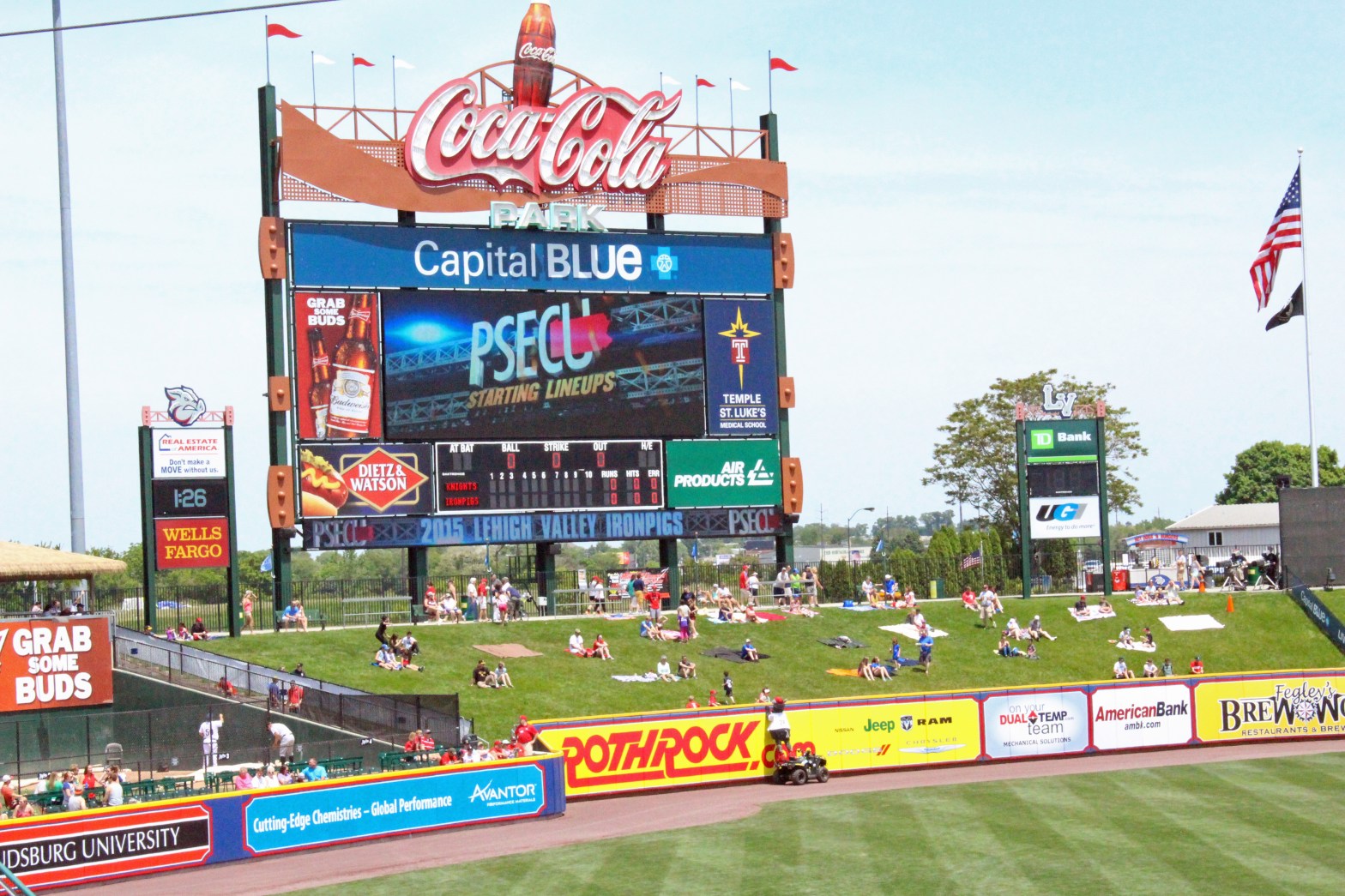
Scoreboard and videoboard behind the centerfield fence at Coca Cola Park. Note the grass perm area, which was not filled to capacity on this afternoon. (Photo credit: Jeff Hayes)

Continuing our tour of the ballpark, we passed by the scoreboard/videoboard combination in centerfield, adorned at the top with a Coca Cola bottle. When home runs are hit by IronPigs players, the bottle shakes and fires off fireworks. Next to the scoreboard are the bullpens, and above them, the Tiki Terrace, which houses group seating and a bar open to all ticketed patrons. Adjacent to the Tiki Terrace is the Picnic Patio, which hosts group gatherings. As we headed toward home plate, it was clear that Coca Cola Park was designed with fan comfort and accessibility in mind. It is little wonder that the ballpark has often won awards (such as the Best Minor League Ballpark on a number of occasions).

The IronPigs draw exceptionally well for minor league baseball, and have the highest average attendance since the ballpark opened in 2008. Not knowing this fact, we did not secure tickets until just before the day of the game, and that ignorance resulted in our seats being located in the lower level down the right field line. Though all of the seats in Coca Cola Park are angled for the best view of the infield, I felt as though we were far from the action, even in a park that was relatively cozy when it comes to seating. After grabbing a baseball lunch from the nearest concession stand, we settled into our seats for the beginning of the game.

The view from our seats at Coca Cola Park. (Photo credit: Jeff Hayes)

Lehigh Valley (the Triple A affiliate of the Philadelphia Phillies) hosted the Charlotte Knights (the Triple A affiliate of the Chicago White Sox) for the early afternoon contest. We expected to see some familiar names in the lineup or on the mound for this game, since AAA teams often have MLB veterans amongst their ranks. Though I didn’t immediately recognize any names in the Knights’ lineup, their starting pitcher was a different story. Taking the mound for the Knights was Brad Penny, celebrating his 37th birthday at Coca Cola Park. A 14 year MLB veteran, Penny was apparently attempting to catch one more ride to the The Show. There were a few familiar names in the IronPigs’ lineup, especially at the top of the order, who were with the Phillies at some point within the last year.

Not every seat in the ballpark was filled, but there did seem to be more than 9,000 fans in attendance for the game. A steady breeze from centerfield kept the temperature from getting too warm (as high temperatures can reach the 90s in eastern PA by Memorial Day weekend), and filtered sunshine made for a nearly perfect day for a ballgame. Charlotte struck first, scoring in the second inning, staking Penny to an early lead. However, Brad Penny did not have his best stuff that day, and after surrendering five runs in the third and fourth innings, his day ended after the sixth inning. Following a disappointing 2015 with the Knights, Penny left organized baseball.

MLB veteran Brad Penny delivering a pitch for the Charlotte Knights at Coca Cola Park in Allentown, PA. (Photo credit: Jeff Hayes)

During the IronPigs’ rallies in the third and fourth innings, we heard something we’d never heard at a ballpark. Rather than simply cheer or applaud, fans squealed or snorted like pigs. Though odd at first (during which time much chuckling ensued, mainly by me), the squealing fit the environment perfectly, as there are MANY aspects of the ballpark that are pig-themed in one way or another. The unique fan celebration lent an air of authenticity to the experience, and when combined with the ballpark itself, created a very enjoyable atmosphere for minor league baseball. Clearly, Allentown loves their IronPigs!

Being fairly close to the right field wall, I could not help but notice the prominence of the advertisement boards. While it is typical for minor league parks to have advertising extending along the outfield wall, these boards seem to rise much higher than most of the parks we had seen to that point. A fairly large set of advertising boards rose up from behind the bullpens in left field, and the signage made Coca Cola Park almost feel like an enclosed MLB park. Despite the signage and its large seating capacity, the ballpark had an imitate feel to it.

A view of the prominent signage above the bullpens in left field. (Photo credit: Jeff Hayes)

Charlotte rallied for runs in the seventh and ninth innings, overcoming a 5-3 deficit for a 7-3 victory. As we waited for the sizable crowd to exit the ballpark, I had a few moments to reflect on Coca Cola Park. The layout of the stadium, as well as the atmosphere created by the ardent IronPigs fans, made our experience enjoyable. Our first visit to a AAA park was a huge success, and had we known that the ballpark was such a jewel, we would have visited sooner.

Leidos Field at Ripken Stadium, Aberdeen MD, Sunday July 15th, 2018

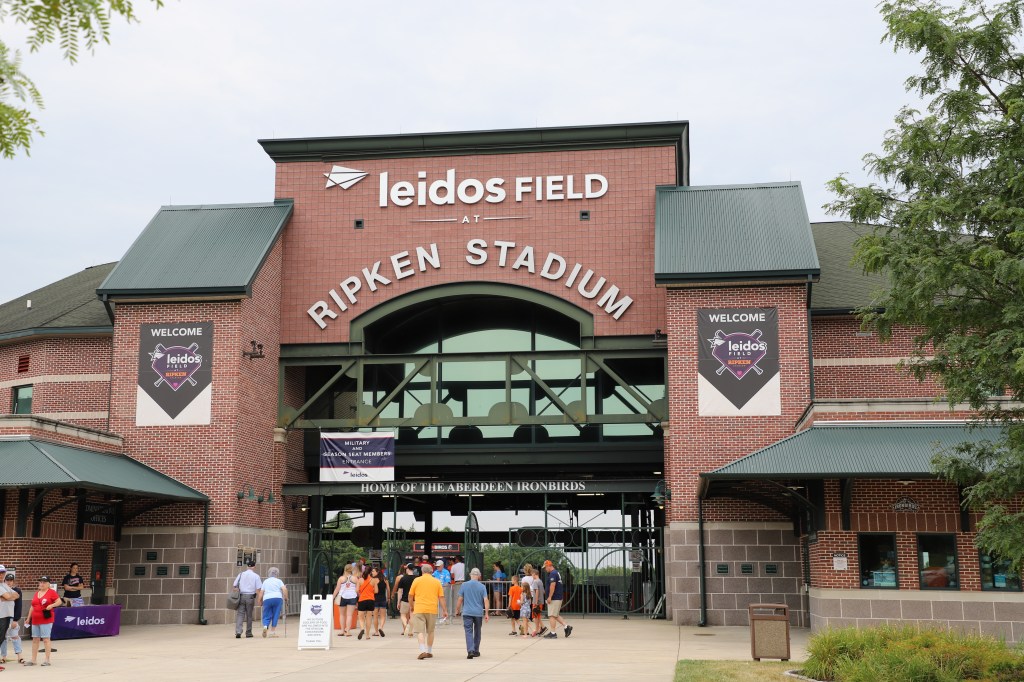
A view of the home plate entrance of Leidos Field at Ripken Stadium in Aberdeen, MD (Photo credit: Jeff Hayes)

On an overcast, humid Sunday afternoon in July, we decided to visit Leidos Field at Ripken Stadium (referred to as Leidos Field for the remainder of the post), the home of the Aberdeen IronBirds. The IronBirds (whose name is an amalgamation of Iron Man, a nickname for Hall of Famer Cal Ripken, Jr and birds, a moniker for the Orioles) were an affiliate of the Baltimore Orioles when we visited in 2018. Members of the Class A Short Season New York-Penn League, the IronBirds played an abbreviated 76 game schedule, stretching from mid June to early September. The New York-Penn League was an entry point into professional baseball, and the teams were chiefly composed on recent college graduate and draft picks of the parent club.

Leidos Field, located in Aberdeen MD, lies along Interstate 95, and is clearly visible from that artery. Living in the DC area, getting to games there could be tricky, as it meant dealing with seemingly unending traffic traveling north into northern MD, and for much of the time I lived near DC, the trip did not seem to be worth the hassle. Though the trip was 60 miles from my home to the ballpark, snarling traffic could make that a 90 minute (or longer) trek, particularly around the time of the evening commute. However, the warm and humid weather, along with the threat of rain, made the journey appear to be tolerable on a Sunday afternoon. Typically, Sunday afternoon in the summer in northern MD could be busy, as people try to beat the traffic leaving after the weekend.

Leidos Field at Ripken Stadium from just to the left of home plate. (Photo credit: Jeff Hayes)

Arriving less than an hour before the scheduled 405 pm start, we found that the parking lot at the ballpark was expansive, to say the least. Leidos Field is part of the Aberdeen complex, which also houses fields for other sporting events. We found parking almost immediately, and unlike most ballparks, parking was FREE. We briefly toured the outside of the stadium, as well as the complex, but there was very little to see or do that afternoon outside of the park. Having purchased tickets online before the game, we entered through the home plate entrance, which led us to the upper concourse. On the upper concourse we found the majority of concession stands, as well as the IronBirds team store (which was well stocked, and we indulged with purchases, including Aberdeen tee shirts).

As is customary for us visiting a new park, we walked along the upper concourse from the left field foul pole to the right field foul pole (the outfield was inaccessible to fans). We discovered that Leidos Field was a modular ballpark that opened in 2002. Much of the seating consisted of green seats divided into a lower deck and upper deck, separated by a lower concourse. Seating stretched from near the left field foul pole behind home plate to the right field foul pole, which was surprising considering the park’s main tenants played a shortened season. A party deck and the Kids Zone lie beyond third base in left field, and luxury boxes extend from dugout to dugout. In total, Leidos Field seats about 6,300 fans, which is a large capacity for the level of play.

A view of Leidos Field at Ripken Stadium showing the two tiers of seats as well as the luxury boxes. (Photo credit: Jeff Hayes)

A small but functional scoreboard stands beyond the left field fence, and a larger, more elaborate video board is located in right center field. Though not as large as video boards we have seen in other minor league parks, it was nonetheless an impressive piece of technology for a park that is used only for a portion of the baseball season. Bullpens are positioned behind the wall next to the foul poles. It is unusual for minor league parks to have bullpens not in play, but as we explored Leidos Field, we discovered that the park was impressive for any level of play in the minors. It was abundantly clear that the ownership spent a considerable amount of time and effort to construct a ballpark that provides an excellent fan experience in a comfortable setting.

A view of the stadium showing both the scoreboard and video board. (Photo credit: Jeff Hayes)

Following our tour of the stadium, we backtracked in the upper concourse to the concessions, located near the home plate entrance. While there were some specialty items available on the menu at some of the concession stands, we chose more standard fare for our baseball dinner, and headed to our seats. Every game since Opening Day in 2002 has been a sellout at Leidos Field (a very impressive feat for a minor league team), and that fact had some influence on the seats we could secure for the late Sunday afternoon game. Though it was clear that the weather would have an impact on the attendance for the game, we could only garner seats in the lower tier just past first base, which provided a less than desirable view of action at home plate. Undeterred, we settled into our seats and awaited the start of the game.

On that afternoon, the IronBirds hosted the Auburn (NY) Doubledays, a team named for the supposed inventor of baseball. The Doubledays were an affiliate of the Washington Nationals, so there was a flavor of a local rivalry in Leidos Field that afternoon. Skies remained cloudy through the afternoon into the early evening, but conditions remained dry (with thunderstorms remaining distant from the ballpark in Aberdeen). Though the game was technically a sellout, there were far fewer than 6,300 people in the ballpark. Threatening skies and a late start on a Sunday may have been contributory factors with respect to attendance, but the ballpark looked and felt as though it was mostly empty.

A view of the action from our seats down the first base line. (Photo credit: Jeff Hayes)

Generally, the level of play in the Class A Short season is entry level; after all, most of the players are getting their first taste of professional baseball. However, it was fairly clear early that both teams were polished, and the level of play was better than I expected. Pitchers tend to lag hitters when it comes to development for the younger ballplayers, with control of their arsenal being the main sticking point. Both pitching staffs acquitted themselves well during the game, though the Aberdeen starter unleashed consecutive wild pitches in the top of the first inning, leading to an Auburn run. As is usually the case in minor league ball games, there were no pitching changes during play, as the respective staffs are as interested in evaluating how their prospects handle pressure as well as how they display their talent. Game situations do not typically determine lineup changes; those changes are based more on when management has seen enough of a particular player on that day.

Clouds and some mist dominated the weather conditions for the game, but even that could not tarnish Leidos Field at Ripken Stadium. Though the stadium is adjacent to Interstate 95, the ballpark felt as though it was perched in a suburban setting, with lines of trees visible beyond the left field fence. During the half-inning breaks, I spent my time admiring the facility, built as if it was designed for a higher level of play. In fact, the park was one of the finer minor league stadiums we have visited. Low attendance for this particular game made it seem empty, potentially robbing it of charm, which we did not feel on this visit.

Rip Chord, one of two IronBirds mascots. (Photo credit: Jeff Hayes)

Auburn won a tight contest 3-2, though the IronBirds scored a run in the bottom of the eighth inning to make the game closer. Toward the end of the game, the clouds thinned out, and there were a few glimpses of sun in the western sky as evening approached. Had I known that the ballpark was such a gem, we would have made an effort to see it before 2018, despite the ever present traffic issues. Since our visit, MLB made sweeping changes to its minor league system. Besides eliminating about one-quarter of the teams, MLB changed the structure, and Aberdeen was installed as the Class A High affiliate of the Orioles. This change means that they moved up in class, and more importantly, the IronBirds will play a full schedule in 2021. Having a full-time team at Leidos Field seems more befitting of the excellent facility. If you are close to Aberdeen during the summer months, and the IronBirds are in town, we would encourage you to deal with any potential traffic problems and see one of the better minor league ballparks we have seen in our travels.

Sunshine peeked through the clouds at the end of the game in Aberdeen. (Photo credit: Jeff Hayes)