Altoona PA Part 2: August 20th and 21st 2022

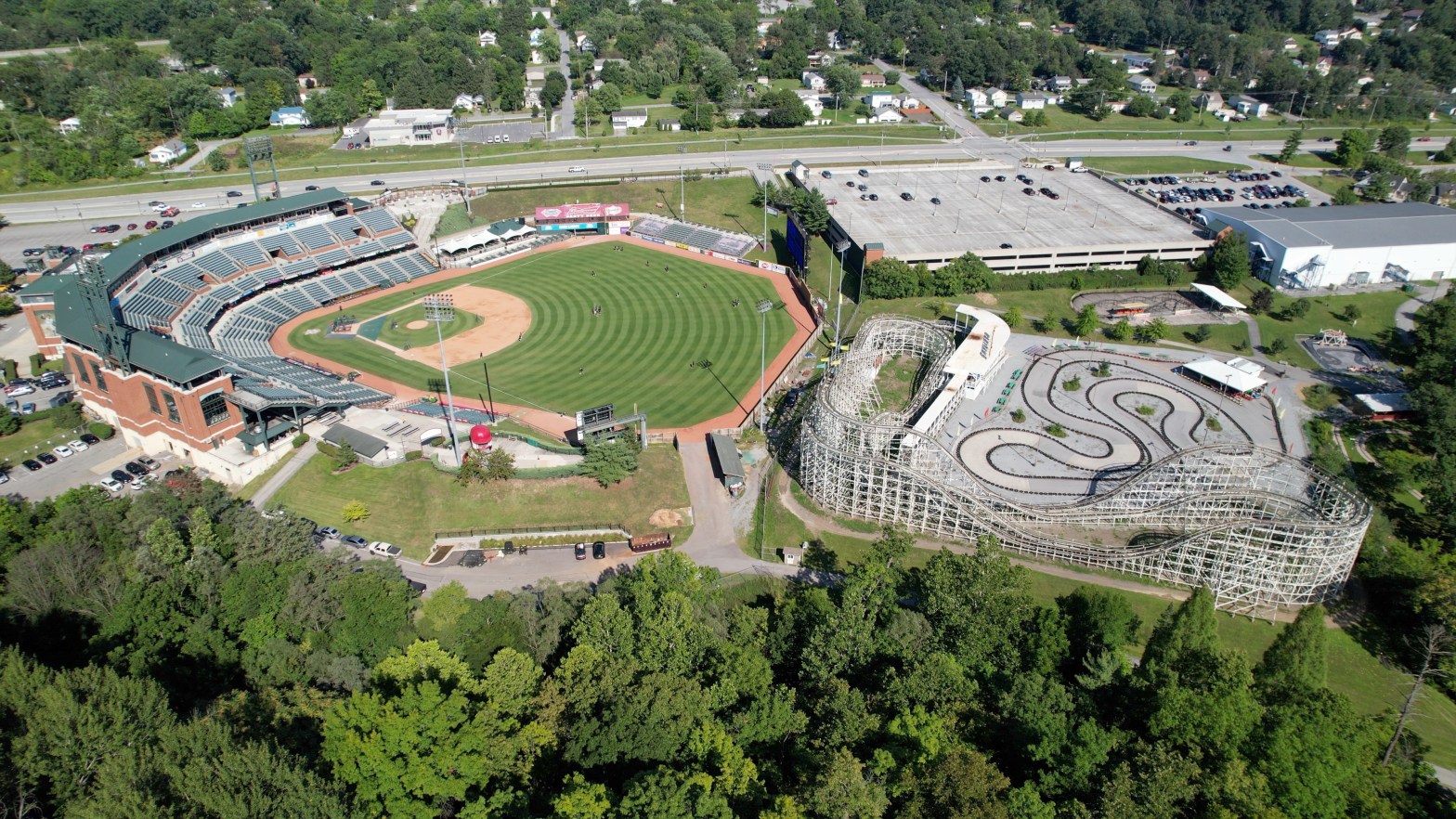
Aerial view of the People’s Natural Gas Field complex, including the Skyliner Roller Coaster and go carts at Lakemont Park. (Photo credit: Jeff Hayes)

Following an ill-fated visit to People’s Natural Gas Field in August of 2019 (the details of which are available here), my brother and I scheduled another visit for the end of August of 2022. From my current home, the ballpark is about two and one-half hours away, which would have been a long day combining travel and seeing the game, so we opted for a weekend visit, attending games on both Saturday and Sunday evenings.

Leaving my home in central PA in the early afternoon of Saturday, August 20th placed us at the hotel in Altoona about 400 PM. Since the gates did not open until 500 pm (ahead of a 600 pm first pitch), we had some time to relax before the game. However, I recently acquired a new drone and was eager to use it on the trip. Heading out to the park early, we parked in the nearby parking garage (where the fee was a very reasonable $3.00) and climbed to the top deck. From there, we launched the drone, and since we were so early, not many people were around to witness the flight. You can see a short video from the flight here.
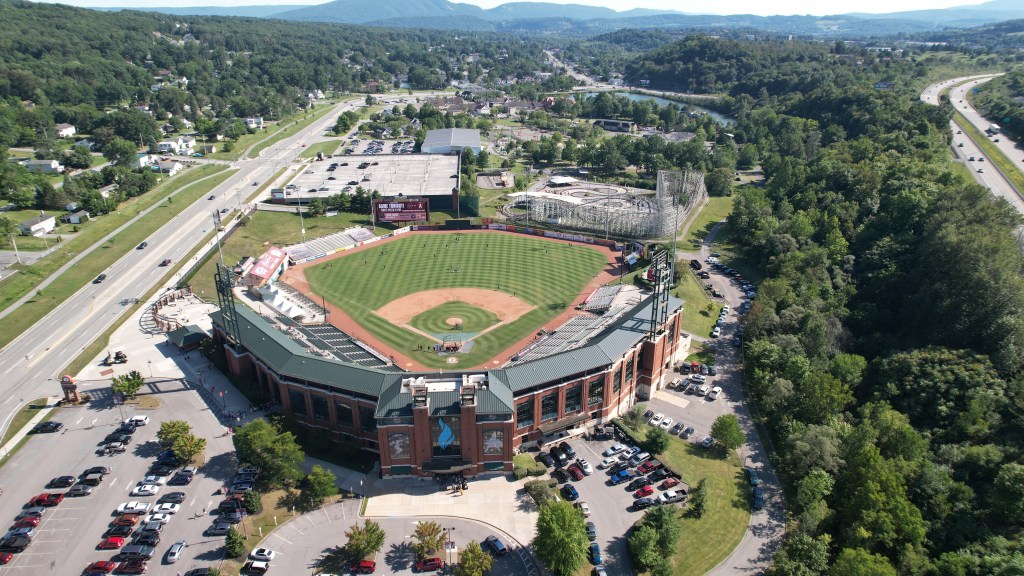
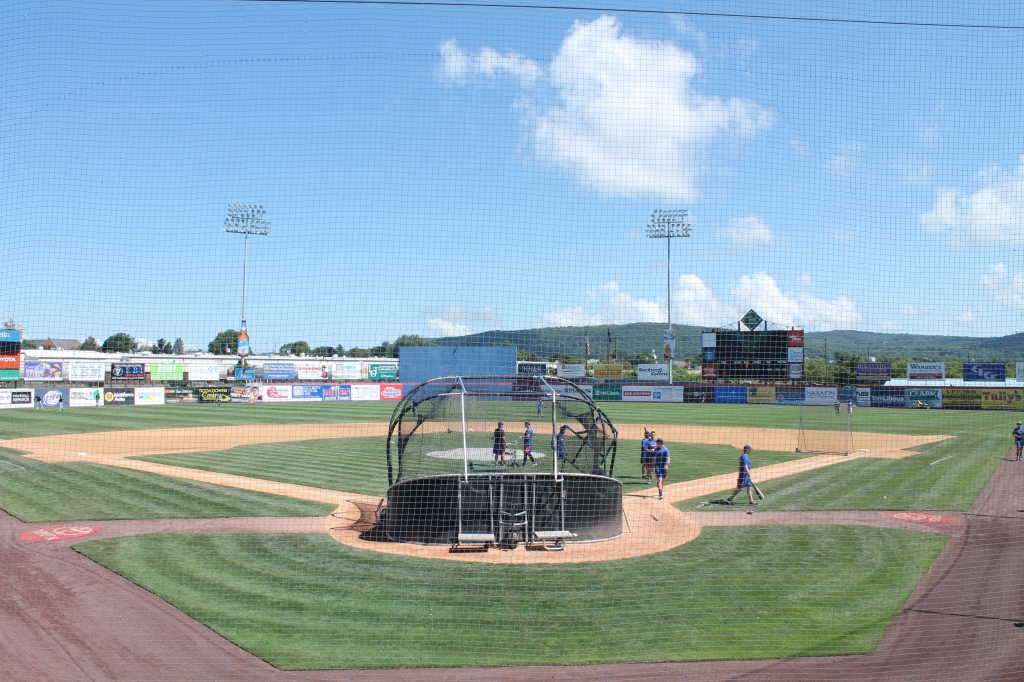
People’s Natural Gas Field from behind home plate.

Batting practice was underway, and has become the custom across baseball at all levels, the public was not permitted to view it. With the drone, we were able to view batting practice and more. People’s Natural Gas Field is one component of the larger Lakemont Park facility, which includes a roller coaster and go kart track. After capturing video and images from the air for about 25 minutes, we returned to the vehicle to secure the drone and grab the camera equipment.

A view of batting practice at People’s Natural Gas Field in Altoona PA.

The parking deck, just across the street from centerfield, is a longer than expected walk to the front of the stadium, leading me to believe the walk could be uncomfortable during hot or inclement weather. We were blessed with sunshine and seasonable temperatures for late August as we waited in line for the gates to open. Once inside, we eschewed our normal tour of the ballpark, as we had been here once before. Instead, we explored the upper deck, which we neglected on our previous visit, due to a lack of time. This brief visit allowed us to get a better look at the Kids Zone, located behind the right field bullpen, as well the excellent auxiliary scoreboard (which I did not notice during our last visit).

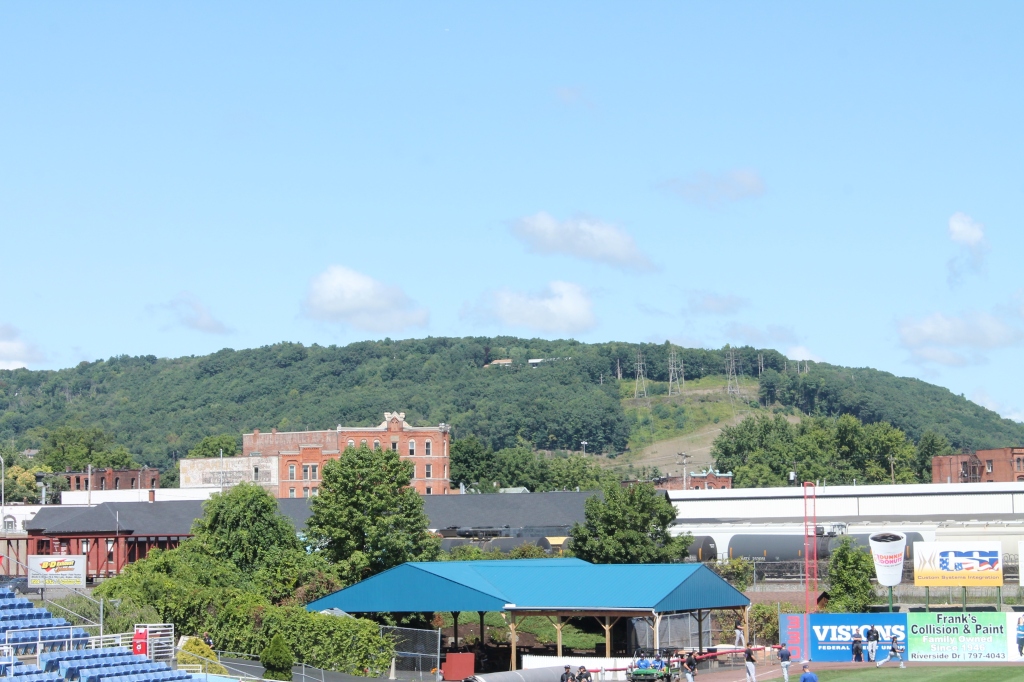
For this game, we chose seats in the upper deck, just to the right of home plate, giving us a different perspective. The seats did not disappoint, as there does not seem to be a bad seat in the house, and sitting behind home plate gave us a great view of the Allegheny Mountains in the distance. Rather than procure a baseball dinner (there are a number of good choices for food at the park), I chose to focus on the game and the location. People’s Natural Gas Field has one of the best views I have seen in a minor league ballpark, perhaps third behind Truist Field in Charlotte NC and Canal Park in Akron OH. In fact, our initial visit was based primarily on the word of others stating that this minor league ballpark was the best they had ever seen. Our view this evening was surely a validation of those recommendations.
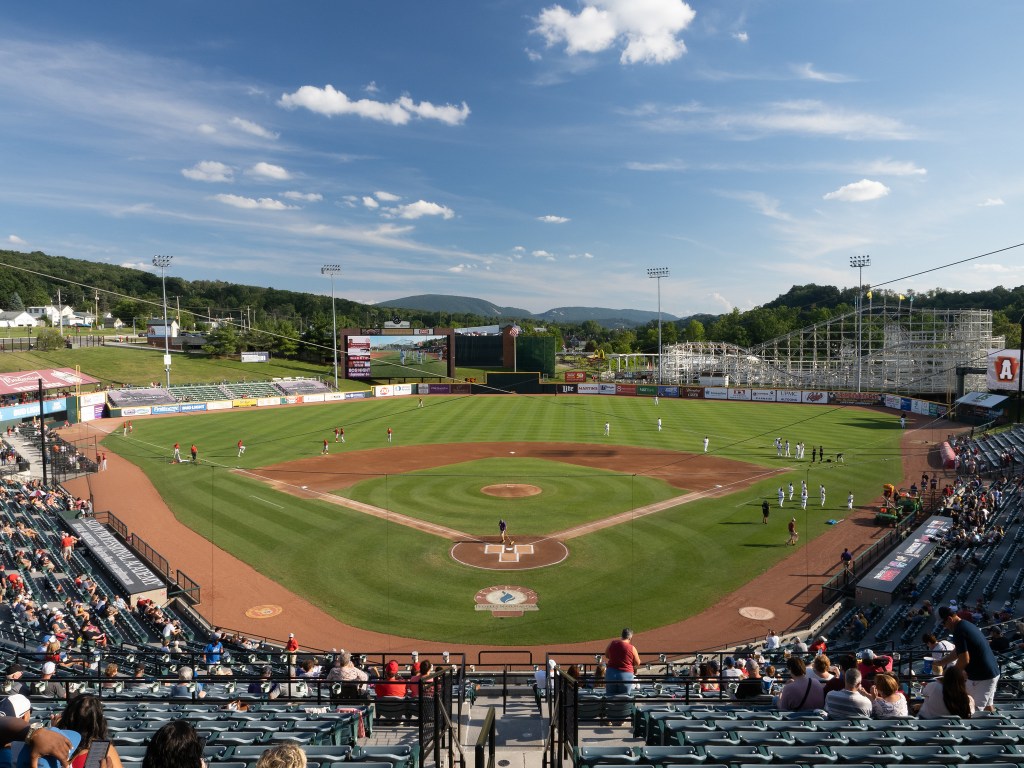
The view from the upper deck behind home plate at People’s Natural Gas Field. Note the mountains in the background. (Photo credit: Jeff Hayes)

This evening’s matchup featured the Harrisburg Senators (my newly adopted minor league home team, and the AA affiliate of the Washington Nationals) and the Curve, the AA affiliate of the Pittsburgh Pirates. The Senators sent right hander Ronald Herrera to the mound, who was in the midst of a disappointing 2022 campaign. Altoona countered with right hander Luis Ortiz, who was also experiencing a down season. Despite the seemingly underwhelming starting pitching, no runs were scored in the first three innings, which took only 34 minutes to complete. Harrisburg scored twice in the top of the fourth inning, as Herrera was cruising along through the fifth inning.
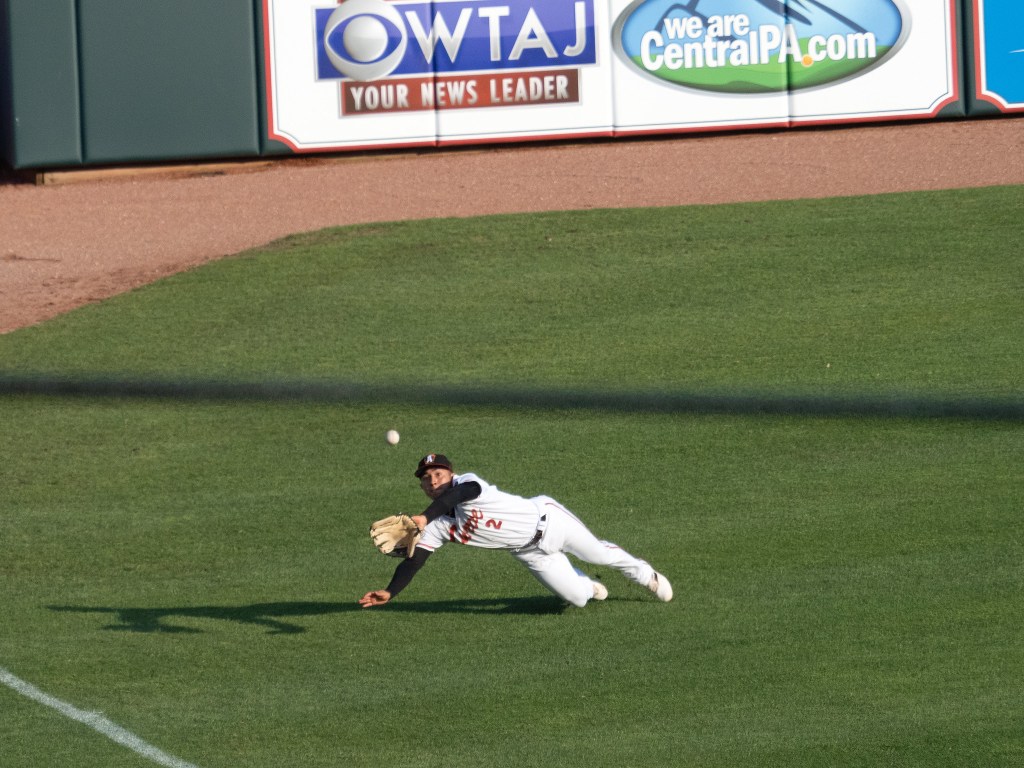
Great action shot from People’s Natural Gas Field, Altoona PA. (Photo credit: Jeff Hayes)

Altoona broke through with five runs in the top of the sixth inning, ending Herrera’s night and effectively putting the game out of reach for Harrisburg. Even as the competitiveness of the game waned, my rapt attention turned to the surroundings. As evening slipped into night, I could not help but admire the beauty of the ballpark and the terrain beyond it. We saw both the go karts in action, as well as people enjoying the roller coaster, the subtle lighting accenting the visually pleasing structure.
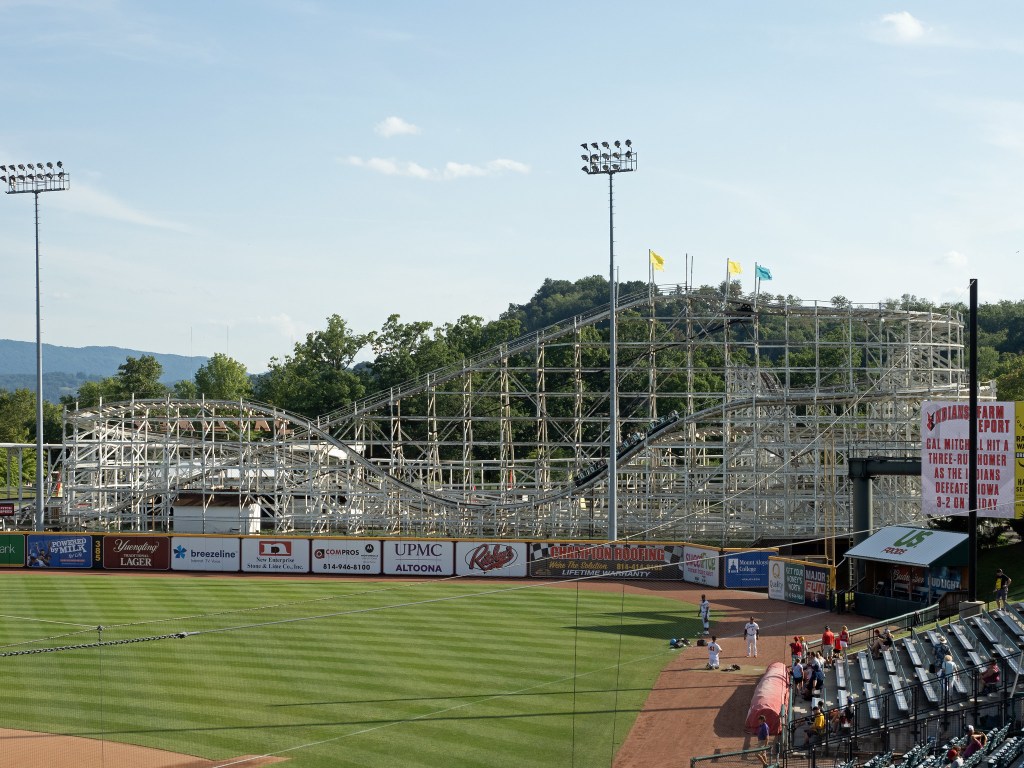
A closeup of the roller coaster beyond the right field fence at People’s Natural Gas Field. It had my attention for much of the game. (Photo credit: Jeff Hayes)

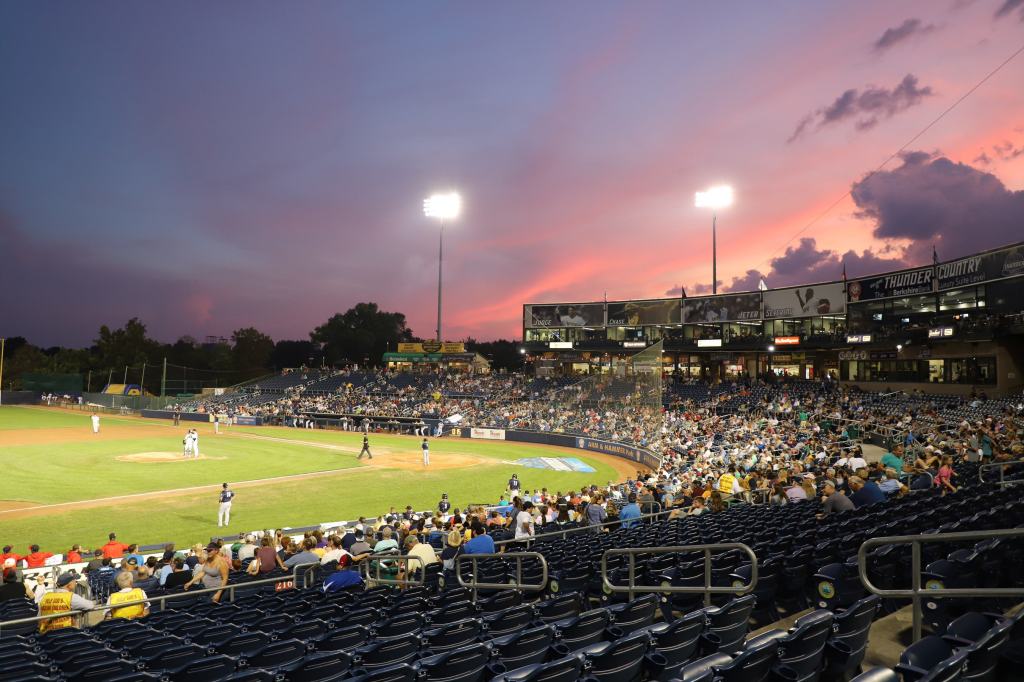
Despite the outcome of the game having been decided, the large Saturday night crowd remained, probably due to the promise of fireworks following the final out. As is our custom, we used the fireworks as cover for a quick getaway, essential when using a parking garage. Our visit today went a long way toward washing away the memories of a rain out last time we were here. Hopefully the weather would cooperate tomorrow, and allow us one more game in this impressive stadium.
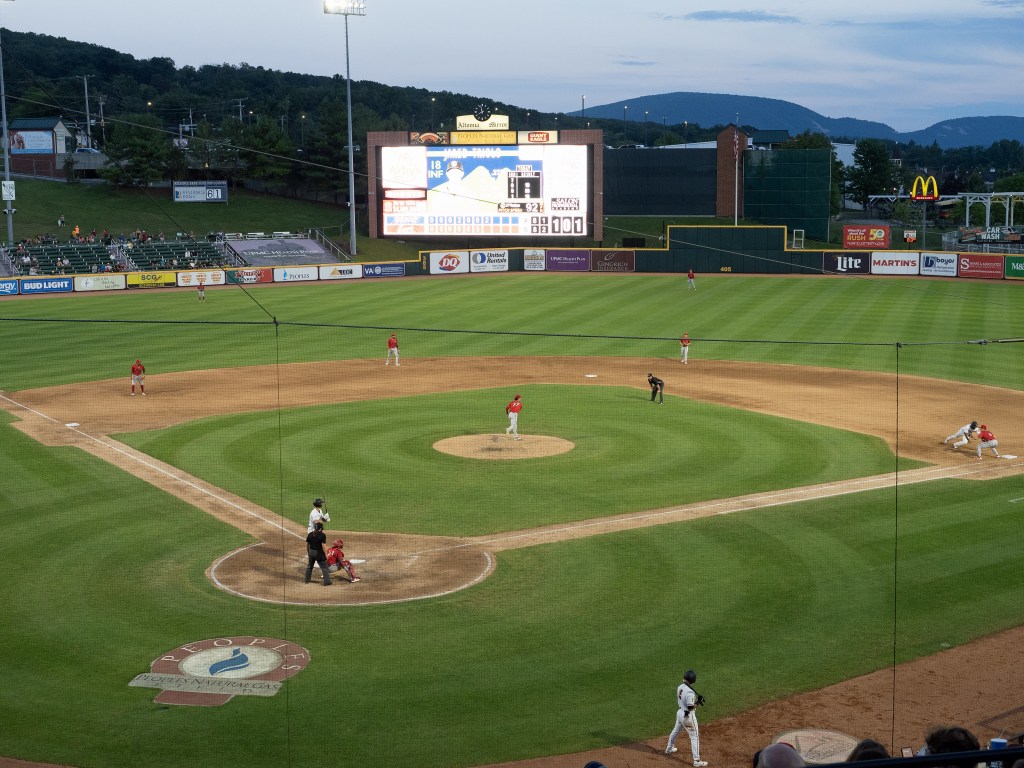
Night approaching at People’s Natural Gas Field in Altoona, PA. (Photo credit: Jeff Hayes)

Sunday, August 21st 2022

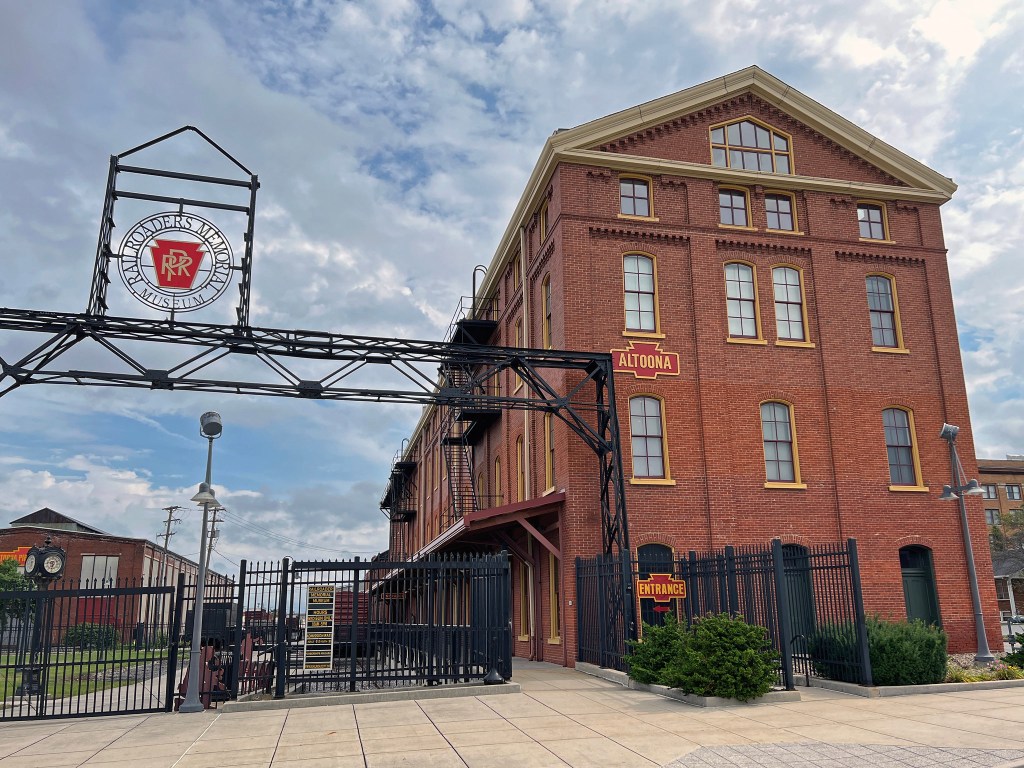
The Railroaders Memorial Museum in Altoona, PA (Photo credit: Jeff Hayes)

Overnight thunderstorms left cloudy and humid conditions in their wake Sunday morning. Based on the radar, it would not be long until the next round of storms approached Altoona, forcing us indoors for our plans. We decided on the Railroaders Memorial Museum, located in downtown Altoona. Our choice fed into my latent obsession with trains, which has been growing since my relocation to central PA. Resembling a train station (though it is actually a Master Mechanic’s Building during the height of train operations in western PA), the museum houses a wide array of displays and exhibits.
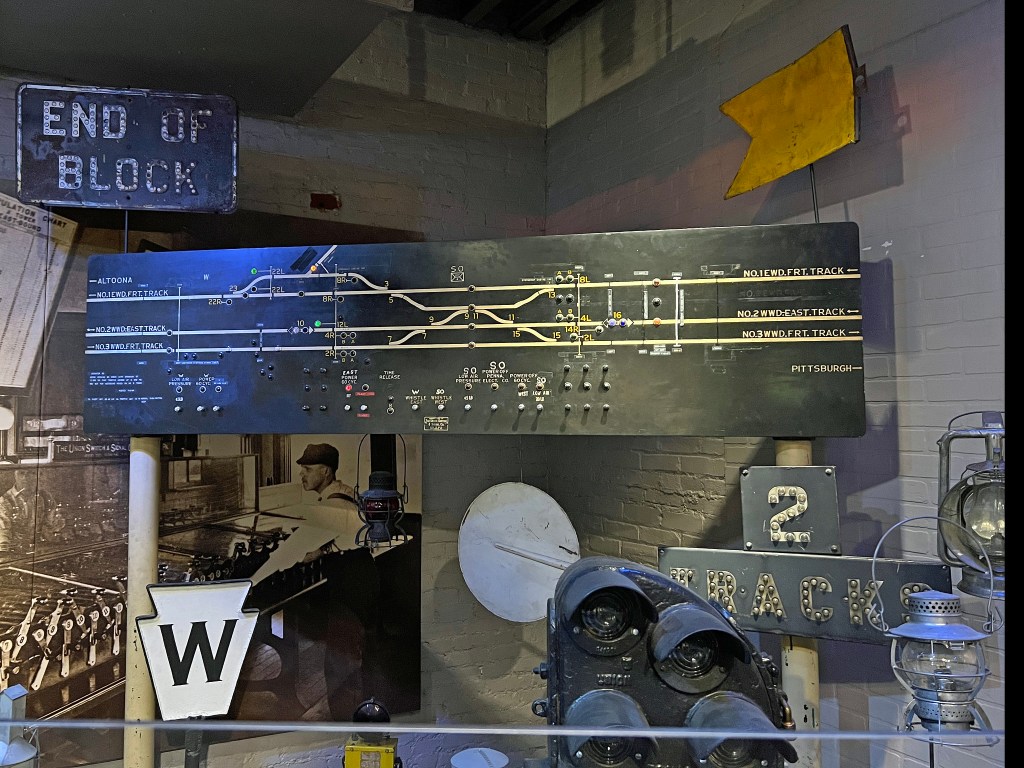
Status board for the PA Railroad at the Railroaders Memorial Museum in Altoona PA. (Photo credit: Jeff Hayes)

Perhaps my favorite part of the museum was the section dedicated to the science of better (and safer) train travel. Several of the exhibits depicted rail accidents that resulted in lost lives, and others showed just how dangerous it was working for the railroad was during the first half of the 20th century. An entire section was devoted to the problem, and I must admit to marveling at the amount and variety of research that was on display here. My brother and I are both scientists, which allowed us to truly appreciate the effort and dedication employed to improve the rail experience. While the tools may seem primitive now, they were state of the art at this time, demonstrating the commitment of the PA Railroad. To my great surprise, we learned that the results of the research conducted was given to rival companies free of charge, something that seems unimaginable now.
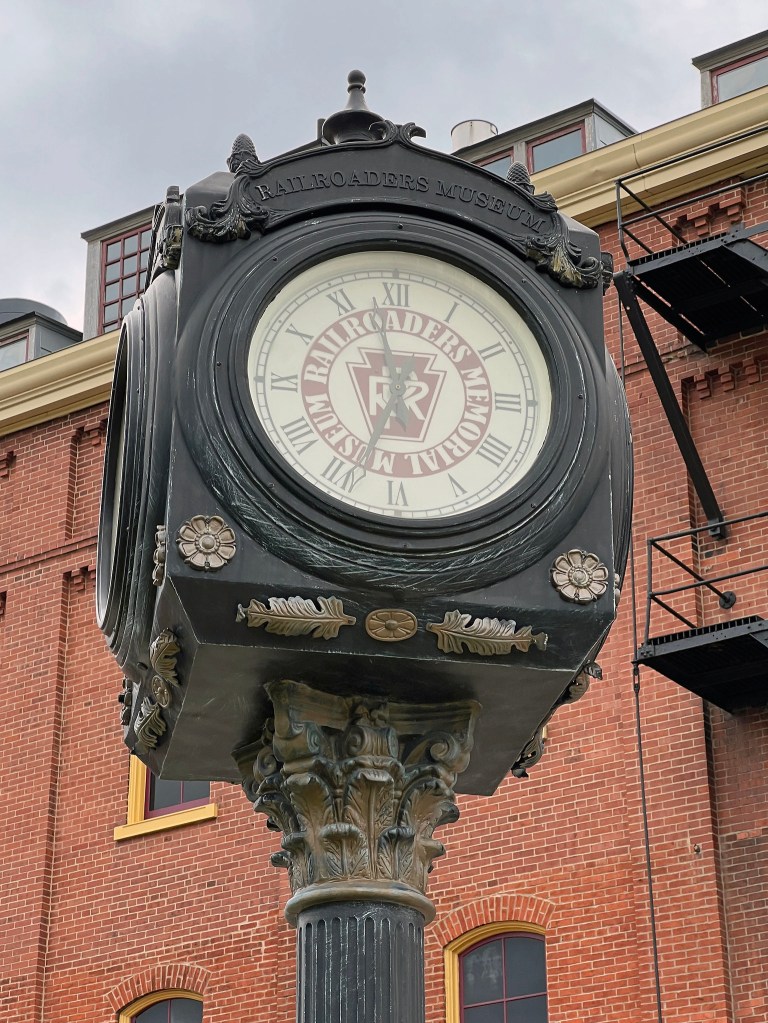
Old fashioned clock outside the Railroaders Memorial Museum in Altoona, PA (Photo credit: Jeff Hayes)

Following our exploration of the main facility, we visited Harry Bennett Memorial Roundhouse, which housed trains and equipment in various states of repair. On the way, we saw locomotives and cars in decay, aping the decline of train ridership since its peak so long ago. Seeing these once majestic machines rusting in the elements also felt sad, as warriors from the past slowly faded away. Finally, we were prepared to visit the World Famous Horseshoe Curve, an outdoor exhibit featuring excellent view of trains cast against the terrain of the Allegheny Mountains. Unfortunately, impending weather drove us back inside, as storms would have marred the visuals of the area.
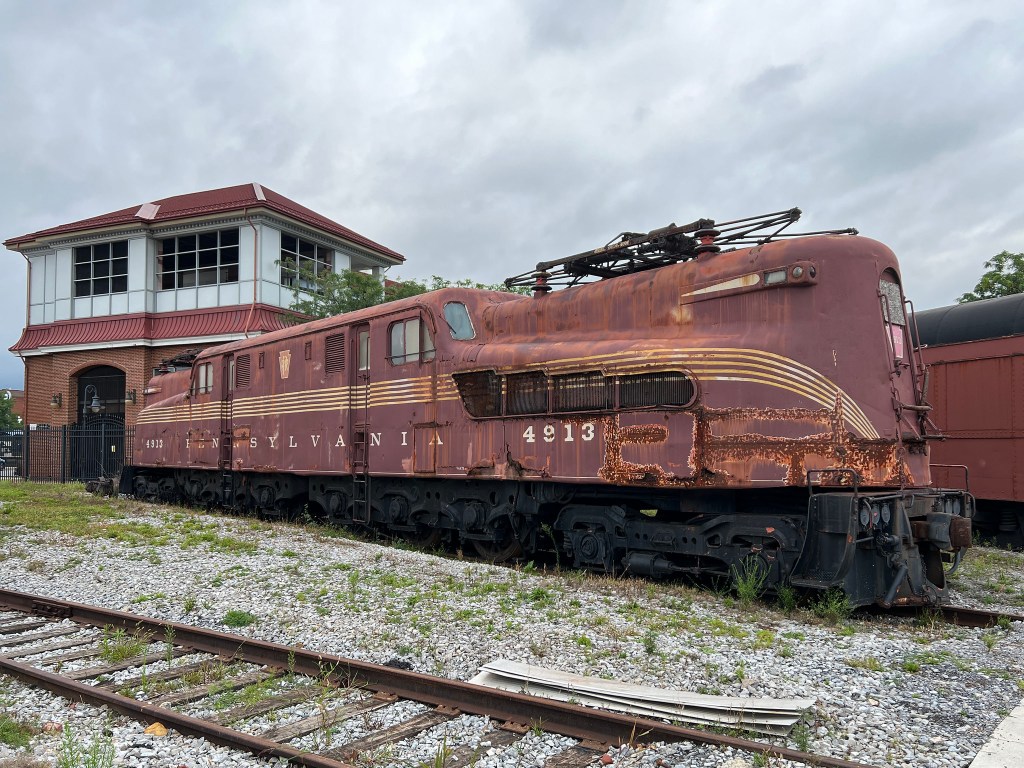
A rusting giant fading away in a lot behind the Railroaders Memorial Museum in Altoona, PA (Photo credit: Jeff Hayes)

Just ahead of the storms, we headed back toward the hotel, choosing to eat lunch at La Fiesta Mexican Bar & Grill, just steps away. The food was good and reasonably priced, but I soon discovered that the food was indeed too rich for me, and I would pay the price. In the wake of the most recent storms, the sun reappeared. Rather than relax after the big meal, my brother suggested another drone flight over the stadium, from a nearby park. Skies had become almost sunny, allowing us to fly over the deserted ballpark and Lakemont Park. As might be expected, the humidity was high during our flights, and we could see storms already developing off in the distance. The forecast for game time was problematic, but we hoped to squeeze the game in before the next round of storms arrived.
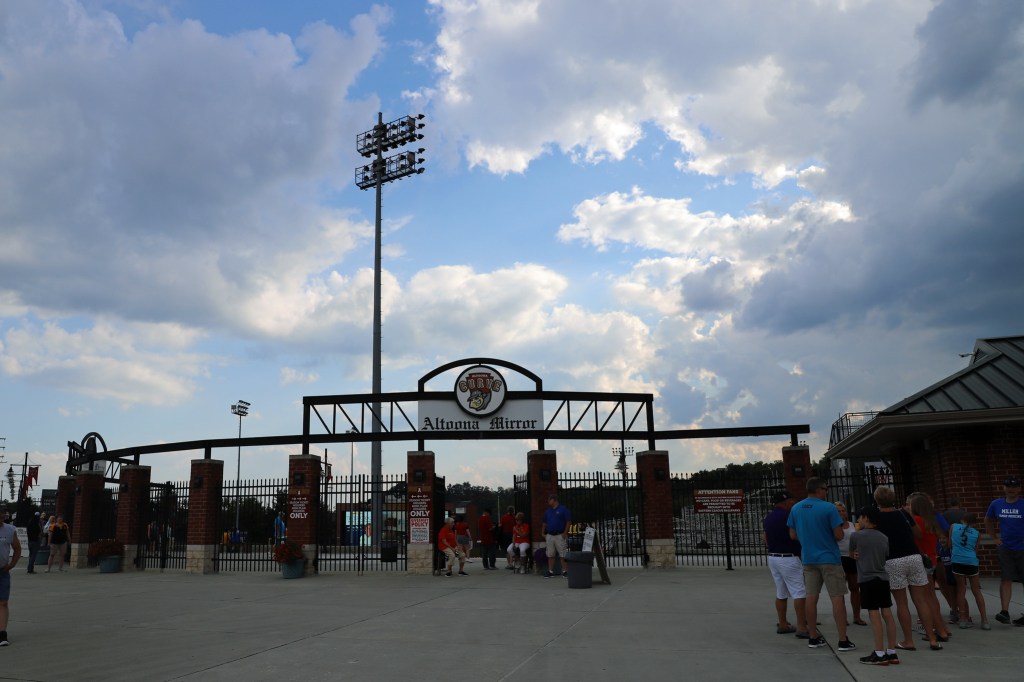
The view from the centerfield gate at People’s Natural Gas Field. Note the ominous clouds gathering in the distance, a harbinger of things to come. (Photo credit: Jeff Hayes)

Following the drone flights, we headed back to the room to relax before heading out to the ballpark. During that time, storms had formed and began their approach. Arriving just before the gate opened, it was clear that we would have to contend with at least one rain delay, but because we were staying in Altoona that night, we were prepared to stay as long as necessary. To pass the time, we explored the center field area of People’s Natural Gas Field, an area we had not yet visited. By the time we found our seats on the 3rd base side of the ballpark, it was becoming increasingly apparent this would be the only time we sit in those seats.
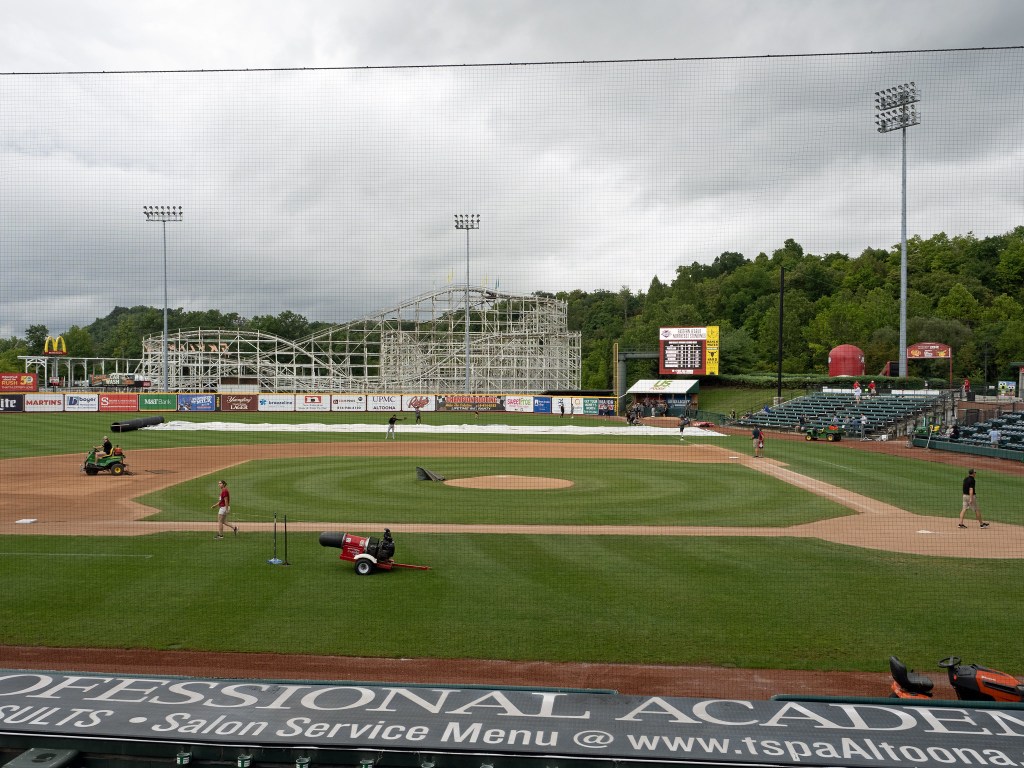
The view from our seats for the Sunday evening game, featuring a good look at the roller coaster. (Photo credit: Jeff Hayes)

As the rain commenced, people abandoned their seats and headed for the concourse. Knowing it would be a long rain delay (based on the radar trends displayed on our phones), we found a bench on the outer concourse, near some open windows. For more than an hour, we listened to the rain falling, interspersed with the occasional peal of thunder. Occasionally, the rain fell so hard that we needed to close the windows or risk becoming soaked. After about 45 minutes, it was obvious that the field had absorbed more water than it could handle, and the inevitable announcement followed; the game was canceled. Because it was so late in the season, there was likely no time that would fit the schedules of both teams for a makeup game, so the contest was simply cancelled.

We waited for a time to leave the park after the official announcement, and it was still raining when we headed back to the vehicle. In fact, it rained all the way back to the hotel, heavily enough at times to obscure traffic. Though the Curve did what they could to play the game, we were destined to miss yet another game to rain. In total, we saw only one complete game of the three that we had hoped to see. While .333 may be a good baseball batting average, it is poor average for seeing baseball games. However, we did not let the weather ruin what was a good visit overall, and we did get to see the park at its best Saturday night. People’s Natural Gas Field (and surroundings) was worth the trip and then some. If you find yourself within range of this beautiful ballpark when the Curve are in town, do yourself a favor and GO!
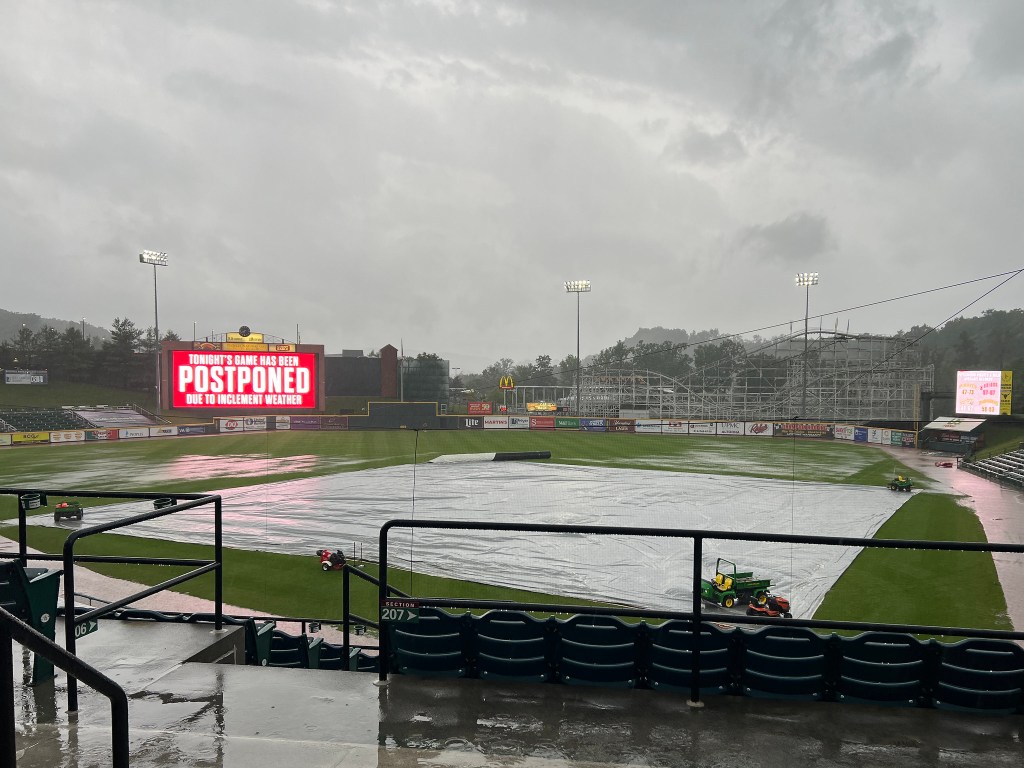
Incredibly, we were rained out AGAIN at People’s Natural Gas Field, for the second time in three tries. The message on the centerfield video board says it all. (Photo credit: Jeff Hayes)

NYSEG Stadium, Binghamton NY, August 23rd and 24th 2014

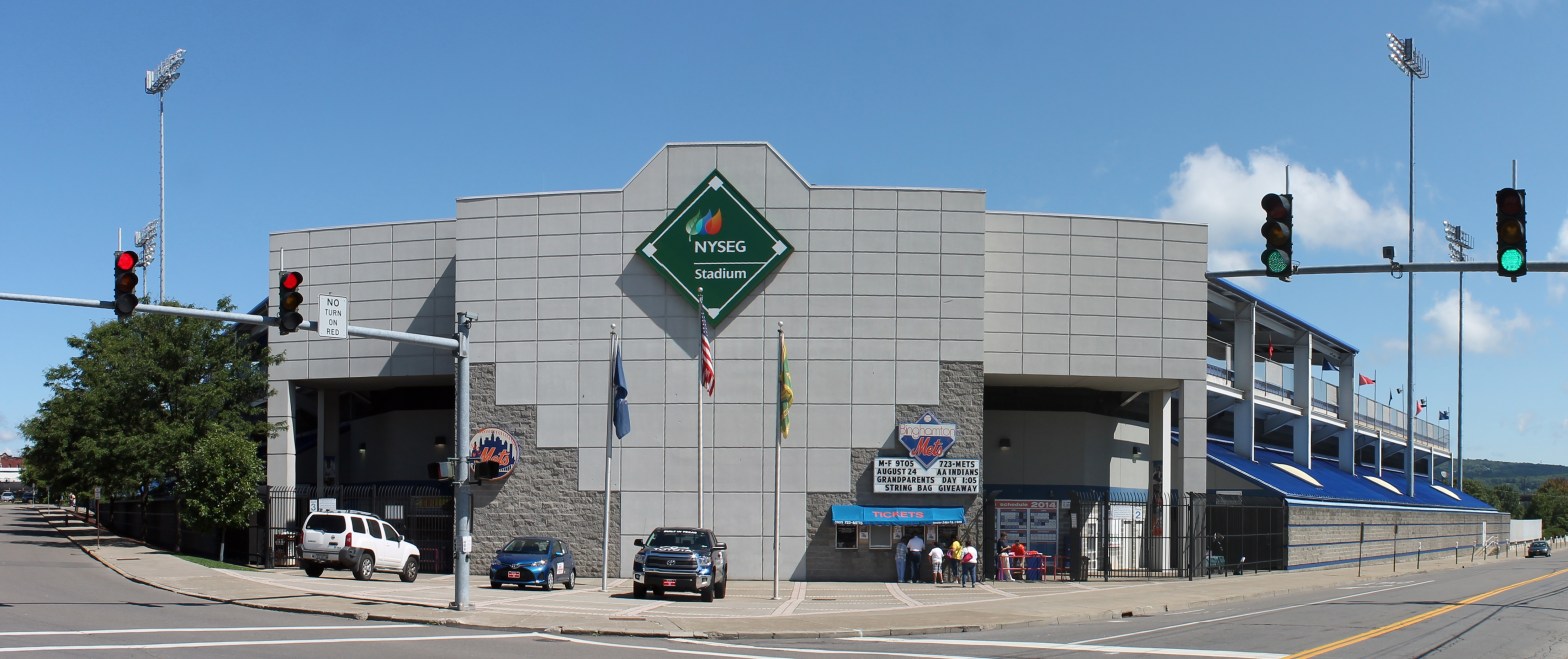
NYSEG Stadium, home of the Mets AA affiliate in Binghamton NY. (Photo credit: Jeff Hayes)

Since the list of MLB stadiums to visit was becoming increasingly small, we decided to branch out and start visiting minor league (MiLB) stadiums. At first, the radius for visiting MiLB ballparks was limited to places within a three or four hour drive from central NJ. Being avid Mets fans, we set our sights on Binghamton, NY, the home of the Mets AA affiliate. Our first visit occurred in August of 2014, and rather than make it a day trip, we planned our weekend trip to cover the last two games of a three game set with the Akron RubberDucks. The drive from central NJ to NYSEG Stadium, the home of the Mets AA affiliate, was fairly easy, taking about three hours following a mostly interstate route.

After checking into our hotel, we headed out toward the ballpark ahead of a 705 pm game start. NYSEG Stadium is located in the southern part of Binghamton, nestled between the Chenango River to the west and the Susquehanna River to the southeast, about a mile from our hotel. Arriving an hour before game time, we parked in a private lot across from the stadium on Henry Street. With the businesses apparently closed for the day, parking here was plentiful, and the price was certainly right (a mere $5). This was not our only option, but it appeared first as we approached the stadium. There is a Binghamton team-run lot behind the right field wall of NYSEG Stadium (which is closed on Fireworks Nights). Parking there is also $5, and the walk to the ballpark is only a little bit longer than the private lots just across the street.

NYSEG Stadium from just behind the dugout on the first base side. (Photo credit: Jeff Hayes)

Located in a mainly residential area, there is not much in the way of activities or places to eat in the immediate vicinity of the park. As a consequence, our normal tour of the outside of a new ballpark was fairly short, and we entered the stadium through the home plate entrance.

NYSEG Stadium is a modular ballpark whose appearance is similar to the majority of the modular MiLB parks we have seen in our travels. There are two decks of seats extending from just beyond the third base to just beyond the first base dugout. The lower deck stretches from the main concourse down to the first seven to 10 rows, and the second deck rises up from the concourse to near the apex of the park. Atop the seating area are luxury boxes and the press level, which are covered by a small roof (as is the top of the second seating deck behind home plate). In total, NYSEG Stadium hold about 6,000 fans, which is on par with other AA stadiums.

The scoreboard/video board at NYSEG Stadium in Binghamton NY (Photo credit: Jeff Hayes)

Like most MiLB parks, wooden advertising signs span the outfield walls, and there is a relatively small video board/scoreboard in right center field. The layout of the video board/scoreboard is vaguely reminiscent of the old Shea Stadium scoreboard, and perhaps the likeness was intentional, as the Mets are the parent club. Overall, the ballpark itself seemed unassuming. It was surprising to learn that NYSEG Stadium opened in 1992, because in some respects the ballpark seems older. This was especially true of the park’s inner concourse, where the bulk of the concessions are located. After walking around the inside of the park (which is typical for a first visit), we obtained a baseball dinner and headed toward our seats.

Akron had been playing well for much of the season, and seemed to be a lock for a playoff spot. However, leading up the series with the Mets, they had been playing uneven baseball, allowing Binghamton to move to within striking distance of the RubberDucks for a playoff spot. Starting for the Mets that night was 26 year old righthander Greg Peavey. Leading the Binghamton staff in wins and ERA during the 2014 campaign, Peavy pitched well enough to keeping the suddenly struggling RubberDucks down for much of the game, with the Mets beating Akron 5-2.

The view of NYSEG Stadium from behind home plate at the end of batting practice. (Photo credit: Jeff Hayes)

In the Mets’ portion of the sixth inning, we saw something I had never seen before in person. With runners on first and second, a line drive off the bat of Mets second baseman Dilson Herrera was nabbed in right field on a great catch by the RubberDucks’ Jordan Smith. The Mets runners were on the move, thinking the ball would find a gap in the outfield, and both runners were unable to return to their bases after the catch, resulting in the first triple play I’d seen live. Later in the game, when RubberDucks manager Dave Wallace made a pitching change, we were close enough to see the desperation in eyes, as though he was witnessing the season slipping away. When the Mets pitching coach Glenn Abbott questioned a procedural error by Wallace, we could hear him say ” What the f**k? Just let it go!”

Following the game, we headed across the street to retrieve the car and head back to the hotel for the night. My first impression of the stadium was that is was fairly non descript, and that the crowd was tiny (far less than the announced attendance of 3,800) for a team that was fighting for a playoff spot. We would get a much better look at NYSEG Stadium during the Sunday matinee, the third and last contest of the three game set. Not surprisingly, the streets in Binghamton were nearly deserted as we made out way back for a good night’s sleep after a long day of travel.

My scorecard from the game.

We had some time on our hands on a bright sunny Sunday morning after breakfast at the hotel, so we walked along the the Chenango River (which runs alongside the Holiday Inn in Binghamton). We then walked the streets of Binghamton on the warm and dry morning. It was obvious that the city had seen better times, and Binghamton was beginning to show its age. With that said, I was impressed by some of the architecture of the city. There were hints of Art Deco, Neoclassic design and even some Modernism in the churches and government buildings, some of which were built during the Great Depression. Never having been here before, I had no idea what to expect, but I was impressed with the part of the city we explored before heading out to the ballpark.

The view over the left field fence ay NYSEG Stadium. showing the tree covered hills, as well as the train track just behind the outfield wall. (Photo credit: Jeff Hayes)

Once again we arrived about an hour before game time, and we were able to secure parking across the street in a private lot. We wandered around the park a bit more than the night before, and discovered that there were some souvenir stands near the right field foul line, as well as some games for the kids. As is often the case for a Sunday afternoon game following a Saturday night game, the crowd promised to be fairly thin, despite wall to wall sunshine, pleasant temperatures and low humidity. Our seats for this game were very good, near the front row of the lower section just behind first base. From that vantage point, we were treated to a good view of the beautiful hills to the northwest of the ballpark, and the train track lying just behind the left field fence.

Steven Matz pitched well for the Binghamton Mets, a game Binghamton would win 5-0. (Photo credit: Jeff Hayes)

Part of the attraction of coming to Binghamton (along with seeing the ballpark) was seeing rising stars in the Mets minor league system up close and personal in their home setting. Fortunately for us, much heralded left handed starter Steven Matz was on the mound for Binghamton, and our seats gave a great look at someone who would be a member of the 2015 National League Champion New York Mets. Matz was impressive in the start, lasting five innings, and allowing no runs on three hits with six strikeouts. Akron struggled against Matz and a trio of relievers, as the Mets took the last game of the series 5-0.

With the win, the Binghamton Mets edged closer to an Eastern League playoff spot. This team loaded with young talent that would at least make an appearance with the parent club in the near future, and would ultimately win the 2014 league championship. As we were leaving for our three hour trip home, I reflected on what we had seen. Because NYSEG Stadium did not have any single outstanding attribute, I felt as though the ballpark took a back seat to the Mets AA team. Having seen the park and the city of Binghamton, I felt as though we had seen all there was to see there, and did not anticipate a return visit.

Arm and Hammer Park, Trenton NJ

Arm & Hammer Park at sunset: (Photo credit: Jeff Hayes)
  • First visit: exact date unknown, probably during the 2011 season
  • Most recent visit: July 25th, 2021

Following a job change that took me from southern Maine (where I saw the Portland Sea Dogs at Hadlock Field) to southern New Jersey in 2010, I found that I had landed in an area that was teeming with baseball. The Philadelphia Phillies were 30 minutes away, and two minor league teams were within 45 minutes or so (the Trenton Thunder, the AA affiliate of the New York Yankees, and the Lakewood Blue Claws, the low A affiliate of the Philadelphia Phillies). Since my brother lives closer to Trenton, I chose to make the Trenton Thunder my new favorite minor league team.

Trenton plays their games at Arm&Hammer Park. Opening behind schedule in 1994 (as cold and snow the previous winter hampered construction efforts), the stadium was part of a larger complex containing office buildings and a night club, known as the Mercer County Waterfront Park. Though the ballpark is technically within Trenton city limits, it is located on the southern edge, away from the influence of downtown. Its location (just off Route 29, on Thunder Road) makes ingress and egress much easier than if the stadium was located downtown.

A view of the Delaware River from Arm&Hammer Park in Trenton. (Photo credit: Jeff Hayes)

Parking at Arm&Hammer Park is fairly straightforward. After entering the complex, the first parking area encountered is a surface lot to the right. Most times, these spaces are unavailable to baseball fans, as they are either occupied by state employees working at the complex, or by fans with mobility issues. Just down the street from the surface lot is a three-tiered parking deck, which most times offers an orderly exit after games. However, we have learned through bitter experience that most people don’t know how to exit a parking deck, and that fact can add a considerable amount of time when trying to leave the complex. Parking is a very reasonable $5.00, and the walk from the deck to the stadium is about one-quarter of a mile or so.

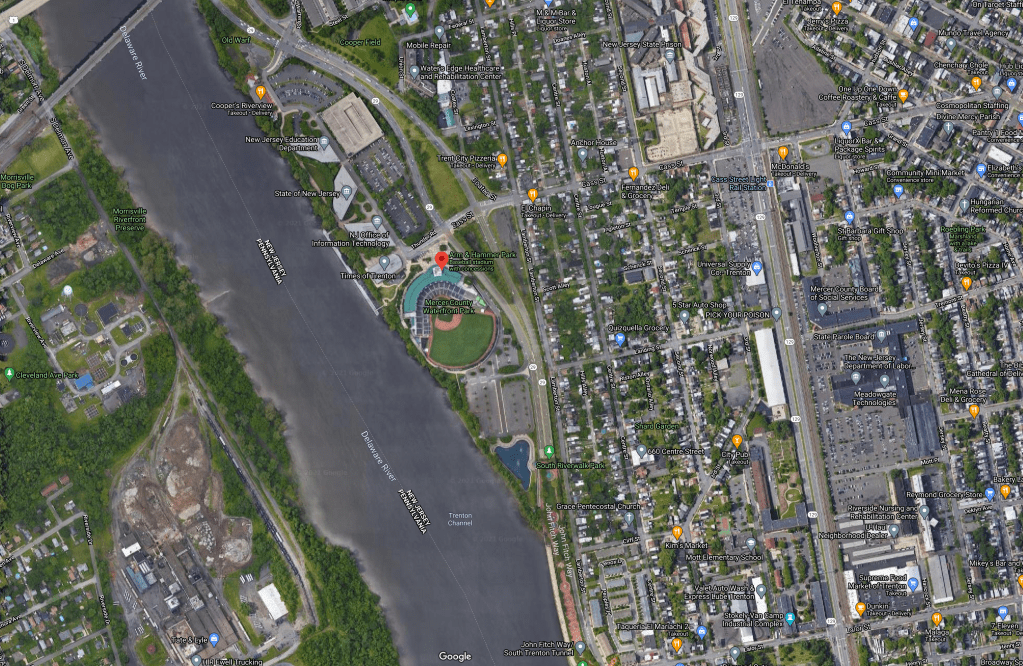
As the name of the complex implies, Arm&Hammer Park lies along the Delaware River, which divides New Jersey from Pennsylvania. Before games, we occasionally walk along a path paralleling the river, a stark contrast to the urban area not too far away, providing a view most people outside of the area would not expect to see in New Jersey. There are three entrances into the ballpark (each of which has a not inconsequential set of concrete stairs to navigate): one adjacent to the river walk on the first base side, behind home plate and behind third base. Arm&Hammer Park has two seating decks that extend from just beyond third base behind home plate to just beyond third base, as well as suites near the top of the stadium, bringing to the capacity of 6,150 (which is typical of a AA ballpark). Bullpens are located along the left field line (visitor) and the right field line (Thunder), and the outfield is nearly ringed by wooden advertising signs located above and just behind the outfield wall.

A Google satellite image of Arm&Hammer Park, nestled between the Delaware River to the left and Route 29 to the right.

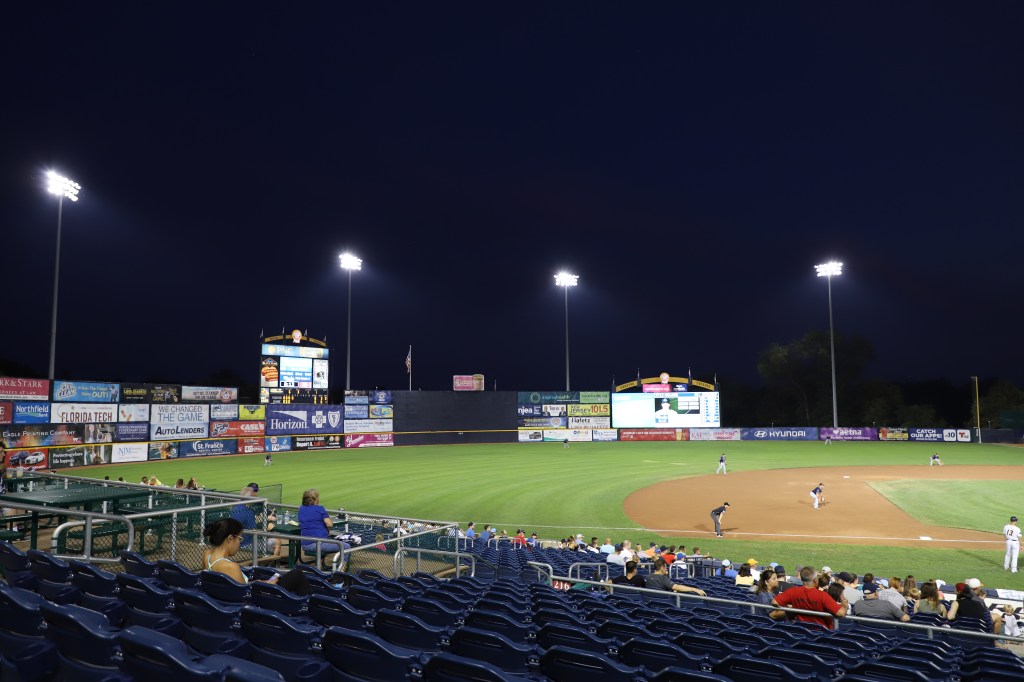
While Arm&Hammer Park is a fairly typical minor league ballpark, it does possess what might be the largest video board in the minors. Located in right centerfield, the size and resolution of the video board is more reminiscent of a Triple A ballpark. Being an affiliate of New York Yankees probably factored into the decision to place such a large video board in the ballpark, and it is the most prominent feature of the stadium. Just to the right of the video board, the outfield wall is low enough to allow home runs to leave the park and head toward the river. Actually, it IS possible to hit a fair ball down the right field line that can land in the Delaware River. Though I am not sure it has been done, it might be possible to hit a home run far enough across the river to have the ball land in the Pennsylvania portion of the river.

Arm&Hammer Park offers the standard fare when it comes to concessions, though there are a couple of places worth noting. My favorite is Chickie’s & Pete’s, located on the main concourse on the first base side. Chickie’s & Pete’s serves crab house food, and I rarely pass up the opportunity to indulge in a cup of crab fires (large French fries covered with Old Bay seasoning). They also offer excellent cheese steaks, brats and hot dogs, which are cooked to order. On the third base side is Boomer’s BBQ, which, as the name implies, offers an array of barbeque meals. Personally, I do not frequent this place as often, but when I do, I usually get the chicken sandwich. Most times, though, I elect to get a baseball lunch or dinner (which generally includes hot dogs) before heading to our seats.

A view of Arm&Hammer Park from the lower deck to the right of home plate. The video board is featured in right centerfield. (Photo credit: Jeff Hayes)

When attending a Thunder game, you definitely want to be in your seats for the bottom of the first inning. During that half of the frame, after each Thunder hitter discards of his bat, the Thunder bat dog retrieves it. Currently, the bat dog is Rookie, but he was preceded by Chase and Derby in the recent past. While Rookie sometimes has difficulty grabbing the bat in his mouth to bring back to the dugout, he is successful most of the time, to the delight of the crowd. After the end of the first inning, Rookie returns to the clubhouse, his task for the day completed. As a side note, when the Thunder played the Bowie Baysox for the Eastern League championship in 2019, Rookie made the trip to Maryland, retrieving bats in the first inning. Probably because he was in a new environment, rather than retrieve the bat after a Thunder player walked, Rookie instead followed the player to first base. Murmurs permeated the air when Rookie did his thing, and the Baysox faithful were enamored with the visitor.

The Trenton bat dog enthusiastically carrying out his duties at Arm&Hammer Park in Trenton, NJ. (Photo credit: Jeff Hayes)

One of the biggest perks of seeing Thunder games is the potential to see MLB players on rehabilitation stints. Being a Yankees affiliate, many past and present Yankees have made appearances at Arm&Hammer Park, and more than 9,000 fans were present when Derek Jeter did his rehab assignment during the Fourth of July weekend in 2011. In 2013, when Alex Rodriguez appeared with the Thunder, Trenton drew in excess of 8,000 fans for each of his two games there. More recently, perennial fan favorite Curtis Granderson made an appearance.

The Philly Fanatic makes an appearance at Arm&Hammer Park. (Photo credit: Jeff Hayes)

In addition to rehab appearances, my brother (who goes to many more Thunder games than me) and I have seen many current Yankees as they came up through the minor league system. Since the Mets AA affiliate Binghamton Rumble Ponies are in the same division of the Eastern League as the Thunder, they come to Arm&Hammer Park a couple of times a year. My brother and I do our best to wrap our plans around these times, and that allows us to see future Mets up close. In the past, we have seen Matt Harvey and Noah Syndergaard on the mound, as well as many position players (like Michael Conforto and Ahmed Rosario) on the field in Trenton. There is something satisfying about seeing future stars in the MLB in such an intimate setting, before they become household names. We were fortunate enough to see Michael Conforto play in Trenton before making the jump to the New York Mets the next day in July 2015.

Curtis Granderson (left) making a rehab appearance at Arm&Hammer Park, and a young and clean cut Noah Syndergaard (right) pitching for the visiting Binghamton Mets. (Photo credit: Jeff Hayes)

Being such a big Mets fan, my best memories of Arm&Hammer Park are tied to visits by the Binghamton Mets/Rumble Ponies. Perhaps the most vivid memory occurred on Friday July 24, 2015. We had just finished a tour of New England minor league ballpark in time to attend all of the four games of the weekend series between the Mets and the Thunder. On that night, Robert Gsellman started for the Mets, who tossed seven and one-third innings of one run ball. The run Gsellman allowed tied the game at 1-1, and eventually the game went into extra innings. Trading scoreless innings, the Mets finally pushed across a run in the top of the 17th inning, defeating the Thunder 2-1.

A total of 13 pitchers were used that night (seven by the Mets and six by the Thunder), and the Thunder sent two position players to the mound (DH Taylor Dugas and 2B Danny Oh) for the 17th inning. Dugas allowed a run in the top of the frame before recording an out, and Oh mopped up, allowing no runs and no hits. The 17 inning game (the longest I have ever seen personally) took four and one-half hours to complete, and we left the ballpark just short of midnight. Fatigue from the road trip, combined with the long game that night, made me grateful we weren’t far from my brother’s home.

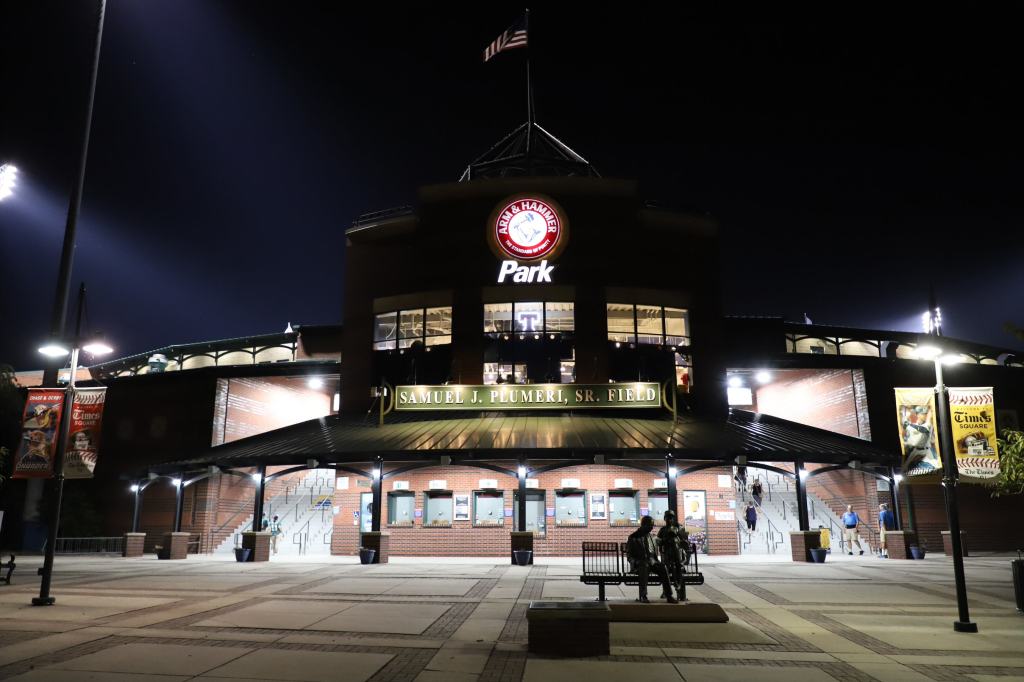
Arm&Hammer Park at night. (Photo credit: Jeff Hayes)

Arm&Hammer Park also hosted the only professional no-hitter I have seen in person, as the Binghamton took on Trenton in an Eastern League playoff game on September 9th, 2017. After the Thunder took a 1-0 lead in the bottom of the first inning, Rumble Ponies catcher Tomas Nido reached on a ground ball to third baseman Dante Bichette Jr in the top of the second. Initially, the play was ruled an infield single. Trenton left hander Dustin Sheffield then shut the Rumble Ponies down in a short but dominant performance.

In the sixth inning, a nearby fan asked me about the hit by Nido, since I was keeping score of the game. When I told him about the hit, he directed my attention to the scoreboard. At some point, the official scorer changed the hit to an error, and suddenly we were witnessing a possible a no-hitter. Once the change was recognized by the crowd, there was an audible response at the prospect of seeing a no-hitter. Sheffield was lifted from the game after four innings (before the hit was changed to an error), and Taylor Widener threw five hitless innings to complete the no hitter. Because the scoring change occurred so late in the game, there was not the anticipation in the crowd that might have been expected to seeing a no-hitter, which was disappointing as a fan.

Though not attached to any particular story about Arm&Hammer Park, I included what I consider to be my brother’s best baseball action shot. Note the ball in the glove , robbing the batter of a home run. (Photo credit: Jeff Hayes)

Though Arm&Hammer Park is a typical AA facility, it has grown on me over the years. Being able to see future Yankees (and occasionally future Mets when Binghamton visit) in such an intimate setting is enjoyable, and my experience in parks just like this has raised my appreciation of the minor league game over the MLB product. However, a disturbing change brought about by the New York Yankees organization has stripped the park of its association with the team. Instead, the Trenton Thunder will play the 2021 season as a founding member of the MLB Draft League. Even with the change, if you find yourself near Trenton NJ on a summer day, check to see if the Thunder are playing. You will be glad you did.

Good night, Arm&Hammer Park! (Photo credit: Jeff Hayes)

Due to the continuing COVID-19 pandemic, it was determined that the Toronto Blue Jays could not play their home games to start the 2021 MLB season. As they did in 2020, the Blue Jays would play their 2021 home games at Sahlen Field in Buffalo NY. Home to their AAA affiliate (the Buffalo Bisons), suddenly Sahlen Field would NOT be available for the Bisons 2021 campaign.

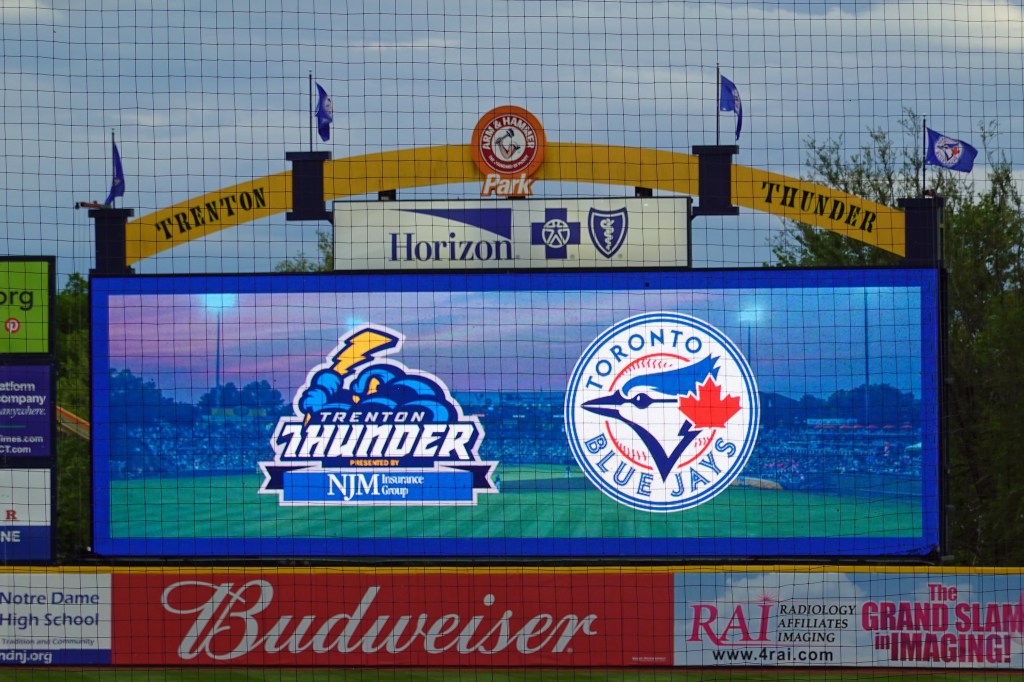
Numerous press reports indicated that there was something of a scramble to find a home for the Bisons. Eventually, MiLB decided on Arm&Hammer Park in Trenton. Having lost their primary tenants to Somerset, the stadium was available for use. To my surprise, the Bisons would play in Trenton as the Thunder (the previous name of the franchise). Since the decision to place the Buffalo team in Trenton occurred quickly (and without much fanfare), it was not clear how many baseball fans knew about the relocation of the Bisons to Arm&Hammer Field.

The scoreboard in Arm&Hammer Field tells the story of the return of the Trenton Thunder. In this incarnation, they are the AAA affiliate of the Toronto Blue Jays. (Photo credit: Jeff Hayes)

My first visit to the see the new Trenton Thunder occurred on Saturday, May 8th 2021, as they hosted the Worcester Red Sox (the AAA affiliate of the Boston Red Sox) on a rainy and cool night. In accordance with New Jersey’s COVID-19 protocol, fans were seated in “pods” (groups of fans surrounded by empty seats), which ensured proper social distancing. To their credit, the fans followed the guidelines set forth by the Thunder and MiLB, and because of the guidelines, attendance was limited to about 25 percent capacity for the game. For the most part, there was not much different about the park, despite the new occupants taking residence with little notice.

It was strange to see the Trenton Thunder in action again at Arm&Hammer Field, this time as a AAA affiliate. Occasional rain during the first part of the contest put a damper on the evening, but since this was my first live baseball game in nearly 20 months, the weather was hardly a concern. Because of the pandemic, there were small but noticeable differences at the ballpark. First and foremost was the absence of Rookie, the Thunder bat dog. Rookie normally retrieves bats for the Thunder half of the first (to the great delight of the home fans), but he did not dispatch his primary duty this evening. Also, there were no bat boys/girls. This meant players had to retrieve bats near home plate, secure foul balls on the field, as well as keep the home plate umpire’s ball supply up to date. There were no on field games for fans between innings, a family favorite at minor league baseball parks.

Our seats for the Saturday night game. Our seats for the Sunday afternoon contest were very similar. (Photo credit: Jeff Hayes)

Though the teams were now AAA, the level of play overall seemed a step down from the AA baseball we had seen at Arm&Hammer Park in the past. Despite scoring eight runs on 14 hits, the Worcester Red Sox struck out 18 times during the Saturday night game. Clearly the obsession with launch angle and hitting home runs has trickled its way down in the minor leagues. In addition, play in the field was not as crisp as it should be at this level, which was even more apparent during the Sunday afternoon game. Granted, the weather was inclement, and could have been a proximate cause for the sloppier than usual fielding, but I was surprised by what appeared to be a lack of concentration on defense. Even with the perceived deficiencies in the play, I was VERY happy to have live baseball back!

For now, it appears as though the team will play its home games in Trenton as the Thunder for the balance of the 2021 season. However, this is contingent on whether the government in Ontario continues to ban the Blue Jays from their home. Should that decision change, it is possible that the Thunder become the Bisons again in Buffalo later in the season. The Ontario provincial government lifted the travel ban for the Blue Jays effective July 30th, 2021, and the Thunder played their final game as the Triple A affiliate of the Blue Jays on Sunday, July 25th. This change allowed the REAL Trenton Thunder (a member of the MLB Draft League) to finish their inaugural season at Arm&Hammer Field in early August.

The revival of the Thunder gives Boomer another chance to entertain the fans at Arm&Hammer Park. (Photo credit: Jeff Hayes)