Nationals Park, Washington DC

Exterior panorama of Nationals Park in 2008. (Photo credit: Jeff Hayes)
  • First visit: Sunday June 8th 2008
  • Most recent visit: Sunday May 20 2018

After moving from Montreal following the 2004 season, the newly minted Washington Nationals (known locally as the Nats) played their first three seasons in RFK Stadium. During that time, its replacement, Nationals Park (known locally as Nats Park), was constructed on the southeast Anacostia River waterfront, not far from the Navy Yard section of Washington DC. An ambitious construction schedule projected completion in time for the start of the 2008 baseball season, a mere 23 months after groundbreaking in May of 2006. Fortunately, weather and other circumstances were kind to the project, and Nats Park opened as scheduled in late March 2008.

Our first visit to Nats Park occurred on Sunday June 8th as the hometown Nats hosted the San Francisco Giants at 115 pm. From central NJ, the drive took about three hours, and we didn’t have much difficulty finding the stadium, after driving around DC first. Sunday morning traffic was light, so the detour did not cause any problems arriving at the park with time to spare before the first pitch. Not knowing much about the park (as it was still fairly new), we were not presented with a multitude of parking options. Finally, we parked on the site of an old foundry down the street from the stadium. During our drive through that section of DC, it was evident that just a couple of blocks north of the park, the neighborhood changed fairly drastically. This was something we would verify on subsequent trips to Nats Park.
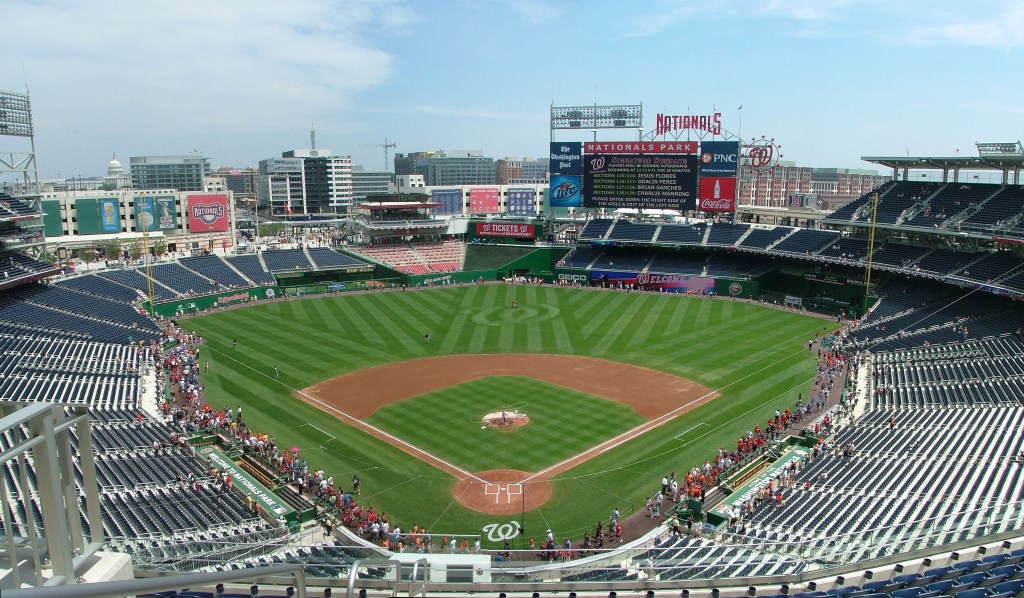
A panorama of Nationals Park from the upper deck behind home plate in 2008. Note the dome of the US Capitol visible behind the left field fence. (Photo credit: Jeff Hayes)

As is our custom, we walked around the perimeter of the stadium prior to entering the ballpark. Nats Park was built on the banks of the Anacostia River, which lies beyond the first base side of the ballpark. A walking trail along the river provided excellent views of the river and the boat traffic. Due to time constraints, we did not spend much time on the banks of the Anacostia, but with what little we did see, I made a mental note to visit this spot the next time we were there.

The destroyer USS Barry docked in the Washington Navy Yard on the Anacostia River, just outside Nationals Park (Photo credit: Jeff Hayes)

As we rounded the right field section of the park, we saw the DC Metro station serving Nats Park. It was a short walk from the stadium, and seemingly most of the fans were arriving via the train. To this point, most of the parks we had visited did NOT have easy access to subway or rail lines (outside of the New York City, of course). Having easy access to mass transit seems to be the key to a better fan experience, and we were pleased to see that DC planned well. Once we completed our tour of the outside of the park, we entered through the home plate entrance. Being in DC, we expected security to be thorough, but it was my opinion that the security at Nats Park was aggressive, rude and surly. Because of that, getting through the security checkpoints has always been the biggest downside of seeing games there.
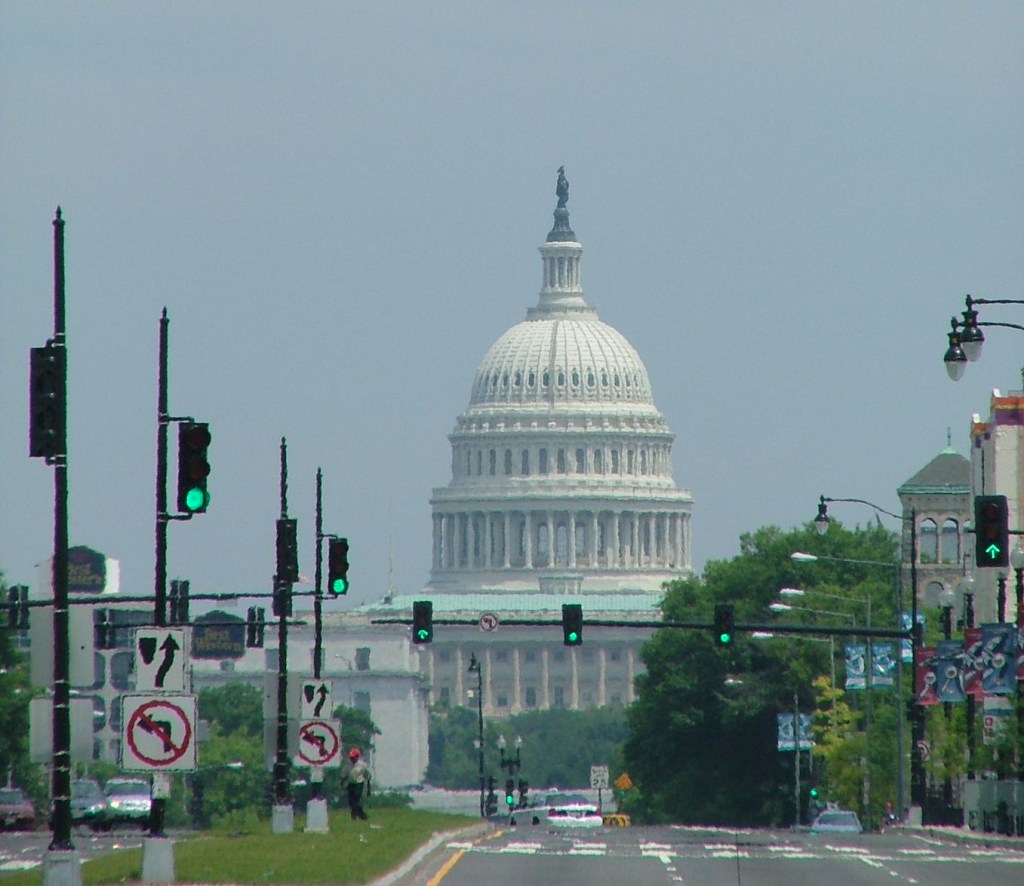
A view of the US Capitol from outside Nationals Park. (Photo credit: Jeff Hayes)

Strolling along the lower concourse of Nats Park, we stadium was vaguely reminiscent of Citizens Bank Park in Philadelphia, which opened four years earlier. Each stadium as three (or four, in left field of Nats Park) tiers of seats, as well as bleacher seats near centerfield. Both parks are open in the outfield, though the view of centerfield here is MUCH nicer than Citizens Bank Park. Rather than a large videoboard in left field (as is the case in Philadelphia), the large videoboard here is in right field, though it is smaller in DC. Both ballparks have an out of town scoreboard/auxiliary videoboard running the length of the right field wall. Though it was still very early in the visit, I thought that while the views from Nats Park were FAR better than those of the Phillies home, Citizens Bank Park had an edge with respect to the interior of the park.

One of the earliest comments we had heard about Nats Park was the height of the press level. Listening to Mets broadcasters describe the TV broadcast booth as the highest they had ever seen, I was curious to see what was so different about this park. As we walked out into centerfield, we found that the press levels is indeed at the top of the stadium behind home plate. We did not appreciate the height until we climbed up to near that level to get pictures for a panorama. While not as high as some of the seats of the multipurpose monsters of the 1960s and 1970s, it was surprising that the press level was that far away from the action.

The press level at Nationals Park, sitting nearly atop the stadium, outlined in red. (Photo credit: Jeff Hayes)

Though the seating capacity of Nats Park is listed at 41,000+, the three tiers of seats (as well as the bleachers in the outfield) made the park seem somehow bigger. In my opinion, the size of the ballpark detracted from the intimacy of the stadium, which has become a hallmark of the “newer” MLB parks built during the 2000s/2010s. Like most of the newer parks, Nats Park featured a large array of restaurants and bars, as well as a very nice lounge area in the 200 section behind home plate. Since my tastes at the ballpark are more traditional, I did not indulge in any of the specialty eateries, relying on the more standard fare available from the concession stands.

A panorama of Nationals Park from centerfield, providing a good look at most of the seats in the ballpark. (Photo credit: Jeff Hayes)

Once we found our seats in the upper deck behind home plate (one of our favored seating locations), we discovered we could see the dome of the Capitol (an unexpected treat). Though the weather was sunny with light winds for our game, it is not hard to imagine that strong or gusty winds in the upper deck could detract from the experience, especially near the top of the stadium in cold weather. Nats Park offers great sight lines from just about all seats, and fans are much closer to the action than the old multipurpose stadiums. While not quite as intimate as Camden Yards just up Interstate 95, Nats Park provides a great place to see a game nestled within the DC city limits.

More impressed with the ballpark than I expected, the game that occurred that afternoon was almost an afterthought. Behind a strong outing by the Giants’ left hander Barry Zito, San Francisco bested the hometown Nats 6-3. Perhaps my best memory of the game was the President’s Race. Its origins reach back to RFK Stadium in 2006, as people dressed in president’s costumes engage in a foot race around the warning track, starting at a gate in centerfield and ending just before the 1st base dugout. In total, seven presidents have run in the race, which occurs in the fourth inning of each home game. There have been some bizarre endings to the race, but none more interesting than when the Easter Bunny leapt out of the crowd, disrupting the race and allowing William Taft to win.
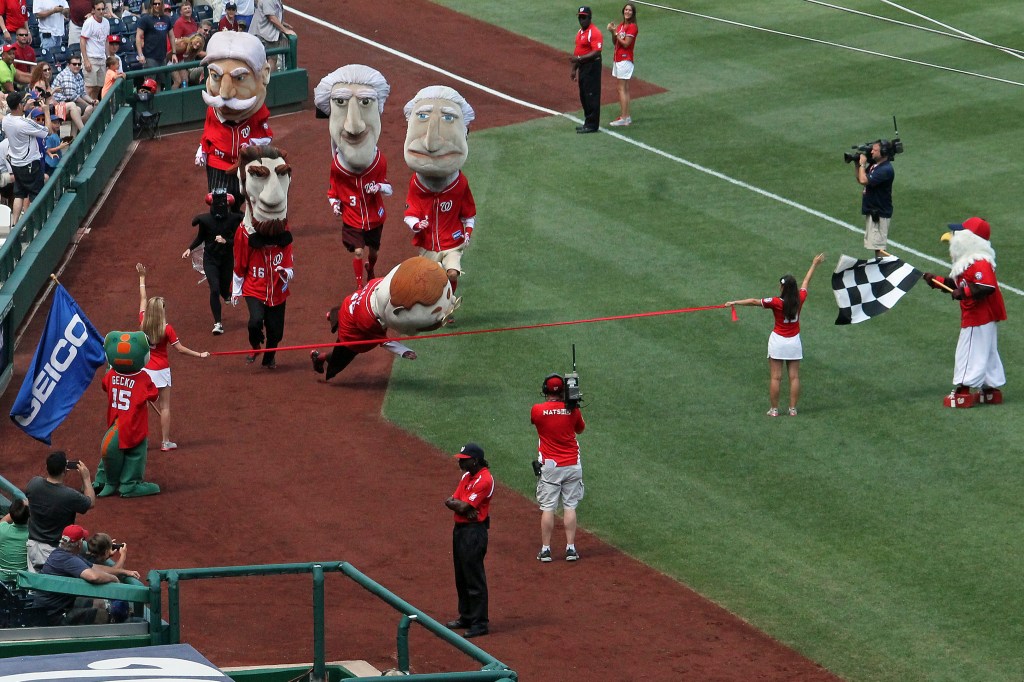
Our view of the President’s Race on a Sunday afternoon, when the presidents wear their “Sunday Best” and run the race down the left field warning track. (Photo credit: Jeff Hayes)

Having a long drive home after the game, we did not take much time to further examine the ballpark. However, on the way out along the upper level concourse, we did catch glimpses of two of DC’s famous landmarks. Both the US Capitol and the Washington Memorial were clearly visible, and despite traveling across the United States a fair amount, this was my first actual look at both (though from a distance).

Views of the Washington Monument (left) and the dome of the US Capitol (right) from the upper level of Nationals Park. (Photo credit: Jeff Hayes)

Living far enough away from DC to make the trip an all day affair, we did not visit Nats Park again until 2013, when I moved to Maryland, just a few miles away from the park. Living less than a mile from the Green Line of the Washington Metro, I quickly discovered that taking the train to the ballpark was cheaper (as parking near the park could cost in excess of $40) and easier than driving. In a surprise to me, the Washington Metro service stops running at 1130 PM. That relatively early shutdown time meant that if Nats games went into extra innings, you had to consider when you would leave the game. A miscalculation could easily result in a taxi or Uber fare of $60 or more.

Since the train ride to Nats Park was only about 20 minutes, it became my preferred location to see our favorite team, the New York Mets. Most of the games we have seen at the ballpark have been against the Mets, and as my brother reminded me, we saw plenty of games with the Mets on the losing end. Unfortunately for us, the Nats were better the Mets most years. In fact, we had the misfortune to see Bryce Harper hit a walk off home run in the 13th inning on a Thursday afternoon in August of 2014. Perhaps the most memorable game (for very bad reasons) we have seen at Nats park was April 30th, 2017.
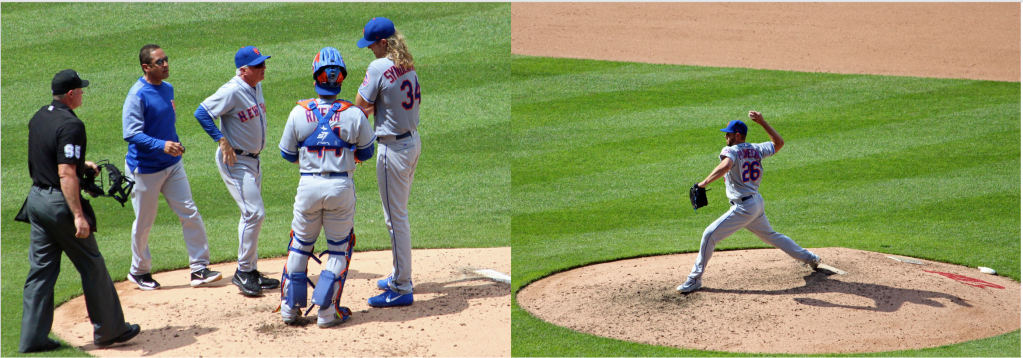
Mets starter Noah Syndergaard (left) tore his lat muscle and wound up missing most of the remainder of the season. As the game got out of hand in the late innings, New York sent backup catcher Kevin Plawecki to the mound. (Photo credit: Jeff Hayes)

The Nats lineup scored five runs off Mets starter Noah Syndergaard in the first inning, and his fastball was uncharacteristically flat. After facing one batter in the second inning, Syndergaard exited the game. It was clear from the expression of concern by Syndergaard and the Mets coaching staff that the injury was serious, and he ended up missing much of the remainder of the season with a torn lat muscle.

After the departure of the Mets starter, the Nats packed lineup feasted on the New York bullpen. Things got so bad for the Mets that they sent backup catcher Kevin Plawecki to the mound in the eight inning. Though he did give up a few runs, his pitching performance that afternoon was not much worse than the rest of the New York pitching staff. The Mets went down quietly in the top of the ninth, mercifully ending a 23-5 romp. In the game, the Nats Anthony Rendon went 5 for 5 with three home runs and 10 RBI. Though the defeat smarted, the loss of the fireballing Syndergaard was something from which the Mets could not recover.

My scorecard of the carnage at Nationals Park on April 30th, 2017.

Nationals Park has grown on me over the years. Once I moved to Maryland, and the park was a mere short train ride away, we visited at least a couple of time a year. However, my love for the minor leagues cut down on the number of trips to Nats Park through the 2010s, as the minor league experience is much more intimate than the MLB experience. If you plan to see a game at Nats Park, I would recommend taking mass transit, since parking is expensive, and the getaway after the game could take a considerable amount of time, especially following an afternoon game during the week.

Oriole Park at Camden Yards, Baltimore MD

Oriole Park at Camden Yards shortly before the first pitch on August 30th, 2017. (Photo credit: Jeff Hayes)
  • First visit: Sunday June 6th 1999
  • Most recent visit: Wednesday August 30th 2017

Our first visit to Orioles Park at Camden Yards in Baltimore MD occurred June 6th 1999, more than seven years after the park opened. A two and one-half hour trip from central NJ, we found the ballpark with little difficulty. Parking was plentiful, with lots near the park, as well as adjacent to M&T Bank Stadium, home of the NFL Ravens. With plenty of time before the scheduled 135 pm start, we decided to explore the environs. After entering the ballpark area, we strolled down the south portion of Eutaw Street, which runs between stadium and the Baltimore and Ohio Warehouse. A carnival like atmosphere brought Eutaw Street alive early that afternoon, with plenty of places to eat and drink. We were STUNNED to see the prices of the offerings along the street, unaccustomed to paying that much for food or drinks near a ballpark. Rather than indulge, we kept walking, eventually surrounding the stadium on our way to the home plate entrance.

Of course, what we did not yet understand is that we were witnessing the birth of the “new” way of seeing baseball games. Oriole Park at Camden Yards (also known as Camden Yards) is generally acknowledged as the first of the new wave of MLB ballparks, and Eutaw Street was our introduction how the environment around the stadium would become a vital part of the overall experience. In fact, MLB parks that followed would adopt this approach, offering a wide variety of food and beverages, whether outside the park or inside with restaurants and bars.

Eutaw Street near Oriole Park at Camden Yards, with the B&O Warehouse to the left. (Photo credit: Jeff Hayes)

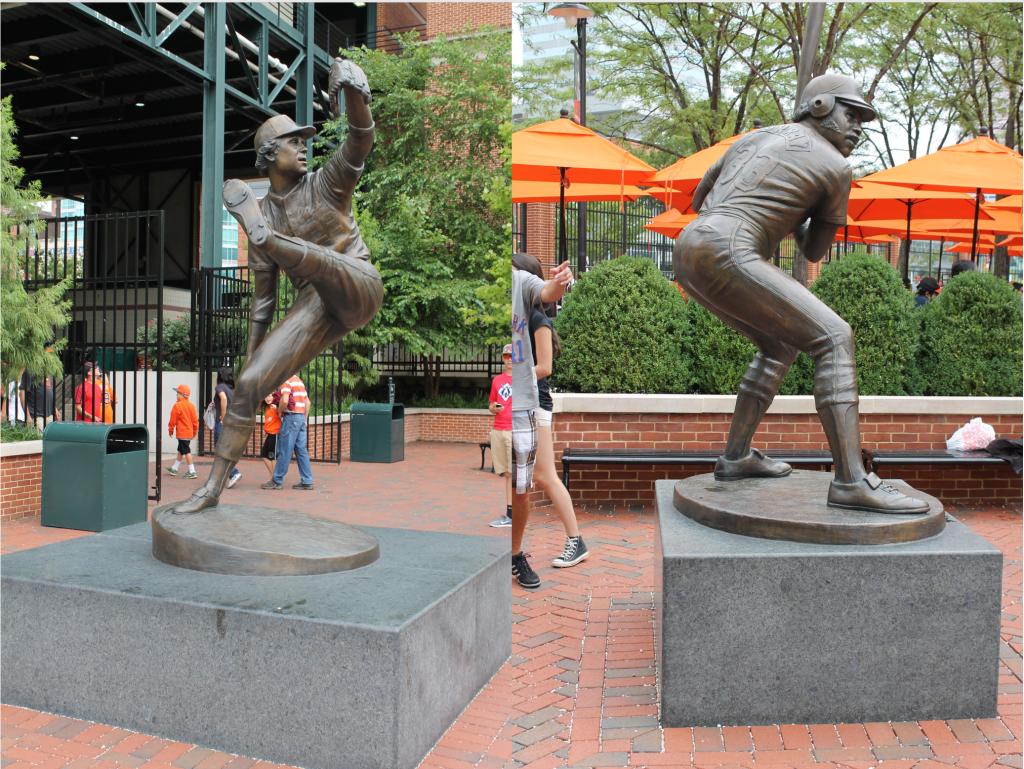
Camden Yards was designed as a replacement for Memorial Park, the home of the Orioles since their arrival in 1954. Designed to vaguely emulate the new Comiskey Park in Chicago, Camden Yards was the first MLB stadium since Ebbets Field (the home of the Brooklyn Dodgers until the late 1950s) to incorporate an existing building as park of the architecture of the stadium. B&O Warehouse, extending the length of Camden Yards’ right field wall, gave the ballpark an unmistakable landmark recognizable to even the most casual baseball fan. On the way back toward the home plate entrance, we discovered statutes outside of the park. Orioles greats Jim Palmer and Eddie Murray were immortalized in bronze, as were Brooks Robinson, Earl Weaver and Cal Ripken. Though new to us, this type of tribute would become nearly ubiquitous in the cadre of new MLB parks that would follow.

Jim Palmer (left) and Eddie Murray (right) immortalized in bronze at Camden Yards. (Photo credit: Jeff Hayes)

Once inside, we wandered the lower concourse, which wrapped around the playing field. We discovered that Camden Yards had three tiers of seats extending from left field behind home plate to right field foul pole, which comprised most of the 48,000 plus seats in the ballpark. Unlike older MLB parks, the seats near the left and right field foul poles were angled toward home plate. This simple gesture greatly increases the fan experience in these areas, and would become the norm for new stadiums during the next decade.

Walking along the lower concourse, we found the picnic area in right field, just above the auxiliary scoreboard/video board extending the length of the right field wall. This was the first dedicated fan gathering area we had seen in an MLB, and again it would serve as a model for ballparks to follow. Of course, the B&O Warehouse dominated the view in right field, becoming synonymous with Camden Yards. Just to the right of the green batter’s eye in centerfield was the main videoboard. Located atop the bleachers in centerfield, the board was surprisingly small for a new park, though in this case a smaller video board was not necessarily a bad thing. Rather than presenting an overbearing presence, the smaller videoboard was adequate as well as unobtrusive.

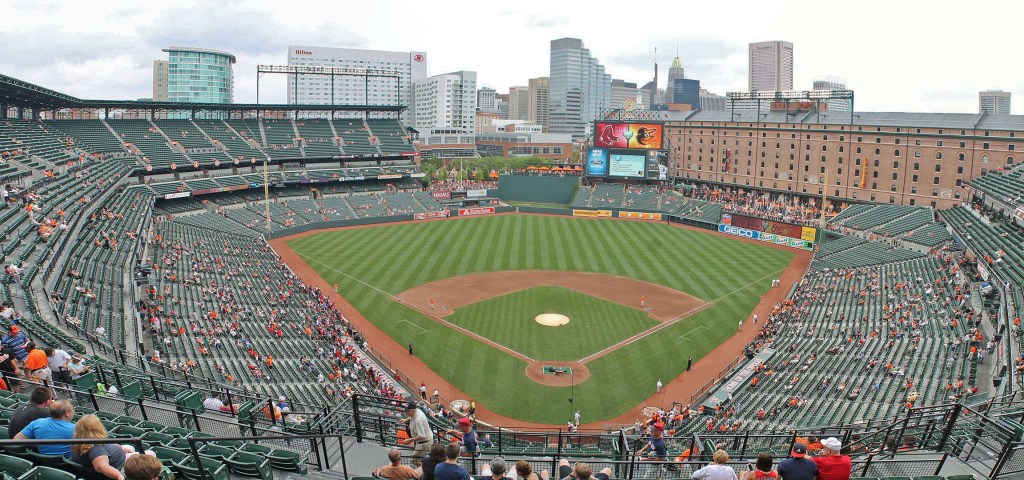
Panorama of Camden Yards from the upper deck behind home plate. (Photo credit: Jeff Hayes)

Continuing along the lower concourse toward the left field foul pole, we encountered the bullpen, which was composed of two levels. At the time, Camden Yards was the first MLB park to sport the two tier bullpen, and this layout would be copied by other newly constructed parks. Finally, we climbed to the upper deck behind home plate to get pictures to create a panorama of the stadium. From that vantage point, we realized that portions of the outfield wall blocked the view of downtown Baltimore. We didn’t think much about it at the time, but featuring a city skyline would become the centerpiece for stadiums that followed (most notably PNC Bank in Pittsburgh and Busch Stadium III in St Louis). Apparently, there was some criticism concerning the blockage of the view of Baltimore, but from our perspective, it did not detract from the beautiful ballpark.

We did not have a camera for our first Camden Yards visit, and I cannot recall where we sat that day. Baltimore hosted the Philadelphia Phillies for the afternoon contest. Philadelphia prevailed in what would become a slugfest, and my scorecard for the game survived the trip home. Considering that we had only visited multipurpose stadiums (as well as Yankee Stadium), digesting what we had seen at Camden Yards was almost overwhelming. We didn’t know it at the time, but we were seeing the future of MLB parks, a blueprint that was employed by other MLB clubs when planning and building their new homes.

My scorecard for our first game at Camden Yards on June 6th, 1999.

We have returned to Camden Yards on a number of occasions during the following two decades. During one our visits, we ventured away from the park, wandering down to the Inner Harbor. Originally a shallow water port used mainly for commercial shipping, the Inner Harbor gradually transformed into a visitor’s haven, complete with recreational facilities, shopping and dining. My attraction to the Inner Harbor consisted mainly of the boat traffic in that portion of the Chesapeake Bay. On this occasion, we were fortunate to see the USS Constellation, a ship from the 19th century. She was designed and built for use in the Mediterranean Sea and Africa in the 1850s, but was summoned home during the Civil War to patrol for Confederate ships. The Constellation served various roles afterward, before finding a permanent home in the Inner Harbor. This find was particularly satisfying for me, as that trip combined two of my passions: baseball and American history.

The USS Constellation moored in the Inner Harbor, Baltimore MD (Photo credit: Jeff Hayes)

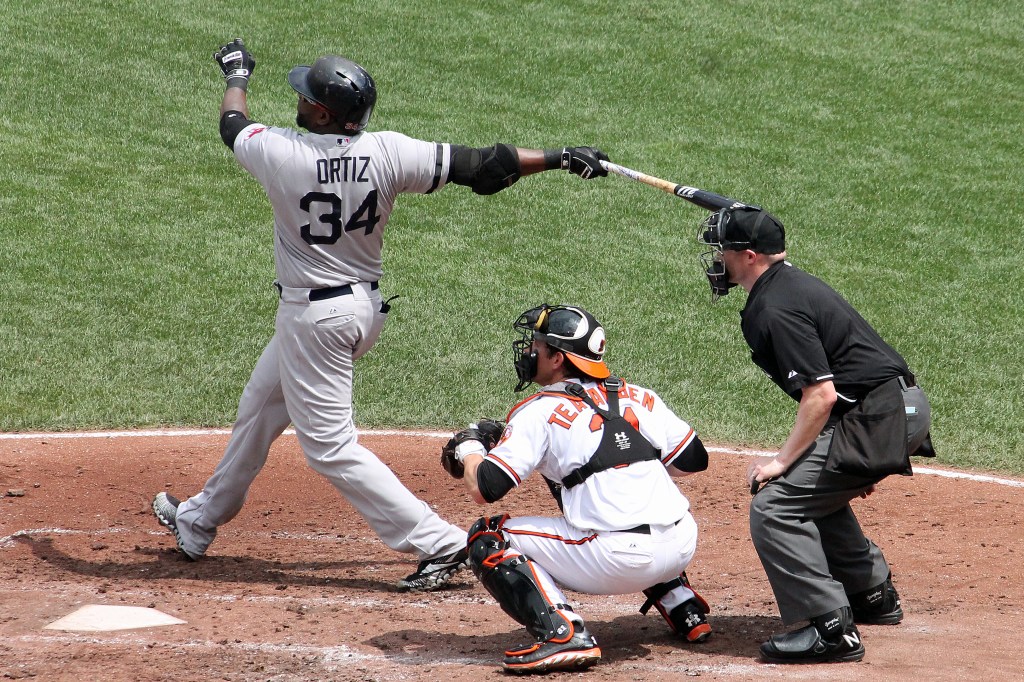
Each visit to Camden Yards was like greeting an old friend, and quickly became one of my favorite parks in MLB. Most of our visits were on weekends, as my brother came down to visit me when I moved to Maryland in 2013. Most games were against either the Phillies or other AL teams, but to date none of the games were important to the playoff fortunes of the Orioles. One of the games that does stand out was against the Boston Red Sox in July of 2013. David Ortiz had just grabbed national headlines by assaulting a dugout phone with his bat after a called strike three with which he did not agree. During this first at-bat of the game we saw after that incident, we was booed mercilessly by the large partisan crowd. To the chagrin of the hometown fans, Ortiz hit a two run homer run in the third, as Jon Lester and relievers shut down the Orioles offense in a 5-0 Boston victory.

David “Big Papi” Ortiz hitting a home run at Camden Yards on July 28th 2013. This is one of my favorite baseball pictures taken by my brother, (Photo credit: Jeff Hayes)

Needless to say, Oriole Park at Camden Yards was a trailblazer from the very start, sparking a revolution in the way ballparks were built that lasts to this day. In addition, it should be noted that the Inner Harbor is just a short walk from the park. If you find yourself within range of the ballpark during baseball season, check to see if the Orioles are in town. You won’t be disappointed!

See you soon Camden Yards! (Photo credit: Jeff Hayes)

Veterans Stadium/Citizens Bank Park, Philadelphia PA

Veterans Stadium, Philadelphia, PA. (Photo credit: Jeff Hayes)

Veterans Stadium (1987-2003)

  • First visit: exact date unknown; some time in the of spring 1987
  • Last visit: Wednesday July 3rd 2002

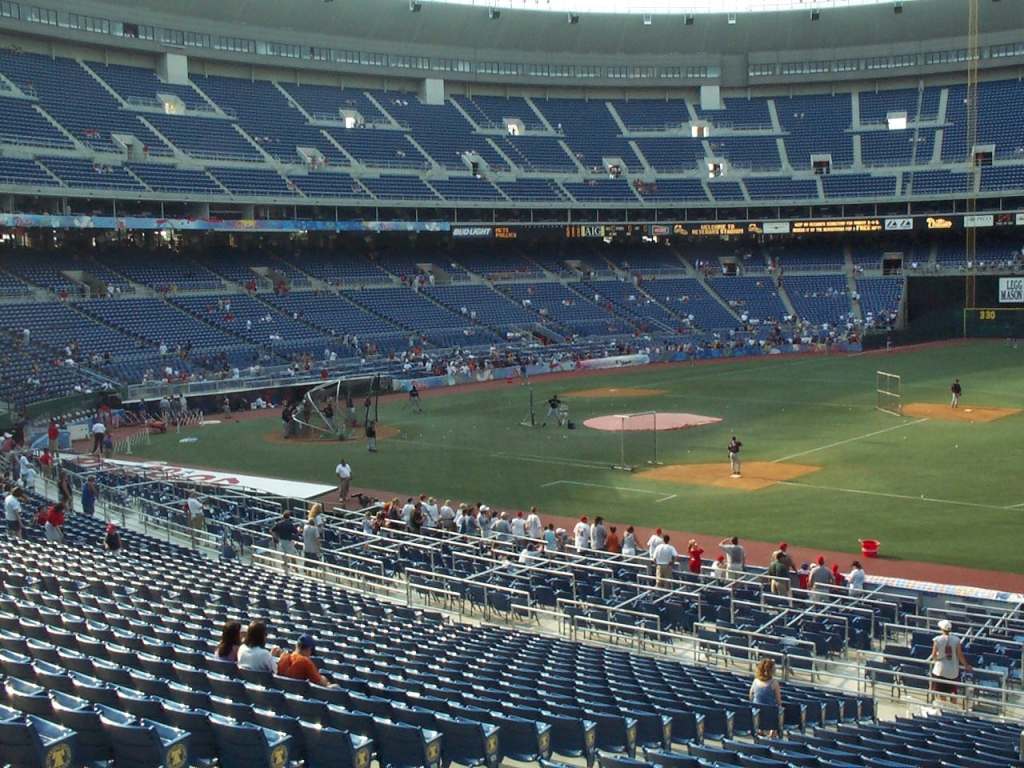
From the Jersey shore (where we grew up), Veterans Stadium in Philadelphia, PA was the closest MLB park. However, we did not visit the ballpark until sometime in the spring of 1987. Our first visit came as part of a bus trip from the local high school, as driving to Philadelphia at that point was not an option. During the mid to late 1980s, the Mets teams were competitive, which made getting seats at Shea Stadium was nearly impossible. In order to see the best Mets teams in more than a decade, we had to see them at the Vet (as it was referred to often). Phillies teams during that era were becoming progressively less competitive, which meant good seats for Mets games at the Vet were much easier to obtain.

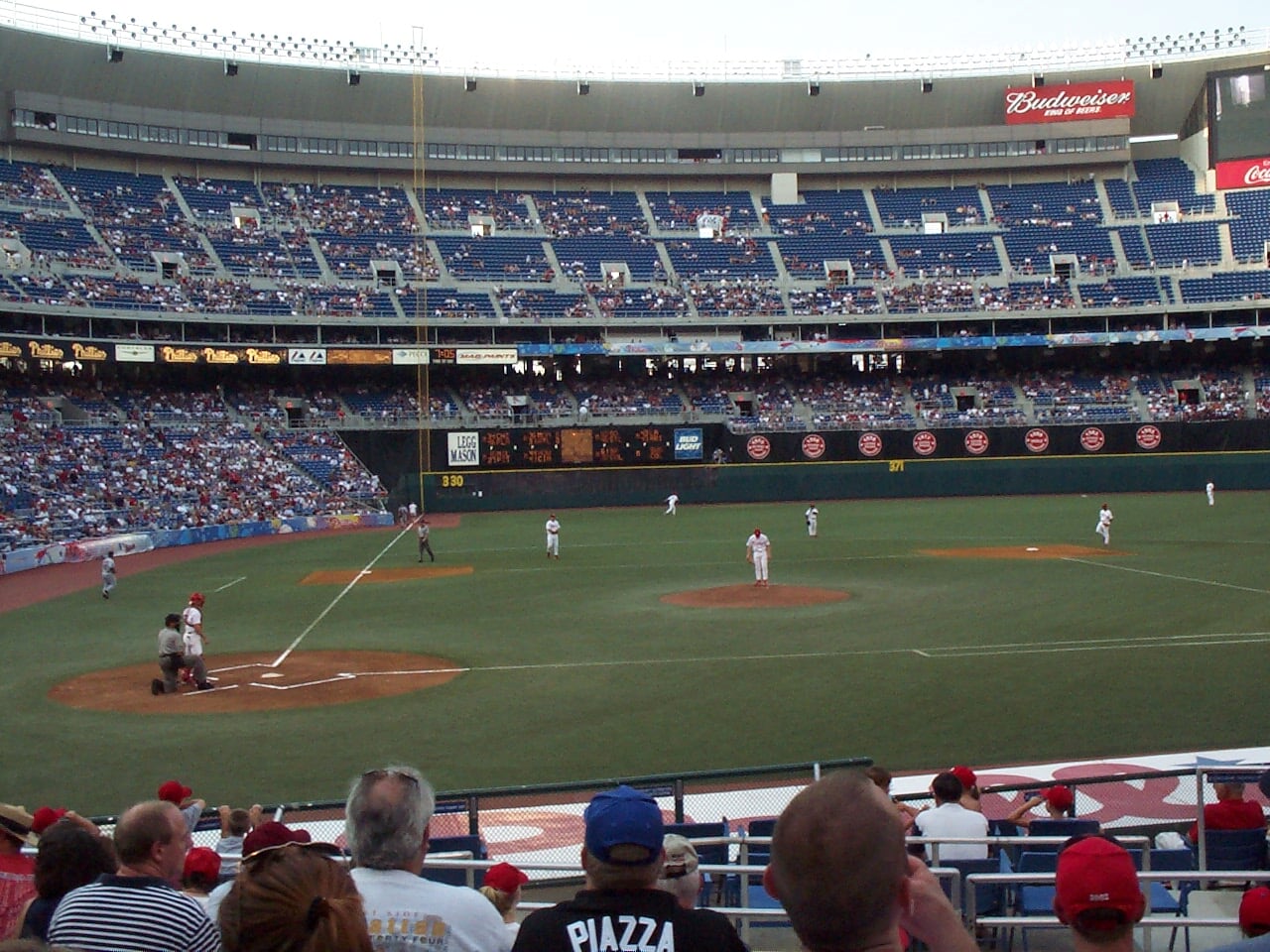
Veterans Stadium was a multipurpose behemoth, home to the Phillies and the NFL Eagles. Like most multipurpose stadiums of the time (such as Three Rivers Stadium in Pittsburgh PA or Riverfront Stadium in Cincinnati OH), the Vet was an enclosed, multi tiered park with a nearly symmetrical outfield. The Vet held over 56,000 fans for baseball (and over 65,000 for football), with many of the seats for baseball much further away from the action than “newer” MLB parks that followed in the 1990s. There were times, when sitting in the upper deck in centerfield, we would see a ball put in play by the batter, only to hear the crack of the bat a split second later. As a budding scientist, I was intrigued to discover that we were seated so far from home plate that the speed of sound was a consideration while following the action.

The Phiily Phanatic (with his ATV) entertaining fans at Veterans Stadium. Not a big fan of mascots, the Phanatic may have been the best mascot I’ve seen. (Photo credit: Jeff Hayes)

Debuting in 1971, the Vet featured an AstroTurf playing surface (except for the home plate area, cutouts around the bases, and the pitcher’s mound). With a thin artificial surface sitting on a concrete base (for stability), heat radiating from that surface would often exceed 110 degrees F (and sometime approach 125 degrees F) during the hottest part of the summer. In addition, the thin turf provided little protection to players on the field, and long term play on that surface caused many injuries, resulting in the shortening of players’ careers. Why did teams use AstroTurf, even with its obvious shortcomings? Like most things, it was all about the money. Two teams sharing a natural grass playing surface (like Shea Stadium) would put serious stress on both the field and the grounds crew, occasionally resulting in a subpar playing field. An artificial surface eliminated that problem.

Veterans Stadium was a generic park, with an adequate if unspectacular scoreboard and video board. Unlike ballparks that would follow, food and beverages were obtained from concession stands or wandering vendors only, with specialty foods and in-house restaurants gradually appearing toward the end of the Vet’s tenure. As mentioned earlier, there were seats that were fairly distant from the action, and the engineering for optimal fan viewing was not yet available. This meant that fans down each line spent an inordinate amount of time leaning toward home plate, which could become fatiguing. However, Phillies fans were treated to possibly the best mascot in sports, the Philly Phanatic. While I found most team mascots uninteresting, the Phanatic would often push the limits of what mascots should do on the field. Luckily, most players (and at least a few umpires) were in on the joke, and would play along with the Phanatic to entertain the fans.

Veterans Stadium during batting practice. (Photo credit: Jeff Hayes)

During our early visits to the Vet, we did NOT have a camera, so most of the information about the stadium comes from personal experience, rather than a digital record. For the most part, Veteran Stadium was a decent place to see a baseball game, though it lacked any sense of intimacy because of its immense size. We did get to see Hall of Fame third baseman Mike Schmidt toward the end of his career, as well as many battles between the Mets and Phillies. We saw Barry Sanders and the Detroit Lions take on the Eagles at the Vet in the early 1990s, and Pink Floyd, the Who and the Rolling Stones between 1989 and 2003. Perhaps the most memorable event we saw at the Vet was when Phillies shortstop Dickie Thon hit a game winning home run against the Mets Don Aase on September 12th 1989. That loss essentially ended the Mets playoff hopes for the 1989 campaign.

A discussion of Veterans Stadium would be incomplete with including details about the courtroom and jail housed within it. If you are not familiar with the sports fans in Philadelphia, they can be a raucous bunch, especially when alcohol is involved. Philadelphia fans have booed Santa Claus and the Easter Bunny, and have been known to be ruthless to visiting and home players alike. Through personal experience, we learned NOT to identify ourselves as fans of the visiting team, lest we incur the wrath of the hometown fanatics. Fan misbehavior became so frequent that Philadelphia County officials found it necessary to place holding cells and a courtroom within the stadium. Individuals committing offenses would be held in the jail cell, awaiting arraignment and adjudication of their misdeeds.

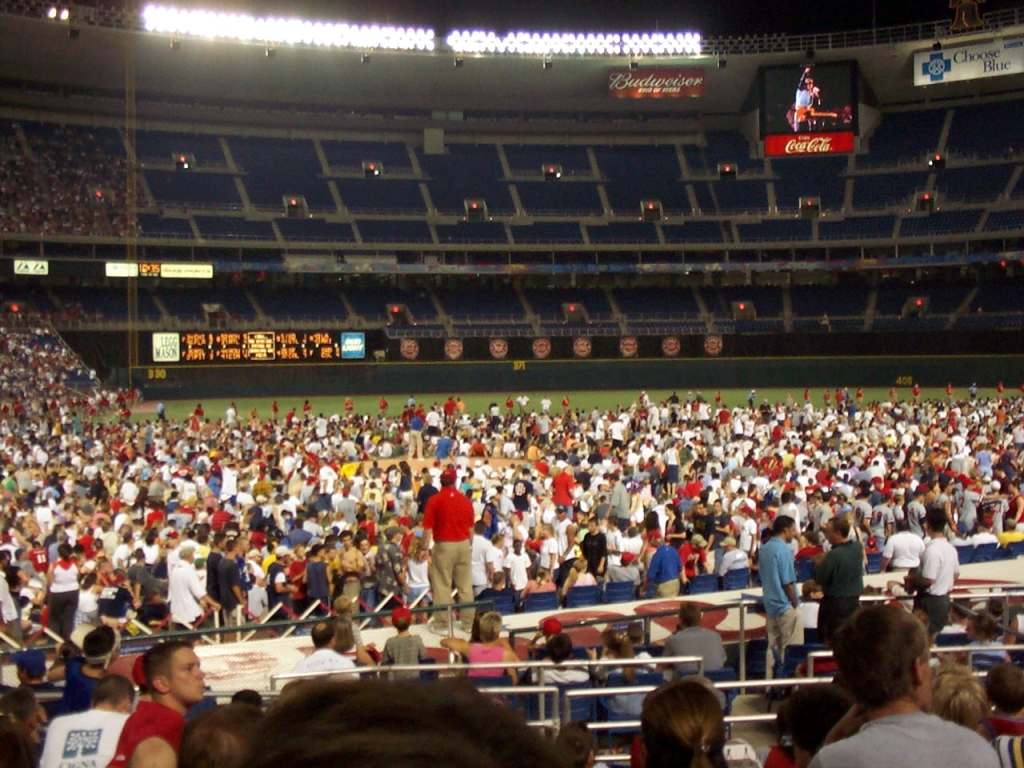
Fans were permitted on the field for a fireworks display in 2002. (Photo credit: Jeff Hayes)

Perhaps the worst aspect of Veterans Stadium was parking and traffic after the game. While there was more than enough parking for the stadium around the Vet, at times finding acceptable parking was difficult. The neighborhood surrounding the park was sketchy in places, and returning to that spot after a night game had to be considered when choosing where to leave your vehicle. We never had a problem with parking, but it would not be a stretch of the imagination to believe that safety could be a concern. Once the game was over, it always felt like you were on your own exiting the area. In the early days, police did NOT direct traffic after games, and leaving became a test of wills. It was not unusual to wait more than an hour in traffic at the Vet after a game before you could get on one of the many highways out of the region. In later years, the police did direct traffic after games, and the process of leaving became much more palatable.

Veterans Stadium, like other multipurpose facilities of the time, was an acceptable place to see a ballgame, but by no means a fan friendly environment. After the completion of Citizens Bank Park, Veterans Stadium met an ignominious end, as it was imploded (on live local TV) March 21st, 2004. We frequented the Vet as often as we did because it was easier to see the Mets in Philadelphia than Queens NY. Unlike Shea Stadium, I do not miss the Vet.


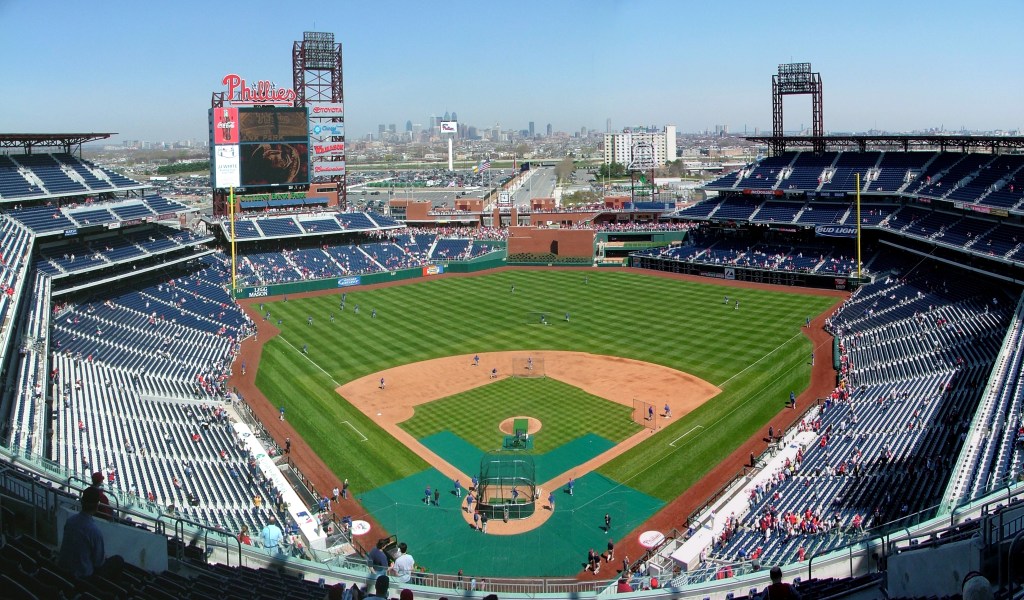
A panorama from Citizen Bank Park in 2004. (Photo credit: Jeff Hayes)

Citizens Bank Park (2004-2019)

  • First visit: Saturday April 17th 2004
  • Most recent visit: Saturday August 31st 2019

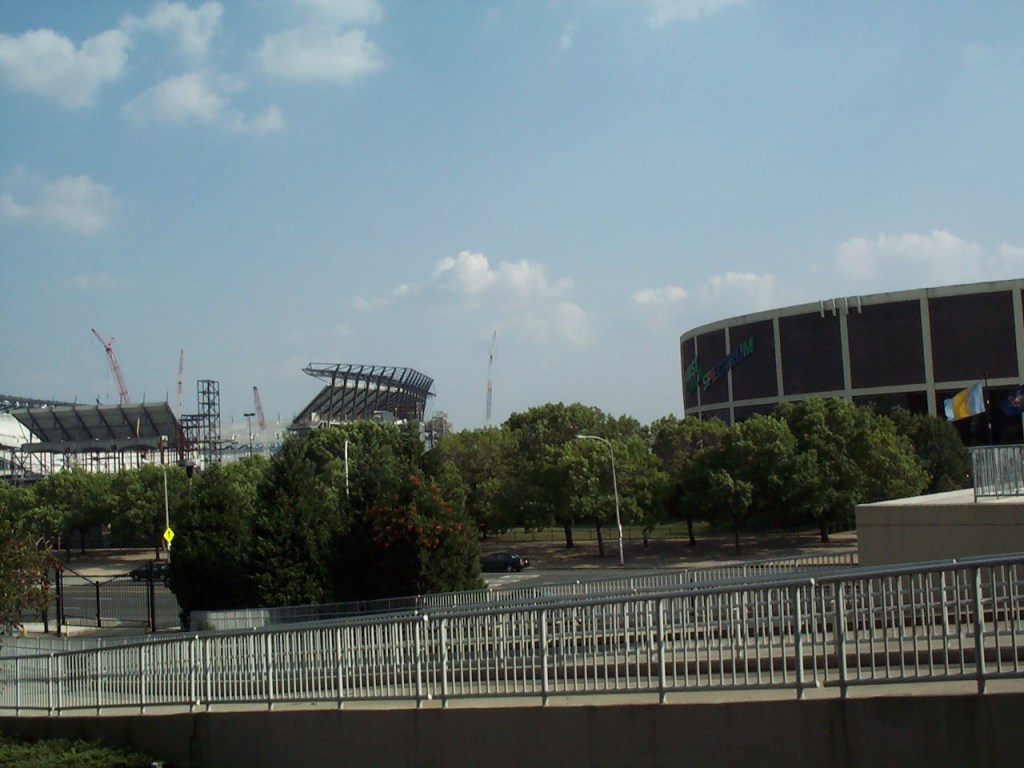
Philadelphia authorized the construction of separate stadiums for baseball and football in the late 1990s, a significant departure from previous policy concerning spending tax dollars on ballparks. Originally slated to be constructed in downtown Philadelphia (like other new MLB ballparks during this time), protests from residents of the Chinatown section of Center City ultimately resulted in the new baseball stadium being located near the site of Veterans Stadium in South Philadelphia. Ground was broken for Citizens Bank Park (the future home for the Phillies) in June of 2001, and during our visits to the Vet, we would check on the progress of the new ballpark.

A view of the new ballpark under construction near the site of Veterans Stadium and the Spectrum. (Photo credit: Jeff Hayes)

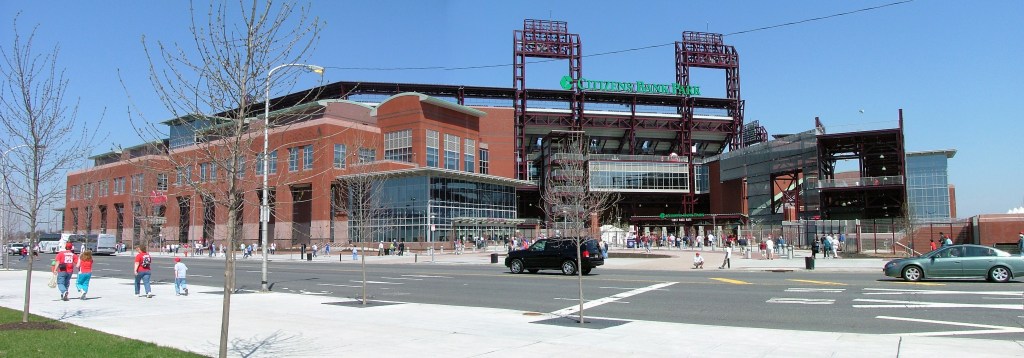
Citizens Bank Park opened its doors on April 3rd 2004, and we our first visit occurred a scant two weeks later on Saturday April 17th, as the hometown Phillies hosted Montreal (in their last season as the Expos). There was not much to see outside of the stadium quite yet, so after a cursory look around, we entered the ballpark through the home plate entrance.

Upon entering, we could immediately see that Citizens Bank Park was a vast improvement on its predecessor. Instead of a behemoth, the ballpark was smaller and more intimate, clearly designed with the baseball fan experience in mind. A wide open centerfield offered a glimpse of Center City Philadelphia, though a very unfortunately placed advertisement sign ruins the view to some degree. A three tiered seating area stretches from left field foul pole into right field, where an auxiliary scoreboard spans the length of the lower deck. Beyond the foul pole in left field was a detached bleacher section, with a very impressive videoboard above it. Obviously constructed as a signature of the newly minted ballpark, it doubles as a scoreboard, filled with any stat a diehard baseball fan could imagine.

Panorama of Citizen Bank Park from the upper deck behind home plate. Note the sign blocking a portion of the view of Center City Philadelphia. (Photo credit: Jeff Hayes)

After drinking in the new park (and its natural grass playing field, a welcome departure from the Vet), we walked along the concourse, which encircled the playing field. Lined with places to eat and shops with Phillies merchandise, the lower concourse snaked through the rear of the lower level into centerfield. From this vantage point, we got a good view of the bullpens. Arranged vertically, the Phillies bullpen, originally placed on the top, was subsequently moved to the lower level, in part to reduce the amount of heckling from rowdy Phillies fans (this is Philadelphia, after all).

Citizens Bank Parks’ bullpens in centerfield, with the visitors bullpen on top and the hometown pen on the field level. (Photo credit: Jeff Hayes)

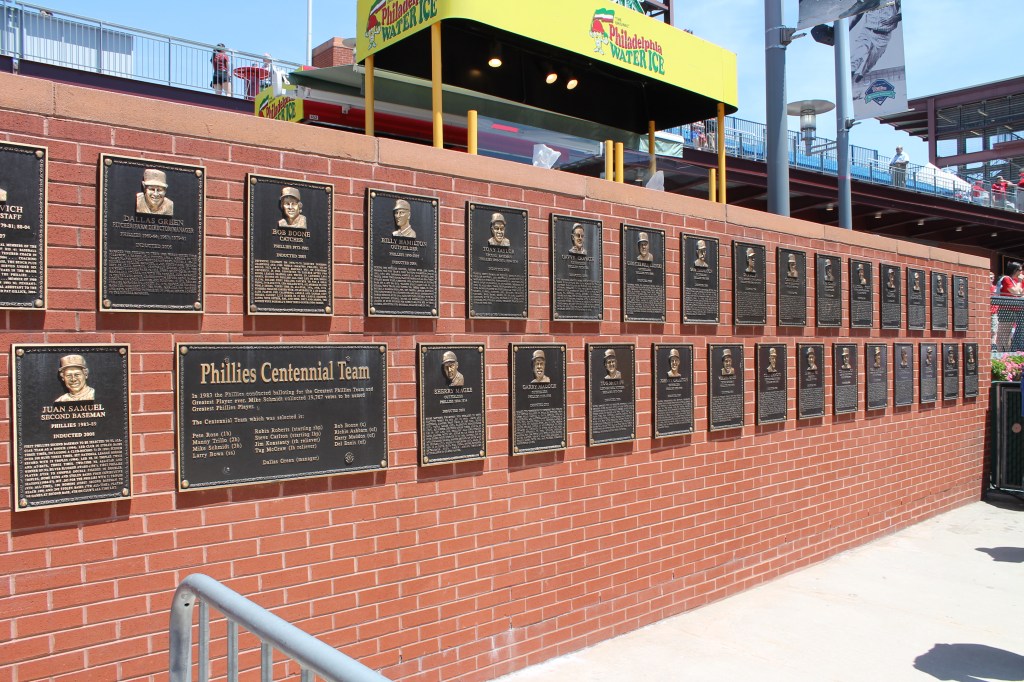
Next to the bullpens was the batter’s eye in centerfield. Adorned with shrubbery amid a small field of grass, the batter’s eye featured a brick wall that was slowly being consumed by an ever expanding area of ivy. One of the quirks of Citizens Bank Park, “The Angle”, was located on the left side of the batter’s eye. It marked the deepest part of the park, a nod to the “imperfections” of ballparks from the past. Moving toward the left field foul pole, we encountered the Phillies Baseball Walk of Fame. Nearly three dozen plaques arranged on the wall paid homage to Phillies greats, labeled as the Phillies Centennial Team.

Phillies Baseball Walk of Fame at Citizens Bank Park. (Photo credit: Jeff Hayes)

Finding our seats for our first visit to the new ballpark, I couldn’t help but feel as though the Phillies organization “got it right”. Following the template forged by Oriole Park at Camden Yards, the Citizens Bank Park gave fans a much better experience, bringing them closer to the action than ever before. The open air feel to the stadium, as well as clean sight lines, made for a truly enjoyable visit. Unlike Veterans Stadium, there were myriad places to eat, with many restaurants offering virtually anything you could want to eat or drink at the ballgame.

Making a nearly clean break from the past, I did not see anything brought over the the new ballpark from the Vet, save for the Liberty Bell located outside of the stadium. However, this IS still Philadelphia, and unfortunately, unruly fans did make the trek from the old stadium to the new one. In fact, we experienced our most harrowing fan interaction at Citizens Bank Park, when a group of Phillies fans engulfed us, preventing us from exiting our seats until the remainder of the fans in that section left. Being outnumbered, we had little choice but to capitulate, reminding us that this place was NOT safe for fans of visiting teams.

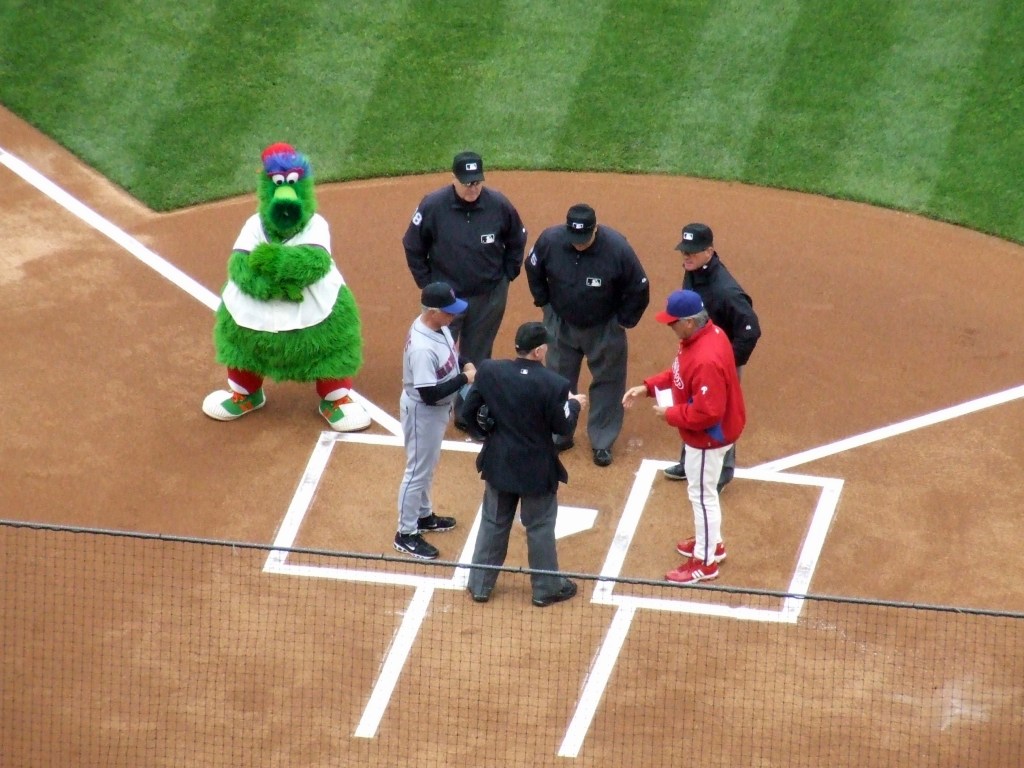
The Philly Phanatic overseeing the exchange of lineup cards at Citizens Bank Park on April 30th, 2011. (Photo credit: Jeff Hayes)

Other than the less than affable Philly crowds, the only aspect of Citizens Bank Park I did not like was the small outfield dimensions. Unlike the Vet, which was cavernous, this ballpark was a “band box”, which promoted home runs. Had Mike Schmidt played in this smaller park his entire career, he might have approached Hank Aaron’s career home run record. Though home runs are appealing to most fans, from my perspective, more home runs make them less exciting.

Being much closer to central NJ than Shea Stadium (and later Citi Field), Citizens Bank Park was our first choice to see New York Mets games, even if they were the visiting team. Other than some forced quirks designed to introduce some character to the stadium, and the raucous fan base, the ballpark offers a first rate facility for baseball, and we visit as often as time and circumstance dictate.