Coca Cola Park, Allentown PA, Sunday May 24th 2015

Coca Cola Park from behind the centerfield fence. (Photo credit: Jeff Hayes)

With most of the local teams on the road for the Memorial Day weekend, we stretched out into eastern Pennsylvania to attend our first AAA game in Allentown PA, to see the Lehigh Valley IronPigs at Coca Cola Park. Years ago, I read a book called Where Nobody Knows Your Name: Life In the Minor Leagues of Baseball, in which the author posits that no players actually want to be in AAA; players from below are waiting for their turn to move to “The Show”, while ex-MLB players are looking to get back there. Not having been to a AAA game, I wasn’t exactly sure what to expect, but I would have been surprised if we didn’t see some familiar MLB names in the lineup or on the mound in Allentown that afternoon.

From central NJ, the 80 mile drive to Coca Cola Stadium took about 90 minutes, with just some construction delays slowing us down on Interstate 78 in eastern PA. Arriving about 90 minutes before the scheduled first pitch (slated for 135 pm), we easily found parking in the onsite lots (which were much bigger than I expected, with parking on either side of the stadium) for the typical price of $5.00. Since there was not much surrounding the park, we headed inside the stadium.

The view of Coca Cola Park from the lower level just behind third base. (Photo credit: Jeff Hayes)

From the right field entrance (which is the main entrance for the ballpark), we walked along the upper concourse toward centerfield. Most of the concession stands are located on the upper concourse, and not surprisingly, the more popular cuisine in the park was pig-themed (considering that the team name is the IronPigs). Not one to engage in more than the standard fare at a baseball game, I did not spend too much time or energy on the cuisine at Coca Cola Park, but I did run across a review of what’s good at the park here. We encountered a picnic area in right field, as well as more places to eat behind the right field foul pole. In addition, we saw an area behind the right field fence designed specifically to allow fans to socialize. This is something we have noticed in an increasing number of new stadiums, as the way fans watch the games has changed.

Unlike most ballparks, the concourse encircled the stadium, allowing us access to the outfield. From the behind the berm in centerfield (where people lounged on beach towels in the bright sunshine), we got a good look at the seating area in Coca Cola Park. There are two levels of seating; the lower level, extended from the right field foul pole behind home plate to the left field pole, and the upper level, from mid right field to mid level field. A set of luxury boxes stretched along the same length as the upper level. Factoring in the seating in the picnic areas in left field and right field, and the seating in the grass areas of the outfield, Coca Cola Park can accommodate just over 10,000 fans (making it one of the largest minor leagues parks we have seen with respect to crowd size).

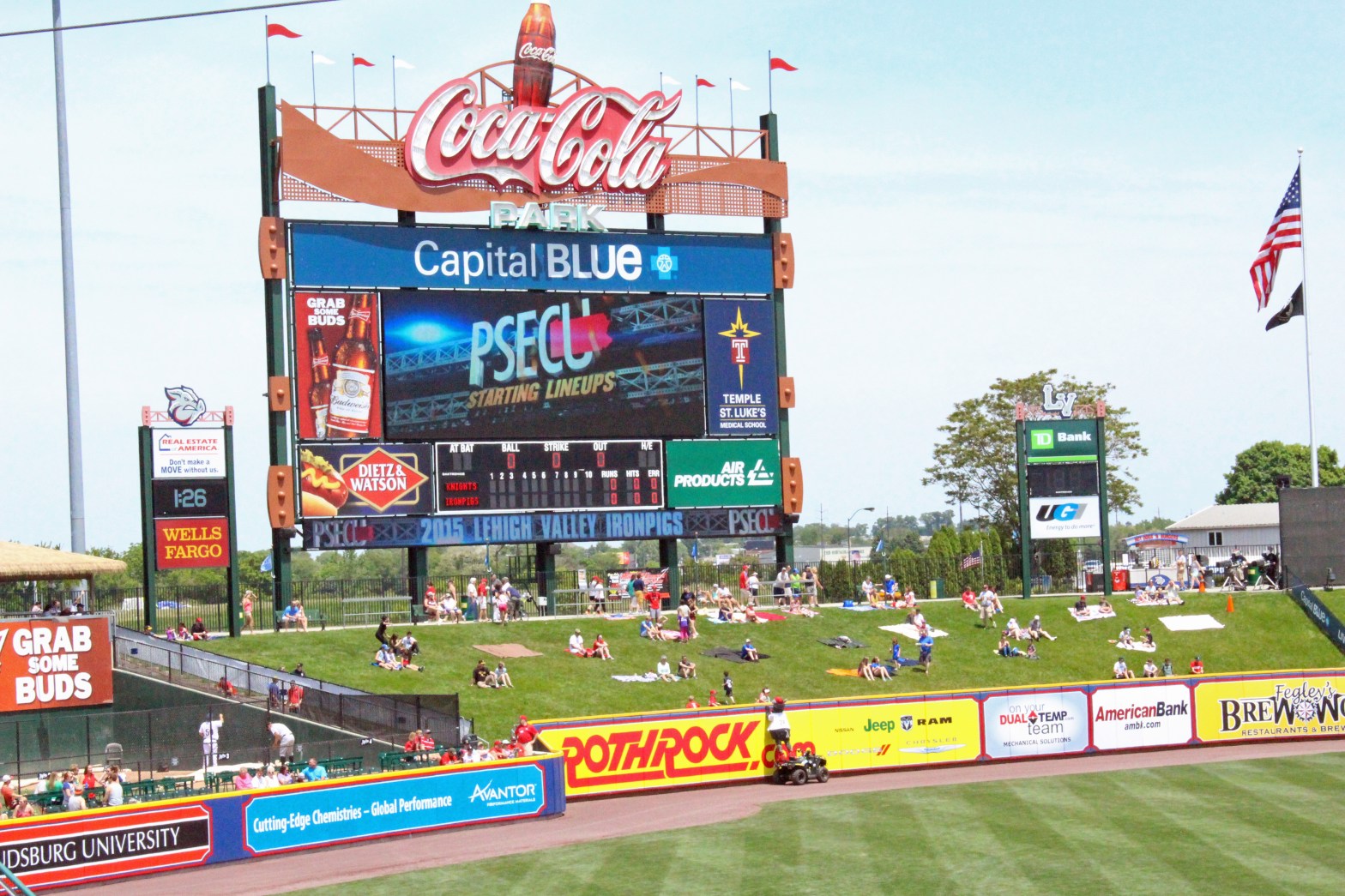
Scoreboard and videoboard behind the centerfield fence at Coca Cola Park. Note the grass perm area, which was not filled to capacity on this afternoon. (Photo credit: Jeff Hayes)

Continuing our tour of the ballpark, we passed by the scoreboard/videoboard combination in centerfield, adorned at the top with a Coca Cola bottle. When home runs are hit by IronPigs players, the bottle shakes and fires off fireworks. Next to the scoreboard are the bullpens, and above them, the Tiki Terrace, which houses group seating and a bar open to all ticketed patrons. Adjacent to the Tiki Terrace is the Picnic Patio, which hosts group gatherings. As we headed toward home plate, it was clear that Coca Cola Park was designed with fan comfort and accessibility in mind. It is little wonder that the ballpark has often won awards (such as the Best Minor League Ballpark on a number of occasions).

The IronPigs draw exceptionally well for minor league baseball, and have the highest average attendance since the ballpark opened in 2008. Not knowing this fact, we did not secure tickets until just before the day of the game, and that ignorance resulted in our seats being located in the lower level down the right field line. Though all of the seats in Coca Cola Park are angled for the best view of the infield, I felt as though we were far from the action, even in a park that was relatively cozy when it comes to seating. After grabbing a baseball lunch from the nearest concession stand, we settled into our seats for the beginning of the game.

The view from our seats at Coca Cola Park. (Photo credit: Jeff Hayes)

Lehigh Valley (the Triple A affiliate of the Philadelphia Phillies) hosted the Charlotte Knights (the Triple A affiliate of the Chicago White Sox) for the early afternoon contest. We expected to see some familiar names in the lineup or on the mound for this game, since AAA teams often have MLB veterans amongst their ranks. Though I didn’t immediately recognize any names in the Knights’ lineup, their starting pitcher was a different story. Taking the mound for the Knights was Brad Penny, celebrating his 37th birthday at Coca Cola Park. A 14 year MLB veteran, Penny was apparently attempting to catch one more ride to the The Show. There were a few familiar names in the IronPigs’ lineup, especially at the top of the order, who were with the Phillies at some point within the last year.

Not every seat in the ballpark was filled, but there did seem to be more than 9,000 fans in attendance for the game. A steady breeze from centerfield kept the temperature from getting too warm (as high temperatures can reach the 90s in eastern PA by Memorial Day weekend), and filtered sunshine made for a nearly perfect day for a ballgame. Charlotte struck first, scoring in the second inning, staking Penny to an early lead. However, Brad Penny did not have his best stuff that day, and after surrendering five runs in the third and fourth innings, his day ended after the sixth inning. Following a disappointing 2015 with the Knights, Penny left organized baseball.

MLB veteran Brad Penny delivering a pitch for the Charlotte Knights at Coca Cola Park in Allentown, PA. (Photo credit: Jeff Hayes)

During the IronPigs’ rallies in the third and fourth innings, we heard something we’d never heard at a ballpark. Rather than simply cheer or applaud, fans squealed or snorted like pigs. Though odd at first (during which time much chuckling ensued, mainly by me), the squealing fit the environment perfectly, as there are MANY aspects of the ballpark that are pig-themed in one way or another. The unique fan celebration lent an air of authenticity to the experience, and when combined with the ballpark itself, created a very enjoyable atmosphere for minor league baseball. Clearly, Allentown loves their IronPigs!

Being fairly close to the right field wall, I could not help but notice the prominence of the advertisement boards. While it is typical for minor league parks to have advertising extending along the outfield wall, these boards seem to rise much higher than most of the parks we had seen to that point. A fairly large set of advertising boards rose up from behind the bullpens in left field, and the signage made Coca Cola Park almost feel like an enclosed MLB park. Despite the signage and its large seating capacity, the ballpark had an imitate feel to it.

A view of the prominent signage above the bullpens in left field. (Photo credit: Jeff Hayes)

Charlotte rallied for runs in the seventh and ninth innings, overcoming a 5-3 deficit for a 7-3 victory. As we waited for the sizable crowd to exit the ballpark, I had a few moments to reflect on Coca Cola Park. The layout of the stadium, as well as the atmosphere created by the ardent IronPigs fans, made our experience enjoyable. Our first visit to a AAA park was a huge success, and had we known that the ballpark was such a jewel, we would have visited sooner.

Leidos Field at Ripken Stadium, Aberdeen MD, Sunday July 15th, 2018

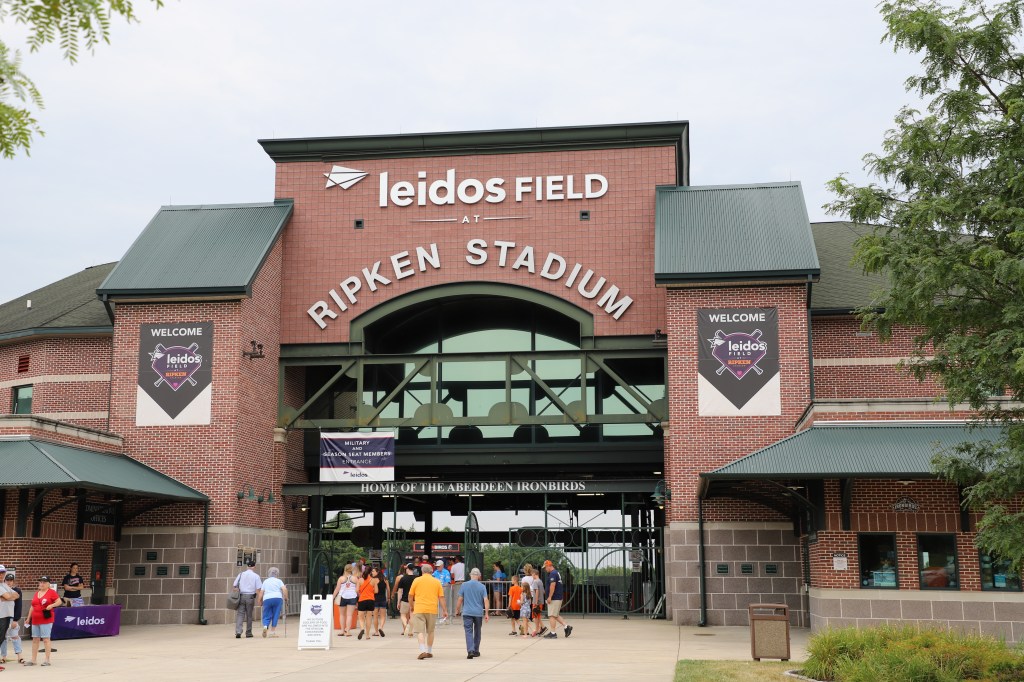
A view of the home plate entrance of Leidos Field at Ripken Stadium in Aberdeen, MD (Photo credit: Jeff Hayes)

On an overcast, humid Sunday afternoon in July, we decided to visit Leidos Field at Ripken Stadium (referred to as Leidos Field for the remainder of the post), the home of the Aberdeen IronBirds. The IronBirds (whose name is an amalgamation of Iron Man, a nickname for Hall of Famer Cal Ripken, Jr and birds, a moniker for the Orioles) were an affiliate of the Baltimore Orioles when we visited in 2018. Members of the Class A Short Season New York-Penn League, the IronBirds played an abbreviated 76 game schedule, stretching from mid June to early September. The New York-Penn League was an entry point into professional baseball, and the teams were chiefly composed on recent college graduate and draft picks of the parent club.

Leidos Field, located in Aberdeen MD, lies along Interstate 95, and is clearly visible from that artery. Living in the DC area, getting to games there could be tricky, as it meant dealing with seemingly unending traffic traveling north into northern MD, and for much of the time I lived near DC, the trip did not seem to be worth the hassle. Though the trip was 60 miles from my home to the ballpark, snarling traffic could make that a 90 minute (or longer) trek, particularly around the time of the evening commute. However, the warm and humid weather, along with the threat of rain, made the journey appear to be tolerable on a Sunday afternoon. Typically, Sunday afternoon in the summer in northern MD could be busy, as people try to beat the traffic leaving after the weekend.

Leidos Field at Ripken Stadium from just to the left of home plate. (Photo credit: Jeff Hayes)

Arriving less than an hour before the scheduled 405 pm start, we found that the parking lot at the ballpark was expansive, to say the least. Leidos Field is part of the Aberdeen complex, which also houses fields for other sporting events. We found parking almost immediately, and unlike most ballparks, parking was FREE. We briefly toured the outside of the stadium, as well as the complex, but there was very little to see or do that afternoon outside of the park. Having purchased tickets online before the game, we entered through the home plate entrance, which led us to the upper concourse. On the upper concourse we found the majority of concession stands, as well as the IronBirds team store (which was well stocked, and we indulged with purchases, including Aberdeen tee shirts).

As is customary for us visiting a new park, we walked along the upper concourse from the left field foul pole to the right field foul pole (the outfield was inaccessible to fans). We discovered that Leidos Field was a modular ballpark that opened in 2002. Much of the seating consisted of green seats divided into a lower deck and upper deck, separated by a lower concourse. Seating stretched from near the left field foul pole behind home plate to the right field foul pole, which was surprising considering the park’s main tenants played a shortened season. A party deck and the Kids Zone lie beyond third base in left field, and luxury boxes extend from dugout to dugout. In total, Leidos Field seats about 6,300 fans, which is a large capacity for the level of play.

A view of Leidos Field at Ripken Stadium showing the two tiers of seats as well as the luxury boxes. (Photo credit: Jeff Hayes)

A small but functional scoreboard stands beyond the left field fence, and a larger, more elaborate video board is located in right center field. Though not as large as video boards we have seen in other minor league parks, it was nonetheless an impressive piece of technology for a park that is used only for a portion of the baseball season. Bullpens are positioned behind the wall next to the foul poles. It is unusual for minor league parks to have bullpens not in play, but as we explored Leidos Field, we discovered that the park was impressive for any level of play in the minors. It was abundantly clear that the ownership spent a considerable amount of time and effort to construct a ballpark that provides an excellent fan experience in a comfortable setting.

A view of the stadium showing both the scoreboard and video board. (Photo credit: Jeff Hayes)

Following our tour of the stadium, we backtracked in the upper concourse to the concessions, located near the home plate entrance. While there were some specialty items available on the menu at some of the concession stands, we chose more standard fare for our baseball dinner, and headed to our seats. Every game since Opening Day in 2002 has been a sellout at Leidos Field (a very impressive feat for a minor league team), and that fact had some influence on the seats we could secure for the late Sunday afternoon game. Though it was clear that the weather would have an impact on the attendance for the game, we could only garner seats in the lower tier just past first base, which provided a less than desirable view of action at home plate. Undeterred, we settled into our seats and awaited the start of the game.

On that afternoon, the IronBirds hosted the Auburn (NY) Doubledays, a team named for the supposed inventor of baseball. The Doubledays were an affiliate of the Washington Nationals, so there was a flavor of a local rivalry in Leidos Field that afternoon. Skies remained cloudy through the afternoon into the early evening, but conditions remained dry (with thunderstorms remaining distant from the ballpark in Aberdeen). Though the game was technically a sellout, there were far fewer than 6,300 people in the ballpark. Threatening skies and a late start on a Sunday may have been contributory factors with respect to attendance, but the ballpark looked and felt as though it was mostly empty.

A view of the action from our seats down the first base line. (Photo credit: Jeff Hayes)

Generally, the level of play in the Class A Short season is entry level; after all, most of the players are getting their first taste of professional baseball. However, it was fairly clear early that both teams were polished, and the level of play was better than I expected. Pitchers tend to lag hitters when it comes to development for the younger ballplayers, with control of their arsenal being the main sticking point. Both pitching staffs acquitted themselves well during the game, though the Aberdeen starter unleashed consecutive wild pitches in the top of the first inning, leading to an Auburn run. As is usually the case in minor league ball games, there were no pitching changes during play, as the respective staffs are as interested in evaluating how their prospects handle pressure as well as how they display their talent. Game situations do not typically determine lineup changes; those changes are based more on when management has seen enough of a particular player on that day.

Clouds and some mist dominated the weather conditions for the game, but even that could not tarnish Leidos Field at Ripken Stadium. Though the stadium is adjacent to Interstate 95, the ballpark felt as though it was perched in a suburban setting, with lines of trees visible beyond the left field fence. During the half-inning breaks, I spent my time admiring the facility, built as if it was designed for a higher level of play. In fact, the park was one of the finer minor league stadiums we have visited. Low attendance for this particular game made it seem empty, potentially robbing it of charm, which we did not feel on this visit.

Rip Chord, one of two IronBirds mascots. (Photo credit: Jeff Hayes)

Auburn won a tight contest 3-2, though the IronBirds scored a run in the bottom of the eighth inning to make the game closer. Toward the end of the game, the clouds thinned out, and there were a few glimpses of sun in the western sky as evening approached. Had I known that the ballpark was such a gem, we would have made an effort to see it before 2018, despite the ever present traffic issues. Since our visit, MLB made sweeping changes to its minor league system. Besides eliminating about one-quarter of the teams, MLB changed the structure, and Aberdeen was installed as the Class A High affiliate of the Orioles. This change means that they moved up in class, and more importantly, the IronBirds will play a full schedule in 2021. Having a full-time team at Leidos Field seems more befitting of the excellent facility. If you are close to Aberdeen during the summer months, and the IronBirds are in town, we would encourage you to deal with any potential traffic problems and see one of the better minor league ballparks we have seen in our travels.

Sunshine peeked through the clouds at the end of the game in Aberdeen. (Photo credit: Jeff Hayes)

NYMEO Field at Harry Grove Stadium, Frederick MD

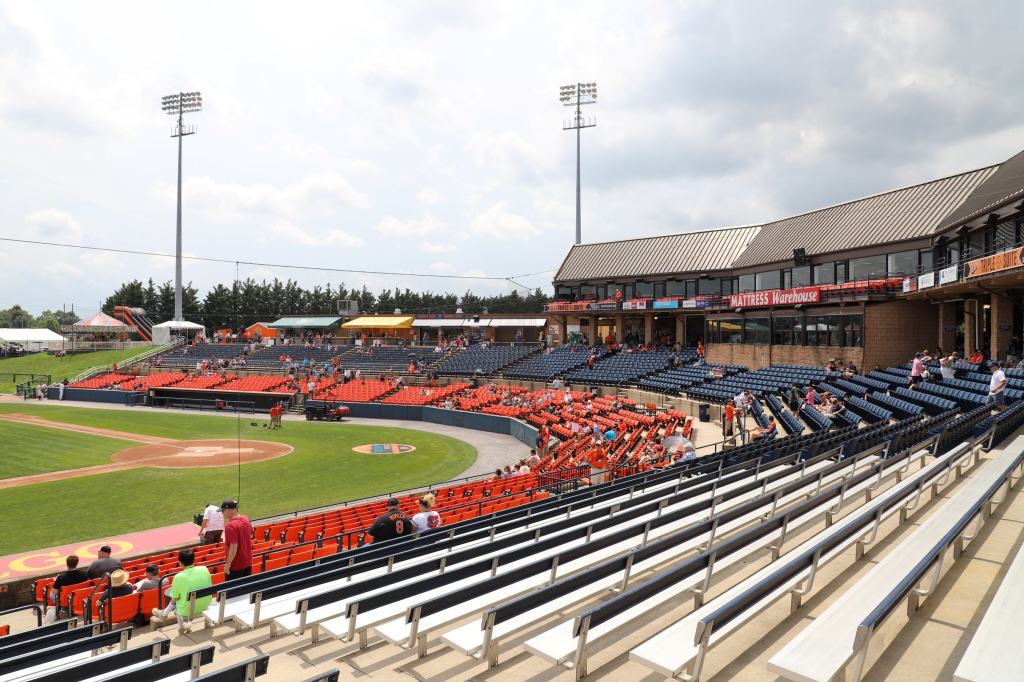
The view of NYMEO Field at Harry Grove Stadium from the upper section of the main seating area. (Photo credit: Jeff Hayes)
  • First visit: Sunday August 12th 2018
  • Most recent visit: Sunday April 21st 2019

With so many baseball choices within an hour or so of where I was living in Maryland, it took until 2018 before we finally visited NYMEO Field at Harry Grove Stadium in Frederick MD. NYMEO Field is the home of the Frederick Keys, the high A affiliate of the Baltimore Orioles, who played in the Carolina League until 2019. From my home, NYMEO Field is about 39 miles away, and the drive varies from 45 minutes to more than an hour, depending on the game time and resulting traffic. After clearing the DC Metro area, the drive becomes scenic in spots, and as long as the evening commute can be avoided, the drive is fairly stress free.

Main parking for NYMEO Field is located in the front of the ballpark, just off Stadium Drive, and is a short walk to the main gate. This parking lot tends to fill quickly, especially during good weather before evening games. If this lot is full, there is a secondary lot behind the right field wall, which requires a walk of less than one-quarter of mile to the main entrance. Unlike most ballparks we have visited, parking at NYMEO Field is FREE, regardless of the lot used.

The main gate at NYMEO Field at Harry Grove Stadium, as seen from the main parking lot in front of the ballpark. (Photo credit: Jeff Hayes)

NYMEO Field at Harry Grove Stadium is a modular ballpark, like many we have seen in our travels. Opening in 1990, it is one of the older minor parks we have encountered, yet its appearance does not bely its age. After entering the park through the main entrance, we crossed the upper concourse, which houses most of the concession stands in the stadium, as well as the team store. Once we emerged from the upper concourse, we saw that the main seating area at NYMEO Field was comprised of two levels, extending from third base base dugout behind home plate to the first base dugout. The lower concourse separates the two seating areas, with the lower seating area sporting orange seats, and the upper seating area adorned with navy blue seats.

Beyond each dugout, there is general admission seating consisting of aluminum benches. Finally, there is a row of luxury boxes atop the park, and a press level, which is flush with the upper concourse. In total, there are about 5,400 seats at NYMEO Field, which is typical of stadiums for this level of play. Ticket prices are reasonable, and all of the seats have good sight lines. There are four concession stands in the ballpark, with a number of portable stands all offering typical fare for baseball. The Roasthouse Pub and Kitchen Creations offer more in the way of variety, and I found myself going to the latter for my concession needs at the park.

The view of NYMEO Field from the general admission seats, offering a good view of the seating area. (Photo credit: Jeff Hayes)

Like many minor league (MiLB) parks we have seen, there is a portion of the park devoted to younger fans. Down the right field line is the Giant Eagle Fun Zone, which offers a carousel, a bounce house and water slides during the summer months. There is a distinct family friendly feel at NYMEO Field, and we saw more kids here than most other MiLB parks, especially when compared to the Orioles AA affiliate in Bowie MD. Sunshine and humid conditions during the early late morning gave way to more in the way of clouds as we reached the park, and there was a concern that thunderstorms might become an issue as the afternoon wore on.

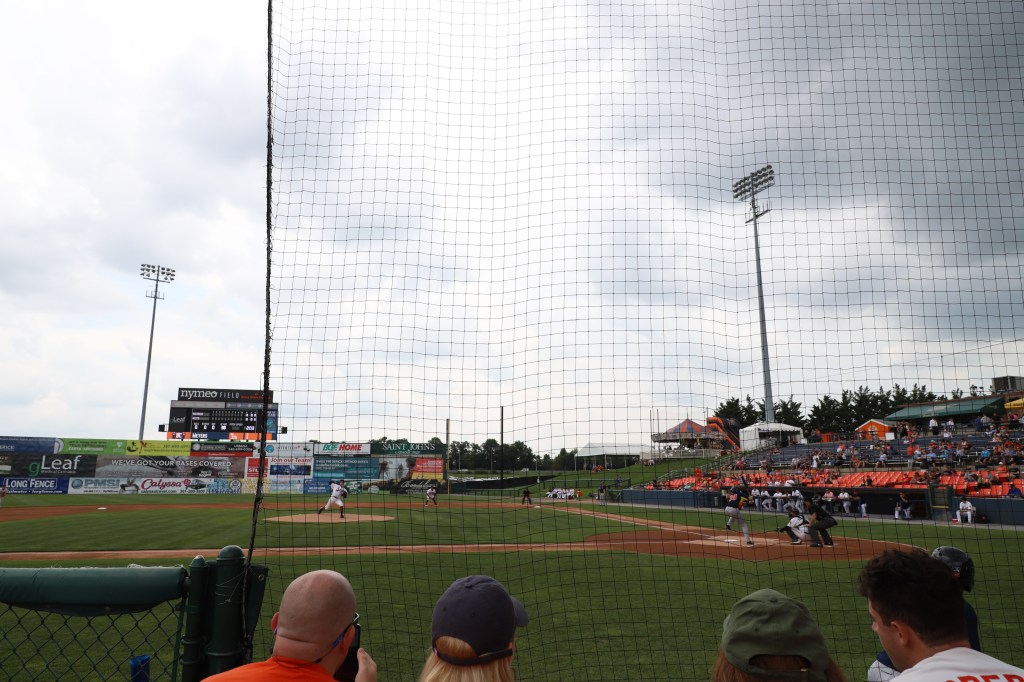
As is typical for Sunday afternoon games following Saturday night contests, the attendance was comparatively light, and there were many good seats available. We sat just to the left of home plate, behind the protective screen in the lower deck. By game time (which was 205 pm), clouds had taken over the skies over NYMEO Field, and I became concerned that the game might be lost to the weather. The forecast was for thunderstorms, but I was hoping against hope that we could get the game in before the skies opened up.

Skies became increasingly ominous with time at NYMEO Field at Harry Grove Stadium in Frederick, MD. (Photo credit: Jeff Hayes)

As we kept a collective eye to the sky, the game started on time. Frederick played host to the Buie Creek Astros, the high A affiliate of the Houston Astros. The second batter for the Astros hit a home run, and the home team found themselves behind 2-0 before coming to the plate. In the bottom of the second inning, the Keys began to claw their way back into the game as second baseman Preston Palmeiro (the son of Orioles great Raphael Palmeiro) hit a home run to make the second 2-1. Rain started to fall in the top of the third inning, with lightning not too far away. Somehow the top of third inning was completed, but shortly thereafter rain and lightning chased most fans in the upper concourse (which was covered from the elements), and play was halted.

Preston Palmeiro rounding third base after hitting a home run in the bottom of the second inning at NYMEO Field. (Photo credit: Jeff Hayes)

Rain and thunder continued for more than 30 minutes at NYMEO Field, and the outlook for the game to continue in these conditions was bleak. We stood with other fans in the upper concourse, vainly hoping we could resume play. While waiting, we perused the Keys team store, which offered standard fare, and listening to the sound of the rain pelting the roof of the stadium. When it became obvious that there would be no more baseball that afternoon, we prepared to leave. Just as we were walking to the exit, the game was officially cancelled. Rather than postpone the game, it was cancelled, since we were so close to the end of the MiLB season. Our first visit to see the Keys was washed out after just two and one-half innings. Disappointed, we pulled away from the stadium. Though the sample size was small, I was impressed with the stadium and its feel, and I knew we would have to visit again.

Unfortunately, this was how our first visit to NYMEO Field ended. (Photo credit: Jeff Hayes)

Fortunately, the weather was much more agreeable for our next visit on April 21st, 2019, as the Keys played host to the Salem Red Sox, the high A affiliate of the Boston Red Sox. Partly sunny skies and seasonable temperatures made for ideal conditions to see a game, and we arrived about an hour before game time. Having seen most of NYMEO Field during our previous excursion, we did not explore the park quite as extensively. Like most MiLB parks, the outfield was ringed by wooden advertising signs (with signs stacked two or three high in places). Sitting atop the the left field advertising signs was a small but functional videoboard and a small but functional scoreboard rose above the wall in right field. A smaller scoreboard and videoboard suited the ballpark nicely, functional and certainly unobtrusive.

Bullpens for the home and visiting teams were located about halfway down the foul lines, and like most MiLB parks, the bullpens were in foul territory. Because of the angling of the field, the seating area for each bullpen placed players in a precarious position for line drive foul balls. We found that pitchers did not occupy this area unless they were warming up to come into the game. More sunshine gave us a better feel for the ballpark, and increased my appreciation for it. In fact, I wished that it was located in Bowie (closer to where I live), since it seemed to be a much better facility than the one I frequented during the summer.

Frederick Keys relief pitchers sitting on the bullpen bench. They tended to scatter during the game, as line drive foul balls are a hazard here. (Photo credit: Jeff Hayes)

Visiting again on a Sunday, the crowd was fairly small, though the nice spring weather certainly wasn’t a deterrent. Because of the thin attendance, we sat in the first row directly behind the third base dugout, giving us a great view of the action. Unlike our previous visit, we were treated to a full game. Though the crowd was spread out across the seating area, they were enthusiastic. We learned that when the Keys were rallying, fans shook their keys (in addition to cheering), which seemed appropriate. To get a better feel for the atmosphere of NYMEO Field, you check out a video clip here.

The level of play in the Carolina League is better than the lower levels, but not nearly as polished as you would expect to see in MLB stadiums. At this level, hitting is usually better than the pitching, as the young arms are still developing. Talent on the field is unmistakable, but players are still, in some cases, working on fundamentals. The experience level in the Carolina League can be wide, as players as young as 18 years of age compete against former college players climbing the ladder through their respective systems. Keeping that in mind, baseball in the MiLB can be more fun than the MLB, watching players that you might see in MLB uniforms in the near future, in a much more intimate setting.

A few shots of the action at NYMEO Field. (Photo credit: Jeff Hayes)

On this day, we saw a relatively well-played game, with fewer walks than typical for high A baseball, as the hometown Keys squeezed out a 4-2 victory. While NYMEO Field at Harry Grove Stadium is a modular stadium that resembles many MiLB parks we have seen, there is an family friendly atmosphere, which results in a pleasant baseball experience. A downsizing plan by MLB threatened to eliminate the Frederick Keys , as MiLB was slated to contract from 160 teams to 120 across the United States after the 2020 season. Given the cancelled season due to the pandemic, there was a distinct possibility that the Keys fans would have been robbed of the chance to say a proper goodbye to their team.

Fortunately, the Frederick franchise was spared the ignominy of oblivion, as they were chosen to host one of the teams of the MLB Draft League. The new league, featuring top prospects eligible to be drafted, will debut in 2021. Though the level of play may not as high as the Keys fans have come to expect, I would encourage you, if given the opportunity, to see a game at NYMEO Field.

Baseball will return to NYMEO Field at Harry Grove Stadium as part of the newly minted MLB Draft League. (Photo credit: Jeff Hayes)