Tokyo/Kyoto, Saturday September 22 2018

Senso-ji Temple in Tokyo on a rainy humid afternoon.

Following a rainy and humid day exploring Tokyo the day before, we started our 2018 Japanese baseball tour at the Tokyo Dome. After spending the previous two nights in Shinjuku, we checked out of our hotel. We were planning to travel on the Shinkansen (bullet train) from Tokyo Station to Kyoto Station after the game, so we needed to arrange for our luggage to get to Kyoto.

There are restrictions on the size of bags we could take on the Shinkansen, and our luggage was too large to bring on the train. The hotel in Shinjuku offered a service to send out bags ahead of us to the hotel in Kyoto for a reasonable fee. We packed clothes and toiletries for a couple of days (since it would take two days for our luggage to get to Kyoto), and had the rest sent ahead.

Google Maps depiction of the trip from Shinjuku Station to Tokyo Station.

1. Getting to the Tokyo Dome

With the smaller bags, we headed from the Shinjuku Station to Tokyo Station, where we would locker our bags until the end of the game. Shinjuku Station is large and intimidating, even to locals who use the station on a regular basis. We knew we had to take the Chuo Line to get to Tokyo Station, but finding the line inside Shinjuku Station proved a formidable task.

After some false starts, we purchased tickets for the line at a ticket machine, and we were on our way. We finally found the line, and it was a 15 minute trip to Tokyo Station. Once in Tokyo Station, we needed to find lockers, which proved almost as challenging as winding through Shinjuku Station. We tracked down some lockers, and secured our bags. Paying for the lockers presented another challenge, since it appeared paying with cash was not the easiest method.

Having figured out the lockers, we headed for the Marunouchi Line. Finding this line was not as difficult, but did require some time and effort. Unfortunately for us, the map of Tokyo Station left something to be desired, so some legwork was required. If you are not experienced using mass transit in urban areas, using the Tokyo Metro could be overwhelming. Tip: do as much research as possible BEFORE heading for the train station.
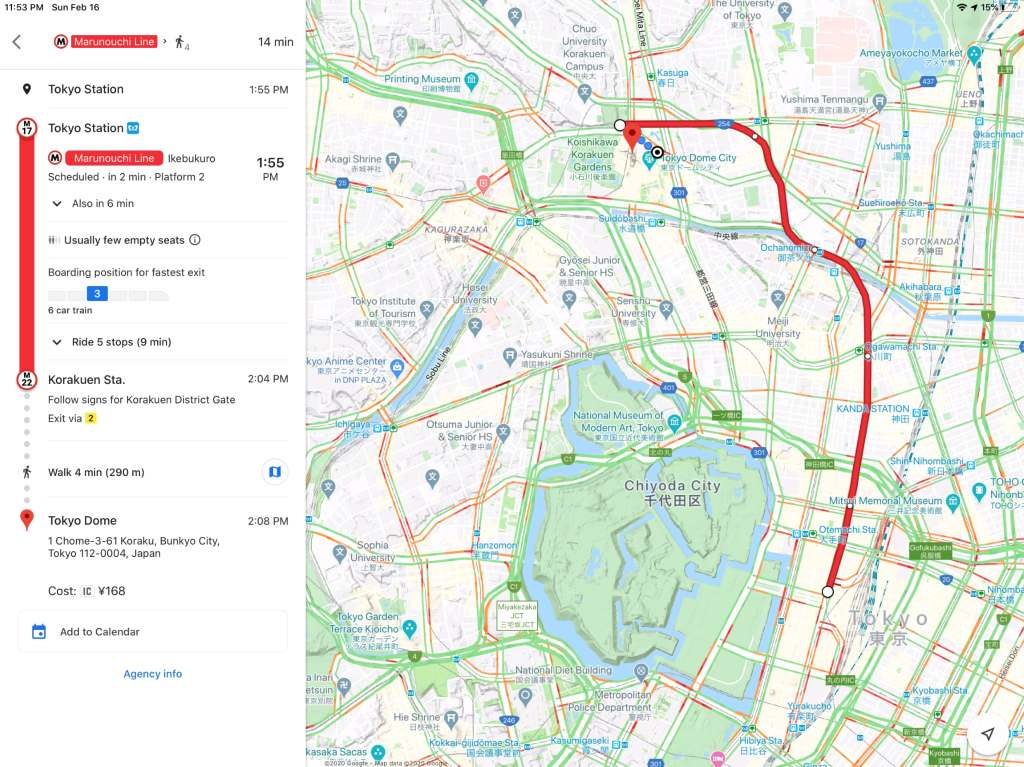
Google Maps showing the train route from Tokyo Station to the Tokyo Dome.

While it wasn’t available to us for this trip, Google Maps is an invaluable resource for riding the train system in and around the Tokyo area. If you don’t have it on your phone, download it; the app is a MUST for traveling on trains in Japan.

Though it was a Saturday morning, the train to the Tokyo Dome was crowded, likely due to the game. The trip from Tokyo Station on the Marunouchi Line to Korakuen Station took about 15 minutes, including a short walk (less than 500 meters) to the Dome.

2. Tokyo Dome

The Tokyo Dome is the centerpiece of the Tokyo Dome City, a complex featuring shops, rides and an indoor playground for the kids. We have heard about this complex for years, as well as seen pictures. However, as often happens, the buildup for the Tokyo Dome City overshadowed the complex itself. While there were places to eat and shop, it seemed to be fairly pedestrain, and held little in the way of interest for us. Perhaps it was a matter of perspective; for a family with children, the place may have a different charm than it did for us.
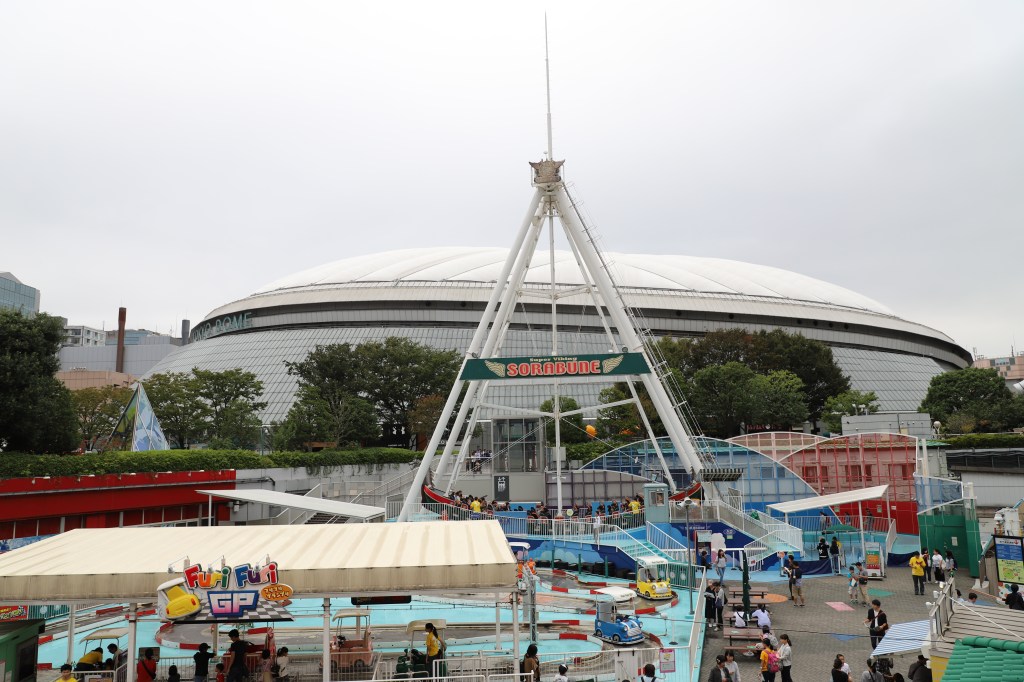
The Tokyo Dome City complex, with the Tokyo Dome in the background. (Photo credit: Jeff Hayes)

Our interests in the complex were within the Dome itself. The Nippon Professional Baseball (NPB) Hall of Fame is located within the Dome, having moved there is 1988. Seemingly modeled after the National Baseball Hall of Fame in Cooperstown NY (USA), the Hall contains many exhibits from the past, as well as displays from the present. Like the Baseball Hall of Fame, there are rows of plaques commemorating NPB greats of the past, including players, managers, officials and executives.

Plaques adorning the walls of the NPB Hall of Fame at the Tokyo Dome. (Photo credit: Jeff Hayes)

Walking among the displays gave us the flavor of the NPB and its past. Unfortunately, almost all of the displays were in Japanese, so some of the history was lost on us because of the language barrier. Nonetheless, the story of the NPB was laid out sequentially, from the beginnings of baseball in Japan through the 1934 MLB barnstorming tour, which gave birth to the modern game. Much like our visits to the Cooperstown shrine, we found ourselves taking many pictures, as well as enjoying the history of the place.

A model of baseball in Japan from the late 19th century. (Photo credit: Jeff Hayes)

Of course, there was a tribute to Babe Ruth, who some in Japan credit with the surge in popularity of the sport after starring in the barnstorming tour. In addition to the past, there were many displays of the present day game with uniforms and posters of the starts of the NPB. Even though the NPB Hall of Fame is smaller than its American counterpart, we spent more than an hour learning about Japanese baseball.

Babe Ruth, responsible for the direction of baseball in both the US and Japan. (Photo credit: Jeff Hayes)

Upon leaving the NPB Hall of Fame, we were drawn to the Giants Team Store. Not surprisingly, the team store was huge, housed within the Dome itself. In addition to the usual souvenirs (including dolls and noisemakers, which are wildly popular in Japan), we were presented with not only apparel for the Giants, but other NPB teams as well. The store was packed, as might be expected before a game, and maneuvering through the crowded store proved tricky. Despite the large selection of items, I left with only baseballs with the Tokyo Dome insignia. My sights were set on seeing the my first NPB game!

3. Seeing the Game
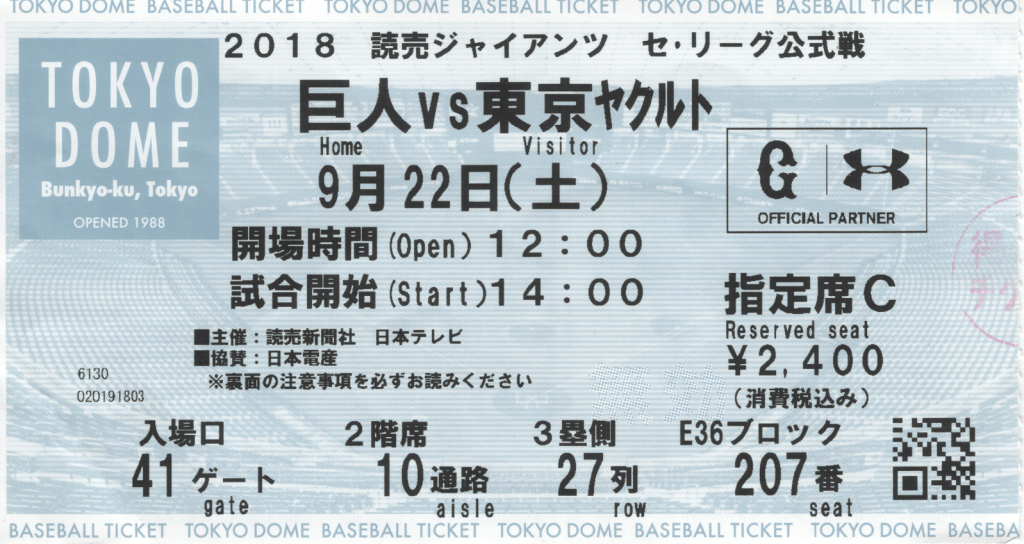
My ticket for the game at the Tokyo Dome. Luckily, all of the vital information had English subtitles.

Thankfully, the tickets for the game were fairly easy to decipher, and we didn’t need any help finding our seats. We obtained our tickets from a broker, meaning that we did not have much choice over where we sat, although for our first NPB experience, it did not much matter. That was a good sentiment, because we were located at the very top of the upper deck behind 3rd base.

After finding our seats, we strolled across the upper deck from foul line to foul line, taking pictures. We have been all of the domed stadiums that host MLB games, and the Tokyo Dome seemed larger than all of them! The place is cavernous, with a capacity of 44,000 for baseball. Looking closely at the field, we could see lines that appeared to be yard markers. In addition to baseball games, the Dome hosts high school and college level American style football.
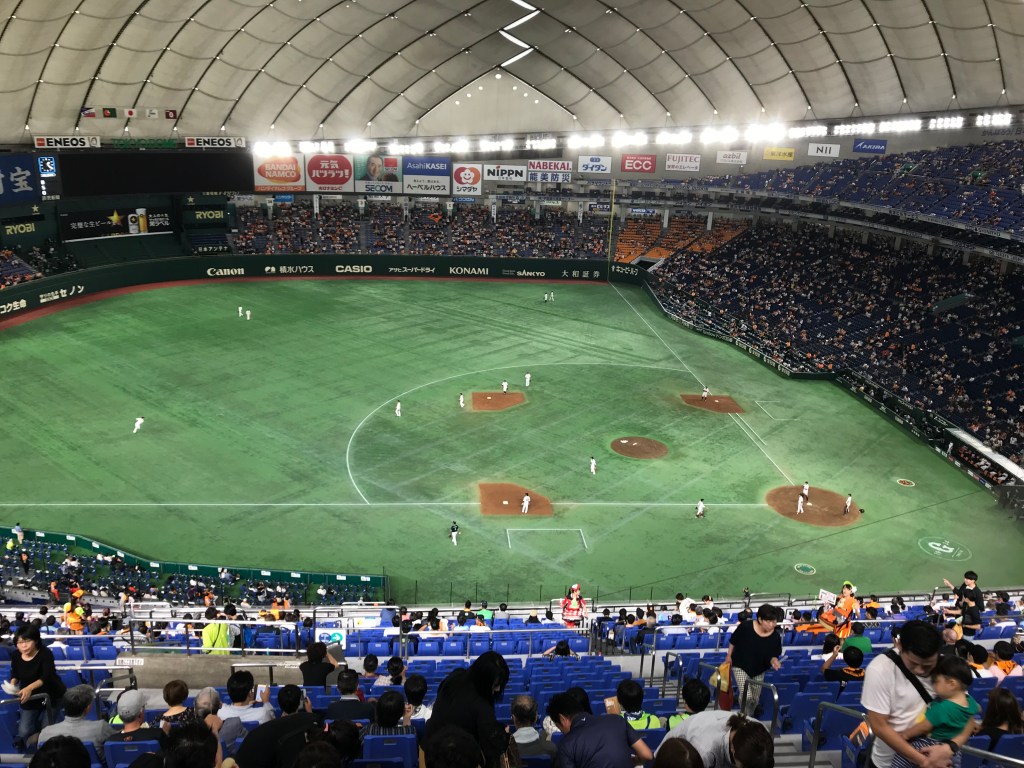
The view from the cheap seats at the Tokyo Dome. The Dome is even bigger than it appears in this picture.

Back at our seats, we realized we were in the very last row at the top of the Dome. It didn’t take long to determine that it was warm and a bit humid in the Dome. Unlike MLB domed stadiums, there was either little or no air conditioning, and experience suggested that the air temperature in the Dome just before game time was probably near 27 Celsius (or 81 degrees F). Judging by neighbors, this seemed normal, but the combination of warmth and humidity made the Dome somewhat uncomfortable for me.

Following pre game pageantry near home plate, the game started precisely at 1400. The Giants’ opponent for the afternoon game was the Tokyo Yakult Swallows, whose home was a short distance away in the Shinjuku section of Tokyo (where we were staying during this part of the trip). Since it was only a train ride away, the Swallows fans were there in force, and in good voice for the game.

Swallows fans located in the lower left field seats at the Tokyo Dome. (Photo credit: Jeff Hayes)

The Swallows fans filled the lower left field seats (reserved for fans of the visiting team), dressed in green. Though it may be difficult to see in the above picture, some fans have musical instruments, led by a conductor. During the Swallows at-bats, the fans play and sing songs specific to the hitter at the plate, and do so for all 9 innings. In the bottom of each inning, the Giants fans do likewise. We had seen videos of Japanese baseball games in the past, but seeing it in person was even better than expected. Even in a place as huge as the Tokyo Dome, their songs were LOUD. To get a feel for how it sounds in person, check this out!

The lineups for each time feature some ex-MLBers, including the starting pitcher for the Swallows, Matt Carasiti (who played for the Rockies and Mariners in the MLB stints). The Giants opened the scoring in the bottom of the 1st, scoring three runs off Carasiti. The Giants would tack on a single runs in the 6th and 7th innings, cruising to a 5-0 victory. Giants pitcher Tomoyuki Sugano tossed a 5 hit shutout, striking out 9 while only walking two.
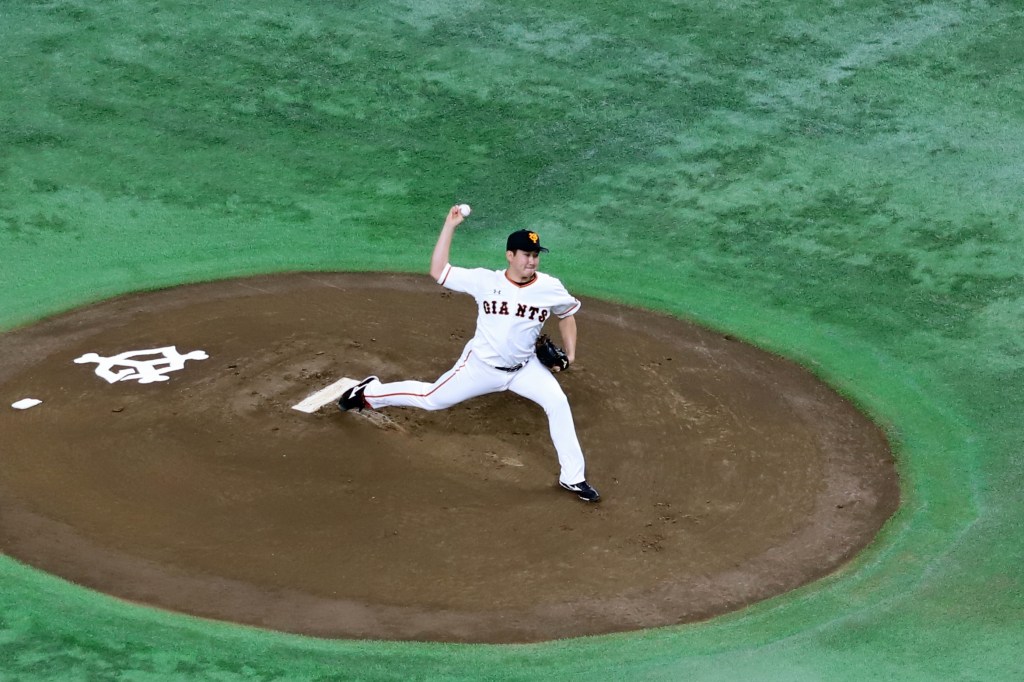
Tomoyuki Sugano delivering a pitch in the 1st inning. Sugano scattered 5 hits while tossing a shutout at the Swallows. (Photo credit: Jeff Hayes)

Though the outcome of the game was decided fairly early, there was still plenty to see. We have come to learn that the Japanese treat baseball games like events, complete with cheerleaders and cute characters from pop culture. Most of the pageantry occurred pre game, but like many minor league games in the US, there were games for fans in foul territory in between innings.

Japanese baseball games have cheerleaders driving around cute characters. (Photo credit: Jeff Hayes)

NPB baseball also has video replay, but the process includes something we don’t see the in the States. During the video review, the home plate umpire explained to the crowd what was going on. Unfortunately, we don’t speak Japanese, so we did not get the information. It would seem that this is a common occurrence, based on the crowd indifference during the announcement.

Finally, I learned of a Japanese baseball tradition that might not go over so well in the US. Dubbed Beer Girls, young Japanese women dressed in brightly colored uniforms carry quarter kegs of beer (as well as other adult beverages) on their backs throughout the crowd during the game. As misogynistic as it may seem by American standards, these women ran up and down the stairs tirelessly the entire game, with a smile on their faces the entire time! Speaking for myself, I was amazed and impressed at how hard they worked, and how they could keep smiling through it all.

A Beer Girl hard at work in the Tokyo Dome. (Photo credit: Jeff Hayes)

Leaving the Tokyo Dome after the game presented yet another surprise. Above the exits, signage warned (in Japanese and English) of strong winds just outside of the doors. This puzzled me, since the weather conditions before the game did not seem conducive to strong winds after the game. However, just after exiting, there were indeed strong winds. The winds dropped off just as suddenly as they had started. It seems as though exiting fans opening all of the exits nearly simultaneously caused a huge exhale from the stadium, resulting in strong winds due to the pressure difference.

My first NPB game experience exceeded my expectations, both on the field and in the atmosphere that is the Japanese game. The venue itself was fairly non descript, but the style of the game, as well as the actions all around is, made a great first impression. It whetted my appetite for more NPB baseball!

4. Getting from Tokyo to Kyoto

Our whirlwind second day in Japan included one more stop: Kyoto. The ancient capital of Japan, it was the perfect jumping off point for our next two games. We would headquarter there for the next few days, enjoying the region while traveling to other cities in Japan for ball games.

First up was getting back to Tokyo Station to retrieve our bags and catch the bullet train to Kyoto. We reversed course from the Tokyo Dome to Tokyo Station, though finding the lockers with our bags once back at the station proved to more than just a trivial matter. As mentioned earlier, Japanese train stations can seem overwhelming, and attempting to locate our luggage eventually tried my patience. Alas, persistence prevailed, and after getting our bags, we headed upstairs to get the bullet train.

We obtained our JapanRail passes for the bullet train the day before (a process that is reviewed in the blog about traveling while in Japan), and we showed them to the attendant as we reached the gate for the train. When the train arrived, we boarded Car 8 (the Green Car), which has reserved seating. The seating was comfortable, and more importantly, had power outlets for our devices.
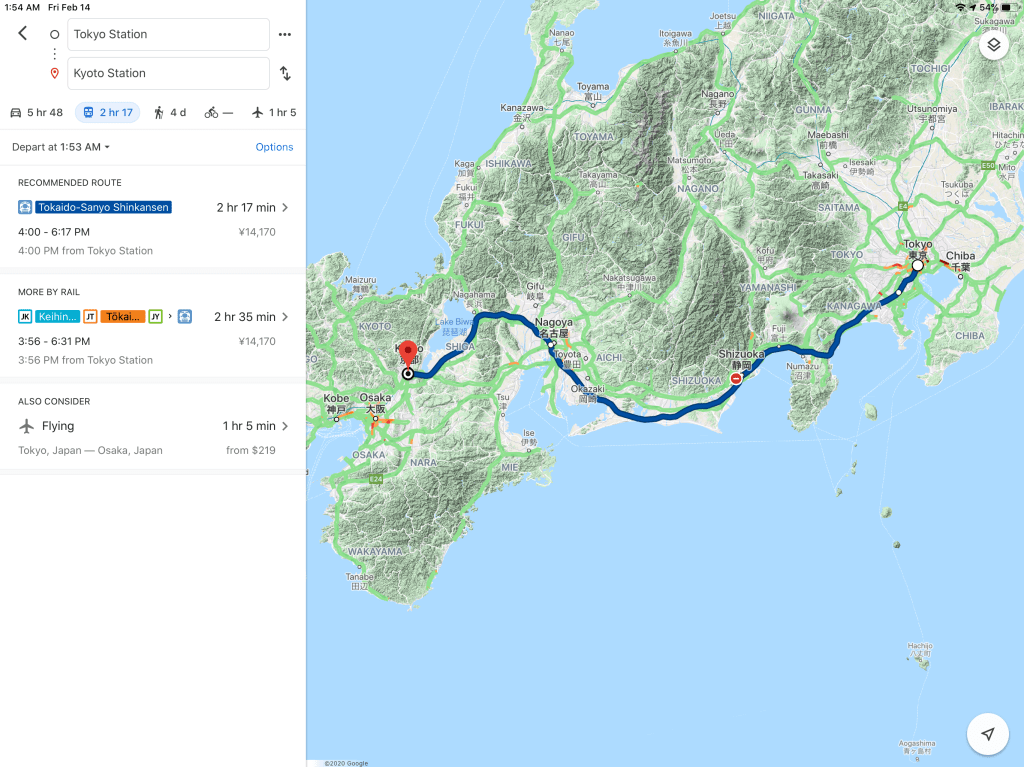
The Google Maps depiction of the trio from Tokyo to Kyoto.

The trip took about two hours and 15 minutes, as the Tokaiso-Sanyo Shinkansen reached speeds of 180 mph. It was unlike any other train ride I’d ever taken, as it far more comfortable than I imagined. The ride was ultra smooth, and the only way we knew we were traveling that fast was to look out the window. The combination of the coming darkness and cloudy skies made sightseeing difficult at best. Instead, we relaxed and enjoyed the first class accommodations, and before we knew it, we arrived at Kyoto Station.

My brother had the foresight to book a hotel just across from Kyoto Station. We checked in and crashed after a long second day in Japan.
Kyoto/Nishinomiya, Sunday September 23, 2018

Day 2 of our Japanese baseball tour moved us to Kyoto. We chose to stay in Kyoto for a few days, since it was the ancient capital of Japan and would afford us an up close view of Japan the way it used to be. My brother chose a hotel close to Kyoto Station, as we would be traveling on the Shinkansen the next three days.

After the rainy and humid conditions in Tokyo, the sunshine in Kyoto was a welcome relief. Following an early breakfast, we went out exploring nearby Kyoto. The hotel was located within walking distance of MANY temples, as well as parks. Walking through local neighborhoods on the way to see the temples, we could not help but notice vending machines nearly everywhere. As we later find out, vending machines are ubiquitous throughout Japan.

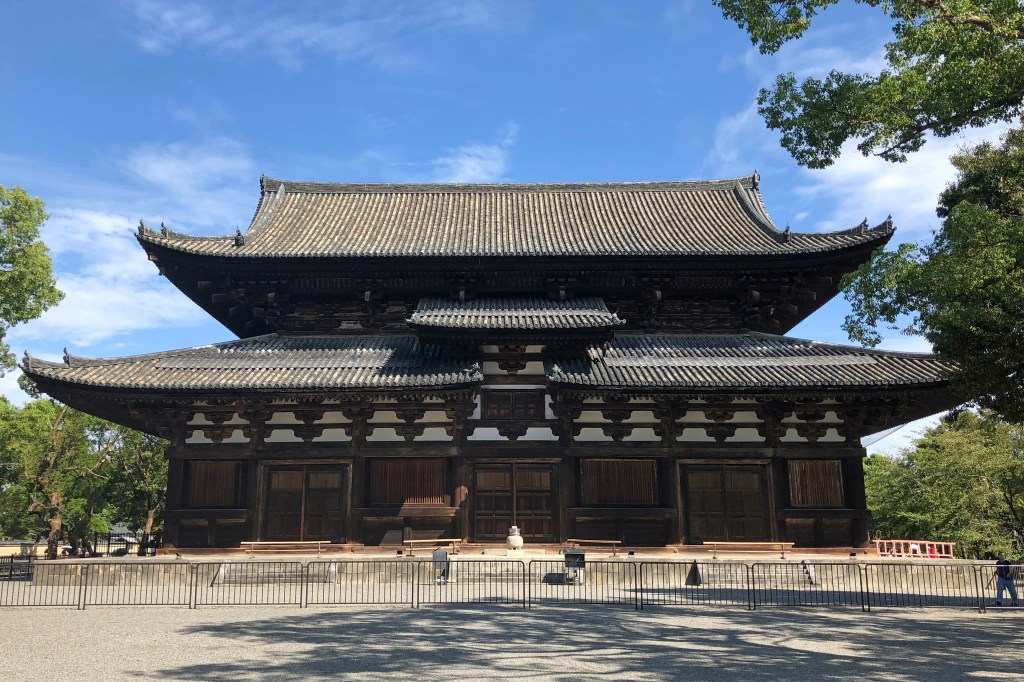
Kondo Hall, the largest structure at the Toji Temple complex.

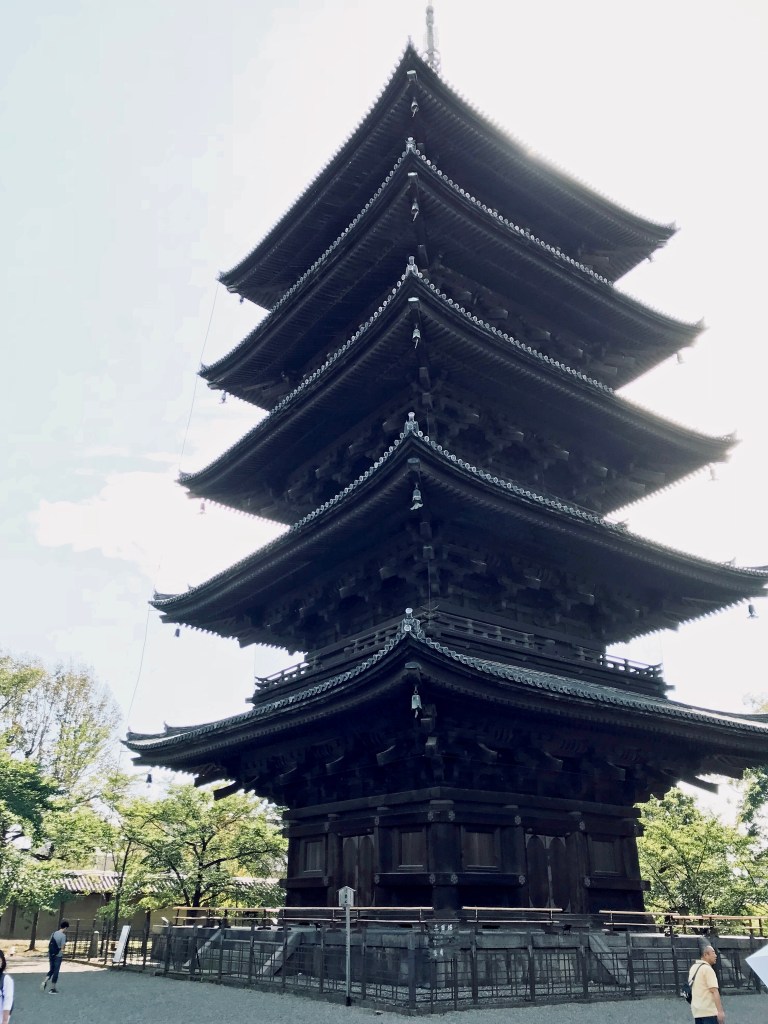
About ten minutes from the hotel, we found the grand complex of Higashi Hongan-ji. There are several temples and shrines in the complex, spread out over a few city blocks. A UNESCO World Heritage site, the complex contains the largest wooden tower in Japan, the five story Pagoda. This structure may be one of the most recognizable in Kyoto, and is spotlighted at night.

The Pagoda on the grounds of the Toji Temple. (Photo credit: Jeff Hayes).

The largest structure in the complex is Kondo Hall (pictured above). Not accessible to the public (like most of the structures here), the Hall is the centerpiece of the temple. Strolling through the complex, we could almost feel the spirituality. It didn’t take long to see why Kyoto is so popular with tourists and Japanese alike.

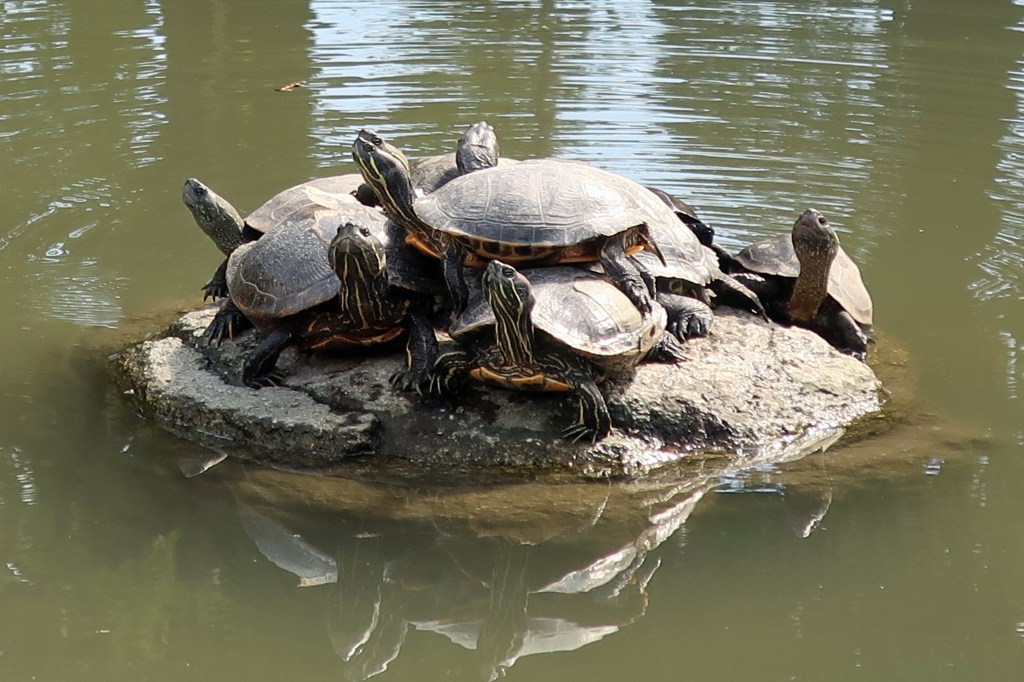
Ambling through the complex, we came upon a manmade pond. Within the pond we saw some of the locals, soaking up the late September sun. Having spent more than two hours at the temple, we headed back to the hotel before leaving for Nishinomiya. The visit to the temple had me looking forward to what else we might see in Kyoto in the coming days.

Toji Template residents sunning themselves on a rock in a manmade pond. (Photo credit; Jeff Hayes)

1. Getting to Nishinomiya

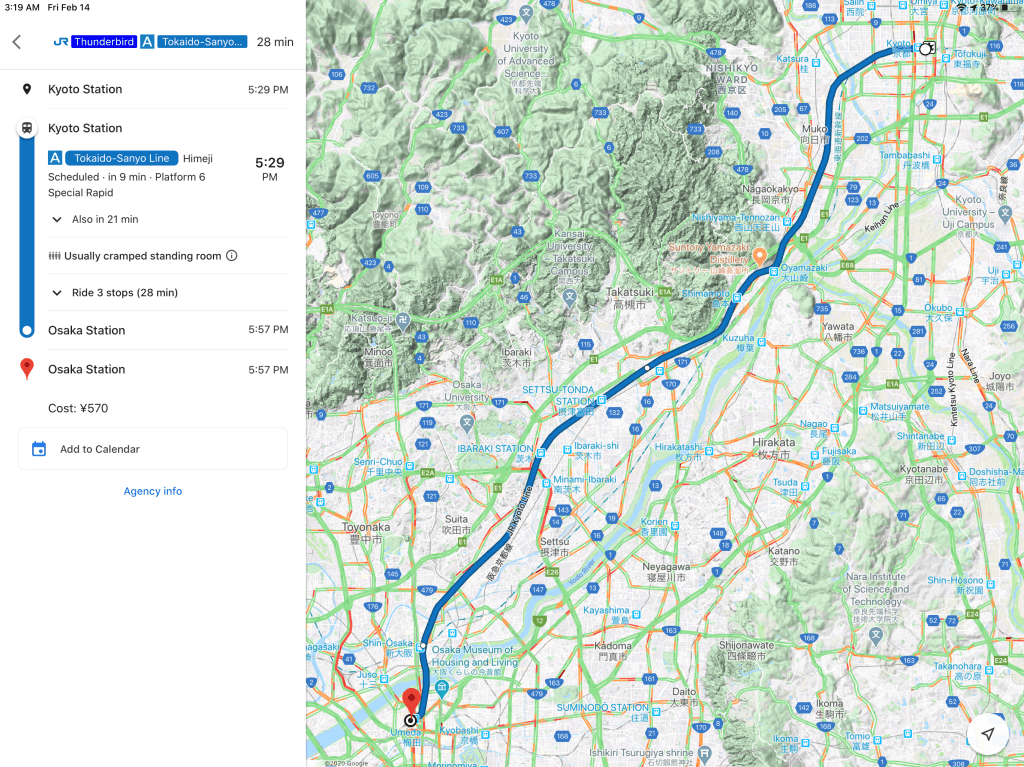
Going to see the Hanshin Tigers take on the Yomiuri Giants at historic Koshien Stadium, we would need to take the Tokaido-Sanyo Shinkansen from Kyoto Station to Osaka Station. The trip took roughly 30 minutes, with three stops. After arriving at Osaka Station, we walked across the street to the Osaka-Umeda Station to catch the local train to Koshen Stadium.

Getting from Kyoto to Osaka, as depicted by Google Maps.

Like many train stations in Japan, the Osaka-Umeda Station seemed like a labyrinth of platforms and escalators. While we knew we had to take the Hanshin Line to the stadium, it wasn’t immediately clear where that was in the station. In addition to the Hanshin Line, there was the Hanshin Railway (a private line). The distinction caused some consternation, but once we determined where we needed to get Hanshin Line, we were ready to head to the stadium.

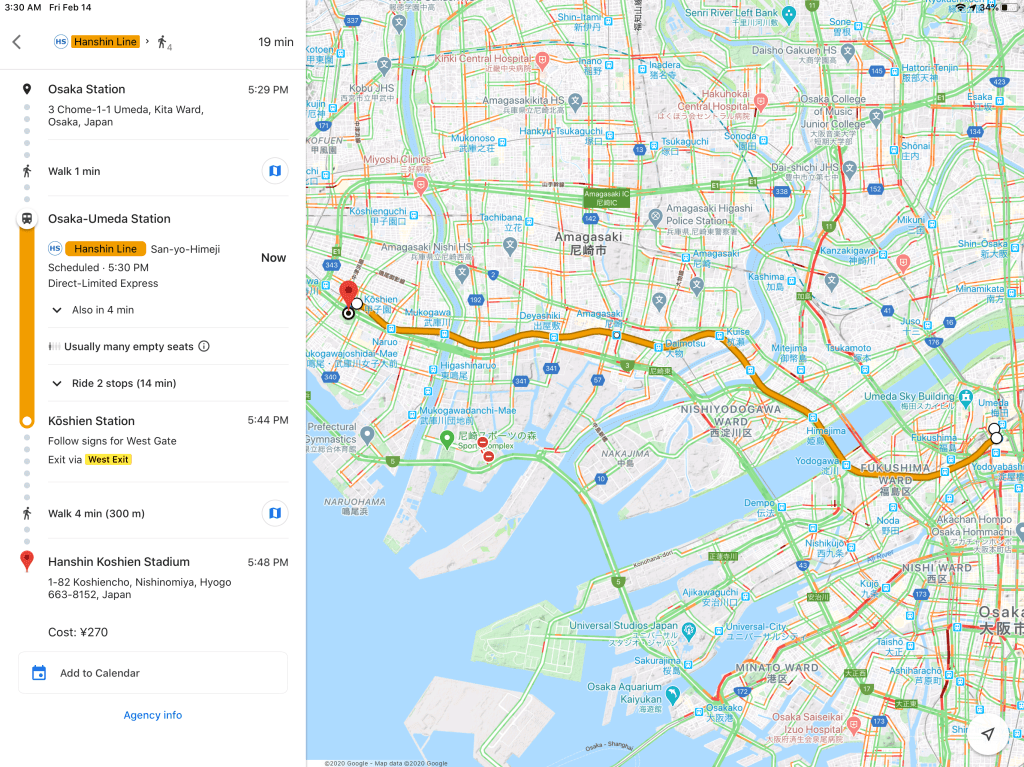
Not surprisingly, the train was packed with Tigers fans headed to the stadium. The trip to Koshien Station took about 20 minutes, with a walk of just a couple of minutes from there to the stadium.

The direct train line to Koshien Stadium took about 20 minutes on a very crowded train.

2. Koshien Stadium

Koshien Stadium is a unique ballpark in many ways. It is the oldest ballpark in Japan, having opened in 1926. It is one of only four major league stadiums still in use in which Babe Ruth played (the others being Meiji Jingu Stadium in Shinjuku, Fenway Park in Boston and Wrigley Field in Chicago). Koshien Stadium is the only remaining NPB ballpark with an all dirt infield.

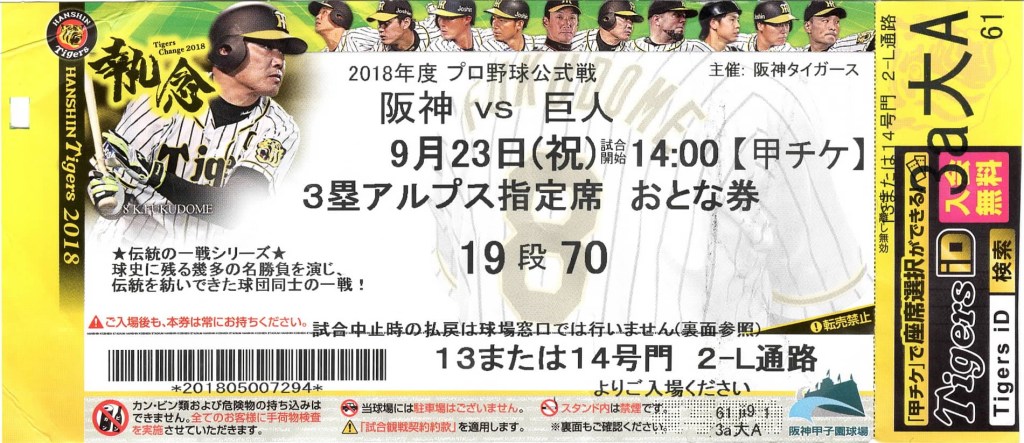
It was against this backdrop that we entered Koshien Stadium. My brother had a QR code for our game tickets, and obtained our tickets via QR scanner at the stadium. Unlike the tickets we had in Tokyo, these tickets were more difficult to read. We asked a stadium employee which gate we should enter, and the answer was not clear. In order to find the gate, we had to nearly circle the stadium.

A ticket for the Hanshin Tigers game on a September, 23, 2018. It took some time to decipher the vital information in order to find our seats.

When visiting the TokyoDome the day before, we were able to walk around from section to section, taking pictures. This was not the case at Koshien Stadium. Security made it clear that we were to stay in our area, which limited our ability to take pictures of the stadium.

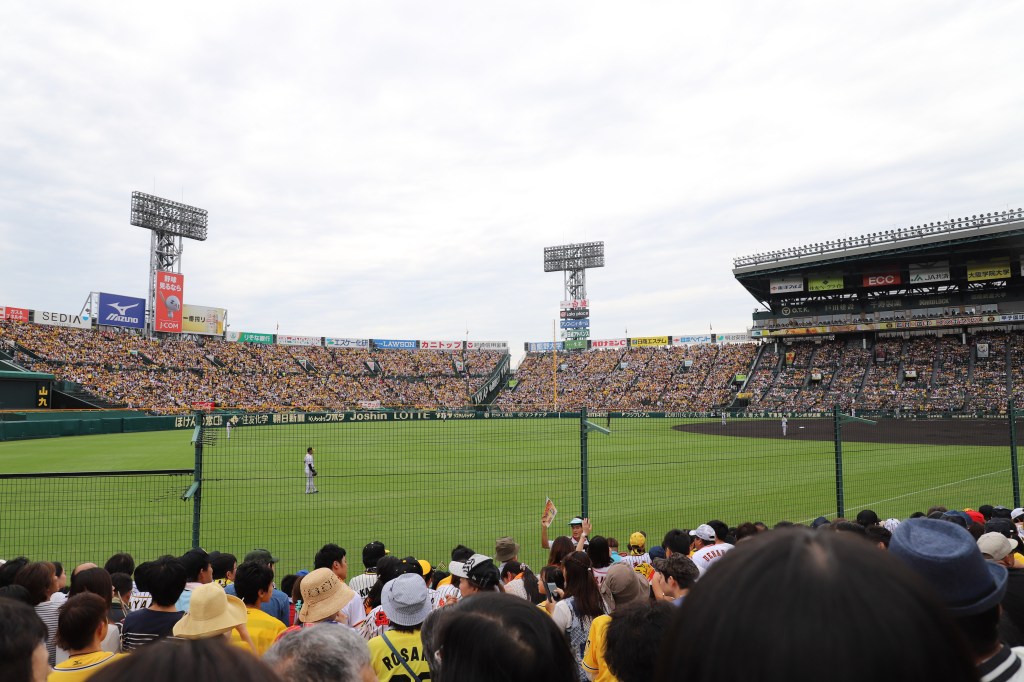
The view from our seats. Note the all dirt infield to the right. (Photo credit: Jeff Hayes)

The stadium was packed, with a sold out crowd there to see the Tigers take on the Tokyo Yomiuri Giants. Clouds gradually filled in during the early afternoon, and by the 1400 start, skies were overcast, but seemingly no threat of rain. Even with cloudy skies, the beauty of the ballpark shined through. The stadium dates back to the 1920s, and possessed some of the charms of an older ballpark. Koshien Stadium has a feel similar to that of Wrigley Field (before its modernization). However, the stadium did not show its age, being maintained and groomed well. From the first look, it was clear that this was a classic ballpark; a great place to see a ballgame.

Our seats were located near the left field corner, less than 10 rows from the action. We were located next to the visitors section in Koshien Stadium. As we would learn, there is a visitors section in each NPB ballpark, but not all are in the same part of the park. It was interesting to be so close to the Giants fans, who were indefatigable throughout the game. You can experience the Giants fans chanting here.

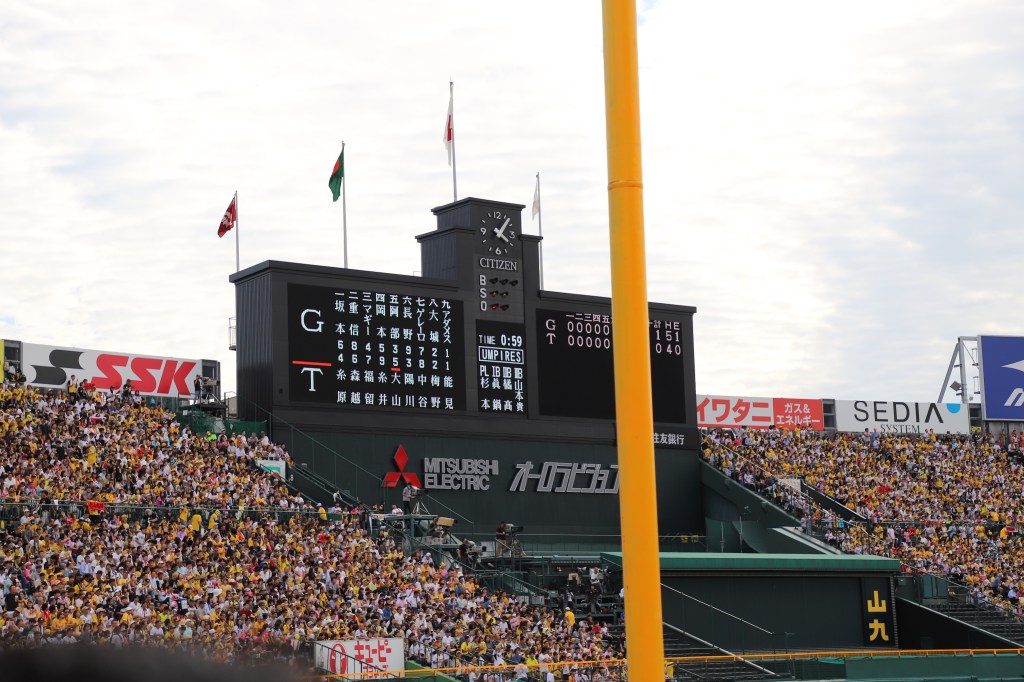
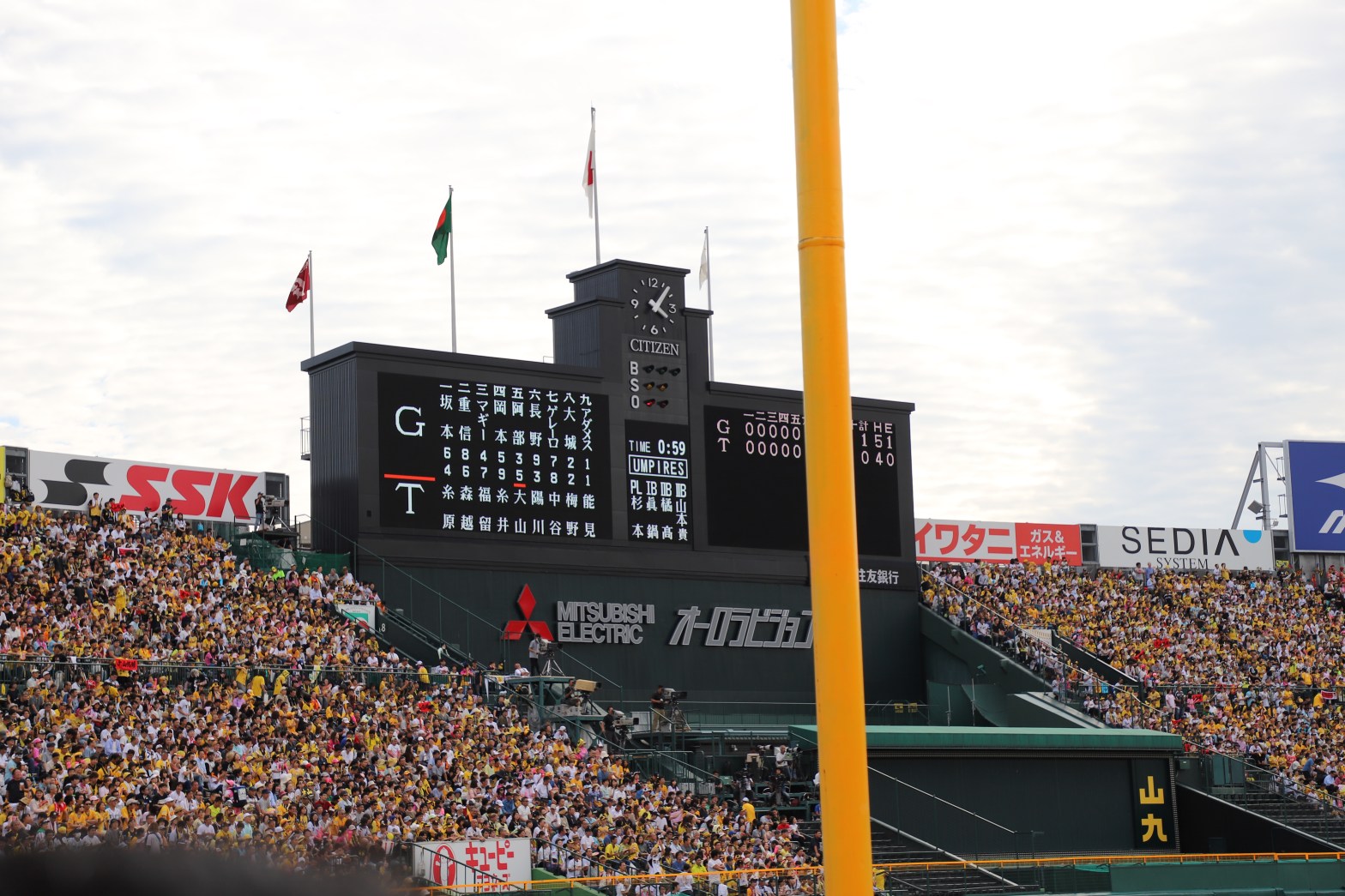
The scoreboard at Koshien Stadium. The scoreboard bares a vague resemblance to the old scoreboard at Wrigley Field. (Photo credit: Jeff Hayes)

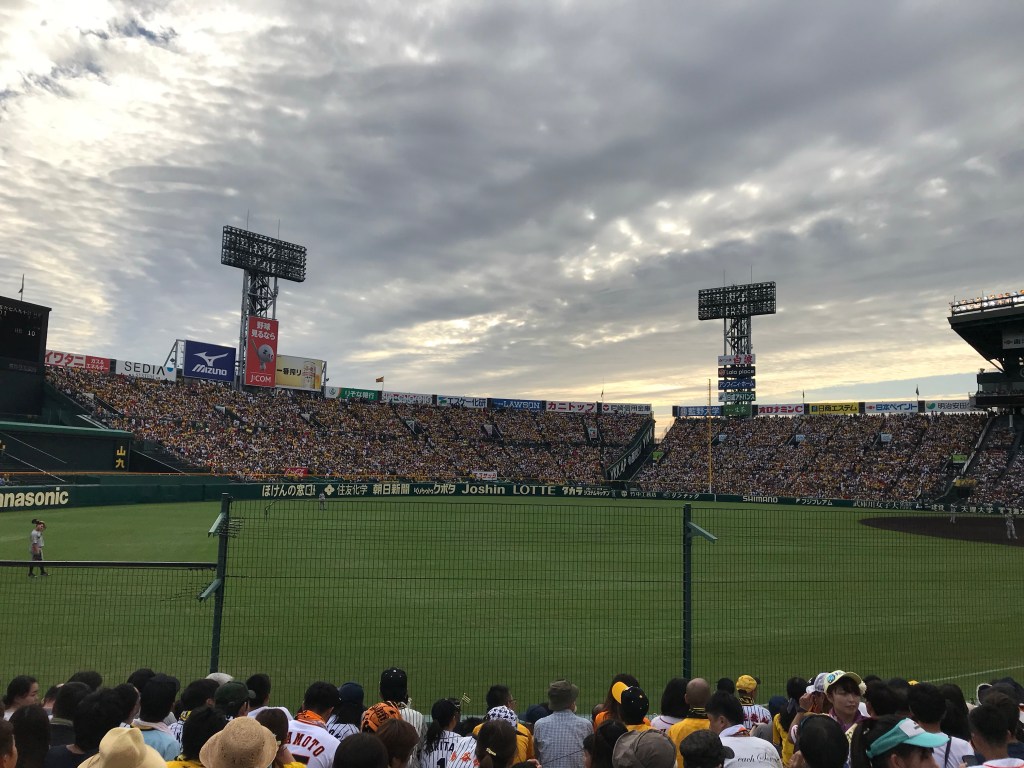
The game itself was a tight affair, scoreless after 5 innings. The Giants opened the scoring with a run in the top of the 6th, with the Tigers answering in the bottom of the 7th. A single run in the top of the 8th provided to be the winning run for the Giants, who triumphed 2-1. Toward the end of the game, the sun tried to break out, resulting in a very striking cloud pattern late.

Sunshine trying to break through the clouds at Koshien Stadium toward the end of the game.

The game time was about three hours and 30 minutes. Unlike MLB games, nobody seemed to be concerned about the pace of play. In fact, we saw a fan served a beer with two out in the bottom of the 9th inning. As we left the stadium, we noticed fans still milling around their sections, slow to exit the ballpark. Clearly, NPB fans see the game as more of an event, and these fans were in no hurry to leave.

Koshien Stadium proved to be a classic ballpark, in the vein of Fenway Park and Wrigley Field. My brother commented this was the stadium he wanted to see on this trip, and it was well worth the effort. Should I ever find my way back to Osaka, I’ll do my best to revisit this place.

The train ride back to Osaka was not quite as crowded as the trip to Nishinomiya, a benefit of a lingering fan base. After arriving in Osaka, a quick walk across the street brought us to the Shinkansen and the ride back to Kyoto. Arriving after dark, we walked back toward the Toji Temple to get a look at the Pagoda at night.

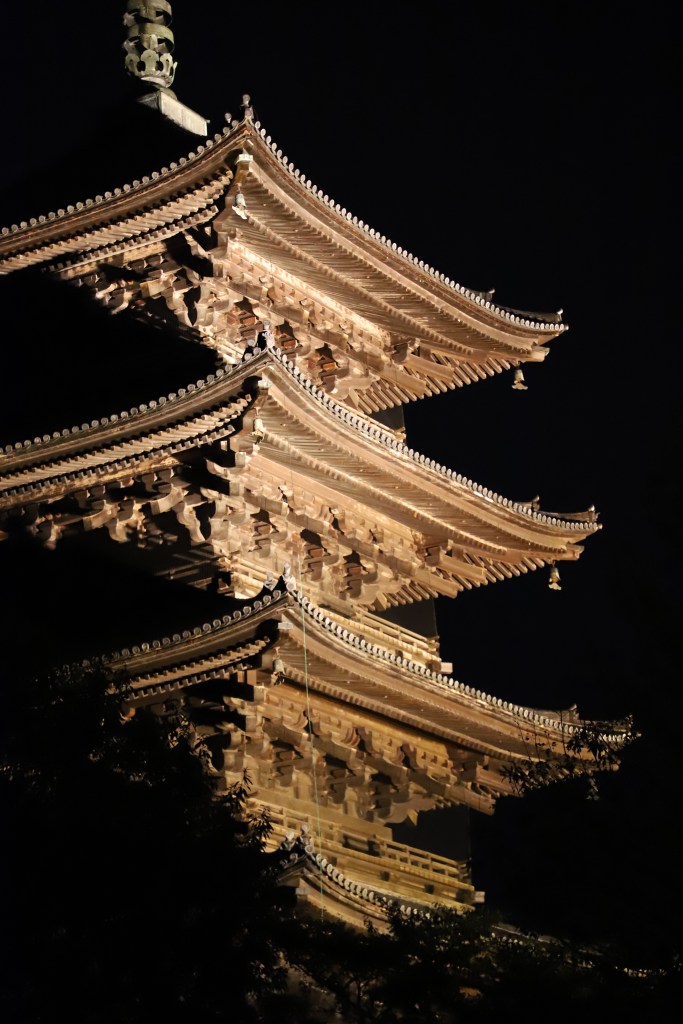
The top of the Pagoda at the Toji Temple. (Photo credit: Jeff Hayes)

Hiroshima, Monday, September 24th, 2018

The third stop on our 2018 Japanese baseball tour took us to Hiroshima. Our main purpose was to see the Carp in action at Mazda Zoom Zoom Stadium. However, the trip itinerary also included a visit the the Atomic Peace Dome and Peace Memorial Park. Having seen the plane that delivered the first atomic weapon, it seemed appropriate to see the remains of the destruction it helped create.

1. Getting to Hiroshima

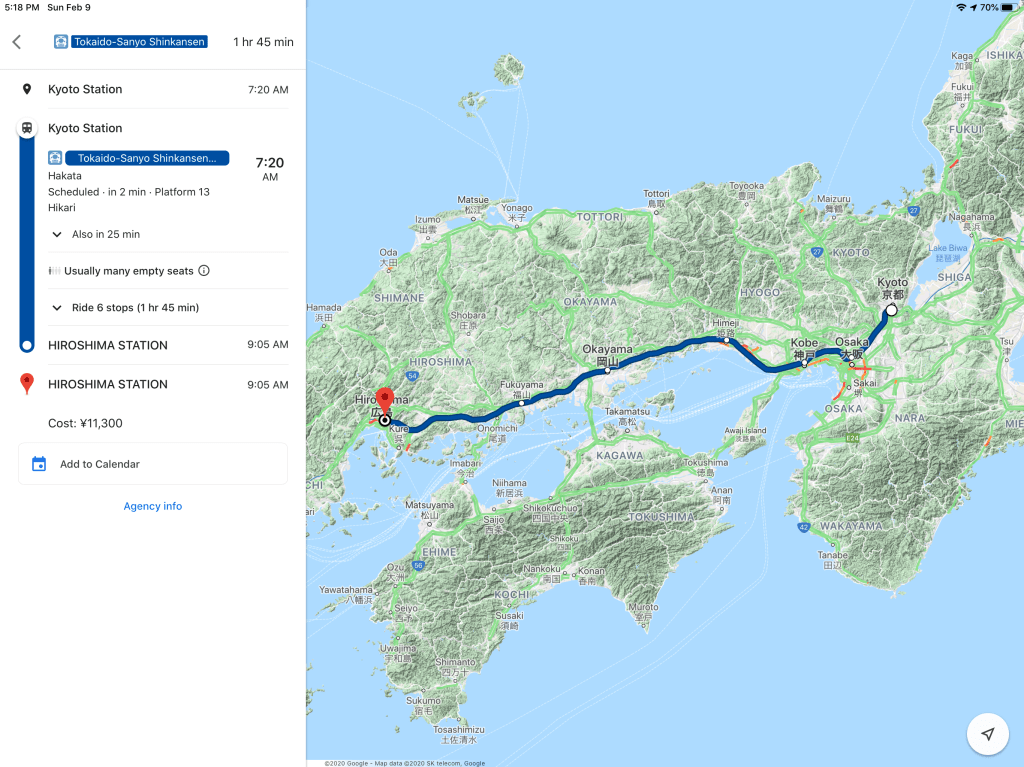
From our base of operations in Kyoto, we walked from the hotel across the street to the Kyoto Station. We took the Tokaido-Sanyo Shinkansen to Hiroshima Station, covering the 350 km distance in about one hour and 45 minutes (including six stops). Morning sunshine in Kyoto faded behind cloudiness as we traveled southwest.

The Kyoto-Hiroshima trip depicted in Google Maps.

The trek covered mainly rural areas, with cities interspersed with the rice paddies and mountains to the north. We noticed many solar farms along the way, but given the weather so far on the trip, I’m not sure useful they were this week.

As we approached Hiroshima Station, we passed close to Mazda Zoom Zoom Stadium. Even though we arrived in Hiroshima more than three hours before the 1330 game start time, there were fans already lining up to enter the ballpark. Most NPB ballparks open their gates about two hours before game time, meaning fans were willing to wait an hour or more in line to get inside. We didn’t know why at the time, but we would find out later.

2. Hiroshima and the Atomic Peace Dome

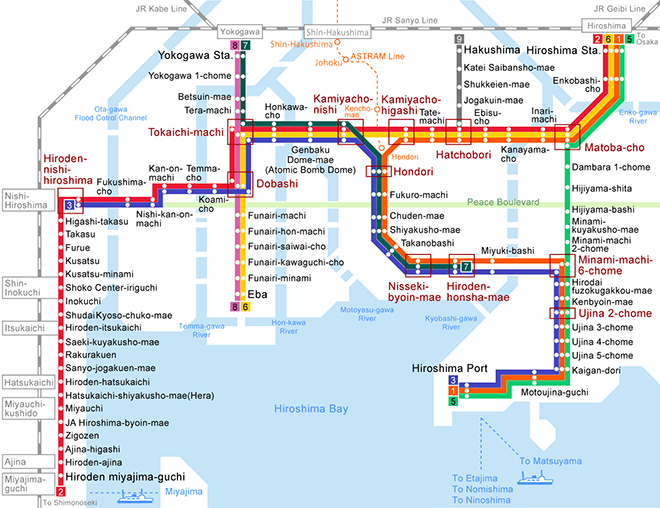
After arriving at Hiroshima Station, we took the Hiroshima Streetcar to the Peace Memorial Park. Though we paid cash for the trip, you can purchase a one day pass (which might be a nice souvenir), or use the Suica card you bought earlier in your trip.

A map of the Hiroshima Streetcar stops. In addition to getting you where
you’d like to go, it afforded a great way to view Hiroshima.

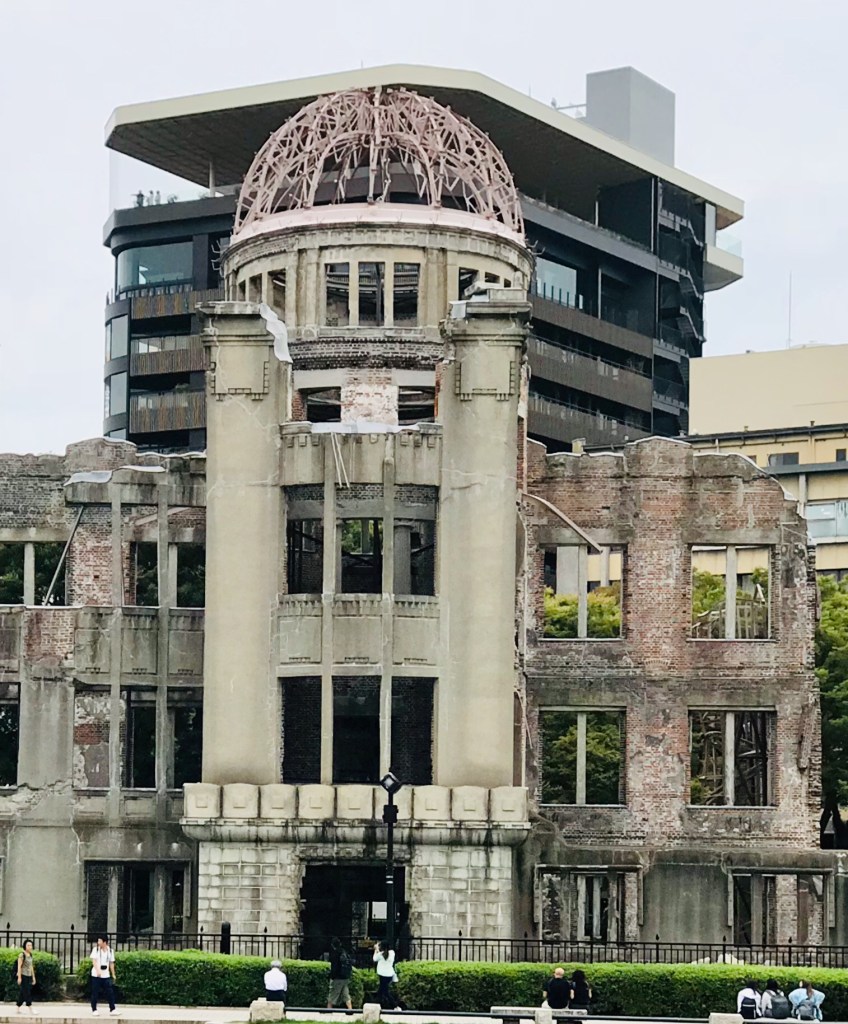
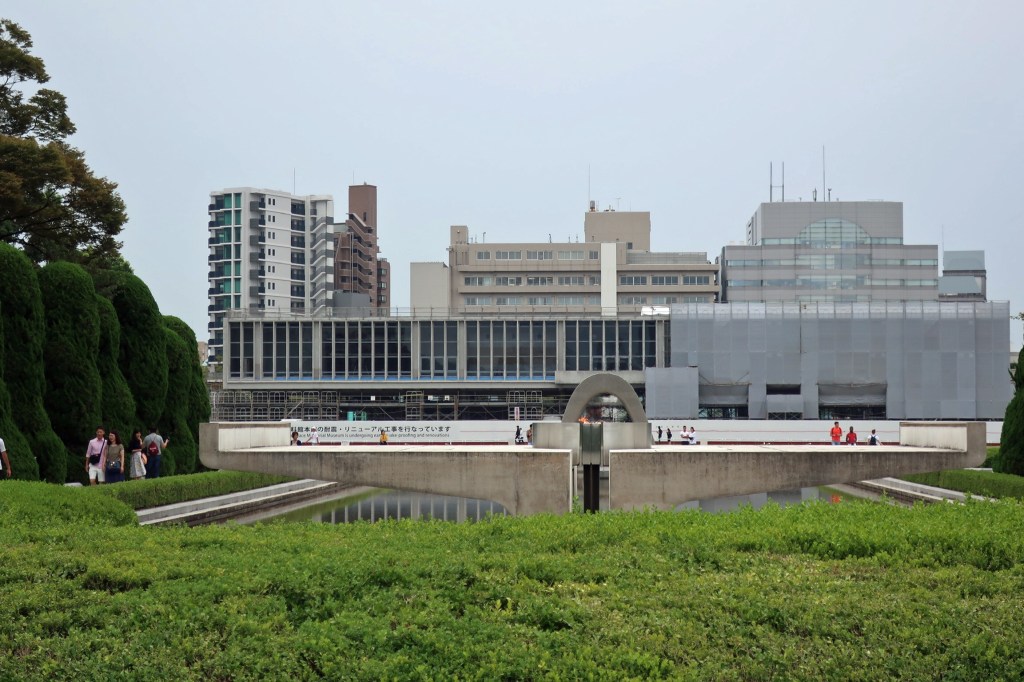
The streetcar stop for the Peace Memorial Park is less than 10 minutes from Hiroshima Station. Upon exiting the streetcar, the Atomic Peace Dome is immediately visible. A somber reminder of the first use of an atomic weapon, the overcast conditions seemed a fitting dreary backdrop. The Dome is the only remaining structure remaining from that day, as it was directly beneath the air blast.

The Atomic Peace Dome. A UNESCO Heritage site, this vantage point superimposes the Dome on the modern Hiroshima in the background.

Upon closer inspection, even the rubble from the blast was left in place. As might be expected, the Atomic Peace Dome drew significant interest, even on this cloudy and humid afternoon. Being in the presence of the Dome was a sobering experience, conjuring images of unimaginable destruction and chaos.

The Atomic Peace Dome is the focal point of the Peace Memorial Park, which stretches along the banks of the Motoyasu River. South of the Atomic Peace Dome is the Peace Memorial Museum. Time was a limiting factor when visiting the museum, which has a Japanese section on one side, and an English section on the other. Among the photographs in the museum is a picture from 1947, in which Hiroshima still lies in ruins. The image shows Emperor Hirohito addressing the citizenry, with the Dome in the background. This is reportedly the first time the Emperor had addressed the nation in person.

The Peace Museum from a distance. The Atomic Peace Dome is to the left in this picture. (Photo credit: Jeff Hayes)

2. Getting to Mazda Zoom-Zoom Stadium

With game time fast approaching, we headed toward Mazda Zoom-Zoom Stadium for the 1330 game start. From the Peace Memorial Park, we caught the streetcar back toward Hiroshima Stadium. The streetcar stop was about 1.3 km from the stadium. Walking through a suburban area following the streetcar ride, we followed a long asphalt walkway toward the stadium. Clouds were lowering and thickening, with rain threatening at any moment.

Along the walkway, we noticed groups of people sitting or standing, watching TVs broadcasting the pre game activities. Though it seemed a bit odd, especially with rain approaching, we didn’t think much of it at the time.

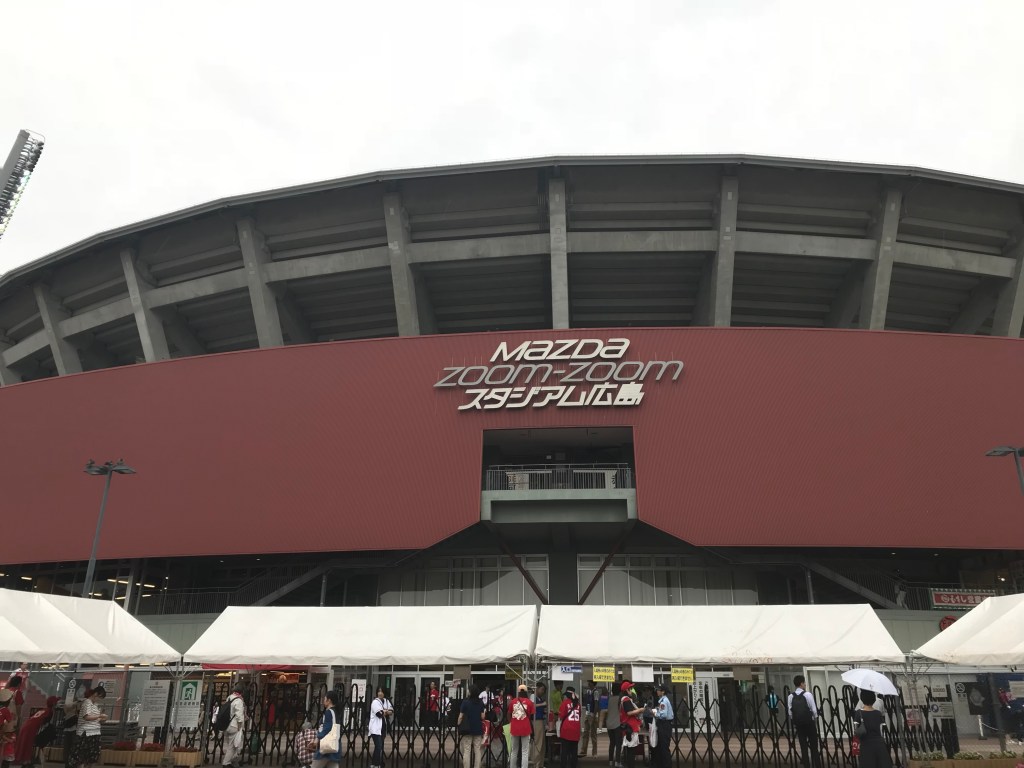
Mazda Zoom-Zoom Stadium in Hiroshima

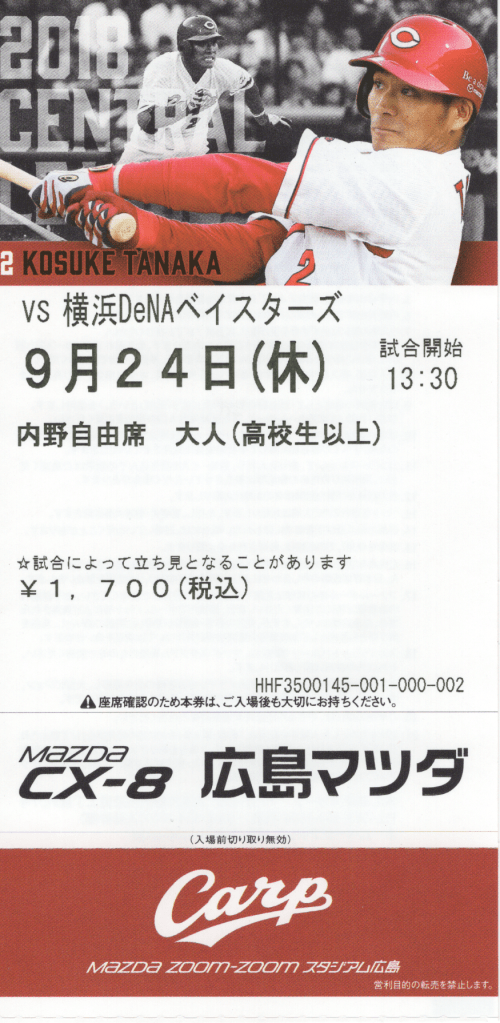
A quick walk around the stadium showed nothing remarkable, though there were food and souvenir stands around the park. Much like other NPB tickets, the seating information was difficult to decipher. Typically, we can at least glean the gate number from the ticket, but in this case, we were stumped concerning where to enter the ballpark. Eventually we tracked down a staff member, who graciously showed us where to enter.

My Hiroshima Carp ticket. Almost all of the vital information is in Japanese.

Our tickets were general admission, which meant we would have to view the game from wherever we could. Soon after arriving, we realized why there were lines to enter the stadium three hours before game time. The general admission seating was long gone. To watch the game, we would need to stand. Unfortunately for us, all of the railing around the ballpark was ringed with fans, sometimes four or five deep. It became clear that our view of the game would be tenuous at best.

The Hiroshima Toyo Carp have perhaps the most enthusiastic fans in the NPB. The team often sells out the entire season (70 home games) just hours after tickets go on sale, so this is definitely a tough ticket to secure. Since it didn’t seem to matter from where we saw the game, we sought out the Carp Team Store. The store was comparatively small, when compared to other team stores we’ve seen. There was not much of interest to us, so I purchased a Carp cap and a program.

Following the trip to the store, we walked around the stadium. The game as a sellout, of course, and we didn’t see many empty seats, even with rain on the way. One thing that struck me about the park was its resemblance to the Great American Ballpark in Cincinnati OH. Of course, the Carp modeled their uniforms after the Reds, so I suppose it shouldn’t be surprising the stadium would have a familiar feel. In any event, we got as close to the railing as we could to see the start of the game.

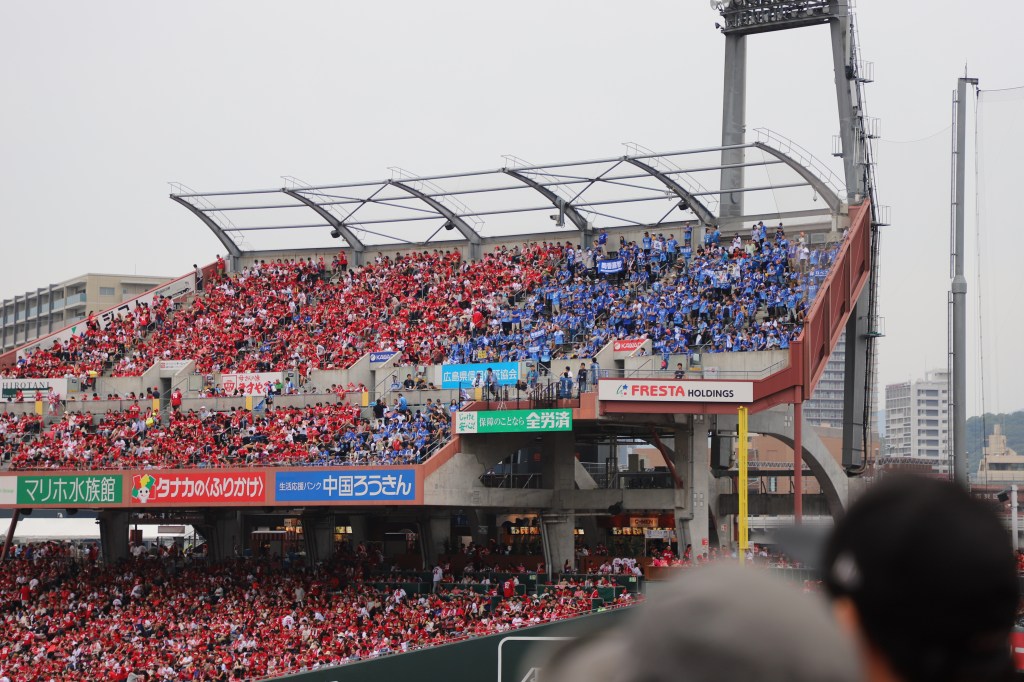
DeNA BayStars fans in the upper deck in right field at Mazda Zoom-Zoom Stadium. (Photo credit: Jeff Hayes)

The Carp’s opponent this afternoon was the Yokohoma DeNA BayStars. A light rain starting falling as the game started, and the afternoon was becoming murkier by the moment. Since we could not get close to the rail to see much of the action, we decided to circle the field, popping in occasionally to watch the action.

Following our trip around the park, the rain began to fall more steadily. Conditions were becoming less conducive to watching a game, especially since we did not have seats. Having seen the stadium, we decided to leave before conditions became worse. Heading back to Hiroshima Station, we saw fans in the rain, huddling around TVs along the asphalt walkway we took coming to the park. The devotion of the Carp fans was impressive, to say the least.

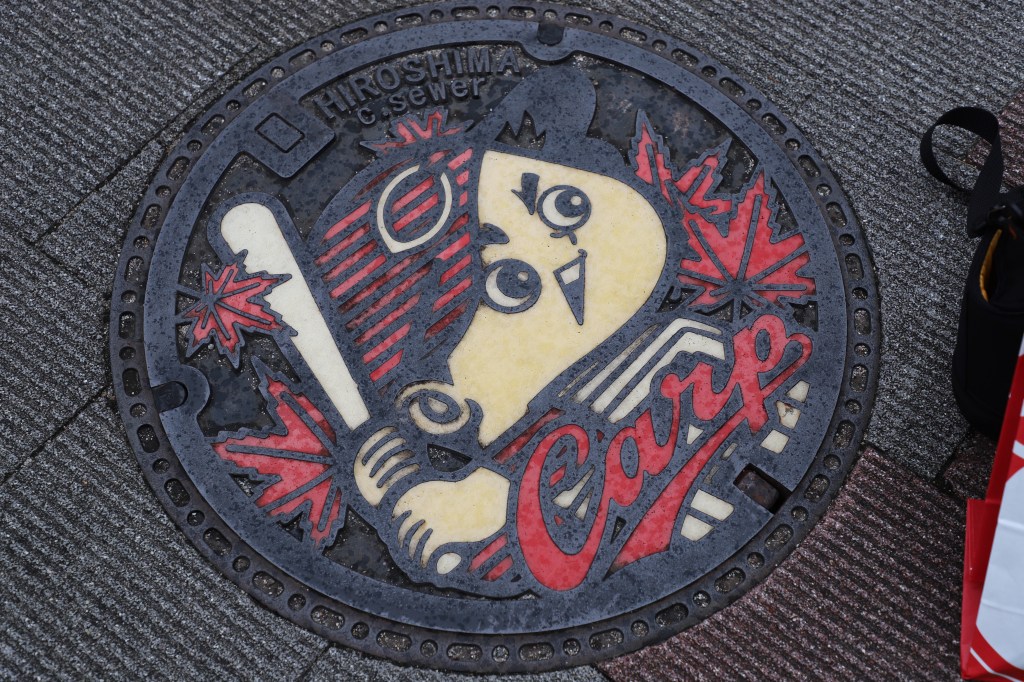
A manhole cover seen on the asphalt walkway back to Hiroshima Station. (Photo credit: Jeff Hayes)

With the weather taking a turn for the worse, we cut short our visit to Hiroshima, and caught the next Shinkansen for Kyoto. Arriving in Kyoto after dark, we decided to visit the Kyoto Tower. Located across the street from Kyoto Station, we had seen it during the day, and thought it might afford a nice view of Kyoto at night.

Kyoto Tower is located in a commercial building, along with shops and restaurants. A quick elevator ride took us to the observation deck. The deck was crowded, which limited the amount of time we could spend in any one location. The view of the city lights was impressive, though low clouds may have obscured some of the lights from nearby cities.

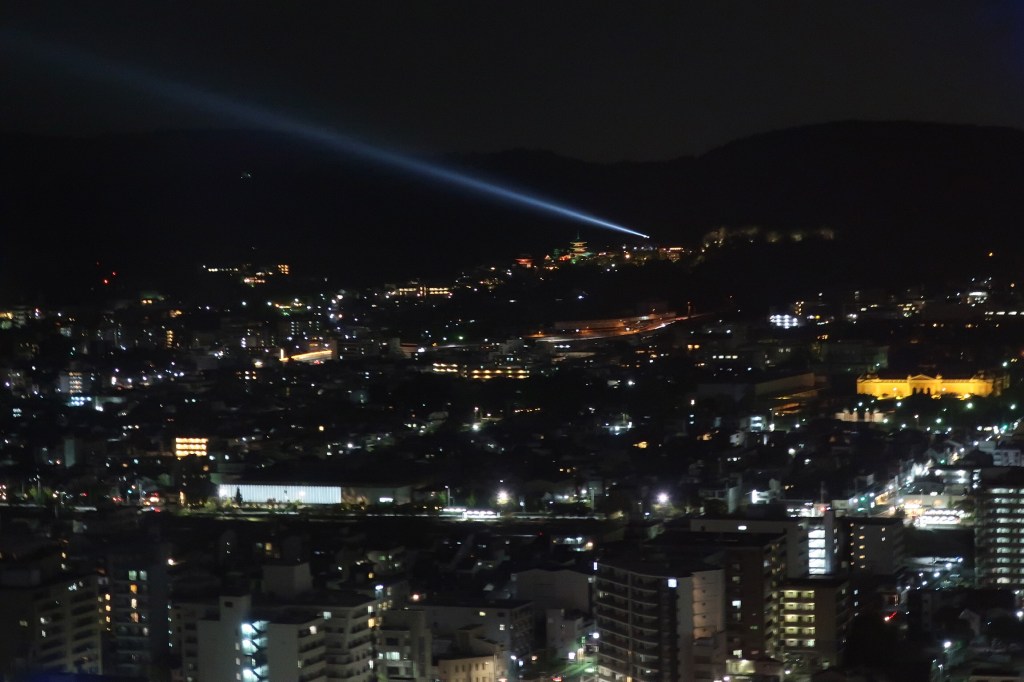
Kyoto at night, from the Kyoto Tower. Even with the clouds, the mountains are visible to the west. (Photo: Jeff Hayes)

Following the visit to the tower, we headed back to the hotel, exhausted from a long but fun day in Hiroshima.